France grants citizenship to over 2,000 foreign workers for Covid-19 response

Faster than Canadian and Quebec programs to regularize the “anges guardians:”

Marlene Schiappa, junior interior minister in charge of citizenship, said that 2,009 people, including 665 minors, had been fast-tracked for naturalisation for “showing their attachment to the nation”.

Schiappa had instructed the authorities in September to speed up the citizenship applications of essential workers who had “actively contributed” to the fight against Covid-19.

She had ordered that they be allowed to apply for citizenship after just two years in France, instead of the usual requirement of five years.

Those involved include health workers, security guards, checkout workers, garbage collectors, home-care providers and nannies.

Over 8,000 people have applied for citizenship under the scheme, Schiappa’s office said, adding that all requests were being given “the greatest consideration”.

In 2020, 61,371 people acquired French citizenship, a decline of 20 percent compared with 2019.

Source: France grants citizenship to over 2,000 foreign workers for Covid-19 response

B.C. gives $2M to Japanese Canadian seniors as step toward righting internment wrongs

Of note:

British Columbia is offering tangible recognition of the historical wrongs caused by the province when it helped to intern thousands of Japanese Canadians during the Second World War.

The province has announced a $2-million fund for the Nikkei Seniors Health Care and Housing Society to enhance programming for seniors and local communities.

A statement from the Ministry of Attorney General says the fund will be used to develop and deliver health and wellness programs to Japanese Canadian internment survivors.

The society and the National Association of Japanese Canadians will also spread the funding to other organizations supporting survivors.

The ministry statement says the grant is a first step toward fulfilling a provincial promise to honour Japanese Canadians by recognizing the traumatic internment of almost 22,000 people beginning in 1942.

Health Minister Adrian Dix says the funding will allow internment survivors to connect with others in their community, helping them stay healthy and remain independent.

“The terrible loss suffered by thousands of Japanese Canadians in the 1940s is still impacting the community today, with many experiencing lasting health issues and trauma,” Dix says in the statement.

The Canadian government detained thousands of Japanese Canadians in early 1942 under the War Measures Act. They were held in crowded internment camps in B.C.’s Interior or were offered the option to work on sugar beet farms in Alberta and Manitoba for the remainder of the Second World War.

Their homes, farms, businesses and other property were sold off by the government and the proceeds were used to pay the cost of their detention.

Ruth Coles, president of the Nikkei Seniors Health Care and Housing Society, says many Japanese Canadian seniors were forced to rebuild their lives outside B.C. and now have “unique needs stemming from internment, forced uprooting, dispossession and displacement.”

Many still feel “shame and a lack of resolution” caused by the internment that have led to a lifetime of challenges, she says.

Then-prime minister Brian Mulroney formally apologized in 1988 for Canada’s role in the internment of Japanese Canadians and British Columbia recognized the discrimination and tremendous losses they suffered when it issued its own apology in the legislature in 2012.

Source: B.C. gives $2M to Japanese Canadian seniors as step toward righting internment wrongs

New Cato Survey Helps Reframe the Debate Over Legal Immigration

Cato Institute’s summary of the key takeaways of their survey that will inform their future work, featured earlier:

My colleagues Emily Ekins and David Kemp just released an excellent new survey on how Americans view immigration and identity. We all worked together on crafting the questions for several months prior to publication and the results are very interesting. Below are some findings and some lessons that folks who support immigration should take to heart.

First, the survey shows that most people know almost nothing about immigration. Even basic facts elude them. About 14 percent of the U.S. population is foreign‐​born but the average respondent thinks that 40 percent of the country’s population is foreign‐​born. Immigrants were the most likely to think that the immigrant population of the United States is high, estimating that 56 percent of the country is foreign‐​born, while third generation and higher Americans estimated 36 percent.

The differences likely result from where the respondents reside in the United States. Immigrants live close to other immigrants and native‐​born Americans live close to other native‐​born Americans. For instance, about 27 percent of California’s population is foreign‐​born compared to just 1.5 percent in West Virginia. Those who live closer to other immigrants are probably more likely to overestimate the immigrant percentage of the population. Using those two states as examples, immigrants in California overestimated the foreign‐​born share of the population by about a factor of two, while third generation and higher Americans in West Virginia were off by a factor of 24. Regardless, native‐​born Americans and immigrants both overestimate the share of immigrants.

Second, focusing on understandable metrics when communicating how the legal immigration system functions is more effective. Americans can better conceptualize the handful of years it takes to wait for a green card than the borderline abstract large quantity of visas issued per year. For example, one of the survey questions asked how long it should take to immigrate to the United States. Eighty percent of respondents said that it should take five years or less to immigrate, and they may have chosen that number because the question prompted them with a mention of a five‐​year average. However, 52 percent of respondents said it should take less than five years. However, responses to another question revealed that 61 percent of respondents said they wanted fewer than one million immigrants a year – probably because one million is a large and abstract number that is difficult to visualize even though it’s a relatively small number of people compared to the roughly 330 million people living in the United States. By comparison, everybody understands what five years feels like and 80 percent of respondents answered that immigrants should wait five years or less for a green card. One lesson is that we should talk about immigration restrictions in terms of waiting times rather than numbers of visas. On the policy side, a maximum wait time for a visa without regard to the numerical caps would increase the number of visas issued without increasing the numerical caps on paper and be more rhetorically appealing. Fortunately, Cato proposed just such a reform in 2020.

Third, Americans care much less about job protectionism than we all thought. Two‐​thirds of respondents said that businesses should be “allowed to hire whoever they believe is best qualified for the job regardless of nationality.” This is great news because wage and job‐​protection regulations are responsible for a large percentage of the regulatory costs for sponsoring immigrants for employment‐​based green cards and other temporary work visas such as the H-1B, H-2A, and H-2B. Removing those regulations would face less popular backlash than many of us assumed.

Fourth, most Americans think that restrictive immigration laws cause illegal immigration. Forty‐​one percent said illegal immigration is caused by the legal immigration system being too restrictive and 19 percent said illegal immigrants were ineligible to apply. Most respondents are primed to understand that restrictions and government bureaucracy are the causes of illegal immigration.

Fifth, 56 percent said that simplifying the legal immigration process is a better way to deal with illegal immigration than building a border wall or increasing border security. This is incredibly good news for those of us who want to expand and liberalize legal immigration. Some findings in the field of political psychology suggest otherwise, that perceptions of chaos along the border influence voters to oppose immigration liberalization. Apparently, most people see chaos and their instinct is to support more enforcement and government control rather than liberalization. This creates a Catch‐​22 because the only way to get sustainable control over the border is through liberalization but liberalization can only be politically sustainable if voters think the border is under control. On the contrary, this survey result indicates that respondents are more open to liberalization as a means of border control than the political psychology literature suggests.

There are many other fascinating findings in this Cato survey on immigration and identity and I recommend that you read and digest it all. However, the above findings are those that we will seek to most incorporate into our work.

Source: New Cato Survey Helps Reframe the Debate Over Legal Immigration

Pelletier: La polarisation numéro 1 [Loi 21]

Of note:

La réputation consensuelle du Québec en prend pour son rhume. Les reportages publiés dans Le Devoir depuis une semaine démontrent que la chicane habite bel et bien nos cabanes, à cette différence près : on se divise, oui, mais en se donnant des « câlins ». En minimisant la discorde dans la mesure du possible. Ce n’est pas tant la chicane qu’on n’aime pas, en fait, c’est son étalage. À cet égard, les réseaux sociaux sont bien arrimés à la psyché québécoise. Sur les plateformes numériques, on fesse, on crache, on insulte, mais sous couvert de l’anonymat. Le mythe d’un Québec consensuel et harmonieux peut donc continuer comme si de rien n’était.

Il n’y a pas meilleur exemple d’un supposé consensus, pourtant pétri de discorde, que la question de la laïcité. « Au Québec, c’est comme ça qu’on vit », disait fameusement François Legault, lors de sa défense télévisée de la loi 21. Comme si, à ce sujet, nous regardions tous dans la même direction. La décision récente du juge Marc-André Blanchard reconnaissant la constitutionnalité de la loi, tout en soustrayant les commissions scolaires anglophones de son application, est venue, bien malgré lui, consacrer cette notion du Québec francophone tout de go derrière l’interdiction des signes religieux. Ce verdict permettait de conclure que seuls les gens de l’extérieur de la province ou encore les minorités religieuses et anglophones s’opposent à la loi.

Rien n’est plus faux, évidemment. Si on a souligné à gros trait la participation du Conseil canadien musulman à cette contestation juridique, rappelons que la Fédération autonome de l’enseignement du Québec, et d’autres, en faisait également partie. Au moment de l’adoption de la loi, en 2019, deux autres centrales syndicales, la CSN et la CSQ, se sont également opposées, sans oublier les commissions scolaires, le Barreau du Québec, la Ligue des droits et libertés, la Commission des droits de la personne, le Parti libéral et Québec solidaire ainsi que de nombreux artistes et intellectuels québécois.

Non, le Québec, même francophone, n’est pas d’un même avis sur cette question. Seulement, c’est tout comme. Il est de plus en plus difficile d’argumenter contre la Révolution tranquille, contre la société distincte, contre la nécessité pour le Québec de défendre sa façon de faire et, par extension, sa survivance. Il est quasi impossible d’opposer des arguments purement rationnels à quelque chose d’aussi profondément émotif — le jugement Blanchard le rappelle de plus belle.

Après avoir redoré le blason de trois partis politiques — l’ADQ de Mario Dumont en 2007 jusqu’à la CAQ de François Legault en 2018, en passant par le PQ et sa charte des valeurs en 2013 —, l’interdiction des signes religieux est désormais perçue comme l’ultime acte de résistance de la nation francophone. Peu importe si le geste est démesuré, voire inutile — il n’y a pas de problème de religion au Québec depuis plus d’un demi-siècle ! — le vrai « leadership », clamait M. Legault récemment, exige qu’on défende le Québec l’arme au poing. Il ne faudrait surtout pas avoir peur d’utiliser la clause dérogatoire, dit-il. Loin d’en avoir honte, cette mesure serait devenue un véritable badge d’honneur, la mesure du vrai patriote.

Déjà très polarisée, la décision du juge Blanchard a invariablement polarisé la question de la laïcité encore davantage. Le débat se pose désormais en ces termes : se laisser dicter nos règles de l’extérieur ou pas. Va-t-on laisser ceux qui ne nous comprennent pas (lire la Cour suprême) nous dire quoi faire ? Il y a ici un véritable enjeu démocratique, c’est vrai. Seulement, il n’est pas celui que l’on pense. Le danger n’est pas que le Québec perde de son autonomie législative, le danger est l’affaiblissement à long terme des droits et libertés pour l’ensemble du Québec.

Rappelons, d’abord, ce qui se perd de plus en plus dans ce débat à sens unique : pourquoi il nous faut des chartes des droits et libertés et pourquoi celles-ci bénéficient d’un statut « supralégislatif ». La Déclaration universelle des droits de l’homme, la première à voir le jour en 1948, et toutes celles qui ont été adoptées par la suite, comme au Québec (1975) et au Canada (1982), sont là pour assurer que personne, indépendamment de son sexe, son ethnie, sa religion ou son orientation sexuelle ne soit traité différemment. C’est la règle la plus sophistiquée, la plus civilisée, dont dispose l’humanité depuis la nuit des temps. C’est également un code qui, par définition, doit transcender l’enceinte politique. On ne peut pas laisser le sort des plus vulnérables (les minorités) entièrement dans les mains des plus puissants (les majorités), c’est la grande leçon du XXe siècle. Par conséquent, il n’y a que les tribunaux, consacrés à l’arbitrage impartial, qui peuvent y voir.

Rappelons aussi que la loi 21 suspend non seulement la Charte canadienne des droits et libertés mais également la Charte québécoise, nous laissant orphelins en la matière. À force de jouer la carte du salut de la nation, pour des raisons opportunistes, strictement politiques, le Québec est en train de se peinturer dans un coin sombre.

Source: https://www.ledevoir.com/opinion/chroniques/600085/la-polarisation-numero-1?utm_source=infolettre-2021-05-05&utm_medium=email&utm_campaign=infolettre-quotidienne

Le critère du français pourrait être abaissé pour certains immigrants au Québec

Of note (reality):

Pour être plus compétitif, Québec envisage de modifier sa grille de sélection et d’abaisser le critère de la connaissance du français pour les travailleurs qualifiés de certains secteurs. Rappelant que l’immigration doit répondre aux besoins du marché du travail, la ministre de l’Immigration, de la Francisation et de l’Intégration, Nadine Girault, a reconnu que pour attirer certains talents, les programmes devront s’ajuster.

« On va modifier une partie, car on veut aller chercher des spécialistes du marché. Dans certains secteurs, c’est extrêmement difficile [d’attirer des gens qui parlent français] », a-t-elle dit en répondant aux nombreuses questions de l’opposition lors de l’étude des crédits de son ministère mardi. « Le critère du français va être toujours là. On veut le faire en fonction des différents postes, mais on est en train de négocier là-dessus. »

Certains projets pilotes testent actuellement cette possibilité, a rappelé la ministre. « On va peut-être regarder pour ouvrir certains de ces postes de nos projets pilotes à des gens qui ne sont pas nécessairement francophones actuellement, mais qui auront l’obligation de se franciser », a-t-elle précisé, assurant que ces personnes devront « signer un engagement formel » pour se franciser.

Mme Girault a déclaré du même souffle que le français devait être encouragé chez les immigrants. « On ne baissera pas le niveau de français et c’est pour ça qu’on met tous les efforts en francisation. On a augmenté le nombre de ressources en francisation », a-t-elle dit, soulignant que jamais autant d’argent n’aura été mis en francisation que les 170 millions consacrés en 2019 par son prédécesseur, Simon Jolin-Barrette.

Un « recul majeur »

Cette déclaration de la ministre a fait grandement réagir les députés de l’opposition. « On a un recul majeur si on est en train de réviser pour certains secteurs professionnels le niveau de français exigé. Surtout que ça vient d’un gouvernement qui dit qu’il aurait le plan le plus costaud en matière de protection de la langue française », a déclaré au Devoir la députée péquiste Méganne Perry-Melançon. Selon elle, le niveau de français ne doit pas uniquement être déterminé par le cadre professionnel, le rôle qu’il joue dans l’intégration doit aussi être pris en compte. « Ces gens-là doivent pouvoir se sentir intégrés et ça passe certainement par la maîtrise du français. »

La députée libérale Christine St-Pierre a quant à elle dénoncé le double discours de la ministre Girault. « Il y a le discours comptable et économique de dire que dans certains secteurs, ce n’est pas grave si on réduit les critères de français, mais pour d’autres catégories, on va dire aux gens qu’ils seront soumis à des critères plus sévères et stricts. » Pour elle, les gens pour qui le critère du français sera abaissé se destinent à des emplois nichés, bien payés et visant des entreprises qui se concentrent à Montréal, alors que plusieurs études ont démontré que la métropole s’anglicise. « C’est deux discours. Ceux qui sont riches, vous êtes les bienvenus et ceux qui n’ont pas de bons salaires, ce sera plus difficile pour vous. »

À la défense de Legault

La ministre de Girault s’est également portée à la défense du premier ministre François Legault, en réaffirmant l’importance de sélectionner l’immigration en fonction des besoins du marché du travail. Lors d’une rencontre privée devant le Conseil du patronat, M. Legault avait parlé de son obsession pour augmenter le salaire moyen au Québec et réduire l’écart avec l’Ontario. « À chaque fois que je rentre un immigrant qui gagne moins de 56 000 [$], j’empire mon problème », peut-on entendre dans un enregistrement obtenu par Radio-Canada.

Les députés de l’opposition ont talonné la ministre sur cette question pendant l’étude des crédits. Le député de Québec solidaire, Andrés Fontecilla, a tenté en vain d’obtenir des données sur le type de qualification et les catégories « par lesquelles rentre l’immigration en ce moment. »

Nadine Girault a expliqué que la plateforme Arrima permet aux employeurs d’aller chercher des travailleurs qualifiés dont ils ont besoin, et ce, dans tous les domaines. « Les immigrants qu’on veut aller chercher, oui ils pourraient combler [ce type de] postes [à plus haut salaire] mais on a aussi des programmes pilotes pour des immigrants, comme des préposées aux bénéficiaires, en transformation agroalimentaire. Ces immigrants ne vont pas gagner 56 000 par année. »

Longs délais de traitement

La députée libérale a également tenu à rappeler à la ministre qu’à l’automne dernier, le secrétaire d’État chargé du Tourisme, des Français de l’étranger et de la Francophonie, Jean-Baptiste Lemoyne, s’était publiquement déclaré insatisfait de la façon dont étaient gérés les dossiers de résidence permanente de nombreux Français et que ce dossier devait être en tête de liste des discussions entre la France et le Québec. La semaine dernière, Le Devoir faisait état des longs délais de traitement des dossiers de résidence permanente, en rapportant des témoignages de nombreux immigrants qui attendent une réponse depuis parfois plus de deux ans. Plus de 50 000 personnes sont en attente d’une résidence permanente au Québec.

La ministre Girault a insisté sur le fait que l’octroi de ce statut relève du gouvernement fédéral et qu’elle a eu des discussions sur le sujet avec son homologue, Marco Mendicino, mardi matin. Elle aurait eu l’assurance que le traitement serait accéléré pour que les cibles de 2021 soient atteintes, de même que le rattrapage pour l’année 2020, où moins d’immigrants que prévu ont été admis.

Programme des anges gardiens

La ministre de l’Immigration n’entend pas élargir le programme l’admissibilité au programme spécial de régularisation des demandeurs d’asile ayant travaillé dans la santé. Depuis son annonce l’été dernier, elle subissait des pressions du milieu pour qu’il soit étendu à toutes personnes ayant occupé des emplois les mettant à risque de contracter la COVID-19, et non pas uniquement au cours de la première vague. « Le programme a été monté pour aider les gens de la première vague », a insisté la ministre Girault. « On voulait une façon spéciale de les remercier », a-t-elle ajouté, laissant entendre que les demandeurs d’asile ayant travaillé durant les 2e et 3e vagues avaient eu du renfort.

Selon les chiffres d’Immigration, Réfugiés et Citoyenneté Canada (IRCC) datés du 10 avril, à peine 7 % (94 sur 1400) des « dossiers » du Québec avaient reçu une « approbation en principe », contre près de 50 % pour ceux dans le reste du Canada. Le cabinet de la ministre de l’Immigration a assuré de son côté que la délivrance des Certificats de sélection du Québec (CSQ) allait bon train, en fournissant des statistiques plus récentes. En date du 3 mai, il aurait finalisé 377 dossiers de CSQ, ce qui correspond à 809 CSQ délivrés.

Source: Le critère du français pourrait être abaissé pour certains immigrants au Québec

Applicants to Canada’s special, one-time immigration program are being forced to navigate the system alone, critics charge

Will be an interesting and important test of IRCC’s modernization efforts. We will see whether the fears of immigration lawyers and consultants are overblown or whether IRCC can design pathways and processes that many can navigate on their own.

Not to be cynical, but simplification in any area or online tools (e.g., will and tax software) often prompt fears of lawyers, accountants and other professionals who benefit from complexity:

With Canada’s highly anticipated special immigration program set to open Thursday, experts say they’re worried about the potential for chaos.

Immigration lawyers briefed about the new program and its portal say they’ve been told applicants must create their own accounts, complete the online application and upload all required documents on their own — without professional legal help.

“There are different forms they need to fill out about family information, travel history, all the (previous) addresses, work history and study periods. They require all the forms and documentations upfront, just shy of the medical and police clearances,” said Toronto lawyer Barbara Jo Caruso.

“Everything needs to be labelled, uploaded and properly attached. If they are not done properly, they will be deemed incomplete and refused.”

The applications are being taken on a first-come, first-served basis. Even if an application is incomplete or an applicant is ineligible, once it’s logged into the portal, it’s counted toward the 90,000 cap under this new program. The system will stop accepting applications once that cap is reached.

Lawyers and consultants asked during the briefing if the portal would reopen if many applicants turned out to be ineligible, but they said immigration officials didn’t have an answer.

The one-time-only immigration pathway, announced in April, aims to grant permanent residence to 90,000 applicants comprising recent international graduates and temporary foreign workers with experience in health-care and essential occupations.

These already-in-Canada candidates have been prioritized to help the country meet its 410,000 annual immigration targets amid uncertainty given the ongoing COVID-19 border restrictions.

The new pathway has already created a buzz — and frenzy — among candidates who have found themselves scrambling to register for one of the two government-designated language tests required to prove language proficiency in their application. (Details about the application process have yet to be published.)

Authorized lawyers and consultants have previously had their own portals with the immigration department that they use to complete and submit applications on behalf of clients.

However, the new stand-alone portal for the new pathway only allows applicants to log in through their personal email and there’s no interface to link their account to their counsel.

“If your whole future depends on this whole process, you want to be fair, you want to be understanding, you want people to have experience in working in the government portal to assist you,” Caruso said.

“It’s tedious work. Government technology is not user-friendly at the best of times, let alone when you are under pressure. There’s a cap and you want to make sure you’re the first one in.”

Among the 90,000 spots of the new program, 20,000 will be dedicated for temporary foreign workers in health care; 30,000 for those in other selected essential occupations; and the remaining 40,000 for international students who graduated from a Canadian institution.

Many of the essential workers will likely have to take time off from work and spend hours to figure out the new pathway application process.

“They are the essential workers. They are the people driving trucks. They’re the people on the front line in the health-care system,” said Toronto immigration lawyer Ravi Jain.

“Many people will apply even if they don’t have their language test results. They are just going to ignore the instructions and hit the submit button. Every time you hit ‘submit,’ you take a spot.”

Last year, the federal government got rid of its first-come-first-serve system for Canadians to sponsor their parents and grandparents abroad as permanent residents after public outrage that the available spots were snapped up within minutes.

It prompted Ottawa to re-introduce a lottery system, in which interested sponsors are now required to first register to enter into the draw, then submit a full sponsorship application if they are selected after duplicate and incomplete forms are weeded out.

“The reality is there are always going to be people who are going to be harmed no matter what direction it goes. There’s a race to file. There are so many things that could go wrong. But then what are the alternatives?” said Mark Holthe, chair of the Canadian Bar Association immigration law section.

“There’s a lot of little nuances with the application that people won’t understand. I envision that we could have up to 20 per cent or even 30 per cent of spoiled applications that people are ineligible who are using up the capped spots.”

Holthe, who started an online course in April to help applicants manoeuvre the basics of the immigration portal, expects the application package for the new pathway to be comparable to the existing one for the immigration of skilled workers.

Anyone interested in applying should start compiling and scanning documentations such as copies of their passports, work permits, reference letters and employment records as these are likely what would be required in the application, he suggested.

There is still time for the immigration department to get the process “right,” says Kareem El-Assal, managing editor of immigration news site CIC News and policy director at CanadaVisa.com.

“Immigration, Refugees and Citizenship Canada deserves credit for trying to accommodate more essential workers and graduates during this crisis,” he said. “But they need to be careful about dotting their i’s and crossing their t’s before they launch the (pathway) streams.”

Alexander Cohen, Immigration Minister Marco Mendicino’s press secretary, said his office is aware of the concerns raised regarding the access to the new portal.

“We remain in close contact with several key stakeholders and are looking into this,” Cohen told the Star.

Source: Applicants to Canada’s special, one-time immigration program are being forced to navigate the system alone, critics charge

Germany Sees 72 Percent Increase in Anti-Immigrant Crimes

Of note:

Germany recorded a 72.4 percent increase in anti-immigrant crimes in 2020 – up to 5,298 total cases – as officials warned Tuesday that the country is experiencing a dangerous rise in far-right violence.

Interior Minister Horst Seehofer said in total, far-right crimes rose 5.65 percent in 2020, and accounted for more than half of all “politically motivated” crimes.

“This shows again that right-wing extremism is the biggest threat for our country,” Seehofer said Tuesday, according to the Associated Press.

In February 2020, the country saw its deadliest anti-immigrant attack when nine immigrants were killed near Frankfurt, Germany, after a gunman opened fire and called for the “complete extermination” of many “races or cultures in our midst,” the AP reported.

Authorities have since raised concerns that the far-right Alternative for Germany party, or AFD, which placed third in the country’s 2017 election and has grown in influence, has played a role in stoking a climate of hatred toward immigrants and the government.

German security agencies have warned of the growing threat of violent far-right extremism. In July 2019, a regional politician from Chancellor Angela Merkel‘s party was killed by a neo-Nazi; three months later, a gunman tried to force his way into a synagogue on Yom Kippur, killing two people.

Seehofer said antisemitic crimes in Germany were up 15.7 percent in 2020 over 2019 with 2,351 total incidents — 94.6 percent of which were committed by a far-right suspect.

Of the total, 62 were acts of violence while the majority were antisemitic hate speech and other related crimes, frequently on the internet or over social media, Seehofer said.

“This development in Germany is not only troubling, but in view of our history, deeply shameful,” he said.

Moshe Kantor, president of the European Jewish Congress, said the German numbers highlighted a broader issue.

“This is a wake-up call, not just for Germany, but for the whole world,” he said. “These figures should ring alarm bells, because we are seeing similar trends across the Western world.”

Many in the AfD have expressed support for, and participated in, the regular protests in Germany against lockdown measures, organized by the Querdenker movement. The demonstrations have become increasingly violent, and the country’s domestic intelligence service last month said it had put some members of the movement under observation.

The protests have brought together a broad range of demonstrators, including people opposing vaccinations, those who deny the existence of the coronavirus, mask opponents, conspiracy theorists and others.

Seehofer said the protests have also attracted neo-Nazis and other right-wing extremists, and have regularly become violent, targeting police and the media. Seehofer said of the 260 reported crimes against journalists, 112 were related to protests against coronavirus restrictions.

“I want to say here very clearly: These acts of violence are no longer about exercising a constitutional right (to demonstrate), but are acts of violence of a criminal nature that I condemn in the strongest possible terms,” he said.

Source: Germany Sees 72 Percent Increase in Anti-Immigrant Crimes

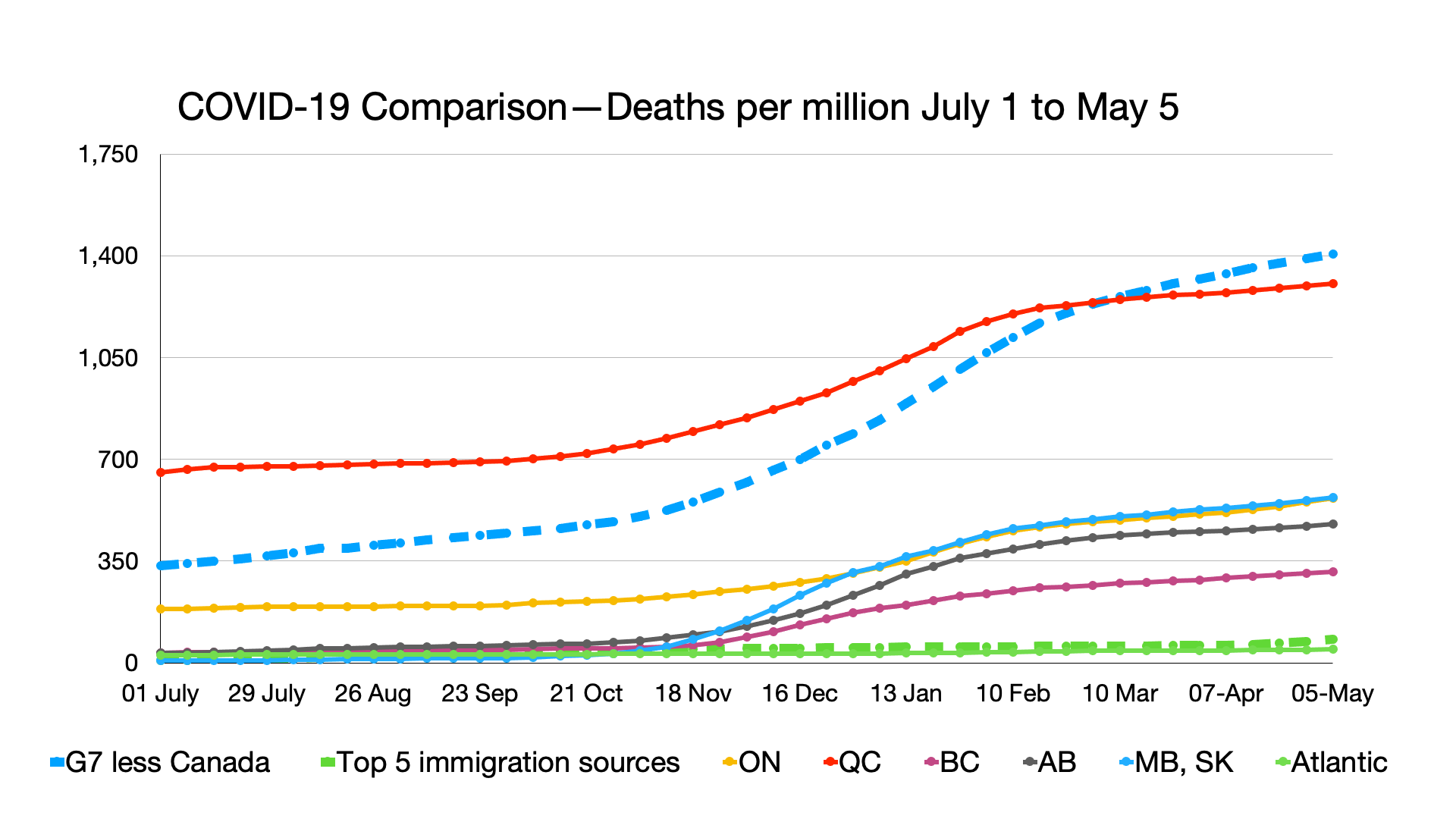
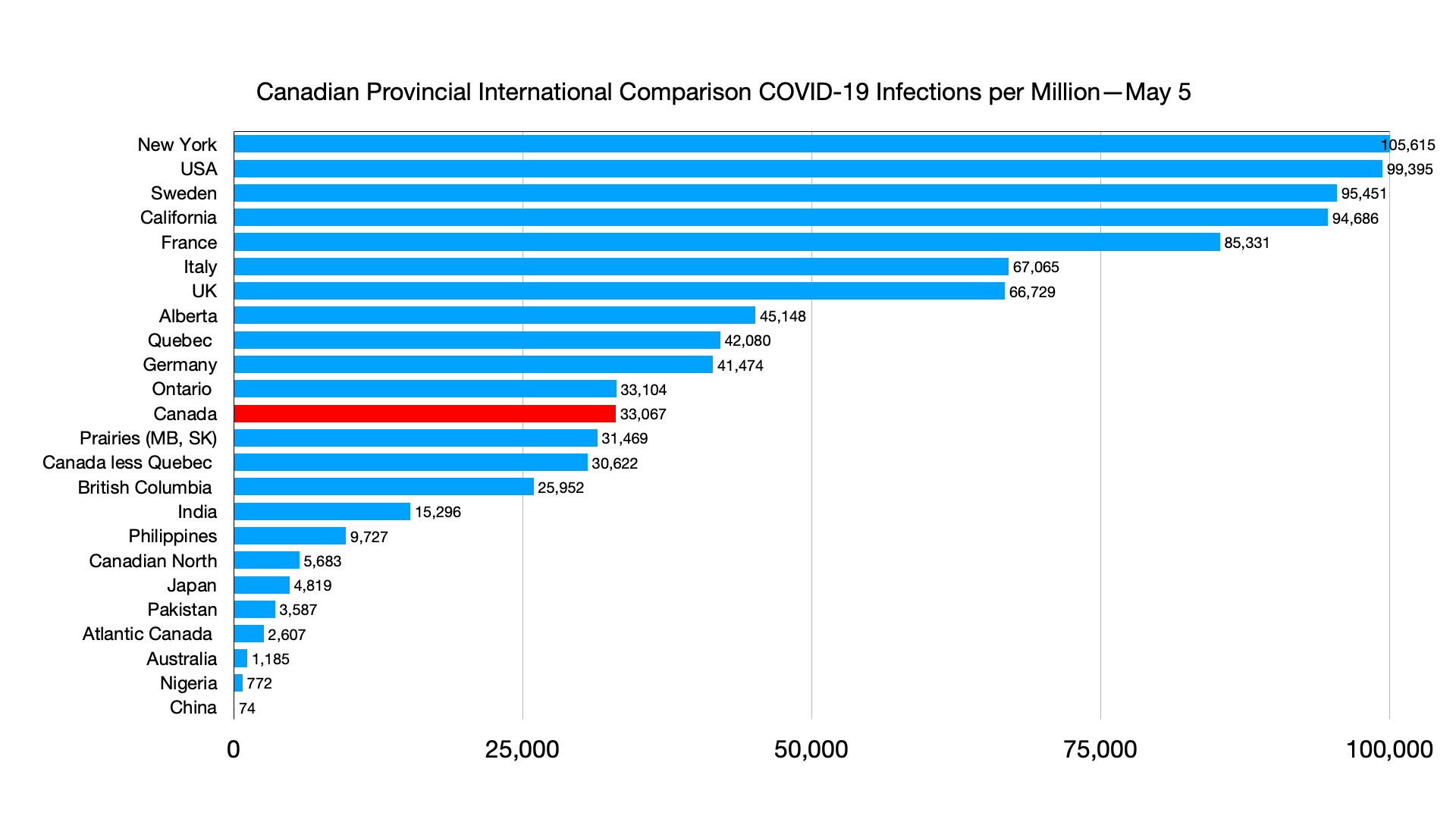
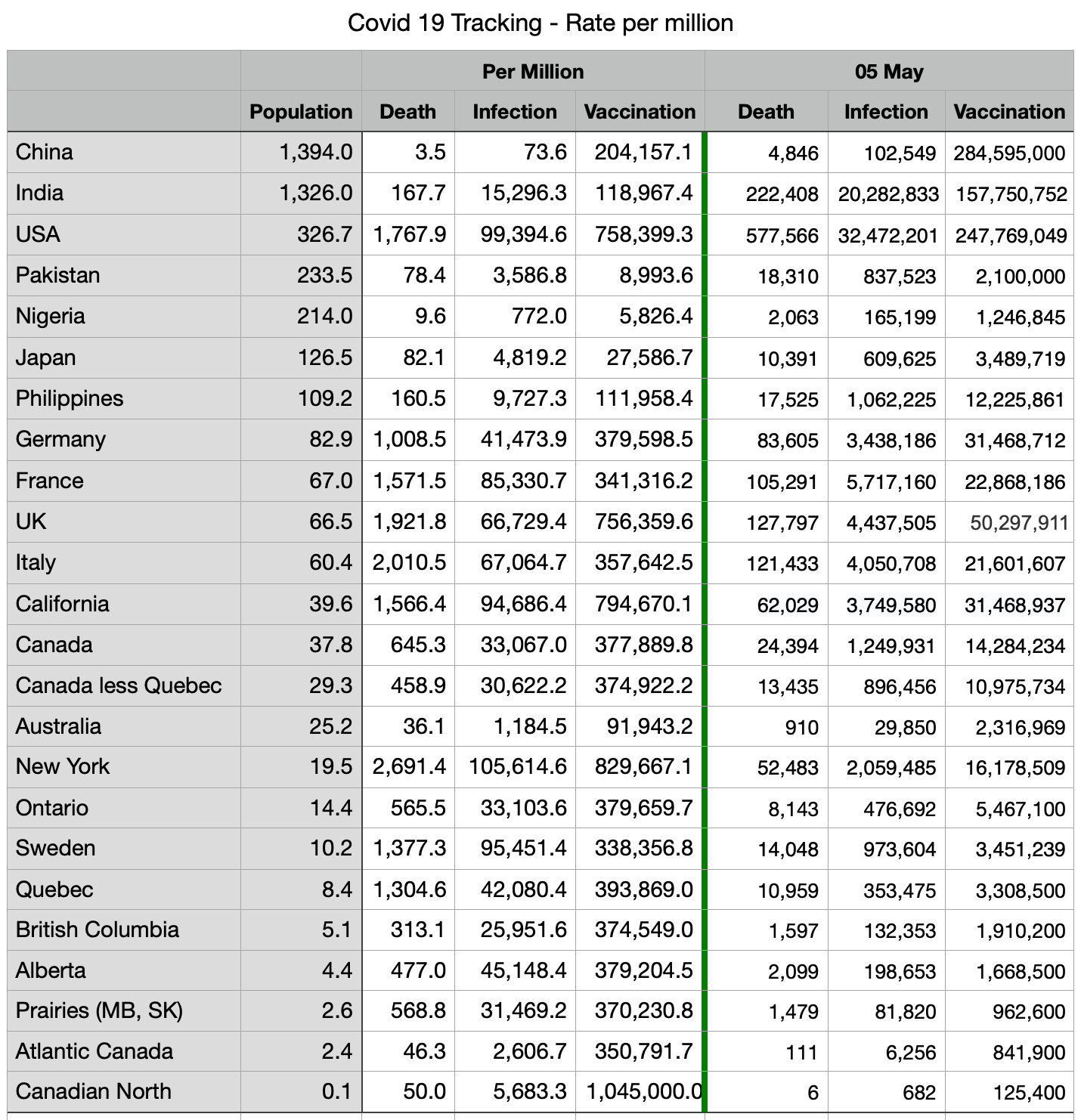
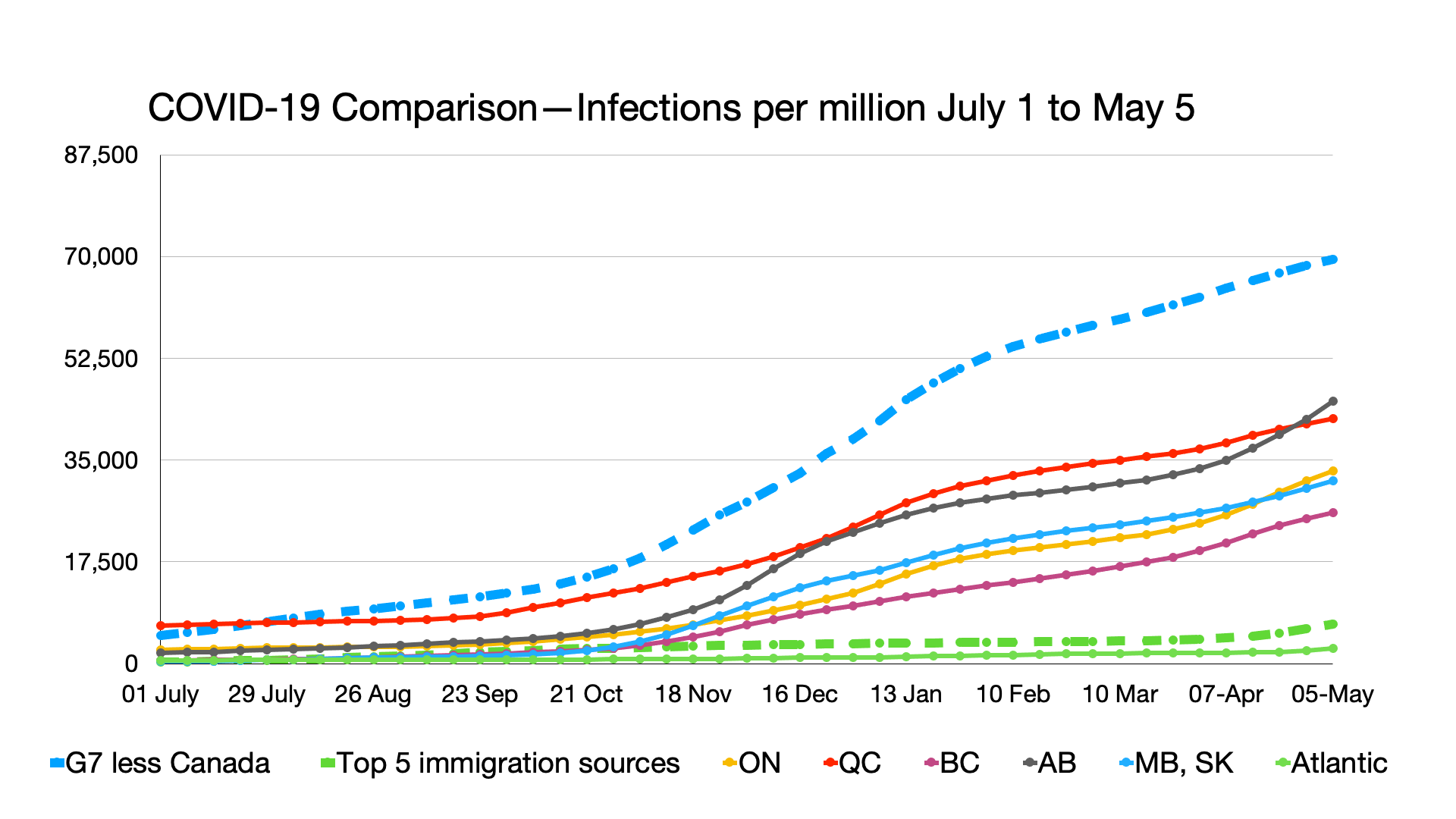
#COVID-19: Comparing provinces with other countries 5 May Update

The latest charts, compiled 5 May as the third wave continues. The ongoing spike of infections and deaths in India per million still has not resulted in a change in the relative ranking given the size of India’s population.

Vaccinations: Overall, Canada and most provinces continue to be comparable or greater to EU countries.

Trendline charts

Infections per million: The ongoing spikes in Alberta and Ontario continue, with Alberta significantly ahead of Quebec, Ontario ahead of the Prairies.

Deaths per million: Gap between G7, Quebec and other provinces continues to grow.

Vaccinations per million: Vaccination rates in Canadian provinces continue to increase more quickly than overall G7 less Canada countries. Increases among immigration source country reflect China and India mass vaccination roll-out, but at lower rates of increase compared to Canadian provinces and G7.

Weekly

Infections per million: Sweden now ahead of California, Italy now ahead of UK, and Ontario ahead of Canada .

Deaths per million: France ahead of California, India ahead of Philippines

Rethinking the U.S. Legal Immigration System: A Policy Road Map

Of interest. Two ideas Canada could consider:

  • “a new “bridge” visa as the main route for admission for most foreign workers arriving on employment visas. This bridge visa would cut across occupations, allow for circularity and bridge the artificial dichotomy between temporary and permanent pathways.” Already happening to a certain extent in Canada given increased numbers of temporary to permanent resident transitions.
  • “creation of an independent expert body within government that makes recommendations on annual admissions based on careful, nonpartisan review of labor market, economic, demographic and immigration trends.”
  • New reporting by the Census Bureau that the United States saw the second slowest rate of population growth since the decennial census began in 1790 represents a warning sign for a country seeing rising shares of retirees and a declining child population. In fact, the Census Bureau is projecting that the United States will have more seniors than children in less than 15 years. In this context, immigration will become increasingly important for sustaining the growth of the U.S. labor force.

    Yet the legal immigration system, which was built on a scaffolding first established in 1952 and saw its last major legislative update in 1990, is profoundly misaligned with these demographic realities and other key factors shaping migration to the country. This misalignment is the principal cause for illegal immigration, with an unauthorized immigrant population estimated at 11 million people. It is also responsible for the mounting backlog in legal immigration streams, with some in the green-card queue scheduled to wait an impossible 223 years for an employment-based visa. 

    The consequences of the failure by Congress and past administrations to update immigration laws to match current realities have been enormous for the country and for its economy, as a new policy brief from the Migration Policy Institute’s Rethinking U.S. Immigration Policy initiative makes clear. In Rethinking the U.S. Legal Immigration System: A Policy Road Map, MPI analysts Muzaffar Chishti, Julia Gelatt and Doris Meissner sketch the broad contours of some of the most needed reforms in the legal immigration system.

    “Immigration policy should fundamentally be tailored to serve U.S. national interests,” they write. “As such, it should reflect factors inside the United States that create a need for immigrant workers and position the country well to benefit from immigration. The age structure of the U.S. population and shifts in the U.S. economy are two such factors, both of which clearly establish sustained immigration as an asset that benefits the country and the economy.”

    The policy brief offers a quick tour of the new framework that MPI is advancing through its Rethinking Immigration initiative. The vision includes:

    • A meaningful and responsible reform of the U.S. immigration system must begin with addressing the challenge of the country’s unauthorized immigrant population, 60 percent of which has been in the United States a decade or more, with legalizations that could be accomplished in incremental steps.
    • Restructuring the employment-based system to better reflect economic and demographic realities and the behavior of employers and workers with three streams: 1) seasonal/short-term workers on briefer stints than current H-2A or H-2B workers but with the same protections as comparable U.S. workers; 2) direct admission of immigrant workers recognized as the best and brightest in their fields as permanent residents; and 3) a new “bridge” visa as the main route for admission for most foreign workers arriving on employment visas. This bridge visa would cut across occupations, allow for circularity and bridge the artificial dichotomy between temporary and permanent pathways. It would more accurately reflect how immigration and labor markets already operate, given 80 percent of those getting an employment-based green card adjust from a temporary work visa in the United States. Under MPI’s proposal, the U.S. government would also pilot a points-based immigration system, similar to those used in Canada, Australia and other countries.
    • Retaining family-sponsored immigration as a major priority of the U.S. immigrant selection system, but with changes to some backlogged categories.
    • Reforming the humanitarian protection system, including U.S. asylum system reform that MPI has been championing for more than two years, to improve efficient and fair adjudication.
    • Injecting much-needed flexibility into immigration levels, with creation of an independent expert body within government that makes recommendations on annual admissions based on careful, nonpartisan review of labor market, economic, demographic and immigration trends.

    “Harnessing the benefits of immigration has long been a source of strength for the United States,” the authors conclude. “Redesigning immigration pathways to match with today’s realities—and building flexibility so that the system can evolve to match tomorrow’s as well—would allow the United States to better reap the advantages of immigration for its economy and society.”

    The road map is the latest in the multi-year Rethinking U.S. Immigration Policy Initiative. The initiative is generating a big-picture, evidence-driven vision for the role immigration can and should play in America’s future. Reports focusing on Department of Homeland Security (DHS) governance, the immigration detention system, the immigration courts and the bridge visa are among those that will be published in the coming weeks and months. 

    Read the legal immigration road map here: www.migrationpolicy.org/research/rethinking-us-legal-immigration-road-map.

    Census 2021: Canadians are talking about race. But the census hasn’t caught up.

    A good, nuanced discussion regarding nomenclature and methodology issues.

    Census data, which links birthplace, generation, ethnic origin, visible minority status, citizenship to socioeconomic data provides a wealth of data that are used to highlight how outcomes vary between groups and cohorts, as well as providing a more quantitative assessment of systemic differences.

    With more disaggregated data available (e.g., labour force survey, public service employment equity reports), the gaps are less significant than before.

    Discussions around nomenclature can sometimes be easier than addressing the issues that the existing data sheds light on:

    This May, Canadians will again be asked if they identify as a visible minority when filling out the long-form census. But it’s a concept and term increasingly out of step with the times.

    The pandemic has laid bare racial inequalities, and racial justice activist groups, like Black Lives Matter, have put anti-Black racism high on the public agenda. Systemic racism, rather than visible minority status, is at the centre of debate. While Canadians are now talking more explicitly about race, the census has yet to catch up. 

    “We’re going to have to ask ourselves, what do we want to do with that category now?” says Michael Haan, a demographer and member of a committee that advises Statistics Canada on ethnocultural diversity. According to him, the committee has had many internal debates about terminology. 

    Indirectly asking questions

    Canada’s anti-racism strategy, which draws on decades’ worth of research, states that race is a social construct. There is no basis for classifying people according to race, but racial bias and discrimination have very real effects. 

    The question is: How do we get relevant data from the census and other surveys on the impact of systemic racism?

    Statistics Canada tries to gather this information without directly asking about race. Race-based data is needed, says Jean-Pierre Corbeil, a diversity specialist at Statistics Canada. But he wonders whether that actually requires referring to race on the census.

    Historically, the government has been reluctant to ask directly about race, which has led to a lack of disaggregated data. After the Second World War, the census used indirect methods of estimating the non-white, non-Indigenous population through racial proxies like language or ethnocultural origin.

    That changed in 1996, says political scientist Debra Thompson, when Statistics Canada began asking Canadians whether they identified as a visible minority. The term, Thompson notes, makes it seem “that things are not about race when of course they absolutely are.”https://www.youtube.com/embed/YnGOR_W7Ca0?wmode=transparent&start=0Statistics Canada advertisement explaining the 2021 census.

    Identifying as a visible minority

    The question on visible minorities was added to the census because of the Employment Equity Act. In order to measure how the white versus the non-white population fares in the labour market as required by this law, the government needed to know who is a visible minority.

    For the purposes of the Employment Equity Act, says Haan, the question works. But he acknowledges the drawbacks: “Is it a perfect facsimile of race or racialization? No, it’s not.”

    Many criticized, and still criticize the government’s approach. The United Nations has repeatedly pointed out that the term “visible minority” lumps together diverse communities and threatens to erase differences among them. Corbeil says Statistics Canada is well aware of the criticism.

    Not easily done

    However, changing the terminology is politically sensitive. Moving away from it would likely require changing the Employment Equity Act, says Fo Niemi, head of Montreal-based Center for Research-Action on Race Relations.

    Instead, Statistics Canada is trying to respond to the demand for more race-disaggregated data through special crowdsourced surveys and increasing sample sizes of marginalized people to allow for enhanced analysis. 

    For example, with support from the federal Anti-Racism Secretariat, it has produced a socio-economic analysis on the Black population.

    During the pandemic, census data has also been combined with other statistics to show that mortality rates are higher in neighbourhoods where visible minorities live.

    “What people want is really to have information on Black Canadians, to have information on South Asians or Latin American Canadians,” says Corbeil. But those categories are controversial too. White, South Asian, Chinese, Black, Filipino, Latin American, Arab, Southeast Asian, West Asian, Korean or Japanese are options non-Indigenous Canadians can choose from on the census. “Other” is also an option, but many feel unrepresented by the list. 

    Expand or shorten the list?

    The population groups, as Statistics Canada calls them, have remained largely unchanged since 1996. The agency uses the list, which was developed through an inter-departmental process in the 1980s — according to Thompson, how the groups were chosen is “a bit of a mystery.”

    They are now part of Canada’s national statistical standards and are widely used by the federal government, including in the monthly labour force survey, which began recording visible minority status as of July 2020

    Statistics Canada has considered changing the list. One alternative was to expand it, but that risked making the answers too similar to the separate ethnocultural origin question. Another was to shorten the list and provide broader categories. Statistics Canada even tested this approach in a 2019 trial run of the census. Respondents had to choose their “descent” from seven options: North American; Latin American; European; North African; African, Afro-Caribbean or African-Canadian; Middle Eastern or West Asian; and Other Asian. 

    But according to Corbeil, the problem there was that Statistics Canada couldn’t identify who was Black because Black Canadians are highly diverse and come from all over the world. That’s important, because the agency’s consultations indicate that “many people want to identify as Black Canadians,” says Corbeil. Because the test was inconclusive, the options have not been changed for the 2021 census.

    Changing the census isn’t so simple

    Dr. Andrew Pinto, a public health and preventive medicine specialist and family physician, is a researcher with The Upstream Lab, which has studied the collection of racial data by health-care providers, says that if patients understand that disclosing their race will be used to address systemic racism, they are willing to provide the information.

    For now, Statistics Canada is reluctant to refer directly to race anywhere on the census. The agency is cautious and for good reasons, says Haan. In order to compare data over time, the questions and the answers need to stay the same. “The census is the gold standard,” he says, “so any modification is carefully considered.”

    Thompson also cautions that simply having the data won’t solve the problem of systemic racism.

    “Yes, we need disaggregated racial data. [But] we also need governments that are brave enough to create targeted policies.”

    Source: https://theconversationcanada.cmail19.com/t/r-l-tltiqlt-kyldjlthkt-c/