Is Australia’s India travel ban legal? A citizenship law expert explains and a critique of the ban

The lack of a charter with mobility rights compared to Canada:

There is a growing public and political outcry over the federal government’s sudden decision to ban Australians from coming home from India.

But as everyone from Indian community leaders to human rights leaders, famous cricketers and Coalition MPs calls on the government to rethink the policy, is it legal? Is a High Court challenge an option?

What is citizenship?

In terms of common law, citizenship is a relationship between an individual and their nation, where each owes fundamental obligations to the other. In broad terms, the citizen’s job is to be loyal to the nation. The nation’s job is to protect its citizens.

Last year, a record number of people pledged allegiance to Australia and became citizens. The largest group of new citizens were Indian migrants, with over 38,000 becoming Australians in 2019-20.

Now, under the Australian government’s tough new travel ban, 9,000 Australians remain stranded in India, which is currently battling a deadly COVID-19 second wave and oxygen and vaccine shortages.

Some were granted permission to travel to India to see dying relatives or attend funerals. Others travelled there pre-pandemicand have since been unable to return to Australia.

Despite having done nothing wrong, these Australians have been left unprotected by a government that has failed to hold up its end of the citizenship bargain.

How does the travel ban work?

The ban makes it unlawful for anyone, including Australian citizens, to enter Australia if they have been in India in the past 14 days. It was made under sweeping powers conferred on federal Health Minister Greg Hunt by the 2015 Biosecurity Act.

Section 477 of the act allows Hunt to issue “determinations” imposing any “requirement” that he deems necessary to control the entry or spread of COVID-19. These determinations cannot be disallowed by parliament. Thanks to a provision aptly known as a “Henry VIII clause”, they also override any other federal, state or territory law.

If a person breaches the travel ban, for instance by transiting through a third country, the Biosecurity Act states they may face criminal penalties of five years imprisonment, a $66,000 fine, or both (even if Prime Minister Scott Morrison says jail time is unlikely).

Hunt says the ban is a “temporary pause”. It will lapse on May 15. However, if he deems it necessary, he could use his broad powers to reintroduce it, or impose similar restrictions.

As political pressure builds to remove the ban early, the government says it is “constantly” reviewing it.

Is the ban legal?

Another basic principle of citizenship is citizens may freely return to their countries. Under common law, this stems from the Magna Carta. It is also an important principle of international law, enshrined in the Universal Declaration of Human Rights, and the International Covenant on Civil and Political Rights.

In March, two Australians stranded in the United States took their case to the United Nations Human Rights Committee. They argued government policies blocking their return contravene international law.

The committee has not reached a decision, but in April it asked Australia to ensure their prompt return, noting they faced “irreparable harm”.

What about our domestic law?

Whether the ban is legal under Australian domestic law is a different question. Although the Department of Home Affairs says Australian citizens can “apply for an Australian passport and re-enter Australia freely”, there is no codified right of return under Australian law. This sets us apart from many countries that have a bill of rights, and include this right.

A High Court challenge is an option, but there is no clear path to success.

The High Court has said little on the subject. A 1908 case suggests citizens may have a common law right to return to Australia, provided this has not been taken away by parliamentary law. The Biosecurity Act of course thoroughly displaces any such right.

Due to the deep links between citizenship and the right of return, it has been suggested citizens may have an implied constitutional right to enter Australia. There is no case law on this yet — just a single, vaguely worded sentence in a 1988 High Court case — and there are good reasons why it might be a difficult case to argue in Australia.

Implied rights must be derived from the text and structure of Australia’s Constitution, which says nothing about Australian citizenship, and little about the relationship between the government and the people, besides providing for democratic elections.

Does it breach the Biosecurity Act?

Another argument might be the travel ban is unlawful on the grounds Hunt failed to comply with the conditions for making a determination under section 477 of the Biosecurity Act.

These conditions require him to be satisfied, before imposing the ban, that it was “likely to be effective” in stopping the spread of COVID-19, “appropriate and adapted” to this purpose, and “no more restrictive or intrusive” than the circumstances required.

Importantly, it is Hunt personally who must be satisfied of these conditions. This means if he reached that conclusion on reasonable grounds, he has not broken the law, even if a different approach might have been available.

Yesterday, Chief Medical Officer Paul Kelly’s advice to Hunt in advance of the travel ban was released. Kelly’s advice emphasises the significant risk quarantine leakage poses to the Australian community and says a travel ban on arrivals from India until 15 May would be effective, proportionate and limited to what is necessary.

In light of this, it seems likely that a court would see the determination as a reasonable exercise of Hunt’s power.

Beyond the law, what about moral arguments?

But, legality aside, let’s return to the idea that Australia has a fundamental responsibility to protect its citizens. In February 2020, Hunt acknowledged this, pointing to two related national priorities: to contain the virus and protect citizens at home, and protect and support Australians abroad.

There may be circumstances in which these priorities conflict with each other. But it is hard to see the conflict in this situation. Quarantine and effective contact tracing have seen those within Australia substantially protected against COVID-19. We have not needed blanket bans on returns from the US, the United Kingdom or other countries that have experienced virus surges.

Kelly’s advice points to potential strain on quarantine, and Morrison has said the ban ensures that “our quarantine system can remain strong”. But the federal government could protect more people in Australia and abroad (not to mention ease pressure on countries experiencing COVID-19 strain), if it worked to bring citizens home while devoting more resources towards strengthening the quarantine system.

Yet the government has resisted this, despite a clear constitutional power over quarantine, the recommendations of public health experts and a national review.

Meanwhile, 9,000 Australians in India are anxiously waiting for a change to the law, which would at least legally permit them to try and return home.

Source: Is Australia’s India travel ban legal? A citizenship law expert explains

Strong commentary by Tim Soutphommasane, former Australian race discrimination commissioner, arguing against the ban:

It has come to this: a government pulling up the drawbridge on its own citizens trying to make it home. Last week’s announcement of a ban on return flights from India marks a drastic escalation of “fortress Australia”.

Yes, it isn’t the first time during the pandemic that Australia’s borders have been closed to people arriving from certain countries deemed high risk. This happened, for example, with China in February 2020.

But this new measure goes beyond a temporary closure of borders. It also involves harsh criminal penalties imposed on people seeking to return from India, including fines and even imprisonment.

There’s something seriously wrong about this. Citizenship is meant to guarantee its bearers certain rights and liberties. The right to vote. The right to expression. The right to live without interference. The right to enter one’s country.

Clearly, we can’t take our basic rights and liberties for granted. It’s no exaggeration to say that this policy undermines the very status of citizenship. The principles of democratic liberalism are under assault.

After all, citizenship means little if you can’t exercise your right to return to Australia in a time of need. Liberal democracy is diminished when your government doesn’t protect you when you’re in present or impending danger.

On every Australian passport, there is a page that bears a request of other governments and people that they “allow the bearer, an Australian Citizen, to pass freely without let or hindrance and to afford him or her every assistance and protection of which he or she may stand in need”. Those words now ring hollow. How can we expect people abroad to do that, if our own government won’t do the same to its citizens?

Equal citizenship

Closer to home, this move inserts some doubts as to whether all citizens can presume they enjoy equal citizenship.

It hasn’t escaped many of us that there have been different standards of treatment given to citizens and residents returning to Australia during this pandemic. Last year, when Covid was rampaging through the United States, the United Kingdom and Europe, the government took no step to close our borders to those places, let alone impose criminal penalties on those arriving from there.

The government says it has introduced this policy based on medical advice. Yet, according to the commonwealth chief medical health officer, Paul Kelly, “no advice was given” in relation to the imposition of fines or jail terms for those seeking to circumvent the India travel ban. Moreover, numerous leading public health experts have questioned why a ban has been introduced.

It wouldn’t be the first time an Australian government has engaged in cynical racial dog whistling. As the Australian Human Rights Commission has stated, the government “must show that these measures are not discriminatory and the only suitable way of dealing with the threat to public health”. Because right now they do look discriminatory. And they are far from the only way to deal with any public health threat.

Here’s how we should be dealing with things. There remain about 35,000 Australians stranded overseas, including about9,000in India. We – and by we I mean the government that acts in our name – must act urgently to bring these Australians home, wherever they are. The way to do that is obvious: charter flights to bring them back, and create dedicated quarantine facilities across the country to make sure it happens safely.

How breathtaking it is that this hasn’t yet happened. We are more than one year into the pandemic. There has been plenty of time to think this through, make plans and deliver.

A choice between two Australias

Then again, you can understand why government hasn’t done this. This pandemic has confronted us with a choice between two Australias: between being an open, confident, internationalist country and being a closed, fearful, parochial nation. Increasingly, it seems as though people are choosing the latter.

There has been a strange acceptance of, maybe even enthusiasm for, a retreat into a hermit nation. Our politicians know all too well that closing borders and imposing lockdowns seem to bring some solid electoral payoffs: just ask Annastacia Palaszczuk and Mark McGowan.

For too many people, including those who may like to consider themselves progressive, border closures have become a fetish. It was weird enough that the pandemic was generating a competition among some premiers to close borders to other states. Now we’ve got to the point where we’re happy to have our national borders closed off to our own people and fellow citizens. At least some of them, anyway.

Covid has confirmed some timeless political truths. Amid threat, fear is a formidable beast to counter. And in tough times, minorities very rarely fare well. Covid has generated a significant rise in anti-Asian racism. Consider too, the disproportionate impact the pandemic has had on migrants and international students.

But now the government is taking things into dangerous territory. Citizenship has been the bedrock of Australia’s multiculturalism: whatever background you’re from, you can be assured formal membership of the community. This latest move signals that, in the eyes of government, some of us are more Australian than others.

Tim Soutphommasane is a political theorist and professor at the University of Sydney. He was Australia’s race discrimination commissioner from 2013 to 2018

Source: Criminalising citizens returning from India signals some are more Australian than others
Le programme des anges gardiens tarde à prendre son envol

Of note:

Après un timide départ, le programme de régularisation des anges gardiens ne semble toujours pas avoir pris de réel envol : à peine quelques milliers de candidats ont déposé un dossier et seulement 216 ont obtenu une résidence permanente, dont aucun au Québec.

À plus de la mi-chemin de la période des mises en candidatures, le nombre de dossiers déposés dans le cadre de ce programme spécial visant à régulariser les statuts des demandeurs d’asile qui travaillent dans la santé ne dépasse pas les 3200 au Canada. De ce nombre, un peu moins de la moitié (1400) proviennent du Québec, selon les données d’Immigration, Réfugiés et Citoyenneté Canada (IRCC) datées du 10 avril. Un dossier représentant deux personnes en moyenne, 7577 personnes au total convoitent actuellement la résidence permanente par l’entremise de ce programme.

« C’est une goutte dans l’océan », a laissé tomber Stephan Reichhold, directeur de la Table de concertation des organismes au service des réfugiés et des immigrants (TCRI). « On ne parle pas de raz-de-marée, on parle d’un mini-programme d’immigration », a-t-il ajouté en rappelant les craintes du gouvernement Legault qui, contrairement à Ottawa, souhaitait un programme plus restreint qui ne toucherait que les demandeurs d’asile ayant travaillé en soins directs aux patients durant la première vague.

À ce stade-ci du programme, le président de l’Association des avocats en droit de l’Immigration, Guillaume Cliche-Rivard, estime que la grande majorité des gens admissibles devraient avoir déposé une demande. Un avis que partagent les trois organismes communautaires québécois mandatés pour accompagner les candidats dans le processus. « On va parler de quelques milliers de personnes à travers le Canada, 10 000 personnes au maximum », dit-il, en soulignant que rien qu’au Québec, le gouvernement Legault cherche actuellement à pourvoir 14 000 postes en santé.

Un programme trop restrictif

Pour Marjorie Villefranche, directrice de la Maison d’Haïti, qui est l’un des organismes accompagnants, il ne fait pas de doute que le programme doit être élargi à plus de demandeurs d’asile. « Peut-on enlever la règle qui dit que 120 [des 750 heures de travail] accumulées doivent l’avoir été pendant la première vague, entre le 13 mars et le 14 août ? Il y en a plein qui ont travaillé tout aussi fort mais pendant les deuxième et troisième vagues », souligne-t-elle.

Dans sa version actuelle, le programme est aussi jugé « trop restrictif » par les organismes, car il exclut plusieurs professions jugées essentielles. Par exemple, les aides de service, qui sont nombreux à avoir effectué des gestes de préposés aux bénéficiaires durant la crise de la première vague, sont exclus. « Selon leur description de tâches, plusieurs personnes ne devaient pas être en contact direct avec le patient, mais dans les faits, elles l’ont été », a dit Martin Savard, qui s’occupe du programme spécial pour le Centre social d’aide aux immigrants (CSAI).

Lenteur de traitement

Au Québec, seulement 94 de tous les dossiers déposés, soit 7 %, ont obtenu une « approbation de principe », ce qui signifie qu’il ne manque que les vérifications d’usage, notamment de sécurité, pour que les candidats soient admis par le gouvernement fédéral. Ailleurs au Canada, ce sont 48 % des dossiers qui sont à cette étape d’approbation. « À ce jour, certaines personnes n’ont même pas reçu d’accusé de réception de la première étape. C’est anxiogène pour elles », constate Yannick Boucher, directeur des services aux personnes chez Accueil liaison pour arrivants (ALPA).

Marjorie Villefranche rappelle que le mouvement pour demander la régularisation des demandeurs d’asile travailleurs essentiels était parti d’ici. « En négociant un programme spécial, le Québec en a fait bénéficier tout le monde au Canada. Mais là, plus de personnes sont acceptées ailleurs, et c’est chez nous que ça bloque », dit-elle. « On ne comprend pas et on regarde les gouvernements se renvoyer la balle. » Avec les deux autres organismes, elle dit avoir fait part de ses doléances lors d’une rencontre proposée par le ministre fédéral de l’Immigration, Marco Mendicino.

Selon Guillaume Cliche-Rivard, les deux ordres de gouvernements ont leur part de responsabilité dans les délais. « Avant qu’on reçoive l’accusé de réception et la lettre permettant de se tourner vers Québec pour demander le Certificat de sélection du Québec [CSQ], IRCC nous fait attendre deux bons mois. Ensuite, le Québec met encore deux ou trois mois à délivrer le CSQ », dit l’avocat, en se basant sur ce qu’il observe des dossiers de ses clients.

Encore des obstacles

Me Cliche-Rivard déplore surtout que le gouvernement du Québec n’ait pas changé son principal formulaire, qui semble toujours exiger une attestation de travail ou une lettre d’emploi dans leur version « originale », ce qui est difficile à obtenir en pleine pandémie. La ministre de l’Immigration, de la Francisation et de l’Intégration, Nadine Girault, avait pourtant annoncé en mars dernier des « mesures d’assouplissement » et des copies avec justification allaient pouvoir être acceptées.

Joint par Le Devoir, le cabinet de la ministre a indiqué qu’il acceptait, comme promis, les copies des documents originaux. Quant aux délais de délivrance de CSQ, ils ne dépasseraient pas un mois et 339 demandes, sur un total de 651 reçues, ont été traitées en date du 26 avril, selon l’attachée de presse, Flore Bouchon. « Le nombre de dossiers traités et de CSQ délivrés est en évolution continue, ce qui démontre le succès du programme spécial », a-t-elle déclaré.

Source: https://www.ledevoir.com/societe/600049/immigration-le-programme-des-anges-gardiens-tarde-a-prendre-son-envol?utm_source=infolettre-2021-05-04&utm_medium=email&utm_campaign=infolettre-quotidienne

USA: Do immigrants harm native students academically?

Interesting debunking:

Over the past 50 years, the United States has experienced the second-largest wave of immigration in its history. As a result, the share of recent immigrants (either foreign-born or children of foreign-born) in public schools reached 23% in 2015, with concentrations over 70% in several school districts in high-immigration states. These trends have generated a policy debate about the effects of immigration on public education and the perceived costs that immigrants may impose on public schools, local governments, and educational outcomes of the U.S.-born student population.

Better understanding the causal effects of immigrants on native students is therefore critical to inform these policy debates, yet there are two factors that complicate any effort to reveal this link. First, immigrant students are not randomly assigned to schools, and are more likely to enroll in schools educating students from disadvantaged backgrounds. Second, U.S.-born students, especially those from comparatively affluent families, may decide to leave when a large share of immigrant students move into their school district—a phenomenon commonly referred to as “native flight.” Both factors imply that simple correlations between immigrant exposure and native student outcomes will likely yield a more negative relationship than the true causal effect of immigrant exposure.

In a recent paper, we show how immigrant exposure affects the academic achievement of U.S.-born students. We do this with an analytical strategy that addresses both concerns above. We make use of rich, longitudinal education and health microdata from Florida. These data are exceptionally detailed. For example, they identify students’ siblings in school records, which enables us to use the within-family, across-sibling variation in immigrant exposure to study the effects of immigrants. In other words, we can compare the learning of U.S.-born siblings when one of those siblings happened to have more immigrants in their school cohort than the other sibling(s).

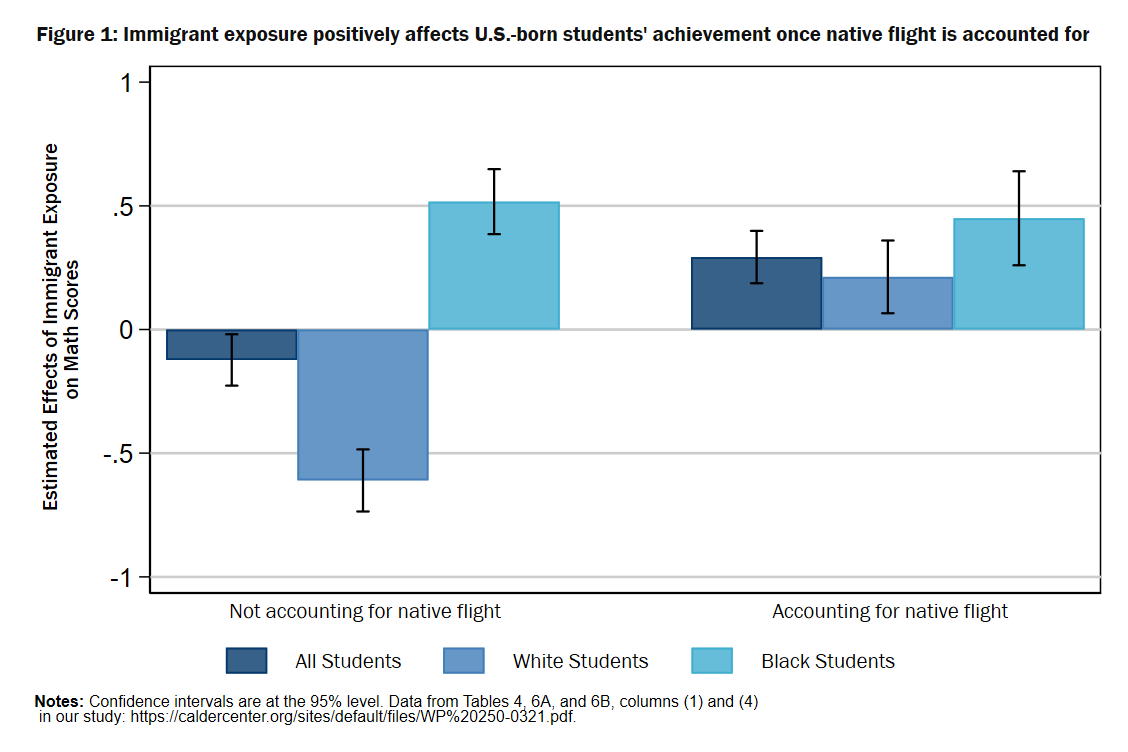
Figure 1, illustrating our main result, shows the relationship between immigrant exposure and native student math scores, and how this relationship changes when one accounts for native flight. We present the results for all U.S.-born students (black bars), along with the results for white (green bars) and Black students (blue bars) to demonstrate the effects for different student groups.

Estimated Effects of Immigrant Exposure on U.S.-Born Student Math Scores: Overall and by Race

The results on the left of the figure are from a common model that accounts for the non-random sorting of immigrants (by comparing U.S.-born students with their peers in the same school), yet does not address native flight. (That is, we compare the academic performance of native students with their peers in the same school who have different levels of exposure to immigrants because they are enrolled in different grades.) On the right of the figure, we present the results from our preferred model where we rely on sibling comparisons. Several findings are worth highlighting.

First, when we move from our baseline model to sibling comparisons that account for native flight, we see that the relationship between immigrant exposure and U.S.-born student test scores changes from negative to positive.

Second, we find that this trend is entirely driven by students from more advantaged backgrounds. For example, for white students, we find a negative relationship between immigrant exposure and math achievement in models that fail to account for native flight compared to a sizable positive relationship in our preferred model. In contrast, for Black students, the positive effect of immigrant exposure remains virtually unchanged between the two models. This is consistent with the expectation that native flight is a bigger issue when examining the effects of immigrants on students from more advantaged backgrounds who can afford alternative schooling options in the wake of an immigrant influx.

In summary, we find no adverse effects of immigrant students on the academic achievement of U.S.-born students. This is true even when the immigrants’ academic achievement is lower than the U.S.-born students. In fact, we find significant benefits of having immigrant peers on the test scores of native students, especially among students from disadvantaged backgrounds.

This does not necessarily mean that immigrant students do not require public resources initially as they acquire English proficiency and get accustomed to the school system and life in a new country, which could have adverse effects on native students in the short-term—especially in the aftermath of large migrant inflows. That said, our findings suggest that, in the long run, the benefits of exposure to recent-immigrant peers, who are typically higher performing academically and have higher educational aspirationscompared to more established immigrant generations, likely outweigh these potential short-term adverse effects.

Source: Do immigrants harm native students academically?

Sarah Halimi: How killer on drugs escaped French trial for anti-Semitic murder

Good overview:

Sarah Halimi was a Jewish, 65-year-old, former kindergarten director, who in April 2017 was beaten, then thrown to her death from her flat in north-east Paris.

The killer was Kobili Traoré, a Muslim of Malian origin who was her neighbour. During the attack, which lasted between 20 and 30 minutes, he chanted verses from the Koran and shouted “Allahu Akbar” – God is greatest.

Loss of control

Two weeks ago, a decision by France’s highest court of appeal, the Cour de Cassation, triggered a storm of indignation, primarily but not solely in France’s Jewish community. Citing Article 122 of the Penal Code, the judges ruled that Traoré had been undergoing a “psychotic episode” at the time of the attack and that his “discernment” had been “abolished”.

The fact that this loss of control was linked to his voluntary smoking of cannabis over many years was, said the court, irrelevant. The root cause of a madness was not an issue in law, the judges said, as long as the madness was established; and it had been, by independent psychiatric analysis.

And so the Cour de Cassation ruled that Kobili Traoré should not stand trial, but remain in the secure hospital where he has been kept ever since the murder.

A dangerous precedent

A week ago thousands protested against the decision in Paris and other cities. There is both reason and emotion behind their fury.

The most obvious argument against the ruling is that it creates a dangerous precedent. As more than one lawyer has pointed out, what now is there to stop other killers from claiming an “abolition of discernment” due to long-term drug or alcohol use?

This is all the more relevant because of the prevalence of cannabis abuse among so many of those found guilty, not just of crimes designated as “anti-Semitic”, such as this one, but also of those designated as “terrorist”.

“Don’t ask me to explain the inexplicable,” said lawyer Aude Weill Raynal. “In most cases, taking drugs is an aggravating factor in a case – and yet here it is regarded as extenuating.”

‘In France we do not judge the mad’

It is true, of course, that in most cases the fact that a killer has taken drugs or drunk alcohol will not stop him or her going to trial – even if there is established a temporary loss of reason – and may even contribute to a stiffer sentence.

But the difference in the Traoré case is expert opinion. Of the three psychiatrists’ reports, two concluded that his discernment was not just “altered” (as it would be if he had just smoked a joint or got drunk) but outright “abolished”.

This was because of the permanent damage to his brain caused by more than 10 years of drug abuse. On the night in question, said the majority of the experts, he was in the grip of a full-scale psychotic attack in which he feared he was being chased by demons.

“The crime was the crime of a madman,” they said in a long justificatory piece this week in Le Monde. “And in France we do not judge the mad.”

But this leads to the second of the arguments against the ruling, which centres on the role of experts in the courts.

Writing in conservative newspaper Le Figaro, philosopher and former minister Luc Ferry said it was a “joke” to regard psychiatry as a “science” on which to base supposedly neutral decisions in law.

“The psychiatrists disagreed among themselves,” he wrote, “one of their reports speaking of ‘alteration’ of discernment, and the other two of ‘abolition.'”

Deciding to take drugs and then “going mad” shouldn’t, in my view, remove your criminal responsibility. I would like the justice minister to present a change in the law very fast
Emmanuel Macron
French President
Jack Broda, a judge from Nancy who has resigned in disgust over the Halimi ruling, said magistrates running the investigation accorded too much importance to psychiatry.
“When you call for an expert opinion, it’s not to nod blindly in agreement with the findings. You need to look at all sides, which can only be done in a trial. Justice is not the work of experts,” he said.

But the deepest source of anger is a feeling shared by many Jews that the court’s ruling was preordained. They believe that from the start the investigation failed to address the attack’s true nature – which for them was both anti-Semitic and, if not planned, then certainly springing naturally from Traoré’s known cultural and religious prejudices.

Changing the law

In the end the Cour de Cassation upheld the designation of the murder as “anti-Semitic”, but many campaigners felt it as a sop to allay their anger over the lack of a trial. Others question how a killing can be at the same time officially anti-Semitic – which implies intention – yet also be the work of a man who has lost his reason.

Underlying all these arguments is an assumption: that parts of the French justice system have a left-wing bias that pushes them to take the side of the poor, black Muslim, and downplays the crime against a Jew.

Which is, of course, fiercely disputed.

So, to go back to the original question: yes, in France a killer can be declared legally insane even if the drugs that destroyed his judgment were taken voluntarily. Why? Because the law says so.

If you want to change the judgement, change the law – which is precisely what the French government is now trying to do.

Too late, though, for the family of Sarah Halimi.

Source: Sarah Halimi: How killer on drugs escaped French trial for anti-Semitic murder

Action needed to end anti-Black racism in public service: advocates

As you may recall, I have analysed both the overall numbers (What new disaggregated data tells us about federal public service …) and the hiring and promotions data (Diversity and inclusion: public service hirings, promotions and separations) which show that:
 
“Black Canadians are the visible minority group with the strongest numbers in the public service compared to their share of the citizen population, but their representation is overwhelmingly in the two administrative categories. This is not unique – there is significant under-representation among Latin American, Chinese, Filipino and South East Asian groups in the executive ranks of the public service. A similar general pattern can be found with Indigenous public service representation.”
 
Striking how the advocates do not appear to be aware of the availability of this data (its posted on open data).
 
Even stranger is PSAC not acknowledging that disaggregated data exists as they surely should know that it does (“He said the current data collected by the government only allow people to self-identify as visible minorities, so it’s not clear how many Black employees are working in each level of the public service.”
 
An earlier study I did regarding the use of non-advertised processes showed little impact on hiring diversity (much to my surprise), ‘Non-advertising’ hiring up due to feds’ new appointments policy, data shows:
 
…the shift towards non-advertised staffing processes does not appear to affect the ongoing trends towards increased representation of women and visible minorities and to a lesser extent, Indigenous peoples. The slight decline in representation of persons with disabilities cannot be attributed to the new appointment policy, given that there was no shift towards non-advertised process that involved persons with disabilities.”
 
As we have evidence, albeit imperfect, advocates and their allies need to use and understand the disaggregated date rather than relying on anecdotes or previous data gaps:

The federal government must address anti-Black racism in the public service by implementing timely changes to staffing processes and effective training programs for public servants, not by long-term promises, advocates say.

The Liberals pledged in the 2021 budget to make changes to the Public Service Employment Act that aim to promote a more diverse and inclusive workforce and to spend $285 million over five years to collect disaggregated data that will help in understanding the experiences of people of colour in Canada.

Nicholas Marcus Thompson, one of 12 current and former Black federal workers who filed in December a proposed class-action lawsuit in Federal Court against the government, said their action is one of the reasons that the government made these promises.

He said it shouldn’t take the government five years to collect disaggregated data to understand the underrepresentation of Black workers in the upper echelons of the public service and to take down barriers they face.

“The time frame is very long and Black workers continue to suffer and show up to work injured every day,” he said.

“There’s a lot of mental health issues associated with the discrimination, the systemic discrimination, that Black workers have faced and continue to face — a lot of racial trauma that Black workers are facing.”

The plaintiffs are alleging systemic discrimination in how the federal government has hired and promoted thousands of public servants for nearly half a century.

“There’s a glass ceiling at the bottom of the public service for Black workers, and the top of the public service is reserved for white folks,” he said.

None of the allegations has been tested in court. The plaintiffs are waiting for a certification hearing scheduled for June.

Treasury Board spokesperson Martin Potvin said it’s premature to comment on the lawsuit, but the government will consider all options, including alternative dispute resolution, as it seeks to address the concerns raised.

The national president of the Public Service Alliance of Canada said anti-Black racism in the federal public service is widespread.

Chris Aylward said there’s limited opportunities for career growth or advancement due to systemic exclusion of Black employees.

“Canada’s public service represents itself as merit-based, inclusive and non-partisan but ongoing systemic discrimination and racism basically show that this is not the reality,” he said.

“There’s no doubt in my mind about that and it’s not specific to any one department or agency. I think it’s government-wide.”

He said the current data collected by the government only allow people to self-identify as visible minorities, so it’s not clear how many Black employees are working in each level of the public service.

“We believe (the disaggregated data) is crucial to understanding the disparities for specific marginalized communities in Canada, and in particular the Black community,” he said.

Potvin of the Treasury Board said more work is needed to eliminate bias, barriers and discrimination in the public service.

“We must take deliberate and continual steps to remove systemic discrimination from our institutions and from our culture,” Potvin said in a statement.

Norma Domey, executive vice-president of the Professional Institute of Public Service of Canada, said she is the first Black executive in her institute’s 100-year history.

“It’s heavy on me to try to push the envelope for our folks and push diversity, and it just makes my job harder,” she said.

Domey said staffing process in the public service is not transparent, and there’s limited recourse provided to candidates that makes it very difficult for them to challenge the system.

She said non-advertised appointments have dramatically increased to 60 per cent in 2020 compared to 29 per cent of all appointments in 2016.

Black employees fear retaliation if they challenge the process, she said.

“It’s the excessive use of non-advertised processes that add to the exclusion to the (marginalized) groups and given the demographics and the biases of hiring managers, it ends up being a huge disadvantage to folks like ourselves,” she said.

Domey said her institution was initially consulted on possible changes to the Public Service Employment Act, but it’s still unclear what changes to the act the government is considering.

“We’re hoping there’s going to be some progress on this whole staffing process, and the revamp of the Public Service Employment Act,” she said.

Potvin of the Treasury Board said information about the changes the government will propose to the act will be made available once legislation has been introduced in Parliament.

Thompson said the government should create a separate category for Black workers under the Employment Equity Act in order to guarantee better representation in the public service.

He said Black people are currently considered a part of the visible minority group.

“What we’ve seen is that they’ve consistently picked one or two groups from the entire visible minority category, (so) they meet (the requirements of) the Employment Equity Act,” he said.

Aylward of the Public Service Alliance of Canada also said federal departments meet the act requirements by hiring non-Black people of colour.

“They say ‘Oh, we’re on target. We’ve met our quota,’ kind of thing. And that’s simply not right,” he said.

He said a complete review of the Public Service Employment Act and the Employment Equity Act has to happen at the same time.

Domey said there also is a need for more bias-awareness training in the public service.

“People don’t even recognize when they’re being racist, so there’s something wrong with that picture,” she said.

She said the training courses need to be ongoing and entrenched into the public servants’ day-to-day activities.

“I hope it’s not just, ‘Oh, I’ve done my presentation. I’m the champion for diversity. Now, I can tick off that box and get my bonus.’ “

Source: Action needed to end anti-Black racism in public service: advocates

Citizenship and the Economic Assimilation of Canadian Immigrants

One of the people I know at StatsCan flagged this recent IADB analysis of the impact of citizenship on earnings to me (the benchmark study, Dan DeVoretz’s The Economic Causes and Consequences of Canadian Citizenship, dates from 2005).

The paper assesses the impact of the increased citizenship residency requirements under the previous Conservative government (from three to four years) on earnings and concludes that a positive causal relationship between citizenship and earnings exists.

Presumably, the return to the previous requirements would show an improvement in earnings given one less year needed to become a citizen.

One can further extrapolate by considering the impact of the 2020 shutdown of the citizenship program and its only partial restoration (54,000 new citizens April 2020 to February 2021 compared to 238,000 for the same period 2019-20).

In other words, the government’s fixation on immigration targets at the expense of citizenship may harm the earnings of those whose citizenship has been delayed:

At the beginning of this paper, we asked whether citizenship acquisition improves migrants’ economic assimilation in Canada. Our empirical analysis shows evidence suggesting that other factors being equal, naturalized citizens earn higher wages than their non-naturalized counterparts (approximately 11 percent more). 

That under the Act, some migrants had to wait one additional year to claim citizenship, while others did not, was a “naturally” occurring sorting process. The enactment of the Act put exogenous variation into the likelihood of becoming a citizen that allowed us to simulate random assignment conditions as it would have happened in a randomized controlled experiment. We provide evidence of citizenship’s causal effects on economic assimilation with a clean identification strategy that ties an immigration policy to the behavioral responses of immigrants affected by it. 

Within that causal inference framework, we found that those immigrants able to acquire citizenship after living for three years in Canada were better positioned in the labor market than those who had to delay their citizenship applications an additional year because of the policy change. In the short term, both earning capacities and the likelihood of landing a job with deserved “job quality’’ were negatively affected by the Act. Our results also suggest that, because of those baseline differences in hourly wages induced by changes in the migration policy, the longer-term wage growth trajectory differs across the two groups, favoring naturalized migrants. 

Our results indicate that, on efficiency grounds, delaying citizenship acquisition can be costly for society: An initial 11 percent difference in earnings can result in a substantial portion of the migrant population being permanently below the threshold where tax contributions are above welfare transfers. On equity grounds, naturalization policy should provide a predictable and stable plan with clear and stable rules for all migrants. We have shown that society pays the price when policymakers manipulate elements of migration policy to favor their political clientele. Providing stable perceptions of fairness around migration policy may benefit members of society, beyond migrants. Suppose the objective is to compete efficiently with developed countries to attract the world’s most talented human capital. In that case, establishing an evidence-based time for naturalization eligibility, and committing to its stability through time, is a priority. 

Our analysis suggests that firms value the clear signal of migrants’ commitment that citizenship reveals. This signaling might be particularly important for those firms that heavily invest in their employees’ human capital because their associated risk of losing those investments is inversely proportional to that commitment. Lack of citizenship might have impacted hiring decisions and the timing and likelihood of promotions, with longer-term implications for wage growth. When migrants lack citizenship beyond a specific time threshold, they appear to become systematically disconnected from opportunities in the labor market for gaining access to well- paid, stable jobs and those characterized by steep growth in wages.

Source: https://publications.iadb.org/publications/english/document/Citizenship-and-the-Economic-Assimilation-of-Canadian-Immigrants.pdf

The harm done by Justin Trudeau’s apology to Italian-Canadians might require an apology of its own

Pandering. Good and needed reminder of the historical record (recall this from my time managing the historical recognition program):

Canada interned hundreds of Italian-Canadians during the Second World War “for the simple reason that they were of Italian heritage,” Liberal MP Angelo Iacono told the House of Commons on April 14, paving the way for Prime Minister Justin Trudeau to announce that Canada would formally apologize for doing so in May.

Mr. Iacono’s claim is remarkable. It suggests that Canada perpetrated a massive violation of human rights among members of that ethnic community. But if they really were interned simply because of their heritage, surely tens of thousands must have been thrown into camps – far more than the 12,000 Japanese-Canadians pulled from their homes on the West Coast and interned during the war (in addition to the thousands more forced to work on farms). There were, after all, more than 100,000 Italian-Canadians in 1940.

And yet, if we don’t count the 100 or so Italian sailors in Canada who were caught off guard by Italy’s declaration of war in 1940, the number of internees totals about 500, less than 0.5 per cent of the Italian-Canadian population. There must have been something special about them. What, one wonders, could it have been?

Fortunately, historians have studied this topic in some detail, so we have answers. Enemies Within: Italian and Other Internees in Canada and Abroad, edited by Franca Iacovetta, Roberto Perin and Angelo Principe is a comprehensive takedown of the claim that Canada waged a “war against ethnicity” when interning Italian-Canadians.

Instead, the book finds that Benito Mussolini’s diplomats in Canada aggressively promoted fascism among Italian-Canadians and met with some success – although only a small minority of Italian-Canadians were involved in fascist organizations. Such people caught the attention of the RCMP, which compiled what historian Luigi Bruti Liberati describes in the book as “a detailed picture of fascist activity in Canada, from the largest urban centres to the most distant mining camps.”

Mr. Liberati notes there are valid reasons to question the accuracy of the RCMP’s conclusions. But they were based on evidence, however imperfect, rather than on blanket assumptions about the entire community.

Mr. Liberati compiled his own biographical database of the internees. He found police had detailed dossiers indicating involvement in fascist organizations for at least 100 of them. Even 500, however, represented a small fraction of the 3,500 Italian-Canadians known to have been members of local fascist groups.

“[M]any who later professed their loyalty to Canada had in fact been fervent Fascists and had maintained their positions even during their internment,” Mr. Liberati writes.

Were some wrongly accused? Certainly, and the harm from that injustice persisted. But Ottawa’s actions were not comparable to those of a police state, he concludes. “This judgment seems to ignore the fact that fascism was well founded in Canada and that a certain number of Italian Canadians had supported it actively, not hesitating on occasion to resort to acts of violence against co-nationals and anti-fascists.”

That last detail underscores the greatest damage done by Mr. Trudeau’s planned apology. To claim that Italian-Canadians were interned because of their ethnicity suggests that they were representative of the entire Italian-Canadian community. They were not. Suggesting otherwise erases the history of Italian-Canadians who fought fascism, at home and abroad, instead of cheering its murderous advance.

Take, for example, Charles Bartolotta. During the Spanish Civil War of 1936 to 1939, when Mussolini sent soldiers to fight and die alongside the Nazis’ Condor Legion, Bartolotta left his home in Hamilton, Ont., to fight the fascists in that prelude to the Second World War. A member of the International Brigades, he was killed in action in September, 1938.

Or consider Frank Misericordia, a father of four who was working at Ottawa’s Chateau Laurier hotel during the Second World War when he was recruited by the Special Operations Executive to infiltrate German-occupied Italy and liaise with anti-fascist partisans there. Five attempts to secretly land him on the Italian coast were unsuccessful, but they took their toll, as one of his superiors noted in a 1944 memo: “In this case a pension from S.O.E. would hardly be any recompense, and I recommend that his services and the aggravation of his illness through the many courageous attempts he made to land in enemy territory be recognized by a one-time bonus when he leaves the country.”

Consider, finally, all those Italian-Canadians who joined the Canadian Armed Forces during the war. They recognized fascism for what it was and stood against it. It’s their story, and Bartolotta’s and Misericordia’s, that should be celebrated. Mr. Trudeau has instead chosen to subsume their heroism in a false, overly broad narrative of ethnic victimhood.

Source: https://www.theglobeandmail.com/opinion/article-the-harm-done-by-justin-trudeaus-apology-to-italian-canadians-might/

Scarborough researchers found the link between multi-generational households and COVID-19. What it could change about housing in years to come

Good and relevant study even if not particularly surprising:

A new study by three Scarborough researchers shows that the places that have been hardest hit by COVID-19 are also the places where multiple working adults or families are all sharing a household. 

The study by the Neighbourhood Change Research Partnership and the University of Toronto found that the maps that showed which areas in the GTA have high rates of COVID-19, shared a lot of overlap with areas that had the most households of what they call “mutually dependent adults.” One of those areas being Scarborough, where all three researchers reside. 

The findings confirm some assumptions people have made about why COVID-19 has spread the way it has, disproved some others, and reinforced why information like this is crucial to an effective pandemic response. 

But looking to the future it also shows that as more people live in bigger households like this, it’s time we get ahead of this issue, and build homes that can keep the people living inside healthy.

What does mutually dependent mean?

Using special-ordered Statistics Canada data from 2006 and 2016, the team parsed data on “mutually dependent adults” — combinations of households that could be a group of roommates, a grandparent living with a single mom, a family who rents out a room in their house — pretty much any situation where multiple working-age adults are living together under one roof, rather than independently, or as just a traditional couple. 

Between 2006 and 2016 as housing costs skyrocketed, the amount of working-age residents living together and depending on one another also grew by about 13 per cent across the country.

The most being in the notoriously expensive Toronto and Vancouver, where in 2016 mutually dependent adults were 27 and 25 per cent of the population, respectively. 

Multiple-family households and COVID-19

When broken down by neighbourhoods in Toronto, overall, the 10 with the highest rate of COVID-19 cases had just over twice as many mutually dependent adults at 37 per cent of the population. These were mostly found in Scarborough, northwest Toronto and some areas of York and North York. 

Meanwhile neighbourhoods that had more independent households also had fewer COVID-19 cases. 

The same held true in the GTA, with areas like Brampton. which has 37.2 per cent of adults in these kinds of households, and the highest average household size in the GTA — 3.5 people compared to Canada’s overall average 2.4. At the end of last year, Brampton also had 68 per cent of Peel Region’s COVID-19 cases.

John Stapleton, social policy expert and one of the study’s authors, said pooling resources in this way is both a solution to the high cost of living in Toronto, and to improve quality of living. It’s a way for people to potentially get more space — a house with a yard, for example, rather than living independently in smaller homes. But it created a higher risk for a virus like COVID-19. 

“What it was doing was creating an accelerant for a pandemic of this particular sort,” Stapleton said. 

Through the pandemic, Stapleton noted the assumptions that were made about why racialized people have seen disproportionate rates of COVID-19 — gathering for holidays like Diwali, language barriers. “It has very little to do with it,” he said. 

“Having so many people in a household and a number of adults working … and most likely working right in key sectors that you can’t do the work from home … that means that those households will be more vulnerable to COVID spread,” said David Hulchanski, a housing and community development professor at U of T.

“It’s demonstrating in yet another way what is wrong with having such a huge gap in income and wealth, which then affects all aspects of our life,” Hulchanski said. 

Seeing the overlap in the maps reaffirms that it is wise to focus treatment and resources in these highly-affected areas.

“In other words, it’s telling you, yes, you should have the vaccines (for) Scarborough. You should be doing this stuff by postal code,” Stapleton said.

Still with the vaccine rollout, Ontario only allotted 25 per cent of supply to hot spot areas despite its science table recommending 50 per cent, and only recently announced plans to up it to half as distribution has expanded. 

Epidemiologist Colin Furness said that the province’s reluctance to collect demographic data and have it influence the response from the start of the pandemic, has been a huge downfall. 

“The tail has really had to pull the dog along here and it really should not be that way,” he said.

Building a healthier future

While the high cost of housing is a factor at play here, Stapleton also notes that for some families, it’s more traditional and a choice to live together, rather than just affordability and circumstance.

And with this data in mind, and the cultural choice factor, both Furness and Stapleton see a takeaway being to make these kinds of multi-family households more livable and safe. 

Furness said: “How do we make ourselves resistant to communicable disease in a home? No one talks about that. So, I think we might have some opportunities in terms of how we think about designing safe residences, given what we now understand both what living patterns are, and what the risks are associated with that.”

Furness said building codes, ventilation requirements, the ability for more separation in the household are all things that could be incorporated into creating living spaces that can keep people safe. And also considering sustainability, rather than plowing into farmland in Ontario to create more and bigger houses. 

It’s a complex problem he said and it’s up to leaders to move the dial in this direction. Furness says he is “not optimistic.”

“What we learn from history is that we do not learn from history.”

Source: https://www.thestar.com/news/gta/2021/05/01/scarborough-researchers-found-the-link-between-multi-generational-households-and-covid-19-what-it-could-change-about-housing-in-years-to-come.html

Auschwitz inmates’ families oppose ex-PM on museum council

Of note:

Relatives of former Auschwitz prisoners from Poland are protesting the appointment of a top member of the country’s right-wing ruling party to an advisory council at the state-run Auschwitz-Birkenau museum in Poland.

They argue that the former prime minster, Beata Szydlo, has tolerated “openly fascist” groups and supported attempts to stifle research into the Holocaust, among other complaints.

Szydlo was appointed in April to the Auschwitz-Birkenau State Museum Council, a body of experts that advises the museum director. That prompted three members of the nine-member panel of experts to resign, followed by a fourth resignation reported this week.

On Friday evening, the news portal Onet carried a letter signed by children and grandchildren of former Polish prisoners, as well as one Auschwitz survivor, addressed to Prime Minister Mateusz Morawiecki.

They did not want Szydlo because of her and the ruling Law and Justice party’s strong opposition to accepting refugees and the conservative party’s attempts in the past to win over voters on the extreme right.

“We remember statements that excluded refugees, the undermining of achievements of Holocaust researchers, the toleration of openly fascist organizations, and finally denying European Union alliances,” they wrote to Morawiecki, according to the letter quoted by Onet. “We do not agree to this.”

Early on during World War II, the German forces operated Auschwitz as a camp for Polish prisoners, including Catholic clergy and members of the resistance. They later created nearby Birkenau for the mass killing of Jews from across Europe. In all, some 1.1 million people were murdered at the site located today in southern Poland.

Among those who signed the letter to Morawiecki were the son and two granddaughters of Capt. Witold Pilecki, one of the most notable heroes of the Polish resistance. Pilecki volunteered to be an Auschwitz inmate and smuggled out reports of atrocities there before fleeing. He was tortured and executed in a show trial by communists after the war.

There were no immediate reactions from the Polish government on Friday evening.

Culture Minister Piotr Glinski, who appointed Szydlo to the council, reacted after the first three resignations by denouncing them.

Glinski said it was an for the museum to have Szydlo on the council and said the resignations threatened to “politicize the discussion around the most important museum of martyrdom in Poland, a place of world heritage.”

Szydlo is now is a member of the European Parliament for the Law and Justice party. She has studied ethnography and history, and is from the area of Oswiecim, the Polish town where the site of the former Auschwitz death camp is located.

Source: Auschwitz inmates’ families oppose ex-PM on museum council

Make becoming a German citizen easier, integration ministers urge

Of note:

Children born to foreigners living in Germany should be granted faster access by law to German citizenship, integration ministers from Germany’s 16 states have urged in a majority appeal

Meeting in the harbor city-state of Bremen Friday, ministers called on the federal government to reform Germany’s Nationality Act (StAG) by reducing a resident child’s waiting time for citizenship from the current eight years to six years.

A reduction to four years should apply to foreign families who show special integrative aptitude, urged ministers, who form Germany’s Integration Ministers’ Conference (IntMK). The group, whose rotating chair is currently held by Bremen’s Social and Integration Senator Anja Stahmann of Germany’s opposition Greens, was initiated under Chancellor Angela Merkel in 2007 to coordinate regional and federal policies, but often exposes major differences among state approaches.

Stahmann said ministers meeting Friday also urged for relaxing Germany’s legislated aversion to multiple nationalities and that German language acquisition at the mid-range B1 level be sufficient to test successfully for citizenship.

The IntMK also received a study showing trust migrants hold toward German authorities and urged the federal government to fully use EU-negotiated quotas to bring “subsidiary” family members and reunite them with refugees already in Germany. Of the 12,000 such entries possible last year only 5,300 visas were issued, it said.

Last week, a flight carrying 103 refugees landed in Hanover, raising to 2,765 the number of arrivals in Germany since April 2020, meeting the target of 2,750 that Germany had declared itself willing to accept.

Source: Make becoming a German citizen easier, integration ministers urge