Germany recognizes colonial killings in Namibia as genocide

Of note:

Germany has reached an agreement with Namibia that will see it officially recognize as genocide the colonial-era killings of tens of thousands of people and commit to spending a total of 1.1 billion euros ($1.3 billion), largely on development projects.

The accord announced Friday is the result of more than five years of talks with Namibia on the events of 1904-1908, when Germany was the southern African country’s colonial ruler.

Historians say German Gen. Lothar von Trotha, who was sent to what was then German South West Africa to put down an uprising by the Herero people in 1904, instructed his troops to wipe out the entire tribe. They say that about 65,000 Herero were killed and at least 10,000 Nama.

“In the light of Germany’s historical and moral responsibility, we will ask Namibia and the descendants of the victims for forgiveness,” German Foreign Minister Heiko Maas said in a statement.

“Our aim was and is to find a joint path to genuine reconciliation in remembrance of the victims,” he said. “That includes our naming the events of the German colonial era in today’s Namibia, and particularly the atrocities between 1904 and 1908, unsparingly and without euphemisms.”

“We will now officially call these events what they were from today’s perspective: a genocide.”

Talks between Germany and Namibia opened in 2015, more than a decade after a 2004 visit to Namibia in which then-Development Minister Heidemarie Wieczorek-Zeul offered Germany’s first apology for the killings, which she said were “what today would be labeled as genocide.”

Maas said that, “as a gesture of recognition of the incalculable suffering,” Germany plans to support Namibia and the descendants of the victims with a 1.1 billion-euro “rebuilding and development” program in whose design and implementation “the communities affected by the genocide will take a decisive role.”

At the same time, he said that “legal claims to compensation cannot be derived from this.”

That reflects Germany’s position that the Genocide Convention of 1948 can’t be applied retroactively, and that its liability is political and moral rather than legal.

The projects Germany will now fund are expected to stretch over a 30-year period and will cover areas such as land reform, including land purchases, agriculture, rural infrastructure, water supply and vocational training. They will be separate from continuing development aid to Namibia.

Germany says that representatives of the Herero and Nama were involved in the negotiations, though Berlin’s direct dealings have been with the Namibian government.

Germany gained control of the desert country in the 1880s and surrendered the territory to South Africa in 1915. Namibia gained independence in 1990.

Source: Germany recognizes colonial killings in Namibia as genocide

Government’s failure to keep stock of PPE reserves hurt us when we needed it most

Good commentary on the long history of government data management and use issues, brought to prominence during COVID-19, along with systemic accountability issues.

And yes, the default option for government data would be public (and to be fair, the open government initiative has resulted in more availability of data):

Seventeen years ago, there was a cabinet minister named Reg Alcock, the President of the Treasury Board, who invited people to his office for lectures about data.

The late Mr. Alcock was a hefty, 6-foot-8 mountain of a man with two main interests: Liberal Party organizing in Manitoba and dragging the government into the digital age. Part of the lecture he gave in 2004 was a question: Why is it that corporate executives have computers that can tell them, for example, how many trucks their company owns, but a prime minister would need a year to get the same answer from government?

On Wednesday, Auditor-General Karen Hogan issued a report on the government’s handling of stockpiles of PPE that let it be known that Mr. Alcock’s question is still hanging in the air, nearly two decades later.

Ms. Hogan’s team reported that the Public Health Agency of Canada (PHAC) had a stockpile of personal protective equipment and medical devices, but it didn’t have a policy about what should be in it, or what was in it, or whether the equipment had expired.

When the biggest public-health crisis of modern times hit and provinces needed N95 masks and ventilators from the National Emergency Strategic Stockpile, well, there wasn’t enough useful stuff there. The data were so unreliable the auditors couldn’t tell how badly it fell short.

The haphazard management of the stockpile wasn’t a new thing. Internal audits in 2010 and 2013 raised those issues.

Citizens might think a decade of disregarded warnings is a scandal that will shake the halls of power in Ottawa. But for a politician, it is cause for relief. The best kind of failure is one that was going on long before you took office. Prime Minister Justin Trudeau’s advisers will be happy enough that the Auditor-General credited the government for responding after the crisis hit.

But note that PHAC did draft a proposal to develop a better inventory management system in January, 2020 – just as COVID-19 was spreading – but agency officials told auditors “it was put on hold because of budget constraints.”

Mr. Alcock, back in the day, didn’t just want government to get computer systems – they have a lot – but to manage data, to make more information available and usable, so that government knows better what is happening within government.

But politicians in charge aren’t good at driving change in long-term, systemic issues that voters don’t even see. Mr. Alcock, for example, was preaching for IT in a Paul Martin government busy with Liberal scandals and non-confidence votes in Parliament.

Two PMs later, and governments still have a hard time seeing what government is doing. The National Emergency Strategic Stockpile wasn’t much use in a crisis because it didn’t do the kind of information management that that happens at a grocery store: figuring out what you will need, buying it, tracking what goes in and out and what is going bad.

By now we know that bad data management, not knowing what you don’t know, raises risk in a crisis. And there’s something else: Most of that data can and should be made public.

Why not let the public see the running tally of N95 masks in inventory, or ventilators on the web? Most people won’t look at it, but perhaps a few experts in universities and elsewhere will analyze the policies, crunch the data and, we can hope, point out when they’re messed up. Or just missing. That applies to other kinds of data, too.

In Britain, this week’s remarkable testimony of Dominic Cummings, a former aide to Prime Minister Boris Johnson, about the chaotic initial response to the pandemic made it pretty clear that it’s no longer necessary, or wise, to leave the data inside government.

Mr. Cummings testified to a parliamentary committee that false assumptions, bad analysis, and groupthink inside government led Mr. Johnson’s government to a disastrous notion that it should try to reach herd immunity rather than slowing the spread of COVID-19. Scientists outside government, notably a mathematician, helped convince him that was “catastrophically wrong,” he said. He and the government’s top science adviser later agreed data should have been released earlier, to get input.

That’s not the same thing as PHAC’s failure to keep track of a stockpile. But then, if we want to encourage the government to keep tabs on the data, one good way is to demand to see it.

Source: https://www.theglobeandmail.com/politics/article-governments-failure-to-keep-stock-of-ppe-reserves-hurt-us-when-we/

Austria sparks uproar with ‘Islam map’

Seems like an easy navigation tool for anti-Muslim extremists as would be an equivalent map of synagogues and Jewish associations for anti-Semites:

The Austrian government came under fire Thursday for a new “Islam map” showing the location of mosques and associations around the country, with religious groups saying it would stigmatize Austria’s Muslim population.Earlier, Integration Minister Susanne Raab unveiled an Internet website called the “National Map of Islam” with the names and locations of more than 600 mosques, associations and officials and their possible links abroad.But the interactive map — compiled in collaboration with the University of Vienna and the Documentation Center of Political Islam — alarmed many of Austria’s Muslims and the ruling center-right OeVP party’s coalition partner, the Greens, also distanced itself from it.
It “demonstrates the government’s manifest intent to stigmatize all Muslims as a potential danger,” said the IGGOe Muslim representative council in a statement.
The Green party’s spokeswoman for integration Faika El-Nagashi complained that “no Green minister or MP was involved or even told about it. The project mixes Muslims with Islamists and is the contrary to what integration policy should look like.”
Raab insisted that the map was not meant to “place Muslims in general under suspicion.”
The aim was “to fight political ideologies, not religion,” she said.
Chancellor Sebastian Kurz has regularly criticized what he calls “political Islam.”
“Imagine if a similar map was drawn up for Judaism or Christianity,” said Tarafa BagHajjati, the head of another Muslim organization, complaining that it equated terrorism with religion.
He pointed out that around eight percent of Austria’s overall population of 8.9 million were practicing Muslims and most of them had no links with such organizations.
“It’s worrying and I’m disappointed with the government for adopting far-right ideas,” he said.
Since an extremist attack left four people dead in Vienna last November — the first to be carried out in Austria — a rise has been reported in the number of incidents in verbal and physical attacks against Muslims in the country.
IGGOe complained that “racism against Muslims is growing.”

Source: Austria sparks uproar with ‘Islam map’

Central Park ‘Exonerated 5’ Member Reflects On Freedom And Forgiveness

Of note (the film depicting their story, When they see us, is well worth watching)

In the memoir, Better, Not Bitter, Salaam reflects on his wrongful conviction and his efforts to forgive those responsible for his vilification.

“You have to be able to forgive so that you can cut yourself from the ball and chain that’s holding you back,” he says. “It has nothing to do with the individual who harmed you, but everything to do with yourself.”


Interview highlights

On how the boys were forced to give false confessions

I remember when I was [at the precinct] with Korey [Wise] hearing him getting beat up in the next room. I remember hearing him yell out, “OK, OK, I’ll tell you!” And he made, if I’m not mistaken, four completely different confessions, four completely different ones. And the one that he implicated me in, they played at my trial and all we wanted to do was go home. This was a nightmare. We were delirious with hunger. We were delirious, because time was passing and we didn’t know what time it was, just a whole nightmare of the whole situation and I think what happened is, after a certain point, you break and in the breaking point, you say anything that will allow you to get out of that.

On the advice his mother gave him — which led him to not initially agree to the police’s narrative

[My mother] told me something that’s very important. And I think that the thing that she told me is something that I tell people often. She said to me, “Stop talking to them.” And then she said to me, “They need you to participate in whatever it is that they’re trying to do. Do not participate. Refuse.” And for me, it was one of the most powerful learning tools that I could ever imagine, because here I was on my own, being told to stand my ground and being told in many ways that it’s on me. “I can’t come into the room with you. I can’t fight for you. You have to fight for yourself. But I need you to know that whatever you do, they’re trying to get you to participate in your own destruction.”

On being in danger in prison because of how high profile his case was

I think all throughout our case, there was a knowledge of who we were. It was very difficult for us to hide. I’m saying “hide,” because we wanted to be anonymous, but we had been convicted of this heinous crime. We have been vilified in the media. Over 400 articles [were] written about us within the first few weeks. And our faces were on every single front page of every newspaper in New York City for a very, very long time. So by the time we got to prison, the inmates had already known who we were. …

You’re told the worst crime that you can go to prison for is rape. The only crime that trumps rape is child molestation. And then you feel all of the tension, all of the negative [energy] … you feel that, and you’re walking through that in these prisons and here are killers around you. Here are [rapists] around you. Here are child molesters around you, and they want justice. They want to do to you what you have been convicted of.

On his feelings toward the police and prosecutors who put him behind bars

The overwhelming feeling that I have towards the police and prosecutors is that they knew that we had not done this crime. They knew it, but yet they chose to move forward. They built their careers off of our backs, and the law of karma caught up to them. And they never imagined that they would have to contend with these crimes that they committed — because these are crimes. They’re supposed to be the upholders of law and they have things like prosecutorial immunity. But they were involved in prosecutorial misconduct. No one wants to be in a situation where the people at the highest level in life are the ones who are the most criminal. We want those people to be the most upstanding. They have to hold that truth in their minds and hearts as they move in the justice system because they’re changing people’s lives. … The people who are supposed to uphold the law, it is criminal when they do the exact opposite of that.

On his healing journey

We’ve been able to make leaps and bounds in our healing, in our adjustments into society, but at the same time, it’s still there lurking in the background. The awful experience that we should have never gone through is really always the cloud over our heads. But the cool thing about it is that we now know how to deal with those emotions. We now can say, “This is how you get through any prison that you may be going through,” whether you’re physically in bondage or not. Making the choices that are meaningful, taking the time to breathe, meditating, creating vision boards, all of those things are necessary.

They say the imagination is the precursor of what’s to come, and so if you can imagine a future that is brighter than the one that you’re growing through — and I’m saying “growing through” on purpose, because when you get to that point, you realize that you’re not just going through something, but that you’re being prepared for greatness, that you need to know the lows in order to appreciate the highs in life. I think that when I look at my story, being able to look at it from the outside gives me the tremendous opportunity to describe in full what it is that I had gone through, and then going back in and being a participant in my growth and development is important because you have to marry those two things together. And it’s that that causes you to step forward with tremendous hope in the future, with tremendous faith in the future, knowing that it can only get better and not get worse.

Source: Central Park ‘Exonerated 5’ Member Reflects On Freedom And Forgiveness

Mulcair: A sneak attack on language rights

Of note for those who remember these “battles” and those who do not:

Quebec and the Constitution are back in the headlines and anyone who remembers Meech and Charlottetown will understandably want to duck and cover. This time around though,  no one is asking for consent from other provinces or from Canadians via a referendum.

Quebec has included what it claims to be unilateral amendments to the Constitution Act 1867 (the B.N.A. Act) in a sweeping proposal  (Bill 96) that seeks to reinforce the status of French there. Many of those changes are indeed provincial in nature and deal with things like labour and consumer rights. The scope and effect of those types of changes will be the object of a good debate in Quebec’s legislature, the National Assembly, and given Legault’s majority most will pass into law.

Because it also affects rights concerning the language of legislation and the courts, Bill 96 deserves a much more thorough review than the nodding approval party leaders in Ottawa have quickly given to that part of it that seeks to amend the constitution unilaterally.

This is a subject I’ve spent much of my career working on. My first job in the Legislative branch of the Quebec Justice Ministry included a memorable mad dash as everyone scrambled, in December of 1979, to react  to a Supreme Court decision that had just been rendered in the Blaikie case. We had to quickly prepare, for re-enactment, all of the Québec laws adopted since the original Charter of the French Language (Bill 101) went into force in August of 1977. Bill 101 removed the obligation that had existed since 1867, in that same B.N.A. Act,  to simultaneously enact all laws in English and in French.

The Blaikie case, as it is called, was important for several reasons. First, the judges unanimously ruled that section 133 of the B.N.A . Act, that requires English and French in laws and in the courts, was not part of Quebec’s constitution and therefore could not be amended unilaterally by the province. Second, the Supreme Court simultaneously corrected a much older illegal Act, the Manitoba Official Language Act of 1890, that removed the French-language rights that had been promised in the Manitoba Act of 1870.

Language rights go to the core of our nation because they deal with the promises we made as this great country of ours came together. It’s been a rocky road at times but the Official Languages Act provided, over 50 years ago, a fresh boost to those promises. Pierre Trudeau even lost one of his prominent Western ministers over the issue. That minister, James Richardson, was from one of the most prominent Winnipeg families and he stood firmly against official bilingualism.

I wound up working in Manitoba after the Supreme Court ruled, a second time,  that all the laws there had to be translated and French and English had equal standing in the courts. That second ruling, in 1985, had become necessary because the Manitoba  government had ignored the first one, arguing (without much of a straight face) that the prior ruling was directive and not mandatory. Keen observers will note that it took over 95 years for Manitoba francophones to have their rights restored and and barely two years for anglophones in Quebec to get theirs.

It was of course mandatory and right after that second Supreme Court ruling, I’d been hired to help oversee and revise the translation of some 10,000 pages of laws and regulations. It was a Herculean task and the Supreme Court was there to monitor and ensure compliance with its definitive ruling.

It’s that history that makes Justin Trudeau’s acquiescence so surprising. He appears to sincerely believe that section 45  of the 1982 Constitution applies to Quebec’s unilateral changes to the B.N.A. Act and that the proposal is legitimate because it only affects the province’s own constitution.

But there’s another section, 43, that says that if the changes affect the right to use English or French, then you need a debate and a motion from both the House of Commons  and the Senate before the change can take place.

Section 43 was ably used by former premier Lucien Bouchard to change Quebec’s constitutionally guaranteed Catholic and Protestant school boards into a French and English system. The House of Commons and the Senate had had to discuss and vote and the English-speaking community of Quebec was consulted and widely agreed. That’s how you change a constitution: you discuss, debate and vote.

Legault’s proposed changes to the B.N.A. Act do indeed affect language rights. Trudeau, Erin O’Toole and Jagmeet Singh with their “move along, nothing to see here” attitude are trying to convince themselves and us that this is simply about Quebec amending its own constitution. That’s the argument Quebec had unsuccessfully argued before the Supreme Court in the Blaikie case back in the 1970’s. With these changes, it could win that case today.

What is and what is not part of the province’s constitution? To begin with, a few paragraphs above, I committed the unpardonable by referring to Quebec’s legislature as…a legislature! The Quebec National Assembly is called that because Quebec decided it preferred the terminology from France and it unilaterally changed the name of its legislature to l’Assemblée Nationale. Pas de problème.

So too when Quebec decided  (like every other province that had one) to deep-six its ‘Legislative Council’ decades ago. It had every right to axe its provincial senate. It was Quebec’s call as it was, indeed, purely the jurisdiction of the province.  Not so with the changes being proposed now by Quebec.

Here they are in detail: “Quebecers form a nation” and  “French shall be the only official language of Quebec. It is also the common language of the Quebec nation”.

When you go through Bill 96, you see proposals to change a series of laws including the Civil Code and the Code of Civil Procedure, to remove the right to produce certain official documents if they’re written in English. An English-language birth certificate from B.C. will henceforth have to be officially translated as if it were from some obscure corner of the world with a little-known language. This is not just the Quebec constitution. This is the right to use English and French as contemplated by section 43. It is impossible that the lawyers at the Justice Department in Ottawa didn’t see this.

Bill 96 has to be read as a whole. Sections have to be construed in context, one with regards to the other in order to understand the overall effect. The context includes changes to existing language rights. The legislator is never presumed to be talking for no reason, the unilateral  changes to the B.N.À. Act are intended to produce and shield the desired overall result: less English in Justice, legislation and the courts.

Québec Justice minister Simon Jolin-Barrette was recently in a knock-down, drag-out fight with the Chief Justice of Quebec Court, Mme Justice Lucie Rondeau. Jolin-Barrette didn’t like the fact that the postings for new judicial appointments required a knowledge of English. She patiently pointed out that there is a constitutional right to a trial in English and that it’s up to the courts to ensure respect of that obligation. Jolin-Barrette didn’t agree and he’s using Bill 96 to remove  bilingualism as a systematic requirement for future judicial appointments even in areas with large anglophone populations. The right to a trial in English will rapidly become theoretical.

Years before Bill 101, Robert Bourassa’s Bill 22 had already proclaimed French to be the official language of Quebec. Stephen Harper had championed a motion in the House of Commons proclaiming Quebecers to be a nation. So what’s the big deal?

The big deal is that Bill 96 does indeed remove existing rights. Professionals, including lawyers, will lose their right to practise law if they fail to maintain what will become a new continuing requirement for a mandatory knowledge of French. Tests or other qualification at the beginning of their career (I had to take one to join the Bar) used to remain valid througout. They would henceforth be deemed to be subject to review and revocation of licensure in case of insufficient knowledge of French.

The big deal is that once those unilateral constitutional amendments are in place, the Quebec attorney general might succeed where their predecessors had failed in 1979. They could point to the new sections as proof that Quebec can indeed adopt its legislation in French only and provide an English translation later on. That could negatively effect everyone’s language rights across Canada as other provinces such as Manitoba and New Brunswick could take note and follow suit.

In 2019, the Quebec and Montréal Bar Associations settled lawsuits that sought to ensure that Quebec respect its constitutional obligation to produce an English version of statutes had equal footing with the French, especially in terms of preparation of amendments. The “Mulcair precedent” referred to in those proceedings was mine. Having worked in Manitoba and been part of the debates there, I knew what the Supreme Court required and I raised it repeatedly when I was a member of the National Assembly. That constitutionally guaranteed equivalent of the English and French versions is in peril with these changes being endorsed by Trudeau and his pliant justice minister David Lametti.

There is a constant whittling away of the status of French and of French-language institutions throughout Canada and all Canadians should  be aware of it and demand their governments help to right that wrong. The most recent heartbreaking example is the scuppering of key French-language programs at Laurentian University in Sudbury leaving many francophone Masters and PhD students high and dry. There is money in the most recent federal budget to come to the aid of minority francophone education in just such a case but so far language minister Melanie Joly has done nothing.

That type of continuing tragedy for the French minority in Canada is correctly pointed to as deux poids deux mesures when comparing the institutions of the English in Quebec and the French outside Quebec.

The essential question for our country’s future is this: do we want to aspire to greater rights for all Canadians or are we going to simply level things downwards, to the lowest common denominator?

Trudeau seems to have veered away from his often espoused vision of a bilingual multicultural Canada towards one where linguistic and religious minorities are on their own. When he and Lametti refused to lift their little fingers to help hard-pressed religious minorities fighting in court against Quebec’s discriminatory Bill 21, the writing was on the wall.

Rights are essential. Failure to defend those rights comes at a cost to our strength, unity and well-being as a country, long term. Short term electoral priorities are no substitute for thoughtful defence of fundamental values and rights.

It’s clear that neither Trudeau nor O’Toole nor Singh has given a great deal of thought to the substantive sections Bill 96. The great irony is that even if they went the route of the more demanding section 43, there’s absolutely no doubt that the House would pass a motion approving it. Trudeau has claimed that he has a legal opinion stating that Québec can indeed proceed on its own to amend the Canadian constitution without even bringing the issue before Parliament. When Lametti was asked on an English Montréal radio station if he was willing to share that legal opinion with Canadians, he skated.

Legault has a clear plan for pulling Québec away from, if not out of, Canada. That plan, as revealed by Legault himself, has three components: language, immigration and culture. He is running circles around our current crop of leaders in Ottawa.

Despite the historical long odds, if done right, there really is reason to hope that this could be turned into a rare opportunity for a deeper understanding of the real differences that exist between the two solitudes. But it can’t be done in a sneaky, backhanded way, without a proper debate as required by the Constitution.

Trudeau is wrong to say the constitution of Canada can be amended unilaterally by Québec. It is not wrong to follow the constitution to bring about change that can close a tough chapter in our history. After all, the much maligned 1982 Constitution, that Quebec never signed, could wind up being used by Québec to try to improve things for the future, as long as rights are guaranteed and respected from coast to coast to coast.

Source: A sneak attack on language rights

‘Fortress Australia’: Why calls to open up borders are meeting resistance

Of note and the challenge of reopening:

Australia has been one of the world’s Covid success stories, where infection rates are near zero and life mostly goes on as normal.

That’s in large part thanks to the early move to shut its borders – a policy that has consistently been supported by the public.

But after a year in the cocoon, there is growing unease in the country over the so-called “Fortress Australia” policy.

Recent announcements declaring that Australia won’t open up until mid-2022 – meaning a two year-plus isolation – have amplified concerns.

Critics argue the extension of closed borders will cause long-lasting damage to the economy, young people and separated families. It also tarnishes Australia’s character as open and free, they say.

Calls for a clear plan to pull Australia back into the world are growing, as the country wrestles with an uncomfortable tension – balancing the safety of closed borders against what is lost by living in isolation.

“A Fortress Australia with the drawbridge pulled up indefinitely is not where we want to be,” says former Race Discrimination Commissioner Dr Tim Soutphommasane.

“Australia is at its best when it’s open and confident – not fearful and insular.”

Locking the gate

In March 2020, the government closed the borders. It barred most foreigners from entering the country and put caps on total arrivals to combat Covid. Mandatory 14-day quarantine and snap lockdowns have also been used to control the virus spread.

The measures are extreme, and among the strictest in the world.

But they’ve worked. Australia regularly sees months without a single case in the community, and it has recorded fewer than 1,000 deaths in the pandemic.

Given that, the strict border controls have proven tremendously popular. Public polls regularly report 75-80% approval ratings for keeping the door shut.

Even higher numbers – around 90% – approve overall of the government’s pandemic handling, and trust in government has increased in contrast to views of voters in some Covid-ravaged nations.

Languishing behind

But the government now also faces mounting pressure over how it plans to handle the next phase of the pandemic.

Prime Minister Scott Morrison – who faces an election next year – has announced Australia won’t re-open borders until mid-2022. The exact timing and just how that will happen are unclear.

But the budget announcement was a shock extension to previous forecasts of an opening-up to occur slowly at the end of this year.

The main reason for the delay is vaccination.

Australia’s immunisation programme has been beset with delays, and lags well behind other developed nations such as the UK and US.

Critics say complacency over the low virus circulation delayed its kick-off. And now rising hesitancy – fuelled at least in part by Australia’s isolation – has also slowed the vaccine rollout.

Facing those failures, the government fell back on the border ban as a resort, critics say.

That’s dealing a heavy blow to sectors like tourism and higher education. Australia’s strong migration programme – relied on to address skills shortages and population growth – has also been cut almost completely.

Ernst and Young, an accounting firm, estimates that Australia’s economy is losing A$7.6bn (£4.18; $5.9bn) a month from the closed borders.

So a group of experts from the University of Sydney have called for an exit plan to be put in place. People need to know their options and prepare for the future, they say.

Their “roadmap to re-opening” focuses on prioritising vaccination, expanding quarantine and starting trials to bring in people for affected industries.

They point to successful examples like the New Zealand travel bubble, and the Australian Open tennis tournament.

“This is the case when measured in hard dollar terms, but also when measured against less tangible factors such as fuelling a negative and inwards-focused national psyche that threatens our global standing, as well as national unity and cohesion.”

‘Us and them’ mentality

Others have also voiced their concerns over how an extended retreat from the world could damage Australia’s character.

When Australia was parochial it had a White Australia policy (1900s-1970s), which restricted immigration from non-European nations. Multiculturalism has replaced that policy in recent decades, but the ideal is still fragile, experts warn.

Dr Liz Allen, a demographer at the Australian National University, contends that Covid has already made the nation more “protectionist and insular”.

Government policies have created an “us and them” division, she argues.

The hostile treatment of migrants is a clear example, she says. Australia’s conservative government of eight years has never advocated for immigration – the coalition won the 2019 election pledging to “slash” the migrant intake.

At the start of the pandemic, Mr Morrison told the nation’s two million migrants on temporary visas to “go home”.

Those visa holders – often doing the low-paid, essential jobs of cleaning and food delivery – were also ineligible for the government’s pandemic welfare support, leaving many facing destitution.

The border ban has also sown community division, seen in its most extreme form last month when Australia took the world-first step of threatening jail for citizens who returned home from Covid-ravaged India. The Indian-Australian community expressed outrage they were being treated like second-class citizens.

Multicultural roots

The issue of stranded Australians reflects Australia’s character as an intensely multicultural nation.

Nearly 30% of the population were born overseas, and another quarter have a parent who was. As a nation of migrants, so many Australians have deep personal ties to other parts of the world.

Prior to Covid, about one million Australians were estimated to be living and working overseas. A section of the population – often highly educated and skilled – was also very mobile.

But the closed-border policy doesn’t appear to recognise these global connections or the disproportionate impact on first and second-generation Australians, critics say.

In addition, the borders created a narrative where blame for a virus outbreak was often laid at the feet of returning individuals.

“We turned on ourselves, on our own people,” says Dr Allen.

Political leaders described the virus as “imported” by returning travellers, rather than escaping through failures in the hotel quarantine system. Such rhetoric egged on social media commentary blaming incoming Australians.

Just happy to be safe

But while there’s division aimed at Australians outside the country, within the borders people feel comfortable with their lot.

First and foremost, people say they feel relieved and grateful to be shielded from the virus.

“There’s a lot of sympathy and real feeling for people caught up outside, and for the people who can’t go to weddings and funerals overseas,” says Melissa Monteiro, head of a migrant resource community centre in western Sydney.

“But you know, everyone ends with ‘that’s just how it is’. People are firstly, just grateful to be in this country and to be safe.”

Race relations researcher Andrew Markus, an emeritus professor at the University of Monash, says most Australians also don’t view the closed borders as a cultural isolation, or a “shutting yourself off from the world”.

Instead it’s just seen as a necessary short-term health measure – an attitude adopted across the political and cultural spectrum, he says.

He notes too that polling throughout the pandemic showed Australians’ support for multiculturalism and globalisation remained strong – about 80% approval – despite concerns about social cohesion and a rise in hate crimes against Asian-Australians.

Dr Allen says that the strong support for the government’s Covid fight is understandable – particularly when it has worked.

But she also says that the Australian public has been presented with no other options. The prolonged border closure and city lockdowns on single infections have all been largely uncontested policies.

She says it’s time now for Australia to move past such policies which she feels are rooted in fear. The country continues to face calls to bring back its own citizens.

“I don’t think it’s bad that people are afraid of Covid – we should be afraid. But we require leadership going forwards that doesn’t leave people behind.”

Source: ‘Fortress Australia’: Why calls to open up borders are meeting resistance

Wells: Who should get a monument? Meet the Canadian man trying to answer the question.

Of interest and relevance given ongoing debates and discussions:

Circumstances have a way of giving meaning to seemingly odd choices. Ten years ago, Ken Lum was an important figure in the Vancouver art scene. Then, without much fanfare, he wasn’t around anymore. But when the long summer of 2020 turned into a global debate about race, memory and commemoration, it turned out Lum was in a vital, important place. In fact, he’d been getting that place ready for years.

In 2012, Lum and historian Paul Farber co-founded Monument Lab, a think tank in Philadelphia that asks what we’re trying to do when we build monuments in public places to historical figures and events.

In the United States in 2012, the political purpose of monuments was already a long-standing debate. It’s just that a lot of people hadn’t noticed. In the years that followed, as controversies over the Confederate flag and monuments to Civil War-era secessionist generals took centre stage in a succession of national controversies, it became harder to ignore the questions Monument Lab exists to raise.

“It started as a pedagogical project,” Lum says in an online interview from his home in the Philadelphia Main Line, a suburb where the 1940 Katharine Hepburn-Cary Grant comedy The Philadelphia Story was set.

“I was teaching a class on observations I had made on my first visit to Philadelphia as a new Philadelphian, regarding the unevenness of the monumental inventory, if I can put that way, of the city.”

Lum had moved to Philadelphia in 2012 to join the faculty of the University of Pennsylvania’s school of design. Over the course of his first summer in the city where the Liberty Bell resides, he had a chance to see many of Philly’s most famous monuments. Ben Franklin, William Penn, Commodore John Barry, all the greats.

Except maybe not all of them? “Philadelphia had over a thousand statues and, at that time, not a single officially sanctioned full-figure African American—in a city that’s 40 per cent African American,” Lum recalls. “And also in the city where John Coltrane, Marian Anderson, Billie Holiday, Paul Robeson”—the legendary jazz saxophonist and three singers, each among the greatest American artists, all Black—“grew up or spent a lot of time. So I became very interested in who gets heeded and who doesn’t get heeded.”

In various ways, Lum has made a career of asking questions about who gets heeded and who doesn’t. If such things can be measured and quantified, Lum was one of Vancouver’s leading artists when he left for Philly. A soft-spoken man with a subtle but persistent mischievous streak, he grew up in Vancouver’s Strathcona neighbourhood and started studying art in his spare time near the end of a difficult undergraduate degree in other subjects. His early experience in art had not been encouraging. “I took art class from Grades 8 to 9 but stopped when the art teacher admonished me for making what he called ‘weird’ images,” Lum writes in the preface to Everything Is Relevant, an essay collection he published in 2020. His teacher “had very strong ideas about what art was and would criticize me harshly for not following his instructions to the letter.” Young Ken would have needed his teacher’s permission to study tenth-grade art, so he gave up.

Eventually he made a career doing the sort of thing that infuriated that middle-school art teacher. Lum’s art is, to some extent, a set of challenges to other people’s strong ideas about what art is. Uninterested in displays of technical skill, he hires tradespeople or buys commercial products to complete his works. His “furniture sculptures” are just that, arrangements of rented furniture. His best-known piece in his hometown is his 2010 Monument for East Vancouver, a neon cross in the form of an image from graffiti art that’s been scrawled on walls and underpasses in the city’s east side since before Lum was born. The A in EAST intersects with the A in VAN, as on a Scrabble board. For a decade the monument has served as a kind of gateway to the neighbourhood.

At times, Lum has seemed to be involved in the design of monuments even without meaning to. In 1990, he was invited to contribute to the opening exhibition of a new contemporary art centre in Rotterdam, Netherlands, the Witte de With Centre for Contemporary Art. One piece he contributed was billboard-sized, a photo of a young woman working an old-fashioned adding machine. The caption is as big as the photo and not subtle: “MELLY SHUM HATES HER JOB.” It was a wry commentary on contemporary workplaces, and its tenure in Rotterdam was meant to be temporary. The museum hung it on the street outside. When the exhibit ended, people called to complain that Melly had vanished. “Every city deserves a monument to people who hate their job,” one caller said. So the museum put Lum’s piece of art back up.

Then, quite recently, things took a surprising turn. The Witte de With Centre was named after the street it is on, which in turn was named after a 17th-century colonial Dutch naval officer who got rich ensuring the Netherlands could efficiently plunder various colonial territories. (As a grim bonus, his name translates as “Whiter Than White.”) The museum decided to change its name, and asked visitors for ideas. The winning suggestion was that it be named after Melly Shum. So since the beginning of 2021, it’s been called the Kunstinstituut Melly, or the Melly Art Institute.

While that entirely accidental process was playing out, Lum and Farber were setting up the Monument Lab. At first the organization was nothing more than a set of questions: what’s a monument? Who decides? Could it be done better? Farber is an academic historian; he wanted to write something. “I was more interested in, ‘Well, how can we make an exhibition out of it?’ ” Lum says. What would the venue be? Lum said the city of Philadelphia itself could be the venue.

In 2015, they set up an office outside city hall and asked visitors, “What is an appropriate monument for the current city of Philadelphia?” Eventually teams of volunteers fanned out across the city to ask the same question. Participants wrote their ideas on file cards. Eventually, more than 4,000 ideas were collected.

Eleven of the proposals were for monuments to soldiers of one kind or another. Sixty-eight proposed monuments to peace, and the word “peace” appeared in 168 proposals. Education was a topic in 173 proposals, the environment in 342. The proposals were sometimes highly specific, and suggested an idea of history at times starkly at odds with the one generations of Philadelphia city elders had promoted. Thirty-five people suggested a monument to commemorate the 1985 firebombing of MOVE, a Black separatist group. During an extended standoff, police helicopters dropped incendiary bombs onto the group’s headquarters. The resulting fire killed 11 people, including five children, and destroyed 65 houses.

To Lum and his colleagues, the desire for a MOVE commemoration suggested people wanted more than a procession of ramrod-straight soldiers in their public squares. “That suggested to us that the citizens, members of a public, which is heeded enough—they have longer memories and a greater sense of decency than the city itself, right?”

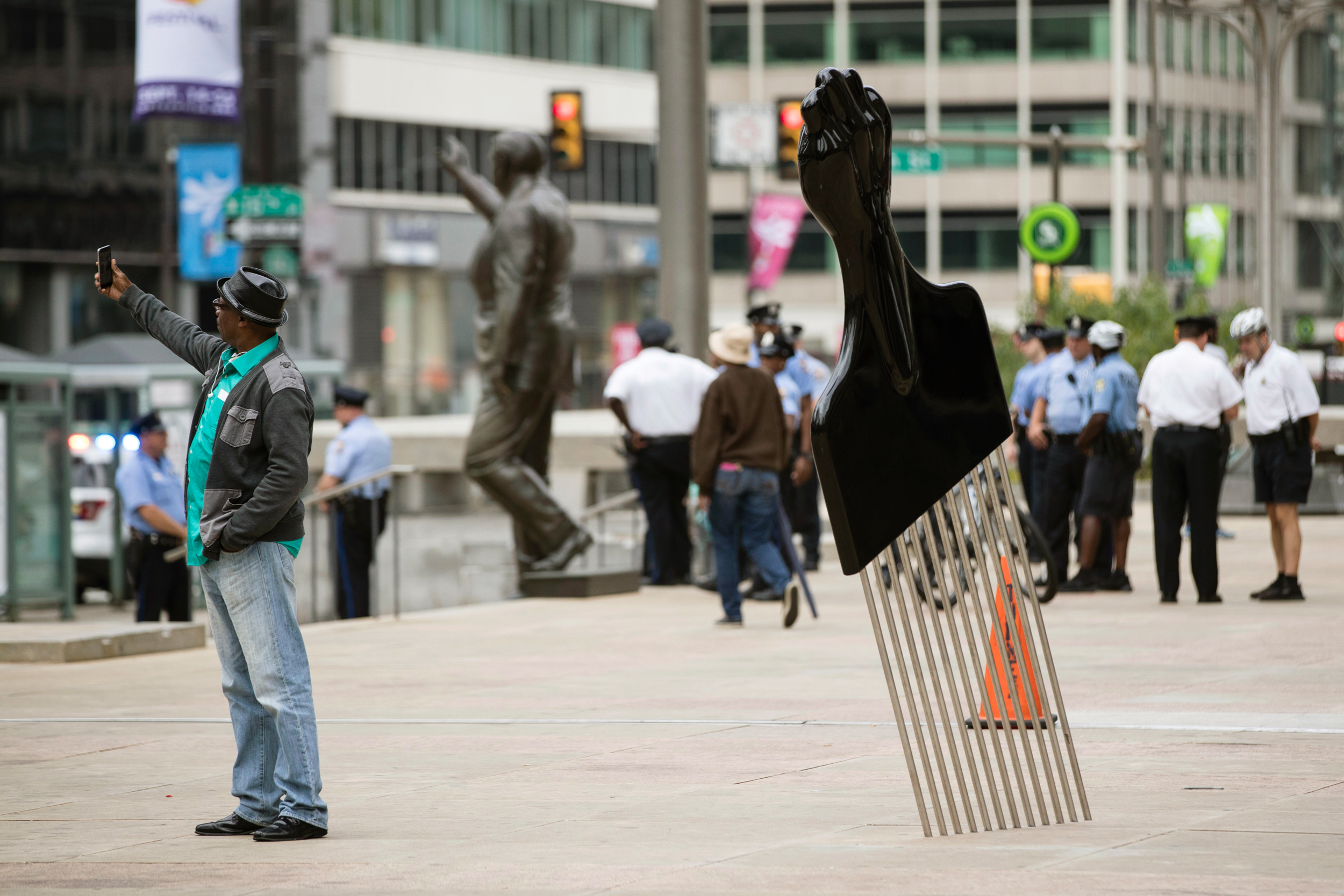
A man takes a selfie in front of Thomas’s sculpture of a 12-foot Afro pick, called All Power to All People, in view of a statue of Philadelphia’s former mayor and police commissioner Rizzo (Matt Rourke/AP/CP)

Monument Lab’s staff published the results of its inquiries as a report to the city. “The way we often talk about existing monuments and public history may severely limit our perception and reinforce the status quo,” they wrote. “We contend that it is not enough to simply say this knowledge is obscure or lost, or that it needs to be discovered or recovered by someone in the future. We must listen and take in what is already common knowledge: an expanded field of history that lives within people and places throughout the city.”

That’s one of the questions you can ask about monuments: who gets heeded, in Lum’s phrase. Another question is how. Big, realistic full-body statues sometimes make sense. There’s been one of those for Joe Frazier in Philly since 2015, an overdue real-life counterpart to the statue of Rocky, the movie boxer, that’s stood in various parts of the city since 1980. But sometimes the depiction can be more oblique or allusive. In 2017, Monument Lab invited 20 artists to build temporary new monuments around the city. Detroit artist Tyree Guyton put dozens of paintings of clocks around every side of a five-storey building: a meditation on time and its different meanings for different people.

Hank Willis Thomas, from Brooklyn, made a 12-foot Afro pick, the distinctive comb that became a symbol of Black pride in the 1970s, and stuck its tines into the ground in front of the Philadelphia municipal services building. For a time it stood within sight of a long-standing statue of Frank Rizzo, a brutal former police commissioner who was Philadelphia’s mayor through the 1970s. Running for a third term, Rizzo urged supporters to “Vote white.” In June 2020, the Rizzo statue came down; the current mayor, Jim Kenney, called his predecessor’s rule “among the worst periods” in the city’s history. Thomas’s giant Afro pick, meanwhile, is part of the permanent collection at the Pennsylvania Academy of Fine Arts.

The debates that fuel Monument Lab’s work have their parallels in Canada. As a Canadian, Lum follows these debates closely. Dundas Street and Yonge-Dundas Square in Toronto are named for a Scottish politician who is viewed by many historians as having delayed the end of the British slave trade. James McGill owned slaves. Egerton Ryerson helped design the residential school system. “Canadians overestimate their benign circumstances,” Lum says, “but there’s a lot of pernicious harm that’s been done.” Should statues come down? Lum isn’t categorical on the question, but whatever happens in every case, there should at least be more discussion and fewer resorts to the notion that monuments, as “history,” are eternal and inviolate.

“I think it’s a testament to a country’s fortitude and character that you can actually say something that is actually true” about the checkered past of previously lionized figures, he says. “It’s not like it’s being made up, or we’re impugning a country for its own sake, right? It’s not like these facts are somehow contrived.”

As most historians would acknowledge, history is about the present as well as the past. Perspectives change. “The whole project” of Monument Lab “is to un-fix the monument, right?” Lum says. “The authority of the monument. I think that’s really important because we tend to bestow this authority upon monuments, as something consensually derived, when in fact it’s particular to certain interests over other people. It’s a reflection of the distribution of power.”

The post Who should get a monument? Meet the Canadian man trying to answer the question. appeared first on Macleans.ca.

‘A deal to be silent’: Public servant paid to keep quiet about discrimination on the job

An annual government report on public servant NDAs would be helpful, which could provide some breakdowns on the nature of complaints, departments and amounts to help identify overall problem areas that should be addressed. Given that Liberal MP and parliamentary secretary Greg Fergus is on record as favouring more information, the government should act:

A Black federal public servant who launched a racial discrimination complaint against the Canadian government says she felt uncomfortable signing a gag order because she feared it could further entrench a culture of silence around racism within the bureaucracy.

“I was signing a deal to be silent about the discrimination I’ve been through,” said the woman, whom CBC/Radio-Canada has agreed not to name because she fears losing her job. “Throughout my entire career, I noticed colleagues, mostly white colleagues, getting privileges that I didn’t.”

The woman said the federal government paid her several thousand dollars in exchange for withdrawing the racial discrimination complaint.

Radio-Canada obtained a copy of the legal document, which was initialled by both the employer and the woman’s union. It contains a confidentiality clause preventing her from speaking out about the racism she says she experienced on the job.”They’re putting a price on it,” she said. “It’s completely inadequate, and those agreements are immoral and they need to stop.”

The woman said the agreement did resolve her specific issue, which she chose not to disclose because she worries it could identify her. However, she said the agreement did little to address the bigger problem of systemic racism within federal departments.

Around 800 current and former Black public servants have launched a class-action lawsuit against the federal government, alleging it has discriminated against Black employees for decades. It was filed with the Federal Court of Canada in December, but the government has yet to file a statement of defence.

The suit, which has not been certified, accuses the government of excluding Black employees from promotions.

‘Making the problem invisible’

Such agreements cover a range of issues from racial slurs to workplace harassment.

Doug Hill, a grievance and adjudication officer for the Public Service Alliance of Canada (PSAC) in Halifax, said about 70 per cent of the complaints he handles are resolved through settlements that contain a similar confidentiality clause. He also said the compensation offered sometimes goes well beyond the maximum $40,000 that can be paid under the Canadian Human Rights Act.

“There is no maximum amount” when it comes to the federal government, Hill said.

But critics say these arrangements are problematic because they cover up the real problem instead of addressing it.

“By making the problem invisible we’re making the victims invisible, and we basically have no precedent to build on and no lessons to learn,” said Fo Niemi, executive director of the Centre for Research-Action on Race Relations (CRARR) in Montreal.

Every year, the non-profit civil rights organization helps about 200 people who are victims of discrimination based on race, gender or disability. Niemi said often, people don’t realize the implications of signing an agreement that includes a confidentiality clause.

“Sometimes the complainant or the victim goes alone, feels very much pressured into signing something that that person may not be able to fully understand,” he said.

Need for transparency

Treasury Board President Jean-Yves Duclos directed Radio-Canada to his parliamentary secretary Greg Fergus, who said he believes these agreements are only acceptable if they are signed at the request of the complainant.

“You want to really recognize that the problem happened, you want to be transparent so you can fix the problem so that we can go ahead and create a better public service,” the Liberal MP for Hull–Aylmer said.

Fergus, who also chairs the Caucus of Black Parliamentarians, said the government needs to keep more detailed data regarding complaints that are withdrawn after the complainant signs a confidentiality clause.

“We can’t change things if we can’t measure them,” Fergus said.

Source: https://www.cbc.ca/news/canada/ottawa/public-servant-signs-deal-to-withdraw-racial-discrimination-complaint-1.6041139

Immigration applicants forced to file access to information requests to get answers on status: report

Hopefully, the GCMS modernization announced in Budget 2021 will enable this through an expanded MyAccount portal with increased functionality to both improve applicant service as well as reduce ATIP requests and costs:

The federal department in charge of immigration applications has been flooded with access to information requests because it provides so little information to applicants proactively, according to a new report by the Information Commissioner.

Have you applied to immigrate in Canada and want to know the status of your application? Or maybe your request was denied and you want to understand why? Well, instead of being able to see that information via your unique login on Immigration, Refugee and Citizenship Canada’s (IRCC) Web portal, you have to file an access to information request (ATIP).

Source: Immigration applicants forced to file access to information requests to get answers on status: report

For the IRCC response, see: IRCC launches efforts to streamline and modernize access to information and privacy system and the related Management Action Plan.

A religious symbol, not a knife: at the heart of the NSW kirpan ban is a battle to define secularism

Australia bit behind Canada in this respect (apart, arguably, from Quebec):

The New South Wales government has put a temporary ban on Sikh students carrying a kirpan in public schools. The kirpan is a ceremonial dagger baptised Sikhs carry to symbolise their duty to stand up against injustice.

The ban was put in place after a 14-year-old boy used a kirpan to stab a 16-year-old at a high school in Sydney.

NSW Premier Gladys Berejiklian said “students shouldn’t be allowed to take knives to school under any circumstances”.

But framing the controversy as whether or not students should be allowed to take knives to school oversimplifies a complex issue.

This issue is not just about knives in schools. It is also about what it means to be a secular school in a multicultural and multi-faith Australia.

Denied the ability to practise their faith

There is a long history of controversy over wearing religious symbols in Australian schools, both religious and secular.

In 2017 the family of a Sikh boy launched legal action against his school after the Christian college banned the boy from wearing a patka (a turban worn by children). The Victorian Civil Administrative Tribunal later ruled the school breached the Equal Opportunity Act.

In 2018 the Secular Party of Australia brought a case against the Victorian education department alleging the department had discriminated against a child by permitting her to wear “religious style clothing that covered her body, leaving only her face and hands exposed”. The case failed.

And in 2019 a Western Australian Catholic high school banned a Hindu girl from attending class after she had her nose pierced for cultural and religious reasons. After six weeks and many meetings, the school appeared to back down and allow the student back to class.

While some of these cases occurred in private and specifically religious schools, they all raise the same issue — to what extent do we accommodate the religious beliefs and practices of minority groups in our community?

In NSW, section 11C of the Summary Offences Act 1988 makes it an offence to carry a knife in a public place or school. The act provides a number of exceptions such as for the preparation of food, or for recreation or sport. Carrying a knife for “genuine religious purposes” is also an exception.

This exception is currently under review by the NSW government. In the meantime, a temporary ban has been put in place. As a result Sikh school children are being denied the ability to fully practise their faith.

What is a secular country?

Controversies like the kirpan ban often occur due to a fundamental disagreement about what a secular education looks like. Western secular democracies have taken two different approaches.

Australia’s government school system is secular. This does not mean it is, nor should be, religion free. Instead Australian secular education means a space where religion is one of many options. Countries that conform to this version of secularism are religiously plural.

In France, secular education means it is religion free. Since 2004 all religious symbols have been banned from state schools. The aim is to create a religiously neutral environment that supports state secularism.

Canada, South Africa and the United Kingdom have adopted a similar approach as Australia. In these countries, secularism means to permit, or even encourage, the expression of multiple faiths in schools to various degrees. The aim is to create a multicultural environment.

The kirpan is fundamentally a religious symbol. It is one of five markers of faith worn by baptised Sikhs, including kesh (unshorn hair symbolising respect for God’s will). Wearing the kirpan is not optional for baptised Sikhs.

The kirpan is similar to the hijab worn by some Muslim women, the kippah worn by Jewish men or the cross or crucifix worn by some Christians.

As the Supreme Court of Canada put it, describing the kirpan as a knife is “indicative of a simplistic view of freedom of religion”.

Banning the kirpan because it resembles a knife heads Australia down a path of religion-free schools. This would be inconsistent with Australia’s commitment to multiculturalism.

There are other options besides a ban

Instead of an outright ban, the NSW government and Australian schools more generally need to find ways to safely accommodate this important religious symbol. This does not mean there should be no restrictions.

In 2006 the Supreme Court of Canada found that a school had discriminated against a Sikh boy when it banned him from wearing his kirpan. A fundamental part of the court’s decision was there were alternatives available to the school.

The student was prepared to accept restrictions on how he wore his kirpan to ensure it could not be used as a weapon. The restrictions included wearing it enclosed in a wooden sheath sewn inside a cloth envelope, which must itself be attached to a shoulder strap worn under the student’s clothing.

Similar restrictions could be implemented in Australia.

The current debate about the kirpan in schools is an opportunity to educate both school children and the wider public about Australia’s secular multicultural society. As the Constitutional Court of South Africa noted in a case about wearing nose studs for religious and cultural reasons:

Granting exemptions will also have the added benefit of inducting the learners into a multi-cultural South Africa where vastly different cultures exist side-by-side.

Allowing kirpans, and other symbols of faith, to be worn in Australian schools is an important part of a multicultural secular education.

Source: A religious symbol, not a knife: at the heart of the NSW kirpan ban is a battle to define secularism