These Numbers Show How More Diversity on TV Leads to Increased Viewership

Of note:

Television that reflects the growing racial and ethnic diversity in the U.S.resonates with audiences and industry stakeholders, a study from the University of California, Los Angeles (UCLA) released on Tuesday shows.

In UCLA’s Hollywood Diversity Report for 2021, which covered the 2019-2020 TV season, researchers found that there was a general increase in hiring diverse talent for people of color and women, both for on-screen and behind-the-scenes roles, despite the challenges many productions faced during the pandemic. To collect the data, researchers tracked racial and ethnic diversity across multiple job categories for 461 scripted television shows across six broadcast networks, 29 cable networks and 15 digital platforms; they also tracked ratings and social media engagement.
[time-brightcove not-tgx=”true”]

The study found that ratings and social media engagement for most groups, including white audiences, peaked for shows that featured casts that were at least 31% minority, while viewership among adults between the ages of 18 and 49 often peaked when a show had a majority minority cast. And for the first time in the study’s history, the percentage of scripted broadcast TV acting roles for people of color, which clocked in this year at 43.4%, surpassed the overall percentage of people of color in the U.S at 42.7% for ethnic and racial groups.

Darnell Hunt, dean of the Division of Social Sciences at UCLA, who co-wrote the report with his colleague Ana-Christina Ramón, says these significant shifts are indicative of the rise in streaming technology, which, through a non-traditional business model, has resulted in more shows by people of color and women being greenlit, which has paid off well. Increasing diversity in the U.S. also means that audiences are hungry to see themselves on-screen—a factor that will only become more important in the future; currently, 53% of all Americans under the age of 18 are people of color, putting the country on track to be majority non-white within two decades.

“People basically want to see the TV shows that look like America, that have characters they can relate to and have experiences that resonate with them,” Hunt told the Associated Press, pointing to the critical and commercial successes of shows like Insecure, which was created by and stars Issa Rae, and the Emmy award-winning Watchmen, which starred Regina King.

But there’s still plenty of work to be done in Hollywood when it comes to furthering diversity and inclusion, per the study. While numbers for representation on-screen have improved, this change can largely be attributed to increased roles for Black or multiracial talent. Asian Americans, who are the fastest-growing racial group in the U.S., Latinx and Indigenous people still remain mostly underrepresented in all acting categories. Both Hunt and Ramón attribute this to executive decisions that see diversity within a Black-white binary.

Behind the scenes, people of color face also face a large parity gap; in TV writing rooms across all platforms, while numbers were up for writers of color, they still made up less than 30% of the writers. This lack of representation was also evident for top roles like directors, show creators, and industry execs.

Source: These Numbers Show How More Diversity on TV Leads to Increased Viewership

Study: Religiosity in Canada and its evolution from 1985 to 2019

Interesting findings from the GSS. Census 2021 will include religious affiliation data which will allow for detailed socio-economic analysis:

A new study finds that Canada’s religious landscape has undergone significant changes in recent decades, including a decline in religious affiliation and a decrease in participation in individual and group religious activities.

The study “Religiosity in Canada and its evolution from 1985 to 2019” uses data from the General Social Survey to profile different patterns of religiosity in Canada and examine how they have changed since 1985.

A clearer understanding of how Canadians’ relationships with religion have evolved provides better insight into the country’s cultural and social history of the country and the diversity of today’s population. New data from the 2021 Census will soon update the portrait of religious diversity in Canada by providing detailed information on religious affiliations and the people with these affiliations.

Around two-thirds of Canadians report having a religious affiliation

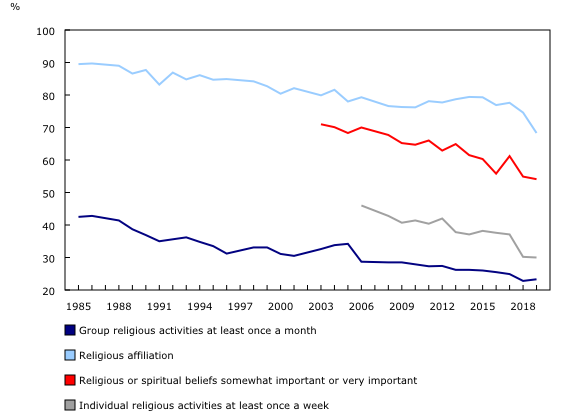
In 2019, just over two-thirds (68%) of the Canadian population reported having a religious affiliation, and over half (54%) said their religious or spiritual beliefs were somewhat or very important to the way they live their lives. 

More than one-third of Canadians (37%) reported engaging in religious or spiritual activities on their own at least once a month, and almost one-quarter (23%) reported participating in a group religious activity at least once a month in the previous year. 

Women were more likely than men to report having a religious affiliation (72% compared with 64%) or to consider their religious or spiritual beliefs somewhat or very important to how they live their lives (61% vs. 47%). They were also more likely than men to participate in religious or spiritual activities on their own at least once a week (36% vs. 24%) and in group religious activities at least once a month (26% compared with 21%). The same types of results are found by gender and age. Women are more likely than men to report having a religious affiliation, to participate in group or individual religious or spiritual activities, and to place a high value on their religious or spiritual beliefs, regardless of age.

Dynamics vary across regions

The diversity of regional dynamics has long been a fundamental characteristic of Canada’s religious landscape. For example, high proportions of non-affiliation have distinguished British Columbia for several decades and still characterize the province, with 40% of the population reporting no religious affiliation from 2017 to 2019.

In Quebec, religious affiliation is relatively high. However, more often than elsewhere, it goes hand in hand with low importance given to religious or spiritual beliefs. From 2017 to 2019, 40% of Quebec residents reported both a religious affiliation and low importance of religious or spiritual beliefs, compared with 15% to 25% in other provinces.

Trends in religion in the Atlantic provinces have generally been more stable than in other regions, particularly with respect to religious affiliation. However, the most recent data show particularly sharp contrasts between generations, suggesting that significant changes in the religious landscape have begun in these provinces. For example, from 2017 to 2019, those born between 1940 and 1959 were twice as likely to report both having a religious affiliation and considering their religious or spiritual beliefs somewhat or very important (74%) than those born between 1980 and 1999 (37%).

Participation in religious activities varies widely across religious affiliations 

Among those who reported having a religious affiliation between 2017 and 2019, nearly one-third (32%) had participated in group religious activities at least once a month. However, the frequency of participation in religious activities varied widely across religious affiliations.

For example, a majority of Jehovah’s Witnesses (86%), Latter Day Saints (80%) and Anabaptists (75%) participated in group religious activities monthly. In contrast, Buddhists (15%), Anglicans (19%) and those affiliated with the United Church (19%) had proportions of monthly group participation well below average.

There is also some variation in the importance given to religious beliefs by religious affiliation. Nevertheless, a majority of people of each affiliation reported that their religious or spiritual beliefs were somewhat or very important, ranging from 62% for Catholics to 98% for Jehovah’s Witnesses.

Declines in religious affiliation and participation in religious activities

Both religious affiliation and frequency of participation in group religious activities have trended downward in recent decades. For example, the share of people who reported having a religious affiliation fell from 90% in 1985 to 68% in 2019. Meanwhile, the share of those who attended a group religious activity at least once a month fell by almost half, from 43% to 23% over the same period.

Similar trends were also observed with respect to the practice of individual religious or spiritual activities and the importance given to religious and spiritual beliefs. For example, in 2003, 71% of people reported that their religious or spiritual beliefs were somewhat or very important, compared with 54% in 2019. Finally, the proportion of people who engaged in religious or spiritual activities on their own at least once a week fell from 46% in 2006 to 30% in 2019.

Chart 1  
Evolution of the different religiosity indicators, 1985 to 2019

Chart 1: Evolution of the different religiosity indicators, 1985 to 2019

Religious affiliation and participation are less common among younger generations

In general, recent generations were less likely than the generations that came before them to report a religious affiliation, to participate in group or individual religious activities, or to place a high value on religious and spiritual beliefs in how they live their lives.

For example, at the same age, when they were 20 to 30 years old, those born between 1960 and 1969 were significantly more likely to report a religious affiliation (82%) than those born between 1990 and 1999 (54%). They were also more likely to participate in group religious activities (24%) than their counterparts born between 1990 and 1999 (14%). Similar trends were also observed for participation in individual religious or spiritual activities and the importance of religious beliefs.

The succession of generations displaying these forms of religiosity less and less often accounts for much of the decline in religious affiliation, practices and importance among the Canadian population over the past few decades.

In terms of religiosity, people born outside Canada differ more from those born in Canada among the younger generations

In general, people born outside Canada are more likely than those born in Canada to report a religious affiliation, to consider their religious and spiritual beliefs important to how they live their lives, and to participate in group or individual religious activities. However, this difference is more pronounced among members of younger generations.

For example, among those born between 1980 and 1999, those born outside Canada were much more likely than those born in Canada to report a religious affiliation (71% vs. 59%) or to consider their religious beliefs to be somewhat or very important (62% compared with 39%). In comparison, those born outside Canada between 1940 and 1959 were about as likely as their Canadian-born counterparts to report a religious affiliation (85% vs. 87%) and only slightly more likely to consider their religious beliefs to be somewhat or very important (74% compared with 66%).

Given that immigration is an important factor in Canada’s population growth, these trends could have an impact on the evolution of the various religiosity indicators examined in this study.

In addition, information from the 2021 Census will soon provide an updated picture of religious diversity in Canada. This information will provide a more detailed picture of religious affiliations and the people with these affiliations.

Source: https://www150.statcan.gc.ca/n1/daily-quotidien/211028/dq211028b-eng.htm?CMP=mstatcan

‘It’s really unconscionable’: Here are the cabinet contenders Justin Trudeau snubbed

The reality of cabinet-making and the various factors – regional, gender, ethnic/racial etc – and how that invariably leads some to not make it.

Visible minority representation in Cabinet was 16.1 percent in 2015, rising to 21.6 percent in 2019 and falling slightly to 20.5 percent in 2021:

While the shuffling of key ministers and the ousting of others dominated cabinet chatter on Tuesday, there were also questions about MPs thought to be cabinet shoo-ins who were nowhere to be seen.

Prime Minister Justin Trudeau’s front bench shakeup saw the creation of a slightly expanded cabinet, with seven ministers remaining in their old posts, nine newcomers, and three members shown the door.

As for those left without a seat at the table, Quebec MP Greg Fergus is one of the names topping that list.

Fergus is set to start his third term representing the riding of Hull-Aylmer, and most recently served as parliamentary secretary to the prime minister, the president of the Treasury Board and the minister of digital government, among other positions.

“You get a guy like Greg who’s done everything right within his party, serving the country — and he gets overlooked,” said NDP MP Matthew Green, a member of the Parliamentary Black Caucus alongside Fergus.

“I just don’t understand it. It’s really unconscionable.”

Fergus, who declined to comment on this story, has done much more than partaking in a never-ending list of parliamentary roles, committees and associations: he also stood by the prime minister’s side during the 2019 election campaign after old photos emerged of Trudeau in blackface.

And even as Trudeau’s past actions loomed over his commitment to combating anti-Black racism the following summer, Fergus took a knee alongside the prime minister during a Black Lives Matter protest on Parliament Hill.

Fergus is one of several MPs from across the National Capital Region who were left without cabinet gigs on Tuesday.

Gatineau MP Steven MacKinnon, also a former Liberal party national director, was another contender who missed out on a spot. In Ottawa, former Ontario ministers Marie-France Lalonde and Yasir Naqvi, who each fit in Trudeau’s vision of a diverse cabinet, also failed to level up.

The region might have done with one more minister, said one government source who spoke on the condition they not be named, given that Catherine McKenna’s departure left only Ottawa-Vanier’s Mona Fortier representing the area.

Fergus and others might have filled that void, the source said, but Trudeau’s commitment to gender parity made that difficult.

The NDP’s Green, meanwhile, says the Liberal government will need to move past “this notion that they can only have a handful of Black people in cabinet.”

Ahmed Hussen was returned to cabinet Tuesday, while Toronto Centre’s Marci Ien became the first Black woman on the front bench in nearly two decades.

But Bardish Chagger’s ejection from cabinet left a potential opening for other picks from southwestern Ontario, like London West’s Arielle Kayabaga, the source said.

And while Atlantic Canada was well-represented among the 38 faces sent to cabinet this week, there are still those who were bypassed, said Lori Turnbull, director of the school of public administration at Dalhousie University.

Halifax MP Andy Fillmore was one of those options, Turnbull said, although one of the top contenders was Halifax West’s Lena Metlege Diab, a former Nova Scotia minister long speculated to fill the void left by former fisheries minister Bernadette Jordan.

Jordan’s Nova Scotia spot on the front bench was instead plugged by Central Nova’s Sean Fraser, a longtime MP who was handed the immigration file Tuesday.

“Every prime minister will have their own math … around how they’re going to put the pieces together and who they want to bring in,” Turnbull said.

“And one thing is that (Diab) represents Halifax West, which is a very safe Liberal riding. So it’s possible that if (Trudeau) is … sort of trying to solidify a seat, he doesn’t need to solidify that one with a cabinet post.”

Source: ‘It’s really unconscionable’: Here are the cabinet contenders Justin Trudeau snubbed

And this piece by Erica Ifill complaining about Greg Fergus’ absence from cabinet is silent about how Black representation in Cabinet has increased from 0 in 2015 to 2 out of 39 in 2021 (Ministers Hussen and Ien):

Fergus’ snub shows that for Black faces, the work is never enough

Dutrisac: Au diable le Québec! [immigration processing delays]

Complaints about slow processing of Quebec appliccations. Hard to know without better comparative data but Quebec’s policy decisions play a role:

Que le Québec soit en mesure de suivre ou non, le gouvernement Trudeau poursuit une politique énergique en matière d’immigration. Les seuils annuels d’admission sont passés de 280 000 à 350 000 ces dernières années. Comme la pandémie a contribué à réduire le nombre d’immigrants reçus, à la fois en raison des contraintes touchant les voyages internationaux et de l’exacerbation des lacunes administratives d’Immigration Canada, l’administration fédérale doit faire du rattrapage en 2021 et traiter 400 000 admissions.

Il semble que la bouchée soit très grosse pour Immigration Canada, qui peine à faire son travail adéquatement. Le ministère est empêtré dans l’accueil des réfugiés afghans et n’arrive pas à délivrer les permis de séjour aux étudiants étrangers en temps utile. Les détenteurs d’un certificat de sélection du Québec (CSQ) sont toujours aussi nombreux à attendre 26 mois en moyenne avant que le gouvernement fédéral ne daigne leur accorder leur résidence permanente pour qu’ils deviennent des immigrants officiellement admis avec tous les droits que ce statut confère.

En 2020, à cause des problèmes administratifs affectant les bureaux d’Immigration Canada en Nouvelle-Écosse qui traitent les demandes de résidence permanente, les autorités fédérales n’ont pu admettre le nombre d’immigrants prévu dans le plan d’immigration du Québec. Cette année, il appert que le rattrapage prévu de 7000 immigrants, ajoutés aux quelque 45 000 autres qui figurent dans le plan, ne pourra pas se faire parce que l’administration fédérale n’arrive pas à traiter les dossiers.

Dans le reste du Canada, l’octroi de la résidence permanente — Ottawa y est responsable de la sélection de tous les immigrants — est beaucoup plus rapide. Ainsi, il est de six mois avec le service Entrée express destiné aux immigrants qualifiés. C’est donc deux poids, deux mesures : une administration fédérale capable d’être efficace pour accorder avec célérité la résidence permanente à des travailleurs qualifiés dans le reste du Canada et la même administration qui a besoin de deux à trois ans pour faire la même chose au Québec.

Au sein des organismes d’aide aux nouveaux arrivants et chez les avocats spécialisés en immigration, on cherche à comprendre les raisons d’une telle disparité de traitement. Immigration Canada n’a plus l’argument de la réduction des seuils d’immigration décrétés par le gouvernement caquiste à son arrivée : le seuil établi par le gouvernement Legault pour 2021 équivaut, avec le rattrapage, à ceux fixés auparavant par le gouvernement Couillard.

En octobre 2020, le ministre fédéral de l’Immigration, des Réfugiés et de la Citoyenneté, Marco Mendicino, a lancé un programme afin d’accorder des points aux candidats « francophones et bilingues » pour Entrée express. Le gouvernement Trudeau avait annoncé son intention de porter à 4,4 % le pourcentage d’immigration francophone en dehors du Québec, alors qu’il était de 2,82 %. Ce nouvel objectif correspond à la proportion des francophones qui subsistent dans le reste du Canada. En avril dernier, le ministre a aussi ouvert une voie rapide pour accorder leur résidence permanente à 90 000 travailleurs temporaires et étudiants étrangers en sol canadien. Invité à adopter le même programme, Québec avait décliné puisque cette sélection définie par Ottawa ne correspondait pas à ses critères et parce que le programme était injuste pour les détenteurs d’un CSQ qui poireautent deux à trois ans avant de devenir immigrants reçus.

Il semble que les mesures portent leurs fruits, du moins du point de vue du ministre fédéral. Ottawa pourra compter sur de nouveaux arrivants francophones établis au Québec pour se rapprocher de sa cible. Le Journal de Montréal a rapporté que plusieurs travailleurs et étudiants étrangers établis dans la région de Montréal, désespérant d’obtenir leur résidence permanente, avaient déménagé leurs pénates en Ontario. Ils ont obtenu le précieux statut en quelques mois.

Il s’agit d’une forme de concurrence malsaine, qui s’ajoute à l’incurie administrative réservée au Québec. Le gouvernement Trudeau exerce une pression sur les fonctionnaires d’Immigration Canada pour qu’ils remplissent cette commande d’accueillir 400 000 immigrants cette année. Entre satisfaire les besoins du Québec et ceux du reste du Canada, les fonctionnaires fédéraux écoutent la voix de leur maître et favorisent le système d’immigration qui relève totalement d’eux.

C’est peut-être voulu, c’est peut-être systémique, mais ce qui est clair, c’est que ce traitement inéquitable sape le système québécois d’immigration.

Source: https://www.ledevoir.com/opinion/editoriaux/642762/ottawa-et-l-immigration-au-diable-le-quebec?utm_source=infolettre-2021-10-26&utm_medium=email&utm_campaign=infolettre-quotidienne

«Malaise» autour du nouveau cours de citoyenneté

Of note, and not entirely unexpected:

Le processus de mise en place du nouveau cours Culture et citoyenneté québécoise provoque un « malaise » parmi les experts et les enseignants mandatés pour créer le programme, qui se sentent « instrumentalisés » à des fins politiques par le gouvernement Legault.

Selon ce que Le Devoir a appris, deux des cinq membres du comité de rédaction du programme ont démissionné au cours des dernières semaines. Des experts d’un autre comité, chargé celui-là de « valider » le contenu, envisagent de démissionner à leur tour devant la tournure jugée « partisane » de l’implantation du cours.

La fonctionnaire du ministère de l’Éducation qui était responsable du programme, Marie-Noëlle Corriveau-Tendland, a remis sa démission en mai dernier. Elle estime que la fonction publique « n’est plus un rempart administratif contre les interventions politiques ».

« Je sentais que pour satisfaire un ministre, on devait modifier le contenu d’un programme d’études. Ça m’a heurtée dans mes valeurs. Quand je suis allée au ministère, j’allais travailler pour l’État et non pas pour le gouvernement », dit Marie-Noëlle Corriveau-Tendland au Devoir.

Elle considère « normal » qu’un ministre cherche à influencer le processus menant à la révision d’un programme. Après tout, il a été élu pour gouverner. La machine administrative doit cependant s’assurer de respecter les façons de procéder afin de « dépolitiser la pédagogie ».

« Les experts trouvent bizarre qu’il y ait des annonces de faites avant même la fin des validations normales du programme », dit l’ex-fonctionnaire, devenue conseillère pédagogique dans un cégep.

Le nouveau programme remplacera le cours Éthique et culture religieuse (ECR), créé en 2008 dans la foulée de la déconfessionnalisation des écoles. Le cours remanié réduit la place des religions et accorde davantage d’importance à la citoyenneté, à la culture ainsi qu’à la laïcité, thème central de l’action gouvernementale depuis l’arrivée au pouvoir de la Coalition avenir Québec (CAQ), en 2018.

Un engagement politique

L’annonce de ce nouveau programme, dimanche, avait des allures d’événement préélectoral. Trois personnalités (Dany Turcotte, Pierre Curzi et Ingrid Falaise) sont venues vanter les vertus du cours amélioré. Dans une vidéo diffusée lors de la conférence de presse, huit ministres et le premier ministre défilent à l’écran pour expliquer que ce programme contribuera à un « Québec fier ».

« On se sent en pleine campagne électorale », déplore une source bien informée des tractations entourant la naissance du cours. Cette personne a demandé à garder l’anonymat par crainte de représailles.

« On parle ici d’un simple cours offert au primaire et au secondaire, mais le gouvernement nous décrit quasiment comme les sauveurs de la société québécoise », lance une autre source qui n’est pas autorisée à parler publiquement.

Le ministre de l’Éducation, Jean-François Roberge, se défend de faire de la politique sur le dos des élèves. « La refonte du cours d’ECR était un engagement de notre gouvernement. Il était normal d’en faire l’annonce. En aucun temps il n’est question de politiser l’enseignement des élèves », indique Jean-François Del Torchio, attaché de presse du ministre.

« Les thèmes qui seront abordés lors de ce programme ne sont aucunement politiques, mais bien des thèmes qui reflètent la réalité quotidienne des élèves, comme les institutions démocratiques, le système judiciaire, l’environnement, l’éducation à la sexualité, la culture, etc. », ajoute-t-il.

« Déjà depuis dimanche, plusieurs enseignants nous ont contactés pour participer à l’élaboration du cours. Ils veulent contribuer », précise le représentant du ministre.

Cap sur les élections

De vastes consultations du milieu de l’éducation ont bel et bien eu lieu à partir de janvier 2020, mais le ministre Roberge a écarté à ce jour les opinions contraires à son projet, indique Marie-Noëlle Corriveau-Tendland.

En privé, des experts et des enseignants disent constater eux aussi que le gouvernement Legault cherche à mettre en avant sa vision politique de la nation québécoise. Cette vision n’est pas nécessairement mauvaise, selon nos sources. Certaines personnes y sont favorables, mais le réseau scolaire doit s’élever au-dessus de la mêlée pour produire un programme pédagogique exempt de partisanerie, souligne-t-on.

Une autre membre du comité de rédaction du nouveau cours, enseignante au secondaire, a récemment remis sa démission. Il ne reste ainsi que trois des cinq membres originaux du groupe chargé de pondre la nouvelle version du programme.

Selon nos informations, des membres du comité de validation — l’étape suivant la rédaction — s’interrogent à leur tour sur la suite de leur engagement. Ce groupe d’une quinzaine d’experts ne s’est réuni qu’une seule fois, en juin dernier. Il n’a eu accès qu’à un résumé de quatre pages du projet de programme.

L’identité des membres de ce groupe est tenue secrète. Tous ont dû signer une entente de confidentialité. La prochaine réunion du comité est prévue pour vendredi. Le cours Culture et citoyenneté québécoise doit encore être peaufiné avant son entrée en vigueur à la rentrée 2023, a expliqué le ministre Roberge. Des projets pilotes doivent avoir lieu à la rentrée 2022.

Mélanie Dubois, chargée de cours en formation des enseignants à l’Université du Québec à Montréal, a l’impression que le gouvernement veut accélérer la mise en place du nouveau programme avant les élections prévues dans un an, en octobre 2022. Elle trouve aussi « décevant » qu’aucun enseignant n’ait été invité à l’annonce du programme par le ministre, dimanche.

Source: https://www.ledevoir.com/societe/education/642852/education-malaise-autour-du-nouveau-cours-de-citoyennete?utm_source=infolettre-2021-10-26&utm_medium=email&utm_campaign=infolettre-quotidienne

How Can Australia Rethink Its Immigration Policies?

The ongoing divergence between Canada and Australia remains, striking given how much the two countries have borrowed ideas and approaches from each other in the past:

Australia has begun having necessary public debates about its post-pandemic recovery. One of the more crucial elements of this recovery is how the country re-establishes its immigration program, which has effectively been paused for the past year and a half. In recent decades Australia’s national strategy has relied on sourcing a significant number of skilled migrants to off-set birthrates that are below the replacement level, drive economic activity, and enhance the country’s overall capabilities. That strategy proved successful.

Due to this, the Australian Chamber of Commerce and Industry has begun pushing for 200,000 skilled migrant visas to be issued annually, a return to the pre-pandemic average. However, advice provided to the new premier of New South Wales, Dominic Perrottet, indicated that Australia will require 2 million new residents over the next five years to meet labor shortages, effectively double the pre-pandemic intake. This would match Canada’s ambitious new target for its own national expansion (one it is already meeting).

In Parag Khanna’s new book, “Move,” the author argues that the post-pandemic world will see a fierce competition for young talent by migrant-accepting countries. Countries that are able to both attract and retain people will find themselves at a distinct advantage. Pre-pandemic Australia could rightly claim to be a lifestyle superpower, providing it with a serious asset for attracting these highly skilled migrants, yet the country’s highly protectionist response to the pandemic may have blunted this image.

While in recent decades Australia has offered migrants opportunities and ways of life that they otherwise may not have had, it has also not made fully accessing these opportunities particularly easy. Australia’s visa system is notoriously complex and expensive, with myriad hurdles to jump, and no clear pathway toward permanent residency. Migrants can spend a decade or more bouncing between an array of insecure short-term visas, limiting their ability to make long-term plans and subsequently limiting their ability to feel welcome and valued in the country. If Australia wishes to compete in a post-pandemic contest for skills it will need a less obstructionist visa system.

Yet there is more to this equation than just Canberra creating the administrative processes to maximize its power and potential. While states may be self-interested entities, they also face conditions that prevent them from acting perfectly in their own self-interest. Immigration can be an emotionally sensitive subject, making the politics around it difficult to navigate. There is a tension between what the country requires and what is politically achievable.

Australia, like other Western liberal democracies, is currently facing a crisis of confidence in its own ideas and values. Admittedly, Australia is not in as degraded a state as other similar countries, but a suspicion of liberalism – and its openness to the world – exists within the country and should not be ignored. This sentiment is born out of a paradox within the nation-state, where some elements within liberal societies believe that the state is undermining the nation.

The political psychologist and behavioral economist Karen Stenner has argued that liberal democracies have reached a stage of complexity that around one-third of their citizens have difficulty adjusting themselves to. These people value consistency, conformity, and homogeneity over difference and change. This disposition can tolerate changing societies under the right conditions, but it is susceptible to arousal and agitation through political demagoguery and media outlets that prey on their insecurities — leading to support for more insular and authoritarian styles of governing.

Following several decades of rapid social change, the COVID-19 pandemic could not have been a worse global-scale event for those who would like to keep this authoritarian disposition dormant. It has exacerbated the sense among some that states are acting against the interests of the public, leading to a further retreating into in-groups. The fear would be that this public sentiment now makes it far too difficult to re-establish Australia’s significant immigration program.

Yet Australia now faces not only economic conditions that require an increased labor force, but also strategic conditions that require an increase in state power. Canberra must confront the dual problem of a powerful and belligerent regional adversary in China alongside a primary security partner in the United States whose domestic instability is making it far less reliable. To negotiate this difficult terrain Australia requires more people to enhance its economic, diplomatic, defense, and cultural capabilities.

The serious question that Canberra must now ask itself is: How does it take the necessary steps to increase its capabilities without disrupting its own internal stability?

Addressing the culture of suspicion and contradictions at the heart of immigration process should be the first place to start. In recent decades Australia has asked migrants to provide the country with labor, knowledge, and taxes, but not civic engagement. Those who perceive that migrants are not “loyal” to the country have been aided in this perception by a visa system that doesn’t give migrants the opportunity to fully invest themselves in the country. There’s the potential to address both problems if handled correctly.

This would also require a change in public narrative, highlighting the courage and resilience of migrants, the honor Australia should feel at being chosen as a destination country, and the prosperity and social enhancement that flows from their contributions to society. If psychological insecurity is the political impediment to Australia’s expanded migration program, then migration as a tool to enhance national security should be emphasized.

The pandemic has offered governments the opportunity to rethink how they approach these key nation-building initiatives. It has also provided an example of what states can do when they focus their minds on a task. This should make it clear to Canberra that such necessary rethinking of immigration’s key role in Australia’s nation-building should not be deemed too difficult to pursue.

Grant Wyeth is a Melbourne-based political analyst specializing in Australia and the Pacific, India and Canada.

Source: How Can Australia Rethink Its Immigration Policies?

Ontario to ask Ottawa to help more PSWs immigrate

Of note:

The Ford government will be closely watching the shakeup of Justin Trudeau’s cabinet on Tuesday to see which Liberal MP takes over immigration.

That’s because whoever it is will largely determine the success of Ontario’s ambitious plan to fix its beleaguered system of long-term care.

The Progressive Conservative (PC) government’s plan is three-pronged: to pass legislation strengthening care standards in nursing homes; to spend $2.7 billion for 30,000 new beds; and to spend another $4.9 billion to hire 27,000 full-time workers.

But meeting the most expensive objective requires migrants, which in turn depends on Ottawa’s willingness to give Ontario the control it wants over jobs that tend to attract foreigners to the province.

“Ontario generally … is working with Ottawa for more flexibility (over) our immigration,” Ontario’s Long-Term Care Minister Rod Phillips said at an event hosted by the Canadian Club of Toronto last week.

“If we’re going to get those 27,000 people … there’s no way we get there without providing pathways.”

Before the last Parliament dissolved in August, Phillips spoke to Deputy Prime Minister Chrystia Freeland about attracting more migrants to work as nurses and personal support workers (PSWs), he said.

The PCs plan to resume those discussions sometime after Tuesday, when the prime minister either renames Marco Mendicino as his minister of Immigration, Refugees and Citizenship, or appoints someone else.

The PCs want more autonomy in running the Ontario Immigrant Nominee Program (OINP), and for Ottawa to let it accept more immigrants through the program each year, said Monte McNaughton, Ontario’s minister of Labour, Training and Skills Development, last week.

A source close to McNaughton told iPolitics the PCs want to double the 8,900 immigrants Ontario accepts each year through the OINP, which is open to foreign workers, international students, and other would-be migrants who work jobs the Ontario and federal governments categorize as in need.

A foreigner who applies to the OINP has to be nominated for permanent residence by the provincial government, and his or her application must be approved by Ottawa.

In 2018, there were 56,000 full-time-equivalent positions in Ontario’s long-term-care sector, and 58 per cent of them were PSWs.

The 27,000 full-time-equivalent positions the PCs want to add over the next four years include 17,000 PSWs, according to comments made by Phillips that were reported by the Ottawa Citizen.

Currently, the OINP doesn’t consider PSWs “skilled workers,” thereby disqualifying them from most of the program’s streams. They can only qualify through the OINP’s “in-demand skills” stream, which has other complicating requirements, including that the applicant already has a job lined up in Ontario that pays more than the provincial average for the position, and that the applicant recently had a job in the same field in Ontario.

Many sectors in Ontario are short workers; government officials say 290,000 jobs are unfilled.

To attempt to fill them, McNaughton announced last week that the Ontario government will introduce a bill making it easier for people trained in certain professions outside Canada to become licensed in Ontario. While the bill would cover jobs in law, accounting, architecture, engineering, and plumbing, it wouldn’t apply to licensed health-care workers, however.

The PCs are interested in exploring similar legislation for immigrant health-care workers, but the sector’s complexity precludes them from McNaughton’s bill, said a source close to the minister.

Trudeau’s government shares some of the PCs’ goals for immigration and long-term care. During the federal election campaign, the Liberals promised to train 50,000 PSWs in Canada and raise their wages to $25/hour. Their platform also included promises to reform economic-immigration programs and to recognize more foreign job credentials.

While she’s in favour of classifying PSWs in a way that makes it easier for them to immigrate, it’s just “one piece of the puzzle” of filling the sector’s staff shortage, Donna Duncan, CEO of the Ontario Long Term Care Association, told iPolitics.

The group represents 70 per cent of the province’s nursing homes, including those which are private, not-for-profit, and municipally run.

Source: Ontario to ask Ottawa to help more PSWs immigrate

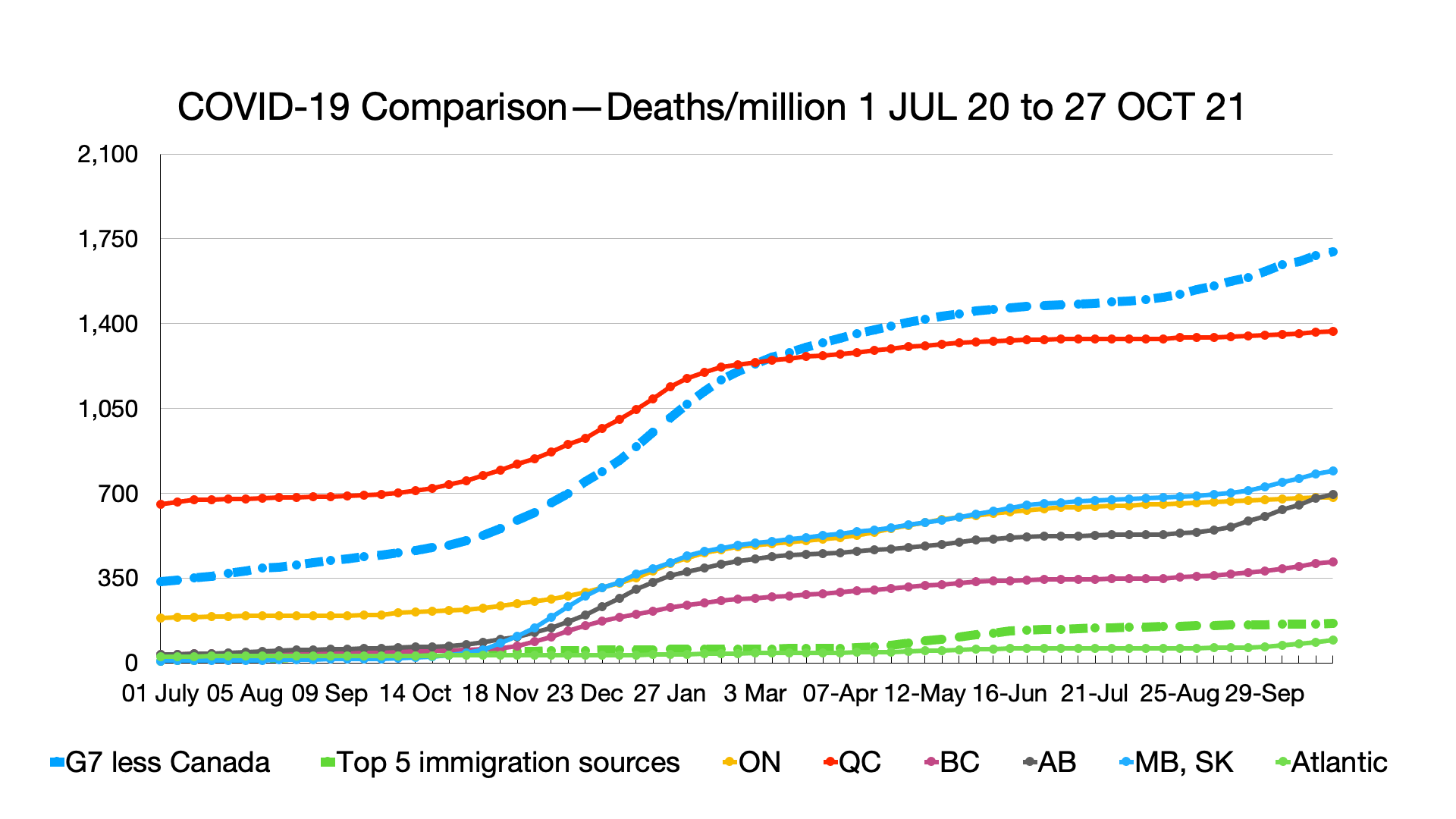
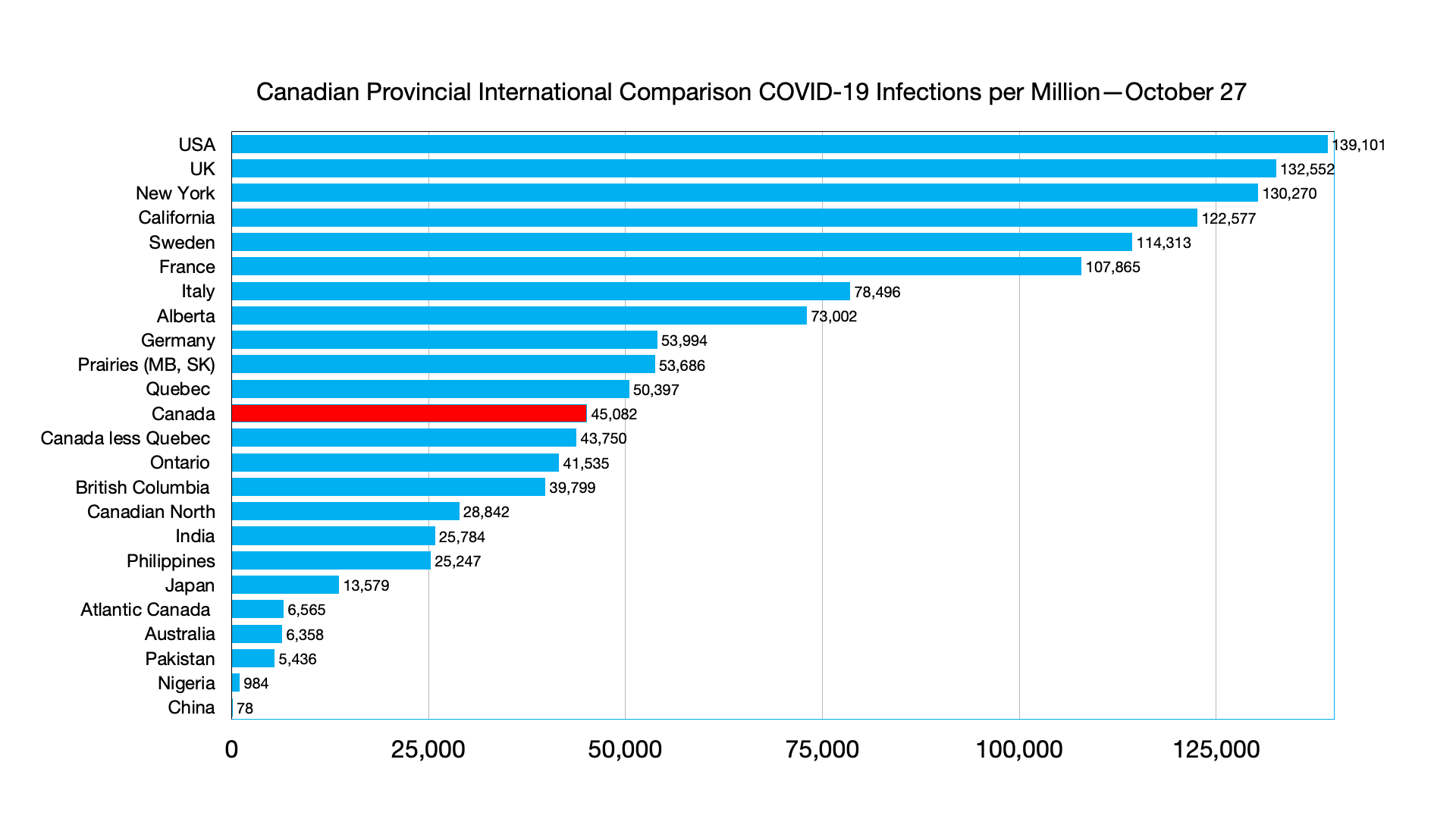
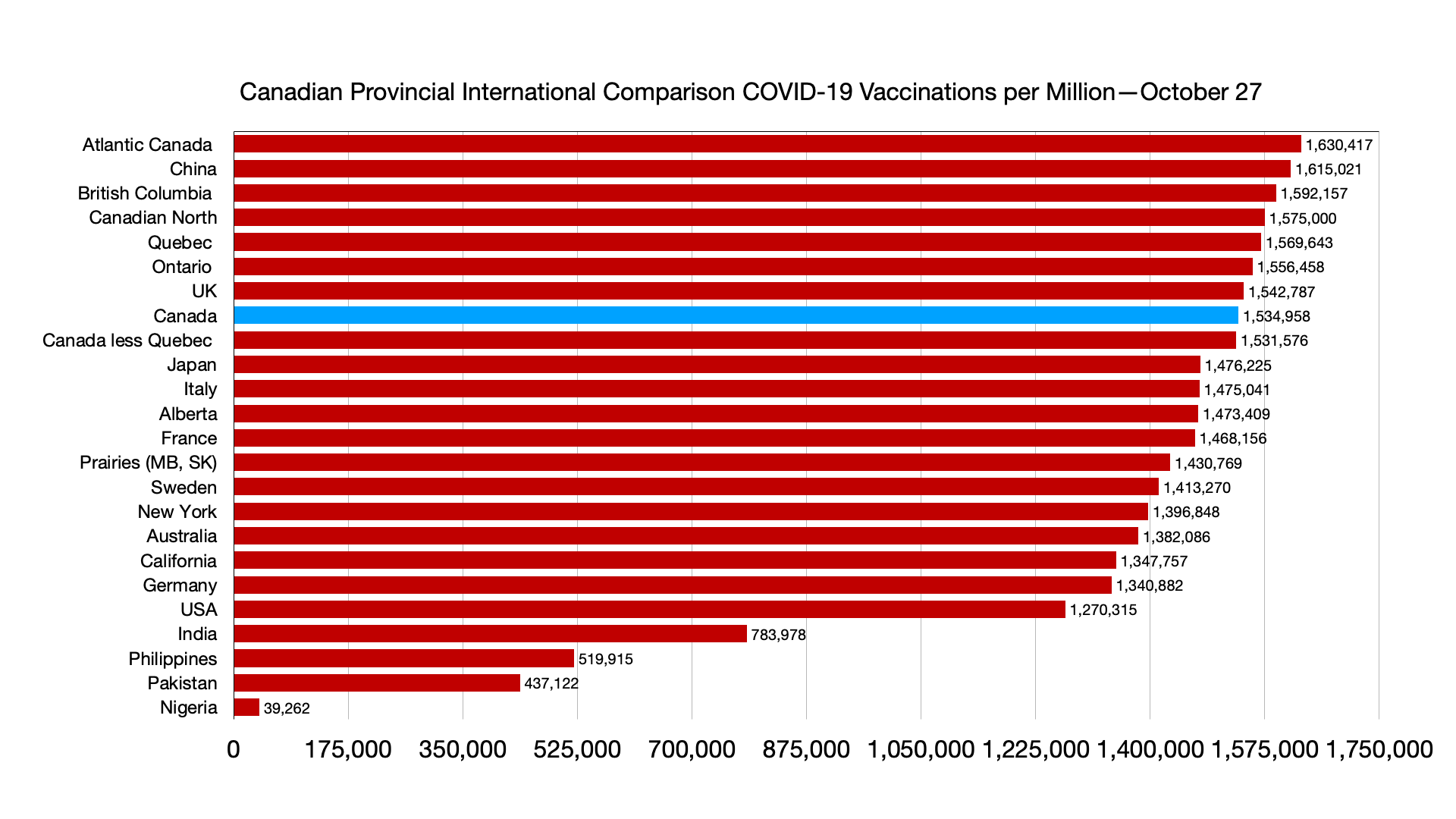
#COVID-19: Comparing provinces with other countries 27 October Update

The latest charts, compiled 27 October. Canadians fully vaccinated 74.8 percent, higher than USA 58.1 percent and the UK 68.2 percent).

Vaccinations: Canadian North ahead of Quebec, UK ahead of Canada, Japan ahead of Italy and France, Australia ahead of California. China fully vaccinated 76.4 percent, India 20.6 percent.

Trendline Charts:

Infections: The chart shows the number of infections in Alberta starting to level off unlike the Prairies or British Columbia.

Deaths: Alberta deaths, along with the Prairies albeit to a lesser extent, continue to climb.

Vaccinations: Alberta vaccinations continue to surpass the Prairies. Immigration source country vaccination rates tapering off.

Weekly

Infections: UK ahead of New York.

Deaths per million: Alberta ahead of Ontario.

Useful analysis in the Economist on the effectiveness of vaccine mandates:

In the 24 hours after France announced that it would require proof of vaccination or a negative covid-19 test to enter many public spaces, 1m people signed up for jabs. Other countries are following suit: Italy imposed a vaccine-or-test policy last week.Listen to this story

How effective will such rules be? The response in France was robust, but many of those people might have sought jabs anyway. In American polls, most unvaccinated people say they do not intend to get shots.

Because jabs for covid-19 are new, the impact of mandating them will probably differ from that of requiring children to get well-established vaccines. However, history still offers relevant data on hardline refuseniks’ susceptibility to legal fiat.https://infographics.economist.com/2021/20211023_GDC100_2/index.html

The link between mandates and uptake of standard vaccines in childhood is murky. Much of Europe enjoys broad coverage without mandates, whereas poor countries’ edicts are often honoured in the breach. Even among countries with similar gdp per person, those with mandates do not vaccinate more—perhaps because only places with low uptake resort to coercion.

Another way to assess impact is studying changes over time when new mandates come in. Uganda’s long-run upward trend in jab rates actually flattened out after the country imposed a mandate. However, it only began requiring vaccines once 80% of children were already getting them.

In rich countries mandates have helped a bit. In 2016 Australia ended an exemption for conscientious objectors. Its jab rate for polio rose by three percentage points. After imposing new mandates in 2017-18 following outbreaks of vaccine-preventable diseases, Italy saw gains in measles shots, and France in meningitis-C jabs. In six countries that have stiffened rules since 2000, the average gain was 2.2 percentage points.https://infographics.economist.com/2021/20211023_GDC100_3/index.html

The best evidence that mandates matter comes from America. Some states offer carve-outs from mandates only for medical reasons; others also recognise religious or philosophical ones. After adjusting for demographic and political characteristics that also affect jab rates, uptake in states with the fewest exceptions is 1.1 percentage points higher than in those with the most.

These effects sound small. But since jab rates cannot exceed 100%, mandates can only do so much if uptake is already high. Moreover, for diseases like measles, 95% of people need protection to reach herd immunity. A few percentage points can determine if outbreaks take off or fizzle out.■

Source: https://www.economist.com/graphic-detail/2021/10/23/the-impact-of-vaccine-mandates-is-modest-but-potentially-crucial

Facebook’s language gaps weaken screening of hate, terrorism

Any number of good articles on the “Facebook papers” and its unethical and dangerous business practices:

As the Gaza war raged and tensions surged across the Middle East last May, Instagram briefly banned the hashtag #AlAqsa, a reference to the Al-Aqsa Mosque in Jerusalem’s Old City, a flash point in the conflict.

Facebook, which owns Instagram, later apologized, explaining its algorithms had mistaken the third-holiest site in Islam for the militant group Al-Aqsa Martyrs Brigade, an armed offshoot of the secular Fatah party.

For many Arabic-speaking users, it was just the latest potent example of how the social media giant muzzles political speech in the region. Arabic is among the most common languages on Facebook’s platforms, and the company issues frequent public apologies after similar botched content removals.

Now, internal company documents from the former Facebook product manager-turned-whistleblower Frances Haugen show the problems are far more systemicthan just a few innocent mistakes, and that Facebook has understood the depth of these failings for years while doing little about it.

Such errors are not limited to Arabic. An examination of the files reveals that in some of the world’s most volatile regions, terrorist content and hate speech proliferate because the company remains short on moderators who speak local languages and understand cultural contexts. And its platforms have failed to develop artificial-intelligence solutions that can catch harmful content in different languages.

In countries like Afghanistan and Myanmar, these loopholes have allowed inflammatory language to flourish on the platform, while in Syria and the Palestinian territories, Facebook suppresses ordinary speech, imposing blanket bans on common words.

“The root problem is that the platform was never built with the intention it would one day mediate the political speech of everyone in the world,” said Eliza Campbell, director of the Middle East Institute’s Cyber Program. “But for the amount of political importance and resources that Facebook has, moderation is a bafflingly under-resourced project.”

This story, along with others published Monday, is based on Haugen’s disclosures to the Securities and Exchange Commission, which were also provided to Congress in redacted form by her legal team. The redacted versions received by Congress were reviewed by a consortium of news organizations, including The Associated Press.

In a statement to the AP, a Facebook spokesperson said that over the last two years the company has invested in recruiting more staff with local dialect and topic expertise to bolster its review capacity around the world.

But when it comes to Arabic content moderation, the company said, “We still have more work to do. … We conduct research to better understand this complexity and identify how we can improve.”

In Myanmar, where Facebook-based misinformation has been linked repeatedly to ethnic and religious violence, the company acknowledged in its internal reports that it had failed to stop the spread of hate speech targeting the minority Rohingya Muslim population.

The Rohingya’s persecution, which the U.S. has described as ethnic cleansing, led Facebook to publicly pledge in 2018 that it would recruit 100 native Myanmar language speakers to police its platforms. But the company never disclosed how many content moderators it ultimately hired or revealed which of the nation’s many dialects they covered.

Despite Facebook’s public promises and many internal reports on the problems, the rights group Global Witness said the company’s recommendation algorithm continued to amplify army propaganda and other content that breaches the company’s Myanmar policies following a military coup in February.

In India, the documents show Facebook employees debating last March whether it could clamp down on the “fear mongering, anti-Muslim narratives” that Prime Minister Narendra Modi’s far-right Hindu nationalist group, Rashtriya Swayamsevak Sangh, broadcasts on its platform.

In one document, the company notes that users linked to Modi’s party had created multiple accounts to supercharge the spread of Islamophobic content. Much of this content was “never flagged or actioned,” the research found, because Facebook lacked moderators and automated filters with knowledge of Hindi and Bengali.

Arabic poses particular challenges to Facebook’s automated systems and human moderators, each of which struggles to understand spoken dialects unique to each country and region, their vocabularies salted with different historical influences and cultural contexts.

The Moroccan colloquial Arabic, for instance, includes French and Berber words, and is spoken with short vowels. Egyptian Arabic, on the other hand, includes some Turkish from the Ottoman conquest. Other dialects are closer to the “official” version found in the Quran. In some cases, these dialects are not mutually comprehensible, and there is no standard way of transcribing colloquial Arabic.

Facebook first developed a massive following in the Middle East during the 2011 Arab Spring uprisings, and users credited the platform with providing a rare opportunity for free expression and a critical source of news in a region where autocratic governments exert tight controls over both. But in recent years, that reputation has changed.

Scores of Palestinian journalists and activists have had their accounts deleted. Archives of the Syrian civil war have disappeared. And a vast vocabulary of everyday words have become off-limits to speakers of Arabic, Facebook’s third-most common language with millions of users worldwide.

For Hassan Slaieh, a prominent journalist in the blockaded Gaza Strip, the first message felt like a punch to the gut. “Your account has been permanently disabled for violating Facebook’s Community Standards,” the company’s notification read. That was at the peak of the bloody 2014 Gaza war, following years of his news posts on violence between Israel and Hamas being flagged as content violations.

Within moments, he lost everything he’d collected over six years: personal memories, stories of people’s lives in Gaza, photos of Israeli airstrikes pounding the enclave, not to mention 200,000 followers. The most recent Facebook takedown of his page last year came as less of a shock. It was the 17th time that he had to start from scratch.

He had tried to be clever. Like many Palestinians, he’d learned to avoid the typical Arabic words for “martyr” and “prisoner,” along with references to Israel’s military occupation. If he mentioned militant groups, he’d add symbols or spaces between each letter.

Other users in the region have taken an increasingly savvy approach to tricking Facebook’s algorithms, employing a centuries-old Arabic script that lacks the dots and marks that help readers differentiate between otherwise identical letters. The writing style, common before Arabic learning exploded with the spread of Islam, has circumvented hate speech censors on Facebook’s Instagram app, according to the internal documents.

But Slaieh’s tactics didn’t make the cut. He believes Facebook banned him simply for doing his job. As a reporter in Gaza, he posts photos of Palestinian protesters wounded at the Israeli border, mothers weeping over their sons’ coffins, statements from the Gaza Strip’s militant Hamas rulers.

Criticism, satire and even simple mentions of groups on the company’s Dangerous Individuals and Organizations list — a docket modeled on the U.S. government equivalent — are grounds for a takedown.

“We were incorrectly enforcing counterterrorism content in Arabic,” one document reads, noting the current system “limits users from participating in political speech, impeding their right to freedom of expression.”

The Facebook blacklist includes Gaza’s ruling Hamas party, as well as Hezbollah, the militant group that holds seats in Lebanon’s Parliament, along with many other groups representing wide swaths of people and territory across the Middle East, the internal documents show, resulting in what Facebook employees describe in the documents as widespread perceptions of censorship.

“If you posted about militant activity without clearly condemning what’s happening, we treated you like you supported it,” said Mai el-Mahdy, a former Facebook employee who worked on Arabic content moderation until 2017.

In response to questions from the AP, Facebook said it consults independent experts to develop its moderation policies and goes “to great lengths to ensure they are agnostic to religion, region, political outlook or ideology.”

“We know our systems are not perfect,” it added.

The company’s language gaps and biases have led to the widespread perception that its reviewers skew in favor of governments and against minority groups.

Former Facebook employees also say that various governments exert pressure on the company, threatening regulation and fines. Israel, a lucrative source of advertising revenue for Facebook, is the only country in the Mideast where Facebook operates a national office. Its public policy director previously advised former right-wing Prime Minister Benjamin Netanyahu.

Israeli security agencies and watchdogs monitor Facebook and bombard it with thousands of orders to take down Palestinian accounts and posts as they try to crack down on incitement.

“They flood our system, completely overpowering it,” said Ashraf Zeitoon, Facebook’s former head of policy for the Middle East and North Africa region, who left in 2017. “That forces the system to make mistakes in Israel’s favor. Nowhere else in the region had such a deep understanding of how Facebook works.”

Facebook said in a statement that it fields takedown requests from governments no differently from those from rights organizations or community members, although it may restrict access to content based on local laws.

“Any suggestion that we remove content solely under pressure from the Israeli government is completely inaccurate,” it said.

Syrian journalists and activists reporting on the country’s opposition also have complained of censorship, with electronic armies supporting embattled President Bashar Assad aggressively flagging dissident content for removal.

Raed, a former reporter at the Aleppo Media Center, a group of antigovernment activists and citizen journalists in Syria, said Facebook erased most of his documentation of Syrian government shelling on neighborhoods and hospitals, citing graphic content.

“Facebook always tells us we break the rules, but no one tells us what the rules are,” he added, giving only his first name for fear of reprisals.

In Afghanistan, many users literally cannot understand Facebook’s rules. According to an internal report in January, Facebook did not translate the site’s hate speech and misinformation pages into Dari and Pashto, the two most common languages in Afghanistan, where English is not widely understood.

When Afghan users try to flag posts as hate speech, the drop-down menus appear only in English. So does the Community Standards page. The site also doesn’t have a bank of hate speech terms, slurs and code words in Afghanistan used to moderate Dari and Pashto content, as is typical elsewhere. Without this local word bank, Facebook can’t build the automated filters that catch the worst violations in the country.

When it came to looking into the abuse of domestic workers in the Middle East, internal Facebook documents acknowledged that engineers primarily focused on posts and messages written in English. The flagged-words list did not include Tagalog, the major language of the Philippines, where many of the region’s housemaids and other domestic workers come from.

In much of the Arab world, the opposite is true — the company over-relies on artificial-intelligence filters that make mistakes, leading to “a lot of false positives and a media backlash,” one document reads. Largely unskilled human moderators, in over their heads, tend to passively field takedown requests instead of screening proactively.

Sophie Zhang, a former Facebook employee-turned-whistleblower who worked at the company for nearly three years before being fired last year, said contractors in Facebook’s Ireland office complained to her they had to depend on Google Translate because the company did not assign them content based on what languages they knew.

Facebook outsources most content moderation to giant companies that enlist workers far afield, from Casablanca, Morocco, to Essen, Germany. The firms don’t sponsor work visas for the Arabic teams, limiting the pool to local hires in precarious conditions — mostly Moroccans who seem to have overstated their linguistic capabilities. They often get lost in the translation of Arabic’s 30-odd dialects, flagging inoffensive Arabic posts as terrorist content 77% of the time, one document said.

“These reps should not be fielding content from non-Maghreb region, however right now it is commonplace,” another document reads, referring to the region of North Africa that includes Morocco. The file goes on to say that the Casablanca office falsely claimed in a survey it could handle “every dialect” of Arabic. But in one case, reviewers incorrectly flagged a set of Egyptian dialect content 90% of the time, a report said.

Iraq ranks highest in the region for its reported volume of hate speech on Facebook. But among reviewers, knowledge of Iraqi dialect is “close to non-existent,” one document said.

“Journalists are trying to expose human rights abuses, but we just get banned,” said one Baghdad-based press freedom activist, who spoke on condition of anonymity for fear of reprisals. “We understand Facebook tries to limit the influence of militias, but it’s not working.”

Linguists described Facebook’s system as flawed for a region with a vast diversity of colloquial dialects that Arabic speakers transcribe in different ways.

“The stereotype that Arabic is one entity is a major problem,” said Enam al-Wer, professor of Arabic linguistics at the University of Essex, citing the language’s “huge variations” not only between countries but class, gender, religion and ethnicity.

Despite these problems, moderators are on the front lines of what makes Facebook a powerful arbiter of political expression in a tumultuous region.

Although the documents from Haugen predate this year’s Gaza war, episodes from that 11-day conflict show how little has been done to address the problems flagged in Facebook’s own internal reports.

Activists in Gaza and the West Bank lost their ability to livestream. Whole archives of the conflict vanished from newsfeeds, a primary portal of information for many users. Influencers accustomed to tens of thousands of likes on their posts saw their outreach plummet when they posted about Palestinians.

“This has restrained me and prevented me from feeling free to publish what I want for fear of losing my account,” said Soliman Hijjy, a Gaza-based journalist whose aerials of the Mediterranean Sea garnered tens of thousands more views than his images of Israeli bombs — a common phenomenon when photos are flagged for violating community standards.

During the war, Palestinian advocates submitted hundreds of complaints to Facebook, often leading the company to concede error and reinstate posts and accounts.

In the internal documents, Facebook reported it had erred in nearly half of all Arabic language takedown requests submitted for appeal.

“The repetition of false positives creates a huge drain of resources,” it said.

In announcing the reversal of one such Palestinian post removal last month, Facebook’s semi-independent oversight board urged an impartial investigation into the company’s Arabic and Hebrew content moderation. It called for improvement in its broad terrorism blacklist to “increase understanding of the exceptions for neutral discussion, condemnation and news reporting,” according to the board’s policy advisory statement.

Facebook’s internal documents also stressed the need to “enhance” algorithms, enlist more Arab moderators from less-represented countries and restrict them to where they have appropriate dialect expertise.

“With the size of the Arabic user base and potential severity of offline harm … it is surely of the highest importance to put more resources to the task to improving Arabic systems,” said the report.

But the company also lamented that “there is not one clear mitigation strategy.”

Meanwhile, many across the Middle East worry the stakes of Facebook’s failings are exceptionally high, with potential to widen long-standing inequality, chill civic activism and stoke violence in the region.

“We told Facebook: Do you want people to convey their experiences on social platforms, or do you want to shut them down?” said Husam Zomlot, the Palestinian envoy to the United Kingdom, who recently discussed Arabic content suppression with Facebook officials in London. “If you take away people’s voices, the alternatives will be uglier.”
Source: Facebook’s language gaps weaken screening of hate, terrorism

Canada has a big-time nursing shortage. So why can’t these two fully certified nurses get the OK to practise?

Of note, along with the backlog numbers for the various programs:

A former intensive-care nurse in the Philippines, Katrina Deauna has watched from the sidelines as Ontario — and all of Canada — struggles with chronic nursing shortages laid bare by the pandemic.

While the foreign caregiver enjoys looking after the 18-month-old baby girl and six-year-old son of her Canadian employer, she says, she would rather use her front-line nursing skills and experience to help those fighting for their lives against COVID-19.

Deauna has met all the licensing requirements of the Ontario College of Nursing. All she is missing is the authorization to work — either through a letter that confirms she’s eligible for permanent residence or a bridging open work permit.

“We are ready to practise in our profession. We are just waiting for our papers,” says the 28-year-old, who worked in the intensive-care unit of the Manila Doctors Hospital, one of the top hospitals in the Philippines, for three years until September 2019, when she was hired as a nanny in Toronto.

“They’re talking about the shortages of nurses in Ontario and Canada. And here we are. The only thing that’s keeping us from our practice is a piece of immigration paper.”

According to Ontario’s regulatory body of nurses, there are currently at least 41 applicants who meet all of its registration requirements but are waiting for the immigration authorization to work in Canada. It’s not sure what the numbers are for other provinces.

Statistics Canada reported that in the first three months of this year, the health-care and social-assistance sector had the largest year-over-year increase in job vacancies compared to other sectors, rising by 27,700 to 98,700 vacancies — an increase of 39 per cent. The positions with the largest vacancy increase were registered nurses and registered psychiatric nurses. Half of those positions had been vacant for 90 days or more, according to Statistics Canada.

Ontario has, so far, been hardest hit. With a ratio of 725 registered nurses per 100,000 people, it ranks as the lowest province in Canada and well below the national average of 811 nurses per 100,000 people, according to 2019 data from the Canadian Institute for Health Information.

Hospitals across the province currently have a vacancy rate of 18 to 22 per cent for nurses, the Ontario Nurses’ Association says.

“Some smaller hospitals closed their emergency departments after four o’clock because they don’t have enough staff,” says Vicki McKenna, head of the association, adding that some operating rooms are running at limited capacity for the same reason..

While complaints from internationally trained nurses have traditionally had to do with the lengthy registration and licensing process with regulators, McKenna said it’s deplorable that those who have met the licensing requirement are being held back due to an immigration backlog.

“We need these nurses, and we can’t afford to have them languish on that list, and we can’t afford to lose them to other provinces. The nursing shortages aren’t in Ontario alone. It’s across this country and it’s an international issue,” she said.

“The U.S. is recruiting hard. Our nurses are leaving, in some cases, to what is seen to be greener pastures there, and we can’t afford to sit and watch. We have to do something.”

Reduced processing capacity due to lockdowns here and abroad, as well as travel restrictions worldwide, have wreaked havoc in the immigration system during the pandemic.

As of July 31, more than 561,700 people were in the queue for permanent residence and 748,381 had a pending temporary residence application as students, workers or visitors, while the backlog for citizenship stood at 376,458 people.

Traditionally, many internationally educated nurses from the Philippines, the Caribbean and Africa arrive and work as foreign caregivers while trying to register and restart their licensing process in Canada once they’re here.

The permanent residence backlogs for foreign caregivers began long before the onset of the pandemic in early 2020. In April, Immigration Minister Marco Mendicino announced a move to prioritize the permanent residence applications of 6,000 caregivers by Dec. 31.

The immigration department said it had processed the applications for a total of 3,253 people under the initiative up to Oct. 17, but it’s not known how many of those were caregivers because the number included their family members. Officials were unable to say how much the caregiver backlogs have been reduced since the announcement.

“Immigration, Refugees and Citizenship Canada has prioritized applications from workers in essential occupations in agriculture and health care, where labour is most needed to protect the health of Canadians and ensure a sufficient food supply,” said department spokesperson Rémi Larivière.

“Applicants who intended to work in agriculture or health care but who applied for an open work permit and didn’t have a valid job offer in advance would not be triaged for priority processing.”

Deauna said she was thrilled with the government announcement, but feels those with pending nursing licences should be fast-tracked if Canadian officials are serious about addressing the shortages of nurses in the country in the wake of the pandemic.

She applied for permanent residence and the bridging open work permit in August 2020 but only received an acknowledgment of receipt this past June. Her caregiver work permit has expired since June.

The Ontario licensing process requires of applicants practical nursing experience within the three years before a certificate of registration is issued.

Deauna fears she may have to go back to the Philippines to get back to practice and restart the licensing process if her immigration and nursing certificate don’t come through before June.

“I can’t afford more delay in my permanent residence or open work permit,” she noted.

Leslie Apurada arrived in 2018 under the home support worker program to look after an elderly man with dementia in Montreal and initiated her licensing process with the Ontario College of Nurses a year later.

The former Filipino registered nurse with a psychogeriatric background underwent Canada’s national nursing assessment, registered for prep courses and sat for — and passed — a couple of required nursing exams, all while working full time to look after her client.

Even though her employer was supportive and tried to spare her from overtime work while she was studying for exams and attending courses, Apurada said she was mentally and physically exhausted jumping through all the hoops to get past the final qualifying test in June. She’s since been waiting for her immigration authorization to work.

“During the height of the pandemic … Canada’s prime minister said we’re all in this together. But we, caregivers, feel we’re always pushed to the sideline. No one really answers to us why the backlog for the caregiver programs has been so extensive,” said the 31-year-old, who is now enrolled in an online course about nephrology at Humber College.

“It’s disheartening to see how strained the Canadian health system is while all along we are here. We’ve passed all the exams and we could’ve helped.”

Karla Ducusin, another former RN from the Philippines, came to Canada in late 2018 by way of Israel to look after an elderly couple with medical needs in Markham. She’s responsible for preparing them meals, administering their medications, escorting them to doctor’s appointments and helping with household chores.

The permanent residence application that she filed last October costs $1,050 and each time she extends her caregiver work permit, it’s another $155.

Given she’s now in Canada on the so-called implied status — in transition with a pending permanent residence application in the system, Ducusin said she has lost her OHIP, which requires a temporary foreign worker to have a valid work permit to be eligible. Her caregiver work permit expired last November.

“I want to be able to help my family more financially. My father is sick and my two younger brothers are not working. I could make a lot more money and pay more taxes as a nurse than as a caregiver,” said the 32-year-old, whose file will be closed by the College of Nurses of Ontario if there’s no update for two years.

“This is putting a heavy toll on our mental health. You wake up every day and there’s still no movement in your immigration application. It’s just so frustrating.”

Source: Canada has a big-time nursing shortage. So why can’t these two fully certified nurses get the OK to practise?