Trudeau promet « un examen détaillé » du refus d’étudiants africains francophones

PM comment of note:

Le premier ministre Justin Trudeau assure procéder à « un examen détaillé » des répercussions qu’ont les critères des programmes fédéraux sur la composition de l’immigration. Faisant référence au refus massif d’étudiants africains francophones, il a affirmé lors de la période des questions à la Chambre des communes mercredi « que ces rapports sont particulièrement inquiétants ».

Le Devoir révélait récemment que les taux de refus de permis d’études pour les ressortissants des pays du Maghreb et de l’Afrique de l’Ouest ne cessent de grimper. Certains candidats qui répondent à tous les critères sont ainsi empêchés de poursuivre leurs études au Québec.

M. Trudeau répondait mercredi à l’intervention du chef du Bloc québécois, Yves-François Blanchet. Sous le « prétexte » que les agents d’immigration ne croient pas que ces étudiants rentreront chez eux après leurs études, ils sont refusés, a-t-il dit. « C’est un grave procès d’intention. Une forme de discrimination à dénoncer, qui nuit aux échanges et au développement de l’Afrique », a ajouté M. Blanchet, exhortant le gouvernement à intervenir.

« Nous n’allons tolérer aucune discrimination systémique », a rétorqué le premier ministre, rappelant qu’il a reconnu qu’il en existe « dans toutes nos institutions à travers le pays ». L’examen détaillé des répercussions des programmes d’immigration servira à garantir que tous les demandeurs sont traités « de manière équitable », a-t-il avancé.

Le taux de refus pour tous les pays d’origine est en outre beaucoup plus élevé dans la province que dans le reste du Canada, un phénomène qui préoccupe toute la classe politique québécoise. Il est « inacceptable » qu’Immigration, Réfugiés et Citoyenneté Canada (IRCC) « nous prive d’étudiants africains francophones correspondants en tout point au profil d’immigrant qu’on souhaite attirer au Québec, notamment pour développer nos régions, soutenir nos cégeps et pallier […] la pénurie de main-d’œuvre », a notamment écrit sur Twitter la députée du Parti québécois Méganne Perry Melançon.

Des problèmes documentés

Le nouveau ministre fédéral de l’Immigration, Sean Fraser, a également promis la semaine dernière de vérifier « personnellement » que les préjugés inconscients des fonctionnaires de son propre ministère ne font pas en sorte de discriminer les Africains francophones souhaitant venir étudier au pays.

Un rapport fédéral publié en octobre révélait que son ministère fait face à des problèmes de racisme à l’intérieur même de sa bureaucratie. Des fonctionnaires utiliseraient des clichés ouvertement racistes dans leurs conversations et des préjugés guideraient les embauches et les promotions.

IRCC échoue par ailleurs toujours à atteindre les cibles fixées pour l’accueil d’immigrants francophones au Québec et hors Québec, a aussi alors rappelé M. Fraser, malgré la pénurie de main-d’œuvre que connaît le pays.

Mardi, un nouveau rapport du commissaire aux langues officielles, Raymond Théberge, en a remis une couche : le Canada aurait dû admettre au moins 75 839 immigrants francophones de plus hors du Québec depuis 2008 pour maintenir le poids démographique du français dans les provinces à majorité anglophone.

Au Québec, les principaux bassins de recrutement des étudiants francophones africains font face à des taux de refus de permis d’études de plus de 80 %. La France arrive souvent en tête de liste des pays d’origine des étudiants étrangers. Depuis 2018, elle partage toutefois la première position avec l’Inde, d’où la majorité des ressortissants choisissent plutôt de poursuivre des études en anglais.

Source: Trudeau promet « un examen détaillé » du refus d’étudiants africains francophones
UK, Islam and media: This is bullying, not journalism

Of note. Similar to other countries:

Watching and reading news on Muslims and Islam is not always a pleasant experience. At least one-fifth of all articles on the topic pertain to terrorism and extremism. This was among a number of concerning facts and figures that I and others at the Centre for Media Monitoring found when we analysed more than a year’s worth of material from British newsrooms that referenced Muslims and/or Islam.

This included around 48,000 online news articles and 5,500 clips that aired between October 2018 and September 2019, giving us a clearer picture of how Muslims are reported on and where the problems lie.

Certain publications – the same ones that lambaste ‘cancel culture’ – often target individual Muslims or organisations

The right-leaning media, which includes most of the country’s heavyweight publications, fared worst across our rating metrics. Using a methodology designed alongside seasoned academics who have studied how Muslims are represented in the media, we pinpointed everything from the reproduction of tropes, to the misrepresentation of Muslim beliefs, to problematic headlines and imagery.

A disproportionate number of articles were biased on the subject of religion, with discussions around Islam mired in Orientalism. Islam was repeatedly framed as a hostile threat to the West, as right-wing pundits trotted out tropes with impunity, while Muslim characters in fictional dramas were shown as intolerant – and were often played by non-Muslim actors.

Around half of the news articles and clips we examined associated Muslims with negative aspects and behaviours. While this might not seem alarming given that news generally tends towards the negative, we did not discriminate between items that were predominantly about Muslims or those that contained only a passing mention, which is a cause for concern.

Platforming marginal figures

Our study was not just about identifying what was bad; we also found pieces that were fair and balanced, punching up against those in power, rather than punching down against Muslims, as is so often the case. Examples included the BBC’s John Sudworthreporting on the persecution of Uyghur Muslims in China, and the Spectator’s Stephen Daisley opining on the Birmingham schools affair, even as his publication was frequently rated poorly across our metrics.

I am often asked whether reporting on Muslims and Islam is getting better over time. But this is difficult to assess, as much depends on the news cycle and which subjects or events are in focus.

We have, however, seen a return in recent days by British tabloids to platforming marginal and unrepresentative figures as the face of British Muslims. In addition, certain publications – the same ones that lambaste “cancel culture” – often target individual Muslims or organisations, in an attempt to delegitimise and de-platform them.

Our report features close to a dozen instances in which individual Muslims were misrepresented in the media; in some cases, the victims spent years of their lives on a quest for justice and an apology. Some of the cases involved neoconservative organisations feeding information to newspapers who appeared happy to lap it up, targeting Muslims in the public space.

This is not journalism. It is bullying, and it impinges on the civil rights of British Muslims, ultimately aiming to silence them.

Willingness to change

Our report also looked at how words are used to delegitimise Muslims, such as by describing any Muslim organisation or individual in the public sphere as “Islamist” or practicing “Islamism”. Such terms have been used in a scattershot fashion, targeting everyone from Islamic State fighters, to democratically elected leaders, to schoolchildren who eat halal food at lunch.

Muslims cannot, and most do not, expect special treatment from the media. What they do expect is fairness

Producing a report as detailed as ours was an arduous task, and not always a pleasant one. But it was done in good faith, with the hope that it will inform and guide members of the media.

Better reporting on Muslims and Islam is not an impossible task, as shown by Daily Express editor Gary Jones, who in 2018 lamented that past front pages at the newspaper had contributed to an Islamophobic environment. He has worked to change that, setting an example for others.

Another encouraging sign came from the editors of the Daily Mirror and Sunday Times, who welcomed our report, even though it criticised some of their coverage. This suggests that there is a willingness at the highest levels to produce better journalism – and we welcome that.

Muslims cannot, and most do not, expect special treatment from the media. What they do expect is fairness and to be treated no differently than any other community. As the former chair of the Independent Press Standards Organisation pointed out a couple of years ago, Muslims have been treated differently by British newspapers. Our findings would agree with him, and it’s up to news editors and journalists to change that.

Faisal Hanif is a media analyst at the Centre for Media Monitoring and has previously worked as a news reporter and researcher at the Times and the BBC. His latest report looks at how the British media reports terrorism.

Source: UK, Islam and media: This is bullying, not journalism

Falling birth rates are not an existential crisis for Central and Eastern Europe, but an opportunity

Of note:

A growing number of countries – including two in Central and Eastern Europe – are adopting coercive pronatal policies in a bid to make women have more children, a new report has found.


The report, Welcome to Gilead, raises serious concerns about the abuse of reproductive rights by nationalistic governments, echoing the pronatal dystopia of Margaret Atwood’s The Handmaid’s Tale.

The report, produced by UK charity Population Matters, details how right-wing, populist and/or nationalist administrations are stigmatising women who choose to have smaller families as unpatriotic and describes how policies intended to limit women’s reproductive choices are linked to population goals.

“Coercive pronatalism is not simply a manifestation of patriarchy or misogyny but can be a product of political and economic forces entirely indifferent to women, for whom they exist simply as productive or non-productive wombs,” says Population Matters Director Robin Maynard.

“These regimes are instrumentalising women’s bodies to serve nationalistic, economic and patriarchal interests. Violating sexual and reproductive health and rights is never justified. It is imperative we all defend them, wherever they are threatened, and for whatever reason.”

In many countries, leaders fear the impact on their economic and political goals of women choosing to have fewer children.

As a result, the percentage of countries with pronatal policies grew from 10 per cent in 1976 to 28 per cent in 2015, according to the UN’s most recent data.

Not all such policies abuse reproductive rights, but increasing numbers are doing so.

The report examines examples of such restrictions in China, Iran, Russia, and Turkey, as well as the emerging Europe states of Hungary and Poland.

It identifies how politicians in the US and Germany are starting to promote the same agenda and policies.

It details in particular how pronatalism is often linked to a restrictive, patriarchal “pro-family” agenda and the promotion of ethnic nationalism, based frequently on religious orthodoxy and hostility to multiculturalism and immigration.

These motivations include subscription at the highest political level to the “Great Replacement” conspiracy theory that Christian and European culture and civilisation will be extinguished by immigration from Muslim countries and high birth rates among immigrants.

Population Matters Policy Adviser Monica Scigliano, who wrote the report, says: “When people think of coercive population policy, their minds often go to examples like China and India, in which leaders wanted to limit population growth by forcing women to have fewer children.

“Now, however, with birth rates declining and in some cases emigration reversing population trends, that has changed.

“As people continue to choose smaller families, more governments across the world are resorting to coercive tactics, depriving people of their reproductive rights in order to increase their populations.

“In particular, nationalistic agendas can lead to a toxic brand of pronatalism that represents an almost inevitable threat to sexual and reproductive health and rights.”

Hungary and Poland

In Hungary, the right-wing populist government of Viktor Orbán is now inching towards a total abortion ban. Orbán states, “we want Hungarian children. Migration for us is surrender”.

Earlier this year, former US Vice President Mike Pence told a summit in the Hungarian capital Budapest that “plummeting birth rates” represent “a crisis that strikes at the very heart of civilisation”, adding that he hoped the US Supreme Court would overturn the landmark Roe v. Wade abortion ruling.

In Poland meanwhile, the ruling populist and pronatalist Law and Justice party recently increased abortion restrictions, banning abortion on the grounds of foetal abnormalities, which had been the reason for 98 per cent of all abortions in the country. Its law has recently claimed its first victim, a pregnant woman named Izabela who died after being denied an emergency operation because doctors insisted on waiting until they could no longer detect her baby’s heartbeat.

Polish reproductive rights campaigner Antonina Lewandowska, who wrote the foreword to the report, says:

“The Polish pronatalist movement drove doctors into such a state of fear that they would rather let Izabela go into septic shock than terminate the pregnancy earlier and save her life. They are terrified of prosecution and stigma, as the pro-natalist/anti-choice movements would probably eat them alive.

“On the other hand, there is a group of medical professionals that are rather comfortable with the current situation, as it lets them argue that medical negligence happens due to that ‘freezing effect’ of an abhorrent law rather then their own incompetence, mistake or deliberate choice to not provide their patients with necessary medical care – an abortion – due to their personal beliefs.

“In both cases, it is clear – aggressive, fundamentalist pronatalism paved the way for violating human rights in Poland.”

The economic value of older people

Central and Eastern Europe’s demographic decline has until now been presented as an existential problem. But have we been looking at the issue from the wrong perspective?

Even relatively poor countries such as Romania and Bulgaria are currently placing more demands on the renewable resources of their land than it can provide, and lower populations reduce that demand, as well as relieving pressure on biodiversity.

“Romania is one of Europe’s more biodiverse countries, for instance, with great forest cover and wetlands in the Danube Delta – both of value to the world, not just Romania,” Alistair Currie, head of campaigns and communications at Population Matters tells Emerging Europe.

“As it becomes more affluent, it has an opportunity to manage that land and natural environment more sustainably. Agriculture is the primary driver of habitat loss, and where countries aren’t scrambling to feed their populations through intensive agriculture and monocultures, that can give nature a break.”

Fears of labour shortages are often exaggerated because of continued population growth and automation, but Currie suggests that any shortages which do arise can be addressed through measures such as increasing labour force participation, judicious immigration policies, further automation and increasing retirement age.

“Fiscal challenges presented by ageing populations can be solved by pension reform, increasing the productivity of older workers, later retirement, investment in preventative health to reduce associated health care costs, and, where appropriate, equitable increases in tax,” he says.

“One thing that really came out strongly in our research is the economic value of older people. That means things like potentially increasing retirement age – low across much of Central and Eastern Europe. To do that, you do need healthy populations, however, which requires investment in preventative health care.

“Pronatal policies, meanwhile, are not productive. They’re often costly, in the short term they increase the number of dependent children, and in the longer term, they drive up consumption and resource use.”

Source: Falling birth rates are not an existential crisis for Central and Eastern Europe, but an opportunity

Most Canadians are fed up with online hatred and discrimination and want to see Parliament act, new survey says

Of note. As always, questions remain in terms of how Parliament should act, and what actions would be most effective:

Canadians seem to be on the same page when it comes to fighting discrimination issues and they want to see Parliament take action, according to a national survey released Tuesday.

The survey, conducted by Nanos Research for the Canadian Race Relations Foundation (CRRF), gauged how Canadians feel about online hatred, employment equity, reconciliation with Indigenous peoples and RCMP reform. The majority of Canadians surveyed showed support for action on all four priorities, and they also weighed in on seeing more diversity in arts and culture, and the impacts of climate change on racialized communities.

Among the strongest response was regarding fighting online hate, which doesn’t surprise Mohammed Hashim, executive director of the CRRF, a Crown corporation.

“They see it challenging their sense of identity, and increasing polarity in very negative ways. There’s real impact and harm that has been created,” he told the Star.

Nearly four in five Canadians support the government creating legislation to combat serious types of harmful online content, according to the survey. About three in four support strengthening the Canada Human Rights Act and the Criminal Code to more effectively combat online hate and close to the same number want to see social media platforms legally responsible for auditing extremist and hateful posts before they’re viewed widely.

And about 70 per cent showed concern with the rise of right-wing extremism and terrorism as well as growing polarization.

In its most recent Forum on Minority Issues at the end of last year, the UN noted minorities are more vulnerable to online hate speech, particularly minority women. They make up three-quarters of victims in many countries.

The responses also showed that two-thirds of Canadians want to see the calls to action by the Truth and Reconciliation Commission of Canada implemented soon on behalf of Indigenous peoples, and an overwhelming majority want safe drinking water for all Indigenous communities.

The survey also suggested that Canadians want to see employment equity addressed by the federal government, but there was less consistent a response regarding the actions behind it, like management being held accountable for equity goals or increasing funding for Employment Equity Act initiatives.

When it comes to RCMP oversight, 58 per cent support the creation of an independent civilian body, and about 53 per cent support the collection of race-based data regarding health, employment, and policing; the same share, 53 per cent, want the Mounties barred from using excessive force in crowd control.

The statements the survey sought responses about came from a combination of community groups, past surveys the CRRF has done and political party platforms.

Hashim said these action items aren’t at all far-fetched. There is movement in Parliament on some of these issues, he said: “Everything is within the realm of possibility.”

Nanos conducted an online representative survey of 2,018 Canadians, age 18 and older between Nov. 3 to 8, and weighed by age, gender and geography to be representative of the country. Nanos says no margin of error applies to this research.

Source: Most Canadians are fed up with online hatred and discrimination and want to see Parliament act, new survey says

Déficit de 75 000 immigrants francophones hors du Québec

Long standing challenge of meeting demographic targets for francophones outside Quebec. Haven’t seen much analysis on the various factors involved:

Le Canada aurait dû admettre au moins 75 839 immigrants francophones de plus hors du Québec depuis 2008, soit environ l’équivalent de la population de la ville de Saint-Jérôme, pour maintenir le poids démographique du français dans les provinces à majorité anglophone, calcule le commissaire aux langues officielles.

Dans son rapport déposé mardi, le commissaire Raymond Théberge estime que le gouvernement fédéral est en voie de rater de nouveau son objectif d’augmenter, ou au moins de maintenir, le poids démographique des francophones à l’extérieur du Québec à 4,4 %. Cette cible avait d’abord été fixée pour 2008, puis reportée à 2023.

49 853 immigrants francophones ont été admis hors du Québec entre 2008 et 2020, un nombre bien en deçà des ​125 692 requis pour maintenir la francophonie hors Québec à 4,4 % de la population.

« Si la cible avait été atteinte depuis 2008, elle aurait pu contribuer à réduire le déclin du poids démographique de cette population entre les recensements de 2001 et de 2016 », note le rapport.

Déclin

À l’extérieur du Québec, la population francophone du pays, définie selon la langue maternelle et la première langue officielle parlée, est en déclin. Elle représentait 4,4 % de la population en 2001 et 3,8 % en 2016.

Le nouveau ministre de l’Immigration, Sean Fraser, a promis la semaine dernière de s’assurer que les préjugés inconscients de ses fonctionnaires ne font pas en sorte de discriminer les Africains francophones souhaitant venir étudier au pays. Du même souffle, il a promis de travailler à atteindre la cible de nouveaux arrivants francophones au Canada, tant au Québec que dans les autres provinces.

Selon les données compilées par Le Devoir, les taux de refus des étudiants originaires de l’Afrique ne cessent de grimper, alors que le nombre d’étudiants étrangers anglophones augmente au Québec.

« On est en train de causer des torts irréparables à la francophonie », indique le titre du communiqué de la Fédération des communautés francophones et acadienne du Canada, qui a rapidement réagi au rapport du commissaire aux langues officielles.

Selon sa présidente, Liane Roy, les communautés francophones hors Québec « ont fait tout ce qu’elles ont pu pour développer l’immigration francophone de A à Z, et elles l’ont fait avec très peu d’appui du gouvernement fédéral sur les plans de la promotion à l’étranger et du recrutement ».

Elle note que, depuis plusieurs années, le taux de francophones parmi les immigrants qui s’installent hors du Québec stagne à 2 %, avec un creux historique de 1,5 % enregistré en 2015.

Source: Déficit de 75 000 immigrants francophones hors du Québec

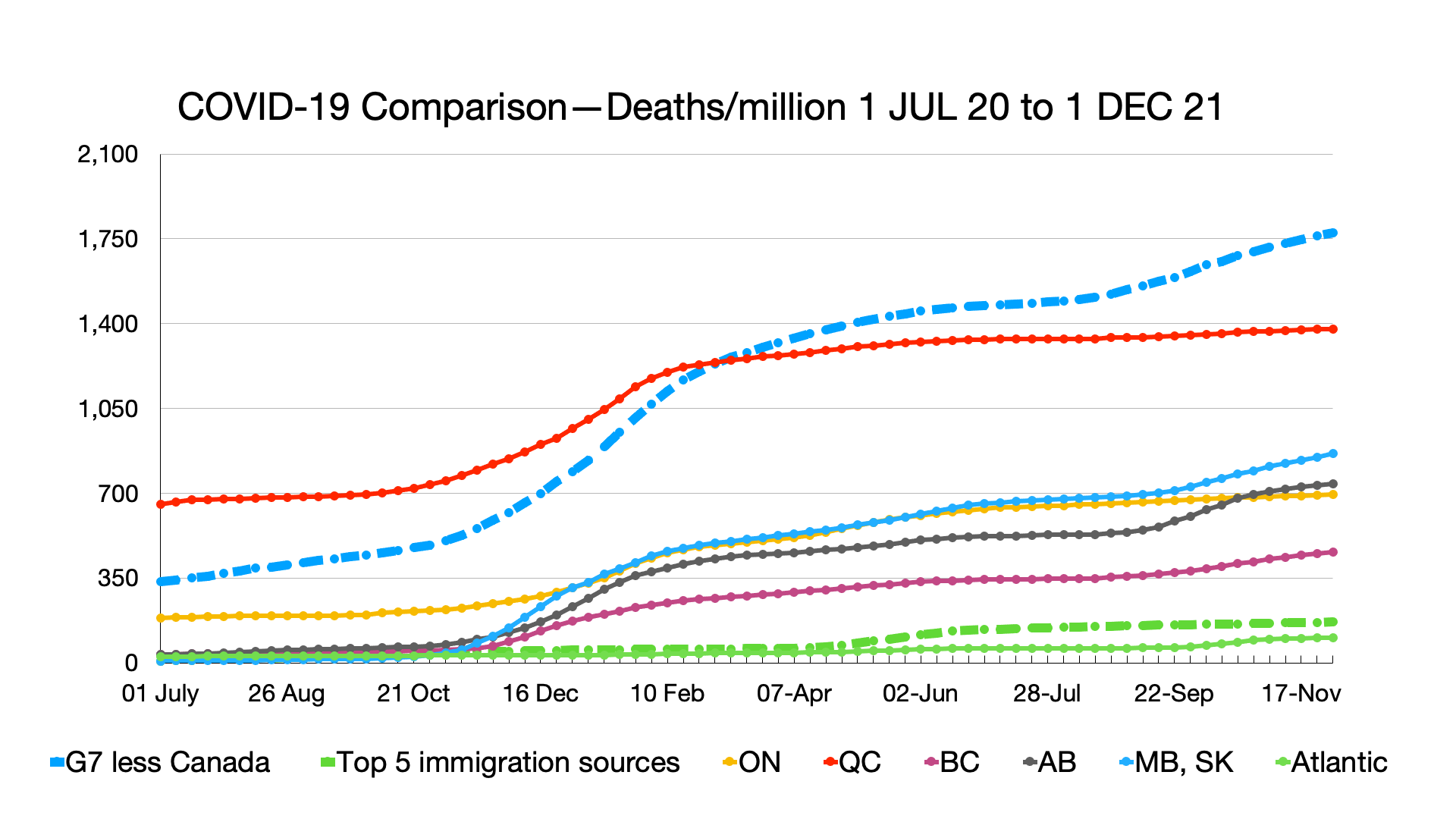
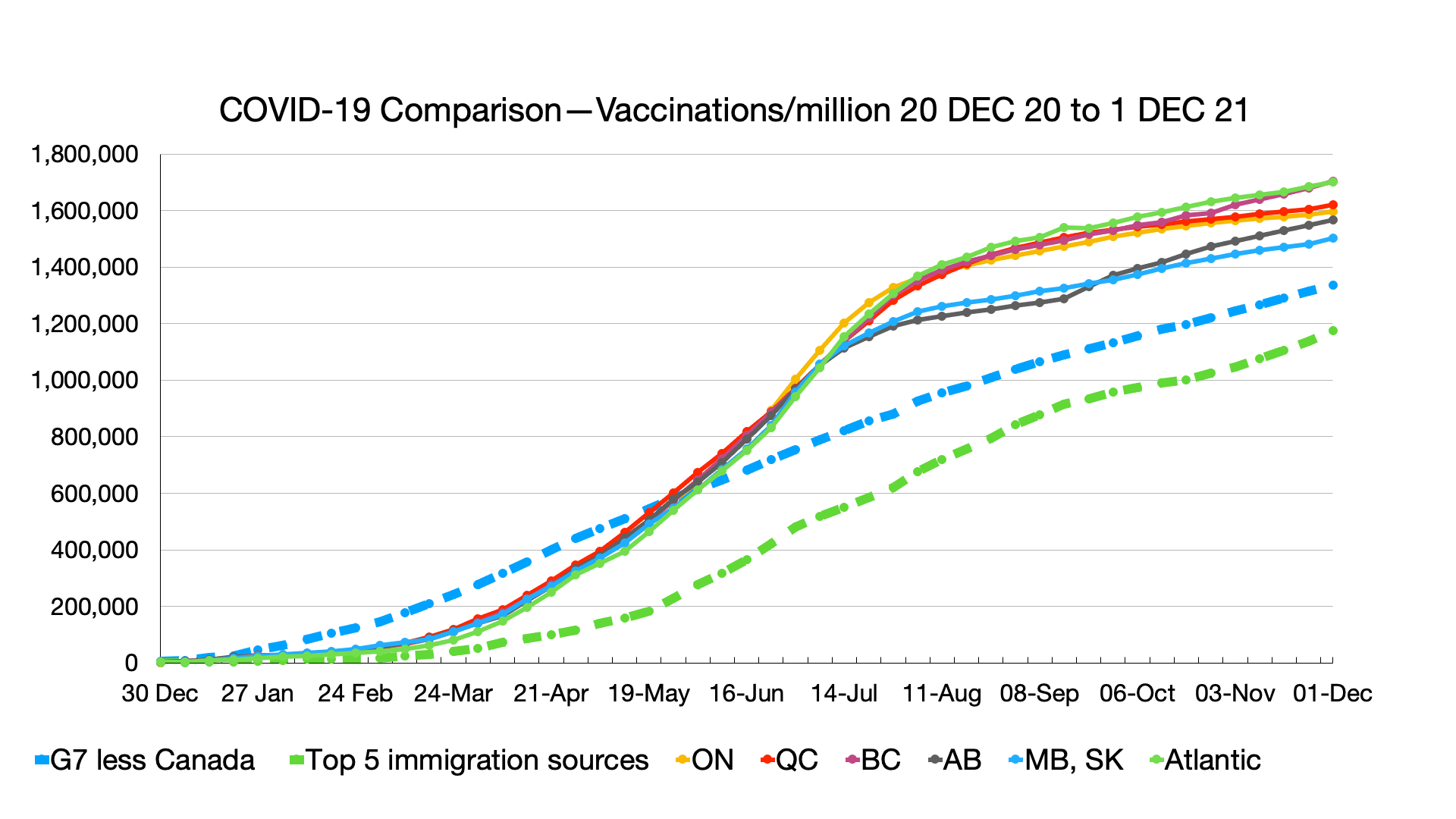
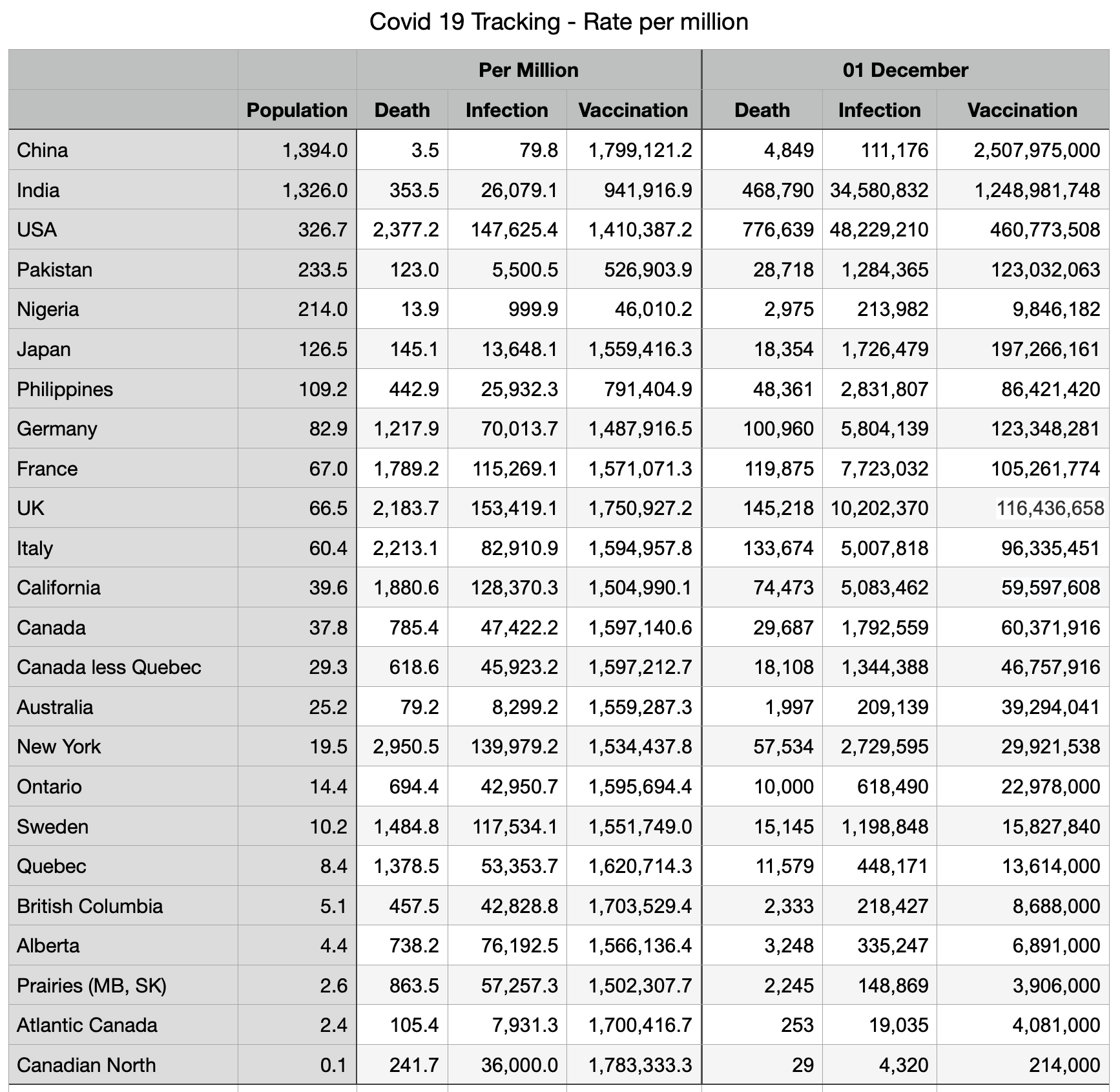
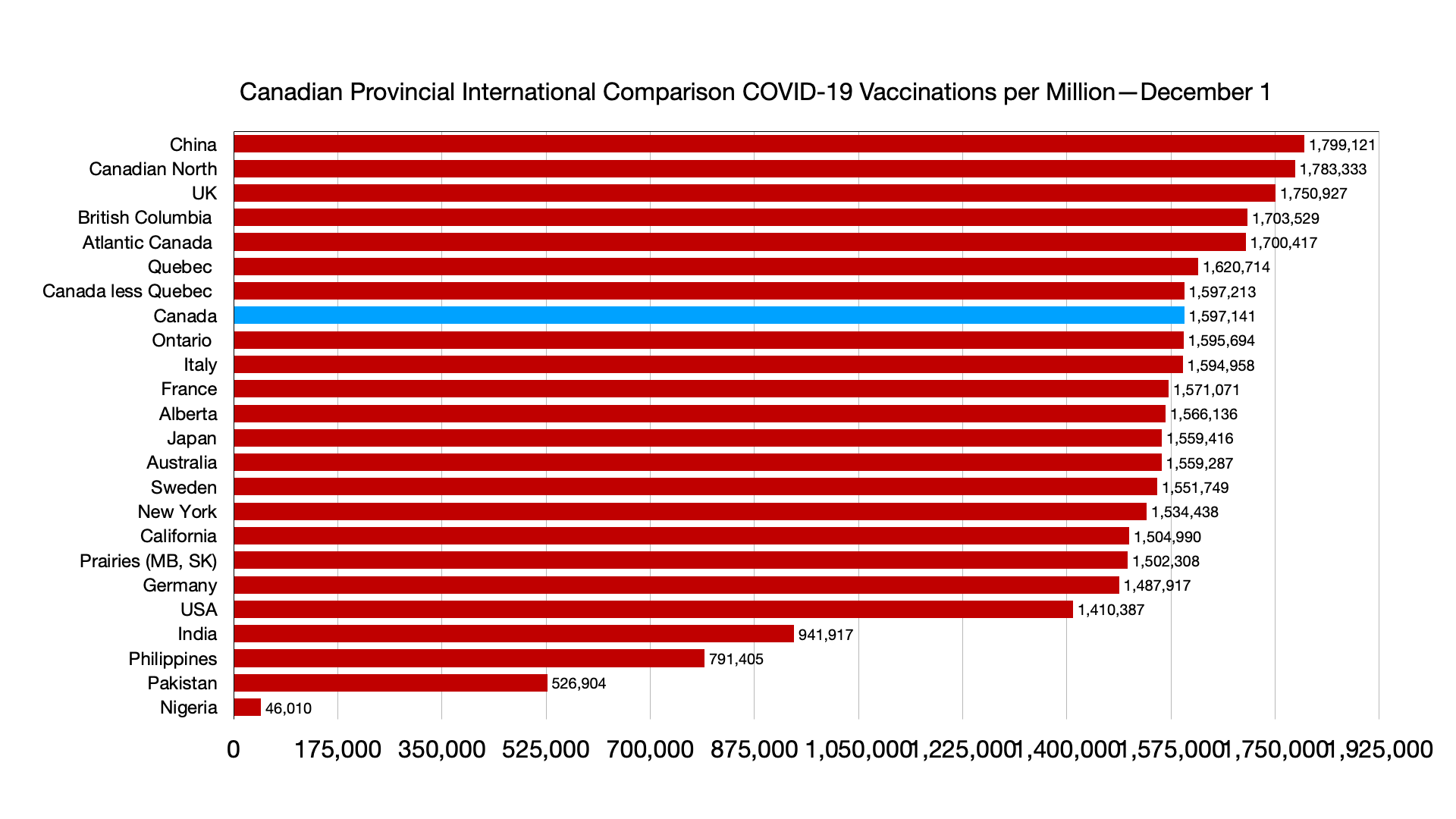
#COVID-19: Comparing provinces with other countries 1 December Update

The latest charts, compiled 1 December. Too early to assess the impact of omicron.

Canadians fully vaccinated 77.2 percent, compared to Japan 77.2 percent, UK 69.4 percent and USA 60 percent.

Vaccinations: Minor shifts: British Columbia ahead of Atlantic Canada, France ahead of Alberta and Japan, New York and California ahead of Prairies. China fully vaccinated 77 percent, India 32.8 percent, Nigeria 1.7 percent, Pakistan 23.2 percent, Philippines 33.6 percent.

Trendline Charts:

Infections: Recent trends of increased infections in Europe continues. Canadian provincial trends showing minimal change from last week, with some levelling off in West.

Deaths: G7 less Canada (driven mainly by USA) continue to increase, West still increasing more than other provinces.

Vaccinations: Ongoing convergence among provinces and G7 less Canada and narrowing gap with immigration source countries given China, and to a lessor extent, India, Pakistan and the Philippines continue to increase vaccinations. Nigeria remains a laggard.

Weekly

Infections: No relative change.

Deaths: No relative change

CILA: IRCC is disadvantaging its clients with its new citizenship application process

My understanding, based on articles as well as discussions with immigration lawyers, is that citizenship is a relatively small part of their practice, given that immigration is vastly more complex with many more pathways and requirements, than citizenship which is a relatively simple program with most applications being straightforward.

Do we have any data on how many citizenship applicants engage a lawyer? A client-centric perspective, as advocated by CILA, would essentially do that for all but the more complex cases.

Needless to say, the policy and program objective should be to eliminate the need for counsel through simplification, streamlining and technology:

Immigration, Refugees and Citizenship Canada (IRCC) has been beta testing a new Citizenship Portal which enables future new Canadians to submit their citizenship applications electronically. The ability to submit applications electronically should help reduce backlogs and speed up processing by removing the bottleneck caused by IRCC having to manually scan applications as they arrive in the mailroom. Electronically submitted applications can also more easily be resubmitted if found to be incomplete. For these reasons applications submitted through the Citizenship Portal are likely to be processed faster.

Under normal circumstances, the modernization of Canada’s immigration system at a time of historic backlogs should be celebrated. Regrettably, however, the creation of this portal is problematic since IRCC has once more made the deliberate choice to exclude those assisted by counsel. The beta version of the portal explicitly excluded all applicants who were represented by an authorized representative. Today, IRCC has amended the instructions on the Citizenship Portal, to permit applicants who are being assisted by a lawyer to use the portal, with one very large caveat.

Representatives are still not permitted to actually access the portal, input data, upload documents, or review applications for their client. IRCC’s expectation appears to be that representatives would screenshare while an applicant inputs the data and uploads the supporting documents themselves. The representative would have to rely on screenshots or what they are able to see via screensharing to ensure that the information is accurate. There is no way for a representative to ensure that the applicant has uploaded the correct supporting documents.

This latest iteration of the IRCC beta Citizenship Portal only does lip service to including counsel while still excluding them from actually being able to properly represent applicants and ensure that a complete and accurate application has been submitted. It also ensures that clients who need the most assistance, who do not have the language skills or technological savvy to use the portal on their own, are not able to benefit from this improved submission method. The courts understand the benefits representatives bring to their clients and the efficient operation of the justice system; why does IRCC not understand the benefits of including counsel?

From a representative’s perspective, the time involved in having to screenshare and talk an applicant through completing an application on their own, and the resulting additional expense to clients cannot be justified. Applicants share the most private details of their lives with their representatives, and so there is no reason that applicants should not be permitted to share their login credentials with their counsel provided there is a way that applicants can advise IRCC that they have used a representative, for example by including a Use of Representative Form (IMM5476), and requiring that clients confirm within the application that they and not the representative have reviewed and signed off on the information being submitted.

Authorized representatives had been promised that a representative portal for citizenship would be available early in 2022. However, it now appears that a representative portal will not be available any time soon. This means that applicants who are represented will either not be able to benefit from the new electronic portal, and will have to submit a paper application, or they will have to complete their applications largely on their own.

CILA also wishes to stress that Canadian citizenship applicants voluntarily choose to hire immigration lawyers. As anyone that has gone through the process before will tell you, applying for, and gaining Canadian citizenship is a defining life moment.

Due to the magnitude of this event, many citizenship applicants choose to hire an immigration lawyer for competent and professional representation. They hire a lawyer they can trust to submit a complete and accurate application to IRCC so that they can gain Canadian citizenship as quickly as possible. They understand fully that any error or omission in their application can delay the citizenship application process by months, or even worse, years. Hiring a lawyer that is familiar with the legal requirements, the forms and the documents needed not only offers peace of mind for an applicant but helps to ensure that the application is processed without delay and is ultimately successful. Using legal counsel conserves valuable department resources so that applications are not filed prematurely and are complete on submission.

At the end of the day, the exclusion of counsel is an access to justice issue. However, there is also a significant operational consideration at stake. Canada is currently grappling with a backlog of some 1.8 million applications, of which some 468,000 are Canadian citizenship applicants. It is in everyone’s best interests for IRCC to receive complete and accurate applications. As we all know too well, however, errors and omissions do occur during the application process which creates additional work and stress for all involved parties. In this vein, it is imperative for IRCC to see counsel as an ally in the shared pursuit of a fast and efficient immigration system. Enabling immigration lawyers to submit Canadian citizenship applications online increases the likelihood that IRCC will be able to render a decision at the first possible opportunity, and reduces the likelihood of unnecessary delays for clients and additional work for IRCC.

CILA expresses its disappointment that IRCC continues to exclude counsel despite a multitude of conversations and correspondence between the immigration bar and the department on this very issue throughout 2021. CILA has submitted letters to IRCC on this matter on August 5August 18, and October 27. Prior to that, the immigration bar has raised alarm on this matter, including in spring 2021 on how the exclusion of counsel would prejudice those looking to apply to the time-limited TR to PR pathways. The crux of the matter here is that IRCC continues to make the choice to disadvantage its own clients.

CILA wishes to offer two major recommendations to IRCC. First, keep your clients front-and-centre of all your modernization initiatives. Having a client-centric view will allow you to unveil modernizations which are inclusive to as many of your clients as possible at the outset, and avoids the creation of a two-tiered system, where some are disadvantaged. Second, consult with as many stakeholders as possible before going live with modernization initiatives; this includes beta testing portals with all stakeholders. Representatives are more effectively able to identify issues with new systems than applicants who only have experience with one application. Canada has a vibrant immigration ecosystem with plenty of stakeholders that can provide IRCC with beneficial guidance that will allow the department’s modernization efforts to be as successful as possible. Again, this will represent a win-win for both IRCC and its clients, including during life-defining events such as the Canadian citizenship uptake process.

Source: https://cila.co/ircc-is-disadvantaging-its-clients-with-its-new-citizenship-application-process/

Canada extends online study eligibility period for PGWP applicants

Hard to understand the logic of this beyond support for universities and helping to meet government immigration levels. Canadian experience was one of the selling points for PGWP, this change largely removes it:

Online study is not normally eligible for the Post-Graduation Work Permit (PGWP), but that has changed since the pandemic.

International students can now do 100% of their studies online from outside Canada, and still get a PGWP once the program is complete. Canada has extended the period that international students can study online until August 31, 2022, up from December 31, 2021. The measure was originally implemented in 2020, as part of a coronavirus-related measure to allow international students affected by the pandemic to still be eligible for the PGWP.

Study programs must be with an eligible Designated Learning Institution (DLI) and meet other PGWP requirements. The shortest length a program may be is eight months. The time spent studying outside Canada after August 31, 2022, and any time spent studying before you applied for a study permit does not count toward the length of a PGWP.

The length of your study period is important both for the PGWP eligibility, and also in determining how long your PGWP will be valid for. If your study program was more than eight months but less than two years, the PGWP’s validity matches the length of the study program. If it was more than two years, the PGWP may be up to three years in duration.

PGWP opens pathways to Canadian immigration

Having Canadian work and study experience can go a long way toward an immigration application. A Statistics Canada report says six in 10 international students (first-time study permit holders) who worked during or after their studies became permanent residents.

Certain economic-class immigration pathways like Express EntryQuebec Experience Program (PEQ), and the Provincial Nominee Program (PNP) all highly value Canadian work experience. Some programs even require it.

The Canadian Experience Class, for example, is an Express Entry-managed program that requires one year of Canadian work experience in a skilled occupation. The PEQ, is a popular pathway for French-speaking international student graduates in Quebec. Also, the PNP opens immigration pathways for people who are not eligible for Express Entry.

The PGWP is an open work permit, meaning you can use it to work for any employer, in any occupation in Canada. It is a one-time deal, and it cannot be renewed or extended.

However, if you do get it, you have the opportunity to work anywhere in Canada. Studies suggest that having both Canadian work and study experience can boost immigrants’ earning potential. For these reasons, the PGWP is a highly sought-after work permit, as it opens the doors to opportunities in Canada.

Source: Canada extends online study eligibility period for PGWP applicants

‘Almost unprecedented’ spike in number of Australians who see racism as a problem, survey finds

Of note:

Australians are increasingly aware that racism is a problem in their country, while positive sentiment about immigration and multiculturalism has also increased over the past 12 months, according to an authoritative survey on social cohesion.

The annual Mapping Social Cohesion Report from the Scanlon Foundation Research Institute, released on Tuesday, has charted a 20 percentage point increase in 12 months in response to the question “How big a problem is racism in Australia?”

Back in 2020, 40% of respondents thought racism in Australia was either a very big or fairly big problem. But in the 2021 survey of 3,572 respondents, 60% held that view.

The survey authors note “an increase of 20 percentage points in response to a general question of this nature is almost unprecedented in the Scanlon Foundation surveys”, which have been conducted annually since 2007. But they say there is no clear trigger or cultural catalyst explaining such a large shift.

The research suggests Australians were also more enthusiastic during the period of pandemic-induced international border closure about the contribution migrants make to the economy, with 86% of the sample agreeing with the proposition “immigrants are generally good for Australia’s economy” (compared with 76% in 2019, the year before Covid-19 hit).

Similarly, 86% of respondents agreed “multiculturalism has been good for Australia” compared with 80% agreeing with that proposition in 2019. A super-majority (90% – the highest affirmation in the survey) also endorsed the importance of the relationship between Aboriginal and Torres Strait Islanders and the wider Australian community.

Source: ‘Almost unprecedented’ spike in number of Australians who see racism as a problem, survey finds

LILLEY: Jihadi Jack’s parents ask Canada to bring the Brit here

Classic example of off-shoring citizenship revocation. One of the examples against the previous Conservative government’s C-24, ironically that Lilley supported at the time if memory serves me correct:

The parents of British-born terrorist Jihadi Jack are seeking the help of politicians in this country to get him sprung from a Syrian prison to live a life of freedom in Canada.

Emails obtained exclusively by the Toronto Sun show that John and Sally Letts have approached MPs and senators asking for meetings to assist their son Jack.

Nikita Bernardi, a public relations consultant working on behalf of the family, makes an empathetic pitch for a man who has admitted to being a member of ISIS and willing to detonate a suicide bomb.

“Jack, who is 23, has been held without charge, and therefore arbitrarily and illegally, since 2017 by the Kurdish forces in overcrowded and unsanitary prison conditions,” Bernardi wrote last week.

Jack Letts was born in Britain in 1995, and beyond some trips to Canada to visit relatives, has never lived here. He was raised in the U.K., educated in the U.K., converted to Islam as a teen in the U.K., and went to Syria in 2014 at the age of 19 because he rejected life in Britain.

He is able to claim Canadian citizenship because his father is a Canadian who moved to Britain decades ago. His connections to this country, beyond asking for consular assistance, are negligible at best, but since the British government stripped him of his citizenship there in 2019, Letts may only be recognized as a Canadian now.

That doesn’t mean we should take him or lift a finger to help him, despite claims by Bernardi that Letts is owed, “assistance and protection as is necessary.”

“Unfortunately, the Canadian government continues to take no action towards repatriating Jack,” Bernardi wrote.

You can’t repatriate someone who has never lived here.

He went to fight in Syria, something he and his family have denied for several years. But a 2019 interview with the BBC shows Letts discussing his work with ISIS and desire to be a suicide bomber — if needed — in battle.

“I used to want to at one point, believe it or not,” Letts told the BBC. “Not a vest. I wanted to do it in a car. I said if there’s a chance, I will do it.”

In 2019, when the Brits pulled citizenship from Letts, then-public safety minister Ralph Goodale said the government was disappointed with the British government’s “unilateral action to offload their responsibilities.”

Asked for comment Monday, Marco Mendicino, the current public safety minister, declined to comment on any specific case, but a spokesperson said criminal charges and prosecution could be in the future of any extremist traveller who comes to Canada.

“It is a Criminal Code offence to travel abroad to engage in terrorist activity. If an extremist traveller is seeking to enter Canada, federal departments work together to tailor an approach to address the threat that the individual may pose,” said spokesperson Craig MacBride.

He added that the government could use tools, including peace bonds, the no-fly list, and revocation of passports in dealing with such travellers.

The family has filed complaints against both the British and Canadian governments and with the United Nations. Bernardi wrote that Canada can be held responsible for anything that happens to Jack while he is in a Kurdish prison.

Did the Canadian government send him to Syria to fight with one of the most blood-thirsty groups the world has even seen? No, they did not — he did that on his own.

There are Canadians, actual Canadians born here or who have lived here at least, held in foreign prisons for various crimes. We don’t get them all back, and we don’t have to try.

If Letts gets out of that Kurdish prison, he is Britain’s problem, not ours.

Source: LILLEY: Jihadi Jack’s parents ask Canada to bring the Brit here