Ottawa Council’s ethnocultural liaison doesn’t see strict vaccine policy as a barrier to increasing diversity at city hall

Sensible:

Council’s liaison for anti-racism and ethnocultural relations doesn’t believe a new COVID-19 vaccination policy will be a barrier to increasing the diversity of the municipal public service.

Rideau-Rockcliffe Coun. Rawlson King said he doesn’t believe the policy, which came into effect this week, will challenge the city in achieving its diversity goals.

“I don’t see that specifically it will actually detract people from joining the public service at the city. I see them as two separate issues, really,” King said Tuesday after a meeting of the finance and economic development committee, which received a new report on the diversity of the municipal workforce.

“The issue that we’re having, or at least what I think in Overbrook or areas of Manor Park, is the fact that people have a lot of life challenges that are getting in the way of them getting vaccinated.”

The City of Ottawa has made progress in diversifying its workforce over the past year, though it has a long way to go when it comes to changing the composition of management, according to the report by Suzanne Obiorah, the city’s director of gender and race equity, inclusion, Indigenous relations and social development.

Meanwhile, the City of Ottawa’s new mandatory vaccination policy requires all members of the municipal public service to be full vaccinated against COVID-19 by Nov. 1. The policy also requires a full COVID-19 vaccination to be hired by the municipal government.

The Black Opportunity Fund, African-Canadian Civic Engagement Council and Innovative Research Group released national survey results in July that suggested 33 per cent of the adult Black population showed some form of vaccine hesitancy. The rate compared to 19 per cent of adult white Canadians and 25 per cent of non-Black visible minorities who showed vaccine hesitancy.

King said the factors for people not getting vaccinated relate more to income inequality. “And, of course, who suffers disproportionately from that? Black and racialized people,” he said.

City manager Steve Kanellakos said the municipal government wants its workforce to represent the community it serves, while also advocating for high vaccination rates to help reduce the spread of COVID-19.

“The City is aware of the barriers certain residents may encounter when accessing health care and continues to work with Ottawa Public Health (OPH) to identify and remove those barriers, address questions, and make accessing a vaccine as easy and convenient as possible for our residents and our workforce,” Kanellakos said in a statement sent through the communications department.

“The City has followed OPH guidance on making the vaccination requirements uniform for all employees to reduce the spread of COVID-19 and make our workplace healthy and safe for all.”

Based on information the City of Ottawa collected in workforce surveys, the rate of visible minorities was 16.27 per cent in July 2021 compared to 12.6 per cent in September 2020. The city’s target is 20.7 per cent. When it comes to the rate of Aboriginal Peoples in the workforce, city hall improved to 1.99 per cent in July, up from 1.4 per cent (the target is 3.2 per cent).

The city has also improved its rate of employees with disabilities. The rate was seven per cent in July, up from 2.4 per cent in September 2020. The target rate is nine per cent.

The rate of women in the municipal public service was 39.16 per cent in July, with a target of 43.3 per cent.

The city has been exceeding its target for women in management (49 per cent compared to a target of 43 per cent), but its rate of visible minorities in management is 9.9 per cent compared to a target of 20.7 per cent.

King said more senior staff could be retiring in the next year or two, presenting a big opportunity to improve diversity in the management ranks.

“This, for me, will be the litmus test to whether an equity employment initiative at the city is a success,” King said.

Source: Council’s ethnocultural liaison doesn’t see strict vaccine policy as a barrier to increasing diversity at city hall

Immigration-related party platform commitments: Updated with Green Platform

I have updated the immigration party platform table to include the Green Party. Please note that this analysis is based on the published platforms only, not other public commitments.

Some general observations that supplement my earlier summary:

  • All platforms have a mix of specific commitments (e.g., LPC reduce family class processing times to under 12 months) versus non-specific commitments (e.g., NDP address backlog for refugees);
  • All platforms resort to process commitments (e.g., Foreign Credential Recognition);
  • Focus on Quebec particularly apparent in Conservative and NDP platforms. All parties save the Bloc silent on Quebec’s Bill 21;
  • All platforms contain “virtue signalling” or party base language (e.g., LPC reference to previous CPC cuts to immigration levels — not true, CPC “prepared to work hard, contribute to growth and productivity of Canada, and strengthen our democracy” for transition to permanent residency);
  • All platforms save PPC are silent on immigration levels. Surprising that Liberals didn’t mention the levels plan given all the messaging around achieving 400,000 this year;
  • Limited immigration policy innovation, save for CPC family class “point system,” expedited processing fee and replacing GARS with PSRs and Blended refugees, along with operational innovation;
  • Clear divisions on the STCA: Liberals silent, CPC and PPC would apply across the border (closing Roxham Road “loophole”), Bloc and Greens would end the agreement, with NDP surprisingly silent;
  • Relatively little attention paid to operational and administrative issues save for general reference to processing times;
  • All parties are silent on issues where either their record is mixed (Liberals on processing) or party positions may be controversial (e.g., CPC on multiculturalism and anti-racism) or unclear (e.g., NDP on economic immigration);
  • Some catering to specific groups (e.g., Liberals with respect to Blacks, Conservatives with respect to visa-free travel for Ukrainians, Bloc of course with Québécois);
  • Liberal (82 pages), Conservative (160 pages), NDP (114 pages) and Green (103 pages) platforms are lengthy, allowing them to micro-target. The Bloc (30 pages) is more concise given its focus on Quebec. PPC has not provided one complete pdf to compare length but covers most areas. Unlikely that any party could deliver on the majority of commitments.

Updated by issues

  • Levels: No reference to specific levels by CPC, NDP, Bloc and Greens.
  • Liberals are silent (save for a false claim of previous Conservative cuts) but levels are known through the immigration plan.
  • PPC platform commitment to reduce levels to between 100 and 150,000.

Economic:

  • Liberal commitments to welcome talented workers through existing Global Skills Strategy and reduce processing times to under 12 months.
  • Conservatives emphasize the priority to be given to healthcare workers and expansion of the Provincial Nominee Program in regions which retain immigrants.
  • PPC commits to increase percentage of economic and require in-person interviews with questions regarding alignment with Canadian values along with additional resources for background checks.

Family:

  • Liberals commit to electronic applications and a program to issue visas to spouses and children abroad pending full application processing.
  • Conservatives, more innovatively, propose replacing the lottery system with a point system based upon childcare and family support along with language competency, along with additional resources.
  • NDP proposes to end the caps on Parents and Grandparents, the Greens propose an increase while the PPC proposes to abolish P&Gs and limit others.
  • Greens also propose to revise adoptions procedures, including adoption bans from Muslim countries.

Refugees:

  • Liberals propose to increase the number of Afghan refugees from 20,000 to 40,000 as well as 2,000 skilled refugees through the Economic Mobility Pathways program with a healthcare focus.
  • Conservatives propose replacing Government Assisted Refugees (GARS) with Privately Sponsored (PSR) and Blended programs with no change in numbers. Priorities will be the most vulnerable, SPOs with strong track record and the introduction of a “human rights defender stream” for situations like Hong Kong as well as making the LGBTQ Rainbow Refugee program permanent. Additional capacity for the IRB along with closing the Safe Third Country Agreement (STCA) loophole (between official points of entry) and joint border patrols with the US are part of the platform.
  • NDP commits to addressing the backlog and working with Canadians to resettle refugees in communities.
  • Bloc would end the STCA and welcome French speaking refugees.
  • Greens also propose to end the STCA, and revise all CBSA practices (e.g., detention centres, family separation), address long processing times, and lower family reunification barriers for convention refugees.
  • PPC commits to fewer refugees, declaring the entire border an official port of entry (thus covered by the STCA), reliance on private sponsorship and no longer relying on UN selection of GARS with priority given to religious minorities in Muslim countries and those who reject “political Islam.”

Foreign Credential Recognition: All three major parties with continue to work with provinces and territories, with the Conservatives committed to a task force for “new strategies.” The Greens promise greater funding and collaboration with accreditation issues.

Cultural Sensitivity: In addition to the Conservative proposal on “cultural sensitivity,” the Greens propose to “address xenophobia in all aspects of settlement, including temporary visa liberalization, issuing of temporary permits …and family reunification.”

Immigration fees: The Conservatives would introduce an expedited service fee for quicker application and the Greens would provide a fee exemption for low-income immigrants.

Temporary Residents: Both Liberals and Conservatives commit to a trusted employer system to reduce the administrative burden on employers.

  • Liberals mention the Global Talent Stream focus on highly skilled workers and commit to an employer hotline to resolve issues.
  • Conservatives would introduce standards and timelines for Labour Market Information Assessments (LMIA).
  • Bloc proposes the transfer of the Temporary Foreign Workers Program to Quebec.
  • Green platform has general reference to liberalization for temporary workers and strategies for workers to report abusive employers without losing status.
  • PPC would limit the number of temporary workers and ensure that they are only filling temporary positions and not competing with Canadians.

Temporary to Permanent Transition:

  • Liberals would reform economic immigration programs to expand pathways to Permanent Residence.
  • Conservatives commit to pathways for both the “best and brightest” as well as low-skilled workers, latter based on labour market data, and those that are “prepared to work hard, contribute to growth and productivity of Canada, and strengthen our democracy”. Employers would be allowed to sponsor those wishing to transition.
  • NDP would provide a pathway to all Temporary Residents, highlighting caregivers in particular.
  • Greens would lower barriers to transition, particularly for healthcare workers.

Consultants: Only the NDP mentions consultants and commits to government regulation.

International cooperation: PPC commits to withdraw from the Global Compact on Migration.

Settlement/Integration:

  • Conservatives state they will support settlement services but with no specifics.
  • NDP states that it will work with the provinces.
  • Greens would provide greater funding for language training and employment skills.

Administration (Processing):

  • Conservatives emphasize simplification and streamlining of application and administrative processing, with technology being used to speed up application vetting. The IT infrastructure (the one currently being developed) would record all transactions and applicants would be allowed to correct “simple and honest” mistakes rather than the application being rejected. The Conservatives also commit to harmonizing FPT systems.
  • The Bloc would accelerate Permanent Resident application processing.

Citizenship:

  • Liberals recycle their 2019 commitment to eliminate citizenship fees.
  • Bloc plans to table a bill requiring knowledge of French to obtain citizenship (currently, knowledge of either official language). Ironic, given the Bloc’s persistent in respecting jurisdictional competencies as citizenship is exclusively under federal jurisdiction.
  • Greens would update the citizenship guide (already been revised, awaiting political decision to release) and exemption from citizenship fees for low income applicants
  • PPC promises to make birth tourism illegal.

Visitor visas

  • Strangely, the Conservatives commit to a five-year super-visa when they had introduced a 10-year super-visa when in government that was maintained by the Liberal government. They also commit to explore more “generous and fairer visas” by more enforceable commitments on length of stay.
  • Greens would remove visa requirements for most parents visiting children, including TRs

Multiculturalism:

  • CPC: No mention or commitments
  • Liberals commitments include: improve gender & racial equity among faculty (Canada Research Chairs $250m), reference to existing initiatives (Black Entrepreneurship, Black-led non-profits, youth), implement the Black-led Philanthropic Endowment Fund, strengthen equity targets for fed-funded scientific research, specific target for Black Canadians and Funding for promising Black graduate students $6m), support production led by equity seeking groups, creation of a Changing Narratives Fund for diverse communities, BIPOC journalists and creatives $20m), and Increase funding to multiculturalism community programs.
  • NDP commitment include preventing violent extremism through support for community-led initiatives, confronting systemic racism (few details), a national action plan to dismantle far-right extremist organizations, a national task force and roadmap to address over-representation of Blacks and Indigenous peoples in Canadian prisons and, working with the provinces, the collection of race-based data health, employment, policing.
  • Familiar Bloc commitments include placing the federally-regulated sectors (banking, communications, transport) under Quebec’s language charter, opposing Court Challenges Program funding for challenges to Quebec laws (e.g, Bill 21), a commission on prevention of “honour crimes,” and excluding Quebec from the Multiculturalism Act.
  • Greens would implement recommendations from the UN Working Group of Experts on People of African Descent, limit RCMP role and funding in municapt and reserve policy, develop a national oversight approach working with provinces, end RCMP carding and shift police resource to social and community services. 
  • PPC would repeal the Multiculturalism Act.

Anti-Racism/Hate:

  • CPC: No mention or commitments
  • Liberal commitments include: a National Action Plan on Combatting Hate, possible amendments the Criminal Code hate provisions, boosting funding to the Anti-Racism Strategy and Anti-racism Secretariat, introducing legislation to combat serious forms of hurtful online content including making social media platforms responsible for such content, strengthening the Human Rights Act and Criminal Code to more effectively combat online hate, and the creation of a National Support Fund for Survivors of Hate-Motivated Crimes.
  • NDP commitments include: ensuring all major cities too have dedicated hate crime units, establishment of national standards for recording hate crimes (beyond police-reported which already exist?) and work with non-profits to increase reporting, ban carding by the RCMP and establishing a national working group to counter online hate and protect public safety, and making sure that social media platforms are legally responsible for distributing online hate.
  • Bloc condemns hate speech but no proposed changes to the Criminal Code and denounces “Quebec bashing” assertions regarding racism in Quebec.
  • Greens commit to developing better guidelines to address weaponization of free expression, funding data collection online hate and real-world violence, improve AI solutions to detect online hate & violence and require social media to detect and prevent online hate.

Employment Equity:

  • Liberal commitments include: the creation of Diversity Fellowship for mentoring and sponsoring of under-represented groups, French language training for 3rd and 4th year university students to bridge language barriers to entry, expand recruitment to international students and Permanent Residents, and the creation of a mental health fund for Black public servants & support career advancement for Black workers.
  • NDP commitments include: a review to help close the visible minority and Indigenous peoples wage gap and ensuring diverse and equitable hiring in the public service and FRS (recent public service data indicates considerable progress).
  • Bloc proposes the use of blind cvs in public service hiring (pilot carried out in 2017 suggested little difference between existing and blind cv processes).
  • Greens welcome the review of the Employment Equity Act and call for greater working input, an extended timeline and increased resources, and broadening it application to outsourced workers.

#COVID-19: Comparing provinces with other countries 8 September Update

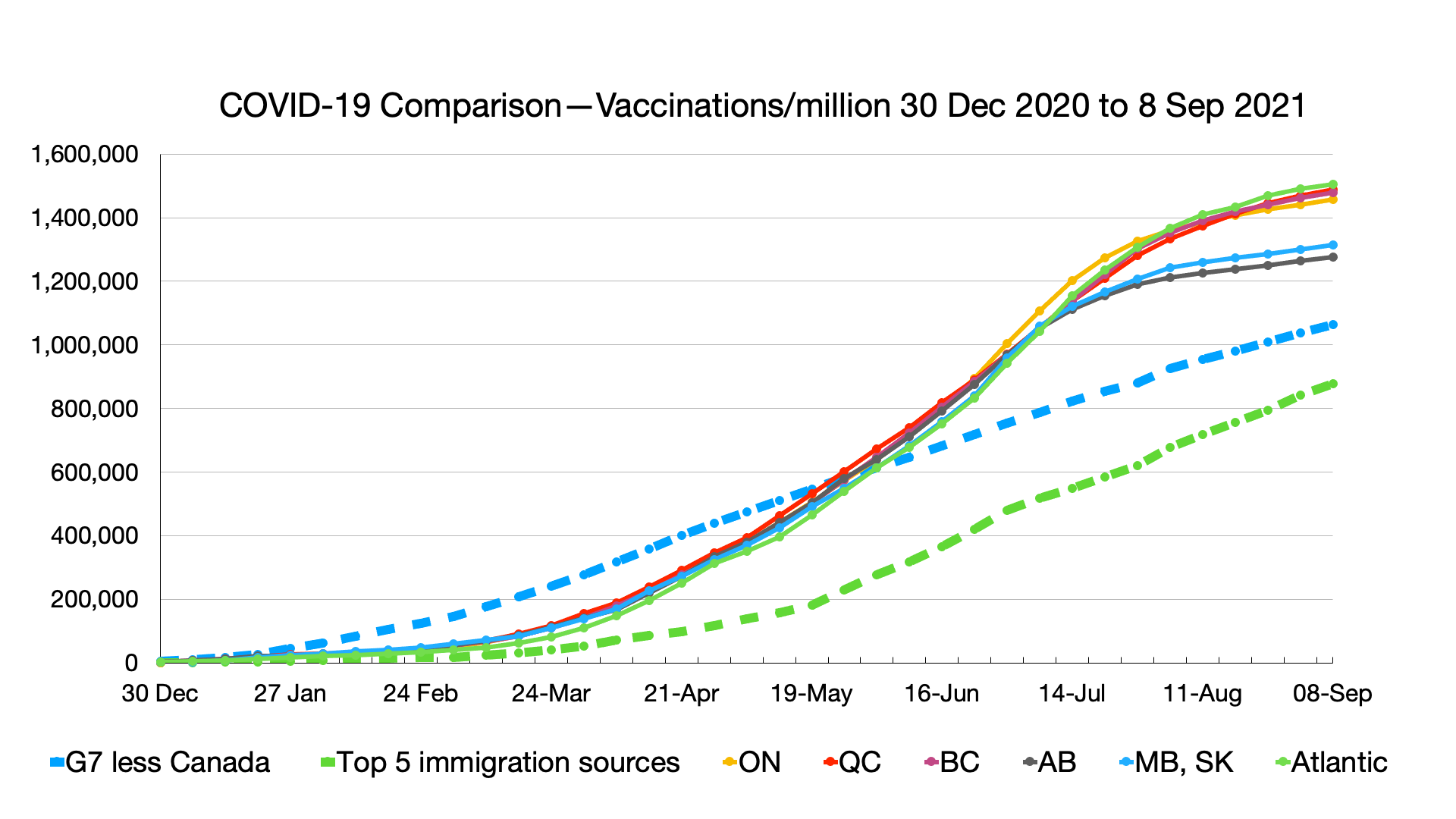
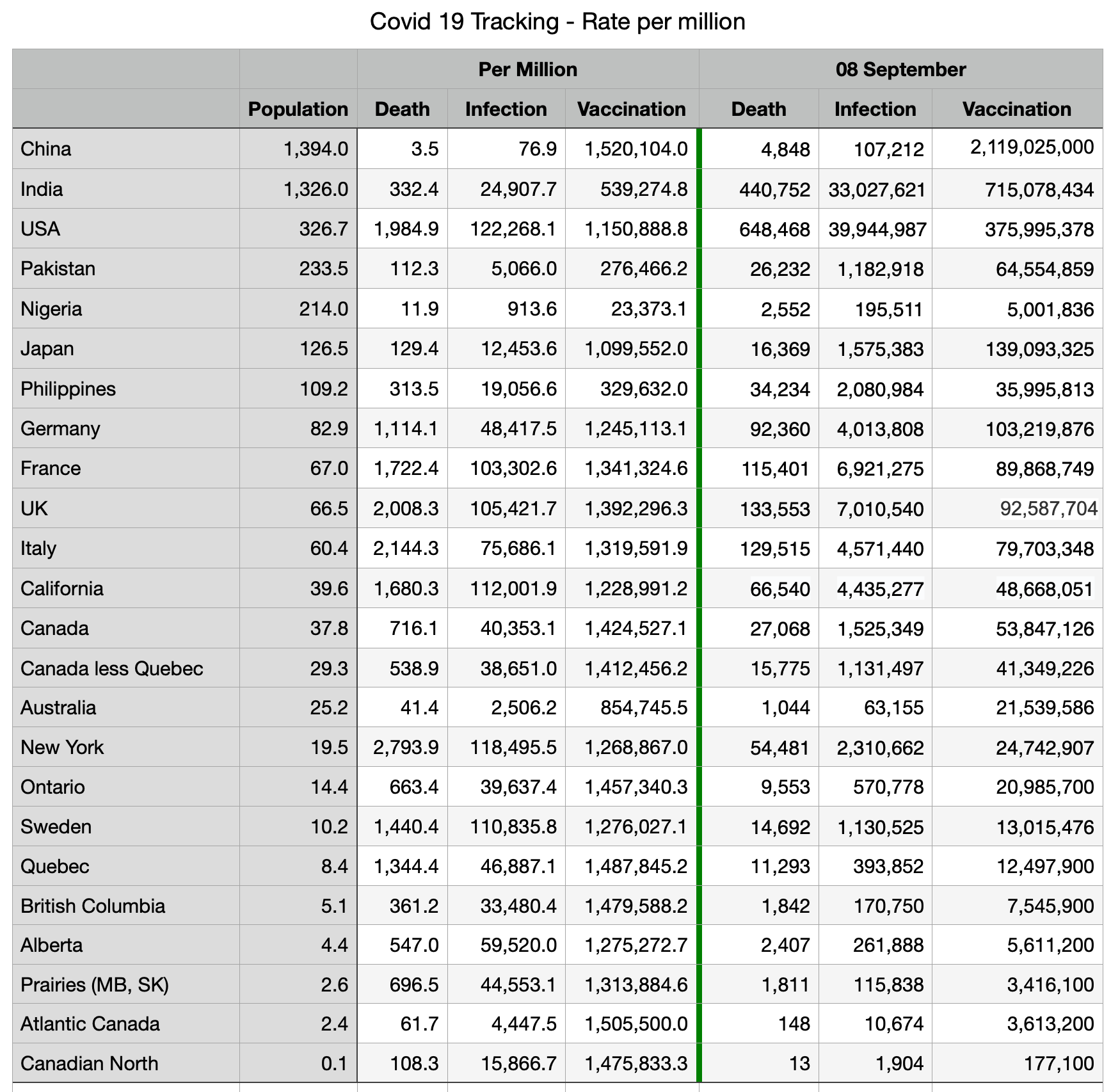
The latest charts, compiled 8 September as overall rates in Canada increase slightly due to the variant. Canadians fully vaccinated 68.6 percent, higher than USA 53.8 percent and the UK 65.1 percent) but all three countries are hitting a wall, with only minimal increases in the past week.

Vaccinations: China now has highest vaccination rate, British Columbia ahead of Canadian North, Italy ahead of Prairies, Sweden ahead of Alberta.  Chinese fully vaccinated, 63.3 percent (unchanged from last week).

Trendline charts

Infections: Same ongoing trend of pronounced uptick in G7 less Canada (driven largely by USA). While all provinces showing increased infections, Alberta and Prairies showing the highest.

Deaths: No major change but uptick G7 less Canada.

Vaccinations: Ongoing steady gap between Alberta and Prairies with lower vaccination rates than elsewhere in Canada. More rapid increase of immigration sources countries continues to be driven by China and to a lesser extent, India.

Weekly

Infections: No relative change except California slightly ahead of Sweden.

Deaths per million: No significant change.

China and the Global Economy: Sad “Business as usual” by CIGI

Hard to believe this “business as usual” approach given Chinese government repression of Uighurs, imposition of the China’s national security law on Hong Kong, and the ongoing arbitrary detention of the Michaels and other Canadians. Particularly cruel and shameful coming after 1,000 days of their detention:

CIGI is pleased to host His Excellency Cong Peiwu, China’s Ambassador to Canada, for a conversation with CIGI President Rohinton P. Medhora about China’s role in the global economy. With the upcoming G20 Heads of State and Government Summit from October 30 to 31, this conversation will explore China’s role and influence in issues preoccupying governments worldwide, such as technology, trade, investment, climate change, and cyber and data governance.

To register for the event on September 30 at 9h30: Registration

Source: https://www.cigionline.org/events/china-and-the-global-economy/?utm_source=cigi_newsletter&utm_medium=email&utm_campaign=will-the-us-congress-compel-transparency-from-facebook

Actor Nicholas Tse renouncing Canadian citizenship amid China’s ‘blacklist’

Seems to be getting a fair amount of coverage:

Hong Kong-born action film actor Nicholas Tse (謝霆鋒) was seen on Chinese TV Sunday (Sept. 5) claiming that he is in the process of renouncing his Canadian citizenship amid rumors he is among the next to be blacklisted by China’s censors.

In late August, the name and likeness of Chinese actress Zhao Wei (趙薇, Vicky Zhao) were suddenly scrubbed from Chinese online streaming sites and social media pages. Last week, rumors began to swirl on Chinese social media that seven famous Chinese actors with foreign citizenship had been placed on a “reorganization list” by the National Radio and Television Administration.

In addition to Tse, the list allegedly includes Jet Li (李連傑), Zhang Tielin (張鐵林), Crystal Liu Yifei (劉亦菲), Will Pan (潘瑋柏), Wang Lee Hom (王力宏), and Mark Chao (趙又廷). Li has Singaporean citizenship; Zhang is a British citizen; Liu, Pan, and Wang have American citizenship; and Tse and Chao have Canadian citizenship.

On Sunday, an excerpt from CCTV 6 program “Blue Feather Reception Room” (藍羽會客室) that featured Tse was posted on Weibo. When asked to expand on his drive to share Chinese culture with the world, Tse said that as he has matured, he has developed this “sense of responsibility.”

In response to netizens’ comments about his Canadian citizenship, Tse stressed, “I was born in Hong Kong, China, so I was originally Chinese.” Addressing questions about his loyalty to China, he said: “In fact, I have already begun applying to renounce my Canadian citizenship.”

Tse pledged that regardless of whether it’s food, action movies, or music, he has a “sense of responsibility to spread these great things from our motherland to the whole world.”

He was born in Hong Kong in 1980, moved to Vancouver, Canada, with his parents in 1987, and currently holds dual citizenship. He lived in Phoenix, Arizona, for one year before dropping out of high school as a sophomore and moving back to Hong Kong, where he was discovered by a talent scout in 1997, according to his IMDB profile.

Source: Actor Nicholas Tse renouncing Canadian citizenship amid China’s ‘blacklist’

Pew Research: Views of Muslims in the US, 20 years after 9/11

Of interest:

An unprecedented amount of public attention focused on Muslim Americans in the wake of the terrorist attacks of Sept. 11, 2001. The U.S. Muslim population has grown in the two decades since, but it is still the case that many Americans know little about Islam or Muslims, and views toward Muslims have become increasingly polarized along political lines.

There were about 2.35 million Muslim adults and children living in the United States in 2007 – accounting for 0.8% of the U.S. population – when Pew Research Center began measuring this group’s size, demographic characteristics and views. Since then, growth has been driven primarily by two factors: the continued flow of Muslim immigrants into the U.S., and Muslims’ tendency to have more children than Americans of other faiths.

In 2015, the Center projected that Muslims could number 3.85 million in the U.S. by 2020 – roughly 1.1% of the total population. However, Muslim population growth from immigration may have slowed recently due to changes in federal immigration policy.

The number of Muslim houses of worship in the U.S. also has increased over the last 20 years. A study conducted in 2000 by the Cooperative Congregational Studies Partnership identified 1,209 mosques in the U.S. that year. Their follow-up study in 2011 found that the number of mosques had grown to 2,106, and the 2020 version found 2,769 mosques – more than double the number from two decades earlier.

How we did this

Alongside their population growth, Muslims have gained a larger presence in the public sphere. For example, in 2007, the 110th Congress included the first Muslim member, Rep. Keith Ellison, D-Minn. Later in that term, Congress seated a second Muslim representative, Rep. Andre Carson, D-Ind. The current 117th Congress has two more Muslims alongside Carson, the first Muslim women to hold such office: Reps. Ilhan Omar, D-Minn., and Rashida Tlaib, D-Mich., first elected in 2018.

As their numbers have increased, Muslims have also reported encountering more discrimination. In 2017, during the first few months of the Trump administration, about half of Muslim American adults (48%) said they had personally experienced some form of discrimination because of their religion in the previous year. This included a range of experiences, from people acting suspicious of them to being physically threatened or attacked. In 2011, by comparison, 43% of Muslim adults said they had at least one of these experiences, and 40% said this in 2007.

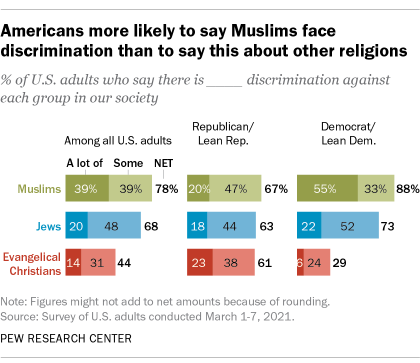
A bar chart showing that Americans are more likely to say Muslims face discrimination than to say this about other religions

In a March 2021 survey, U.S. adults were asked how much discrimination they think a number of religious groups face in society. Americans were more likely to say they believe Muslims face “a lot” of discrimination than to say the same about the other religious groups included in the survey, including Jews and evangelical Christians. A similar pattern appeared in previous surveys going back to 2009, when Americans were more likely to say that there was a lot of discrimination against Muslims than to say the same about Jews, evangelical Christians, Mormons or atheists.

A series of Pew Research Center surveys conducted in 2014, 2017, and 2019 separately asked Americans to rate religious groups on a scale ranging from 0 to 100, with 0 representing the coldest, most negative possible view and 100 representing the warmest, most positive view. In these surveys, Muslims were consistently ranked among the coolest, along with atheists.

Over the last 20 years, the American public has been divided on whether Islam is more likely than other religions to encourage violence, and a notable partisan divide on this question has emerged. When the Center first asked this question on a telephone survey in 2002, Republicans and Republican-leaning independents were only moderately more likely than Democrats and Democratic leaners to say that Islam encourages violence more than other religions – and this was a minority viewpoint in both partisan groups. Within a few years, however, Republicans began to grow more likely to believe that Islam encourages violence. Democrats, in contrast, have become more likely to say Islam does not encourage violence. Now, Republicans are far more likely than Democrats to say they believe Islam encourages violence more than other religions.

Though many Americans have negative views toward Muslims and Islam, 53% say they don’t personally know anyone who is Muslim, and a similar share (52%) say they know “not much” or “nothing at all” about Islam. Americans who are not Muslim and who personally know someone who is Muslim are more likely to have a positive view of Muslims, and they are less likely to believe that Islam encourages violence more than other religions.

Source: Views of Muslims in the US, 20 years after 9/11

25-year-old internal memo to Canada Revenue Agency predicted foreign money distorting housing market

Pretty outrageous, both the initial non-release and the five-year ATIP battle. Kudos to Ian Young of the SCMP for persisting. David Anderson and Jane Stewart were ministers at the time:

An internal Canada Revenue Agency audit concluded 25 years ago that wealthy new immigrants were buying up most of the priciest houses taken from a sample in and around Vancouver while declaring poverty on their tax returns. But the report was not made public until a five-year access-to-information battle concluded recently.

Housing and immigration academics say the study could have warned the public about the scale of foreign money being parked in Metro Vancouver’s residential real estate – decades before the provincial government began taking meaningful action to slow this trend.

During the federal election campaign, all three major parties have proposed various policies to curb international demand for real estate, which has contributed to rising unaffordability in a number of urban centres.

The Liberals and Conservatives are promising to ban foreign home buyers for at least two years. The New Democrats have pledged to tax those who aren’t Canadian citizens or permanent residents with a 20-per-cent levy – the same penalty imposed in British Columbia’s biggest cities for the past three years.

But critics say the parties need to follow B.C.’s lead to capture even more information about property owners so that they can be taxed more equitably and governments can tamp down international real estate speculation.

The CRA’s analysis from October, 1996, was shared with The Globe and Mail this week after its release to Ian Young, the South China Morning Post’s Vancouver correspondent who first requested the information in 2016 after being leaked portions of the internal memo explaining its findings.

The audit focused on 328 higher-end sales in the suburbs Burnaby and Coquitlam, but the study also analyzed a random sample of 6,060 sales from Vancouver and neighbouring Richmond and discovered “similar demographic results.”

Of the 46 houses bought in Burnaby, staff found 72 per cent were purchased by new arrivals to Vancouver who reported an average total family income of just $16,000. In contrast, the CRA’s chart from the audit showed four buyers who were long-term residents reported average family incomes that were tens of thousands of dollars higher.

This income gap between new immigrants and neighbours who had lived there longer was also observed in Coquitlam, according to the CRA’s chart released in the package of documents.

“It should be noted that an obvious large discrepancy exists between the average total family incomes for long-term Canadian residents and newer Canadian residents,” the author of the memo wrote to his CRA boss. “Furthermore, based on lifestyle and average age of these taxpayers, it is likely that many of these new Canadians still have active business activities, but are not reporting all their sources of income.”

Vancouver lawyer Richard Kurland, who has been helping international clients immigrate to B.C. for 25 years, said the analysis proves the CRA failed to catch those hiding their global income while competing for homes on Canada’s West Coast.

“They knew it was happening and did nothing, so the bleeding continued, taxes were not paid, property was subject to speculation and the end result [is] people in Vancouver are paying many more times than they have to for residential property because the CRA did nothing when it was warned by its own employees about what was going on,” he said.

David Ley, a geography professor at the University of B.C. who studies housing bubbles, said the 1996 report could have spurred politicians to address the anomaly of “apparently poor people buying very rich properties” decades earlier. He said the CRA had long maintained that they it would take too many resources to crack down on home buyers hiding wealth abroad, in large part because other countries they lived in were unlikely to release the pertinent tax information.

“It’s very difficult to pursue foreign sources of income – so they didn’t,” Dr. Ley said.

The CRA told The Globe this week that the study intentionally focused on cases where the buyer may have been underreporting their income and, thus, “was not intended to, and should not be, extrapolated to the whole population.”

But large parts of the internal communications around the release of this document were redacted because the agency said federal access-to-information law allows consultations or deliberations between government employees, a minister of the Crown or their staff to remain confidential.

The federal agency said it takes cheating its system seriously and has stepped up audits in the hot housing markets of Toronto and Vancouver in recent years. Still, the CRA said its five-year battle with Mr. Young over the release of this document is “clearly not normal, nor is it acceptable; we are continuing to take steps to improve [our] performance.”

Andy Yan, a housing analyst and director of Simon Fraser University’s city program, said the federal government has a lot of tools – such as home loan data and analysis of social demographic changes in neighbourhoods – through which it can confirm or refute how widespread these investment patterns have been. But, ultimately, he said, the CRA has not effectively enforced the country’s tax rules, helping create an unfair system where foreign capital is stored in residential real estate.

“There shouldn’t be any free parking,” said Mr. Yan.

In 2015, a Globe and Mail investigation into public data – including land titles, tax reporting and court records – revealed a similar pattern to the 1996 CRA study that suggested the typical wealthy foreign family buying Vancouver real estate pays little or no income or capital gains tax. These family homes were priced out of reach for many locals whose taxes pay for public services.

The Globe discovered that one in three multimillion-dollar homes bought in Vancouver areas popular with foreign buyers was registered to a homemaker, student or corporation – one indicator of how the identity of the person who actually paid can be hidden.

When a spouse or child sells a property that is registered in their name, the real investor can avoid capital-gains taxes – because the relative in Canada can claim it was their primary residence, therefore not an investment.

This and other Globe investigations helped increase public pressure on the provincial Liberal government to enact Canada’s first tax on foreign homebuyers. After the New Democrats were elected in 2017, in part on their pledge to further crack down on expanding real estate speculation, B.C. implemented a host of new taxes and demand-side tools.

Mr. Kurland said more provinces need to follow B.C.’s lead in requiring that homebuyers declare their country of residence for tax purposes as well as create a registry for beneficial owners – which will come into full force at the end of this year to make it tougher for people to hide real estate investments behind corporations, trusts or partnerships.

He said the CRA’s current “whack-a-mole” approach to catching scofflaws in the housing market relies on auditors digging for specific information in individual cases, but it will soon be able to use algorithms to scour all its tax information and these twin data sets to better catch those hiding wealth in B.C.

“It’s equivalent of an abacus versus a spreadsheet,” said Mr. Kurland, who added that he saw a “massive selling spree” among foreign owners in B.C. before each of those two policies became law.

Rohana Rezel, a software engineer who advocates for more affordable housing by using software and data to uncover speculators in Metro Vancouver’s market, said the most effective federal policy on this issue would be to blanket the whole country with a speculation tax on all homes.

Then, owners could offset this two-per-cent penalty against what they pay to the CRA each year, said Mr. Rezel.

“If you’re paying income taxes of a certain amount it doesn’t apply to you,” said Mr. Rezel, who immigrated to Canada from Sri Lanka in 2008.

Source: https://www.theglobeandmail.com/canada/british-columbia/article-25-year-old-internal-memo-to-canada-revenue-agency-predicted-foreign/

Facebook Apologizes After Its AI Labels Black Men As ‘Primates’

Ouch!

Facebook issued an apology on behalf of its artificial intelligence software that asked users watching a video featuring Black men if they wanted to see more “videos about primates.” The social media giant has since disabled the topic recommendation feature and says it’s investigating the cause of the error, but the video had been online for more than a year.

A Facebook spokesperson told The New York Times on Friday, whichfirst reported on the story, that the automated prompt was an “unacceptable error” and apologized to anyone who came across the offensive suggestion.

The video, uploaded by the Daily Mail on June 27, 2020, documented an encounter between a white man and a group of Black men who were celebrating a birthday. The clip captures the white man allegedly calling 911 to report that he is “being harassed by a bunch of Black men,” before cutting to an unrelated video that showed police officers arresting a Black tenant at his own home.

Former Facebook employee Darci Groves tweeted about the error on Thursday after a friend clued her in on the misidentification. She shared a screenshot of the video that captured Facebook’s “Keep seeing videos about Primates?” message.

“This ‘keep seeing’ prompt is unacceptable, @Facebook,” she wrote. “And despite the video being more than a year old, a friend got this prompt yesterday. Friends at [Facebook], please escalate. This is egregious.”

This is not Facebook’s first time in the spotlight for major technical errors. Last year, Chinese President Xi Jinping’s name appeared as “Mr. S***hole” on its platform when translated from Burmese to English. The translation hiccup seemed to be Facebook-specific, and didn’t occur on Google, Reuters had reported.

However, in 2015, Google’s image recognition software classified photos of Black people as “gorillas.” Google apologized and removed the labels of gorilla, chimp, chimpanzee and monkey words that remained censored over two years later, Wired reported.

Facebook could not be reached for comment.

Source: Facebook Apologizes After Its AI Labels Black Men As ‘Primates’

Close to home: how US far-right terror flourished in post-9/11 focus on Islam

Of note. Tragic irony:

The US government acted quickly after 9/11 to prevent further attacks by Islamic extremists in the US. Billions of dollars were spent on new law enforcement departments and vast powers were granted to agencies to surveil people in the US and abroad as George W Bush announced the war on terror.

But while the FBI, CIA, police and the newly created Department of Homeland Security scoured the country and the world for radicalized Muslims, an existing threat was overlooked – white supremacist extremists already in the US, whose numbers and influence have continued to grow in the last two decades.

In 2020 far-right extremists were responsible for 16 of 17 extremist killings, in the US, according to the Anti-Defamation League, while in 2019, 41 of the 42 extremist killings were linked to the far right.

Between 2009 and 2018 the far right was responsible for 73% of extremist-related fatalities in the US, while rightwing extremists killed more people in 2018 than in any year since 1995, when a bomb planted by an anti-government extremist killed 168 people in a federal building in Oklahoma City.

Despite the statistical dominance of far-right and white supremacist killings in the US, America’s intelligence agencies have devoted far more resources to the perceived threat from Islamic terror.

“The shock of 9/11 created this incredible machinery really, in the US and globally – the creation of entire new agencies and taskforce hearings, and all those sorts of things, that created blind spots,” said Cynthia Miller-Idriss, author of Hate in the Homeland: The New Global Far Right and a professor at American University, where she runs the school’s Polarization and Extremism Research and Innovation Lab.

“Of course, they were also interrupting plots and warning of threats. So some of that was happening, but at the same time, this other threat was increasing and rising, and they weren’t seeing it,” she added.

In the last few years alone, a gunman killed 23 people in El Paso, Texas, after allegedly posting a manifesto with white nationalist and anti-immigrant themes online. In it he wrote that he planned to carry out an attack in “response to the Hispanic invasion of Texas”.

In February 2019, a US Coast Guard lieutenant who was a self-described “white nationalist” was arrested after he stockpiled weapons and compiled a hitlist of media and government figures. He was sentenced to 13 years in prison in 2020.

Nine black church members were murdered in Charleston, South Carolina, in 2017, by a 22-year-old who confessed to the FBI that he hoped to bring back segregation or start a race war.

But successive governments have spent most of the last two decades putting the majority of their resources towards investigating Muslims, both in the US and abroad. In 2019 the FBI said 80% of its counter-terrorism agents were focused on international terrorism, with 20% devoted to domestic terrorism.

As the government pursued Islamic terrorism, the civil rights of Muslims in America were impinged, and many innocent Muslims suffered. More than a thousand people were detained in the months following 9/11, and thousands more questioned as mosques and Muslim neighborhoods were placed under surveillance. The number of hate crimes against Muslims in the US spiked in the immediate aftermath of the attack, and have remained way above pre-2001 rates in every year since.

“There was a lack of attention from authorities – resources – but some of the actual interventions that authorities made were Islamophobic. And so they fostered some of this Islamophobia, anti-immigrant sentiment,” Miller-Idriss said.

Michael German, a former FBI special agent who specialized in domestic terrorism and covert operations, said a disparity in the attention giving to alleged Muslim actors and white supremacists was growing even before 9/11.

After that attack, however, new laws, including the Patriot Act, gave the government extra powers to surveil and target Americans, while the justice department was given more power to investigate people with no criminal record.

German, who is a fellow with the Brennan Center for Justice’s Liberty & National Security Program said these powers were mostly focused on Muslim Americans, while paying white supremacists little heed.

“[There was] a disparity between how the FBI targeted Muslim Americans who simply said things the government didn’t like, or were associated with people the government didn’t like, or the government suspected just because they were Muslim, and had never committed any violent crime, had never been engaged with any terrorist group versus failing to even document murders committed by white supremacists,” German said.

After the World Trade Center attacks, “a tremendous amount of resources were coming into the Joint Terrorism Task Force and the counter-terrorism work”, German said. “But that was all being focused on potential terrorism committed by Muslims.”

A justice department audit in 2010 revealed that between 2005 and 2009 an average of fewer than 330 FBI agents were assigned to domestic terrorism investigation, out of a total of nearly 2,000 counter-terrorism agents.

The decision to not focus as intensely on white supremacist or domestic terrorism wasn’t just a strategic one, German said. He said the influence of money and big business had a role, as industries lobbied lawmakers and even the FBI itself to instead pursue anti-capitalist and environmental protest groups.

“The FBI needs resources. And to get resources, it needs to convince members of Congress. And Congress works most effectively when there are wealthy patrons who contribute to their campaigns,” German said.

“So the FBI has to cultivate a base of support in the wealthy community, and how can they do that? Well, by going to corporate boards, and telling them, you know, the FBI needs more resources.

“And then of course, that gets the corporate boards a lot of influence over what the FBI does. And what those corporate boards were saying wasn’t that there are minority communities in the United States that are being targeted by white supremacists, what are you doing about it?

“They were saying: ‘Hey these [anti-corporate or environmental] protesters are a real pain and you know, there’s a potential they could become violent.’”

When the government and intelligence agencies sought to expand its collection of intelligence post-9/11, that gave corporations another bargaining chip, German said – further knocking white supremacy and the far right down the priority list.

“Giant corporations hold a lot of private information about Americans, and getting access to that information became important to the FBI, so pleasing those corporations became part of the mission.”

Alongside that issue is the fact that there are “lingering racism problems within the FBI”, German said, with the agency still a predominantly white and male organization.

“So that’s one end of the spectrum, the people who are either explicitly racist or implicitly racist. Because white supremacists don’t threaten their community so they don’t see it as a threat.

“The white male agent who goes home to a white suburban community doesn’t really see a lot of white supremacist skinheads causing problems in his community. So it becomes a lesser threat.”

In 2020 there were signs that more attention was being focused on the far right. The Department of Homeland Security said white supremacists were “the most persistent and lethal threat in the homeland” as it announced a report on threats in the US.

But that came just days after Donald Trump had told the extremist group Proud Boys to “stand by” during a presidential debate.

Trump was notoriously reluctant to condemn white supremacist violence, and his “both sides” comments after the Charlottesville riots were seen as legitimizing the far right. In April 2020, as the pandemic raged in the midwest, he told his supporters to “LIBERATE MICHIGAN!” after Gretchen Whitmer, the state’s Democratic governor, imposed stay-at-home orders. Hundreds of armed rioters duly stormed the Michigan state capitol. In October 2020 the FBI charged six people with allegedly plotting to kidnap Whitmer, who had been a target of Trump’s attacks for months.

The riot in Michigan could be seen as a grim preview of the events of 6 January, when a far-right movement that had been brewing for years spilled out in Washington DC and attacked the Capitol.

Joe Biden has been less reluctant than his predecessors to identify the danger to US citizens. In June Biden said white supremacists are the “most lethal threat” to Americans, and later that month his administration unveiled a sweeping plan to address the problem.

PW Singer, a strategist who has served as a consultant to the US military, intelligence community and FBI and is a fellow of New American, a public policy thinktank, said the growing threat of white supremacism in the US was too complex to blame just on a lack of attention from government intelligence agencies – “but it certainly didn’t help stop it”.

“Think of it as akin to a disease striking the body politic. The person was not only in active denial, deliberately avoiding the needed measures to fight it, but the normal defenses [used] against other like threats were not deployed.”

Trump may be gone, but the pandering of some Republicans to rightwing extremists seems unlikely to stop. As recently as August Mo Brooks, a Republican congressman from Alabama, defended a Trump supporter who carried out a Capitol Hill bomb threat.

“Although this terrorist’s motivation is not yet publicly known, and generally speaking, I understand citizenry anger directed at dictatorial Socialism and its threat to liberty, freedom and the very fabric of American society,” Brooks tweeted, hours after the man had parked close to the Capitol and supreme court and told police he had a bomb.

“The way to stop socialism’s march is for patriotic Americans to fight back in the 2022 and 2024 election,” he said. “Bluntly stated, America’s future is at risk.”

It’s a dangerous game, but with the rise of Trumpism and far-right extremism in conservative politics – which can be traced back to the Tea Party movement which demonized Barack Obama – it is one Republicans seem likely to continue.

“What was once the unacceptable extreme has become an accepted part of our politics and media,” Singer said.

“It is a hard truth that too many are unwilling to accept. It didn’t start on 6 January, but years before, where these extremist views were first tolerated and then celebrated as good for clicks, and then votes.”

Source: Close to home: how US far-right terror flourished in post-9/11 focus on Islam

Parties should target the millions of voters outside Canada

Never supported expatriate voting for those with minimal to no connection to Canada which the current law allows.

Tax, passport and other data indicates that the number with strong connections to Canada is much lower and the 2.8 estimate is from an Asia Pacific Foundation study that included those under 18 and Permanent Residents (not just citizens).

Experience from other countries indicates a relatively small portion of expatriates vote given their greater connection to country of residence or other factors: less than 10 percent with the exception of France):

It’s estimated that 2.8 million Canadians live outside the country, yet Elections Canada expects as few as 34,000 expatriates will vote in Canada’s 44th general election on Sept. 20.

As polls tighten, and political parties try to expand their support, Canadians like me who live abroad are another source of voters Liberals can tap in order to secure a majority mandate — or the Conservatives can use to pull off an upset win. They just need to mobilize us, which the pandemic has actually made easier.

Despite attempts by former prime minister Stephen Harper to restrict the voting rights of Canadians who’ve lived abroad for more than five years, now, any adult who’s lived in Canada at some point in his or her life is eligible. Whether they agree with them or not, these are the rules the parties should consider as they strategize.

To maximize their chances of forming government, political parties spend campaigns energizing their supporters, or enticing undecided ones, to cast a ballot for their candidates.

Traditionally, they can count on about 60 per cent of eligible Canadians to vote. In the last election, 67 per cent of electors, or about 18 million Canadians, cast a ballot.

But despite efforts by political parties, in the past five elections, voter turnout has never exceeded 70 per cent. This leaves parties with limited ways to increase their bases.

But one way is to add voters. According to Nik Nanos of Nanos Research, the Liberals were denied a majority in the last election after losing 13 ridings by a total of 22,599 votes.

Canadians living abroad must register or request a special ballot to vote, mail it in, and vote where they last lived. Elections Canada is expecting a surge in these types of votes from inside the country, given the reluctance to vote in person during a pandemic.

This has changed the way political parties are campaigning. Large rallies and other traditional activities have been modified to meet public-health restrictions, which vary in degree across the country.

Much of the campaign is online, and this makes social media, organic and paid, more important. Digital tactics, which include encouraging mail-in ballots, make it easier for political parties to reach Canadians outside the country, who’d normally be left out.

Parties assign regional campaign chairs to groups of provinces and territories. Meanwhile, the estimated 2.8 million Canadians living abroad exceed the populations of nine Canadian provinces and territories, although it’s unlikely that campaign resources have been dedicated to engaging these millions of expats.

In contrast, Democrats Abroad, for example, actively supports voter registration, while keeping Americans who live abroad informed of key programs and policies.

Canadians live all over the world, but by analyzing past voting habits, we know where to target them.

In the 2019 election, most special ballots were requested from the U.S. and the U.K., and many fewer from China, Hong Kong, Australia, and Germany.

While we might not know how Canadians abroad vote, we know that millions of them have the right to vote and never have.

In a tightening race — and in an online campaign driving mail-in ballots — this is an opportunity for parties to gain voters. With some small changes in messaging targeted at key overseas locations, it could make all the difference.

Max Stern is a former employee of the Liberal Party of Canada, and a graduate student and communications consultant living in Brooklyn, New York.

Source: Parties should target the millions of voters outside Canada