What Kind of Political Correctness Do We Want? PC culture has become a problem, but jettisoning all political correctness is untenable

Am doing some thinking regarding political correctness and other phenomenon (identity and dog whistle politics, snowflakes, virtue signalling, tone policing etc) with a view to understanding how these are practised by both the right and left. One article that caught my eye at this stage:

We can easily think of many obsolete expressions, particularly slurs, to which thoughtful people have rightly said, “good riddance.” It’s a sign of progress that we can no longer use such speech in polite company. But it’s worth noting that the project of sensitizing language is open-ended, lacking any natural end point.

Language can always be made more sensitive, though it’s not clear it always should be. If the norms become too restrictive, or are enforced too severely, important discourse will be suppressed — especially when the norms are ideologically charged. How we should strike the balance between sensitivity and freedom in language is a central theme in debates about political correctness.

What is “Political Correctness”?

The term “political correctness” was once used unironically to describe the kind of orthodoxy good comrades in the Soviet Union and Maoist China were supposed to live by. George Orwell refers to this notion of political correctness in his “Principles of Newspeak,” the appendix to 1984.

In the 1980s, conservative intellectuals adopted the term as a hyperbolic description of a new kind of speech control on the left. The use of “political correctness,” or “PC,” in that sense persists today. A Google search turns up a good definition:

The avoidance, often considered as taken to extremes, of forms of expression or action that are perceived to exclude, marginalize, or insult groups of people who are socially disadvantaged or discriminated against.

This definition allows that political correctness isn’t inherently extreme; sometimes it may be appropriate. It also allows that conservatives may be PC enforcers; some of the recent criticism of Rep. Ilhan Omar (D-Minn.) for remarks perceived as anti-Semitic may be an example. However, not all efforts to control expression in order to avoid giving hurt qualify as PC, since not all are primarily concerned with marginalized groups. Criminalizing the burning of the American flag would be censorship, but not political correctness.

Finally, note that opposition to perceived excesses of political correctness does not entail condoning bigotry. It’s perfectly consistent to be opposed to racism and sexism and to be concerned about the excesses of anti-racism and anti-sexism. By way of analogy, there’s no contradiction in saying that disease is a bad thing, but so is obsessively washing your hands hundreds of times a day. The worst aspects of the left’s anti-racism and anti-sexism fervor are obsessive in this way, except that the concern is mostly with washing other people’s hands.

Why does “Political Correctness” Matter?

Not long after the term’s reintroduction and popularization, “political correctness” became a major cultural fault line in American politics. In 1993, economist Glenn Loury wrote that political correctness “has replaced communism as the primary locus of partisan conflict in American life.” According to a study with over 8,000 participants described in The Atlanticlast year, 61 percent of self-described liberals, 97 percent of self-described conservatives, and 80 percent of Americans agreed with the statement “political correctness is a problem in this country.” Even 30 percent of progressive activists agreed.

Skeptics see “political correctness” as a distraction that serves the interests of right-wing politicians. Unsurprisingly, politicians will capitalize on whatever resentments exist. The charge that people who reject political correctness are bigots also has, in many cases, a grain of truth. That is why online platforms that advertise themselves as anti-PC, such as Gab or 8chan, quickly attract extremists (see also here). But it’s hard to believe that all of the antipathy toward political correctness, including from avowed anti-racists, stems from bigotry first and foremost.

Conservatives exaggerate the peril of certain aspects of the PC problem — such as “no-platforming” un-PC speakers on college campuses. Sometimes, a person invited to speak at a university is prevented from doing so by threats of violence — and sometimes actual violence — or pressure to disinvite him or her. The Foundation for Individual Rights in Education (FIRE) maintains a database of all disinvitation efforts since the year 2000 that have come to its attention. Although these episodes contribute to political polarization, they are relatively rare, and generally don’t impede discourse in a serious way. If Ben Shapiro is no-platformed at the University of California-Berkeley, he can still address millions of people on his podcast the next day.

But subtler manifestations of political correctness turn out to be more sinister. As Glenn Loury writes:

For every act of aberrant speech seen to be punished by the “thought police,” there are countless critical arguments, dissents from the received truth, unpleasant factual reports, or nonconformist deviations of thought that go unexpressed, or whose expression is distorted, because potential speakers rightly fear the consequences of a candid exposition of their views. As a result, the public discussion about vital issues can become dangerously impoverished.

People are reasonably risk averse when it comes to their careers and reputations. Hence the visible punishment of a few people for deviant views may induce many people to keep quiet, distorting public dialogue. In his essay, “Why People are Irrational About Politics,” the philosopher Michael Huemer observes:

The problem of political irrationality is the greatest social problem humanity faces. It is a greater problem than crime, drug addiction, or even world poverty, because it is a problem that prevents us from solving other problems. Before we can solve the problem of poverty, we must first have correct beliefs about poverty, about what causes it, what reduces it, and what the side effects of alternative policies are.

PC excesses matter because they have the potential to derail rational discussion, which remains our best hope for dealing with the problems we face.

Worrisome Manifestations of Political Correctness

Instead of giving a roll call of recent PC flare-ups, I will mention three types of incident that encourage self-censorship.

1 — Politically motivated firings or coerced resignations
In 2006, Lawrence Summers stepped down from his post as president of Harvard University. In 2013, Brendan Eich resigned as CEO of the Mozilla Corporation. In 2017, software engineer James Damore was fired by Google.

Summers’s resignation was largely due to the backlash against a 2005 speech he gave arguing the idea that the underrepresentation of women in some fields may be explained in part by different distribution of cognitive skills. Damore had written an internal memo that criticized Google’s diversity policies (in response to a request for input) and similarly emphasized sex differences as a factor in the shortage of women in tech jobs. Eich had come under fire for donating a few thousand dollars in support of Proposition 8, which banned same-sex marriage in California, a few years earlier.

Each of these men articulated mainstream views. Barack Obama was officially opposed to same-sex marriage for a few years after Eich made his donation; Summers and Damore cited peer-reviewed scientific research in support of their views. These episodes signal that it’s possible to lose your job for expressing views, or endorsing causes, that are out of step with the micro-culture at your place of work. Even CEOs and presidents of elite universities can be punished for deviance; indeed, their high status might even make them more attractive targets, politically.

Political firings thus encourage self-censorship and groupthink in some of the world’s most powerful institutions. Moreover, these episodes invite a kind of populist backlash we should be worried about. Why shouldn’t conservatives be skeptical of elite institutions if they realize that no one who agrees with them is allowed a place at the table? Why shouldn’t they be skeptical of academics’ conclusions about climate change, or anything else, if they perceive that dissenters can be defenestrated on political grounds?

2 — Blacklisting
Katja Thieme, professor at the University of British Columbia with over 4,000 Twitter followers, retweeted a tweet harshly critical of Quillettemagazine, adding: “YES. If you’re an academic and you publish in Quillette, we see you. We fucking see you. And we are looking right at you” (three emoticons of eyes added effect). Another professor, Terry Bridges, commented on the thread: “It would be nice to have a list of Canadian academics who have published in that shitrag.” This prompted a strong reaction from many Quillette writers and fans.

Presumably, no one would say “we see you” three times in succession, or talk about drawing up a list of names in this context, for idle purposes. Interpreting this as a threat against academics who write for Quillette seems reasonable. Some of Thieme’s defenders pointed out that conservatives also make lists of names of academics they don’t like (e.g., Turning Point USA’s Professor Watchlist). The main difference is that conservatives aren’t in a position to dominate hiring searches and promotion decisions in the way that progressive professors are.

Thieme’s defenders responded that there’s no evidence that any anti-Quillette blacklist actually exists. But Quillette writers don’t know that such a list doesn’t exist, or that it won’t soon be created. There’s also precedent for this kind of behavior. Transgender activists in the U.K. were recently accused of creating a secret online list shaming professors who disagreed with their views on gender identity. The Times of London reports:

The online forum, seen by The Times, also revealed that members plotted to accuse non-compliant professors of hate crime to try to have them ousted from their jobs. Reading, Sussex, Bristol, Warwick and Oxford universities were among those deemed to have “unsafe” departments because they employed academics who had publicly disputed the belief that “trans women are women” or questioned the potential impact of proposed changes to gender laws on women and children….

How this encourages self-censorship among academics should be obvious.

3 — Twitter Mobbing
There are many forms of social media mobbing, but one subgenre seems especially noxious: online “social justice warriors” getting their hands on advance copies of young adult novels and denouncing them for various forms of bigotry, triggering a pile-on. Often, these attacks target debut works. Four such recent controversies have involved The Black Witch by Laurie Forest, American Heart by Laura Moriarty, Blood Heir by Amelie Wen Zhao, and A Place For Wolves by Kosoko Jackson.

Although the complaints often have little substance, publishers, reviewers and authors seem easily intimidated. Kirkus Reviews apparently changed a review of American Heart, removing a star and adding a line about identity concerns, after Moriarty was accused of promoting a “white savior narrative.” Moriarty said in an interview that her publisher, Harper Collins, nearly dropped the project as a result. In response to the social media campaign against The Black Witch, Kirkus published an essay by editor Vicki Smith that ostensibly defended a positive review of the book but spent an inordinate amount of time acknowledging the critics’ concerns.

Jackson’s case was ironic, since A Place for Wolves had been promoted under the Twitter hashtag #OurVoices and was supposed to be a model progressive novel. Jackson had even participated in the earlier mobbing of Zhao. Nonetheless, dominoes fell quickly after an anonymous review on Goodreads claimed that Jackson had, among other transgressions, focused excessively on privileged characters and made the villain a Muslim terrorist. A few weeks later, Jackson posted an apology, and announced that he had decided to cancel the release of his book, thanking his attackers for enlightening him. Zhao had issued a similar apology, though she has since reversed course and announced that she will publish her novel. A Slate article on the Jackson episode observes:

…we’ve gotten an increasingly toxic online culture around YA literature, with evermore-baroque standards for who can write about whom under what circumstances. From the outside, this is starting to look like a conversation focused less on literature than obedience.

It’s worth pondering whether J.K. Rowling could have published her Harry Potter novels in this environment. Who knows what worthwhile projects are being abandoned by prospective writers, perhaps at the advice of rattled agents, in anticipation of backlash.

Where Do We Go From Here?

A tempting response to these excesses is to simply say: “To hell with political correctness!” A lot of people feel this way, which may partly explain Donald Trump’s political success. But, though hyper-woke Twitter mobs is not where we wanted to end up, there’s a reason we started down this road. We need norms of speech that preserve the enlightened aspects of political correctness while mitigating against its excesses. The following is a non-exhaustive list of suggestions:

1 — Objectivity
Violations of our speech norms cannot merely be a matter of the “victim’s” feelings.

This is not because feelings don’t matter; all politeness presupposes that feelings matter. But we can’t adjust our behavior according to standards that aren’t based on publicly available reasons. We need know what categories of behavior will be regarded as reasonable cause for offense, e.g., “He repeatedly draws unnecessary attention to his coworkers’ racial and/or sexual characteristics.”

2 — Consistency
Political correctness as it now exists seems inconsistent. Whites are cautioned against trying to be “racially blind,” but can also be called out whenever differential treatment isn’t well-received, even if it is clearly well-intentioned. I once heard a professor opine in a lecture on racism that too many whites enthusiastically thanked him after his lectures; he doubted their sincerity.

The casual denigration of white people, especially white men, in “progressive” discourse also seems inconsistent with norms against racist speech. For example, The Daily Beast ran an article titled “The Starbucks Music Store Under Howard Schultz Was Painfully White.” It’s hard to imagine anyone who considers himself a progressive describing any music store as “painfully black.” I see no reason for thinking that differences in “social context” should nullify our general concern about racial sensitivity when it comes to whites.

3 — Proportionality
The punishment of un-PC speech is often disproportionate to the crime. For example, Megyn Kelly lost her show on NBC for asserting without elaboration that some Halloween costumes featuring blackface can be acceptable. Maybe she had in mind a white seven year old who wanted to dress as Black Panther. This opinion is certainly not more foolish than what commentators regularly say without being made to issue an on-air apology, as Kelly was, and then being fired regardless of the apology.

Virginia governor Ralph Northam faced, and resisted, pressure to step down when it came to light that he had appeared in a photograph from the 1980s featuring a person in blackface and another in KKK garb (it’s still not clear which is Northam). It’s unlikely that there would have been such calls in response to almost any other form of immoral-but-legal behavior he could have engaged in during the 1980s. Why should someone be punished more harshly for racist speech than for transgressions like adultery, lying, or verbally abusing one’s children?

Free speech in its First Amendment sense — the absence of government restraints on, or legal penalties for, expression — is important, but ultimately it’s only a means to an end. Legal free speech matters because a culture of open discourse matters; the absence of formal penalties for deviant speech is moot if all of the other mechanisms of society conspire to silence dissenters. What comfort is it that you won’t go to jail if speaking your mind means losing your job, being on the receiving end of shaming, and enduring severe ostracism? For most people, the threats of these things are sufficient to enforce silence.

This is why the excesses of political correctness are worrisome. Though they don’t — yet — compromise “free speech” narrowly construed, at least not in the U.S., they degrade the culture of open discourse that free speech exists to protect.

Our response should not be to reject political correctness altogether, which would be damaging to public discourse for different reasons. Instead, we should think about what kind of political correctness we should want to have. At a minimum, these norms must be objective, consistent, and punished proportionally.
Source: What Kind of Political Correctness Do We Want? – Arc Digitalarcdigital.media › what-kind-of-political-correctness-do…

Learn to Argue Productively Arguments don’t have to be heated, explosive moments. As long as everyone’s in good faith, everyone can learn from one another.

Sound advice, if hard to put into practice. I found the distinction regarding the type of argument–about facts, values or practicality–particularly useful:

Arguments and disagreements aren’t always bad. They can solve problems, show you sides of things you haven’t considered before, and even be fun. But unproductive arguments, or worse circular arguments that you keep having over and over again, are a time and emotional drain — which nobody needs right now.

Like most things, there’s a skill to having good arguments. You can get better at having them with practice — and not in the high school debate-winning way. Productive disagreements aren’t all out shouting matches with a victor and a loser; they’re deliberate attempts to explore differences and reach a common ground, whether that be about who should be President of the United States — or if pizza for dinner is acceptable three nights in a row.

“In order for someone to have better disagreement with you, there has to be this sense that you’re working with the same material,” Buster Benson, author of Why Are We Yelling: The Art of Productive Disagreement, said. If one of you thinks the argument is about facts and the other about moral philosophy, you’re never going to reach an agreement.

In his book, Mr. Benson identified three “realms” of arguments: the realm of the head, the realm of the heart, and the realm of the hands. Arguments in the realm of the head are about what is true. “There has to be factual evidence you can go and look up somewhere,” he said. It’s things like the size of Los Angeles or the equation to determine the volume of a sphere.

Arguments in the realm of the heart are about what is meaningful — they’re about matters of personal taste and moral value judgments. For example, disagreements over whether Tom Cruise is a great actor or if babies should be allowed to wield firearms without parental supervision.

Arguments in the realm of the hands are about what is useful and practical. Whether it’s better to exercise before or after work, for example. Or if bailing out the airlines will help the economy. They can only really be settled with some kind of test or waiting to see how things go.

When you’re having a disagreement with someone, Mr. Benson suggested asking yourself (and the person you’re arguing with), “Is this about what’s true, what’s meaningful, or what’s useful?” Many unproductive disagreements happen because one person thinks it’s an argument about facts (Mr. Cruise has never won an Academy Award) while the other thinks it’s about one’s opinion (“Top Gun,” “Jerry Maguire,” and “A Few Good Men” are all exceptional films carried entirely by Mr. Cruise).

By stepping back and asking whether the disagreement is about the facts at hand, a matter of opinion, or how something should be done, you can make sure everyone involved in the argument is participating in the same realm. It doesn’t matter that Mr. Cruise hasn’t won an Academy Award as that’s a very poor proxy for brilliance — what matters is how he makes me feel.

Anxiety is a tool that can help you understand what you value and why people argue with you, Mr. Benson said. The emotions you feel when someone disagrees or challenges you on something reveal where your personal expectations don’t line up with reality. He suggested paying close attention to what sparks it.

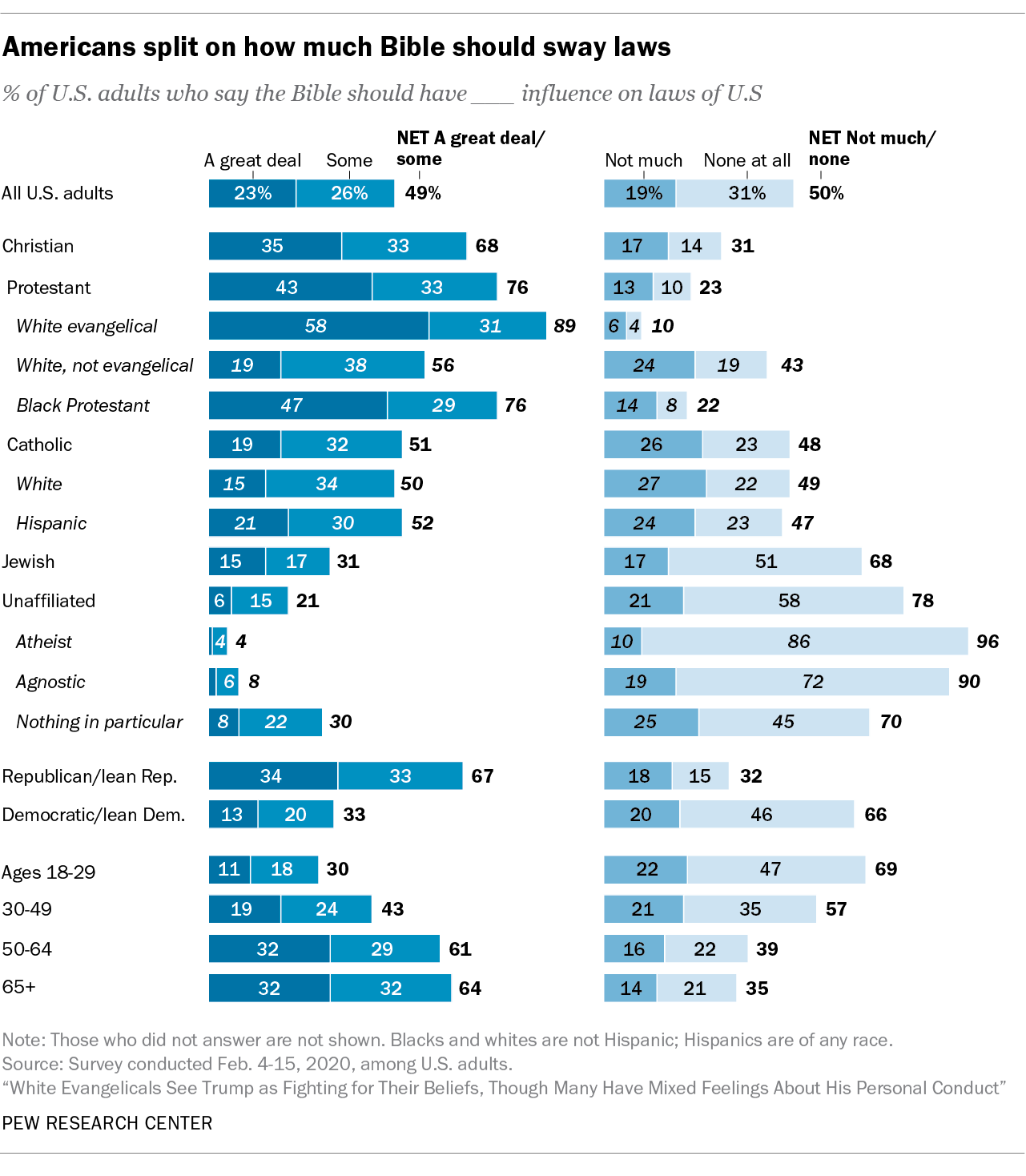
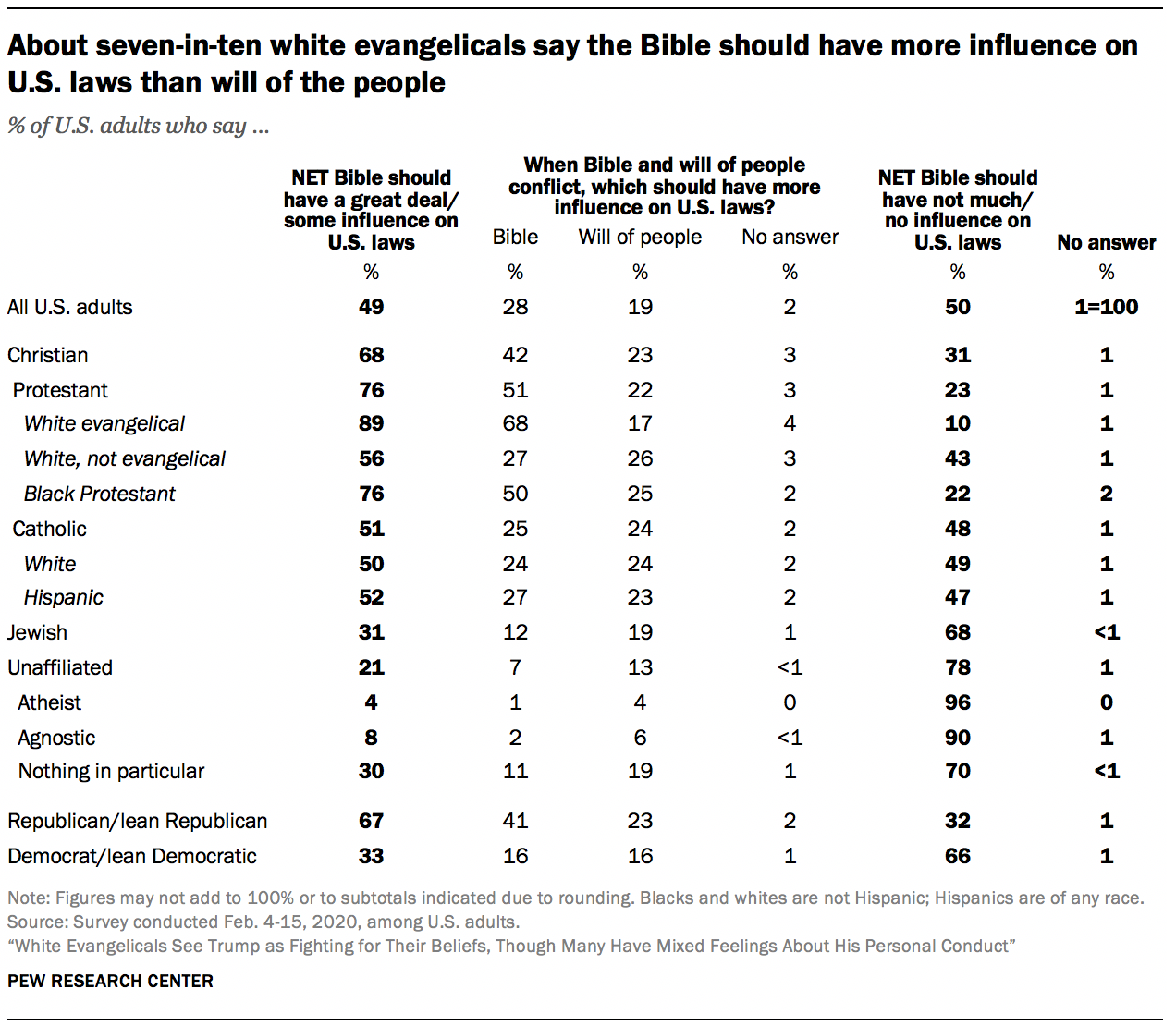
Half of Americans say Bible should influence U.S. laws, including 28% who favor it over the will of the people

Who’s Hit Hardest By COVID-19? Why Obesity, Stress And Race All Matter

More on disparities in health outcomes:

As data emerges on the spectrum of symptoms caused by COVID-19, it’s clear that people with chronic health conditions are being hit harder.

While many people experience mild illness, 89% of people with COVID-19 who were sick enough to be hospitalized had at least one chronic condition. About half had high blood pressure and obesity, according to data from the Centers for Disease Control and Prevention. And about a third had diabetes and a third had cardiovascular disease. So, what explains this?

“Obesity is a marker for a number of other problems,” explains Dr. Aaron Carroll, a public health researcher at the Indiana University School of Medicine. It’s increasingly common for those who develop obesity to develop diabetes and other conditions, as well. So, one reason COVID-19 is taking its toll on people who have obesity is that their overall health is often compromised.

But does obesity specifically affect the immune system? Perhaps.

Prior research has shown that people with obesity are less protected by the flu vaccine. They tend to get sicker from the respiratory disease even if they’ve been immunized. In fact, researchers have found that as people gain excess weight, their metabolism changes and this shift can make the immune system less effective at fighting off viruses.

“What we see with obesity is that these [immune] cells don’t function as well,’ says Melinda Beck, a health researcher at University of North Carolina, Chapel Hill. Basically, she explains, obesity throws off the fuel sources that immune cells need to function. “The [immune cells] are not using the right kinds of fuels,” Beck says. And, as a result, the condition of obesity seems to “impair that critical immune response [needed] to deal with either the virus infection or [the ability] to make a robust response to a vaccine.”

So this is one explanation as to why people with obesity seem more vulnerable to serious infection. But, there are many more questions about why some people are hit harder, including whether race is a factor.

The CDC found that 33% of people who’ve been hospitalized with COVID-19 are African American, yet only 13% of the U.S. population is African American. Some local communities have found a similar pattern in their data. Among the many (26) states reporting racial data on COVID-19, blacks account for 34% of COVID deaths, according to research from Johns Hopkins University.

This disproportionate toll can be partially explained by the fact that there’s a higher prevalence of obesity, high blood pressure and diabetes among African Americans compared with whites.

And as Dr. Anthony Fauci of the National Institutes of Health said last week at a White House coronavirus task force briefing, this crisis “is shining a bright light on how unacceptable that is, because yet again, when you have a situation like the coronavirus, [African Americans] are suffering disproportionately.”

There are several factors, including some genetic ones, that may make African Americans more vulnerable to COVID-19. There have been a few studies that have pointed to African Americans potentially having genetic risk factors that make them more salt-sensitive,” says Renã Robinson, a professor of chemistry who researches chronic disease at Vanderbilt University. This may increase the likelihood of high blood pressure, which, in turn, is linked to more serious forms of COVID-19. “It could be a contributing factor,” she says, but there are likely multiple causes at play.

Another issue to consider, she says, may be high stress levels. She says when a person experiences racial discrimination, it can contribute to chronic stress. She points to several studies that link discrimination and stress to higher levels of inflammationamong black adults. “And chronic stress can make one more vulnerable to infection because it can lower your body’s ability to fight off an infection,” she says.

Chronic stress is linked to poverty — so this could be a risk factor for low-income communities. In fact, research has shown that people who report higher levels of stress are more likely to catch a cold, when exposed to a virus, compared with people who are not stressed.

According to a new survey from Pew Research Center, health concerns about COVID-19 are much higher among Hispanics and blacks in the U.S. While 18% of white adults say they’re “very concerned” that they will get COVID-19 and require hospitalization, 43% of Hispanic respondents and 31% of black adults say they’re “very concerned” about that happening.

And other aspects of structural racism could contribute to the elevated risk for black Americans.

“Every major crisis or catastrophe hits the most vulnerable communities the hardest,” say Marc Morial, president and CEO of the National Urban League. And he points to several factors that help to explain the racial divide.

“Black workers are more likely to hold the kinds of jobs that cannot be done from home,” Morial says. So, they may be more likely to be exposed to the virus, if they are working in places where it’s difficult to maintain social distancing. In addition, he points to longstanding inequities in access to quality care.

“There also is bias among health care workers, institutions and systems that results in black patients … receiving fewer medical procedures and poorer-quality medical care than white individuals,” he says. He says an expansion of Medicaid into those states that still haven’t expanded would be one effective policy to address these inequities.

The characteristics of the communities where people live could affect risk, too especially for those who live in low-income neighborhoods. The roots of chronic illness stem from the way people live and the choices that may or may not be available to them. People who develop the chronic illnesses that put them at higher risk of COVID-19 often lack access to affordable and healthy foods or live in neighborhoods where it’s not safe to play or exercise outside.

“Let’s take a patient with diabetes for example. They are already at high risk for COVID-19 by having a chronic condition,” says Joseph Valenti, a physician in Denton, Texas, who promotes awareness of the social determinants of health through his work with the Physicians Foundation.

“If they also live in a food desert, they have to put themselves in greater risk if they want access to healthy food. They may need to take a bus, with people that have COVID-19 but aren’t showing symptoms, to get access to nutritious food or even their insulin prescription,” he says.

Poor nutrition, and the obesity linked to it, is a leading cause of premature death around the globe. And, this pandemic brings into focus the vulnerability of the millions of people living with lifestyle-related, chronic disease.

“We’re seeing the convergence of chronic disease with an infection,” says UNC’s Beck. And the data suggest that the combination of these two can lead to more serious illness. “We’re seeing that obesity can have a great influence on infection,” she says.

So, will this shine a spotlight on the need to address these issues? “Hopefully,” Beck says. “I think paying attention to these chronic diseases like obesity is in everybody’s best interest.”

Source: Who’s Hit Hardest By COVID-19? Why Obesity, Stress And Race All Matter

How the language of migration put expats on a pedestal – and left immigrants in the dust

Good discussion on the changing meanings of immigrant, migrant and expat. The greater distinction, in my view, is between immigrant and migrant/expat, as the former means settling more or less permanently with a more formal pathway to citizenship, whereas migrant/expat is more temporary, with the distinction being more with respect to socioeconomic status:

Growing up in Hong Kong, I was constantly surrounded by people from around the world. From the UK to South Africa and Canada, I was exposed to a number of different cultures in my day-to-day life, especially in school. But it wasn’t until middle school, where acquaintances would casually use two distinct terms to define either affluent or poorer areas of the city, that I really began to take notice of the significance of the language of immigration.

Based on what I observed, it was clear that whenever someone referred to a person as an “expat”, they generally tended to be middle to upper-class native English speakers, working in professions such as banking, tech, education or creative roles. When it came to the word “immigrant”, the term tended to apply loosely to both blue-collar workers, and those desperate to flee their birth country in order to make “a better life” for themselves.

Around a month ago, while FaceTiming a friend who had just moved back to Singapore from London, the extent of those differences became even more pronounced. In the middle of our chat, he mentioned a print magazine called Expat Living, and how bizarre it was that among other publications, it was still considered a best-seller in the country despite the dying print media industry. It led me to think about the marketing power of the word “expat” – clearly a symbol of financial value in society. It placed them on a uniquely aspirational pedestal.

Expats are praised for daring to move to a new country, while immigrants feel pressured to get approval from citizens and assimilate for survival. Whether it’s a conscious or subconscious decision, there’s no denying that these terms represent the double standards in society’s view on immigration. It’s not so different here in London, where even after seven years of living here, I’m still confronted by the same forms of hypocrisy, especially in the language the media uses in stories about immigration. Prior to this pandemic, for example, a simple search for the terms “immigrant” would typically pull up more divisive and sensationalist headlines.

In popular media, the word “immigrant” often showcases individual storylines of struggle, hard work and overcoming hardships. On Instagram, a search for accounts and posts hashtagged with “immigrant” reveal feeds of documentary-style visuals and text about sacrifice and injustice. Clearly, there’s a heavy sense of activism connected to the immigrant experience in the media, in contrast to the image of luxury and privilege that is seen to come with being an expat.

Why? When it comes to the way people treat both groups, the narratives the words we use to describe create an unconscious bias. There’s a general feeling that immigrants are associated with negative qualities about their birthplace, whereas expats are commended for living in a country outside of their own. The meanings we’ve ascribed to these words have a lot to do with connotations about certain races and class systems.

Look at the etymology of the word​ “expat” (the short form of “Expatriate”), for example. It derives from the Latin terms “ex” (out of) and “patria” (fatherland). By definition, an expat is just someone who moves to live in a country they weren’t born in. Interestingly, the term was most commonly used in the 20th century to describe British servants who were often sent to work abroad against their will. According to Sophie Cranston, a lecturer in human geography at Loughborough University​, who spoke to The Atlantic about the changing meaning of terms like expat, it was only in the early 90s, that it came to mean what it does now: a descriptor for (typically wealthy) westerners living abroad.

With immigration being brought up more on social and mainstream media, it’s also important to note that these terms are being reclaimed. The term “migrant”, which is sometimes used in place of “immigrant” and often bears the same connotations (although the definitions vary from place to place), seems to have been reclaimed.

In 2015-16, immigration became the hottest political topic in the UK due to the European migrant crisis and Brexit. The Leave campaign heavily focused on villainising immigrants in the media, using anti-migrant propaganda and anti-migrant sentiments to create fear towards them, which subsequently led to their unfortunate victory.

The negativity has since inspired a rise of people from immigrant backgrounds to create movements reclaiming and redefining the meaning of being an immigrant. Groups like Migrants in Culture and Migration Collective are both optimistic examples of how immigrants have used the power of art, statistics, and culture to express different realities and examine issues regarding immigration in the UK.

Migrant Journal, a monthly print and digital magazine with a social media platform that focuses on the experiences of people, goods, and information around the world and the positive impact they have on various spaces, has also embraced the word “migrant”. The design of their issues are illustrative, with cerebral stories and minimal details that bring a smart and thoughtful impression to “migrant” labels. They’ve shown that beyond the stories of people, other things such as objects, spaces and fine art can express the immigrant experience in media in a highbrow manner.

Contrastingly, there’s a rise in using social media to poke fun at “expat” realities and stereotypes. For instance, the popular meme Instagram account @hkmehmeh was founded by a Korean woman who identifies as an expat living in Hong Kong. Her account uses popular internet culture with a mix of Cantonese slang and relatable “Hong Kong” sayings to create humorous memes that put a light-hearted spin on living in the city from an expat perspective. The account’s satirical integration of expatriate stereotypes and local culture makes it entertaining for all people who reside in the city – there’s no discrimination with her memes. As a Korean expat, her presence is inadvertently broadening the image of “expat” and diminishing the assumption that expats can only be white people.

While these labels once showed the double standards of the language of migration, they’re beginning to break away from strict definitions. By forging cultural visibility for terms like these, we create opportunities for more open conversations about questioning the need for labels, their effect on our unconscious bias and reclaiming these terms in a positive way.

Platforms that enable positive outlooks on reclaiming negative labels can unite people rather than split them apart. Hopefully, more of this kind of action will allow people to see that regardless of your identity, anyone who immigrates to another country shares more similarities than differences and that labels shouldn’t limit or define anyone in what they want to achieve.

Source: How the language of migration put expats on a pedestal – and left immigrants in the dust

Critics say more action needed from Alberta government on immigration issues in wake of public opinion survey

Reflects the overall more conservative rural base and while the difference with other provinces is significant, there is less polarization than portrayed in the article. The UCP government, like most provincial governments, is generally pro-immigration:

Almost half of Albertans feel that there is too much immigration, a major increase over the national average. But advocates say the Alberta government has not done enough to curve that discrimination.

According to the Canadian Public Opinion on Immigration survey conducted in 2019 by the Environics Institute, 42 per cent of Albertans feel there is too much immigration. This is nine per cent more than the national average, with British Columbia at 30 per cent and Saskatchewan at 34 per cent.

The survey was based on telephone interviews conducted via landline and cell phones with 2,008 Canadians between Oct. 7 and Oct. 20, 2019. The results are accurate to within plus or minus 2.2 percentage points in 19 out of 20 samples.

These results don’t come as a surprise, as Alberta has made headlines for its anti-newcomer sentiments.

In 2016, an article from the National Post reported that a Calgary school was vandalized with anti-Syrian and anti-Trudeau graffiti. These messages included “real Canadians hate Syrians” and “burn all mosques.”

A similar story happened later in 2016 when a Calgary man spray-painted anti-Syrian graffiti to a Calgary LRT station because he was “mad at ISIS.” According to the CBC, the man later apologized in court and stated he had “changed his views.”

Two years later, a video of a woman shouting at a group of men in a Lethbridge Denny’s was uploaded to Facebook. The video shows the women yelling things such as, “Go back to your own f–ing country. We don’t need you here,” and “You’re not Canadian.”

The group of men she was yelling at were of Afghan background.

That anti-immigrant sentiment continues to this day. Dina Farman – an immigrant who moved to Alberta in 2006 – says she still faces discrimination.

“I worked in retail. I know how some people don’t like immigrants,” she says. “And even with me actually, I have black hair and [an accent], and some people give you that look like you’re not welcomed or something.”

One group that has been accused of making newcomers feel unwelcome is the Yellow Vests, a movement that has members in Calgary. The group was inspired by the “gilet jaunes” protests that began in France in 2018 as a result of high gas prices and the rising cost of living there. The movement there has been linked with outbursts of racism and anti-semitism.

But, in Canada, the Yellow Vests Facebook page says the group was created to “protest the CARBON TAX, Build That Pipeline and Stand Against the Treason of our country’s politicians who have the audacity to sell out OUR country’s sovereignty over to the Globalist UN and their Tyrannical policies.”

This movement is also known for opposing the presence of some newcomers in Canada and have been associated with racist and xenophobic behaviour and comments. In Calgary, members advocate for an end to what they describe as illegal migration while supporting immigration of “people who share our democratic values.”

One member of Yellow Vests Calgary — who wished not to be identified to prevent media scrutiny — says that for her, migration and immigration are different. Migrants and refugees have created some negative experiences for her, while the immigrants who “are willing to integrate are a joy.”

“I would consider immigration to be something that’s embedded, that we are choosing people that are going to help us economically, that are going to contribute and integrate and that they’re going to become Canadian. That’s a good thing for this country.”

“But then you have a large faction of people that come, that aren’t integrating and they’re clinging to a nation for which they’ve kind of turned away from but haven’t really [given up],” she says.

“If there’s an idea that they’re bringing with them [from] wherever they’ve come from, and it doesn’t fit with the morals and values of the country that you’ve chosen to come to, then that’s the challenges you face as an immigrant.”

Abdie Kazemipur, a professor at the University of Calgary who studied the socio-economic experiences of immigrants in Canada, says this is a very common argument. However, he says every time there is a pressure by mainstream institutions or populations to force immigrants to adopt their mainstream values, it actually backlashes.

“Even if immigrants [integrating] into the mainstream values and cultures is the desired outcome, the way to achieve that is by opening the society to them and giving them their space and allowing them to have interactions,” he says

Meanwhile, some governments in Canada are trying to reduce discrimination against refugees and immigrants.

In Manitoba, that led to the creation of their Advisory Council on Citizenship, Immigration and Multiculturalism in 2015.

Their council is similar to Saskatchewan’s multicultural council, which was founded in 1975 to raise awareness of the benefits of cultural diversity and the dangers of racism.

More recently, the United Nations Refugee Agency created the campaign #WithRefugees in order to invite cities and local authorities all over the world who are working to promote inclusion, support refugees and bring communities together to sign a statement of solidarity.

While 16 cities across Canada have signed onto this campaign to show support, no cities in Alberta signed on.

But, at a provincial level, Alberta has taken some action. In 2018, the government released a long-delayed report on anti-racism activities. At the time, Global News published an article in which Greg Clark, the now-former MLA for Calgary-Elbow, said “it just fell off the radar and we’ve heard nothing about it. So obviously there is action needed.”

After that release, the Anti-Racism Advisory Council was created as the first government organization to fight the increase of racism in Alberta. A $2 million anti-racism community grant was also introduced to do the same thing.

However, since the UCP government has come into power, there has been no update found on the Anti-Racism Advisory Council’s webpage.

The UCP government has also eliminated the Alberta Human Rights Commission’s human rights education and multiculturalism fund as of November 2019 under the recent budget cuts. This $1-million grant has helped fund anti-racism and anti-discrimination in Alberta since 1988.

Additionally, the $2-million anti-racism community grant was replaced with the multiculturalism, indigenous and inclusion grant program with a budget of $1.5 million under the UCP government. In other words, less money is now being used to address a lot more problems – just one of which would be anti-immigrant sentiment.

Sam Nammoura, the co-founder of the Calgary Immigrant Support Society, says the government of Alberta can be doing more to bring awareness towards the discrimination of immigrants.

“Instead of making a one-week event to create awareness, it should be addressed constantly,” he says.

Kazemipur, who wrote his PhD thesis on the economic experiences of immigrants and ethnic minorities in Canada, also says the Government of Alberta is taking too minimal of an approach.

“They can actually try to encourage the population to develop better views and better experiences of immigrants and minorities,” he says.

“After this happens and after this population blends into one larger population, then this distinction between immigrant and non-immigrant becomes basically meaningless. So all these negative feelings towards immigrants will disappear as a result.”

Kazemipur thinks that the best way to encourage this solution would be through educational programs that bring people together.

“Educational programs are definitely a starting point to emphasize the cultural competence and to expose people to different lives despite different cultural orientations and the values that are embedded in any of these alternative lifestyles,” he says.

“I think there could be more education in order to move people from their own comfort zones so that they can engage with people from other cultural backgrounds.”

Nada Bodagh, who moved to Canada from Iraq in 2009, agrees.

“People just don’t understand yet because they need answers to their questions,” she says. [Immigrants need to] feel they are involved so they are not isolated because the worst feeling when they are new here is feeling lonely and isolated.”

Kazemipur says that the government needs to make improvements to strengthen the bond between the population.

“The provincial government could be more proactive and could make this a priority knowing that without [social interaction] in the population, the economic plans and political plans wouldn’t succeed,”

“I think there’s a lot more work that needs to be done,” says Nammoura.

To better understand the work that is being done by the Alberta government, the Calgary Journal attempted to contact Leela Aheer, the minister of culture, multiculturalism and status of women for an interview involving the lack of programs in place that create inclusiveness for immigrants and refugees.

Instead, we received a statement from the press secretary, Danielle Murray.

“Our government is working to build a province where all people feel safe, welcome and valued. We are working with the Alberta Anti-Racism Advisory Council to determine how they can support our work to address racial and multicultural barriers in Alberta,” the statement read.

We did not receive any further response after a second request for an interview with Aheer.

Source: Critics say more action needed from Alberta government on immigration issues in wake of public opinion survey

‘A Perfect Storm’: Extremists Look For Ways To Exploit Coronavirus Pandemic

As they seek to exploit all issues:

For months, authorities say, 36-year-old white supremacist Timothy Wilson amassed bomb-making supplies and talked about attacking a synagogue, a mosque or a majority-black elementary school.

Then the coronavirus hit the United States, giving Wilson a new target — and a deadline. The FBI says Wilson planned to bomb a Missouri hospital with COVID-19 patients inside, and he wanted to do it before Kansas City’s stay-at-home order took effect at midnight on March 24.

“Wilson considered various targets and ultimately settled on an area hospital in an attempt to harm many people, targeting a facility that is providing critical medical care in today’s environment,” the FBI said in a statement.

The attack never happened. Wilson died in a shootout March 24 when federal agents moved to arrest him after a six-month investigation. It was an extraordinary domestic terrorism case, yet it got lost in the nonstop flood of news about the coronavirus pandemic. Extremism researchers warn against overlooking such episodes; they worry the Missouri example is a harbinger as far-right militants look for ways to exploit the crisis.

Already, monitoring groups have recorded a swell of hatred — including cases of physical violence — toward Asian Americans. Dehumanizing memes blame Jews for the virus. Conspiracy theories abound about causes and cures, while encrypted chats talk about spreading infection to people of color. And there is the rise of “Zoombombing” — racists crashing private videoconferences to send hateful images and comments.

“We know from our work in the trenches against white nationalism, antisemitism, and racism that where there is fear, there is someone organizing hate,” Eric Ward, executive director of the Western States Center, said in a statement. The Oregon-based monitoring group recorded about 100 bias-motivated incidents in the two weeks after the alleged Missouri plot was foiled.

Here are some areas extremism trackers are watching as the pandemic unfolds:

Hate crimes

A March FBI assessment predicted “hate crime incidents against Asian Americans likely will surge across the United States, due to the spread of coronavirus disease,” according to an intelligence report obtained by ABC News.

The report, prepared by the FBI’s Houston office and issued to law enforcement agencies nationwide, warned that “a portion of the U.S. public will associate COVID-19 with China and Asian American populations.” That idea has been reinforced by political leaders including President Trump, who has referred to the “Chinese virus” and variations that reference China or Wuhan rather than the clinical terms used by health officials.

Asian Americans say they have experienced hostility, with a dramatic increase in reports of racist incidents. A handful of them were violent attacks that are under investigation as hate crimes. For example, federal authorities say hatred motivated a 19-year-old Texas man who was arrested in a stabbing attack that targeted an Asian-American family at a Sam’s Club. The suspect told authorities that he thought the family was spreading the coronavirus.

Some Asian Americans have expressed fears that violence could increase once stay-at-home orders are lifted. A coalition of advocacy groups has appealed to Congress to denounce racism and xenophobia linked to the pandemic.

“This is a global emergency that should be met with both urgency and also cultural awareness that Covid-19 is not isolated to a single ethnic population,” Jeffrey Caballero, executive director of the Association of Asian Pacific Community Health Organizations, said in a statement. “Xenophobic attacks and discrimination towards Asian American communities are unacceptable.”

Recruiting out-of-school kids

Millions of young Americans are home from school, bored, and scrolling through social media sites for hours every day. To white supremacist recruiters, they’re prey.

Cynthia Miller-Idriss, an American University professor who writes extensively about far-right extremism, said the increase in unsupervised screen time at a time of crisis creates “a perfect storm for recruitment and radicalization.” PERIL, the extremism research lab Miller-Idriss runs on campus, is scrambling for “rapid response” grants to develop an awareness campaign and toolkit for parents and caregivers about the risks of online radicalization in the coronavirus era.

“For extremists, this is an ideal time to exploit youth grievances about their lack of agency, their families’ economic distress, and their intense sense of disorientation, confusion, fear and anxiety,” Miller-Idriss said. Without the usual social support from trusted adults such as coaches and teachers, she said, “youth become easy targets for the far right.”

Anti-government flashpoints

Militias and self-described “constitutionalist” factions, categorized by federal authorities as anti-government extremists, are making noise about stay-at-home orders. Some armed groups reject the measures outright, calling them unconstitutional or overreaching. Another subset is openly defiant, as if daring authorities to use force and turn the issue into a high-stakes standoff.

Over Easter weekend, Ammon Bundy, who led an armed occupation of a federal wildlife refuge in Oregon in 2016, held a service that drew some 200 people to a warehouse in Idaho. Photos showed worshippers, including children, unmasked and sitting in close quarters.

If the perceived constitutional infringements worsen, Bundy has told his supporters, then “physically stand in defense in whatever way we need to.” That kind of provocation could turn ugly quickly, warn monitors of the anti-government movement.

Calls for violence

Extremism monitors are keeping tabs on so-called accelerationists, a subset of the racist right that believes in using violence to sow chaos in order to collapse society and replace it with a white nationalist model.

The Southern Poverty Law Center, an extremism watchdog group, has said, “Accelerationists consider themselves the revolutionary vanguard of the white supremacist movement.” In chat forums, they’ve discussed using the virus to infect people of color, staging attacks on medical centers and other forms of violence they hope will trigger a domino effect leading to the breakdown of society.

“These far-right extremists are arguing that the pandemic, which has thrown into question the federal government’s ability to steer the nation through a crisis, supports their argument that modern society is headed toward collapse,” wrote Cassie Miller of the Southern Poverty Law Center.

Miller wrote that, for now, the fallout is already so chaotic that the accelerationists are content to watch, reckoning, “the situation seems to be escalating on its own, requiring no additional involvement on their part.”

Miller cited a white supremacist podcaster who told his followers: “It seems to be going plenty fast, thanks.”

Source: ‘A Perfect Storm’: Extremists Look For Ways To Exploit Coronavirus Pandemic

La pandémie force Ottawa à vider ses ambassades, Ottawa tente de régulariser le statut des Canadiens coincés à l’étranger

Two articles in French language media on relatively under-covered aspects of COVID-19:

Starting with the reduced staffing of Canadian missions abroad and the impact on consular service. Less concerned about political reporting given the amount of information publicly available:

Radio-Canada a appris qu’une soixantaine de missions diplomatiques ne peuvent désormais qu’assurer le strict minimum en matière d’aide consulaire, puisque le personnel jugé non essentiel à la réponse à la COVID-19 a été ramené d’urgence au Canada depuis quelques semaines, du jamais-vu.

Environ 1000 personnes, diplomates et membres de leur famille, ont ainsi quitté ambassades, hauts-commissariats et autres missions diplomatiques un peu partout sur la planète. Selon nos sources, le personnel diplomatique travaillant dans des pays où le système de santé est jugé peu fiable a été rapatrié en priorité.

L’opération a commencé en janvier par le retour au Canada du personnel non essentiel en Chine, premier foyer d’infection par le coronavirus, avant de se poursuivre dans une soixantaine de pays.

Le ministère [des Affaires étrangères] a un devoir d’assurer la santé et la sécurité de ses employés, indique une source gouvernementale qui a requis l’anonymat pour s’exprimer librement.

Les chefs de mission, comme les ambassadeurs, restent toutefois en poste. Si Affaires mondiales Canada demeure en mesure d’assurer les services consulaires d’urgence, le rapatriement massif du personnel force la mise en veilleuse de nombreux programmes.

Dans ces pays, ce sont surtout les programmes d’aide au développement et les missions commerciales qui sont touchés, confie un employé d’Affaires mondiales Canada bien au fait du dossier.

On fait ce qu’on peut à distance, mais c’est sûr que notre capacité à livrer des programmes et faire des suivis est réduite, ajoute cette même source.

Les opérations régulières sur le terrain avaient toutefois déjà été lourdement perturbées avant que ces diplomates ne reviennent au Canada, alors que le ministère consacrait tous ses efforts au rapatriement des ressortissants canadiens.

Une « perte de contact » avec le monde

Si le Canada n’avait d’autres choix que de rapatrier un maximum de ses représentants, Gilles Rivard, l’ancien ambassadeur du Canada en Haïti, croit que cette vaste opération nuira en premier lieu à la collecte de renseignements dans les pays où les missions auront réduit leurs ressources au maximum.

On ne produira plus de rapports politiques sur ce qui se passe dans ces pays, c’est une perte de contact que le Canada va vivre, dit-il en entrevue.

Gilles Rivard ajoute qu’il ne faut pas négliger les conséquences de la réduction du personnel canadien à l’étranger.

Ça va avoir un impact extrêmement important. Pas juste sur les programmes culturels, mais également sur les programmes d’aide au développement. Il n’y aura plus personne pour suivre les projets sur place qui sont gérés par le Canada, il n’y aura pas de suivi pendant un certain temps, souligne le diplomate de carrière.

M. Rivard rappelle cependant que le Canada peut se fier davantage à ses partenaires internationaux, comme la Croix-Rouge, pour gérer les programmes financés par le gouvernement canadien.

Dans ces moments difficiles, l’ancien chef de mission pense aussi beaucoup aux diplomates, autant les rapatriés que ceux restés à l’étranger, et à leur famille.

L’impact sur les proches est immense, dit-il. Dans des cas comme ça, des familles doivent partir en premier et certains diplomates restent derrière, c’est très difficile humainement. Ceux qui doivent partir se sentent coupables de laisser la mission derrière, ce sont des gens qui ont à cœur ce qu’ils font.

And Foreign Minister Champagne on the repatriation flights. Despite the various frustrations and complaints by many Canadians stuck abroad, the scale of the effort given the many countries involved, is impressive:
Le ministre des Affaires étrangères, François-Philippe Champagne, a indiqué que ce dossier a été abordé durant les discussions qu’il a eues avec ses homologues d’une douzaine de pays lors d’une récente conférence téléphonique.

Ce dossier devrait être de nouveau à l’ordre du jour lors de la sixième conférence téléphonique que M.  Champagne doit organiser ce vendredi avec ses vis-à-vis de l’Allemagne, de la France, de l’Angleterre, de la Turquie, de la Corée du Sud, du Brésil, du Mexique, de l’Indonésie, de l’Australie, de l’Afrique du Sud, de Singapour, du Pérou, du Maroc et de l’Union européenne.

Depuis plus d’un moins et demi, et à l’instigation de M.  Champagne, les ministres des Affaires étrangères de ces pays se donnent un rendez-vous quasi hebdomadaire afin de discuter des enjeux liés à la COVID-19 qu’ils ont en commun. À la prochaine conférence téléphonique, l’Inde a fait part de son intérêt à y participer.

Au cours des dernières semaines, les responsables de la diplomatie étrangère de ces pays ont pu coordonner leurs efforts pour rapatrier leurs ressortissants respectifs dans un contexte des plus difficiles, discuter des mesures à prendre pour protéger la chaîne d’approvisionnement mondiale en biens essentiels, faciliter l’établissement de ponts aériens et protéger les routes maritimes.

La prolongation des permis de séjour pour les ressortissants qui n’ont pas été en mesure de rentrer dans leur pays fait maintenant partie de dossiers prioritaires.

« L’objectif, c’est de s’assurer que nos ressortissants ne se trouvent pas en violation technique de leur visa ou de leur permis de séjour. Il n’y a pas que des Canadiens qui pourraient se retrouver dans cette situation. Il y a aussi des Australiens, des Britanniques, des Français, etc. Cela fait partie des enjeux que l’on aborde ensemble », a indiqué M.  Champagne dans une entrevue accordée à La Presse.

Le ministre a indiqué que les opérations visant à rapatrier les voyageurs canadiens qui se trouvent toujours à l’étranger sont à « 75 % à 80 %  » terminées. En date de mardi, les autorités canadiennes ont pu rapatrier 16 606 Canadiens en provenance de 65 pays à partir de 119 vols. Il a répété que malgré tous les efforts qui ont été déployés jusqu’ici, « on ne pourra pas ramener tout le monde ».

Quant au nombre de ressortissants canadiens qui pourraient avoir besoin d’une prolongation de permis de séjour ou de visa, il est difficile d’en dresser un portrait précis. Tout dépendra du succès des opérations de rapatriement qui auront lieu au cours des prochains jours et du nombre de Canadiens qui se seront inscrits auprès des services consulaires.

« S’il y a un moment dans l’histoire où on doit plus collaborer, c’est bien maintenant. Chaque jour, j’ai toujours l’impression que l’on fait un pas de plus », a affirmé le chef de la diplomatie canadienne.

« Dans le cas des opérations de rapatriement, c’est durant ces discussions que plusieurs pays ont décidé de mettre leurs ressources en commun pour faciliter les opérations. On devrait avoir une déclaration commune sur d’autres mesures que l’on veut prendre ensemble après notre rencontre du 17 avril », a-t-il aussi avancé.

Au départ, M.  Champagne avait comme objectif de créer un sous-groupe de pays membres du G20 pour discuter des enjeux liés à la pandémie de la COVID-19. Alors que certains de ses collègues évoquaient les problèmes qu’ils éprouvaient dans les efforts de rapatrier leurs ressortissants au Pérou et au Maroc, M.  Champagne a décidé d’inviter les ministres des Affaires étrangères de ces deux pays à participer à la conférence téléphonique pour les sensibiliser.

« Je voyais bien que nous avions tous les mêmes enjeux au Pérou et au Maroc. J’ai alors demandé au ministre des Affaires étrangères du Pérou de se joindre à l’appel, comme celui du Maroc. Et ils participent toujours aux appels aujourd’hui, même s’ils ne font pas partie du G20 », a-t-il raconté au bout du fil.

« Ce que j’aime dans la composition régionale, c’est d’abord l’importance des joueurs autour de la table. Ce n’est pas un groupe fermé. Ceux qui veulent s’y joindre – c’est au niveau ministériel – peuvent le faire. Cela nous a permis de développer des liens, de raffermir des liens. Aux dires des collègues, c’est le seul appel régulier qui se tient dans le monde sur la COVID-19 aujourd’hui », a-t-il pris soin de relever.

L’esprit de collaboration qui règne durant ces appels donne espoir à François-Philippe Champagne. Cela pourrait renforcer le multilatéralisme, mis à rude épreuve en ce moment par les États-Unis depuis l’arrivée au pouvoir de Donald Trump à Washington.

« Il y aura peut-être un renforcement du multilatéralisme dans le sens où les gens auront vu la nécessité de coordonner, de coopérer et de collaborer face à des enjeux qui dépassent les frontières. On le voit au niveau des changements climatiques, on le voit au niveau du nouveau coronavirus. On est en train de se donner des exemples très concrets où le multilatéralisme prend tout son sens », a-t-il affirmé.

Source: Ottawa tente de régulariser le statut des Canadiens coincés à l’étranger

Germany plans stricter citizenship rules

Situations of false identity are a form of citizenship fraud and/or misrepresentation and thus in Canada and many countries, are grounds for revocation (children raise more complex issues given separation and other issues):

In an apparent bid to deter asylum-seekers from providing false information about their identities, the German government plans on making it harder for foreign nationals to attain citizenship, Die Weltnewspaper reported on Friday.

A draft law drawn up by the Interior Ministry targets immigrants who have been living in Germany under a false name or provided authorities with incorrect information about their country of origin when they arrived.

Currently, foreigners are generally eligible for German citizenship if they’ve lived in the country for eight years or more.

Under the new law, the years that an immigrant lived under a false identity would no longer count towards the total years required to attain citizenship.

Changes for residence permits

The draft law would also create a second significant hurdle to citizenship by changing the rules on residence permits.

Under the new measures, immigrants found living under a false identity would be denied an unlimited or permanent residence permit. The law would make “the clarification of identity and nationality” a prerequisite for attaining permanent resident status.

Immigrants could still attain a time-limited residency permit, but the permanent resident status is required for German citizenship.

Withholding citizenship from children

The German government’s plans also have a direct impact on children of foreign nationals — even if they were born in Germany.

Until now, babies born in Germany to two non-German parents can typically become citizens if one of their parents has been living in the country for eight years.

Under the new rules, children would only be granted German citizenship if their parents prove their identity and nationality.

The Interior Ministry’s draft law is currently being reviewed by the other ministries and must gain their approval before moving on to parliament.

Source: Germany plans stricter citizenship rules

After coronavirus: Immigrants will be key to Canada’s economic recovery

While I value the work and analysis of Kareem El-Assal, I think that this presents an overly optimistic picture, or at least a pre-mature one as we really don’t know about how fast and complete the recovery will be, particularly when you consider the impact on retail, travel and hospitality industries.

And like so many pro-immigration narratives, it tends to gloss over whether the impact would be only on overall GDP or also with respect to per capita GDP where the benefits are less clear.

My guess is that we will only really know about one year from now, when most of the effects have hopefully worked their way through society:

The coronavirus pandemic is having a devastating impact on economies around the world.

The IMF projects the global economy will contract by 3 per cent in 2020, in what it calls the worst economic downturn since the Great Depression.

Just days before it announced travel restrictions to help contain the spread of COVID-19, Canada said it would welcome over 1 million immigrants between 2020-2022, mainly to help grow its economy.

Of course, little did Canadian government officials know at the time of the announcement that the global economy would be heading towards such a major contraction.

Should Canada welcome more immigrants?

The current state of affairs may lead one to legitimately question whether Canada should continue with its immigration plan, or scale it back.

There is no doubt that COVID-19 will require Canada to adjust its immigration plans.

However, it would not be sound economic policy to significantly reduce Canada’s immigration levels beyond the coronavirus crisis.

The reason for this is that Canada needs immigrants more than it ever has in its modern history to promote economic growth.

Why Canada needs more immigrants

Canada’s desire to welcome over 300,000 immigrants per year is meant to help alleviate its demographic challenges.

Canada has one of the world’s lowest birth rates and one of the world’s oldest populations. As more Canadians retire, it will struggle to replace them in the labour market since the country is not having enough children. This is where immigration comes in.

Immigration has been the main driver of Canada’s population growth since the 1990s, and will be the only driver of it by the early 2030s.

Population growth is important because it fuels labour force growth. The two ways to grow an economy is by adding more workers and using those workers more productively.

Today, immigration tends to account for all of Canada’s labour force growth, or the vast majority of it, in a given year. This means that Canada would constrain its economic growth potential if it welcomed fewer immigrants.

Canada will see a full economic recovery

The consensus among economists is that the Canadian and global economy should rebound fairly quickly once social distancing restrictions have been eased.

This means that more Canadians will be back to work, and there will also be more job opportunities for immigrants.

Canada’s economy pre-coronavirus is very telling of what we can expect once the economy is back to normal.

Leading up to the coronavirus pandemic, Canada’s unemployment rate was at record lows and its economy enjoyed a decade of growth following the 2008 global financial crisis. Remember that Canada maintained high levels of immigration even following that crisis, which in hindsight, was the correct economic decision to make.

One significant reason for the low unemployment rate pre-coronavirus is many of Canada’s over 9 million baby boomers were retiring, which caused a shortage of workers as the economy was expanding. This benefitted Canadian-born workers and immigrants alike.

Similarly, Canadian-born workers and immigrants are poised to benefit from the post-coronavirus economic rebound. In the coming years, it is realistic to expect Canada to deal with worker shortages again, and even more so than prior to COVID-19 as all of Canada’s 9 million baby boomers reach the age of retirement within the next decade.

Immigration policy always has long-term economic implications and we should not lose sight of that even in the wake of the coronavirus crisis.

Immigrants will help to create more jobs post-coronavirus

Canada’s economy is facing tough times, but immigration will play a pivotal role in supporting Canada’s economic recovery since immigrants will help to fill newly-created jobs and also support job creation in other ways.

Statistics Canada research shows that immigrants have a high propensity to start businesses. In one of its recent studies, Statistics Canada found that immigrant entrepreneurs created 25 per cent of new private sector jobs between 2003 and 2013, even though they accounted for 17 per cent of companies studied. In other words, immigrant entrepreneurs punched above their weight when it came to job creation.

Hence, immigrant entrepreneurs post-coronavirus will create businesses that will create new jobs for fellow Canadians.

Finally, immigrants bring significant savings with them which helps to fuel the economic activity that is critical to fueling job creation in Canada.

Consider the useful proxy of international students. According to the federal government, the over 600,000 international students in Canada contribute to over $22 billion in economic activity each year which supports nearly 200,000 Canadian jobs.

Canada has over 8 million immigrants, who make an even bigger contribution to economic growth and job creation than international students.

Source: After coronavirus: Immigrants will be key to Canada’s economic recovery