U.S. Supreme Court lets hardline Trump immigration policy take effect

Sigh:

The U.S. Supreme Court gave the go-ahead on Monday for one of President Donald Trump’s hardline immigration policies, allowing his administration to implement a rule denying legal permanent residency to certain immigrants deemed likely to require government assistance in the future.

The justices, on a 5-4 vote, granted the administration’s request to lift a lower court’s injunction that had blocked the so-called public charge policy while litigation over its legality continues. The rule has been criticized by immigrant rights advocates as a “wealth test” that would disproportionately keep out non-white immigrants.

The court’s five conservative justices, including Chief Justice John Roberts and two justices appointed by Trump, carried the day. The court’s four liberal justices said they would have denied the administration’s request. The action was announced even as Roberts sat as the presiding officer in Trump’s impeachment trial in the U.S. Senate.

Lawsuits aiming to block the policy were filed against the administration by the states of New York, Connecticut and Vermont as well as by New York City and several nonprofit organizations.

In imposing an injunction blocking it, Manhattan-based U.S. District Judge George Daniels on Oct. 11 called the rule “repugnant to the American Dream” and a “policy of exclusion in search of a justification.”

The administration asked the high court to let the rule go into effect even before the New York-based 2nd U.S. Circuit Court of Appeals rules on Trump’s appeal of the injunction. The 2nd Circuit is considering the matter on an expedited basis, with legal papers to be submitted by Feb. 14 and arguments expected soon afterward.

The administration can now enforce the rule nationwide except in Illinois, where a lower court has blocked its implementation.

Ken Cuccinelli, acting deputy secretary at the U.S. Department of Homeland Security (DHS), praised the high court.

“It is very clear the U.S. Supreme Court is fed up with these national injunctions by judges who are trying to impose their policy preferences instead of enforcing the law,” Cuccinelli told reporters.

GREEN CARDS

At issue is which immigrants will be granted legal permanent residency, known as a “green card.” Under Trump’s policy, immigration officers would consider factors such as age, educational level and English proficiency to decide whether an immigrant would likely become a “public charge” who would receive government benefits such as the Medicaid health insurance program for the poor.

The administration has said the new rule is necessary to better ensure that immigrants will be self-sufficient. Critics have said the rule would disproportionately bar low-income people from developing countries in Latin America, Africa and Asia from permanent residency.

“Limiting legal immigration based on an applicant’s wealth is shameful and entirely un-American,” Democratic Senator Dick Durbin wrote on Twitter.

A spokesman for U.S. Citizenship and Immigration Services, the agency that processes visa applications, said it would “determine the most appropriate method to implement the public charge rule” and would release additional information soon.

Trump has made his tough immigration stance a hallmark of his presidency and 2020 re-election campaign.

U.S. immigration law has long required officials to exclude people likely to become a “public charge” from permanent residency. U.S. guidelines in place for the past two decades had said immigrants likely to become primarily dependent on direct cash assistance or long-term institutionalization, in a nursing home for example, at public expense would be barred.

The new rule expands the “public charge” bar to anyone deemed likely to receive a much wider range of public benefits for more than an aggregate of 12 months over any 36-month period including healthcare, housing and food assistance.

The vast majority of people seeking permanent residency are not eligible for public benefits themselves. A 2019 Urban Institute survey found that the administration’s rule was already deterring people from seeking benefits for U.S. citizen children for fear of harming their own future immigration status. Benefits for family members are not considered under the rule.

Claudia Center, a lawyer with the American Civil Liberties Union, said the rule targets disabled people applying for green cards and “enshrines the false stereotype that people with disabilities do not contribute to our society.”

The high court could give Trump more victories on immigration policy. The conservative justices signaled support in November for Trump’s bid to kill a program that protects hundreds of thousands of immigrants – dubbed “Dreamers” – who entered the United States illegally as children. A ruling is due by the end of June.

The court in 2018 upheld Trump’s “travel ban” targeting people from several Muslim-majority countries.

Conservative Justice Neil Gorsuch, a Trump appointee who voted to lift the injunction, issued an opinion criticizing lower courts’ “increasingly common” use of nationwide injunctions to halt government policies. Gorsuch urged the court to confront the issue.

“What in this gamesmanship and chaos can we be proud of?” Gorsuch asked.

Two other federal appeals courts previously lifted nationwide injunctions ordered by lower courts blocking the rule.

Source: U.S. Supreme Court lets hardline Trump immigration policy take effect

Fear over coronavirus prompts school board in Ontario to warn parents about racism against Chinese community

Not unexpected and always the challenge in communicating the origins of a specific risk and the impact on the community, irrespective whether historical tropes are involved or not. And I assume that some of these fears are shared by many Chinese Canadians:

The message York District School Board staff had been sending to parents on the coronavirus was pretty standard: Wash your hands; stay home if you’re sick; cover your mouth and nose when you sneeze. Then they saw the petition.

More than 8,000 people were calling for school boards in the region north of Toronto – a region in which the top reported ethnic origin is Chinese – to not allow students whose family members had travelled to China within 17 days to come to school.

On Monday, the York board released a note to parents to address another virus: anti-Chinese xenophobia.

“We are aware of an escalated level of concern and anxiety among families of Chinese heritage,” wrote Juanita Nathan, the board’s chair, and Louise Sirisko, its education director. “Individuals who make assumptions, even with positive intentions of safety, about the risk of others, request or demand quarantine can be seen as demonstrating bias and racism.”

Though public-health officials across the country have urged Canadians to take a measured response to the coronavirus, a panic akin to the one from 2003’s SARS outbreak has already taken hold. To date, there is one confirmed and one presumptive case of the new virus in Canada.

Avvy Go felt a tickle in her throat on the subway ride to work Monday, but willed herself to suppress the cough. She feared coughing on public transit as a Chinese woman might make her a pariah as it did for so many other Asian-Canadians during the SARS outbreak.

In Yellow Peril Revisited, a 2004 report about the impact of SARS (severe acute respiratory syndrome) on Canada’s Chinese community, Ms. Go, the director of the Metro Toronto Chinese & Southeast Asian Legal Clinic, detailed the myriad ways SARS affected her clients: Many suffered job losses after Chinese restaurants saw a steep drop in business; Asian claimants who appeared before the Immigration and Refugee Board faced staff wearing masks; and tenants reported being threatened with eviction by their landlords because they were Chinese.

Ms. Go shared much of this when she testified at Ontario’s public hearings on the SARS crisis but she was disappointed to find nothing about racism in the inquiry’s 2007 report. Recommendations on how to respond to racist rhetoric would have been helpful for future outbreaks such as this one, she said.

“As they prepare for the virus, they [should] also prepare for the virus of racism and have everything in place at the same time,” she said.

When Toronto Chinatown Business Improvement Area chair Tonny Louie addressed the crowd at Saturday’s Lunar New Year parade, he felt the need to explain his sore throat.

“I reminded everybody there that I do not have the virus. I just happen to have a cold,” he said.

The next day, he noticed a drop in business throughout downtown Toronto’s Chinatown and its dozens of restaurants – something he blames on fears about the virus. He repeated the message that the district was safe, as was the food, and called on politicians to have meals in Chinese restaurants as then-prime minister Jean Chrétien did during the 2003 SARS outbreak to signal to Canadians that doing so was safe.

But that sort of PR move might not be enough to counter racist messaging, given the power of social media.

In the past few days, video of a woman eating a bat with chopsticks in a restaurant has gone viral, with many suggesting, in posts heavy with racist rhetoric, that Chinese people eating foods seen as unusual to a Western palate has contributed to the outbreak.

The way in which the video has been shared has vilified and othered Chinese people, says Kevin Huang, executive director of the Hua Foundation, a Vancouver-based non-profit that promotes racial equity.

Rather than thinking of the coronavirus as an us-versus-them situation, Mr. Huang suggests using a global lens.

“Removing our Western exceptionalism and … humanizing [Chinese people] allows us to think about a more global concerted effort to try and contain this virus,” he said.

Why people would share misinformation like that while ignoring facts from public-health agencies speaks to how racist content “feeds into already pre-existing underlying biases or prejudices,” York University sociologist Harris Ali said.

In a research paper about SARS and the stigmatization of the Chinese population in Canada, he found that racist sentiments that had previously been internalized or only shared during private conversations “found explicit expression during the outbreak.”

Mr. Huang says the way some have drawn a connection between the virus and Chinese food is part of a long history of “yellow peril” or anti-Chinese sentiment.

Government policy that disenfranchised Chinese people, such as the head tax (an immigration tax imposed on Chinese arrivals), “fed into these tropes of this disgusting, uncivilized cultural grouping,” he said.

He has seen rampant misinformation and panic spread among Chinese-Canadians, too, some of whom are reacting to alarmist Chinese media reports. Last weekend, two Lunar New Year events in Vancouver were cancelled because of fear of the virus’s spread.

Ms. Go feels confident the Canadian health-care system is much better equipped to deal with containing coronavirus than it was with SARS, but she has little optimism about how it will contain the public’s fears.

“Unfortunately, because of the underlying racist attitudes that exist in Canadian society, it doesn’t matter what scientific evidence is there of how the disease has been contained, people will still believe what they believe,” she said.

Source: Fear over coronavirus prompts school board in Ontario to warn parents about racism against Chinese community Though public-health officials have urged Canadians to take a measured response, a panic akin to the one during 2003′s SARS outbreak has already taken hold
Fear, fear, fear.

The word appears repeatedly in the headlines and stories about the new coronavirus.

But what is fear? What causes us to be fearful? How can we assuage the public’s distress?

The dictionary definition of fear, the noun, is “an unpleasant emotion caused by the belief that someone or something is dangerous, likely to cause pain, or a threat;” and the verb, “to be afraid of (someone or something) as likely to be dangerous, painful, or threatening.”

In public health terms, “fear” is our perception of risk, of danger.

We tend to be more fearful of new threats to our health, such as coronavirus, than of well-established ones, such as influenza, no matter how irrational that is.

To date, there have been about 4,500 recorded cases of Wuhan coronavirus and 106 deaths. By comparison, three to five million people contract serious flu cases requiring hospitalization annually and somewhere between 290,000 and 650,000 die. Yet, both are respiratory illnesses spread in a similar fashion.

When it comes to being fearful, better the devil we know than the one we don’t, apparently.

If the unknown fuels fear – and it does – then our best weapon against coronavirus is knowledge.

The good news is that the science is advancing at breakneck speed and with an unprecedented level of co-operation.

The coronavirus genome was decoded in fewer than 10 days and the results shared publicly. As a result, researchers are already working on novel treatments and potential vaccine targets.

Scientific journals, normally highly protective of their papers, have agreed to share them with public-health officials prior to publication and lifted their paywalls for articles about coronavirus.

That means we already have a sense of how infectious coronavirus is (moderate) and a sense of who is being infected (a broad range of people) and who is dying (largely patients with underlying chronic conditions).

But, of course, good science alone cannot assuage fear.

The way public-health officials and the media communicate information is key to shaping perceptions. Increasingly, there is a wild card in this equation – social media.

The mainstream media fearmongers, however inadvertently, by using exaggerated language like “killer virus” and by fixating on body counts. When you constantly update the number of cases and deaths, you wildly amplify incremental change. Of course people will be scared. Imagine if we sent out push alerts for every tuberculosis death (1.5 million a year) and every measles death (140,000 annually).

Finding the balance between providing up-to-date information on a new threat and putting that threat into context is not easy.

On social media, there is too often little attempt to do so. From WeChat to Twitter, wild rumours and outright falsehoods fly routinely, as do unhinged demands such as shutting down all air traffic from China, quarantining all travellers and so on, with many of these purported measures driven by thinly veiled racism and xenophobia rather than science. (For the record, there is little evidence that massive quarantines or thermal screening of passengers has any benefit in stemming transmission of diseases like coronavirus.)

The most difficult communications challenge, however, lies with public-health officials who have to simultaneously track the shifting science, ratchet up preparedness and calm public fears.

Peter Sandman, a former professor of journalism at Rutgers University and a risk-communications guru, says the one thing public officials (or the media) should never do is tell people not to panic. That’s because, in crisis situations, people rarely do panic.

Prof. Sandman actually has a brilliant list of tips for those who need to calm people’s fears about unknown threats such as the coronavirus:

  • Don’t over reassure; talk about most likely scenarios rather than worst case ones;
  • Acknowledge uncertainty; paradoxically, saying “I don’t know” reassures the public;
  • Deliver clear, consistent messages;
  • Don’t be dispassionate; when experts speak of their personal fears, it makes them more relatable;
  • Give people things to do to protect themselves, such as urging handwashing; what fuels fear is powerlessness;
  • Don’t worry about panic, as was already mentioned.

What each of these elements has in common is that they are about building trust. What calms people’s fears is not just having information, but trusting the source of that information.

Risk communication is fraught with peril – and more often than not, we won’t get it quite right – but it is also essential.

As Franklin D. Roosevelt famously said, “The only thing we have to fear is … fear itself – nameless, unreasoning, unjustified terror which paralyzes needed efforts to convert retreat into advance.”

Source: What should we fear more: Coronavirus or fear itself? During an outbreak such as the coronavirus, building trust through communication is key: André Picard

Canada Wins, U.S. Loses In Global Fight For High-Tech Workers

The latest article on the “Canadian advantage:”

Hundreds of tech workers pack an auditorium for a recent networking event in Toronto. The evening’s host glides around the room on a hoverboard, equal parts game show host and tech bro.

“Who here is new to Canada?” asks Jason Goldlist, the co-founder of TechToronto, an organization that helps newcomers navigate the city’s fast-growing tech ecosystem.

Dozens of hands shoot up in the air — one belonging to Alok Chitnis, who moved to Canada last year. Chitnis is originally from India. He went to graduate school in the U.S. and found a job in Colorado. But last May, he moved to Canada to launch his own startup.

“It’s vibrant. It’s very welcoming for immigrants,” Chitnis says. “There are a lot of services by the government to help newcomer entrepreneurs especially. So the whole ecosystem is pretty welcoming compared to the U.S.”

If there is a war for global tech talent, right now Canada is winning — and the U.S. may be losing its edge. Toronto saw the biggest growth in technology jobs of any North American city over the past five years, outpacing San Francisco, New York and Seattle. Vancouver also made the top five.

The tech industry across Canada is booming. And one of the biggest reasons is U.S. immigration policy. The Trump administration has made it harder for high-skilled workers to get visas. It also has blocked entrepreneurs from some majority-Muslim countries altogether under the travel ban, which it’s moving to expand to more countries.

Canada, meanwhile, has been making it easier for tech workers to immigrate there. A new streamlined visa in Canada has brought in more than 40,000 tech workers from around the world in the past two years alone.

“While the States has gone, ‘Let’s make it difficult to get the employees here on a visa,’ Canada’s gone the exact opposite, and it’s beneficial for Canada,” says Alex Norman, the other co-founder of TechToronto. “You had a fast-growing ecosystem here that’s been getting a shot of steroids.”

Under the Trump administration, high-skilled workers are getting rejected at a higher rate. In 2015, 92% of new H-1B visa applications were approved. But in the last two years, the approval rate dipped to only 75%.

Immigration authorities say they’re trying to ensure that companies follow the rules. Employers are required to show that hiring a foreign worker will not hurt Americans.

“You know, I have a high regard — as does the president — for protecting U.S. workers,” said Ken Cuccinelli, who was then the acting head of U.S. Citizenship and Immigration Services, in an interview last year.

Cuccinelli was asked about the need to crack down on fraud and abuse. “The H-1B program has been controversial in this regard,” he said. “And it is concerning.”

Meanwhile, U.S. tech companies complain that they can’t find enough qualified candidates to fill all their open jobs.

More than a dozen hiring managers from tech startups recently squeezed into a private dining room at Del Posto, a high-end New York City restaurant. One of them was Susan Riskin, the head of human resources at Bitly, which is well-known for making Web addresses shorter.

“We doubled the size of our technology team in the last year,” Riskin said. “And we feel like we have exhausted New York and Denver. And now it’s like we’re trying to figure out where to go next, what we need to do.”

All of the hiring managers at the table were confronting a similar problem. They came for the New York strip steak and Italian wine — but also to hear a business pitch from Irfhan Rawji, the founder of a Canadian company called MobSquad.

“If you’d rather fill a job than go without, call us,” Rawji said. “We’ll open a virtual subsidiary for you in Canada. You get access to the world.”

Rawji’s pitch, in a nutshell, is this: Say your firm wants to hire an international tech worker, but the worker’s visa application is rejected or the application process is dragging on for months.

“The next-best solution to keeping them here in the U.S., if you can’t do that, is to put them in Canada,” Rawji said. “The flights are an hour and a half to two hours. It’s the same business culture. And we try to match or beat the total cost for you here.”

U.S. tech companies have long relied on a steady stream of engineers and software developers from China, India and elsewhere. The process of getting an H-1B visa was often expensive and slow, says Meagan Soszynski, the head of human resources for an advertising app called Yieldmo. But at least it was predictable.

“You followed a certain process, you paid a premium, but you pretty much always got the outcome that you wanted,” says Soszynski.

She says that’s not the case anymore.

“In the last year, I would say every one of my H-1B cases have been met with some sort of delay,” Soszynski says. “So the immigration changes are certainly being felt by us on the front lines.”

The U.S. remains a popular destination for international workers. The number of applicants for H-1B visas stills exceed the annual cap of 85,000. But in recent years, fewer are applying.

“The biggest thing that’s going to hurt the U.S. competitiveness is the overall rhetoric or tone” on immigration, says William Kerr, a professor at Harvard Business School and the author of The Gift of Global Talent, who also serves on the board of MobSquad.

“If you think about migration, people are making a choice to come and invest in their lives, whether for school or for work, and they want to have long-term opportunities,” Kerr says. “And the uncertainty and the hostility really dampen that enthusiasm.”

President Trump says he understands the problem.

“We have to allow smart people to stay in our country,” Trump said in an interview with Laura Ingraham on Fox News this month.

“We don’t have enough of them. And we have to be competitive with the rest of the world too,” Trump said.

But global tech workers say the Trump administration’s policies make the U.S. less attractive.

Ozge Yoluk started a new job in Toronto this month. She was born in Turkey and studied in Europe. Yoluk worked as a postdoctoral researcher in computational biology at the University of Maryland in Baltimore. She says the field is “like playing video games” — except in these games, the characters are proteins and experimental drugs.

The company she joined, ProteinQure, is using tech to design new treatments. Pharmaceutical companies in the U.S. are doing similar work. But Yoluk says she didn’t even bother applying for those jobs.

“Getting a visa in the U.S. is not easy,” Yoluk says. “And it’s really costly, not just for the companies but also for the person itself.”

Yoluk says the higher rejection rate for work visas has made U.S. companies more reluctant to sponsor foreign workers — and foreign workers more reluctant to go through the process.

“I said I will not waste my time applying for positions in the States,” Yoluk said. “Whereas in Canada, the process was easy.”

Yoluk says she got her Canadian visa approved in about two weeks. She didn’t even need a lawyer to navigate the process.

A few blocks away, I met Milad Zabihi at a coffee shop in downtown Toronto. Zabihi is the CEO of a startup called Peekage, which helps companies target customers. Zabihi immigrated to Canada from Iran. Several of the company’s other co-founders are also Iranian.

“We are a bunch of friends from university time,” Zabihi says. “We were thinking of like, you know, starting something new.”

Zabihi says they wanted to locate this new venture in the United States. But then, Trump’s travel ban blocked most immigrants and visitors from Iran and several other Muslim-majority countries.

“Everyone’s like, OK, the U.S. is not an option,” Zabihi says. “Especially we like, you know, what is happening right now with the new administration and Islam. So we were basically thinking of, like, what would be the best next option.”

Now big U.S. tech firms are following global tech workers north of the border.

Google, Microsoft, Intel and Uber have either opened or announced plans for new offices in Canada.

“Toronto’s now the fastest-growing tech city in North America,” said Yung Wu, the CEO of the MaRS Discovery District, a technology hub in Toronto that’s home to 150 tech startups. It takes up most of a city block, with multiple buildings connected by a soaring glass atrium.

Wu says the Toronto tech industry has been growing for a while. But the U.S. immigration crackdown accelerated that growth.

“Look, every time Trump tweets, we get another sort of injection, which is all good from my perspective,” Wu says. “Companies are locating here because they can get access to foreign talent faster.”

Wu says hiring the right people at the right time can be the difference between a company that succeeds and one that doesn’t.

Canada is betting on it.

Source: Canada Wins, U.S. Loses In Global Fight For High-Tech Workers

‘Mexico has become Trump’s wall’: how Amlo became an immigration enforcer

Of interest (just as the Safe Third Country Agreement acts as a wall with the USA):

When a group of Central American families forded the Suchiate River into Mexico last week, they were greeted by a wall of national guardsmen who locked riot shields and fired teargas into the crowd.

Questioned about the incident, Mexico’s president, Andrés Manuel López Obrador, dismissed it as “an isolated case” and said such scenes were “not the style of this government”.

The very next day, the national guard once again teargassed migrants near the border with Guatemala. News footage showed women and children howling in distress as guardsmen rounded them up and loaded them on to buses.

The president, generally referred to as Amlo, once railed against the abuse visited on migrants. In opposition, he pleaded for Mexico to provide safe passage to people heading for the US border.

But 13 months into his presidency – and under the looming threat of US tariffs – Amlo has assumed a new role: immigration enforcer.

The president his struggled to reconcile his past rhetoric with current actions, claiming good intentions at every turn, invoking human rights and even citing scripture to call for the proper treatment of migrants.

But Amlo has staunchly defended the national guard, a militarised police forced he created last year ostensibly to fight organized crime. Its first deployment was against migrants, even as violence continues to wrack the country.

“The national guard resisted a lot because there was aggression, on the part of the migrants,” he told reporters. “They didn’t fall in the trap of responding with violence, which is possibly what the leaders of these caravans and our political adversaries were looking for.”

Cabinet ministers parroted the same line: “In no way was there an act of repression,” said the interior minister, Olga Sánchez Cordero. “A tragedy was avoided,” said the foreign minister, Marcelo Ebrard.

The National Immigration Institute, meanwhile, said that it had “rescued” 800 migrants – using the word as a euphemism for “arrested”.

As he swept to power in 2018, Amlo promised to end a bitter history of government repression: under successive administrations, soldiers and police have often been deployed to disperse – and disappear – protesters and opposition activists.

“Mexico has a long history of its government acting out against its citizens,” said Esteban Illades, editor of the magazine Nexos.

But the arrival of migrant caravans from Central America has exposed the extreme ideological promiscuity of Mexican politics. Like his ministers, members of Amlo’s coalition have followed the president’s lead and turned against the caravans.

Source: ‘Mexico has become Trump’s wall’: how Amlo became an immigration enforcer

Administrative law just got a new ‘standard of review’

More on the Vavilov decision and possible implications for refugee claimants and others (a Citizenship Act amendment would be needed to prevent future Vavilov-type situations):

A Supreme Court of Canada judgment made headlines around the world in December by deciding that Alexander Vavilov, born in Canada to “deep cover” Russian spies, was entitled to Canadian citizenship. Lawyers and scholars took to Twitter to joke that reporters had missed the really exciting part: the Supreme Court of Canada had just redefined the “standard of review” in administrative law.

The terms confuse even lawyers in other fields, but the stakes are high: administrative law concerns how all levels of government — from a municipality granting construction permits to the governor general making someone a member of the Order of Canada — reach their decisions; the standard of review is how much scrutiny the courts will apply if someone challenges those decisions. The Court has given new directions in the Vavilov case on how the lower courts determine what makes a decision legal or reasonable — directions that will help vulnerable individuals who bear the brunt of government decision-making.

For years, courts have debated how much deference they owe. On the one hand, if Parliament or a legislature has delegated a decision to an official, board or tribunal, courts should be reluctant to interfere. On the other hand, the rule of law means the courts must ensure that government action is consistent with legal rules, including the Constitution, and is neither arbitrary nor unfair.


These issues mattered to Vavilov because just after his 20th birthday, the Canadian Registrar of Citizenship cancelled his citizenship certificate, based only on written submissions. The issue was his parents’ status when he was born: they were foreigners living under false identities and working for Russia as spies. He learned their story only just before his 16th birthday, when they were arrested in their Boston home. The family was sent to Russia in a “spy swap,” but for Alexander, it was a move to a country he had never known.

Canada grants citizenship to almost everyone born here, but the Registrar of Citizenship relied on a few words in the Citizenship Act that create an exception for the children of “a diplomatic or consular officer or other representative or employee in Canada of a foreign government”; she argued that Alexander fell into this exception and was ineligible for citizenship.

The underlying issue — the kind that makes non-lawyers shake their heads — was whether the exception applies to any “employee of a foreign government” or whether those few words take their meaning from the larger context and apply only to foreign government employees with diplomatic status, which the Vavilovs were not. Alexander’s lawyers pointed out that restricting the exception to diplomatic employees was the only interpretation consistent with international treaties and with a generous view of citizenship; on their reading, Alexander’s parents were not diplomatic or similar employees, and he would be outside the exception and eligible for citizenship by birth.

The procedural issue was just how much deference the courts had to show to the Registrar’s own interpretation of the Citizenship Act. Vavilov argued that she had to make a decision that was correct: that is, there could be only one valid interpretation of the statute, and the Registrar had to get it right. Government lawyers argued the opposite: officials need only render a decision that appears reasonable, even if the courts might disagree.

The Supreme Court of Canada announced that it would use the case to reconsider the standard of review for government decision-making in general. The judgment decided that the category of cases in which administrative decisions must be correct — where the courts have the final word on interpreting the law — will continue to be limited: where a formal appeal is provided for or where the issues are constitutional or of fundamental importance to the legal system. All other decisions are entitled to deference and must only be reasonable.

But all nine judges decided the decision to cancel Alexander Vavilov’s citizenship was notreasonable: his parents did not benefit from any diplomatic privilege or immunity, so the exception from citizenship by birth was not meant for Alexander; and the Registrar did not consider the harsh consequences that her decision would have for him.

The majority defined what reasonableness means. Among other things, for a decision to be reasonable, it must be consistent with Canada’s international law obligations. In addition, a decision’s impact matters: an individual whose “life, liberty, dignity or livelihood” will be affected deserves greater procedural protection.

This is good news for individuals like refugee claimants facing a return to danger or tenants facing evictions: “ordinary people, including the most vulnerable among us,” in the Supreme Court’s words. They can rely on Canada’s international promises to protect refugees from harm or to ensure the right to adequate housing, along with other economic and social rights. They can also demand that government decision-makers take into account the real-life consequences for them.

Source: Administrative law just got a new ‘standard of review’

Five times immigration changed the UK

Nice background and some overlap with Canada (with the exception of the Vietnamese and other boat people):

After the war, fewer than one in 25 of the population had been born outside the country; today that figure is closer to one in seven.

Many moments have contributed to this transformation in net migration. Here are five key turning points.

1948: The Windrush Generation

In the aftermath of the war, the UK saw huge investment in public infrastructure. Bombed cities were rebuilt, transport systems expanded and new institutions, such as the NHS, had to be staffed.

Employment opportunities abounded, and people from all over the Commonwealth came to the UK to help fill the labour shortage.

Some of the first to arrive in 1948 were a group of 500 or so Caribbean migrants, who arrived on former troopship the Empire Windrush. Consequently, they and the 300,000 West Indians who followed them over the next 20 years, were known as the Windrush generation.

Alongside those from the Caribbean came some 300,000 people from India, 140,000 from Pakistan, and more than 170,000 from various parts of Africa.

Windrush in numbers

  • 492passengers docked in Essex on the Empire Windrush in 1948
  • 910,000 peoplefrom the West Indies, India, Pakistan and Africa followed
  • 500,000current UK residents were born in the Commonwealth pre-1971
  • 18were apologised to for being wrongfully deported or detained

Source: ONS, UK census, UK Government, BBC

Immigrants from the Republic of Ireland had the same rights, and also flocked to the UK. Between 1948 and 1971, one-third of 18 to 30-year-olds left the country in search of work, about half a million people. The overwhelming majority of them were bound for the UK.

In the 1940s and 50s, none of these people required visas; as “citizens of the United Kingdom and Colonies”, they were automatically given the right to reside in the UK.

However, the Home Office did not keep a record of those granted leave to remain. Despite living and working in the UK for decades, it emerged in 2018 that some Windrush migrants and their families had been threatened with deportation and even removed. The UK government was forced to apologise.

1956: The Hungarian Revolution

The end of World War Two also brought huge political changes in eastern and central Europe.

After liberating the region, the Soviet Union installed Communist regimes here that were deeply unpopular with many people. It also annexed the Baltic States and parts of Poland.

In reaction, hundreds of thousands of refugees fled to the West. The first to arrive in the UK were about 120,000 Poles, who arrived in 1945; the substantial Polish communities in Manchester, Bradford and west London date from this time. About 100,000 people from Ukraine and the Baltic States also came to the UK for similar reasons.

At the time, these population movements were considered the final consequences of World War Two. In fact, they were the symptom of a new Cold War.

This was confirmed in 1956, when the people of Hungary rose up against their Communist rulers. After Soviet tanks drove into Budapest to crush the uprising, almost 200,000 Hungarians fled the country.

Britain took in 30,000 of these political refugees, setting a precedent for the years to come. From 1956 onwards, political dissidents from eastern Europe were routinely accepted and integrated into British society.

Presentational grey line
Banner image: BBC Briefing

Some of the data in this article is drawn from BBC Briefing, a mini-series of downloadable in-depth guides to the big issues in the news, with input from academics, researchers and journalists. It is the BBC’s response to audiences demanding better explanation of the facts behind the headlines.

1971: Immigration Act

The post-war boom in immigration from Commonwealth countries was not welcomed by everyone.

In the late 1950s, racial tensions erupted in a series of riots, most famously in 1958 in Notting Hill and Nottingham.

And in 1968, the Conservative politician Enoch Powell spoke out against continued immigration, in his divisive “Rivers of Blood” speech.

Under considerable pressure, the British government eventually cracked down on all forms of racial discrimination.

But it also introduced a series of laws limiting immigration.

The most important of these was the Immigration Act of 1971, which decreed Commonwealth immigrants did not have any more rights than those from other parts of the world. This effectively marked the end of the Windrush generation.

1972: The Ugandan Asian Crisis

The first major test of the new immigration rules came the following year when war-torn Uganda, a former British colony, announced the immediate expulsion of its entire Asian community.

Prime Minister Edward Heath declared the country had a moral and legal responsibility to take in those who had UK passports. Of the 60,000 people expelled, a little under half came to the UK.

This highlighted a change of emphasis in immigration policy. The UK was now wary of people coming in search of jobs, but it would continue to welcome those coming in search of asylum.

Throughout the 1970s and 1980s, fewer than 5,000 asylum seekers came to the UK each year, on average. But in 1990, after the fall of the Berlin Wall, applications for asylum rose suddenly to more than 16,000 people. In the following two years this figure doubled, and then doubled again.

This trend would continue over the following decade, as instability in countries like Yugoslavia, Somalia and Iraq brought more refugees to the UK’s door.

1992: The EU expansion

In 1992, the UK joined other EU nations in signing the Maastricht Treaty on European integration. This granted all EU citizens equal rights, with freedom to live in any member state they chose.

In the following decade, tens of thousands of EU citizens came to live and work in Britain.

Few people protested, possibly because these newcomers were balanced out by the tens of thousands of British people who moved away to other parts of the EU.

Nevertheless a new principle had been set. Just as the country had once held an open door to the Commonwealth, so it now held an open door to the European Union.

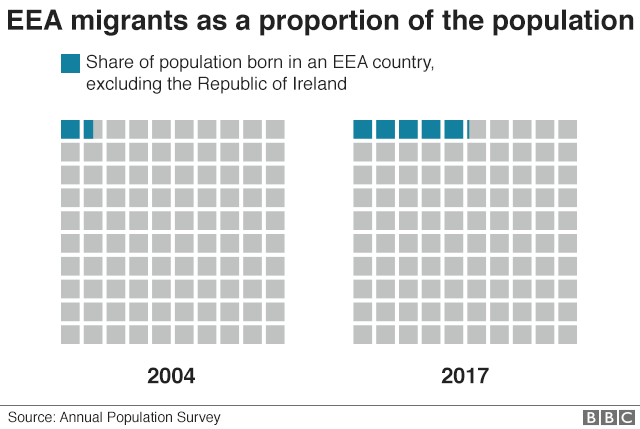
graph: eea migrants as a proportion of the population

In 2004, the EU was expanded to include seven nations from the Eastern Bloc- Estonia, Latvia, Lithuania, Poland, the Czech Republic, Slovakia, and Hungary – while Slovenia, Malta and Cyprus also joined at the same time.

Unlike Germany or France, the UK put no temporary restrictions on arrivals from these new member states.

Tony Blair’s Labour government had a positive stance on immigration: it argued a growing economy required a larger workforce and, as in the 1950s, people from other countries were considered a good source of new labour.

In any case, the government predicted that EU enlargement would only cause a rise of up to 13,000 people a year in immigration.

In the event, more than a million people from these countries arrived and stayed over the next decade. It was one of the biggest influxes in British history.

Since 2016, the year of the Brexit referendum, EU immigration has fallen – although more EU citizens still arrive in the UK than leave.

The current government plans to end the free movement of EU citizens to the UK once the Brexit transition period ends.

In the meantime, however, immigration from other parts of the world has increased to fill the gap. Despite government targets to reduce net migration to the “tens of thousands”, the UK’s net migration figures remain historically high in the context of the past century.

Source: Five times immigration changed the UK

Peculiar Case of Viktor Orban’s Visit to Indonesia

Interesting take:

“We don’t see these people as Muslim refugees. We consider them Muslim invaders,” Viktor Orban, Hungarian Prime Minister.

If the aforementioned interview quote from Bild was well-known among Indonesians and wide-spread among bapak-bapak‘s Whatsapp groups, Viktor Orban would have been welcomed differently in his latest three days visit to Indonesia.

The Hungarian Prime Minister Viktor Orban has been in Indonesia conducting his diplomatic tour in Asia, including his visit to Jakarta and Yogyakarta. This is not his first time landing on Indonesia’s soil as previously he was welcomed by President Joko Widodo (Jokowi) in 2016.

His latest visit to Indonesia is officially stated to strengthen 65 years standing bilateral ties between the two countries, especially by deepening cooperation on economic, infrastructure, trade, health, and people-to-people contact. Orban also attended CDI (Centrist Democrat International), an international centrist and Christian democratic party alliance, Executive Meeting hosted by Muhaimin Iskandar’s National Awakening Party (PKB) in Yogyakarta.

Orban himself is the Vice-President of CDI. Jokowi looked happy with his Hungarian counterpart’s visit as Orban pledged attractive investment and diplomatic commitments. Muhaimin Iskandar also seemed to be pretty much enjoying Orban’s visit, judging from his multiple Instagram stories.

It appeared that nobody really cares about Victor Orban’s erratic political footprints, especially on contentious issues such as multiculturalism, refugees, and Islam. Orban is widely known as the beacon of European populism, a poster boy of the rise of right-wing movements in the West as he staunchly criticizes the European Union’s Immigration policies, refuses refugees, and denounces multiculturalism.

Fidesz, his political party, is associated with anti-Islam and anti-Semitism narratives in Hungary and Central Europe. He repeatedly mentions the danger of multiculturalism and liberalism to Hungarian Culture by referring to the “Muslim refugees invasion” in “mass scale” as an example.

Given his political stance and discourse, it is intriguing to observe how Orban, the proponent of so-called “Christian and Illiberal Democracy”, engages in closer diplomatic partnership with the biggest Muslim nation in the world.

This is not to mention his partnership with PKB, the biggest Islamic party in Indonesia, under the CDI platform. Lest we forget that PKB is strongly popular with its multiculturalism and pluralism notions inherited by Abdurrahman Wahid’s thoughts.

Indeed, strategic and material considerations play profound roles as the main driver of Orban’s intention visiting Indonesia. In 2011, he launched Opening to the East Policy to diversify Hungarian economic ties by paying more attention to Russia and Asian countries.

Although it has been navigated since nine years ago, this ambitious foreign policy direction has not managed to be meaningful as Orban has not fully utilized Hungarian engagement to Asian countries. Visiting Indonesia, then, would be pivotal to spur Hungary’s footing in Southeast Asia.

Under his administration, the central European country has been enjoying the relatively enviable economic performance with an average 4.5 percent gross domestic product growth in the last three years, surpassing most of its neighbors in Europe.

Hungarian industries, infrastructure developments and services have been quite vibrant. It massively provides opportunities for Indonesia to be a strategic partner in trade and investment. Hungary also has advanced and sophisticated water management shown in Budapest and across the Danube river — an important know-how for future Indonesia’s new Capital city plan.

This is aligned with Jokowi’s vision to attract more foreign investment to Indonesia.

Getting closer to Hungary also means that Indonesia might open a new perspective export market to central and eastern Europe. Those regions are not only posed as alternative markets needed for Indonesian economic diplomacy. They also are increasingly pivotal in the geopolitical landscape in Europe.

However, Orban’s negative discourse on Islam and multiculturalism should not be left unnoticed. Orban’s negative discourse has, directly and indirectly, inspired Islamophobic notions in Europe.

Hence, Jokowi must not only take merely on Hungary’s economic and political variables into his account. These increasingly closer ties with Hungary should be used as a means to overcome xenophobia and anti-Islamic sentiment rooted in Hungary and Orban’s mind. Jokowi must follow up on Orban’s diplomatic commitment with efforts to promote interfaith understanding.

Indonesian Ministry of Foreign Affairs shall offer people-to-people diplomacy emphasizing multiculturalism, pluralism, and interfaith dialogues embedded in bilateral economic and political cooperation with Hungary.

The exchange of political and religious leaders is desperately needed to gradually foster a better understanding of Islam and multiculturalism in Hungary. This must be followed by Indonesian Fidesz counterpart, PKB to delve into deeper communication with Hungary.

PKB should have more moral responsibility and be the first loudest voice to speak up against anti-pluralism and Islamophobic to Fidesz through direct contact or using the CDI platform. It is not enough to take Instagram stories and only be a nice host for CDI’s event.

PKB can elevate its level and quality by being the biggest proponent against Islamophobia and anti-multiculturalism, not only in Indonesia but also in the heart of anti-Islamic sentiment. Indonesia rightfully has the legitimacy and credibility to communicate that democracy, pluralism, and religious values are possible to harmonize.

These values are not counter-intuitive with each other as believed by Orban and his party. These, in fact, are proven to be the source of a nation’s strength as demonstrated by Indonesia and it should be demonstrated to Hungary.

Because bilateral cooperation built upon solely on material benefits would not last sustainably, diplomacy must be developed perpetually upon constructive values. There must be efforts to ensure both countries embarking on the right side of history against hatred and xenophobia.

Both Indonesia and Hungary can work together on these constructive values while enjoying better economic cooperation, for the good of both regions, for the welfare of both nations, in the present and the future.

Source: Peculiar Case of Viktor Orban’s Visit to Indonesia

We must not forget the Holocaust. But the way we remember will change

From the conclusion of Erna Paris’ excellent long read and analysis of the various stages of coming to terms with the Holocaust:

As though Holocaust denial and museum controversies were not sufficient challenges to the narrative of memory, disputes of a different nature have divided the community of survivors, themselves, some of whom have preferred the commemoration of their unprecedented life tragedy over professional history.

In retrospect, commemoration was perhaps destined to conflict with the dry pursuits of scholars combing through archives, since personal recollections may, or may not, correlate with the rigours of historical fact.

In his 1961 book, The Destruction of the European Jews, the first archival work on the Holocaust, historian Raul Hilberg paid a heavy price. When he told the world that his research indicated that the number of murdered Jews may have been closer to five million than six million, anger erupted. The six-million figure was already settled. It mattered to commemoration. Dr. Hilberg, who was himself a refugee of Nazi Germany, was called an accomplice to Holocaust denial.

I, too, was led to a misunderstanding about history versus commemoration. In the 1990s, I was invited to lecture on Daniel Goldhagen’s provocative book, Hitler’s Willing Executioners, which claimed that ordinary Germans were “willing executioners” because they had been indoctrinated into what Dr. Goldhagen called “eliminationist anti-Semitism.” I had reservations about the fairness of this thesis and had already published my views in a book review in The Globe and Mail. I had barely begun to speak before a woman jumped up and said, “You should be ashamed of yourself!”

What followed was a shouting match among the audience, some attacking me, others defending me, while I sat down in amazement. Yet, all these years later, two remarks from that evening have never left me. A man seated at the back of the room said pointedly, “We don’t need history. We were there.” With sorrow in his voice, someone else said, “In 30 years you can say this. When we are all dead.”

What I came to understand that evening, with compassion, was that the commemoration of experience was what mattered for some people – commemoration and its complement, commemorative history. My criticism of an approved-of book had been perceived, by some, as an attack.

Contested historical narratives provoke impassioned debate. My favourite example of this was an illustration from the French newspaper, Le Monde, showing a large history book open to the year 1943. On one side of the book are dozens of tiny people pushing to close the page. On the other side, the same number of Lilliputians struggle to hold it open.

So we should not be surprised that the Holocaust, which was unprecedented in so many ways, continues to engender argument even among those who would not dream of denying its existence. But today we must ask a new question, which brings me to the third stage of my timeline of remembrance. How will the Holocaust be remembered after the remaining survivors die and its specific horrors recede from living memory?

I could be wrong. But I can suggest a few possibilities, based on present trends.

First, the bad news. In her recent studies of what she calls collective or cultural memory, reputed German scholar Aleida Assmann has argued that the shelf life of front-burner historical memory is approximately 70 to 80 years. That’s where we are now with regard to the Holocaust.

What this means is that it will become increasingly important to keep a factual narrative of memory alive in the face of possible distortion, forgetfulness or both.

The good news is that much good work has already been done. There has been a concerted effort to record the testimony of Holocaust survivors. These recordings will benefit future generations.

Another piece of good news is the creation of excellent Holocaust museums and memorials around the world. But memorials, too, must be curated properly, for when they are not, the results may be appalling.

For example, in a residential neighbourhood of Berlin, I once came across a memorial, made of mirror glass, upon which were engraved the names of the deported Jews of the district. It stood in the middle of an open-air food market and from time to time the vendors squinted through the names of the dead to apply their lipstick.

Many schools around the world now include Holocaust education in their curriculum, but how the subject is taught matters. Teachers must be trained to present difficult material in ways that do not overly traumatize youngsters, while at the same time offering them ways of using this hard learning to make a difference in the world.

I came to this conclusion on a visit to Nuremberg, where I heard a survivor tell her horrifying story to a group of shocked high-school students. One youngster raised his hand and asked the survivor what German children like him could do to ease her suffering. “Nothing,” she replied.

From her point of view, she was right. It was not her job to smooth reality to make that child feel better. But my heart went out to that boy – that descendant of Nazi Germany. He needed not to feel helpless before the enormity of his inheritance.

Carefully calibrated school courses, museums and memorials must offer a way forward, psychologically. To believe that one can learn hard truths, then make a difference to one’s society, will help to keep the memory of the Holocaust alive in positive ways.

In pondering the future of Holocaust memory, we might wish to return to the seminal debate between Mr. Carter and Mr. Wiesel. Mr. Carter’s secular vision was that the Holocaust was a crime against the Jews, but also a universal crime against humanity at large. Mr. Wiesel’s view of the Holocaust claimed Jewish particularity and had a quasi-religious cast, as evidenced when he said, “One should take off one’s shoes when entering its domain; one should tremble each time one pronounces the word.”

How might this controversy unfold in the future? I think we can already see where it is going.

After the genocides in the former Yugoslavia and Rwanda in the 1990s, in which similarities with the attempted Nazi genocide of the Jews were visible, Holocaust and genocide studies began to flourish in universities, including here in Canada. These studies are historical, but they are also interdisciplinarian in nature. The hope is that by incorporating the disciplines of psychology and sociology, for example, we will learn more about how and why such events occur and also how they might be prevented. A broader scope of study appears to be the new direction.

An interesting example of this widening scope took place just last summer. In the United States and elsewhere, people had used the phrase “concentration camps” to refer to the detention centres at the U.S.-Mexican border where children were separated from their parents and held in abominable conditions. In response, the United States Holocaust Memorial Museum issued a statement in which it rejected any possible analogies to the Holocaust, or to the events leading up to it. The uniqueness argument, in other words.

What followed was most revelatory. Hundreds of scholars of the Holocaust signed a public letter stating that the museum’s position made learning from the past almost impossible – and was far removed from contemporary scholarship.

The survivor recordings, the museums and the monuments, along with the extensive scholarly research that has informed the consciousness of the world, will all help keep the memory of the Holocaust alive. So will events such as Holocaust Remembrance Week.

Yet, at the same time as we rightly fight to preserve historical memory, we must realistically knowledge the potential lifespan of collective remembrance, the time-related slide into forgetfulness, the incessant politics that have always surrounded Holocaust discourse, and the real challenges being faced by the liberal international institutions and values that came into being as a result of the Nazi genocide, including the European Union.

Article 2 of the EU states that the organization is founded on values of respect, freedom, democracy and the rule of law, yet the EU continues to fund the illiberal regime in Hungary that has vilified George Soros and his Open Society Foundations with Nazi-style, anti-Semitic tropes. Resistance to this must harden.

A continuing positive consensus about the Holocaust will require active vigilance in the effort to protect all liberal democracies – the open societies that value ethnic diversity and religious tolerance.

All the same, change, like taxes and death, is inevitable. Nothing remains the same. And given the current trends in Holocaust studies, for example, it is possible that 50 or 100 years from now the Holocaust may primarily be remembered as a “first among others,” within a context of other genocides.

This should not worry us, in my view, for the “lessons of the Holocaust” are both particular and universal. As the scholars who opposed the Washington museum’s narrow approach to Holocaust history pointed out, what is and will be important is the ability to learn from the past.

The core learning future generations must acquire, in addition to the facts of Holocaust history, will be to recognize the impulse to genocide, how and why it starts, the propaganda tools it employs to persuade, and the known consequences of silence and indifference. I think this learning must also include the somewhat rueful acknowledgement that most humans are susceptible to propaganda in various degrees, which is why early-stage vigilance is so crucial.

Viewed from this perspective, the Holocaust may one day be remembered not only as tragic, but also as transformative in our understanding of humankind’s darkest impulses.

Source: We must not forget the Holocaust. But the way we remember will change Erna Paris

More research needed to break down job barriers for racialized Canadians

While the specific suggestions have merit, I think it would be more productive to focus on the effective of existing policies and programs in addressing gaps and challenges:

To improve understanding and pathways for progress, researchers should continue and expand work in several areas, including the following:

  • more disaggregated data to allow us to better understand the experience of different populations within the categories of “visible minority” or “immigrant”;
  • greater focus on the impact of bias, discrimination and systemic barriers in the employment system rather than focusing solely on how job seekers can be better “adjusted” for the labour market;
  • a better understanding of who does what in areas like language training, bridging and other occupational programs, so that we can develop better data on what works for whom;
  • greater examination of how policies in the selection of immigrants, in settlement support and in training programs affect newcomers’ opportunities, and of how these policies can be aligned with employers’ needs; and
  • more examination of ways to promote innovative employer practices to recruit, advance and create inclusive environments for newcomers and racialized Canadians.

The great number of underemployed newcomers and racialized Canadians represents a significant opportunity for Canada’s employers and for the economy more generally. By further investigating these questions, we can help to ensure that all Canadians are able to seize, and benefit from, the opportunities presented by a future of work that is more diverse and inclusive.

Source: More research needed to break down job barriers for racialized Canadians

Macpherson: Electoral reform or not, Montreal loses out

Good look at the impact and likely underlying motives:

“Gerrymandering” is a form of electoral fraud in which the boundaries of constituencies are drawn to advantage — or disadvantage — a particular party or group of voters. Two centuries after the practice was named after a Massachusetts governor named Gerry, it’s still used, notably in some Republican-controlled states to reduce the political influence of minorities.

To achieve a similar purpose here in Quebec, Smiling Frank Legault’s francophone-supremacistgovernment proposes to use not only the electoral map but also the voting system. Let’s call this variation “Frankymandering.”

I’ve already written about how, in the Coalition Avenir Québec government’s proposed new system, what a former nationalist premier notoriously called “ethnic votes,” already underrepresented in the legislature, would control an even smaller proportion of the seats.

There would still be 125 members of the National Assembly, but only 80 would still be elected directly by their constituencies. The other 45 seats would be distributed according to the vote in each region on a second ballot for a party rather than an individual candidate. Those “regional” members would owe their seats more to their party than to the voters.

And since the 80 ridings would generally be larger, the minorities, which are concentrated in the Montreal area, would control proportionately fewer of the 125 total seats.

The government has been far from transparent about how the changes would affect representation, leaving it up to voters to try to figure that out for themselves.

Among other things, Montrealers would lose political clout, not only because they would have fewer MNAs directly accountable to them, but because the island would have fewer MNAs in all.

As reported by La Presse this week, a Université Laval expert on voting systems, Louis Massicotte, found that among other things, the CAQ’s Bill 39 would “substantially” reduce the influence of Montreal Island.

In a brief to an Assembly committee holding a public consultation on the voting legislation, Massicotte wrote that “without the slightest justification,” the island would lose three seats, or 11 per cent of its present representation.

He said that when the bill was presented last September, its drafters “hid” this. The governing CAQ was making a “victim” of a region where it holds only two of the present 27 seats, which he called “obscene.”

In an article published in Le Devoir last December, Massicotte had written that some of the bill’s provisions might be seen as punishing “a region that is demographically important, but ethno-linguistically atypical, for its lack of enthusiasm for the present government.” Montreal, with its minorities, is the stronghold of the Quebec Liberal Party.

The government could hardly dispute Massicotte’s analysis in his brief, since it had a similar one of its own, in a briefing note for the minister responsible for electoral reform, Sonia LeBel. It finally released the note this week, but only because it was forced to do so after Radio-Canada obtained it.

It confirmed that Montreal Island would lose three seats, leaving it underrepresented in the Assembly with 19.2 per cent of the seats for 21.5 per cent of the registered voters for the 2018 general election. It would be left with only 16 riding MNAs compared to the present 27, and eight regional ones.

If Bill 39 is adopted as is, there will be a referendum on the proposed new system at the same time as the next general election, due in 2022. Apparently, the government hopes its own proposal will be rejected.

The CAQ promised a new voting system before the last election, but discovered the advantages of the present one when the Coalition won 59 per cent of the seats with 37 per cent of the vote.

But accidents happen. And just in case the proposal is approved in the referendum, the CAQ has built in a Plan B to weaken the influence of the minorities who now form the core of the remaining electoral base of its Liberal opponents: the Frankymander.

Source: https://montrealgazette.com/opinion/columnists/macpherson-electoral-reform-or-not-montreal-loses-out/