White House Sought Ways to Block Undocumented Immigrant Children From Attending Public Schools

Sigh…:

Some top aides to President Donald Trump sought for months for a way to give states the power to block undocumented immigrant children from enrolling in public schools — all part of the administration’s efforts to stem illegal crossings at the southern U.S. border.

Trump senior adviser Stephen Miller had been a driving force behind the effort as early as 2017, pressing cabinet officials and members of the White House Domestic Policy Council repeatedly to devise a way to limit enrollment, according to several people familiar with the matter. The push was part of a menu of ideas on immigration that could be carried out without congressional approval.

Ultimately, they abandoned the idea after being told repeatedly that any such effort ran afoul of a 1982 Supreme Court case guaranteeing access to public schools. But the consideration of denying hundreds of thousands of children access to education illustrates the breadth of the White House’s push to crack down on undocumented immigrants.

The strategy echoed the aim of a new rule the administration announced earlier this week that could block immigrants from becoming legal permanent residents if they’ve used government benefits. Any immigrant who had used Medicaid, public housing assistance or food stamps for more than 12 months over a 36-month period can be denied permanent resident status under the new rule.

The so-called public charge rule has sparked outrage among Democrats, who say it’s cruel. They have criticized Trump on a range of immigration policies, including a plan he announced last month to force Central American migrants to file for asylum in Guatemala instead of the U.S., a measure advocacy groups said would put their lives at risk. The debate over immigration is all but certain to play a central role in the 2020 elections.

A senior administration official, who requested anonymity when asked to comment on the story, dismissed accounts of Miller’s initiative as gossip from disgruntled bureaucrats but declined to identify any specific inaccuracy. The official also said undocumented immigrants placed an enormous strain on social services, including school districts.

Public Services

Starting in late 2017, Miller pressed hard to find a way to limit undocumented immigrants’ access to public services, including education, according to the people.

That effort included consideration last year of a guidance memo issued by the Education Department that would tell states they had the option to refuse students with an undocumented status to attend public schools from kindergarten through high school. A memo was never issued.

Education Department spokeswoman Liz Hill said: “The memo wasn’t issued because the secretary would never consider it.”

The White House’s push was dropped because members of the administration determined the plan could violate Plyler v. Doe, a 1982 Supreme Court case that prohibited states from denying free public education based on their immigration status.

The court, in a 5-4 ruling, said that denying migrant children an education would “foreclose any realistic possibility that they will contribute in even the smallest way to the progress of our nation” and that punishing them for their parents’ actions “does not comport with fundamental conceptions of justice.”

‘Punish Little Kids’

Immigration activists said they were alarmed the White House would consider a policy change targeting migrant children.

“Such a radical policy change would be unlawful, unacceptable and un-American,” said Frank Sharry, who runs the immigration advocacy group America’s Voice. “The notion that we should punish little kids who go to school and pledge allegiance to our flag because Trump and Miller want to make America white again is incredibly cruel, dark and sinister.”

The president in May said he was concerned that abuse of the asylum system “strains our public school systems” and used funds that should go to American citizens.

“We’re using the funds that should be going to them,” Trump said. “And that shouldn’t happen. And it’s not going to happen in a very short period of time.”

During the presidency of Barack Obama, immigration rights groups raised concern about that schools systems were making it too hard for children to enroll by imposing rigid documentation requirements. In response, the administration issued guidance to school administrators to be more flexible in the documents they accept.

Residency Documents

The 2014 guidance said schools should accept utility bills or leases as substitute proof of residency after reports that some districts were demanding driver’s licenses or Social Security cards that could be unattainable for those in the country illegally.

“Public school districts have an obligation to enroll students regardless of immigration status and without discrimination on the basis of race, color, or national origin,” then-Attorney General Eric Holder said in a statement at the time.

Congress also attempted to pass legislation in 1996 that would have allowed states to block public education benefits to undocumented children or charge tuition, but the effort failed when former President Bill Clinton threatened to veto the bill.

Around 725,000 kindergarten through 12th-grade students in U.S. public and private schools in 2014 were unauthorized to be in the country, according to a study by the Pew Research Center. That amounts to about 1.3% of total school enrollment.

The U.S. Census bureau said earlier this year that the cost spent by per pupil on elementary and secondary education was $12,201 annually, meaning spending on undocumented migrant students could exceed $8 billion annually.

Source: White House Sought Ways to Block Undocumented Immigrant Children From Attending Public Schools

Segal: Ten questions we should ask all party leaders in Canada’s federal election

Former Senator Segal is always worth reading as he tries to elevate political debate and discussion to more long-term perspectives. Unfortunately, politics has a short-term bias, particularly during election campaigns:

In the normal rhythm of election campaigns, coverage includes polls, the horse race and transient controversies of lasting or little significance. They occupy much media and narrative space.

The fact that shorter-term questions dominate the agenda is not a sign of weakness in our politics. It merely reflects the focus on the urgent and timely, rather than the long-term and more complex. But we should not minimize the longer term.

Here are 10 questions we should ask party leaders:

• With a population about the same as California and three per cent of the world’s capital, are you happy with our small population and economic capacity? Our population and modest capital markets do not enhance Canada’s clout in international negotiations with powers like China, the U.S. and the EU. Neither birth rates nor present immigration levels will change our population size or economic heft. Are leaders happy with the status quo? Are they content with our present approach to managing migration?

• Our able and well-trained military is under consistent pressure from international commitments and demands for civil aid at home. Can a country with our geography, neighbours and international commitments manage with a small armed force? Does Canada wish to be a global partner with allies who defend democracy, gender equality, human rights, freedom of the press, open navigation of international waters, diversity and freedom, or would we rather leave that to others? What should the projected strength of our Armed Forces be through the next decade?

• Under the present and most recent past government, Canada’s development investment to combat global poverty, human rights violations and promote economic opportunity among the least advantaged has been sharply reduced. We minimally assist our Commonwealth Caribbean, African and Central American partners. Yet many migration pressures facing Canada emanate from these regions. Is our continued withdrawal the right long-term course?

• The spectrum of reconciliation and partnership opportunities with First Nations is an amalgam of respect, economic rights recognition and commitment to economic rents and royalties for First Nations whose land is the source of economic profit for others.  Are our leaders satisfied with the slow progress on this file, evidenced by the continuation of the Indian Act and other colonizing and public policy practices?

• Setting aside the short-term debate about how best to price carbon, where are our leaders on the massive but economically productive investments necessary for adaptation to rising temperatures? Do leaders have a long-term view on scope and funding and are they prepared to share that with us?

• Gaps between our richest and poorest are increasing. Most provincial welfare plans keep poor Canadians trapped in poverty. Do any of our leaders care? And, if so, what are their long-term plans?

• If over-regulation is a detriment to economic productivity and investment, what about the impacts of under-regulation? From largely unregulated online platforms, to airline passenger rights, to digital privacy protections, to the private use of surveillance for profit-making, are leaders content with the status quo? If not, what is their long-term perspective?

• The Arctic remains an area where successive Canadian governments delivered far less than promised. The Chinese and Russians have made substantive investments in infrastructure, military and national capacity. Do leaders have a long-term strategy for protecting Canadian sovereignty and rights in that region – especially since climate change appears to be taking a toll on ice-field and glacier melting?

• With electoral reform on the sidelines, what do leaders feel are the priorities for strengthening Canadian democracy? Campaign finance, unregulated (allegedly) third-party coalitions with obvious partisan bias, invasive exploitation of social media, foreign intrusion in the voting process itself – all require updating. Do leaders have long-term priorities in this area?

Other valid questions will suggest themselves to many. The short-term is important. But in an election, the long-term should not be ignored.

Source: Segal: Ten questions for party leaders in Canada’s federal election

Hong Kong Immigration to Taiwan Surges as Protests Grind On

Hong Kong Immigration to Taiwan Surges as Protests Grind On


Other countries will likely see a similar increase (Hong Kong applications to Canada increased from 1,209 in 2016 to 1,877 in 2018):

As Hong Kong’s unrest continues, some in the city are looking to the less expensive rents, leafy green streets and relative political shelter of neighboring Taiwan as a safe haven.

The number of people moving to Taiwan from Hong Kong has risen rapidly — up 28% over first seven months of 2019 compared to a year earlier — fueled in recent months by anti-government protests that have swept the former British colony amid fear its autonomy from Beijing is being eroded.

Upwardly mobile entrepreneurs, salespeople and managers say they are attracted by a better quality of life in the democratically run Taiwan — including cheaper property prices, business opportunities and a safer living environment.

Hong Kong’s violence has increased in recent weeks as police and protesters clash and demonstrations spread across the city, including sit-ins that paralyzed its international airport for two straight days last week. China has doubled down on support for local leader Carrie Lam amid fears it will send in its army to restore order, and the city’s economy has begun feeling the toll of 11 straight weeks of rallies. With no end in sight, some residents are looking for a way to leave.

Taiwanese President Tsai Ing-wen has been vocal in her support for Hong Kong’s protesters in their pursuit of greater democracy, a contrast to the aggressive police tactics Lam’s China-backed government has used to try and subdue the rallies. The independence-leaning Tsai is up for reelection in January and has seen her support ratings rebound since the movement began, as Taiwanese voters recoil at the scenes unfolding in Hong Kong. China considers Taiwan part of its territory.

‘No Future’

“I want to move to Taiwan because Hong Kong is in a period of white terror and ruled by the police, which scares me,“ said 37-year-old retail salesperson Steven Chen, a Hong Konger who said he was working to move to the island. “I saw no future for the city when it returned to China some 20 years ago, but now it’s dangerous to live in as the police are not protecting people.”

Chen said he was borrowing money from friends and family to come up with the NT$6 million ($190,000) Hong Kong citizens need in order to apply for residency through a Taiwanese government investment scheme.

Chen said he has joined every protest since July 1 in support of Hong Kong’s mostly student protesters, including one in which he was almost hit by a rubber bullet. He saw his life as being in danger.

Dozens of Hong Kong protesters involved in the July ransacking of the city’s Legislative Council arrived in Taiwan last month to seek asylum, the Apple Daily newspaper reported. They were preceded by prominent activist and bookseller Lam Wing-kee, who fled to the island over the extradition legislation that sparked the current protest movement.

New arrivals from Hong Kong accounted for 9.4% of all immigration to Taiwan in the first half of the year — almost double last year’s percentage — according to Bloomberg calculations based on data from Taiwan’s immigration agency.

The trend is likely to continue as the Taiwanese government has no caps on relocations from Hong Kong and is open to more of its residents coming. “We welcome them,” says Taiwan’s interior minister Hsu Kuo-yung, adding that applications from Hong Kong have risen at least 30% in recent weeks.

A timeline of Hong Kong’s historic summer of protest

In a late 2018 survey from the Chinese University of Hong Kong — before the protests started — Taiwan ranked as the third most popular destination for Hong Kongers planning to move overseas, after Canada and Australia.

Norris Lo is another Hong Konger attracted by what Taiwan has to offer. She and her husband plan to open a pastry shop in the central city of Taichung next year. After considering countries like Australia and New Zealand, they opted for Taiwan due to its affordability.

“We want to open a small store of our own, and it’s impossible to do so in Hong Kong,” the 34-year-old pastry teacher said. She also cited the financial hub’s soaring cost of living and densely packed environment.

“We don’t see any light at the end of the tunnel,” she says. “If we could see a better future in the next 10 or 20 years, we would be willing to wait. But we don’t see it.”

Source: Hong Kong Immigration to Taiwan Surges as Protests Grind On

Australian citizenship law change affecting New Zealanders, high commissioner says

Tens of thousands of long-term residents could fail the new test, triggering the deportation process, a parliamentary inquiry heard on Monday.

The new migration rules will give the minister or his or her delegate a new discretionary power to cancel a visa if a person is convicted of certain offences, punishable by a maximum of two years in jail.

Offences include assault, using or possessing weapons, sex crimes or breaching an apprehended violence order.

A person will fail the character test if convicted of one of these offences, regardless of the actual length of the sentence imposed.

The test will also apply retrospectively, meaning the offence to trigger the reconsideration could have occurred decades ago.

New Zealand high commissioner Dame Annette King told the Senate’s legal affairs committee 2014 changes to visa rules which lowered the threshold for cancellations on character grounds had incurred a “disproportionate” impact on Kiwis living in Australia.

New Zealanders made up 10 per cent of the foreign born population but 50 per cent of deportations.

By comparison, only 1 per cent of New Zealand’s deportations were Australians.

“We don’t believe our community is less safe than Australia’s,” Dame Annette said.

She said Australia’s tightening migration rules had “become a rub and corrosive to our relationship”.

She urged the government to revert to the pre-2014 rules.

“If that is not possible we would like special consideration of New Zealanders living in Australia, because of the relationship, it is not like any other relationship,” Dame Annette said.

The Law Council of Australia also raised concerns that previous expansions of the power had not only led to more deportations, but greater ministerial intervention.

The number of via cancellations on character grounds rose by 1400 per cent between 2013 and 2017, the council said,

“The character test expansions have led not only to more cancellations but also a greater use of the minister’s personal powers, not only through section 501 but also through section 195A, which enables the minister to grant visas to detainees even where a section 501 cancellation has taken place,” its submission said.

“This is an inefficient use of ministerial time. Detainees must remain in prolonged detention while the department and the minister consider such matters.”

But Department of Home Affairs officials said the new rules were required to set an “objective, transparent” threshold for visas to be cancelled.

“I’d like to be clear that the consequences of not meeting this subjective threshold is that there would be further consideration of a discretionary power to refuse or cancel a visa where a non-citizen is convicted of a designated offence,” acting first assistant secretary of the immigration policy division, Michael Willard said.

“It’s important to note the conviction itself does not result in the automatic cancellation of the visa or a refusal of the visa and there’s a separate process for consideration of using this discretion that delegates or the minister would undertake.”

Head of the community protection division, Sachi Wimmer, said while it was impossible to say how many of Australia’s 1.9 million permanent visaholders would be captured by the changes, the department was bracing for an increase in referrals.

Source: Australian citizenship law change affecting New Zealanders, high commissioner says

‘Naïve and dangerous’: Conservatives blast Liberal policy after U.K. strips ‘Jihadi Jack’s’ citizenship

Of the many articles on Jack Letts, I picked this one, given the Conservative’s implementation revocation provisions is C-24. During parliamentary hearings on C-24 (and the subsequent repeal under the Liberals in C-6), the risk of “beggar the neighbour” approaches between countries was raised by Audrey Macklin among others.

So no surprise that it has happened, and from an overall security perspective, offloading a suspected terrorist to another government, does not increase security. That Britain did so, when Letts only has a formal connection to Canada, having been raised and grown-up in the UK, only makes it worse.

Conservative leader Scheer did not include citizenship issues when he unveiled his immigration policy a few months ago:

The Conservatives on Sunday renewed their condemnation of the Liberal government’s position on citizenship rights for terrorists, following news that U.K. officials had stripped former ISIL member Jack Letts — known as “Jihadi Jack” — of his British citizenship.

Conservative public safety critic Pierre Paul-Hus did not commit to overturning a policy introduced by Prime Minister Justin Trudeau in 2015 that would prevent Canada from making a similar move, but said the Liberal government must fight to keep Letts out of the country. 

“The idea that anyone who signed up to fight with ISIS can be reformed is naïve and dangerous to the safety of Canadians,” Paul-Hus said in a statement on Sunday. Justin Trudeau must assure Canadians today that he isn’t trying to bring Jihadi Jack back to Canada.”

Public Safety Minister Ralph Goodale on Sunday confirmed reports that the United Kingdom had revoked Letts’ citizenship, saying in a written statement that Canada was “disappointed” by the move, and accusing Britain of trying to “off-load their responsibilities.”

The move means that if Letts is deported, he would become the sole responsibility of Canada.

The issue might have set off a behind-the-scenes diplomatic row between the two countries, according to media reports and private emails from Canadian consular officials unearthed by the National Post. It could also refuel debate over whether Ottawa should be allowed to revoke dual citizens of their status as Canadians if convicted of terrorism, treason or espionage.

Letts, who was dubbed “Jihadi Jack” by British media, is being held by Kurdish forces in northern Syria. The longtime U.K. resident, now 24 years old, converted to Islam at a young age and eventually left the country to join the extremist organization, eventually settling in the ISIL stronghold of Raqqa. He was arrested and imprisoned in 2017.

His entire family are dual British-Canadian citizens, including his father, John Letts, who was born in Ontario, and his U.K.-born mother, Sally Lane.

In June, Letts’ parents were found guilty of funding terrorism after they wired their son money in a bid to help him escape an ISIL-controlled region of Syria.

The court heard that a member of Letts’ mosque in the U.K. had warned the parents that their son might have been radicalized, and that they should take away his passport as a way to protect him. But Letts and Lane reportedly ignored the advice and bought him a plane ticket to Jordan in 2014 for a “grand Middle East adventure,” according to one recollection of events.

According to media reports, Letts became known to authorities after a spate of violent Facebook posts, in which he said he would “happily kill each and every one” of the members of a British military regiment of which a former schoolmate was a member.

There is no clear evidence whether Letts personally carried out any violent acts during his time with ISIL.

Citing private emails from Global Affairs Canada, the National Post reported last October that Canadian consular officials had been in contact with Letts’ parents for months. The officials went as far as to discuss possible escape routes for Letts out of Syria, and assured his parents they were “working diligently on your son’s file,” according to the emails.

But their tone shifted abruptly in early 2018, the emails show, leading the family to believe that British officials had struck down those efforts behind closed doors.

The diplomatic spat could refuel a long-standing debate in Canada. Because international law prevents governments from making anyone “stateless,” only people with two passports can have their citizenship stripped.

In 2014, former prime minister Stephen Harper amended the Citizenship Act to allow Canada to strip the status of any dual citizen who is found guilty of terrorism, among other things. The Liberal government under Trudeau reversed that decision in a bill that passed through the Senate in 2017.

Some experts say efforts by Britain are counterproductive and run afoul of human rights laws.

“I think there’s a real question here as to whether Britain is violating international law by doing this, and whether Canada could seek to hold the U.K to account,” said Audrey Macklin, a human rights law professor at the University of Toronto.

Macklin said moves to render people stateless can in turn stymie efforts to snuff out terrorist organizations.

“If you are serious about global co-operation in combatting terrorism, you would realize that citizenship stripping is inimical to that,” she said. 

Trudeau is due to meet the new British prime minister, Boris Johnson, at a Group of Seven meeting in France that starts on Aug. 24.

British Foreign Secretary Dominic Raab met Canadian Foreign Minister Chrystia Freeland in Toronto earlier this month. The two ministers discussed Letts during the visit, yesterday’s statement from Goodale’s office said.

“While we are disappointed in their decision, we do not conduct tit-for-tat diplomacy. Canada and the U.K. continue to work closely together on a number of issues, including the situation in Hong Kong,” the statement added.

Source: ‘Naïve and dangerous’: Conservatives blast Liberal policy after U.K. strips ‘Jihadi Jack’s’ citizenship

Sensible commentary by Doug Saunders:

The Easter Sunday atrocities in Sri Lanka have not only brought horror to the island’s tiny, impoverished Christian community and threatened an end to the country’s decade of unsteady peace. They’ve also struck fear in the governments and security agencies of many countries, including Canada, which have been struggling to deal with a steady trickle of their citizens seeking to return home from Syria and Iraq.

We don’t know whether reports are true that two or more of the Sri Lankan terrorists had gone to Syria to fight with the terrorist army that calls itself Islamic State (also known as ISIS, ISIL and Daesh), and returned after that organization’s self-proclaimed caliphate was crushed and defeated last year. It is clear, however, that the attacks are linked to a desire among some of that organization’s former fighters to bring revenge to their own countries.

There are currently several hundred European, U.S. and Canadian alleged IS fighters being held in northern Syria by the Kurdish-led Syrian Democratic Forces (the number of Canadians may be as low as 10). Whether they should be returned to their home countries is the subject of an intense international debate.

Some have suggested stripping them of their citizenship – which was a legal option, rarely if ever applied, under Stephen Harper’s Conservative government – thus making them the responsibility of some other country. Others wonder why we should be responsible for investigating and trying Canadians who allegedly have committed grave crimes abroad; in other circumstances, they’d be tried and sentenced in the place where their crimes took place.

But they are, ultimately, our problem. They aren’t foreign – almost all the Canadians accused are Canadian citizens born here to Canadian families, and their radicalization took place here, in the dark corners of Canadian society. To attempt to dump them on another country, or on a poor and struggling Kurdish-led Syrian democracy movement that has already been betrayed by Canada and its allies, would be both immoral and dangerous.

There are good reasons why nobody is eager to see them returned. The probability of any returned foreign fighter committing violence is low – a 2015 study found that only 0.2 per cent of returned fighters, or one in 500, had been charged with terrorism offences. The return of IS fighters has not produced the wave of attacks that many had anticipated. But the few who do maintain their violent commitments are noted, in the words of a study published last year by the United Nations Security Council, for their “increased lethality, both as attackers and as attack planners,” making them responsible for “some of the most lethal terrorist attacks.”

But the flaw in the citizenship-stripping approach becomes apparent when you take a close look at those who have dual citizenship, and would therefore be eligible.

Typical of them is Syrian detainee Jack Letts, who holds both Canadian and British citizenship. Neither Canada nor Britain wants him back. Political leaders in both countries have suggested revoking his citizenship – and thus dumping his case, and the considerable security and justice costs associated with his case, on the other country.

As a result, he waits in Syria. If he is guilty of atrocities or war crimes – and simply being a member of IS could qualify as one – neither country is willing to expend the investigative and judicial resources to prove it and bring him to justice. If he is innocent, as he claims, neither country is willing to try to clear him.

The Kurds have made it clear that they do not want hundreds of people such as him on their hands. Ilham Ahmed, a leader of the Kurdish-led SDF, says it is straining their resources just to hold people such as him. “We have provided the support we can by arresting them and detaining them in prisons, but who is going to take them to court?” she told the Financial Times. “Who is going to [be] carrying out the prosecution?”

Another horrific news story this month illustrated the risk of not taking these people back. Germany is currently trying a 27-year-old woman from Lower Saxony known as Jennifer W. for allegations that she, as an IS “morality policewoman” in Syria, tortured a 5-year-old Yazidi slave girl to death. Prosecutors consider themselves lucky to have found a phone containing what they say are incriminating messages.

If kept in Syria or foisted on another country, she would never have been charged. Trials such as hers are expensive, difficult and risky, but the expense is necessary, and the risk would be greater if these people were left at large. Some of them may be the world’s worst people, but they are our people. If they are truly to be brought to justice, or at least kept under watch so they pose less danger, it is far more likely to happen here.

Source: Canadian extremists returning from Syria are a big problem – but they’re our problem

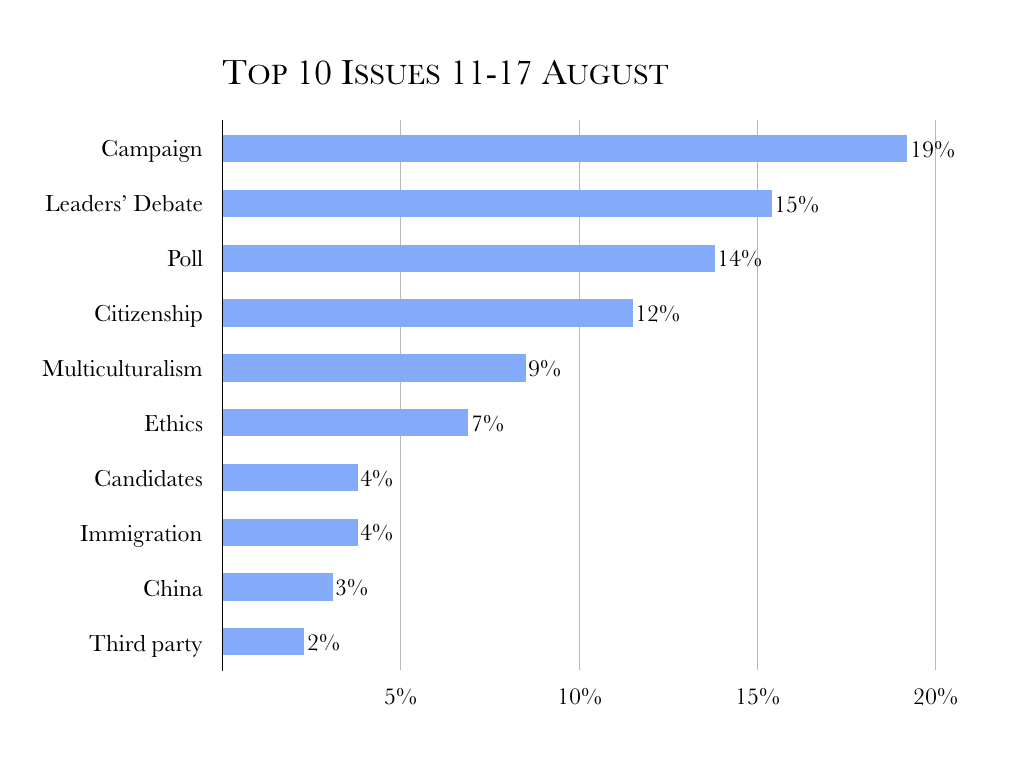
Ethnic Media Coverage 11-17 August

Latest weekly analysis of ethnic media coverage. For the analytical narrative, go to diversityvotes.ca Ethnic media election coverage 11-17 August 2019:

I’m a Black Feminist. I Think Call-Out Culture Is Toxic. There are better ways of doing social justice work.

Thoughtful reflections:

Today’s call-out culture is so seductive, I often have to resist the overwhelming temptation to clap back at people on social media who get on my nerves. Call-outs happen when people publicly shame each other online, at the office, in classrooms or anywhere humans have beef with one another. But I believe there are better ways of doing social justice work.

Recently, someone lied about me on social media and I decided not to reply. “Never wrestle with a pig,” as George Bernard Shaw said. “You both get dirty, and besides, the pig likes it.” And one of the best ways to make a point is to ignore someone begging for attention. Thanks, Michelle Obama, for this timely lesson; most people who read her book “Becoming” probably missed that she subtly threw shade this way.

Call-outs are often louder and more vicious on the internet, amplified by the “clicktivist” culture that provides anonymity for awful behavior. Even incidents that occur in real life, like Barbeque Becky or Permit Patty, can end up as an admonitory meme on social media. Social media offers new ways to be the same old humans by virally exposing what has always been in our hearts, good or bad.

My experiences with call-outs began in the 1970s as a young black feminist activist. I sharply criticized white women for not understanding women of color. I called them out while trying to explain intersectionality and white supremacy. I rarely questioned whether the way I addressed their white privilege was actually counterproductive. They barely understood what it meant to be white women in the system of white supremacy. Was it realistic to expect them to comprehend the experiences of black women?

Canadians in Hong Kong urged to vote in federal election with an eye on party policies toward territory and China

Interesting that virtually all of the advocates quoted are non-Chinese Canadians. The one Chinese Canadian quoted makes the most sensible comment that his vote won’t be this single issue.

Given the large number of Canadian expats in Hong Kong, Richmond BC was a possible example where Chinese Canadian expats could influence the election result in that riding.

We will see whether the indefinite extension of voting rights for expats results in a significant increase in expat voting (only 15,603 registered in 2015 of whom 10,707 valid votes cast):

 As Hong Kong wrestles with its worst political crisis in years, Andrew Work wants the hundreds of thousands of Canadians living there to know they have a new chance to help elect a government in Ottawa that will represent their interests.

Mr. Work, president of the Canadian Club in Hong Kong, is organizing a voter-registration drive to urge some of the estimated 300,000 Canadians who live in the city to cast their ballots in the coming federal election in Canada. Previously, Canadians who had lived outside Canada for more than five years were barred in theory from voting under legislation from the early 1990s, That law was only loosely enforced. In response to a Harper government’s attempt to enforce that law, however, the Supreme Court ruled this January that all non-residents have the right to vote, no matter how long they have lived elsewhere. The Liberal government also passed legislation last December extending voting rights to all non-resident citizens.

“I am sure for some people, they will very much have [Hong Kong’s political turmoil] on their mind as they would look carefully at Canadian policies towards China and Hong Kong as part of their voting calculation,” Mr. Work said in an interview from Hong Kong.

“Ten years ago, that wasn’t the case. Now that Hong Kong is on the front page of newspapers everyday around the world, including Canada, Canadians of all types will have Canada’s policy on their mind.”

Ghislain Desjardins, a spokesman for Elections Canada, Asia, said earlier this week that there are 628 voters registered on the International Register of Electors in 198 different electoral districts. The agency doesn’t have country-specific numbers.

Hong Kong has been racked by months of protests by demonstrators angry at what they see as the Chinese government’s increasing incursion into the semi-autonomous territory’s affairs.

Barrett Bingley, originally from Victoria, now works as the North Asia sales director for The Economist in Hong Kong. He said the protests are having a devastating effect on the people who work for him.

“I have many staff who I worry about now,” he said. “I had staff who had been tear gassed; staff who were not protesting who were tear gassed … We have staff who are experiencing psychological issues. We have to make sure they’re well taken care of.”

When casting his vote in the Canadian election, he said he’ll be considering which political leader is willing to take a strong stand to protect the “one country, two systems” philosophy that China promised when it took possession of the territory from Britain in 1997. The arrangement allows Hong Kong its own laws for 50 years.

The recent weeks’ increasing violence in Hong Kong have made him concerned about his and his family’s safety. He said both Australia and British consulates sent representatives to Hong Kong’s airport, where some of the latest demonstrations took place. He said the Canadian consulate should be doing more to safeguard its citizens.

Instead, Mr. Bingley said he has been watching the Canadian government “say virtually nothing” on the issue except for a “soft statement” made by the Prime Minister Justin Trudeau earlier this week.

On Monday, Mr. Trudeau told the media that the government is “extremely concerned” about the situation in Hong Kong and called on Beijing to be “careful and respectful” in its handling in this crisis.

“We need to see the local authorities listening to the very serious concerns brought forward by Chinese citizens and their concerns around the decisions that the local authorities in Beijing have taken,” he said.

Mr. Bingley said he prefers the statement issued by Conservative Leader Andrew Scheer, who wrote on Twitter: “As Beijing amasses troops at the Hong Kong border, now is the time for everyone committed to democracy, freedom, human rights, and the rule of law to stand with the people of Hong Kong, including the 300,000 ex-pat Canadians. Now, and in the coming days, we are all Hong Kongers.”

Montreal-born Jean-Christophe Clement has been living in the city for a decade and has participated in the protests. The employee of a finance software vendor, 49, recently registered to vote and said a federal party’s position on what’s happening in the region would “almost entirely set the tone” for his voting decision.

He said he would cast his vote for a politician who is “in support of the protection of rule of law and democracy in Hong Kong.”

Although escalating tensions in the city haven’t affected his daily life much, he said the China’s People’s Armed Police exercising in Shenzhen, on the border with Hong Kong, worries him.

“My concern would be PLA comes in and there’s martial law.”

Paul Evans, professor in the School of Public Policy and Global Affairs at the University of British Columbia, said Mr. Scheer’s invocation of Cold War imagery of Berlin and the rallying cry of democracy, human rights and the rule of law will likely appeal to some.

But from his own experience in Hong Kong, he said people in the region are more realistic about the limited options that the territory has operating in its Chinese context, and the ability for other countries to have an impact.

For some other Canadians in Hong Kong, candidates’ domestic policies will weigh more in their votes.

Nathaniel Chan, who grew up in Toronto, said politicians’ positions on the Hong Kong issue have “no bearing” in his ballot.

“I think when we vote in a national election, it should be mostly about the standard of living for people in Canada or policies that affect all Canadians.”

Mr. Desjardins of Elections Canada said they sent 857 ballot kits to international electors in Asia during the last election, but the agency does not provide data on the number of ballots returned, for security reasons.

The agency conducts outreach through a small digital ad campaign targeting electors abroad, according to Mr. Desjardins, and also places posters at embassies and consulates with information on voting.

It’s not enough, Mr. Bingley said.

“What hasn’t been in Hong Kong so far though is there hasn’t been a campaign by the federal government, by the consulate to get Canadians registered and to explain how to do it,” Mr. Bingley said.

“There needs to be concerted information campaign of how to do this.”

Unequal citizenship rights for women and equality in law — Malaysian Campaign for Equal Citizenship

Of interest:

The Campaign for Equal Citizenship led by the Foreign Spouses Support Group welcomes the recent announcement by Tan Sri Muhyiddin Yassin and the Ministry of Home Affairs to draw up a new standard operating procedure (SOP) for citizenship applications. This would presumably ensure that citizenship applications are considered more fairly and promptly.

However, this is inadequate for the thousands of Malaysian mothers who wish to confer citizenship to their children born overseas. The government must fix the law, so that Malaysian women enjoy equal citizenship rights compared to Malaysian men.

Of course, a Malaysian mother married to a foreign man who gives birth in Malaysia can confer citizenship to their children but the discrimination is stark when these mothers for various valid reasons give birth overseas.

Reasons for giving birth overseas range from holding overseas jobs, unable to afford flights, premature births or risking medical complications. There are also many reasons such as aging parents, why women choose to return to Malaysia with their families and have their children grow up here as citizens.

Whilst a Malaysian father can simply notify and register at the nearest embassy of the country where his foreign wife has given birth, whereupon Malaysian citizenship papers will be issued within a time period from 3 days two months, however the Malaysian mother has to apply for citizenship for her children

Based on experiences of these Malaysian mothers, they are often misinformed by authorities abroad and at home, given inconsistent information and experience inconsistent practices. While there have been success stories, we are looking at an average waiting time of one to seven years or more to get an approval, often after multiple rejections and re-applications. Allegedly rejections are part of the SOPS to test to see if these Malaysian mothers are truly sincere and loyal to Malaysia a test not accorded to Malaysian fathers.

So, while developing a new SOP may be a temporary solution, there is a dire need for a permanent solution.

To do so, we must address first the root of the discrimination. In principle, Malaysia does not recognise mothers as equal parents by law, as the Federal Constitution expressly provides that children born overseas to married Malaysian fathers are entitled to citizenship by operation of law (Article 14(1)(b) but is silent on children born overseas to Malaysian mothers.  Consequently, the process for registering children born overseas as Malaysian citizens is far more arduous for Malaysian women making them feel like second-class citizens.

This law is deeply rooted in patriarchy which allows for sexist attitudes that influence the applications processes. These women are expected to follow the husband’s citizenship, live overseas and not enjoy the option for their children to choose their nationality. Not to be labour a point, the children born overseas to Malaysian fathers enjoy this choice.

Malaysia is currently one of only twenty-five countries globally, and one of four countries in the Asia Pacific region, which has discriminatory citizenship laws.

Amend Schedule II of Federal Constitution to explicitly allow both men and women to confer citizenship on their children born outside of Malaysia through the same process. and make it equal and right for Malaysian women, we make up half of Malaysia and we count.

Source: Unequal citizenship rights for women and equality in law — Malaysian Campaign for Equal Citizenship

Ibbitson: At the core of the SNC-Lavalin affair, a familiar case of he said, she said

The most interesting commentary on the SNC-Lavalin affair I have seen, given its gender take:

Justin Trudeau and the Old Boys at SNC-Lavalin will never understand why so many people are so angry at them. They’ll never understand why those women over at the Justice Department fought them and defeated them.

But others do understand. They know what frustrated privilege looks like, what happens when powerful men don’t get their way.

“I’m not going to apologize for standing up for Canadian jobs, because that’s my job,” Mr. Trudeau repeated, defiantly, Thursday, after Ethics Commissioner Mario Dion found the Prime Minister had repeatedly violated the Conflict of Interest Act in trying to prevent the criminal prosecution of the engineering firm. “I disagree with the Ethics Commissioner’s conclusions,” he declared, even though “I take full responsibility.”

Prime Minister: If you won’t apologize and you reject the report’s conclusions, you are taking no responsibility at all.

But this fits with Mr. Trudeau’s attitude and the attitude of those who surrounded him during this affair.

Consider: SNC-Lavalin had been pushing for a deferred prosecution agreement that would let it escape trial on corruption charges practically from the day the Liberals took office. It worked.

After then-chief executive officer Neil Bruce met with Finance Minister Bill Morneau at the Davos Economic Forum (of course), Mr. Morneau inserted a measure into the 2018 budget that would allow a company in SNC-Lavalin’s situation to secure a deferred prosecution agreement.

Mr. Morneau was shocked when Kathleen Roussel, Director of Public Prosecutions and the first woman to stand up against this Old Boys club, decided later that year that SNC-Lavalin did not qualify for a deferred prosecution agreement. Mr. Morneau and Mr. Trudeau believed Jody Wilson-Raybould, as attorney-general, should intervene. Ms Wilson-Raybould, the second woman in the line of fire, backed Ms. Roussel.

The Old Boys fought back. Former Supreme Court justice Frank Iacobucci, who is legal counsel to SNC-Lavalin, offered an opinion that an intervention by the attorney-general would be legitimate. Another former Supreme Court justice, John Major, weighed in on a related matter.

Meanwhile, aides to Mr. Morneau and Mr. Trudeau put pressure on Jessica Prince, Ms. Wilson-Raybould’s chief of staff, to make her boss see the light. They failed.

Mr. Trudeau and Michael Wernick, then-clerk of the Privy Council, met in person with Ms. Wilson-Raybould, to no avail. But aides Mathieu Bouchard and Elder Marques kept pushing. So did Gerry Butts, Mr. Trudeau’s then-principal secretary, and, to a lesser extend, Katie Telford, Mr. Trudeau’s chief of staff.

Kevin Lynch, chairman of SNC-Lavalin and a former clerk of the Privy Council, and Robert Prichard, legal counsel for SNC-Lavalin and former president of at University of Toronto (among many other things), took the matter to Scott Brison, then-president of the Treasury Board. Mr. Brison was sympathetic, but he got nowhere with Ms. Wilson-Raybould, either.

SNC-Lavalin proposed that Beverley McLachlin, the former chief justice of the Supreme Court, mediate a settlement. But Ms. McLachlin had her own reservations and Ms. Wilson-Raybould saw no need to consult her. So that was that.

Put it all together. On one side, a coalition that included Mr. Trudeau, two cabinet ministers, the clerk of the Privy Council, political advisers and the leadership at SNC-Lavalin. Almost every one of them a man, steeped in the Ottawa establishment and used to being obeyed.

On the other side, a group of women, led by Ms. Wilson-Raybould, that included her chief of staff, the Director of Public Prosecutions and deputy minister Nathalie Drouin. They were joined by Jane Philpott, who ultimately resigned from cabinet in solidarity with her friend.

According to the report, Mr. Trudeau’s lawyer described the Prime Minister’s relationship with Ms. Wilson-Raybould as “challenging and tense.” He alleged friction between the minister and cabinet colleagues, and described her decision-making as “infected by legal misunderstanding and political motivation.”

So which is it? Did a difficult and unqualified attorney-general resist the reasonable advice of the Prime Minister and his senior advisers, who were trying to save a valued company from an unnecessary prosecution that could put it out of business, costing thousands of jobs?

Or, did a domineering group of entitled men unsuccessfully try to bully Ms. Wilson-Raybould into interfering in a criminal prosecution, for which the Prime Minister should apologize?

We know what Mr. Trudeau thinks. What do you think?

Source: Opinion At the core of the SNC-Lavalin affair, a familiar case of he said, she said