With female and LGBTQ prayer leaders, Chicago mosque works to broaden norms in Muslim spaces

Of interest:

The story of Rabia al-Basri is one that Muslim kids learn early.

She ran through her hometown of Basra, Iraq, with a torch in one hand and a bucket of water in the other. When townspeople asked her why, she said she wanted to burn down heaven with the torch and put out hellfire with the water so that people could worship without fear of punishment or desire for reward, for the sake of God alone.

“The story defines this space,” said Mahdia Lynn, who co-founded the mosque in 2016 in the Loop that bears the name of Rabia, and, more importantly, she said, the responsibility that comes with it.

At Masjid al-Rabia, the difference from mainstream mosques is immediately apparent. Every Friday, a handful of men and women pray shoulder to shoulder. The khutbah, or sermon, is a discussion, and congregants participate in a group circle. There is no consistent imam, or leader in prayer; rather, anyone can volunteer to stand in the front to lead. It is one of very few public mosques in the world that allows and encourages women to lead prayer in a mixed-gender prayer space.

“Our approach says that wanting to lead a prayer in that moment, that is what makes a person equipped to lead,” Lynn said.

In mainstream mosques where men lead the prayer, men pray in the front and women pray behind them, or in some cases, behind a barrier. Sometimes, women pray in a separate room with an audiovisual setup.

While women-only mosques have existed for hundreds of years in China, it is only in the past several years that imams and scholars have begun to organize more inclusive mosques in Indonesia, Europe and the United States — all with varying styles and levels of success. In 2015, the first women’s-only mosque in the U.S. opened in Los Angeles, according to news reports.

Though men and women often attend private prayer groups together, it is difficult to find any mosques in the world that publicly advertise having a prayer space with no barriers to gender, like Masjid al-Rabia.

“Most of the places it is happening, people are organizing based on who wants to worship and not because they want to publicize it,” said Amina Wadud, an Islamic scholar who has worked for decades at the intersection of Islamic theology and women-centric movements. “Sometimes you do a thing because you feel the thing is good and you don’t need any attention for it. Sometimes you have to combine that intention with some advertisement because how else do you open people up to the story?”

In Chicago, Lynn said the group is moving to a larger space that, in addition to hosting prayers, will serve as a hub for the social justice work the mosque began several years ago. The most important work the mosque does, Lynn said, is its prison ministry, which has grown to more than 600 participants in the past two years.

“Like Muslims who are queer and trans, (incarcerated people) are our family members who are forgotten. And the fact that they are forgotten is both unacceptable and changeable,” said Lynn, who is transgender. “In the faith tradition, there is a strong idea of freeing prisoners and serving those who are oppressed. You are ultimately helping the oppressor by preventing them from oppressing people.”

‘Embodied ethics’

Lynn’s work is only the latest in a long tradition of global attempts to broaden mainstream prayer norms.

Twenty-five years ago in Cape Town, South Africa, Wadud, who is retired and lives in Indonesia, for the first time led a part of the Friday prayer, which is generally performed by a male leader.

She waited more than 10 years to do anything as public as that again, though she was asked. She said she took time in the interim for “spiritual reflection and intellectual research,” to figure out her own intentions. The next time she led a Friday prayer service, it was in New York in 2005 and it made headlines because of the size of the congregation — more than 100 people participated — and a protest was held outside.

She said it was important to take a public step at that time.

“It was about embodied ethics, where it’s not enough to say, ‘I believe women are equal to men.’ I have to demonstrate it with my body,” Wadud said. “Sometimes you have to do that.”

Imam Ibrahim Khader of the Muslim Community Center organization, which has three locations in the Chicago area, said the separation of men and women in a prayer space is based on hadith, or sayings, of the Prophet Muhammad, one of which states that, in a congregation, the best place for a man during prayer is the front row, and the best place for a woman during prayer is the back row. He also pointed to the requirement of Muslim men to attend Friday prayers, which, according to hadith, does not exist for Muslim women.

“At the end of the day, these are narrations,” Khader said. “We can try and reason with these and understand the context, but we still follow them.”

Scholars, particularly those who say they prioritize inclusion over other ideas, lean on the Quran, which they say has higher authority than either the words or the actions of the Prophet Muhammad, to make their case.

“In Muslim patriarchies, men’s authority is underwritten by specific interpretations of ‘Islam.’ I put ‘Islam’ in quotes because, if we are speaking about the Qur’an, then there is nothing in it — not a single verse — that says women cannot lead a prayer and only men can,” Ithaca College professor Asma Barlas, who studies patriarchal interpretations of the Quran, said in an email. “Nor is there a single statement to the effect that men are morally or religiously or ontologically superior to women. Not one.”

Chicago activist Hind Makki runs a blog called Side Entrance, through which she encourages Muslim women to document women’s prayer spaces in mosques around the world: “the beautiful, the adequate and the pathetic.”

“Certain prayer spaces can be spiritually abusive, and we need to collectively create our own spaces,” Makki said.

As some Muslim communities struggle with inclusion, Makki encourages people to create third spaces, away from mainstream mosques and the secular world, where they can follow their faith without some of the cultural baggage.

“In the here and now, people have shown that they need to create their own spaces that are healthy and welcoming for spiritual sustenance, which you can’t get at mosques where your spirituality is not part of the picture,” she said. “Whether that’s creating a mosque like Masjid al-Rabia, or just gathering in someone’s living room, it’s so important for your spiritual health.”

An interfaith environment

Lynn, 31, who is from southeast Michigan, said she has always had an instinct toward community organizing, and she found Islam in her early 20s, at a time when she was living a very different kind of life than now.

“I was not good at being a human being. I was just not understanding what my place in the world was. Who to be, how to live, what to do,” she said. “Islam gave me an understanding and an order.”

She said the first year of being Muslim was a journey she took alone, but in 2014, she attended an LGBT Muslim retreat in Philadelphia.

“It felt like I was among people who knew the importance of the tradition, what it meant to be a transgender woman practicing Islam, what it means to be someone on the outside looking in,” she said. “That got me back into the community organizing and activism, back to troublemaking.”

This year, Lynn conducted her first nikkah, or wedding ceremony, and the masjid’s (mosque’s) first one — for two queer Muslim men in a prison hundreds of miles away. It was a wedding, she said, that ended up being a stack of papers an inch or two thick mailed to Lynn that contained some of the essentials for an Islamic wedding: written statements from witnesses, an exchange of vows, a mahr statement (a financial agreement in the case of separation). Later, she and others from the mosque threw a party that doubled as a proxy wedding with stand-ins for the grooms.

This week, the masjid, which is run by Lynn, who is a part-time employee, and a few other volunteers, moved into a space at GracePlace in the South Loop, sharing a prayer hall with Christian congregations, and hosted its first Friday prayer. At the final prayer before the move, congregants discussed their new home.

“Are they also progressive?” asked one attendee.

“Yeah, we had to make sure they were OK letting all the gay Muslims in,” said Hannah Fidler, a volunteer program coordinator at the mosque. The group laughed, even though for a community like this, security can be a real concern.

The move to a more public forum is a big change for the community, and Lynn said she hopes it will allow Masjid al-Rabia to become more established in Chicago. The focus for the past couple of years has been mission-based activities, like the prison ministry, a joint Eid and Pride celebration, and Quran study groups, she said. But with a larger space, it’s possible to intentionally grow Friday attendance and make sure it’s accessible to everyone.

Wadud, the Islamic scholar, said this kind of space marks an evolution.

“We are seeing, what does it take to start a movement? What does it take to spread a movement?” she said. “What does it take for it to no longer be a movement because it’s just par for the course?”

Source: With female and LGBTQ prayer leaders, Chicago mosque works to broaden norms in Muslim spaces
As he readies for new role, 1st Mountie to wear turban reflects on RCMP career

Thoughtful reflections of a trailblazer:

Baltej Dhillon has kept a scrapbook during his nearly three-decade career with the RCMP.

There are photos of him standing proudly in the red serge in the early 1990s, the iconic Stetson hat replaced by a tan turban. There are newspaper clippings — both positive and negative. And there’s a schoolyard poem, filled with nearly every ignorant stereotype about Sikhs one could imagine.

“I’ll dress up in my coat of red / And wear my laundry on my head,” part of the poem reads. “It’s much better, they’ll decide / If we ride camels in the musical ride.”

It was written by a child and shared around the schoolyard, but it’s a dark reminder of some of the attitudes the trailblazing officer has faced over the years.

This week, Dhillon, 53, retired from the RCMP after a career that saw him rise to the rank of inspector, as he took part in high-profile cases, including the investigations into serial killer Robert Pickton and the Air India bombing.

“When I first got involved in the Air India task force, I wasn’t trusted. I wasn’t included in some of the meetings,” said Dhillon. “I was told that it was because there was concern that I might compromise the file.”

That mistrust is something Dhillon experienced before he ever donned the red tunic.

Born in Malaysia, a teenage Dhillion and his family moved to British Columbia in 1983. After high school, he studied criminology and initially wanted to be a lawyer. But he sought to become a Mountie after volunteering with the RCMP as a translator for Asian immigrants.

Dhillon formally applied to the force in 1988 and passed all the entrance requirements. But at the time, the RCMP dress code banned both turbans and beards — key components of his Sikh faith.

A CBC News story from 1989 shows a spandex-clad Dhillon exercising, as he waits for the regulations to change, allowing him to serve with a uniform that doesn’t clash with his religion.

A petition calling for the exclusion of turbans in the RCMP circulated at the time, with thousands of signatures. A Calgary businessman had pins made that clearly express opposition to turbaned Mounties.

In 1989, Baltej Dhillon, 23, had passed the tests required to begin training as an RCMP officer, but his refusal to stop wearing a turban, an article of faith for Sikh men, kept him on the sidelines. 1:54

But the young prospect had supporters, including mentors and the RCMP commissioner, and the regulations were ultimately changed to allow Mounties to serve with a beard and turban.

“The RCMP commissioner came face to face with the Charter of Rights [and Freedoms] in Canada, which clearly states that one cannot be discriminated for practising their faith,” said Dhillon.

When he went for training in Regina, Dhillon said other members of his troop were cordial. But the first time he entered the mess hall, the room fell completely silent.

“When I walked in, there were 1,200 eyes looking at me … it was very intimidating,” he recalled.

The young constable’s first assignment was in Quesnel, B.C., where he was greeted with a large plywood sign that said, “Welcome to Quesnel, Turbocop.” Dhillon decided to assume it was a welcoming message.

But he soon learned that his partner had told other officers that he wouldn’t back Dhillon up, because he was wearing a turban.

“All you’ve got is your partner, and if your partner’s saying, ‘I’m not backing you up,’ well, there goes your lifeline,” said Dhillon, adding that his staff sergeant soon took care of the situation.

For seven years, Dhillon was the only Mountie to wear a turban, until another Sikh man was posted in Burnaby, B.C., in the late 1990s.

“It was incredible … I certainly picked up the phone right away and shared with him my excitement and glee of seeing him in the ranks,” he said.

While Dhillon is leaving the RCMP, he’s not leaving law enforcement. He’s beginning a new role with the Combined Forces Special Enforcement Unit of British Columbia, an integrated police agency focused on gang activity.

As he looks back on his career as a Mountie, Dhillon chooses to focus on the service he provided for the communities where he worked — not the death threats he received in the mail from across the country.

Diversity is now more visible in the RCMP and, according to Dhillon, the racism isn’t as prevalent — either inside the force or in the broader community. But it certainly hasn’t disappeared.

“Racism exists in our country,” Dhillon said. “It takes a toll on all of us.… It takes energy away from being better Canadians, being better citizens, being better neighbours and working toward something more for our children and our future.”

Source: As he readies for new role, 1st Mountie to wear turban reflects on RCMP career

Trump’s Impact On Federal Courts: Judicial Nominees By The Numbers

Significant longer-term impact:

President Trump can be a master of distraction, but when it comes to judges, his administration has demonstrated steely discipline.

In the 2 1/2 years that Trump has been in office, his administration has appointed nearly 1 in 4 of the nation’s federal appeals court judges and 1 in 7 of its district court judges.

The president recently called filling those vacancies for lifetime appointments a big part of his legacy. Given the relative youth of some of his judicial picks, experts say, those judges could remain on the bench for 30 or even 40 years.

Legal observers say Trump and his Republican allies in the Senate have placed an unmistakable stamp on the federal judiciary, not only in ideology but in identity.

“What stands out to me is that President Trump is deliberately nominating the least diverse class of judicial nominees that we have seen in modern history,” said Kristine Lucius, executive vice president for policy at the Leadership Conference on Civil and Human Rights. “It is stunning to me that 2 1/2 years in, he has not nominated a single African American or a single Latinx to the appellate courts.”

In all, around 70% of Trump’s judicial appointees are white men. Dozens of those nominees have refused to answer whether they support the Supreme Court’s holding in Brown v. Board of Education, the 1954 opinion that said racial segregation of public schools is unconstitutional.

Civil rights advocates say those nonanswers should be disqualifying. But with Republicans holding 53 seats in the Senate and on board with Trump’s program to confirm as many judges as possible, these nonanswers usually aren’t.

Conservative legal analyst Ed Whelan said there are good reasons why some judicial candidates balk at those questions.

“I think there’s a game being played here, and the critics are part of that game,” said Whelan, who leads the Ethics and Public Policy Center in Washington, D.C. “It’s quite clear that what Democratic senators aim to do with that questioning is say, ‘Well, if you can answer questions about Brown, why won’t you answer questions about Roe?”

Whelan was alluding to Roe v. Wade, the decision that legalized abortion.

Consequences of courts transformed

Abortion-rights groups worry that Roe is now in peril from the new generation of judges with ties to the conservative Federalist Society, whose leader has consulted with the White House to select two Supreme Court justices and many other candidates for the lower courts.

With all his judicial appointees, however, Trump has not transformed the courts as much as he could have, legal analysts say. If more Democratic vacancies had been open, Trump’s impact could have been even more dramatic.

Russell Wheeler, a visiting fellow at the Brookings Institution, said Trump has mostly replaced judges appointed by Republican presidents with his own candidates, adding to conservative majorities in courts based in the South and narrowing the margin in the 9th Circuit in San Francisco — a frequent target of the president’s attacks.

All the same, Wheeler said, the new judges of the Trump era are generally more conservative than the older ones winding down their careers.

“When you replace a 70-year-old George W. Bush appointee who is slightly to the right of center with a 45-year-old movement conservative, obviously you’re not trading apples for apples,” Wheeler said.

A high-water mark?

Trump and Senate Majority Leader Mitch McConnell, R-Ky., may have reached a “high-water mark” on the federal appeals courts, Wheeler said.

They may have filled vacancies so quickly that there are unlikely to be many more openings on the circuit courts in the year ahead — unless judges appointed by Democrats decide to retire in large numbers.

That means attention is turning to the lower courts, which handle cases on civil rights, the environment, financial regulation and federal crimes.

On July 30 and 31, the Senate confirmed 13 district court judges before leaving the Capitol for its August recess. The Senate Judiciary Committee, run by Chairman Lindsey Graham, R-S.C., is poised to pick up the district court judge process again this fall.

Whelan, of the Ethics and Public Policy Center, said evangelicals and other conservatives are delighted with that pace — and with the White House for delivering on its promises to prioritize the judiciary.

In a few cases, Republican senators have brought down the president’s own nominees, getting the candidates to withdraw sometimes because they’re not conservative enough.

For progressive activists, that only highlights the need for Democrats to take judicial appointments more seriously. The subject has so far not been a focus in any of the Democratic presidential debates, in which 2020 hopefuls are making the case for why they should be the Democratic Party’s nominee to take on Trump.

But as Brian Fallon of the group Demand Justice pointed out, the Democratic presidential candidates are campaigning on ambitious ideas — climate change policies, health care and financial regulation.

Those things, he said, will be disputed in court and will need to survive judicial review in front of judges — many of whom were appointed by Trump.

Fallon has this to say to Democrats vying for the White House: “They actually owe it to the voters to explain very clearly what they’re going to do to take back the courts and who they’ll nominate in order to do that.”

Source: Trump’s Impact On Federal Courts: Judicial Nominees By The Numbers

Visitors from India face high rejection rates on visa applications

Good analysis of the data and indication that the government is addressing fraud and applying risk management to different applications:

Refusals on visitor applications from India due to fraud and misrepresentation are soaring, which Ottawa and immigration experts say is in part due to unscrupulous “ghost consultants.”

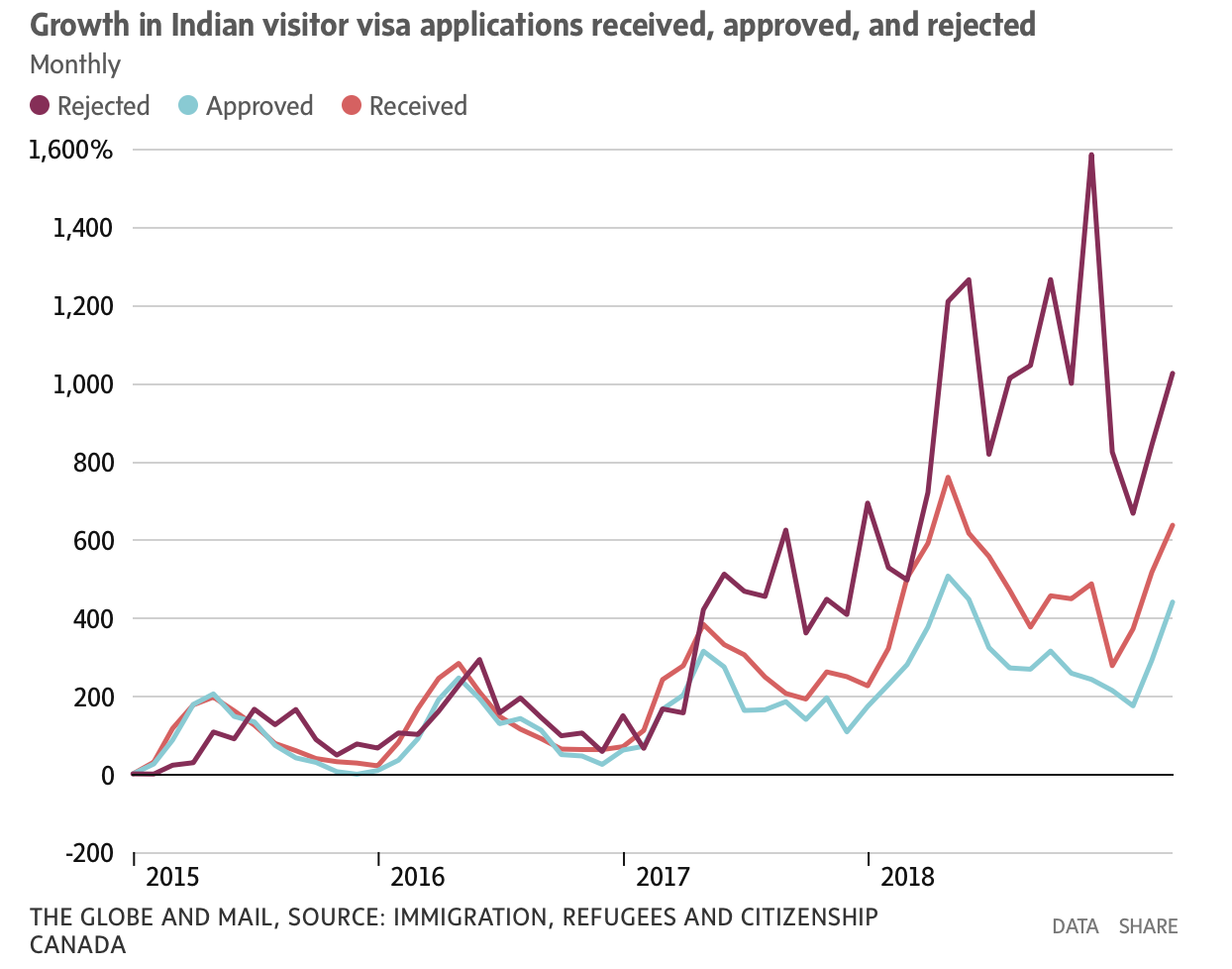
While the number of Indian visitor visa applications has increased significantly, refusals are growing at an even faster clip. Data provided by the federal government show that the percentage of refusals due to an applicant misrepresenting themselves – through fraudulent submissions, for instance – has nearly tripled. In 2017, 0.9 per cent of all Indian visitor visa rejections were for misrepresentation; from January to May this year, the number jumped to 2.5 per cent.

Immigration, Refugees and Citizenship Canada (IRCC) refused 1,477 applications due to misrepresentation in 2017. Between January and May of this year, that number had already reached 3,709. The department could see close to a 500-per-cent increase in fraud refusals by year’s end compared with 2017 if current trends hold.

In response to the increasing number of refusals for Indian applications, in June the federal government rolled out an information campaign targeting Indians applying for visas. The effort includes resources on identifying and reporting fraud throughout the process, including by ghost consultants – unscrupulous, unlicensed immigration consultants.

“We anticipate that this campaign will help address some of the spinoff effects of circulating misinformation, such as high refusal rates and abuse of the asylum system,” Mathieu Genest, a spokesperson for Immigration Minister Ahmed Hussen, said in an e-mailed statement. Mr. Genest said the problem of ghost consultants is “particularly acute” in India.

Bank statements, income taxes, medical files, education histories, funeral home letters and even letters of support from members of Parliament are some of the types of fraudulent documents received by IRCC in recent years. Aside from fraud, Mr. Genest said the government is also seeing an increase in repeat applications from Indians previously denied and an overreliance on paper applications, which take longer to process, but noted that the increase in refusals should not affect legitimate applicants.

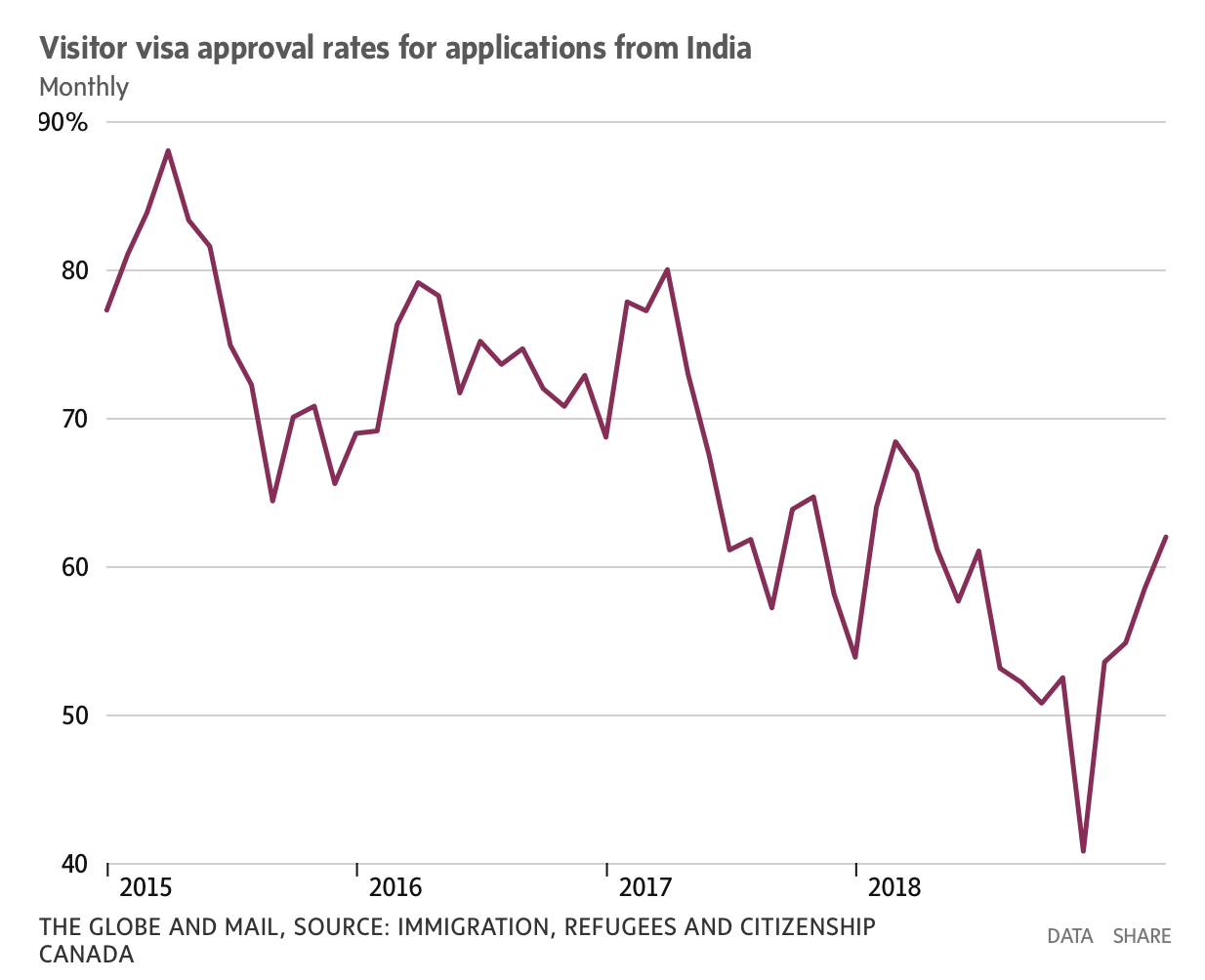
Partly owing to the increase in misrepresentation refusals, approval rates on Indian visitor visa applications have plummeted.

In April, 2015, 88 per cent of visa applications from India were approved – Ottawa received 27,600 applications that month. But by December of 2018, Canadian immigration authorities were receiving more than 58,000 applications each month and approval rates had dropped to 40.8 per cent.

The drop in India’s approval rates comes as the federal government has worked to streamline the visa process. According to documents obtained by The Globe and Mail through access-to-information requests, IRCC is using artificial-intelligence tools to review temporary resident visa applications from China and India as they come in.

Online applications predicted by AI models to be low-risk are sent to an immigration officer for review, simplifying the process. According to IRCC, 30 per cent to 40 per cent of China’s visitor visa applications are are now handled through this streamlined process; however, only 3 per cent to 5 per cent of Indian applications meet that low-risk threshold.

As of April, India was the top source of visitor visa applications to Canada. The country recently surpassed China, where applications have declined in recent months, which some attribute to the continuing diplomatic dispute between Ottawa and Beijing.

According to data from IRCC, Indians submitted 73,457 temporary resident visa applications that month, accounting for nearly a third of the worldwide total. China came in second place, with 46,646 applications.

Visitor visas are required for anyone from a non-visa-exempt country and looking to visit, work or study in Canada. As such, they’re often the first step in the immigration process.

Prashant Ajmera, an immigration lawyer in India who has an office in Montreal, was surprised to hear that the approval rate for visas from India had decreased so dramatically. He said the Canadian government has been touting the growing number of visitors from India, drawing attention to the fact that Canada welcomed nearly 300,000 visitors from that country last year. (There is no cap on how many visitor visas Canada issues each year.)

However, Mr. Ajmera said the Canadian government’s information campaign in India will not solve the problem, as applicants already know about visa fraud and immigration scams.

“They are aware of it but they’re taking calculated risks, most of them,” Mr. Ajmera said. “It’s a very common story.”

He said it would be a better use of Canada’s time to work with other like-minded governments, such as the United States, Britain and Australia, to encourage the Indian government to better regulate its immigration consultants in an effort to stem visa fraud.

One Canadian immigration lawyer thinks that the immigration consultant industry itself may be to blame. Ravi Jain, a Toronto-based immigration lawyer at Green and Spiegel LLP, said that lawyers are taking on clients who first worked with an Indian immigration consultant, only to find that the client’s visitor visa application was riddled with mistakes.

In some cases, unlicensed immigration consultants impersonate applicants throughout the process. “Often times, those people will even make up e-mail addresses. I’m not kidding, they do this,” he said.

Unscrupulous immigration consultants are not the only possible explanation for the decline in India’s approval rates.

Vancouver-based immigration lawyer Richard Kurland said he believes visa fraud, particularly relating to study permits, is the main reason for the decline in the approval rate of temporary resident visas from India. He said study permits are the “number one threat to Canada’s immigration system today” because there is no cap on the number of permits the government can issue, allowing foreign immigration consultants to take advantage of the program.

A recent Globe and Mail investigation revealed that private colleges in Canada are being accused of paying overseas agents to persuade international students that paying tens of thousands of dollars in tuition to study in Canada is the easiest way to get into the country and work toward becoming a permanent resident.

Statistics of anti-Semitism in US are misleading

Good serious comparison of the various datasets available. The observations regarding the limitations of ADL statistics also apply to B’nai Brith as to those on FBI data also apply to StatsCan complication of police reported hate crimes.

With respect to the National Crime Victimization Survey, the closest Canadian equivalent is the currently underway General Social Survey – Canadians’ Safety (GSS) which includes self-reported victimization, to be released winter 2020-21:

On Sunday, a Jewish man standing outside a synagogue was shot in the leg in what police are investigating as a possible hate crime. It was only the latest in a string of anti-Semitic attacks this year.

These attacks have brought in their wake headlines declaring “a spike in hate crimes” and “increased anti-Semitic attacks all across this country,” based on episodes like Sunday’s as well as data. Earlier this year, the FBI reported the largest increase in hate crimes since 2001, and the Anti-Defamation League reported that anti-semitic incidents rose by 57% in 2017.

As a result, a consensus has developed around the idea that hate crime and anti-Semitism are rising, and that Jews are no longer safe in the U.S. Leaders across the political divide agree.

But I’ve found myself skeptical of these claims of rising hate. Partly, this is because of a rather personal reason: Since moving to the US over a decade ago, I have never personally experienced hate or a hate crime.

But I was skeptical for a professional reason too. As a mathematician by training, I spent my PhD years working with messy crime data. And the truth is, it cannot be trusted at face value.

I couldn’t help but wonder if the data on hate crimes, especially those pertaining to the Jewish community, might have similar problems.

And it does. Big time.

To dig deeper, I looked at all the available data on hate crimes, which included incidents of hate by year, surveys, and reports. I sought out datasets, what are in their ideal form collected methodically year after year by faceless government statisticians. I also downloaded spreadsheets and mined the numbers myself.

What I found will probably surprise you: We have a real anti-Semitism problem in this country. But it’s not getting worse.

It’s important to keep in mind that hate crimes are not a leading cause of injury or death; in the same year 37,000 people were killed on the roads, and 2.3 million injured or disabled.

But you can’t compare hate crimes to road accidents; with a hate crime, like with terrorism, the victim is targeted because of their group identity, and the entire group feels threatened. Hate crimes select symbolic targets, such as community buildings, whose significance far exceeds their property value.

And research indicates that being in a targeted group is not just discomforting but can have a tangible effect how people behave. We know from Europe that attacks on Jews can trigger a wave of immigration to Israel, and it should not be assumed that the same cannot happen to American Jews.

Even more disturbingly, research on fertility data from 170 countries found that during waves of terrorism there is a decline in births.

All of this made me even more anxious to find out if there was actually a wave of anti-Semitism sweeping through America. So I sought out the two most frequently-cited sources of hate crime data: reports from the ADL and the FBI.

Let’s start with baselines. According to the FBI’s most recent data, 2017 saw 7,175 hate crimes nationwide, including 15 hate murders. Anti-Jewish hate crime incidents represented 13% of all incidents – 923 – coming in second only to Anti-Black hate crimes, which numbered 2,013 incidents.

There were also more anti-Semitic incidents than “anti-gay” crimes, for example. Most importantly for our purposes, because Jews make up just 1-2%of the US population, these numbers mean that the Jewish community is targeted by hate crimes disproportionately to its numbers by a factor of ten.

The ADL has been tabulating data on anti-Semitic hate crime for an impressive 40 years, and it receives data both from the police and the public. The ADL has built out a modern data center and has interactive online visualizations.

In its most recent audit, the ADL reported that 2018 had the third-highest number of incidents of the past four decades, with 1,879 incidents. The 2018 total is 48% higher than the number of incidents in 2016, and 99% higher than in 2015. Both 2017 and 2018 had far more incidents than typical for the previous eight years. This is, indeed, alarming.

However, these numbers should be taken with a mild dose of the proverbial salt. The problem with hate data is that only 20% of hate crimes are reported to the police, and, one suspects, even fewer to the ADL. So the statistics give just the tip of an iceberg; the majority of hate times are not included in this count.

This makes them somewhat unreliable. To rely on 20% of the data to determine if there is a wave of anti-Semitic hate crimes would be like looking at the top shelf of your fridge, and finding it overflowing, deciding that you need to buy a larger fridge (I would suggest looking at the other four shelves first).

And you can’t just compare the 20% of reported crimes each year to the 20% from last for the simple fact that the reporting rate is not a constant 20% of all crimes. Reporting goes up and down along with public concern. An increase in concern about hate crimes can increase the number of reports by the public, and even the number of police investigations, making more of the “iceberg” (or fridge) visible and inflating the numbers.

To put it plainly, if many people started to believe, fairly or not, that we are in the midst of a wave of hate, they would also start to report more hate crimes, making the data inconsistent with the past.

This is not to say that the jump in anti-Semitic hate crimes reported by sources like the ADL is a statistical mirage. But the reality is probably different from what the numbers suggest.

Independently of the ADL, the FBI has been reporting hate crime data since the 1990s through its Hate Crime database. It has developed impressive guidelinesto judge if a crime incident is indeed a hate crime, and its reports are available online. Surely, here we can expect to finally find deep databases processed by standard and reliable statistical methods!

But alas, the FBI’s numbers also need to be taken with a little grain of kosher salt. The problem is that crimes are generally reported to the local police department and not to the FBI directly, so the FBI’s data is only as good as the reports it receives.

In some states, less than 10% of the police agencies bother to report to the FBI at all, and likely only report the more severe crimes. As a credit to the system, the FBI provides consistent data that goes back to the 1990s, and thus is well-suited to recording if there are any national trends.

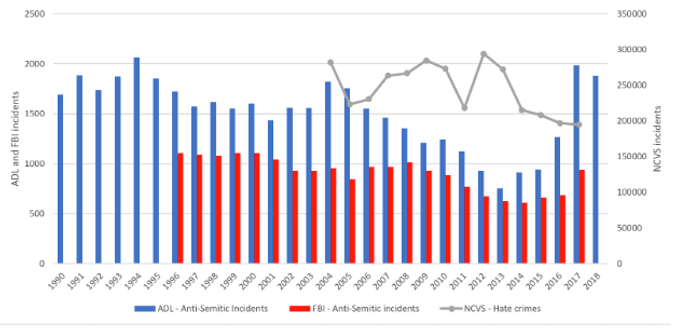
But charting the FBI data from 1996 to 2017 suggests that we are far from having achieved new heights of anti-Semitism. Rather, anti-Semitic incidents peaked in 1999 at 1,109 per year, then declined from 2008 to 2014, and have been trending up since then, reaching 976 in 2017.

As with the ADL numbers, the data quality is not great, thanks to under-reporting. But even taking that into account, we appear to still be well below the numbers of the 1990s.

Fortunately, there is another government crime tracking program that has been all but forgotten by the press: the National Crime Victimization Survey. Unlike the ADL and the FBI, who collect reports, the NCVS goes out to the communities and interviews some 160,000 people every year, asking them if they were victims of various crimes.

Because the NCVS uses a representative sample, it can reliably estimate the number of crimes in the entire country, including hate crimes. If there is a wave of hate in America, the NCVS would detect it in its survey.

In its most recent report, NCVS estimated that 204,000 hate crimes occur in the US annually, of which just 15,000 are confirmed by the police.

The NCVS also shows that hate crime rates have been steady every year since 2015, and were probably higher ten years ago.

There is no data specifically on anti-Semitism in NCVS, but if we assume per the FBI’s estimate that about 13% of hate crimes are anti-Semitic, then there are a staggering 26,000 anti-Semitic crimes every year in the US — 30 times more than reported by the FBI and 14 times more than the ADL.

What we can learn from these statistics is both good and bad. For all the problems of the last few years, there is no reason to fear a wave of hate, because the wave, if it exists, is a small one.

Today’s Jewish America has probably the safest existence of any Jewish community in history. In this generation, a Jew is much more likely to suffer a car accident than a hate crime.

But to believe naively in the American utopia is to ignore the truth: Hate is alive and well in America, and Jews are often the target of it.

Source: Statistics of anti-Semitism in US are misleading

Canada’s Immigration Minister on Tackling Rise of ‘Anti-immigrant’ Rhetoric

Newsweek profile:

As the U.S. government continues a hardline crackdown on immigration across the country and along the southern border, its northern neighbors have been keeping a watchful eye, wary of how a rise in anti-immigrant rhetoric south of the border might affect the daily discourse in Canada.

In an interview with Newsweek, Ahmed Hussen, Canada’s Minister of Immigration, Refugees and Citizenship, said that while Canada is lucky to have a population that “generally supports immigration,” it is not immune to the “anti-immigrant narratives” being espoused in the U.S. and around the world.

“I think we’re very lucky in Canada, by and large, to have a population that generally supports immigration, understands the positive role that immigration has had on our country and understands the positive contributions of immigrants,” Hussen said on Wednesday, following a roundtable discussion organized by the Concordia Forum at Canada House in London.

“However,” he said, “we cannot take that for granted and we are being bombarded with a lot of anti-immigrant narratives right now.”

With Canada’s looming federal election set to take in October, Prime Minister Justin Trudeau’s government has sought to resolidify its commitment to welcoming migrants, asylum seekers and refugees into the country. Earlier this year, the Trudeau administration announced plans to attract one million immigrants to Canada over three years.

Hussen, who came to Canada as a refugee himself at the age of 16 after he and his family were forced to flee Mogadishu in Somalia, said he was well-aware of the way anti-immigration rhetoric in a country like the U.S. can shape the discourse around the world.

To counter that, the immigration minister said, the Canadian government has made a conscious effort to “shore up” support for pro-immigration initiatives “by sharing success stories.”

“Not just success stories of the newcomers themselves,” Hussen said, “but also of Canadians who have been transformed by the experience.”

Pointing to Canada’s Private Sponsorship of Refugees Program, now in its 40th year, as one key example, Hussen noted that “over the last 40 years, over two million Canadians have personally sponsored a refugee.”

“Now, that really does something,” he said. “It transforms people… Because we find that not only are those two million Canadians who are signed on to sponsor transformed by that experience, but their networks also get involved with embracing that refugee family.”

“So, for a big substantial percentage of the Canadian population, refugees and immigrants are not an abstract issue. It’s a member of their new family and so, there’s a resilience there,” he said.

Further, he said, that “resilience” is something that more countries have been working towards building, despite the rhetoric coming out of the U.S. Britain, for example, has not only joined Canada in promoting the private sponsorship model, but also in offering a “community sponsorship program.”

“Now, the UK and Canada are jointly promoting this to other countries, so there’s now about 12 countries that have either adopted…or are about to launch…a program in places like Germany, or places you wouldn’t expect, like Belgium,” Hussen said.

When it comes to countering anti-immigration sentiments, the immigration minister said: “I think that’s the way you do it, because that helps to increase the places [for refugees], but it also helps to change perceptions.”

Another way that the Canadian government is seeking to “change perceptions” around refugees, Hussen said, is through a new pilot scheme that allows refugees to enter the country through economic immigration programs.

Run by Talent Beyond Boundaries, a non-government organization that has partnered with the UN Refugee Agency to help match refugees with employers in Canada and Australia, Hussen said the program is aimed at giving refugees more agency.

There are several competitive economic immigration programs in Canada, he said, and “for those spots, people are selected based on their human capital, skills, education, work experience and so on.”

“It doesn’t matter who you are, where you’re from, your religion, or your background, but refugees, right now, are not eligible for those programs because they’re displaced,” the immigration minister said.

“What I’m saying is that’s not fair to many refugees who have skills, so why don’t we allow them to compete here?” he said. “You know, not just giving them a spot the way we do with the refugee program, because that is not based on skills, it’s based on vulnerability… We’re saying for those who can contribute, and a lot of them can, why not allow them to compete with everyone else here?”

Already, Hussen said, a number of refugees have started working in the country under the program, including a Syrian refugee who was living in Lebanon before being recruited to work for a technology firm in Kitchener-Waterloo earlier this year.

“He used this program to come through the economic skilled immigration competition and he came through the highest federal skilled worker program,” the immigration minister said. “He has the human capital… He just happens to be a refugee.”

Despite the positive influence that Hussen is confident initiatives like the one run by Talent Beyond Boundaries will have on both the economy and perceptions on immigration in Canada, recent public opinion polls have suggested a hardening of Canadian views towards immigrants and refugees.

A recent poll commissioned by the Canadian Broadcasting Corporation (CBC) and conducted by Public Square Research and Maru/Blue found that of the 4,500 adults participating in the online survey, 57 percent felt that Canada should not be accepting more refugees.

Of those surveyed, 64 percent also said they believed illegal immigration is becoming a serious problem in Canada, while 56 percent said they felt that accepting too many immigrants into the country will change the nation. Meanwhile, 24 percent said they felt too many immigrants are visible minorities.

Despite signs of anti-immigration sentiments growing in Canada, Hussen said his government was determined to stay the course in keeping its commitments to migrants, asylum seekers and refugees.

Source: Canada’s Immigration Minister on Tackling Rise of ‘Anti-immigrant’ Rhetoric

PPC defined by anti-immigrant stance

Editorial in the Winnipeg Free Press, highlighting an ongoing challenge:

For a party allegedly trying to distance itself from accusations of xenophobia, if not outright racism, the People’s Party of Canada isn’t exactly covering itself with glory.

PPC Leader Maxime Bernier and numerous candidates have made no secret they want Canada to decrease immigration. And while discussions of immigration limits and border protection are legitimate political conversations, the PPC leader has also said he is against a policy of multiculturalism — a defining element of the Canadian identity.

The immigration question, however, seems to be the thin edge of the PPC’s rhetorical wedge.

PPC candidate Jane MacDiarmid (Winnipeg South Centre) has said she dislikes the Liberal government’s handling of immigration and that it “has to be done the right way, and we have to bring the right people in that are going to support our country.” Ms. MacDiarmid has previously run as a candidate for the Christian Heritage Party, whose platform in 2017 included a “moratorium on immigration from any Sharia-based countries.”

Elsewhere, attitudes about the “right kind” of Canadians were shown in tweets from PPC candidates Jeff Benoit (Chateauguay-Lacolle) and Cody Payant (Carlton Trail-Eagle Creek).

In a since-deleted tweet, Benoit wrote, “We have to ensure that our children have a right to exist and to their identity. We have to ensure that our children have the right to access good jobs and not be limited to quotas and missed opportunities. This fundamental applies to all Canadians from coast to coast!”

The wording strongly echoes the infamous white supremacist slogan known as the “14 words”: “We must secure the existence of our people and a future for white children.”

Mr. Payant, meanwhile, tweeted out a photo collage of a Caucasian baby with bizarrely blue eyes, the Canadian flag and a mountain range, adding “PPC stands for the future of your kids.”

Meanwhile, Winnipeg South PPC candidate Mirwais Nasiri — himself an immigrant from Afghanistan — says he agrees with the party’s promise to reduce Canada’s annual immigration targets by more than 50 per cent. Mr. Nasiri, who works as a settlement facilitator for immigrants, says having fewer immigrants means we can better take care of them. One can’t help wonder if such a philosophy, had it been in place as official government policy, might have affected his arrival in Canada.

It’s safe to assume all the PPC’s candidates — since none appear to be Indigenous — are descended from immigrants. Throughout Canada’s history, many immigrant groups have experienced xenophobia, including the Chinese head tax levied in the late 19th and early 20th centuries, resistance to allowing Mennonites fleeing Stalinist purges in the 1930s to settle on the Prairies, the Japanese internment camps of the Second World War and perhaps most infamously, the turning away of Jews fleeing the Holocaust.

Canada’s policies on immigration and refugee acceptance have evolved over the decades. Under recent Conservative and Liberal governments, initiatives such as the provincial nominee program and the federal government’s response to the Syrian refugee crisis have added to Canada’s cultural mosaic — just as previous waves of immigrants and refugees have.

A strong indictment of the PPC’s platform came from within the party in July, when prospective Elmwood-Transcona candidate Willows Christopher and his riding board all quit, citing what they saw as bigotry against immigrants and the LGBTTQ+ community within the party’s ranks.

This much is clear: the unsettling statements are not mere gaffes. For the PPC, it seems xenophobia is not a problem; it’s part of the brand. And that’s not something Canadians should embrace.

Source: PPC defined by anti-immigrant stance

Advocacy group Equal Voice faces fallout after firing three racialized staffers

I have always had great respect for the needed work Equal Voice does, and Daughters of the Vote were a diverse group.

Always felt that they had missed an opportunity, however, in their data collection and analysis in not examining women visible minority candidates and MPs (in 2015, the percent of women visible minorities was about one third of all visible minority MPs, higher than the overall 26 percent representation of women:

An organization aimed at supporting women in politics is facing backlash over its decision to fire three racialized employees last week, sparking resignations and a social media campaign calling its commitment to diversity into question.

Equal Voice, a multi-partisan organization dedicated to getting more women elected at all levels of government, had four members of its board of directors resign in recent days as young women have been tweeting about what they call negative experiences with the organization.

That online conversation, taking place under the hashtag #notsoequalvoice, has included stories shared by young women who were delegates at the Daughters of the Vote conference, which brought 338 young women — one from every federal riding — to Parliament Hill this spring.

The fallout began after three young women — Shanese Steele, 26, and Cherie Wong and Leila Moumouni-Tchouassi, both 23 — were dismissed from their jobs at the national organization’s Ottawa office following months of tension and issues with management.

‘Nothing to do with anyone’s face’

Eleanor Fast, executive director of Equal Voice, said she cannot comment on internal human resources matters, but she defended the organization against allegations that their identities played any sort of role in terminating their employment.

“The recent staffing changes had nothing to do with anyone’s race, ethnicity, religion,” Fast said in an interview. “The insinuation in that regard is completely false.”

Nonetheless, she said, she is concerned about the online discussion, adding that the organization is working on how best to learn from its mistakes and be more inclusive, both internally and externally.

She said Equal Voice wants to take the time to get it right and has hired a senior adviser to work on the issue.

Equal Voice works closely with politicians from all parties and receives its funding from big business, the labour movement and other sources.

It also received $3.8 million from Status of Women Canada for a project aimed at expanding leadership opportunities for young women in politics, for which the organization committed to “using an anti-oppression approach.”

A spokesperson for Maryam Monsef, the minister for women and gender equality, said the department is aware of the situation but cannot comment.

Not the first controversy

The turmoil is expected to come up as the board meets Thursday, although it’s not the first time the organization has grappled with the charge that it has failed to take the needs and perspectives of women and gender non-conforming people from all backgrounds into account.

The Daughters of the Vote event in April saw dozens of young women turn their backs on Prime Minister Justin Trudeau as he addressed them in the House of Commons; others walked out when it was time for Conservative Leader Andrew Scheer to speak.

The National Observer reported that several of the young women who took part in the protests said they had faced open hostility for doing so, and did not receive enough support or accommodations from Equal Voice throughout their experience.

The latest development has raised the question of whether Equal Voice can continue to straddle the line between supporting all women in politics, no matter their ideologies on hot-button issues such as immigration, while also satisfying stakeholders who want the organization to pick sides.

Fast said she does not see a conflict.

“We may support women who have different views on the world than what we believe in at Equal Voice in terms of our commitment to our employees and stakeholders and those that take part in our programs, and there is no issue there,” she said.

Former employees speak out

The three former employees said their work at Equal Voice had included a push for greater cultural competency they felt was not being taken seriously by the organization’s leadership. Each described relationships with managers that were fraught with tension.

“I want to make sure that advocacy includes and raises the voices of black and Indigenous women,” said Wong, who identifies as a Hong Kong-Canadian, and said she felt as if she was being seen as a troublemaker for pushing management on the issue.

Emails the women provided to The Canadian Press show the situation devolved after a dispute over flexible working arrangements, especially after Fast raised the issue of activities during work hours, including streaming television shows while in the office.

The three former employees said they viewed her comments as contributing to an unsafe and inequitable work environment. They also said they felt threatened after another member of the leadership team described their criticism as “personal attacks” and said continuing may result in discipline.

Then last week, Steele published a social media post that she said referred to Fast — without specifically naming her or Equal Voice — as “an ignorant white colonizer.”

Steele, who identifies as an Afro-Indigenous woman, said in an interview that she stands by her statement: “I was not aware that calling someone white was a derogatory term.”

The other two women shared the post on their own social media accounts. All three were fired shortly thereafter.

Moumouni-Tchouassi, who identifies as a Franco-West African woman, said she has been encouraged by the reaction online.

“It really made me hope and see that Equal Voice would maybe take a position of more accountability and be able to recognize their wrongs and move forward,” she said.

Source: Advocacy group Equal Voice faces fallout after firing three racialized staffers

Atlanta Will Add Context About Racism to Historic Monuments

I have always preferred this approach, providing context and using monuments as a means to increase understanding, rather than tearing them down or renaming:

Atlanta will soon add some lessons about the South’s racist history on markers placed next to four historic monuments amid the ongoing national debate over Confederate statues.

The first of the panels could be installed as early as Friday, officials said.

In Atlanta’s Piedmont Park, the 1911 Peace Monument commemorating post-Civil War reconciliation will get context noting that its inscription promotes a narrative centered on white veterans, while ignoring African Americans.

Many white Southerners viewed the American Civil War through “the lens of Lost Cause mythology” following the defeat of Confederate forces.

“That mythology claimed that despite defeat, the Confederate cause was morally just,” states the marker to be placed near the Peace Monument.

“This monument should no longer stand as a memorial to white brotherhood; rather, it should be seen as an artifact representing a shared history in which millions of Americans were denied civil and human rights,” it states.

Georgia law bars the removal of such monuments. Other states with laws protecting Confederate monuments include Alabama, Mississippi, North Carolina, South Carolina, Tennessee and Virginia.

The project puts the city ahead of other communities grappling with what to do about their monuments, Atlanta History Center President and CEO Sheffield Hale says.

“It’s telling the truth, and it’s also giving people an opportunity to have a discussion around facts,” Hale said. “The goal is to start a community discussion.”

States, cities and universities across the country began debating whether to remove Confederate statues after self-avowed white supremacist Dylann Roof killed nine black worshippers at a church in Charleston, South Carolina, during the summer of 2015. Roof had posted pictures of himself with a Confederate battle flag on social media.

A violent rally involving white supremacists in Charlottesville, Virginia, in August 2017 added more fuel to the nationwide examination of Confederate monuments.

A few days after the Charlottesville rally, protesters sprayed red paint on Atlanta’s Peace Monument. Statues in other cities have also been vandalized in recent years.

One hope in Atlanta is that adding context in the form of the markers “will take some of the oxygen — the accelerant — out of the room” and make it less likely that statues will be vandalized, Hale said.

Another of the new Atlanta markers will be placed near a monument erected in 1935 to commemorate the Battle of Peachtree Creek. It notes that the statue’s inscription describes the U.S. after the Civil War as “a perfected nation.”

“This ignores the segregation and disenfranchisement of African Americans and others that still existed in 1935,” the marker states.

Other Atlanta markers will be placed near two monuments in the city’s historic Oakland Cemetery: The “Lion of Atlanta” monument and the Confederate Obelisk.

The Atlanta History Center has developed a Confederate Monument Interpretation Guide to add historical perspective to such statues, Hale said. He’s hoping Atlanta’s efforts to add context can be used to guide other communities as they decide whether what to do with their own monuments.

“I think in a lot of cases once people see the power of contextualization, some people might decide they’d like to keep them there as a way to show how far we’ve come, or the journey that we’ve had, and explain what was going on at the time they were erected,” Hale said.

Source: Atlanta Will Add Context About Racism to Historic Monuments

Domise: Who gets to be a ‘teen’ and a ‘good kid’?

Worth reflecting on:

For a very long time, I’ve been of the mind that corporal punishment is detrimental for black children, and should be discouraged. Many in the Caribbean community would likely disagree; spare the rod, spoil the child is an axiom I learned from elders long before I first read its source quote in the Book of Proverbs. But it never sat well with me that black children, faced with a world that would capriciously limit their opportunities, fling them into the maw of the criminal justice system, and justify their murder at the hands of police and vigilantes, should come home—their only refuge against a world that fears and misunderstands them—only to be faced with more harsh discipline.

In her recent book Spare the Kids, journalist, anti-spanking advocate and Morgan State University professor Dr. Stacey Patton draws a solid line between corporal punishment and the violence of western colonialism, slavery, and genocide. The harsh treatment of white children endemic in Europe, Patton argues, gave way to a widespread belief in the innocence of children that stigmatized use of “cat-o’-nine-tails, shovels, canes, iron rods and sticks” in the 19th century.

In place of such punishment, which often resulted in infanticide, and wasn’t prosecuted for a long time, came the manual discipline we refer to today as spanking. “In other words,” writes Patton, “white people began to recognize the vulnerability of their own children and had to rescue them, if only partially, from this unthinkable close proximity to blackness and the brutality of childhood.”

For the African-descended and Indigenous people of the Americas, regarded as the most savage and therefore childlike members of the human race, the concept of childhood carries a much different import. All punishments allotted to them—floggings, rape, torture and murder—were not considered wanton violence, but instead the loving attempt of the white patriarch to drive savagery out of their bodies and instill the values of civilization. This belief, that black and Indigenous peoples must be refined through the disciplining of their bodies and minds, has lingered in the white psyche long after the emancipation of black people, and the recognition of Indigenous sovereignty.

It is a belief that white people, as humanity’s patriarchs, have a responsibility to discipline humanity’s children.

This belief is why the words “boy” and “girl” can become slurs when they slide off the white tongue, directed at grown adults. Meanwhile, our children are stamped from birth with the stigma of maturity; plenty of studies exist to show that our children are viewed as older and less innocent by teachers, police and other authority figures who are, by the oaths they take and the titles they wear, supposed to be children’s protectors.

This has tainted racialized communities with a social paradox that quickly ages children out of childhood in order to strip from them the aegis of innocence, yet also infantilizes our adults in order to subordinate them to white hegemony. Thus, acting in loco parentis, the brutality visited on racialized adults and children alike by authority figures—our schools, police, court systems—is not seen as cruel and unjust violence, but instead as a form of socialized corporal punishment, birthed by colonialism and nurtured institutions—our political class and mass media—which function as vestiges of white patriarchal hegemony.

The acceptance of this socialized corporal punishment, by white authority figures, is why Eric Casebolt (then a McKinney, Texas police officer) can throw a black child through the air, drag her by the hair, and slam her to the ground, and not only will he not be charged with a crime, a prominent white news anchor will comment “The girl was no saint, either.” It’s how former Cleveland police officer Timothy Loehmann can jump out of a police cruiser and summarily execute 12-year-old Tamir Rice, and have his actions covered by a municipality that blames Rice for failing to “exercise due care to avoid injury.” And it’s also how an all-white jury can acquit Saskatchewan farmer Gerald Stanley of second-degree murder, even after Stanley admitted to aiming a handgun at Cree youth Colten Boushie and pulling the trigger.

Spare the rod and spoil the child. If there is no child to be found behind those savage eyes, then put down a threat.

On the other hand, white youth who commit atrocities in the name of white nationalism are not only draped in the innocence of childhood from birth, but are covered by its long tails into adulthood.

Consider the case of Kam McLeod and Bryan Schmegelsky, two young white men from Port Alberni, British Columbia, who are currently the subjects of a nationwide manhunt. Early on, when their disappearance shifted from missing teenagers to murder suspects, news media continued referring to them as “teens” and uncritically ran pull-quotes from community members who called them “boys.”

To be clear, these “boys,” 18 and 19 respectively, are not only prime suspects in the murders of three people, but Schmegelsky is alleged to have uttered violent threats to his classmates, and have a fascination with neo-Nazi imagery and organizations. Yet, their families have been offered uncritical coverage in Canadian news: McLeod’s father describing him as “kind, considerate and caring,” and Schmegelsky’s father describing his son as “a child in some very serious pain.”

Not long after McLeod and Schmegelsky’s alleged killings, 19-year-old Santino William Legan, of Gilroy, California, armed himself with a legally purchased AK-47 variant rifle, and opened fire at a local town festival. Three people were killed, two of them children, and another 12 people were injured by gunfire. Though Legan was himself killed in a shootout with police, and was found to have posted links to a white supremacist manifesto on one of his social media pages, he was—rather amazingly—described in a tweet by South Carolina-based The Greenville News as “a quiet teen who stayed out of trouble.”

The infantilizing and innocence-jacketing of white murderers and murder suspects is part and parcel of a long tradition; the childhood of New Zealand mosque shooter Brenton Tarrant (aged 28) was given an extensive profile by Australia’s The Daily Telegraph, Dylann Roof (aged 21) was described as a “sweet kid” corrupted by “internet evil” in coverage after his arrest, and was even brought a Burger King meal by police while in custody. Twenty-two-year-old Santa Barbara shooter Elliot Rodger’s “happy childhood” in England was covered by The Guardian, and it took years to debunk the myth that Dylan Klebold and Eric Harris, the mass shooters at Columbine (aged 17 and 18 respectively), were lonely kids retaliating for a lengthy history of being bullied in school.

Rather than harsh social discipline, young white men who commit these heinous acts are faced with a society endlessly devoted to making sense of their crimes. Behind that, I believe, is a motivation to understand how white children brought up according to plan, and kept safe from exposure to socially corrupting elements—drugs, crime, pornography—could regress so drastically from civilization to savagery. Racialized children, on the other hand, are born into stigma and need no such understanding or explanation. Their already and always existing predisposition for delinquent behavior requires purging from their bodies, and if they happen to be injured or die in the process, well, they should have exercised due care.

I have no doubt that, when Schmegelsky and McLeod are finally apprehended, plenty of coverage will be devoted to figuring out where these young men went wrong. I also have no doubt that, even in the face of glaring evidence that white mass shooters are working from a well-established ideology that requires the removal—if not extermination—of non-white races for a harmonious society, plenty of coverage will be devoted to missing that point.

What I do doubt, however, is that the broader conversation on mass killings will land on the relationship between white supremacy and the power it grants white people (white men in particular) to inflict brutality on others, as well as the logics to justify it.  The social agreement to infantilize spree killers after they’ve passed into adulthood is only one factor in a broader environment of racialized patriarchy; one that warps them in to believing they are acting as soldiers in a race war, and every murder they commit, even against other white people (whom they often deem to be enablers of race-mixing and demographic replacement) is a swing of the rod for the good of society.

And this is why I believe corporal punishment inside the home to have such a damaging effect on black children. A world which grants them no childhood, no innocence, and no protection from physical harm against the people who believe they are entrusted with the responsibility to purge the world from the perceived savagery of our races, well, that’s a harsh enough world already. At the very least, they should find safe shelter from that world with their families, and inside their homes.

Source: Who gets to be a ‘teen’ and a ‘good kid’?