Bollywood actor who campaigned for Stephen Harper was granted Canadian citizenship by Conservative government

Undermines some of the language used to describe citizenship:

But I can tell you – as someone who attends quite a few more Citizenship Ceremonies than do most people – I have never met a single newcomer to Canada who fails to appreciate how precious and how meaningful it is to be a citizen of this free, democratic and diverse country.

Courageous, dedicated, and hard-working people come from all over the world to Canada. They make enormous personal and family sacrifices to obtain citizenship and to earn the opportunity to contribute to our society and our economy. (Jason Kenney on citizenship residence fraud issues, 9 December 2011)

It would be of interest to do a study of individuals who have been granted this “fast-track” citizenship, without meeting the basic requirements (I am aware it has been awarded to Olympians given their training schedules make it difficult to meet the residency requirements). Unlikely, however, that IRCC could provide the data, given privacy concerns.

Doesn’t pass the smell test:

In the thick of the 2011 federal election, Stephen Harper appeared in the Indo-Canadian heartland of Ontario with a ringer.

At a campaign stop in Brampton, Bollywood mega-star Akshay Kumar praised the then prime minister, danced on stage with his wife, Laureen Harper, and thrilled the audience.

It’s unclear if Kumar’s stumping had any impact on voters, but a few weeks later the Conservatives swept every riding in Brampton and nearby Mississauga that has a large south Asian population.

And at some point, the Harper government invoked a little-known law to grant the actor Canadian citizenship, circumventing the usual, stringent residency requirements for would-be Canadians, says a former Conservative cabinet minister.

That Canadian passport recently caused a commotion in Kumar’s native India, where he has fashioned himself as an Indian patriot – and promoted nationalist Prime Minister Narendra Modi in the election that just ended.

But the way he became a Canadian raises questions about his participation in this country’s politics, too.

MP Tony Clement, who as industry minister met with Kumar in Mumbai, says the citizenship grant was just a thank you for the actor’s help in promoting Canadian tourism and trade to a huge emerging economy – not a reward for partisan support.

“Basically, he had offered to put that star power to use to advance Canada-India relations, our trade relations, our commercial relations, in the movie sector, in the tourism sector,” said Clement. “He earned it … He has a great attachment to Canada as well as India, so he was doing all this free work.”

But at least one critic of the citizenship system said Tuesday he is appalled by the gesture, especially since countless people with far deeper roots in Canada have struggled for years to gain citizenship.

“This is so unjust,” said Don Chapman, a U.S.-based airline pilot who has made “lost Canadians” a life-long cause, even authoring a book on the topic. “Why was Harper denying us and accepting him? … I think it was, pure and simple, ‘You campaign for me, I’ll get you in’.”

Representatives for Harper and Alberta Premier Jason Kenney, who was federal immigration minister at the time, did not respond to requests for comment.

Kumar first attracted controversy last month when he conducted a lengthy, televised interview with Modi that was criticized as little more than campaign propaganda.

“I think it was, pure and simple, ‘You campaign for me, I’ll get you in’.”

Then under pressure he admitted he had obtained Canadian citizenship several years ago, an act that would require him to relinquish his Indian nationality. Kumar said he hasn’t stepped foot in Canada for seven years and pays all his taxes in India.

Many members of the Indian elite obtain foreign passports, allowing them to travel the world more widely, says Chinnaiah Jangam, a Carleton University history professor.

In Canada, people born in other countries to non-Canadian parents typically have to first be accepted as permanent residents and live here for three of the previous five years before they can apply to be citizens.

But under section 5 of the Citizenship Act(4) , the minister can grant the privilege at his or her discretion in cases of statelessness or unusual hardship, or “to reward services of an exceptional value to Canada.”

Kumar did, in fact, provide such services to Canada, as an official ambassador of the Canadian Tourism Commission – now called Destination Canada – and in other roles that included carrying the Olympic flame through Toronto in 2009, said Clement.

“It became bedlam and mayhem as like 10,000 people showed up to watch him jog the flame into Toronto,” he recalled. “He’s been a great friend to Canada and certainly promoted Canada-India relations when we were in power.”

But Chapman said giving Kumar a passport was simply not fair. He said he’s worked with numerous people who have lived much, or all, of their lives in Canada and been repeatedly denied citizenship, often because of arcane aspects of the federal legislation. They include Second World War veterans classified as British citizens, and crooner Robert Goulet, whose parents were Canadian and who lived in this country from age 13 until his early 20s.

“I feel Canadian,” Goulet said in 2006. “I tried to become a citizen for a long time but the red tape is going to drive me nuts … It’s always the red tape.”

He died a year later aged 73 and, said Chapman, still had not obtained that passport.

Source: Bollywood actor who campaigned for Stephen Harper was granted citizenship by Conservative government

Backlash over the Women’s Mosque of Canada is predictable – and misplaced

Of note:

Across the country, makeshift mosques are popping up in various towns and cities. Many Canadian Muslims are observing Ramadan and renting out community centres, or taking up space in each other’s living rooms, basements and local dining halls to join in congregational prayers before breaking fast or to perform extra evening prayers.

There isn’t anything controversial about these gatherings. As meals are set out on tables, patterned prayer rugs, large colourful linens or simple mats are laid out nearby. Men, women and children eventually line up together in prayer.

Yet, one such pop-up gathering has received particular attention – and not all of it positive. A few weeks before Ramadan, a group of women launched the Women’s Mosque of Canada. The inaugural Friday prayers were held inside Trinity-St. Paul’s United Church in Toronto. Roughly 40 Muslim women and allies from various faith traditions listened to co-founder Farheen Khan give the sermon.

While the prayers proceeded in tranquility, reaction to the event was less calm. The debate that emerged once again symbolizes the divide that continues to exist in our communities when it comes to the place of women in traditional sacred spaces.

Why do we need this, wondered people writing in an online discussion group of more than 300 Toronto Muslim activists, leaders and scholars and posting to the Women’s Mosque’s Facebook page. One community leader admonished the effort, saying there was nothing in Islamic tradition to support the notion of a women-only mosque. Others suggested the effort would only divide people and would reinforce harmful stereotypes about the oppression of women.

Then there were the supporters, including several men who have themselves witnessed the unequal treatment of women and girls. They are sometimes banished to cramped rooms and poorly maintained areas, or made invisible behind barriers – physically and spiritually separated from a wider community in which they expect to belong.

“It’s been 30 years. How long should I tell my daughters to wait before they get taken as equal partners where they worship?” asked Naeem Siddiqui, a long-time community advocate.

Many women have decided they’ve already waited long enough.

Ms. Khan, herself deeply tied to the traditional mosque environment, was hoping to avoid any backlash. She simply aims to provide an opportunity for women and girls to regularly gather for Friday prayers and together reclaim their religious inheritance.

“Like many women, I grew up in a religious family and attended mosque. In fact, my father was one of the founders of the first mosque in Mississauga, so faith is an essential part of my life,” she wrote in a recent essay for NOW Magazine. “But as I got older I felt less connected to the experience. I didn’t see myself reflected in the scholarship, in the language and in the programming offered to women. Women’s Mosque of Canada is an attempt to engage women, like myself, to reconnect with their religion in a space with other women.”

That Muslim women, often facing the brunt of Islamophobia, need a place to heal is not lost on many. “Sadly, the reality today is that many women feel welcome everywhere except in what we believe are the best places on Earth, the mosques,” Ottawa Imam Sikander Hashemi acknowledged in an e-mail.

Indeed, a 2016 Environics survey of Muslims in Canada confirmed that women were much less likely to attend places of worship than their male counterparts.

Canadian filmmaker Zarqa Nawaz chronicled the growing alienation she felt in her own local community in a 2005 National Film Board documentary, Me and the Mosque. Little has changed since then, although many continue to push for better representation of all levels of mosque governance and participation.

Following in-depth studies of American mosques titled Re-Imagining Muslim Spaces, the Institute for Social Policy and Understanding launched a toolkit in 2017 to encourage religious leaders to nurture more welcoming spaces. Other American national institutions have similarly called for more inclusion and provided advice on how to achieve it. Last year, the Muslim Council of Britain launched a six-month program to train women to become mosque leaders.

“Muslim women, Muslim male allies and non-Muslim supporters of mosque reform are participating in one of the most significant struggles presently happening in our global Islamic communities,” Canadian researcher Fatimah Jackson-Best wrote in 2014 for the magazine Aquila Style. “Mosque reform is not some fringe movement or a bunch of troublemakers trying to jeopardize the image of Islam. This is about spiritual equality and destroying archaic notions that are based in culture and custom and have little to do with the religion.”

Growing alienation has sparked the UnMosqued movement in which women, young people and converts eschew traditional institutions, including multimillion-dollar mosques, in search for alternatives or third spaces. These are formal and informal gatherings outside of traditional religious centres and homes, where there is often less rigidity and an authentic embrace of diversity.

Those anxious about the Women’s Mosque of Canada should be less concerned with the thought of women reconnecting with their faith and instead commit to addressing the schism that drove them out of the mosques in the first place.

Source: Backlash over the Women’s Mosque of Canada is predictable – and misplaced Amira Elghawaby

How Syrian refugees to Canada have fared since 2015

Early indications for Syrian refugees. Given timing of Census (about a year after arrival), too early to draw definite conclusions. However the longer term analysis of refugee economic outcomes, broken down by private sponsorship and government selected, along with country of birth, are more interesting and informative:

The life of a refugee can be many things—dangerous, wearying, heart-rending, boring, nerve-racking, expensive and full of countless unexpected challenges to overcome. It also appears to be quite noisy.

Right now, for instance, the Kitchener, Ont., apartment of Jehad and Baraa Badr is cacophonous—much of it baby noise. Their older son, Hussam, has dropped by with grandson Zain for a playdate with a neighbour’s young child, who is also visiting. Younger son, Adam, makes his own contribution to the din. As do various electronic devices: some reminders for prayer time, others bringing texts and phone calls from friends and family. Rising above all this clamour, however, is Jehad’s exuberant account of the wonders of life in Canada, his gratitude for the help his family has received so far and his many plans for the future.

“I love being here. I love my friends. I love Canada,” he says loudly and with enthusiasm, his expressive body language making up for obvious struggles with language. “Good equality in Canada. Good government. No Syria government. No help.”

After spending three years in Egypt and Turkey—having left war-torn Syria behind in 2012—Jehad, Baraa and nine-year-old Adam arrived in southwestern Ontario in spring 2016 as part of the massive wave of Syrian refugees admitted into Canada following the last federal election. Hussam and his young family arrived a month later. Two other sons, however, will never arrive. Frustrated by the long wait in Egypt, they paid smugglers to take them across the Mediterranean Sea to Italy and then made their way to Austria, where they now live permanently.

This separation of their family is just one of the many tests the Badrs have had to endure since fleeing their homeland. As with the rest of the more than 50,000 Syrian refugees who have arrived in Canada since 2015, settling into Canadian society requires grappling with the many cultural nuances and obligations of their new home. But most significantly, it means mastering a new language and finding employment. “I need a job,” says Jehad, 59, in his halting, declarative style. “I need English. But job and school? Problem.” It is a problem with both personal and political implications.

If there was a single defining issue of the 2015 federal election, it was debate over the proper national response to the Syrian refugee crisis—a question seared into our collective consciousness by that heart-wrenching photo of young Syrian refugee Alan Kurdi’s lifeless body being carried away on a Turkish beach.

Demands for a political response to the humanitarian emergency immediately changed the course of the federal campaign. Prime Minister Stephen Harper said his government would take a total of 10,000 additional Syrian refugees—arguing that to accept any more would create security risks—while maintaining Canada’s military presence in the Middle East as a check on further crises. Liberal Leader Justin Trudeau upped this to 25,000 refugees by the end of the year, and vowed to withdraw our squadron of CF-18s. NDP Leader Thomas Mulcair topped both of his competitors by saying he’d accept 46,000 over several years, as well as end Canada’s military contribution.

In the end, Canadian voters apparently found Trudeau’s offer of 25,000 refugees the most persuasive. And while he failed to make good on his initial deadline, the Prime Minister’s goal was realized by mid-2016. Since then, the flow has slowed but is nowhere near stopping. The most recent count of Syrian refugees admitted into Canada since the election stands at 58,650, exceeding even Mulcair’s highest bid. For this effort, Canada has earned many admirers. “Thank God for Canada!” read a headline in the New York Times this year, lamenting the fact America under President Donald Trump had accepted only 12,000 Syrian refugees.

But taking in large numbers of refugees to widespread international acclaim is one thing. Integrating them successfully for their own happiness and well-being, and to prevent any urgent political or social issue, is quite another. With nativist sentiment rising around the world, and with the emergence of irregular refugees as a new hot-button political issue in the upcoming federal election, it seems both appropriate and necessary to check on the progress of the class of 2015/16. So how are Canada’s Syrian refugees doing?

Statistics Canada recently took a close look at that first cohort of 25,000 Syrian refugees who landed as of May 10, 2016. Employment is the most important metric by which to gauge the integration of refugees into Canadian society. And here the news seems rather disappointing. Only 24 per cent of adult male Syrian refugees were working, according to census data. For government-sponsored male refugees (as opposed to those sponsored by charities, churches or other private organizations), the employment rate was a mere five per cent. These figures are substantially below the 39 per cent average for male refugees from other countries. The gap between female Syrian refugees and those from other countries is equally significant: eight per cent versus 17 per cent.

Such low rates of employment are largely explained by the demographics and timing of the Syrian refugee cohort. In response to the humanitarian crisis, Canada adjusted its acceptance criteria to include more young families with children and fewer working-age males. Standards for language skills and education were also lowered. More than half the Syrian refugees could not speak an official language, compared to just 28 per cent of refugees from other countries. Among adults, less than half had even a high school diploma. (Neither Jehad nor Baraa Badr are high school graduates.)

For Bessma Momani, professor at the Balsillie School of International Affairs and senior fellow at the Centre for International Governance Innovation, the relatively poor performance of the Syrian refugees in finding work is entirely understandable given their profile. “Canada did a good job of targeting the most vulnerable people,” she says. “This group includes semi-skilled and mostly uneducated people. Some were also injured.” It makes sense that a group chosen for humanitarian reasons would take longer to find their footing in a new country than migrants selected for their employability, she says. Plus, it’s still early days. Many of the Syrian refugees had been in Canada for only a few weeks or months when the census was taken. It would be a supreme accomplishment for anyone to have found a job and learned a new language in such a short time.

As for political fears raised during the 2015 election about security risks and the national capacity to absorb such a large influx of refugees, Momani notes time has proven such claims misplaced. “Canada is a big country with a lot of capacity,” she says. “The debate between 10,000 and 25,000 was really just an arbitrary distinction since we have now taken in over 50,000.” And she highlights how popular providing aid to Syrian refugees proved to be among voters. “I think that surprised many Canadian politicians,” she adds.

Syria’s diaspora may no longer be the dominant political topic in Canada, but refugees remain a key election issue—except that now it’s marked by a growing note of skepticism. After years of pressure from federal Conservatives over the influx of more than 40,000 irregular refugees through unauthorized border crossings, mostly in Quebec, the Trudeau government is now adopting a much tougher stance toward these asylum seekers. The 2019 federal budget, for example, proposes to take away their right to a full refugee hearing; it also boosts funding for border measures to “detect and intercept individuals who cross Canadian borders irregularly.” These irregular border-crossers are mostly from Africa and the Caribbean, not the Middle East.

In another recent development signifying a change in mood toward refugees, the 2019 Ontario budget eliminates all legal aid funding for refugee and immigration programs.

As for the long-term consequences of Canada’s mostly generous approach to refugees, another recent StatsCan study looked at all 830,000 refugees who entered Canada between 1980 and 2009 and found their employment and earnings tend to improve slowly over time, but with some significant variations. Refugees who were privately sponsored seem to do better than those sponsored by the federal government, but this difference evaporates after about a decade.

One puzzle that appears permanent, however, is the role played by culture in the integration process. After 15 years in Canada, StatsCan notes that refugees from certain countries (Yugoslavia, Poland, Colombia, Vietnam, Cambodia, Laos and El Salvador) had earnings largely indistinguishable from immigrants accepted on strict economic criteria. But refugees from some other countries (Iraq, Somalia, Afghanistan, Pakistan and China) appear to do noticeably worse, even after accounting for factors such as education, language skills and age. StatsCan admits it has no real answer as to why such differences persist.

It is perhaps too soon to tell which category the Syrian refugees will fall into, but the early figures show those who arrived in late 2015 are already more likely to have a job than those who came a few months later, suggesting a fairly rapid process of integration. “I think we’ll see a lot of new small businesses coming out of this group of Syrian refugees,” says Momani, noting anecdotally that the national shawarma shop sector appears to be undergoing substantial growth. “I suspect by the next census, the numbers [of employed Syrian refugees] will have greatly improved. There is a lot of early success out there.”

Of course the biggest barrier to early success in the job market remains language. And this often requires some difficult choices for newcomers to Canada.

Shortly after arriving in southwestern Ontario, Jehad [Badr] enrolled in an English language school located in the basement of Waterloo’s First United Church, which supported his family’s refugee claim. “First six months, I go to English school. But I need job. I have rent. You need money,” says Jehad, who owned an auto upholstery repair shop back in Syria.

Mounting bills and a gnawing desire for independence eventually convinced him to drop out in favour of a job at a local patio furniture manufacturer. “I wish I go back to school. Maybe when I am old man,” he laughs. Sometimes Jehad answers questions twice, first in Arabic to his son Hussam, who acts as a language coach, and then again in English.

In contrast, Baraa, 49, has stuck with her language training and is now close to graduating. “When I am done, maybe I study more or look for a job,” she says.

Having chosen work over study, Jehad has already weathered two layoffs in the past two years as a result of the seasonal nature of the patio furniture business. A monthly $3,000 stipend from the church has long since run out and now rent consumes more than half his income. But he remains determined to pay his own way. Responsible for reimbursing the federal government for the cost of his family’s flight from Turkey, Jehad declined the option to pay it back at the modest rate of $9 per month.

“The government got $200 every month. Finished. No debt,” he states proudly, wiping his hands together. To supplement his income, he has also been doing small upholstery jobs on the side. And to save on expenses, he has discovered the wonders of Kijiji. “Six chairs and table. Twenty-five dollar!” he exclaims in disbelief, pointing across his small but homey apartment to his family’s “new” dining room set.

Independent, proud, hard-working and frugal. In many ways, Jehad already seems plenty Canadian. Perhaps the fact the enormous influx of Syrian refugees no longer constitutes a federal election issue can be partly ascribed to Jehad’s impressive work ethic and gregarious nature. As well as his family’s determination to fit into Canadian society. (They will be applying for citizenship shortly.) He even claims to love winter.

“In Syria, when winter comes one day, we drive 50 kilometre to see ice and snow. Everyone excited. Here… ” Jehad tails off, searching for the words to explain how Canadians don’t seem to get quite as excited about the cold stuff. But you get the sense he’ll eventually figure it out. A new home always takes some getting used to.
Source: How Syrian refugees to Canada have fared since 2015

Immigration program aims to boost Canada’s high-tech sector

More on Canada becoming an attractive destination for tech:

For Hafsa Imran, the decision to come to Canada to work in the high-tech sector was a no-brainer.

“At this point no one in IT wants to go to the United States, and Canada is the natural choice,” said the 26-year-old software engineer, who arrived from Pakistan last September after she was brought in by her Toronto employer under the federal Global Talent Stream pilot program.

The program is aimed at attracting top talent to Canada’s tech industry by fast tracking approvals; the federal government can issue a work permit in less than two weeks, while in the non-migrant-friendly U.S. under President Donald Trump and in protectionist Europe, the process can take months.

“With a work permit, we can see if Canada is for us or not. If we like it, we have a pathway to stay as permanent residents,” Imran said. “It’s a win-win.”

According to the federal government, since the launch of the two-year program in 2017 to this past January, more than 1,000 Canadian companies have used it to hire more than 4,000 highly skilled foreign workers. The program received such positive feedback from employers and applicants that Ottawa announced in the March budget that it was making the pilot permanent.

As part of the application process, an employer is required to develop a company-specific plan that outlines their commitment to generate lasting benefits for Canada, including creating jobs for Canadians and investing in both training and skills development.

The program has spurred the creation of 21,000 new jobs for Canadians as well as 3,500 paid co-op positions, and these employers have invested $9.3 million into skills training for Canadians, according to Employment and Social Development Canada.

“In the global race to attract the investment of innovative companies, competitors in the European Union as well as the United States have considerably larger pools of talent and labour to draw from than we do in Canada,” said immigration department spokesperson Nancy Caron. “By facilitating the faster entry of top talent with unique skill sets and global experience, the goal is to help innovative companies in Canada grow, flourish and create more jobs for Canadians.”

Head hunters for Canadian high-tech companies said since Global Talent Stream was turned into a permanent program, they have noticed a surge of interest from foreign high-tech workers.

Global Skills Hub, a Toronto-based company that helps Canadian startups find international talent, said 249 overseas high-tech workers responded to its recruitment efforts in the month before the government’s March announcement. Since then, the number has shot up to 2,370.

The company’s co-founder Yousuf Khatib said Canada lacks senior tech talent, many of whom have been poached by Silicon Valley. A recent report by the Information and Communications Technology Council projected that Canada has to fill 216,000 tech-related jobs by 2021.

“Whether it’s a startup or big corporation, every company has become a tech company and is looking for IT talent,” said Khatib, whose firm also handles the work permit application process for clients. “This program issues foreign tech workers with a two-year work permit and gives them a chance for permanent residence. The process is quick and it can stay relevant to the needs of the fast-changing tech world.”

Alisha Patel, vice-president of finance and human resources of Toronto-based TWG, a software company, said the Global Talent Stream helps Canada fill the gaps with foreign workers who can, in turn, assist in helping Canadians develop their skills.

TWG tests and screens prospective foreign workers online before issuing job offers. The new arrivals are then provided with an orientation and mentorship to help them settle in, said Patel. TWG has already brought in a handful of foreign software developers and engineers, including Imran, through the government program.

Imran, who has a university degree in electrical and software engineering, previously worked in Lahore for an electronic design automation software company, a subsidiary of electronics giant Siemens, before she was recruited by TWG. She underwent two technical tests and a series of online interviews before she was offered a job. At that time, Global Skills Hub, the head hunter, took over her work permit application.

Although she feels homesick from time to time, she said she is in love with Toronto and plans to apply for permanent residence when her two-year work permit expires.

“The best of the world are here in Toronto. It’s not just work, work and work, like in Pakistan. My employer invests in training me and is helping me develop my career path,” said Imran, who has found more personal time here to pursue her interests in books and sports.

Source: Immigration program aims to boost Canada’s high-tech sector

Australia’s new parliament is no more multicultural than the last one

Dramatic contrast with Canadian numbers: 56 foreign-born (44 MPs, 12 Senators, 2017), and currently 48 MPs who are visible minority:

Politicians often say Australia is the most successful multicultural country in the world – but it would seem the country’s growing diversity is failing to make its mark in the corridors of power.

The newly elected 46th parliament will likely have little more cultural diversity than the previous one, according to figures compiled by the Parliamentary Library and SBS News.

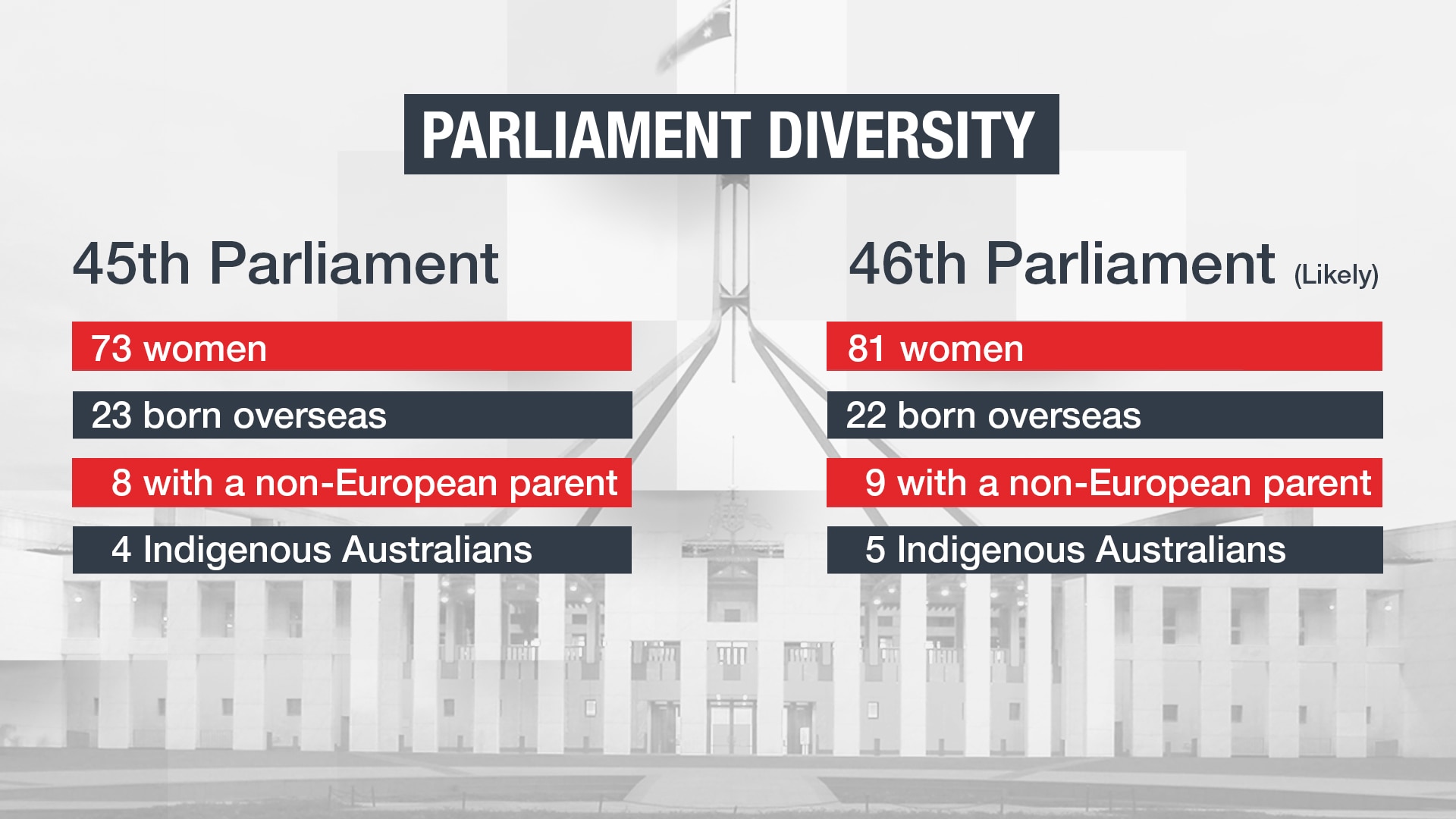
The number of MPs born overseas in the new parliament is down from 23 in the previous parliament, to 22, across the House of Representatives and Senate. While the number of MPs with one or more parent from a non-European background rose slightly, from eight in the previous parliament to nine in the new one.

45th Parliament versus the 46th Parliament

SBS News (source Parliamentary Library and SBS News)

Some of the notable exiting MPs include the Liberal’s Tony Abbott, born in England and Lucy Gichuhi, born in Kenya. As well as Labor’s Lisa Singh whose parents were born in Fiji.

Some of the newly elected MPs from diverse backgrounds include Liberal’s Dave Sharma, born in Canada to an Indian father; the Green’s Mehreen Faruqi, born in Pakistan; and the Liberal’s Gladys Liu, born in Hong Kong, who as of Tuesday was on track to pick up the closely fought Victorian seat of Chisholm.

According to the 2016 census 28.5 per cent of Australians were born overseas. While the United Kingdom remains the largest country of origin within that, China and India are in second and third place respectively.

UTS sociology professor Andrew Jakubowicz said he wasn’t surprised parliamentary diversity hasn’t grown in the new parliament.

“Parliament is essentially a white club, it is essentially a white boys club … The dynamic of change which is sweeping through the Australian community more widely is very apparent at the state level, but the federal level it seems to have been squeezed out,” he told SBS News.

The figures on multiculturalism for the 45th Parliament come from the Parliamentary Library and were accurate as of April 2019.

Data for the new parliament is compared with the previous figures and available public biography information of all new incoming MPs on their official websites.

Parliament is essentially a white boys club.

– ANDREW JAKUBOWICZ, ACADEMIC

SBS News has reached out to both the Labor and Liberal parties to confirm the birthplace of several new members who haven’t mention their place of birth on their official websites.

The analysis is also based on the likely results, with some Senate and Lower House results still not finalised on Tuesday, following Saturday’s election win for the Coalition.

Where there has been change, is in the number of women who will take their place in parliament, with at least 81 women having confirmed to have won seats in the Senate or the House of Representatives.

This is compared to 73 female MPs in the previous parliament. There are 227 seats across both houses of parliament.

The number of Indigenous Australians in parliament will also likely increase from four to five with the return of Tasmanian Senator Jacqui Lambie.

During her first stint in Parliament, Ms Lambie used her maiden speech in 2014 to reveal her family connection to Tasmania’s Indigenous population.

According to an Essential Research poll commissioned for SBS News prior to the election, 71 per cent of Australians believed the country would benefit from a greater representation of under-represented groups in parliament.

Of those who agreed with the sentiment, 46 per cent said they would like to see more women in parliament, 32 per cent said more Indigenous Australians and 17 per cent said more Australians born overseas should be in parliament.

Professor Jakubowicz said he believed the Section 44 controversies and dual-citizenship concerns may be a barrier for multicultural Australians who are thinking about getting into politics.

“I think people from ethnically diverse communities who might want to make a run might be fairly intimidated by the sorts of hoops needed to jump through,” he said.

He also added that until the major parties change their internal processes and begin pre-selecting diverse candidates in winnable seats, little would change.

“The idea is that the parliament represents the range of the Australian people … that isn’t happening,” he said.

Source: Australia’s new parliament is no more multicultural than the last one

The dangers of ‘one of us’: The NZ Chief Human Rights Commissioner on othering

Well stated:

A recent Dominion Post column attacked British-born Chief Human Rights Commissioner Paul Hunt as not ‘one of us’. It’s a phrase we should all feel uncomfortable with, writes Hunt, wherever we come from.

Not long after I took up office as Chief Human Rights Commissioner, a newspaper columnist complained that I am not “one of us”.

This charge raises important questions.

In super-diverse Aotearoa New Zealand with its more than 200 ethnicities and 160 spoken languages, who is “us”?

And who defines “us”?

However defined, it is dangerous to view society as some people who are ‘us’ and, by implication, ‘others’ who are separate and alien.

This vision of society is inconsistent with equality, non-discrimination, respect for diversity and a multiculturalism which is grounded in Te Tiriti o Waitangi. It undermines inclusion and promotes exclusion.

‘Others’ tend to include new immigrants, residents and citizens. They are often ethnic and religious minorities. They may also include tangata whenua and Pacific peoples. There are exceptions, but these ‘others’ consistently fall behind in a range of socio-economic outcomes. Some of them are regularly subjected to discrimination and abuse. Among them, there are additional layers of disadvantage for women, disabled people and sexual minorities. The two most common areas of complaint received by the Human Rights Commission are race-related and disability discrimination. Many discriminatory incidents are unreported.

‘Othering’ me – that is, complaining that I am not “one of us” – is of no consequence because I enjoy numerous advantages, such as ethnicity and gender. But ‘othering’ disadvantaged individuals and communities is dangerous because it reinforces their vulnerability, makes them feel unsafe, and exposes them to more abuse.

Moreover, ‘othering’ can lead to demonising.

And demonising can lead to the mass murder of peaceful people at prayer.

For the record, I married a New Zealander over 30 years ago. We settled in Hamilton in 1992. Our son was born in Hamilton. I completed a degree at Waikato University and lectured at the university for eight years. Our children were schooled in Hamilton. I have been a New Zealand citizen for decades.

In 2000, the government commissioned me and three colleagues to undertake a review of New Zealand’s human rights institutions. In 1998, the National-led government nominated me to an independent UN human rights position. In 2002, the Labour-led government supported my candidacy for a similar position. Both posts were voluntary.

Lured back to Europe by an employment opportunity in 2000, I have visited New Zealand every year, for weeks or months, to write, give talks and spend time with whanau. Last year, my wife and I relocated back to New Zealand.

Does all this make me “one of us”? It should not be necessary to ask.

But if someone declares I am not “one of us” it means that, in their worldview, many thousands of New Zealand immigrants, residents and citizens are also not “one of us”.

‘Othering’ on that scale diminishes and threatens our multiculturalism.

As someone who is new to the Chief Commissioner role, I have taken as many opportunities as possible to listen. I’ve heard that poverty is a recurrent concern; it’s also a crucial human rights issue.

I want to hear from those with lived experience of poverty and widening social and economic inequalities. So, colleagues and I visited the Corstorphine Community Hub in Dunedin, Tuwharetoa Health, Education & Social Services in Kawerau, and Habitat for Humanity in Rotorua.

During the Rotorua visit, we met a widow whose children suffered from serious health issues made worse by their damp cold home. (She now owns a new home thanks to Habitat for Humanity and her own toil and investment.) In Kawerau, we met a reformed dad who is not allowed to see his children and is made to feel like a criminal when he deals with the authorities. We also learnt about a flax-roots initiative which has dramatically reduced the suicide rate in the community.

The overall impression was of proud individuals and communities, precarious and raw, living on the edge.

Our ‘listening visits’, as well as other consultations, will enrich the planning process for the Human Rights Commission’s future work. In this process, we are asking difficult questions like: how can we convey that human rights are based on shared values like fairness, decency, dignity and equality?

How can we make human rights relevant to the practical realities of everyday lives throughout New Zealand?

How do we convey to national and local officials that human rights can make a practical contribution towards the effective delivery of policies which aim to enhance wellbeing?

Consistent with the Universal Declaration of Human Rights, as well as the Convention on the Rights of the Child, the commission will not only focus on vital civil and political rights such as freedom of expression, but also on important social rights, such as the rights to a decent home and accessible education. The commission has tried this before and we need to build on those foundations. Should we also work on the right to a healthy environment?

Our overarching question is this: how do we refresh human rights for modern times?

No ‘othering’, no barriers

Across all my human rights work, I have always sought to be non-party political and non-sectarian. This might be the influence of Quakerism and its call for dialogue and peaceful reconciliation. In the 1980s, I worked for Quaker Peace and Service on its Israel/Palestine programme, and Quakerism continues to inform my thinking.

Later I worked for a London-based civil liberties organisation which had an all-party parliamentary group encompassing libertarians and social democrats.

In Belfast, long before the Good Friday Agreement, I would discuss prisoners’ rights with unionist organisations in the morning, then walk across the city, and discuss prisoners’ rights with nationalist organisations in the afternoon, to the bemusement of my Irish friends.

Perhaps this explains why I am alert to ‘othering’.

Talking about some people as being “one of us”, and implying that ‘others’ are alien, places a barrier between communities.

What is needed is support, dialogue, friendship, respect, acceptance of diversity and recognition of human rights for everyone.

The ‘other’ road is fraught with danger.

Source: The dangers of ‘one of us’: The Chief Human Rights Commissioner on othering

The New German Anti-Semitism

Good long and disturbing read:

One of Wenzel Michalski’s early recollections of growing up in southern Germany in the 1970s was of his father, Franz, giving him some advice: “Don’t tell anyone that you’re Jewish.” Franz and his mother and his little brother had survived the Holocaust by traveling across swaths of Eastern and Central Europe to hide from the Gestapo, and after the war, his experiences back in Germany suggested that, though the Nazis had been defeated, the anti-Semitism that was intrinsic to their ideology had not. This became clear to Franz when his teachers in Berlin cast stealthily malicious glances at him when Jewish characters — such as Shylock in “The Merchant of Venice” — came up in literature. “Eh, Michalski, this exactly pertains to you,” he recalls one teacher telling him through a clenched smile. Many years later, when he worked as an animal-feed trader in Hamburg, he didn’t tell friends that he was Jewish and held his tongue when he heard them make anti-Semitic comments. And so Franz told his son Wenzel that things would go easier for him if he remained quiet about being Jewish. “The moment you say it, things will become very awkward.”

As a teenager, Wenzel defied his father’s advice and told a close friend. That friend quickly told his mother, and the next time Wenzel saw her, she reacted quite strongly, hugging him and kissing his face: “Wenzel! Oh, my Wenzel!” Now a stocky, bearded 56-year-old, Wenzel recalled the moment to me on a recent Saturday afternoon. He raised the pitch of his voice as he continued to mimic her: “You people! You are the most intelligent! The most sensitive! You are the best pianists in the world! And the best poets!” In his normal voice again, he added, “Then I understood what my father meant.”

Wenzel Michalski is now the director of Human Rights Watch for Germany. He and his wife, Gemma, an outgoing British expat, live in a cavernous apartment building in the west of Berlin. In their kitchen, Gemma told me that after arriving in Germany in 1989, she often got a strangely defensive reaction when she told people she was Jewish; they would tell her they didn’t feel responsible for the Holocaust or would defend their grandparents as not having perpetrated it. And so, to avoid conversations like these, she, too, stayed quiet about being Jewish.

Recently, the Michalskis’ youngest son became the third generation of the family to learn that telling people he is Jewish could cause problems. The boy — whose parents asked that he be called by one of his middle names, Solomon, to protect his privacy — had attended a Jewish primary school in Berlin. But he didn’t want to stay in such a homogeneous school for good, so just before he turned 14, he transferred to a public school that was representative of Germany’s new diversity — a place, as Gemma described it, where he “could have friends with names like Hassan and Ahmed.”

The first few days there seemed to go well. Solomon, an affable kid with an easy smile, bonded with one classmate over their common affection for rap music. That classmate introduced him to a German-Turkish rapper who would rap about “Allah and stuff,” Solomon told me. In return, he introduced the classmate to American and British rap. Solomon had a feeling they would end up being best friends. On the fourth day, when Solomon was in ethics class, the teachers asked the students what houses of worship they had been to. One student mentioned a mosque. Another mentioned a church. Solomon raised his hand and said he’d been to a synagogue. There was a strange silence, Solomon later recalled. One teacher asked how he had encountered a synagogue.

“I’m Jewish,” Solomon said.

“Everyone was shocked, especially the teachers,” Solomon later told me about this moment. After class, a teacher told Solomon that he was “very brave.” Solomon was perplexed. As Gemma explained: “He didn’t know that you’re not meant to tell anyone.”

The following day, Solomon brought brownies to school for his birthday. He was giving them out during lunch when the boy he had hoped would be his best friend informed him that there were a lot of Muslim students at the school who used the word “Jew” as an insult. Solomon wondered whether his friend included himself in this category, and so after school, he asked for clarification. The boy put his arm around Solomon’s shoulders and told him that, though he was a “real babo” — Kurdish slang for “boss” — they couldn’t be friends, because Jews and Muslims could not be friends. The classmate then rattled off a series of anti-Semitic comments, according to Solomon: that Jews were murderers, only interested in money.

Over the next few months, Solomon was bullied in an increasingly aggressive fashion. One day, he returned home with a large bruise from a punch on the back. On another occasion, Solomon was walking home and stopped into a bakery. When he emerged, he found one of his tormentors pointing what looked like a handgun at him. Solomon’s heart raced. The boy pulled the trigger. Click. The gun turned out to be a fake. But it gave Solomon the scare of his life.

….

Le français décline comme langue seconde de préférence

While the overall support for bilingualism is strong, the growing lack of interest in learning a second language, whether French or another language, is worrisome in an era of greater mobility and globalization:

Si le bilinguisme officiel continue à bénéficier d’un très fort appui au pays, la préférence pour l’apprentissage du français comme langue seconde a décliné, surtout chez les jeunes. En fait, la simple idée qu’il importe de maîtriser une deuxième langue, peu importe laquelle, chute en popularité, au grand étonnement de certains experts.

Ce sont là quelques-unes des conclusions d’un sondage réalisé par six instituts de recherche, qui ont voulu tâter le pouls des Canadiens sur le concept de dualité linguistique, alors que l’on souligne en 2019 le 50e anniversaire de l’adoption de la première Loi sur les langues officielles.

La nouvelle encourageante, selon l’auteur du rapport, c’est que 82 % des répondants se disent en faveur de la politique du bilinguisme officiel au pays – un pourcentage qui se maintient depuis le début des années 2000, au fil des diverses enquêtes menées sur la question.

« L’opposition n’est pas en croissance. J’étais un peu trop jeune pour sonder en 1969, mais j’imagine que l’opposition aurait été supérieure. Et il y a plein de partis politiques qui aimeraient avoir l’appui de quatre personnes sur cinq », relève Andrew Parkin, du Mowat Center, en entrevue avec La Presse.

L’enthousiasme face à la dualité linguistique et à son enchâssement dans la législation fédérale, sous le gouvernement de Pierre Elliott Trudeau, est nettement moins présent en Alberta, où 3 personnes sur 10 ont affirmé désapprouver le fait que le Canada ait deux langues officielles.

Il n’y a là rien de « surprenant », souligne Stéphanie Chouinard, professeure adjointe au département de science politique du Collège militaire royal du Canada, à Kingston. « On sait qu’historiquement, l’Alberta, ç’a été un terreau fertile pour des partis qui avaient des positions assez fortes contre le bilinguisme, dont le Parti réformiste », explique-t-elle dans un entretien téléphonique.

UN AUTRE BILINGUISME

Pas de quoi tirer la sonnette d’alarme, donc. En revanche, un aspect du sondage fait allumer un voyant rouge au tableau de cette spécialiste en langues officielles : le déclin de la préférence pour le français comme langue seconde.

« On voit que les Canadiens croient encore au bilinguisme, mais que ce bilinguisme-là, ce n’est pas nécessairement le bilinguisme français-anglais. »

– Stéphanie Chouinard, professeure adjointe au département de science politique du Collège militaire royal du Canada

La tendance est plus particulièrement marquée chez les 18 à 34 ans, d’après l’enquête que les instituts de recherche rendront publique aujourd’hui. En 2001, parmi les anglophones hors Québec de cette tranche d’âge qui disaient juger important que leurs enfants apprennent une autre langue, 75 % déclaraient que ce devait être la langue de Molière. En 2019, cette proportion est passée à 61 %.

L’apprentissage de l’une ou l’autre des deux langues officielles – l’anglais pour les francophones (88 %) et le français pour les anglophones (67 %) – reste le choix de prédilection des répondants. Mais des langues autres que les officielles ont maintenant la cote. Chez les allophones, 18 % préconisent l’apprentissage de langues chinoises pour leurs enfants. Chez les anglophones, 6 % miseraient sur l’espagnol.

UNE LANGUE SUFFIT

Mais la trouvaille la plus étonnante du sondage est ailleurs, soit dans la réponse à la question : « Dans quelle mesure est-il important pour vous que vos enfants (si vous en avez) apprennent à parler une deuxième langue ? » Dans toutes les tranches d’âge, partout au pays, on a constaté un déclin – plus ou moins marqué selon la province – du nombre de personnes qui jugeaient l’aptitude très ou assez importante.

« On aurait pensé [dans un contexte de mondialisation] que les Canadiens jugeraient encore plus pertinent d’apprendre une autre langue. Il faut faire attention en interprétant les résultats : une majorité le pense toujours, mais la tendance est à l’inverse de ce que l’on prévoyait », fait remarquer Andrew Parkin.

Le politologue Rémi Léger ne peut malgré tout s’empêcher d’y voir quelque chose de préoccupant. « Sur la durée, sur 20, 30, 40 ans, est-ce que cette tendance va se maintenir ? », soulève en entrevue celui qui enseigne la science politique à l’Université Simon Fraser, en Colombie-Britannique.

D’autant plus que la tendance s’est inversée chez les répondants de 18 à 34 ans. « Alors que les Canadiens plus jeunes étaient auparavant plus susceptibles que les plus âgés à dire qu’il était important que leurs enfants apprennent une autre langue, ce n’est plus le cas », note-t-on dans le rapport. Ils étaient 86 % d’anglophones hors Québec à le penser en 2001, et voici qu’en 2019, ils ne sont plus que 69 %.

C’est un mystère qu’espère élucider Andrew Parkin dans une prochaine enquête.

Méthodologie et crédit

Le sondage a été réalisé en ligne dans les provinces et par téléphone dans les territoires auprès d’un échantillon représentatif de 5732 Canadiens âgés de 18 ans et plus entre le 14 décembre 2018 et le 16 janvier 2019. Le projet est une collaboration du Centre Mowat, de la Canada West Foundation, du Centre d’analyse politique – Constitution et fédéralisme, de l’Institut de recherche en politiques publiques, de l’Environics Institute for Survey Research et du Brian Mulroney Institute of Government.

Source: Le français décline comme langue seconde de préférence

Limiting Muslim immigration is patriotic, US cardinal says

??? Pope Francis has his challenges:

Limiting the number of Muslims allowed to immigrate to traditionally Christian nations would be a prudent decision on the part of politicians, said U.S. Cardinal Raymond L. Burke.

During a pro-life and pro-family conference in Rome May 17, the day before Italy’s March for Life, Burke outlined his views on immigration.

“To resist large-scale Muslim immigration in my judgment is to be responsible,” Burke said, responding to a written question.

Islam “believes itself to be destined to rule the world,” he said. “You don’t have to be a rocket scientist to see what has happened in Europe,” the cardinal said, citing the large Muslim immigrant populations in France, Germany and Italy.

Burke’s comments are the latest addition to a debate among Catholics regarding the application of Gospel precepts to the large numbers of migrants arriving in Western nations from Africa and the Middle East.

In early May, Cardinal Konrad Krajewski, the pope’s almoner, told a reporter that the Vatican would refuse a papal blessing to Matteo Salvini, Italy’s deputy prime minister, who is known for his restrictive immigration policies.

Burke said that the while the Church must be generous to “individuals that are not able to find a way of living in their own country,” this is not the case for many Muslim migrants, “who are opportunists.”

The cardinal mentioned the book No Go Zones: How Sharia Law is Coming to a Neighborhood Near You, written by former Breitbart News reporter Raheem Kassam, as evidence that Muslim immigration is having an effect even in the United States.

Pope Francis has made a generous attitude toward migrants a cornerstone of his pontificate, underlining the Christian duty to “welcome the stranger” over political or demographic considerations, although he repeatedly has added that government leaders have a responsibility to assess how many migrants their countries truly can integrate. Such an assessment should include the financial costs of helping immigrants learn the local language and customs, the pope has said.

Answering the written question from a conference participant, Burke said Christian nations’ abandonment of traditional moral norms has been a cause of Europe’s Muslim influx.

“Muslims have said that they are able today to accomplish what they were not able to accomplish in the past with armaments because Christians no longer are ready to defend their faith, what they believe; they are no longer ready to defend the moral law,” the cardinal said.

Another reason for the demographic shift, the cardinal said, is that “Christians are not reproducing themselves,” referring to the widespread use of contraceptives.

In this context, Catholics have a duty to instruct migrants on “what is bankrupt in the culture” into which they are received. To the extent possible, Catholics should even to try to work with them “to recover what is true culture,” which includes a recognition of the dignity of life, respect for sexual morality and proper worship of God, the cardinal said.

In view of these considerations, limiting “large-scale Muslim immigration is in fact, as far as I’m concerned, a responsible exercise of one’s patriotism,” Burke said.

In April, Burke contributed a foreword to a book titled, Love for the Papacy and Filial Resistance to the Pope in the History of the Church, by Roberto de Mattei, an Italian historian.

“At a time of profoundest spiritual and moral crisis, the Catholic Church needs more than ever before to recall her sacred tradition, unbroken from the time of the apostles,” the cardinal wrote.

Burke, 70, is perhaps best known as one of four cardinals who, opposed to the possibility that some divorced and civilly remarried couples might eventually be readmitted to the sacraments, wrote a series of “dubia” or doubts about Francis’s 2016 exhortation on the family, Amoris Laetitia.

Source: Limiting Muslim immigration is patriotic, US cardinal says

More women, fewer minorities receive appointments under Liberals’ ‘merit-based’ process, documents show

Interesting. When I requested the information earlier, PCO did not provide the breakdown between applications and appointments for GiCs (in contrast to judicial appointments – see Taking stock of Ottawa’s diversity promises):

The Liberal government’s overhaul of the patronage system has led to gender parity in government appointments, but new figures show few of those women are in leadership posts and visible minorities are being left out.

Documents from the Privy Council Office, obtained under the Access to Information Act, show that as of last year, 55.5 per cent of appointees to federal agencies, boards and organizations were women, slightly above their proportion in the Canadian population.

But the Liberals’ “merit-based” process for appointments has screened out 61.8 per cent of visible-minority candidates as insufficiently qualified, compared with 37.6 per cent of applicants who are not visible minorities.

Visible-minority applicants who made it past that cut and into job competitions were less likely to be recommended or appointed.

“This is one of the reasons why we need to know what constitutes merit,” said Kathy Brock, a politics professor at Queen’s University who has studied the changes in the appointments system.

“What are the criteria that are being used to screen people, and embedded in that criteria are there certain considerations that have a negative impact on those communities?”

Despite the changes, final say still sits with the responsible minister or the Prime Minister’s Office, meaning a partisan lens remains in place on appointments, Brock said.

Months after taking power in late 2015, the Liberals changed how the government makes hundreds of appointments each year to the boards of Crown corporations and tribunals that make decisions on benefit payments and immigration claims, for example. The majority are part-time. They don’t include senators, judges or officers of Parliament, such as the ethics commissioner, who are not chosen with the same process.

Before 2015, governments simply decided who would get what position, often giving posts to party loyalists. The Liberals promised to make appointments based on merit, where applications are open to anyone and selection committees recommend names based on precise criteria.

“The government is striving for gender parity, and seeks to ensure that Indigenous peoples and minority groups are properly represented in positions of leadership,” spokesperson Stéphane Shank said in an email, calling the number of visible minority applicants “encouraging.”

As of April 30, 2019, the Liberal government has concluded 1,100 appointments under the new process, he said, noting that 13 per cent of the appointees self-identified as visible minorities. Another nine per cent identified as Indigenous.

The percentage of visible minorities currently serving in the roles nearly doubled, from 4.4 per cent in November 2015 to eight per cent in May 2019.

About 4.5 per cent of appointees identified themselves as having disabilities, below the 15.5 per cent of people with disabilities in the Canadian population.

The government documents show that eight per cent of female appointees had been placed in leadership positions. But they don’t offer the same information for male appointees, so it’s not clear how the sexes compare.

The figures were smaller for visible minorities and Indigenous people: two from each group had been put in “leadership” positions. Like visible minorities and Indigenous people, only two people with disabilities have been appointed to leadership positions.

“It’s that whole analogy of a big ship that has a big wake and you have to give it some space to move. That’s what we’re seeing here with the appointments,” said Carole Therrien, who worked on such appointments in Jean Chretien’s Prime Minister’s Office.

Although upcoming openings are supposed to be flagged a year out, and recommended candidates vetted by the Privy Council Office within four weeks, the new system has often been criticized for leaving too many positions unfilled for too long.

The documents show that at the end of 2018, the selection processes for 181 positions had yet to start, including for some openings as distant as February 2020. The documents don’t identify those positions.

A similar number of appointments — 183 — were sitting with the Prime Minister’s Office or a minister’s office awaiting approval.

Source: More women, fewer minorities receive appointments under Liberals’ ‘merit-based’ process, documents showThe Record·2 days ago