Refugees hoping to become citizens face high bar to achieve language benchmarks

While I would not want to water down the language requirement, the arguments for more flexible language training programs have merit. Similar issues present themselves with the knowledge test as illiteracy generally goes along with unfamiliarity with tests:

Fatum Ibrahim is pointing to her nose and smiling ear-to-ear.

“Nose,” she proudly pronounces, eager to demonstrate her expanding English vocabulary.

Three years ago, a day shy of Valentine’s Day, 36-year old Ibrahim and seven family members landed in Surrey, B.C., as part of Prime Minister Justin Trudeau’s signature Syrian Refugee Initiative. She didn’t know a word of English, nor could she read or write in her native Arabic.

Despite taking language classes four days a week, she has a long way to go to meet the English-language requirement for Canadian citizenship. While her mom, dad, grandmother and two school-age brothers are eligible to become citizens this year, she and two other adult siblings, who also never learned to read or write, will not be. Without a passport, they are stuck in Canada, unable to visit the six siblings they left behind in Turkey.

“I want to be a Canadian. I love it because our country has been destroyed and is gone. Now Canada is our only country. … But I don’t think I will learn to pass the English test until the end of my life,” Ibrahim says through an interpreter.

Ibrahim and her two siblings, both of whom live with intellectual disabilities, are not anomalies.

Government-assisted Syrian refugees came to Canada with less education than the refugees who came before them. Eighty-one per cent of the first 15,000 government-assisted refugees reported an education level of secondary school or less.

While Syria’s average literacy rate – eight in 10 before the war took a toll – is relatively high for the region, there is a sizeable disparity between rates for men and women. Only 77 per cent of Syrian women are literate, compared with 90 per cent of men, with rural women such as Ibrahim faring the worst. It was these women and their families whom the Canadian government prioritized for resettlement.

“I went to school only for one year, in the first grade. But I didn’t like it. I wasn’t smart,” Ibrahim says. “None of my sisters finished school; our brothers did. We spent our days cooking, cleaning the house, laughing, playing. We were so happy. … Only here in Canada did I start school again. I was terrified.”

Diana Jeffries manages English-language classes for Pacific Immigrant Resources Society, with funding from the federal government’s Language Instruction for Newcomers to Canada (LINC) program. She says adult literacy learners such as Ibrahim are right to wonder whether they will ever qualify for citizenship.

To meet the English-language requirement, individuals must reach Level 4 of the Canadian language benchmarks, meaning they can understand simple sentences and use basic grammar. Ibrahim has sat in a Level 1 class for more than a year.

“It is impossible. I have never seen someone who is non-literate get past a Level 2 literacy level,” says Jeffries. “You also have to take into account, not only do these women have no literacy skills, they often have tons of anxiety about being in a classroom. They also are women who have a lot of other things going on – often, they lack any sense of agency and have so many other needs with children, caretaking and domestic violence. It can take six months to learn how to print on a line and because it takes a really, really long time, they can give up.”

Ibrahim is not giving up yet, having just learned how to hold a pen and write her first name. She and her mom, Shakha, try to make it to their three-hour classes Mondays to Thursdays.

But chronic health challenges lead to sporadic attendance. And attendance matters more than ever.

Since 2016, LINC programs have adopted a new way of measuring language proficiency. Called the portfolio-based language assessment, it requires students to collect evidence of 32 successfully assessed assignments in order to rise to the next level. Assessments are held in class, so missing a session means missing an opportunity to progress.

Julie Ship, the settlement language co-ordinator for British Columbia’s Affiliation of Multicultural Societies and Services Agencies, argues that the portfolio process is not designed for adult literacy learners who face barriers to classroom engagement. There was no feasibility study of how changes to the assessment process might affect refugees with low-to-no literacy in their native tongues.

“We are hearing clients are intimidated by the whole process, and if they miss a class, which happens a lot when there are health appointments or they need child minding, they miss out on the assessment,” Ship says. “It is almost too rigorous. The idea was to introduce a steady flow of assessments, but it actually kind of backfires, because talking about assessments all the way through still conveys something scary.”

In fact, the portfolio process is so rigorous that it exceeds the government’s language requirement for citizenship. To become a Canadian citizen, refugees aged 18 to 54 who have lived in Canada for three years must demonstrate that they can speak and listen at Level 4. Older refugees such as Ibrahim’s mother, father and grandmother are exempt.

The portfolio assessment process gauges skills in four areas: speaking, listening, reading and writing. Although individuals can pay $200 to bypass LINC classes and take an English-language test, they must be able to read and write to use its online interface. That puts refugees with no experience of reading or writing at a disadvantage. Without a Level 4 certificate, these refugees won’t become citizens, with the capacity to vote or freely travel, until they turn 55.

Immigration Refugees and Citizenship Canada responded to a request for comment with a statement that did not address questions about the needs of refugees who are illiterate in their primary language.

It says in 2018-19, it is spending about $762-million to support the settlement needs of newcomers across all provinces and territories, excluding Quebec, and it spends more on language training than any other settlement service.

“IRCC-funded language training is offered at a range of ability levels from basic literacy to advanced language skills,” it says. “This includes more specialized courses such as labour market language training, which offers job-specific programming, mainly at higher language proficiency levels, coupled with mentoring and work placements to speed up the transition to employment.”

In 2008, before the influx of Syrian refugees, Jeffries ran a pilot program specifically for refugees with multiple disadvantages. The program’s funding was not renewed and did not run long enough to compare results with standard programming.

“The pre-literacy classes were fantastic, because it was really using different teaching pedagogies that were more experiential and kinesthetic,” Jeffries says. “Reading on a flat surface is not easy, nor is looking at black-and-white text on a piece of paper left to right. We could do art projects that were language-based and that were satisfying. In cooking, they could make measurements. We could paint the alphabet, and just do more creative things. Now, there is nothing like that with portfolio-based language assessment.”

Andrea Solnes, an independent consultant in settlement language, has been writing a guidebook on marginalized and multi-barrier learners, based on research with English-as-second-language teachers. Best practice suggests pair work, learning stations, active use of volunteers and paid teaching assistants.

“None, that’s how much specific training there is about illiteracy. Teachers are clearly expressing that they would like more,” Solnes says.

To improve outcomes for adult literacy learners, both Solnes and Ship see value in an approach that is less focused on meeting standards and more focused on building relationships between refugees and the broader community.

“Because language classes are often the first services that newcomers to Canada access, it is such a strong place to work from,” Solnes says.

But she says the push for a more standardized assessment structure means students spend less time outside the classroom learning other skills they need to be successful in Canada. “It’s important to not just look at language outcomes, but overall community engagement.”

Ibrahim is seeking more community support. She asks whether the interpreter can help her prepare for the language test. While she feels she is making progress in the classroom, it is outside those four walls where she struggles most.

“I only understand at school with my teacher,” Ibrahim says. “What is there outside of school to help me learn? I wish there were other classes after my class. We are trying. English is very hard.”

Source: Refugees hoping to become citizens face high bar to achieve language benchmarks

Maybe We Should Build A Wall To Keep Immigrants In

Nice reverse argument, with some numbers to back it up:

In the midst of overheated debates about immigration and an ugly upsurge in nativism, it’s worth reminding ourselves that entrepreneurial immigrants make an outsized contribution to new business creation. And new and young companies are the primary source of job creation in the American economy.

The contributions of entrepreneurial immigrants have been well documented:

  • Immigrants are twice as likely to become entrepreneurs as native-born Americans.
  • As of 2016, first generation immigrant entrepreneurs represented 30% of all new entrepreneurs in 2016, up substantially from 13% in 1996.
  • Forty-three percent of founders of the 2017 Fortune 500 are immigrants or the children of immigrants.
  • Immigrants constitute 15% of the general U.S. workforce, but they account for around a quarter of U.S. entrepreneurs (defined as the top three initial earners in a new business) and account for a about a quarter of U.S. inventors.
  • Immigrants account for more than 90% of the growth in self-employment since 2000, with particularly significant contributions since the Great Recession.
  • Firms founded by immigrants close at a faster rate than firms founded by natives, but those that survive grow at a faster rate in terms of employment, payroll, and establishments, a phenomenon called “up or out,” which is how young firms create more jobs.
  • Half of America’s startup companies valued at $1 billion or more (as of January 1, 2016) were started by immigrants.

Despite those contributions, our inadequate HB-1 visa system coupled with anti-immigration rhetoric and attempts to further limit legal immigration are driving many foreign students to return home when they’ve completed their education, driven away many other skilled immigrants who have tired of the interminable and uncertain wait for a green card and discouraged talented people abroad to seek more hospitable countries like Canada.

But the real flashpoint in the immigration debate has been around Latin American immigrants, fueled by baseless claims of an “invasion” on our southern border. (From the end of the Great Recession, more Mexican immigrants returned to Mexico from the U.S. than migrated here, according to a 2015 Pew Research Center study.) Meanwhile, Hispanics have made significant contributions to the entrepreneurial economy:

  • The five areas with the highest startup activity in the 2017 Kauffman Startup Activity Index were, in order, the metropolitan areas centered on the cities of Miami, Austin, Los Angeles, San Diego, and Las Vegas—all cities with heavy concentrations of Latinos.
  • Among minority ethnic and racial groups, Latinos have the highest rate of new entrepreneurs.
  • The Latino share of all new entrepreneurs rose from 10% in 1996 to 24% in 2016.

Far from the hothouse of Silicon Valley and its venture capital-backed startups, the vast majority of Latino entrepreneurs, like 99% of all entrepreneurs, are what I call bedrock entrepreneurs. Typically, they start modest businesses (sometimes with themselves as the only employee), largely fund those businesses out of their own pockets and the pockets of their family and friends. They start small; they try to minimize losses and avoid failure, and methodically grow their businesses over the long haul.

Although there are no definitive studies, many observers ascribe higher rates of entrepreneurship among immigrants to personal characteristics like a willingness to take risks (as they did when they moved to an unfamiliar country), a strong sense of identity and intrinsic motivation. Many Latino immigrants, facing discrimination and lacking good English skills, have little choice but to be entrepreneurial. As a result, they are likely to perceive opportunities that other people miss, possess an ability to persist through the myriad difficulties of entrepreneurship and draw on deep reserves of motivation to succeed.

In addition, as politicians debate the ultimate fate of people who were brought to the U.S. illegally as children, they might want to remember this: Immigrants that came to the U.S. as children are more likely to start larger firms than immigrants who arrived as adults and have lower closure rates. Moreover, a 2017 survey conducted by the Center for American Progress found that among the DREAMers under Deferred Action for Childhood Arrivals (DACA) some 5% of respondents started their own business after receiving DACA. Among respondents 25 years and older, that figure rises to 8%. Meanwhile, among the American public as a whole the rate of starting a business is only about 3.1%. According to the U.S. Hispanic Chamber of Commerce, which represents the interests of more than 4.37 million Hispanic-owned businesses, if both the DREAMers and recipients of Temporary Protected Status (TPS) were forced to leave the United States, the U.S. economy would experience a $597 billion reduction in gross domestic product (GDP) over the next decade.

With entrepreneurship in long-term decline, we need all the entrepreneurs we can get. Thirty years ago, about 800,000 new companies in the US were being formed per year, and in some years there have been as many as 13 million people aspiring to start their own businesses. Today only about 600,000 businesses are being formed per year and the number of aspiring entrepreneurs has dropped to about 10 million. Immigrants, with their strong propensity for new business creation, can help reverse that decline, create jobs, help lift our economy and contribute to the general well-being of the country—but not if we drive them away.

Source: Maybe We Should Build A Wall To Keep Immigrants In

Australia: Melbourne gets nod for $1mn ethno specific aged care

Have seen some of these initiatives in the Canadian context for language (second language fluency can decline), community and food choice reasons:

Indian community members joined local politicians and aged care providers recently at the launch of Planning Permits for an ethno specific, Indian aged care facility in Melbourne. The Australian Federal Government has approved a $1 million dollar grant towards the 108-bed facility in the south-eastern suburb of Noble Park.

According to Petra Neelman, Executive Director of MiCare (Formerly Dutch Care), the facility will ensure availability and access to linguistic and cultural needs, social activities and food choices for the residents. The plans include four prayer rooms, a vegetarian kitchen and a 300-seat capacity community hall among other culturally sensitive features.

Years of persistence in attempts to provision aged care services from an ethno specific Indian perspective finally saw some promising development with this launch. As all the dignitaries that attended the event pointed out, the credit for this exciting development goes to community leader and Multicultural Ambassador Vasan Srinivasan, who worked persistently to bring the plans to fruition.

Alan Tudge MP, Minister for Cities, Urban Infrastructure and Population, commended Vasan for his persistence in spearheading projects that included the development of the Museum India in Dandenong, where the aged care facility launch was held.

‘Energiser Bunny’ and ‘Organiser Extraordinaire’ were the terms used to describe Vasan as the Minister acknowledged his hard work in negotiating with both the Federal and State Governments in relation to the proposed facility.

According to the Minister, ethno specific services provide enhanced connectedness and mental wellbeing for older people from diverse backgrounds. He thanked everyone involved for getting this up and running and officially declared the planning approvals as completed.

Roz Blades, Mayor, City of Dandenong, joined the Minister in launching the plans along with Neil Angus, Shadow Minister for Citizenship and Multicultural Affairs and Matt Fregon, Member for Mount Waverley.

Despite the melting heat, the event was well attended by multicultural leaders, community representatives and local media. MC Aneka and Swati admirably kept their cool through the entire event as they invited the dignitaries to say a few words.

Rakesh Malhotra (Consul General of India in Melbourne), Dr Dinesh Parekh (Artistic Director of Museum India) and Dr Sharad Gupta (President of FIAV) also addressed the audience briefly. A traditional Indian wrap and flowers were presented to all the dignitaries.

A light vegetarian meal was served after the event.

Speaking to the guests post event, Vasan Srinivasan shared his experience of the challenges that were faced and the multiple attempts made before reaching this stage of approval.

He is optimistic that the combination of MiCare’s experience of working with ethnic backgrounds, Federal and State Government funding and community support will ensure the realisation of this project. “As the population of Indians in Melbourne continues to grow it is imperative that the community has access to ethno specific aged care in order to age and live well,” said Vasan.

According to him, availability of an ethno-specific and multicultural aged care, bilingual workforce and health educators will play a pivotal role in promoting healthy ageing and community capacity building.

Source: Melbourne gets nod for $1bn ethno specific aged care

The Great British Race to Get a Second Passport

Good overview:

For the vast majority of British citizens who oppose a no-deal Brexit, the state of play in Parliament is dismaying. Although many members of Parliament are resolutely opposed to the United Kingdom crashing out of the European Union come March 29, the reality remains that no deal is their default option: Should Prime Minister Theresa May be unable to find support for her withdrawal agreement—which, by every indication, will be the case—Britain will have no choice but to leave the EU on the severest of terms.

Among the most vulnerable in this scenario are the 1.3 million British citizens currently living in Europe. They would have only a year and change to reorganize their lives, until December 2020, when the Brexit transition period ends and their rights to remain expire. A number of advocacy groups have joined together in a coalition called British in Europe in order to raise awareness and lobby lawmakers. But so far these groups—including the Brexpats, Bremain in Spain, RIFT(Remain in France Together), BRILL (British Immigrants Living in Luxembourg), and others—have struggled like everyone else to move the needle. For its part, the EU has encouragedmember states to “take a generous approach to the rights of UK citizens in the EU, provided that this approach is reciprocated by the UK.” Whether the U.K. will ultimately reciprocate, seeing as the free movement of people was a lightning rod of the Brexit referendum, is far from guaranteed.

Even if the British government fails to retain access to Europe, however, British citizens living at home and abroad may be able to find a way on their own. The solution: a second passport. Across the English Channel lies an obscure but inviting matrix of citizenship and residency laws that, for some, promises to keep alive the freedom to live and work throughout the continent. And in a nation where 48 percent of voters, or 16 million individuals, voted to stay in the EU, the opportunity to do so—albeit in a different form—is sure to be appealing.

Of the British citizens living in Europe, 310,000 are in Spain, 280,000 are in Ireland, 190,000 are in France, 107,000 are in Germany, and 64,000 are in Italy—followed by a significant drop-off to a smattering in other countries around the continent. Fortunately for these British citizens, and for the handful living elsewhere, passports are not particularly difficult to come by (at least compared with other parts of the world). And seeing as the number of British citizens with dual EU nationality increased by 159 percent in the year after the referendum, many have already realized how to escape a fate they did not choose.

Roughly speaking, second passports can be obtained in three ways: organically, financially, or ancestrally. The organic route to the passport is perhaps the most difficult as it requires lengthy naturalization processes. Ireland, for example, which saw a staggering 497 percent increase in new citizenship for British people in the pre- and post-Brexit years of 2014 to 2015 and 2016 to 2017, requires applicants to prove residency for five of the past nine years. France, which has seen a 226 percentincrease, is even stricter, with the same five-year residency requirement plus proficiency in French, proof of integration, and a citizenship test. Germany, which has seen a remarkable 835 percent increase in citizenship for Brits, is stricter still, with requirements of six years of residency, language proficiency, a citizenship test, and an integration course. Although the British government estimates that 900,000citizens are “long-term residents” of another EU country, it is by no means a given that all or most of them will meet their host country’s naturalization criteria. And while marriage can offer a bit of a shortcut, restrictions still apply—Ireland requires three years of marriage, France requires four with three spent in the country, and Germany requires two years of marriage along with three years of residency. For the British citizens who have suddenly been struck by the possibility of no deal, meeting requirements and spouses will be a tall task.

For a murky few, however, a much easier path is available in the form of “golden passports.” This is the financial route to citizenship, a backdoor into the EU that can be accessed through foreign direct investment for five-, six-, or seven-digit sums, often coming in the form of real estate purchases. The BBC has the figures: On the lower end, Croatian passports will cost 13,500 euros. On the higher end, a Luxembourg or Slovenian passport can cost upwards of 5 million euros. For price tags in the middle, wealthy people can get away to Greecefor a quarter of a million euros, Spain for a half a million euros, Malta for a million euros, Cyprus for 2 million euros, and more. However, the elitism and corruptibility of the golden passport scheme hasn’t gone unnoticed, and only a few months after a report from Global Witness and Transparency International detailed the more than 6,000 unaccounted new citizens, 100,000 new residents, and 25 billion euros gained through golden passport programs, the European Commission launched its own inquiry into the peculiar “investor citizenship” arrangements. The results of that inquiry were released last week and made the case for tougher security checks, more rigorous residency requirements, and better transparency. And although they did not go nearly as far as some had hoped, the very fact of the report’s existence suggests that the golden backdoor will eventually be closed.

The final path to a second passport, the ancestral option, emerges as both the least demanding and the least expensive. For some countries, such as Italy and Ireland, the generous principle of jus sanguinis invites anyone who can prove their ancestral ties to the country (with birth or citizenship records in a direct line of parents, grandparents, great-grandparents, or great-great-grandparents) to claim a passport of their own. It is difficult to determine just how many people actually qualify, and in some cases those eligible may not even know. But the eagerness among many to find out is eminently clear: Ireland’s Department of Foreign Affairs reported a twofold increase at the same time that one Italian law firm reported a tenfold increase in pre- and post-Brexit passport applications.

The ancestral option offered by other countries, however, has the much darker dimension of reparations and restorations for some of the most heinous offenses in the history of Europe. This variety of ancestral passports begins with allocations for Soviet exiles and their descendants, offered by Latvia, Lithuania, and Estonia. So far, these states have not reported much traffic, but this is quite likely to change given the 25,000Baltic men and women who came to Britain in the 1940s and the thousands more who came in the decades after.

For Germany and Austria, where descendants of the victims of the Third Reich are also offered citizenship, applications have surged. In pre- and post-Brexit years, new Austrian citizenship among Brits has risen 112 percent. The number of applicants to Germany’s specific reparations program has swelled even more, by an astounding 1,500 percent. While Poland offers the same program to Soviet and Nazi victims, exiles, and their descendants, it has been somewhat less popular, seeing only a 100 percent increase in citizenship.

Going back even further in the timeline of Europe’s atrocities, Spain and Portugal offer citizenship to Sephardic Jews who are descendants of victims of the 15th-century Inquisition, the mass exile of Jews and Muslims from the Iberian Peninsula that began in 1492. (Somewhat controversially, however, passports are not granted to Muslims whose Moorish ancestors suffered the same fates.) Since Spain and Portugal extended this offer, some 10,000 special passports have been granted—with an eightyfold increase in British-based applications in the months following the referendum.

Proactive though some European states are, one glaring absence in the list of victim and ancestral passports cannot be overlooked: colonies. It remains the case across Europe that the victims of colonization and their descendants are marginalized in the accounting of Europe’s faults as no major reparations program, citizenship-based or otherwise, is offered. And even though reparations for some do exist, many victims and their family members have been rightfully reluctant to seize the opportunity. Shortly after the referendum, Harry Heber, an 85-year-old Austrian-Jewish refugee, told the Guardian, “The proposition of seeking sanctuary in the very place that murdered my relatives absolutely appalls me.”

Why the media loves the white racist story

Thoughtful discussion on how sometimes the focus on the individual provides a means to avoid some of the more uncomfortable discussions regarding systemic barriers:

Racism isn’t new and will not go away. What is new is the interest in pointing it out and calling out its perpetrators through both mainstream and social media. Especially white racists. What explains the need to do this? And why do incidents go viral so quickly?

Take for instance the case of Nick Sandmann, a white teenager from Kentucky whose picture and video many will have now seen. In a video, Sandmann is standing across from Native American demonstrator, Nathan Phillips, who is holding a rawhide drum. Sandmann is smiling or smirking at Phillips. From the videos, we don’t know which it is.

What we do know is that Sandmann has been widely condemned for disrespecting Phillips. Sandmann was wearing a Make America Great Again (MAGA) cap. And many people believe wearing the MAGA cap proves that Sandmann is a racist.

Maybe, as everyone seems loathe to do, instead of asking whether Sandmann is a racist or not, we might ask another question: Why is there so much interest in this story?

Why are so many people interested in pointing out and shaming individual white racists? There have been dozens of these events highlighted on social and mainstream media this year. Here are a few of the incidents that went viral and sparked outrage: a video of Fort McMurray teens mocking Indigenous dance, another of a North Carolina woman’s racist rant and the racist tirade against a Muslim family at the Toronto Ferry Terminal.

Why are people less interested in calling out the systems that prime them to act in racist ways and foster lifelong inequities.

Easy targets

We think the reason lies in the fact that by pointing out other individual racists, people can feel good about themselves without actually doing very much. In this way, individuals do not need to question how they must change their lives to create the more just society they say they want.

White people can feel good about themselves because, unlike what is claimed about Sandmann, they probably aren’t overtly racist.

These days most people are not overtly or publicly racist. And being labelled a racist can lead to social stigma. The individual (who may or may not be white) racist and their story, however, provides easy answers and easy targets.

Structural racism and colonization are not seen as the problem. It also allows people to ignore broader trends, such as the recent rise of hate crimes. Instead the focus is often on the spectacle of the incident and the problem is pinned on just one individual or a group of individuals.

In the Sandmann case, many see the problem as the individual racist, not the context that created the MAGA movement.

Ignored in the process of labelling people racists and shaming them is that the shaming fails to condemn actions. Instead, it focuses on a single person. Condemning people gives them little room to change, grow or learn from their mistakes. Humility is needed on all sides.

The move to innocence

Pointing out and condemning individuals for their racism is popular because it exemplifies what scholars Eve Tuck and Wayne Yang would call a “move to innocence.” Moves to innocence are the rhetorical moves that people use to distance themselves from genocide and colonization.

Those who have privilege and power can just tell themselves that they are one of the “good ones” because they aren’t racist like the people in the videos.

In pointing out others as racist, people don’t then have to ask themselves difficult questions about their own privilege or do the work of fostering social humility. Those of the dominant society don’t have to think about the ways that they benefit from slavery, colonialism and land theft.

They don’t have to think about pipelines and stolen land. They don’t have to think. They can just point.

If we want to move forward, we need to stop taking an aggressive punitive approach to individual racism. This only divides the right and the left. No side is “innocent” when it comes to discrimination or colonization.

Source: Why the media loves the white racist story 

Dialogue de sourds sur la laïcité

Good discussion regarding the two different forms of liberalism: in English Canada, the state should not involve itself in value conflicts between individuals (as long as no violation of the law or adverse impact on the rights of others) and in Quebec, that the state can play a more proactive role in imposing liberal values:

« Alors que le premier modèle véhicule l’idée que l’État ne doit pas s’immiscer dans des conflits de valeurs entre individus, dans le second, l’État doit être proactif pour imposer les valeurs libérales auprès des individus », détaille Luc Turgeon.

Au Québec, un citoyen qui défend des valeurs sociales libérales est plus prompt à appuyer des restrictions au port de signes religieux. Dans le reste du Canada, un citoyen qui défend ces mêmes valeurs est plus susceptible de s’opposer à toute restriction touchant le port de symboles religieux.

C’est la conclusion, à la fois étonnante et instructive, à laquelle en sont venus quatre politologues canadiens dans le cadre d’un projet de recherche lancé en 2014 dans la foulée du débat entourant la charte des valeurs du Parti québécoiset dont les résultats seront publiés prochainement dans le Canadian Journal of Political Science.

« On a testé les mêmes valeurs [appui à l’égalité homme-femme, au droit à l’avortement, à la légalisation de l’euthanasie, entre autres], on a posé les mêmes questions dans un sondage et ça prédit de façon diamétralement opposée la relation qu’entretiennent les deux communautés avec les symboles religieux », résume Antoine Bilodeau, professeur de science politique à l’Université Concordia à Montréal.

Ainsi, contrairement aux idées reçues, ce n’est pas un sentiment de xénophobie, une insécurité culturelle ou encore un niveau de religiosité plus faible qui expliquerait pourquoi l’appui à ces restrictions est plus fort au Québec qu’ailleurs au pays.

« Ce qui explique au bout du compte cette différence, c’est le fait qu’être socialement libéral au Québec et dans le reste du Canada a des effets opposés », poursuit Luc Turgeon, professeur de science politique à l’Université d’Ottawa.

Un vaste sondage

Les conclusions des chercheurs — qui signent l’article « A Tale of Two Liberalisms ? Attitudes toward Minority Religious Symbols in Quebec and Canada » conjointement avec les politologues Stephen White de l’Université Carleton à Ottawa et Ailsa Henderson de l’Université d’Édimbourg au Royaume-Uni — reposent sur des données issues d’un sondage en ligne réalisé par la firme Léger pour le compte des chercheurs et auquel ont participé 6400 Canadiens en janvier et février 2014.

Ce sondage mesurait l’appui des répondants à trois scénarios de restriction au port de symboles religieux chez les groupes minoritaires. Résultats ? L’appui aux interdictions était systématiquement plus élevé chez les Québécois.

Ainsi, 74 % des Québécois appuyaient le bannissement de signes religieux pour les policiers contre 45 % dans le reste du Canada ; 59 % des Québécois soutenaient l’interdiction pour les enseignants du réseau public, contre 29 % pour les autres Canadiens ; et 37 % des Québécois étaient d’accord avec une proscription pour les élèves des écoles publiques, contre 20 % pour les autres Canadiens.

L’enquête évaluait également l’adhésion des répondants à différentes valeurs libérales (égalité homme-femme, droit à l’avortement, légalisation de l’euthanasie, légalisation de la prostitution), mesurait leur sentiment à l’égard de l’immigrationet de la diversité ethnoculturelle et quantifiait l’importance de la religion dans leur vie.

Deux libéralismes

En analysant ces données, les quatre chercheurs ont été en mesure de conclureque le seul facteur expliquant cette différence en ce qui a trait au soutien aux restrictions est la relation qu’entretiennent les deux communautés aux valeurs libérales, des effets opposés qui s’expliquent par le fait que deux types de libéralisme se sont développés au pays au cours des trente dernières années.

Pendant que dans le reste du Canada un discours axé sur le libéralisme multiculturel a pris racine, au Québec, un libéralisme des lumières, inspiré par le modèle français, a gagné en influence.

« Alors que le premier modèle véhicule l’idée que l’État ne doit pas s’immiscer dans des conflits de valeurs entre individus, dans le second, l’État doit être proactif pour imposer les valeurs libérales auprès des individus », détaille Luc Turgeon.

Certes, la xénophobie peut mener à une volonté de restreindre les symboles des minorités religieuses dans l’espace public. « Mais ce facteur-là est aussi important au Québec que dans le reste du pays », précise Antoine Bilodeau.

Et c’est précisément là que réside l’essentiel de l’incompréhension entre le Québec et le reste du Canada dans ce fastidieux débat. « Dans la dynamique canadienne-anglaise, l’essentiel des gens qui veulent restreindre les symboles religieux, ce sont des gens qui sont mal à l’aise avec la diversité ethnoculturelle, alors qu’au Québec, ce n’est pas seulement ça », explique Antoine Bilodeau.

« Mais dans leur prisme de compréhension du monde, si tu veux restreindre les symboles religieux, la seule raison qui peut exister, c’est l’intolérance », pointe-t-il.

UNE ALLIANCE CONTRE NATURE À L’ASSEMBLÉE NATIONALE

L’appui à la charte des valeurs reposait sur une « alliance insolite » (« strange bedfellows ») entre conservateurs nationalistes(« conservative nationalists ») et partisans d’un libéralisme des lumières (« liberal nationalists »), avancent les quatre universitaires.

Une idée — inspirée des travaux de Jocelyn Maclure, professeur de philosophie à l’Université Laval — que les chercheurs ont étayée dans un autre article, intitulé « Strange Bedfellows ? Attitudes toward Minority and Majority Religious Symbols in the Public Sphere », publié dans la revue Politics and Religion en 2018.

Une coalition contre nature dont le point de rupture se situe au niveau de la place réservée au crucifix à l’Assemblée nationale. « On se disait que ceux qui étaient pour la charte et pour le retrait du crucifix à l’Assemblée nationale (« liberal nationalists ») ne le faisaient pas pour les mêmes raisons que ceux qui étaient pour la charte, mais contre le retrait du crucifix (« conservative nationalists ») », explique Luc Turgeon.

Incidemment, les travaux des chercheurs ont permis de démontrer que les Québécois qui se sont prononcés en faveur de la charte, mais contre le retrait du crucifix avaient des attitudes plus négatives envers les minorités et l’immigration et avaient un sentiment de menace culturelle plus fort que ceux qui étaient contre la Charte.

« Mais ceux qui étaient pour la charte et pour le retrait du crucifix n’avaient pas une attitude plus négative par rapport aux minorités culturelles et aux gens issus de l’immigration. Ce sont des gens qui, du point de vue du libéralisme social, sont plus progressistes que les gens qui étaient contre la charte », remarque Luc Turgeon.

Alors que le débat sur le port de signes religieux est sur le point de rejaillir à l’Assemblée nationale, la question du crucifix risque encore de soulever les passions.

« Si l’opinion publique n’a pas changé par rapport à ce qu’elle était en 2014, ce sera un grand défi pour le gouvernement caquiste de régler la question du crucifix, relève Antoine Bilodeau. C’est un enjeu au potentiel de division énorme, en raison de sa sensibilité, mais aussi parce qu’il définit la ligne de démarcation, presque à parts égales, entre les deux groupes qui forment cette coalition. »

Fewer street checks in Halifax but black people still more likely to be stopped

Good municipal level data:

Halifax Regional Police are performing fewer street checks but new numbers released by the force show that visible minorities, especially black people, are still more likely to be stopped by an officer.

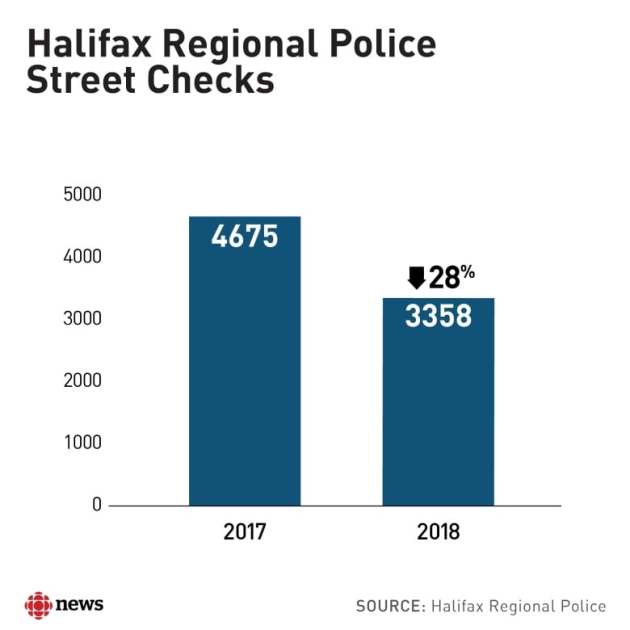
The data shows street checks dropped by 28 per cent between 2017 and 2018, part of a continuous decline since 2012.

Despite that decrease, a CBC News analysis of the data found black people were four times more likely to be street checked than white people in 2017 and 2018.

People identified by police as Arab or West Asian were nearly three times more likely to be street checked.

The figures “are alarming in the sense that they’re very high,” said Michael Kempa, chair of criminology at the University of Ottawa.

“It’s not a morally good thing. But they’re consistent with the numbers right across the country.”

In Halifax, police checks can take one of two forms: a face-to-face interaction between police and an individual or group, or observations made at a distance. The figures released by police don’t differentiate between the two.

Checks are recorded with details such as age, gender, location, reason and ethnicity.

CBC’s analysis was based on 4,579 people who were street checked a single time by police between Jan. 1, 2017 and Dec. 31, 2018.

Kempa said similar studies from other Canadian cities have shown visible minorities are street checked at three to four times the rate of whites. ​

“Looking at [CBC’s] statistical analysis, you made conservative assumptions in your data,” he said. “So if anything, you’re underestimating slightly.”

‘Still the target’

Ashley Taylor, who’s black and works as a support worker for African-Nova Scotian high school students, said street checks make him feel like “an enemy.”

He said he believes he draws police attention attention because he’s black, wears his hair in dreadlocks and drives a Mercedes Coupe. His job as a social worker often takes him to higher-crime areas of the city.

CBC News interviewed Taylor in January 2017 when a different CBC analysis showed black people were 3.2 times more likely to be street checked than whites between 2005 and 2016.

At that time, Taylor said he was being street checked approximately three times a year. Since then, Taylor said he’s been street checked maybe once.

“The frequency [of street checks] might have changed, but the stats are still the same,” he said. “I guess we’re still the target.”

Following CBC’s street check coverage in 2017, the Nova Scotia Human Rights Commission hired criminologist Scot Wortley from the University of Toronto to study how street checks impact visible minority populations in Halifax.

His study is scheduled for release on March 27.

The Halifax Regional Police said it would not grant any interviews before the report’s release.

“Out of respect for Dr. Wortley’s process, we are not commenting on issues related to street checks,” said spokesperson Const. John MacLeod.

Fear of complaints

Kempa attributes the overall decline in street checks to a number of factors.

“Street checks … have really leapt into the public consciousness. People have become sensitized to it and aware that there’s something not quite right going on there. They’re more adamant about pushing their rights with police officers,” he said.

Individual officers may be less likely to stop and question citizens because they’re worried about complaints being filed against them, said Kempa.

“They’re tending to pull back a little bit in engaging the public at all, most especially with a formal street check.”

Taylor’s experiences with street checks have left him hyper-vigilant when he’s behind the wheel. He said he switched from driving a white car to a black one to “blend in and stay under the radar.”

If he notices a police car around, Taylor assumes he’s being followed.

“Is that me thinking, that I guess, I’m losing my mind?” he said.

“It’s not. It’s just something that, you know, your sixth sense takes over, and those are the things that you feel while you’re driving … It just feels like it’s very tough sometimes to be who you just want to be.”

Source: Fewer street checks in Halifax but black people still more likely to be stopped

Diversity Votes — February By-elections: Matching Census Data with Ethnic Media Coverage (24-30 January 2019)

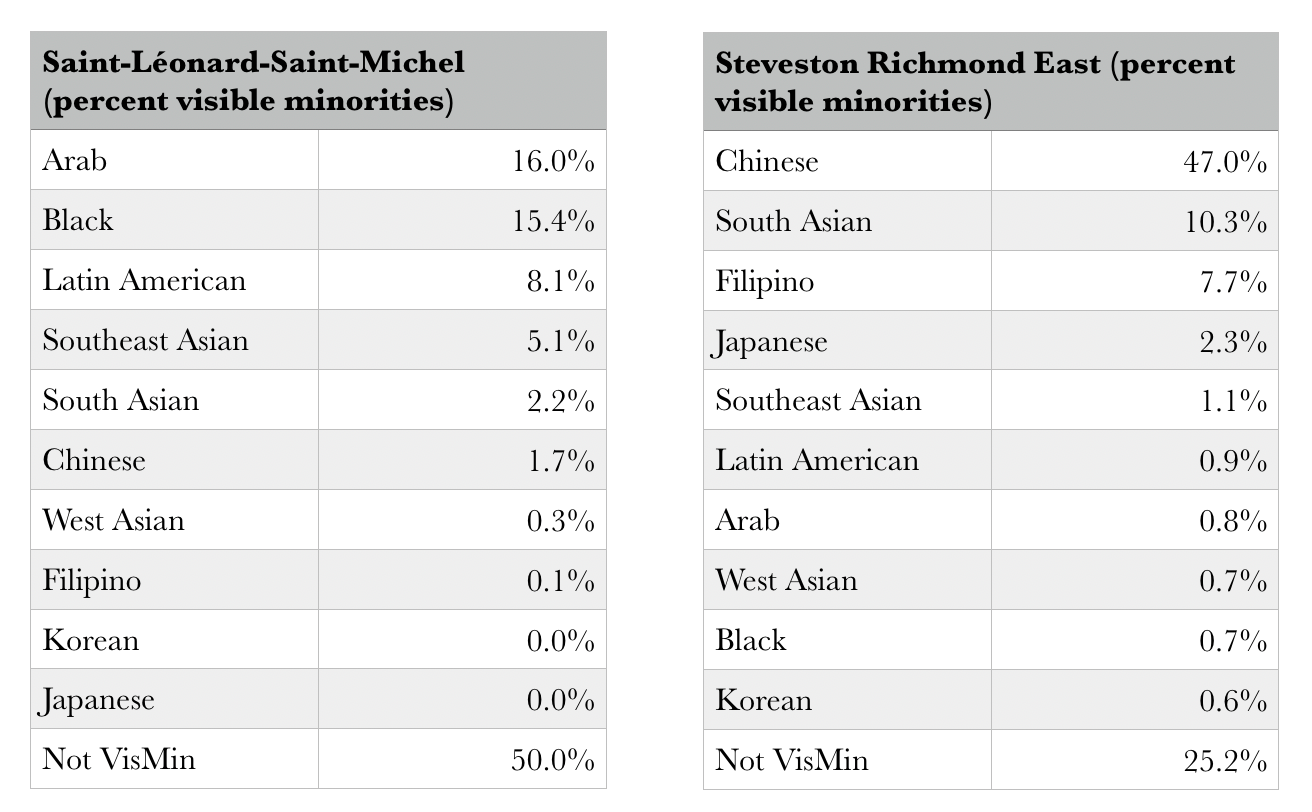
For background data on the riding demographic, economic, social and political characteristics, see: February By-elections: Matching Census Data with Ethnic Media Coverage (1-18 January 2019).

Ethnic Media Coverage

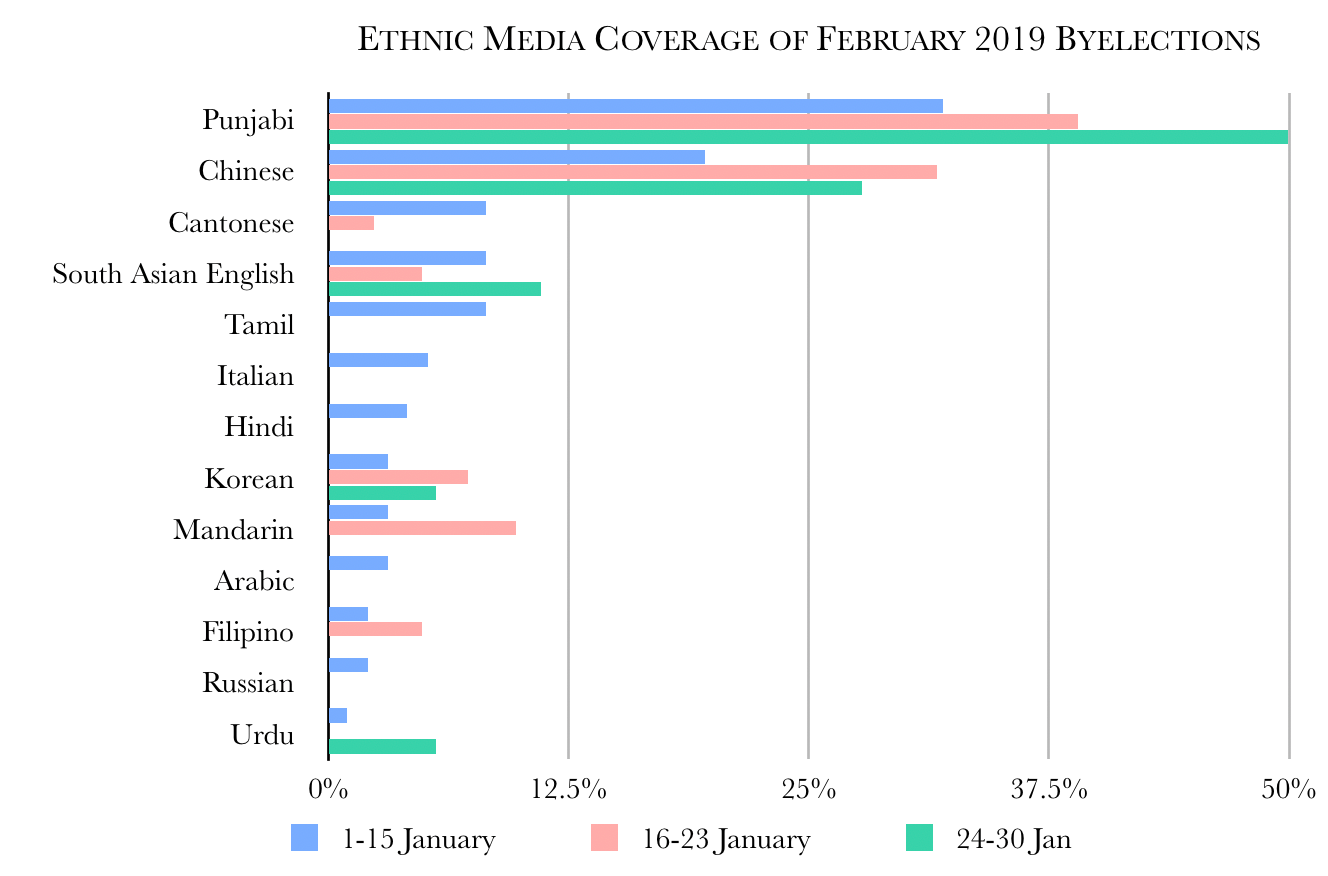
The absence of controversy in Burnaby South following previous weeks resulted in fewer articles in the ethnic media, with again the focus being on Burnaby South, with only 18 articles compared to 41 and 97 in previous weeks .

Media coverage was overwhelmingly in Punjabi (50 percent) and 27.8 percent in Chinese, Cantonese and Mandarin language media. Punjabi media covered the belated resignation of Liberal MP Di Iorio (Saint-Léonard-Saint-Michel). Chinese media covered the opening of the campaign office of PPC candidate Laura-Lynn Thompson and the nomination of James Seale in Outremont.

NDP leader and candidate Singh’s focus on affordable housing received widespread coverage in Punjabi media and was the focus of the one article in Korean media, with no coverage in Chinese media. The one article in Urdu media referenced immigration as an issue given Singh’s pledge to end the Safe Third Country Agreement with the USA and the number of asylum seekers.

In terms of commentary (including analysis and opinion pieces), Punjabi and South Asian English media predominated with two items apiece and Chinese one. 

Three pieces were neutral in tone while an editorial in Punjabi media was sharply critical of “cheap minority politics and the cry for Canadian values.” In Chinese media, one commentary accused the mainstream media of “deliberately alienating ethnic groups from each other” in terms of how they characterized criticism of former Liberal candidate Karen Wang’s divisive remarks on WeChat.

In general election coverage, the government’s announcement of measures to reduce foreign interference in the federal election received widespread coverage in virtually all languages. 

Other stories include the PPC having raised $300,000 was covered in Gujarati media and former Liberal candidate Wendy Yuan having “jumped ship” to seek the nomination for the Conservatives in Steveston Richmond East (she had previously run for the Liberals in Vancouver Kingsway in 2008 and 2001 and had sought the nomination in Steveston Richmond East in 2015).

See the MIREMS blog for some of the stories being covered: MIREMS blog.

Is there a better way to reunite families? Thousands left in lurch by chaotic immigration application process

Good balanced discussion regarding the challenges of devising a system that pleases everyone – or displeases everyone equally:

The chaos around a new application process to bring parents and grandparents to Canada has left advocates and would-be applicants wondering if there is a better — and more fair — way to reunite families.

The immigration department’s new first-come-first-serve online application process launched Monday saw 27,000 “expression of interest” spots snapped up in mere minutes, leaving tens of thousands of other potential sponsors frustrated and angry at being shut out.

“Whatever system we have, there’s always the question of fairness,” said Surrey, B.C., lawyer Marina Sedai, chair of the Canadian Bar Association’s immigration division. “No one can come up with a perfect solution that satisfies the needs of all Canadians.”

For decades, any Canadian citizen or permanent resident interested in sponsoring parents and grandparents could apply in an “all-in” system where they simply waited for their turn, based on the order applications were received. However, due to overwhelming interest and limited resources, the backlog had grown to 165,000 people and applicants had to wait for up to eight years for their relatives to arrive.

In 2011, the then-Conservative government suspended new applications for two years before reopening the process and, in 2014, imposing a cap of 5,000, to be accepted on a first-come-first-serve basis. Paper-based applications had to be sent by mail or registered courier to a single government processing centre in Mississauga and were assessed in order of their time stamp. Applicants complained that this forced them to spend large amounts of money on couriers each year in an attempt to make it into the top 5,000 spots.

In 2016, the Liberals raised the annual quota to 10,000. And in January 2017, Ottawa introduced the lottery process. Sponsors were asked to submit an expression of interest form, and from that pool, people were randomly selected to continue with the application process. That year, some 95,000 would-be sponsors vied for the 10,000 spots; only 6,020 applications were completed because some were deemed ineligible, others never completed the process, and multiple entries by the same applicants were discarded.

This year, applicants had to compete to fill out a 10-page interest-to-sponsor digital form and only the first 27,000 submissions were accepted. Based on the time of receipt, the first 20,000 eligible ones will be invited to submit a formal application for sponsorship.

A spokesperson for Immigration Minister Ahmed Hussen said more than 100,000 people attempted to access the digital form when it went live online at noon on Monday but “no technical issues” were reported. In less than seven minutes, the quota of 27,000 was reached. Failed applicants took their frustration and anger to social media, blasting the government’s efforts.

Toronto immigration lawyer Clifford McCarten said people were unhappy with the old lottery system because they didn’t want to be subjected to a random process where they could miss out repeatedly and be separated from their family perpetually. “People want predictability,” he said.

McCarten offered three alternatives as possible solutions:

  • Taking in everybody and pre-screening them for eligibility before sponsors could bid for a place in the lottery;
  • A hybrid system where equal spots would be allotted for a lottery, for first-come-first-serve, and for humanitarian screening based on personal circumstances and factors such as the number of previous failed attempts;
  • A point system similar to one used to rank skilled immigrant applicants on personal attributes to decide which parents and grandparents were more deserving to come here.

Heather Otto, one of the would-be sponsors left in the lurch on Monday, said the good thing about the lottery was that everyone had an equal chance.

“They said it’s first-come-first-serve, but I was excluded right off the bat on Monday,” said the Toronto computer programmer, who would like to sponsor her parents here from South Africa. “I had everything ready by noon and started refreshing my computer every few seconds. By the time I saw the (apply) button at 12:08 p.m., it said the program had already closed.”

Otto said she wasn’t sure how a point system could work for parents and grandparents, but everyone interested in getting in the pool should be asked to pay the $1,040 fee ($75 for sponsorship, $475 for processing and $490 for the right of permanent residence) upfront so only serious applicants would get a chance.

Natalya Sakhno, another disappointed sponsor, said she preferred the lottery system to the mad-rush chaos on Monday, which ended up being a race of who had the fastest keystrokes and internet speed.

“Every system has its positives and negatives,” said the Toronto human resources professional, who wants to bring her father here from Ukraine. “It’s a gamble.”

Another failed applicant, Behnam Esfahanizadeh, said a real first-come-first-serve system is when the process is open to all and everyone waits in order.

“They just have to get the applications in line and let everyone wait for their turn,” said the Toronto IT consultant, who has made three unsuccessful attempts to bring his wife’s parents here from Slovakia.

Sedai said the debate over the “fairness” issue is bound to continue unless Ottawa is ready to raise the annual admission quota for parents and grandparents and deploy more resources to process applications.

Source: Is there a better way to reunite families? Thousands left in lurch by chaotic immigration application process

Why Hungary’s state-sponsored schoolbooks have teachers worried

More discouraging news from Hungary:

Flick through a Hungarian history book for high school students, and you’re left in no doubt about the government’s view on migrants.

The section on “Multiculturalism” opens with a photo of refugees camped under a Budapest railway station. Flanking the image is a speech given by strongman Prime Minister Viktor Orban on the perils of migration: “We consider it a value that Hungary is a homogenous country,” he says.

The state-sanctioned textbooks are part of a government shakeup of Hungary’s education system that is causing deep unease among some teachers and publishers.

Critics say the textbooks are just one front in a government crusade to remake the education system — and the country — in its Christian, nationalist image. Orban has also scrapped academic programs that don’t fit with his conservative values, effectively forcing one of Hungary’s leading universities to move its courses abroad.

Education ‘straight from the state’

The shake-up comes amid weeks of street protests against Orban’s hardline policies, signaling cracks in his grip on the central eastern European nation.

Since Orban’s populist Fidesz Party swept into power in 2010, and most recently won a landslide victory again in April last year, it has been at the helm of a “major educational reform,” government spokesman Zoltan Kovacs told CNN when it visited Hungary late last year.

Previously, local municipalities oversaw the country’s public schools. But in recent years the state has taken over responsibility — and that includes supplying textbooks, said Kovacs of the measure to tackle funding “insufficiencies.” He said that “finally, after almost 20 years of struggle of how to finance and run the education system, we have taken responsibility.” The government hoped to introduce a new curriculum by fall this year, Kovacs added.

School books are created in the state-run Education Research and Development Center (OFI) by various contributing experts, explained Ildiko Repárszky, a history teacher and author of some of the earlier versions.

These days, the books don’t bear the name of a single author on the cover. Instead, a board of editors reportedly handles the texts from contributors “completely freely, as raw material, reshaping them at will,” said Repárszky.

The reforms come as the country’s Central European University — founded by billionaire philanthropist and well-known Orban foe George Soros — announced last month it had been “forced out” of Hungary by a hostile government and was moving its US-accredited courses to the Austrian capital Vienna.

The internationally renowned university called it a “dark day” for Hungary and Europe — something the government dismissed as “nothing more than a Soros-style political bluff.”

But some educators in Hungary told CNN that Orban’s hardline policies were already having a deep impact on the nation’s children, long before they entered university.

‘This is just everyday politics’

In his small office in central Budapest, chairman of Hungary’s Association of History Teachers, Laszlo Miklosi, opens a history book for 14 and 15-year-olds covered in Post-it notes.

He turns to the page on multiculturalism and points to a speech Orban gave to the European Parliament in Strasbourg in May 2015 that laid out Hungary’s position on migrants.

In the speech, the Prime Minister said Hungarians considered it a value that their country was homogenous in terms of its “culture,” “traits” and “way of thinking.” “This is just everyday politics,” said Miklosi, adding “It doesn’t say anything about the actual reasons for existing problems of migration — instead it’s what the current prime minister thinks about it.”

Orban’s defiant relationship with the European Union also plays out in a cartoon showing Germany as a giant sow feeding piglets representing Greece, Spain, Belgium and Portugal. Standing apart from the rest and happily munching its own grass, is the Hungary piglet.

In the same geography book under the chapter on “Population Decline and Migration,” another cartoon shows a Hungarian boy and girl with the caption: “The number of those who think Hungary is the best place to live has significantly increased.”

The illustration includes statistics like “67% of young people can only imagine their future in this country.” And “every 4th young person lives in a marriage or a permanent relationship and 68% of those who don’t, would like to,” with no clear source for the findings.

The image “enlarges the patriotic feelings of young people in Hungary, their contentedness with their country, their willingness to get married and start a family — while also downplaying their willingness to move abroad,” said Repárszky, who is also part of the Association of History Teachers, which has around 400 members.

Government spokesman Kovacs dismissed the teachers’ concerns as a “political opinion,” adding that the government always welcomed “criticism, contribution, observations and comments” from “professional organizations.”

‘Migrant’ and ‘Soros’ are schoolyard taunts

Miklosi, who has reviewed school textbooks for more than 30 years, believes Orban’s anti-migrant rhetoric has filtered down to classrooms and playgrounds.

“‘Migrant’ has become a swear word for many people, including many children,” he said.

Should a teacher say the words “Jewish” or “gypsy” or “Slovak” they are often met with students “giggling and nudging each other” and the teacher has to “actively fight for space to discuss these categories in a neutral way,” Miklosi added.

It’s a view shared by English teacher Juli Karolyi, who said for some students the words “migrant” and “Soros” had become “swear words used in schoolyards and playground conflicts.”

But she added that children’s views were “mostly decided in the home” rather than in the pages of textbooks. “If the parents fall for the government propaganda, the kids will follow suit — especially the younger ones,” she said.

A few blocks from Miklosi’s inner-city office, 18-year-old student Akos Blaskovics has just finished a morning history class at his high school, Fazekas Mihály Gimnázium. The quietly-spoken teenager told CNN that he “hasn’t really seen a difference in the messages of textbooks in recent years.”

But he did think the government has tried to “make people focus on the question of migrants,” rather than “more important things like education, healthcare and social problems.”

Five textbook publishers, 123 trials

In a small village 30 minutes’ drive east of Budapest, publisher András Romankovics’ home office is packed with bookshelf after bookshelf of rainbow-colored spines arranged by decade.

The former teacher and his wife started publishing school textbooks in 1978, and he estimates around 10 million copies have been printed over the years.

Hungarian school textbook licenses must be renewed every five years. Romankovics is one of five independent textbook publishers who are suing the government after it rejected their requests to extend their licenses, which were due to expire at the end of 2018.

The court case relates to 123 books in total — meaning 123 separate trials for each book. Needless to say it’s a lengthy process, and since the trials began in September, around 20 books have been granted permission to extend their licenses, said Romankovics.

Meanwhile the licenses of state-sponsored textbooks were extended, he said.

Kovacs, the government spokesman, would not comment on why the government had rejected the independent textbook publishers’ license requests, saying only that it was an “ongoing case” and “going through a higher level of decision-making.”

But Romankovics, who is also chair of the National Textbook Association, which represents 20 publishers, warned that without a true diversity of books, children’s education would suffer.

‘There is a deeper problem here’

While independent publishers battle to keep their textbooks in schools, university professors are battling to keep their programs in Hungary.

Inside the grand, high-ceilinged offices of Budapest’s CEU, gender studies associate professor Eva Fodor is dismayed that the government has scrapped her program which has been running for over 20 years.

The university offers US- and Hungarian-accredited gender studies degrees — or at least it did, until the government struck gender studies from its list of accredited programs in October.

While the US-accredited program will continue in Vienna, the Hungarian-accredited degree no longer exists, affecting around 45 MA students enrolling each year, said Fodor. The only other Hungarian university to offer gender studies — Eötvös Loránd (ELTE) — was also forced to scrap its program.

“It’s a clear and unprecedented violation of academic freedom,” said Fodor, adding that it wasn’t just gender studies that didn’t fit with Orban’s world view.

“It indicates that there is a deeper problem here,” she said. Orban wants to create a strong ideology that people can hold on to, based on “national pride and his idea of very simple Christian values,” Fodor said. “And (he’s) eliminating everyone else who is not willing to subscribe to this ideology,” she added.

According to Kovacs, gender studies degrees were scrapped because of low enrollment, scarce job opportunities, and the government’s “philosophical approach.”

“We believe there are only two sexes — men and women,” he said. Kovacs added that students were still free to research gender issues from the perspective of other disciplines, such as philosophy or sociology. “But we don’t believe that gender is an independent discipline in itself.”

Students who see it otherwise had better look for classrooms outside Hungary.

Source: Why Hungary’s state-sponsored schoolbooks have teachers worried