Whites Have Huge Wealth Edge Over Blacks (but Don’t Know It) – The New York Times

The Yale researchers suspected that many people would not get the answers right.

“I’m a person who studies inequality, who should really know how inequality looks,” said one of the psychologists, Michael Kraus, who researches the behaviors and beliefs that help perpetuate inequality. “And I look at the black-white gap, and I’m shocked at the magnitude.”

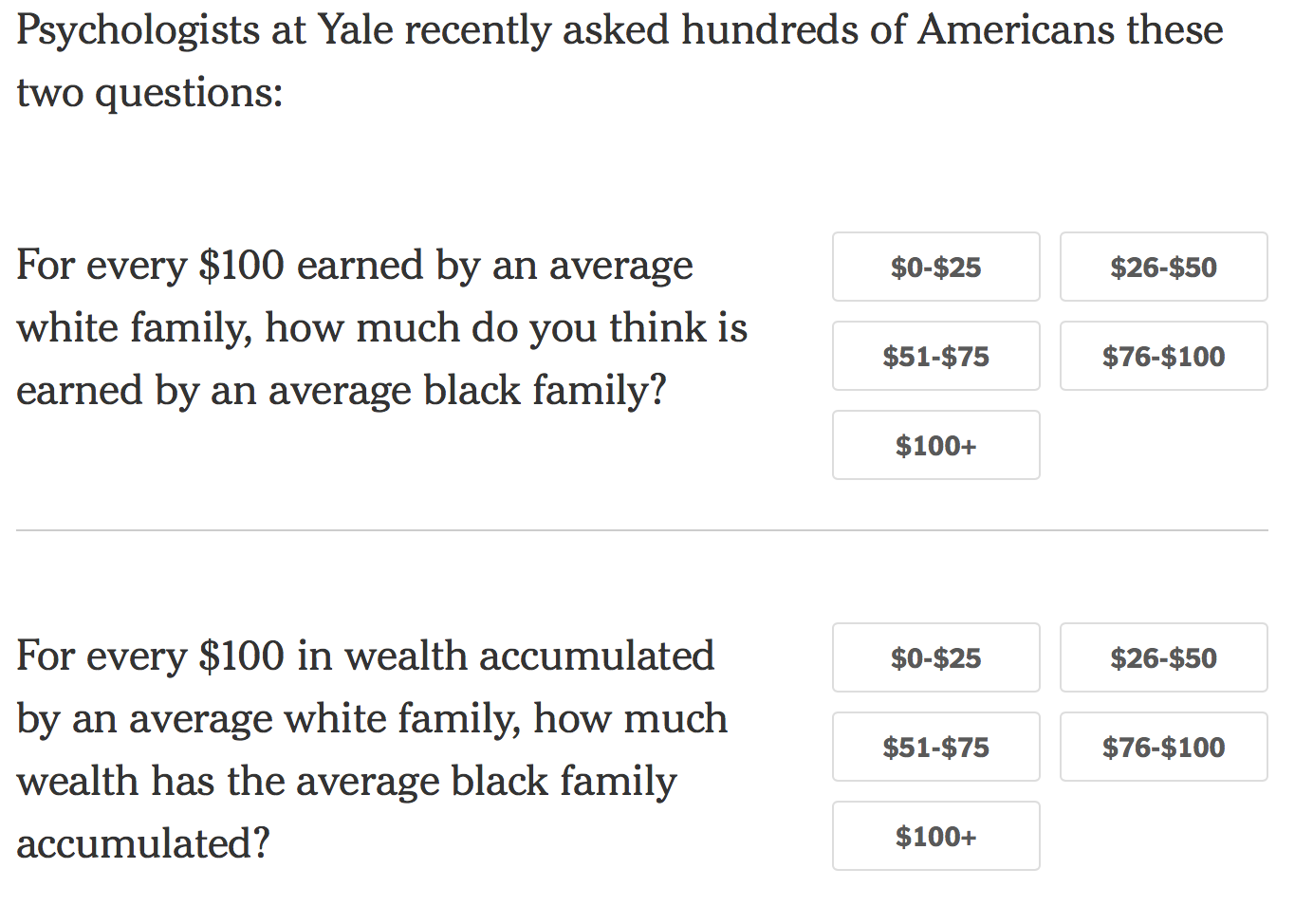
Black families in America earn just $57.30 for every $100 in income earned by white families, according to the Census Bureau’s Current Population Survey. For every $100 in white family wealth, black families hold just $5.04.

If Mr. Kraus, of all people, is taken aback by these numbers, what are the odds that most Americans have a good understanding of them? The answer, he and his colleagues fear, has broad implications for how we understand our society and what we’re willing to do to make it fairer.

Americans, and higher-income whites in particular, vastly overestimate progress toward economic equality between blacks and whites, the psychologists reported Monday in the Proceedings of the National Academy of Sciences. Americans believe that blacks and whites are more equal today than they truly are on measures of income, wealth, wages and health benefits. And they believe more historical progress has occurred than is the case, suggesting “a profound misperception of and unfounded optimism” regarding racial equality.

“It seems that we’ve convinced ourselves – and by ‘we’ I mean Americans writ large – that racial discrimination is a thing of the past,” said Jennifer Richeson, who was another of the study’s authors, along with Julian Rucker, a doctoral student. “We’ve literally overcome it, so to speak, despite blatant evidence to the contrary.”

To understand how people have perceived that progress, the researchers asked blacks and whites of varying income levels to estimate answers to the questions above in both recent years and historically. They also asked about how much black workers with a high school diploma but no college degree earn relative to whites of the same education level, and how the earnings of blacks and whites with a four-year college degree compare.

The present-day results, aggregated across several surveys used in the study, are compared here with actual government data:

The researchers suspect that the answer in part has to do with how little exposure Americans have to people who are unlike them. Given how economically and racially segregated the country remains, many Americans, and especially wealthy whites, have little direct knowledge of what life looks like for families in other demographic groups.

But the pattern this study identifies isn’t simply about lack of access to accurate information. As Mr. Kraus points out, popular videos and charts regularly circulate on social media highlighting the startling levels of inequality in America. And yet, many people who click on them forget about the severity of inequality just long enough to be surprised by it again in the future.

“Despite this information being out there, we don’t really take it in,” Mr. Kraus said. This happens “in a way that suggests that maybe we’re motivated to forget it, or motivated to distort it in our own minds.”

He and Ms. Richeson suspect that we also overgeneralize from other markers of racial progress: the election of a black president, the passage of civil rights laws, the sea change in public opinion around issues like segregation. If society has progressed in these ways, we assume there’s been great economic progress, too.

We’re inclined, as well, to believe that society is fairer than it really is. The reality that it’s not — that even college-educated black workers earn about 20 percent less than college-educated white ones, for example — is uncomfortable for both blacks who’ve been harmed by that unfairness and whites who’ve benefited from it.

“It’s very difficult to consider the possibility that some of what we’ve achieved or gained is due to forces that aren’t our own individual hard work,” Ms. Richeson said. “That’s hard to grapple with, especially in American society. We really believe in egalitarianism and meritocracy.”

These findings suggest that the motivation to see the world as fair may be even stronger in this context than stereotypes white Americans hold, for instance, equating blacks with poverty.

The researchers found in some additional surveys that whites answer these questions more accurately when they’re first asked to consider an America where discrimination persists. If we want people to have a better understanding of racial inequality, this implies that the solution isn’t simply to parrot these statistics more widely. It’s to get Americans thinking more about the forces that underlie them, like continued discrimination in hiring, or disparities in mortgage lending.

It’s a myth that racial progress is inevitable, Ms. Richeson said. “But it’s also dangerous insofar as it keeps us blind to considerable inequality in our nation that’s quite foundational,” she said. “Of course we can’t address it if we’re not even willing to acknowledge it.”
And if we’re not willing to acknowledge it, she adds, that has direct consequences for whether Americans are willing to support affirmative action policies, or continued enforcement of the Voting Rights Act, or renewed efforts at school desegregation.

Islamophobia is not colour blind: Paradkar

Good commentary on the intersection between religious and ethnic/racist discrimination and useful reminder of the Runnymede Trust’s definition of Islamophobia:

This week, the House of Commons heritage committee enters the second phase of M-103, the motion to combat Islamophobia, and begins a study on systemic racism and religious discrimination in Canada.

Its report card will hopefully contain two outcomes: Strategies to combat systemic racism, and a definition of Islamophobia that will place it in the context of Canadian laws as well as overall racism in the country.

For the latter, committee members would do well to examine a new paper out of Rice University in Texas titled, “The Racialization of Islam in the United States: Islamophobia, Hate Crimes, and ‘Flying while Brown.’ ”

“We often hear that because Muslims are not a race, people cannot be racist for attacking Muslims,” sociologist and study author Craig Considine is quoted saying in the University’s media statement. “This argument does not stack up. It is a simplistic way of thinking that overlooks the role that race plays in Islamophobic hate crimes.”

Islamophobia is not colour blind.

In the U.S., some 30 per cent of Muslims describe themselves as white, 23 per cent as Black, 21 per cent as Asian, 6 per cent as Hispanic, and 19 per cent as other or mixed race, according to the Pew Research Center in Washington.

Yet, nearly all Muslim racial or ethnic groups have higher odds of reporting one or more types of perceived discrimination than white Muslims, a 2016 study showed.

“Islamophobia does not belong in the realm of ‘rational’ criticism of Islam or Muslims; it is often discrimination against people who look different to the majority of U.S. citizens,” Considine says in the paper.

If “Driving While Black” is anti-Black racial profiling, “Flying While Brown” is anti-Muslim racial profiling leading to humiliating searches and detentions.

In any case, both are ineffectual at stopping crime or terrorism, according to the American Civil Liberties Union.

Canada has seen hate crimes against Muslims increase by 253 per cent in four years, according to a Statistics Canada report, with 45 crimes reported in 2012 and 159 in 2015.

I doubt the haters were religious scholars who had a rational critique of Islam.

Yet, attempting to condemn Islamophobia itself is seen as an attempt to stifle free speech and any criticism of the religion.

Casual anti-Islamic expressions are dotted with annoyance of visible religious markers such as head scarves on women, or an intangible fear of Sharia law, supposedly barrelling down on poor, unsuspecting us to blanket our society in darkness.

This fear that Muslims are conspiring to either destroy or dominate the West explains the hostile reception to M-103, which was a motion to speak out against discrimination.

This, although Liberal MP Iqra Khalid who brought forward the motion said quite clearly, “M-103 is not an attempt to create Sharia. I vow to oppose any law that threatens our multicultural society.”

The non-binding motion passed in March this year.

Reasonable people would shun the idea of violence against anyone based on their race or religious belief. But what is a fair critique of religion and what constitutes hate speech?

I see Islamophobia as anti-Muslim racism against predominantly brown and black-skinned people but with an added edge. Not just of superiority but also the righteous anger of fending off a menacing culture incapable of compatibility with others. It’s the conflation of all Muslims with terrorists, or impatience with cultural practices, or anger against those seen as hailing from a backward culture incapable of debate within itself.

In its 1997 report “Islamophobia: A Challenge for Us All,” a British left-leaning think tank, The Runnymede Trust, defined Islamophobia as the unfounded and close-minded fear and/or hatred of Islam, Muslims or Islamic/Muslim culture.

It identified eight components of Islamophobia, one of which included seeing it as violent, threatening or supportive of terrorism. Another included viewing it as primitive or barbaric or sexist. Using anti-Muslim hostility to exclude or discriminate against Muslims was, of course, one of the components.

Stereotyping has a lot to do with this.

Considine found that out of more than 1,000 Hollywood films depicting Arabs, 932 negatively stereotyped them. For example, Arabs/Muslims were constructed as the ominous figure: “the bearded, dark-skinned, turban-wearing terrorist guided by perceived archaic religious practices.”

This would help explain why a dark-skinned, turban-wearing Sikh man such as NDP leadership hopeful Jagmeet Singh had to fend off a ranting Islamophobe at a campaign rally. Or why a Inderjit Singh Mukker, a 53-year-old Sikh taxi driver near Chicago was beaten and bruised by a man who called him “Bin Laden” and told him to go back to his own country.

You don’t have to be Muslim to be vilified. Just being Muslim-like is enough. This is textbook racialization.

Source: Islamophobia is not colour blind: Paradkar | Toronto Star

Emmys: How to Get Away With the Bare Minimum of Diversity

Sharp commentary:

Sunday morning, hours before this year’s Emmys ceremony, Being Mary Jane actress Gabrielle Union tweeted: “I’ve been doing TV since 1995. This will be my 1st time going to the Emmys & I’m presenting an award! 22 yrs later. #OvernightSuccess.”

The actress’ first credited appearance was in an episode of Saved by the Bell: The New Classand while that might not be the type of show that garners you an Emmys invite, it’s surprising that in 22 years as a successful actress Union hasn’t even been at the ceremony. But then again, she’s a black woman in Hollywood, so it’s not really surprising, is it?

This moment for Union comes two years after Viola Davis gave her a shoutout in her historic win as the first black woman to win a best actress in a drama Emmy. Awarded a statue for her role in How to Get Away With Murder, Davis who traded in roles like the one in The Help where she played a maid, Davis put her community to task for its lack of inclusion. “In my mind, I see a line. And over that line, I see green fields and lovely flowers and beautiful white women with their arms stretched out to me, over that line. But I can’t seem to get there no how. I can’t seem to get over that line,” Davis said, quoting Harriet Tubman. She followed the quote by saying: “The only thing that separates women of color from anyone else is opportunity. You cannot win an Emmy for roles that are simply not there. So here’s to all the writers, the awesome people that are Ben Sherwood, Paul Lee, Peter Nowalk, Shonda Rhimes, people who have redefined what it means to be beautiful, to be sexy, to be a leading woman, to be black. And to the Taraji P. Hensons, the Kerry Washingtons, the Halle Berrys, the Nicole Beharies, the Meagan Goods, to Gabrielle Union: Thank you for taking us over that line. Thank you to the Television Academy. Thank you.”

Two years after the first best actress in a drama Emmy was awarded to a black woman shouldn’t be the year you pat yourself on the back. Especially not when Lena Waithe on Sunday was the first black woman to win an Emmy for best writing in a comedy. Or a night when Donald Glover was the first black male to win for comedy directing. Or a night where Riz Ahmed was the first male actor of Asian descent to win an acting Emmy. When we’re still in a business of firsts, you can keep your congratulations and you can keep your jokes about diversity, too. Sunday’s host, Stephen Colbert, followed in the footsteps of many white awards-show hosts who love making jokes about diversity to a room where there’s less black people in it than Williamsburg.

Because for an industry that loves to pretend it’s inclusive and diverse whenever awards season rolls around (like when Moonlight won an Oscar this year), it’s the bare minimum of diversity. The shows that these diverse nominees are awarded at are usually full of white people. The hosts are usually white—there hasn’t been a non-white Emmys host since Bryant Gumbel (don’t ask) in 1997. And the diversity usually extends to white women and black men. It’s true, women probably wouldn’t win any damn awards if they didn’t have separate acting categories, but the women that are nominated in these categories are usually white. When Nicole Kidman, Reese Witherspoon, and Laura Dern make pleas for more television starring women, it’s a lovely sentiment until you remember that the only black woman in Big Little Lies was Zoe Kravitz and there’s been three or four ensemble actress television shows starring white women since Charlie’s Angels. When Sex and the City was popular on HBO, we got a ton of knockoffs. Meanwhile, HBO has another female-led hit on its hands with Insecure, but there’ve been no influx of television series starring black women and HBO would rather greenlight bullshit like Confederate.

Meanwhile, out of all the black people who’ve won Emmys, the overwhelming majority are black men. Hollywood is a white world and it’s a man’s world. It usually benefits white men, white women, and then black men. There will plenty of more shows like Big Little Lies on the air, but will there be more like Being Mary Jane? Jane the Virgin? Fresh Off the Boat? Master of None? Asian-American actors are barely on television at all, and when they are, they usually portray terrorists in shows like 24 and Homeland.

True diversity in Hollywood means that it will have to step beyond the parameters of the usual suspects and start telling stories that look like the rest of America. I mean, it was absolutely shocking seeing some of the pairings chosen to give out awards—Gina Rodriguez and Shemar Moore, Riz Ahmed and Issa Rae, B.D. Wong and Matt Bomer (two openly gay men and one of them Asian?! You didn’t even see that on Looking)—and then realizing that you never see that kind of diversity on TV. Hell, these awards were on CBS and it was the most diverse thing you’ll ever see on this white as hell network.

Take this for instance: RuPaul and Tituss Burgess were included in two of Colbert’s comedic bits and they stole the show. Moonlight won an Oscar this year, but how long until we see a queer person of color hosting one of these damn things? No, Hollywood won’t know what real diversity is until people of color stop being bit parts or window dressing (like Superior Donuts’ Jermaine Fowler as the emcee) to make their awards shows look more “hip.”

Getting back to Gabrielle Union: Being Mary Jane has been on the air since 2013 and was created by Mara Brock Akil, a black woman and TV veteran. Union’s work has yet to be recognized by her peers. Will it ever be? Or do we only notice women of color like Viola Davis when they star in television shows on a white network like ABC, in a show written by a white man?

Source: Emmys: How to Get Away With the Bare Minimum of Diversity

Australia: Peter Dutton concedes he will need to rethink English test in citizenship overhaul| The Guardian

Proposed bill continues to be in trouble:

The immigration minister, Peter Dutton, has admitted he will need to overhaul the English-language test in the government’s citizenship package to have any hope of getting the legislation through the parliament.

But the critical parliamentary powerbroker on the controversial citizenship overhaul, the Nick Xenophon Team, is signalling the rework will need to be more broad-ranging than just the language test.

“There are so many components of this whole package that are a problem,” the NXT senator Stirling Griff told Guardian Australia on Tuesday. “Our position hasn’t changed at all.

Australia offers to pay Rohingya refugees to return to Myanmar
Read more
“Peter Dutton needs to go back to the drawing board.”

Last week, the Senate gave Dutton four sitting days to put his controversial citizenship bill up for debate, otherwise it would be struck from the notice paper.

The procedural pincer movement in the parliament came less than a week after the Nick Xenophon Team derailed Dutton’s attempt to enact the citizenship package, saying it could not support it in its current form.

The government does not currently have the numbers to get its citizenship overhaul – which has been badged politically as a national security measure – through the parliament.

It has been unclear how the government would respond to the current parliamentary deadlock – whether it would pull the whole package, or negotiate – but Dutton on Tuesday signalled for the first time he was prepared to negotiate.

Asked whether he was prepared to overhaul the English-language test, which currently requires a university standard of language fluency, Dutton told Sky News: “Of course we are flexible.”

The minister said he was talking with Nick Xenophon in an effort to reach a compromise. Dutton described the dialogue with the NXT as “constructive”.

The government needs the NXT bloc because both Labor and the Greens are opposed to the package.

Dutton said the government’s objective was to ensure would-be citizens had a functional level of English, and improved their language proficiency over time.

The citizenship changes in their current form would increase the waiting times for permanent residents before they could apply for citizenship (from one year to four years) and force new applicants to complete a tougher English-language test (and achieve a pass mark of 75%) equivalent to level 6 of the international English language testing system (IELTS).

The package also gives Dutton significant power to overrule decisions on citizenship applications by the Administrative Appeals Tribunal (AAT).

As well as raising broad-ranging concerns about the practical implications of the package, the NXT has expressed particular objection to the enhanced ministerial powers over tribunal decisions.

Griff said on Tuesday the government needed to go back to the drawing board and consult more widely about the implications of the changes.

Source: Peter Dutton concedes he will need to rethink English test in citizenship overhaul | Australia news | The Guardian

Racisme systémique: la CAQ demande l’annulation de la commission

Ongoing denial among the major opposition parties:

La pression s’accentue sur le gouvernement Couillard afin qu’il abandonne l’idée d’une consultation sur la discrimination systémique et le racisme. Après le Parti québécois (PQ), c’est au tour de la Coalition avenir Québec (CAQ) d’en demander l’annulation complète.

Lundi, la porte-parole caquiste en matière d’immigration, Nathalie Roy, a fait valoir que le gouvernement rate sa cible lorsqu’il parle de racisme «systémique». «On ne croit pas que ça existe», a-t-elle affirmé lors d’un entretien téléphonique avec La Presse canadienne.

Le racisme systémique, ou racisme institutionnel, est une forme de discrimination qui s’exprime par le traitement inégalitaire d’individus racisés par une société et ses institutions.

Mme Roy a dit ajouter sa voix à celles des nombreux «analystes, leaders d’opinion, éditorialistes et chroniqueurs» au Québec qui s’opposent à une vaste consultation sur le racisme.

Le PQ avait aussi demandé, le 6 avril dernier, l’annulation des procédures dans une pétition réclamant «l’abandon immédiat du projet de consultation sur le racisme et la discrimination systémique».

Il est illusoire, selon les partis, de penser que l’on puisse tenir une telle consultation en année préélectorale, lorsque traditionnellement les esprits s’échauffent.

«Vous savez très bien que ce sont des sujets extrêmement délicats et qu’il ne faut pas faire de politique sur le dos des communautés culturelles», a affirmé Mme Roy.

«Cette consultation-là repose sur une stratégie de M. (le premier ministre Philippe) Couillard qui va exacerber les divisions et les tensions à un an des élections.»

Par ailleurs, la députée de Montarville maintient que les libéraux ont failli à leur tâche d’accroître la représentativité des membres des communautés culturelles au sein de l’administration publique.

En 2008, Yolande James, l’ex-ministre libérale de l’Immigration, avait pourtant déposé un plan d’action, intitulé «Diversité: une valeur ajoutée», qui fixait un objectif d’embauche de 25 pour cent.

Elle promettait, entre autres, d’intensifier la diffusion ciblée des offres de recrutement, l’analyse des outils de sélection en vue de s’assurer qu’ils ne comportent pas de pratiques discriminatoires, et la promotion des possibilités d’emplois dans la fonction publique.

Or, selon les informations obtenues par Mme Roy lors de l’étude des crédits, le gouvernement serait encore bien loin de sa cible, aux alentours de huit pour cent.

Annonce de la Commission des droits de la personne mardi

La Commission des droits de la personne, qui dirige la consultation, ira tout de même de l’avant et lancera ses travaux mardi, a appris La Presse canadienne.

Elle accuse du retard; la liste des organismes à but non lucratif qui sont impliqués n’est toujours pas connue, alors qu’elle devait être publiée le 1er septembre dernier.

La commission est également aux prises avec des difficultés à l’interne. La nouvelle présidente, Tamara Thermitus, serait visée par des plaintes pour abus d’autorité et mauvaise gestion.

Le lancement des travaux se fera donc sans tambour ni trompette, soit par communiqué de presse, a confirmé l’agente d’information Meissoon Azzaria.

Le PQ et la CAQ en ont également contre la décision de la Commission des droits de la personne de tenir ses premières consultations locales, auprès de personnes racisées, à huis clos.

«Le huis clos, c’est la goutte qui fait déborder le vase, a soutenu Nathalie Roy. C’est cette même commission-là, à l’intérieur de laquelle la chicane est pognée, qui va faire une consultation avec, entre autres, des témoignages à huis clos. Ça ne tient pas la route, c’est parti tout croche.»

La ministre de l’Immigration, Kathleen Weil, a pour sa part affirmé que la consultation sera à la fois publique et privée, pour permettre aux gens de s’exprimer librement.

«Notre gouvernement est déterminé à éliminer les barrières à la pleine participation des Québécois de toutes origines», a-t-elle déclaré dans un courriel, lundi.

«Le racisme et la discrimination en font partie. Nous avons le devoir d’agir et de mobiliser toute la société pour contrer ces phénomènes. C’est pourquoi nous avons confié le mandat de cette consultation à la Commission des droits de la personne et des droits de la jeunesse (CDPDJ) qui procédera d’ailleurs sous peu à l’annonce des organismes retenus pour les consultations locales», a-t-elle ajouté.

Source: Racisme systémique: la CAQ demande l’annulation de la commission | Caroline Plante | Politique québécoise

Over a quarter of British people ‘hold anti-Semitic attitudes’, study finds – BBC News

Despite the headline, a more nuanced poll and study than most on antisemitism or other forms of racism and prejudice:

More than a quarter of British people hold at least one anti-Semitic view, according to a study of attitudes to Jewish people.

The Institute for Jewish Policy Research said the finding came from the largest and most detailed survey of attitudes towards Jews and Israel ever conducted in Britain.

But it said the study did not mean that British people were anti-Semitic.

Researchers also found a correlation in anti-Jewish and anti-Israel attitudes.

The study found a relatively small number of British adults – 2.4% – expressed multiple anti-Semitic attitudes “readily and confidently”.

But when questioned about whether they agreed with a number of statements, including “Jews think they are better than other people”, and “Jews exploit holocaust victimhood for their own purposes”, 30% agreed with at least one statement.

Despite this, the researchers said they found that levels of anti-Semitism in Great Britain were among the lowest in the world.

A spokesman for the Community Security Trust, which has recorded high levels anti-Semitic crime, said: “We believe the new findings, data and nuance in this study will help us to work even more effectively with partners inside and outside the Jewish community to tackle this problem.”

The report said about 70% of the population of Britain had a favourable opinion of Jews and did not hold any anti-Semitic ideas or views.

Muslim views

The IJPR’s researchers questioned 5,466 people face-to-face and online in the winter of 2016/17 – 995 of these were Muslims, although a smaller number of Muslims were included in the statisticians’ nationally representative sample.

They found more than half of Muslims (55%) held at least one anti-Semitic attitude.

Dr Jonathan Boyd, director of the IJPR, said: “Our intention here was not to make any broad generalisations about the Muslim population and their attitudes towards Jews.

“There does seem to be some relationship between levels of religiosity in the Muslim population and anti-Semitism.”

The institute said it wanted to promote an “elastic view”, making a distinction between people who are clearly anti-Semites, and ideas that are perceived by Jews as anti-Semitic.

In December 2016 the government adopted an internationally recognised definition of anti-Semitism: “a certain perception of Jews, which may be expressed as hatred toward Jews”.

Questions on Israel

The researchers also questioned people about their views on statements about Israel and the conflict with the Palestinians.

Their report said fewer than one in five people questioned (17%) had a favourable opinion of Israel, whereas about one in three (33%) held an unfavourable view.

The report said: “The position of the British population towards Israel can be characterised as one of uncertainty or indifference, but among those who hold a view, people with sympathies towards the Palestinians are numerically dominant.”

Dr Boyd said: “Anti-Israel and anti-Jewish views exist both together and in isolation.

“The higher the level of anti-Israel attitudes measured, the more likely they are to hold anti-Semitic views as well.”

The study also revealed that anti-Semitic attitudes were higher than normal among people who classified their politics as “very right-wing”.

Among this group they were two to four times higher than among the general population.

The researchers said the prevalence was considerably higher among right-wingers than on the left.

Rabbi Charley Baginsky, from the Liberal Judaism movement, said: “The report is important for helping us understand where the anxiety comes from within the community at large and for understanding why anti-semitism seems to be the prevailing discourse within the community.

“We must be really careful that it does not come to define us and that we celebrate the positive interactions with society at large.

“What is arguably more important … is to educate and interact, to be more outward facing and open to discussion than inward facing.”

Source: Over a quarter of British people ‘hold anti-Semitic attitudes’, study finds – BBC News

Iqra Khalid urges MPs to take unified approach in Islamophobia study

Will be interesting to see the degree to which the Conservatives play a constructive or obstructive role in the Committee study – and whether the Liberals resist partisanship in their approach.

Their choice of witnesses will be as revealing as their interventions (don’t have the complete list to be able to assess the respective balance but the inclusion of Tarek Fatah on the Conservative list suggests that their approach may not have changed):

The inclusion of the phrase Islamophobia in a hotly debated motion passed by the House of Commons last year was meant as an example of forms of racism, the Liberal MP who sponsored the proposal said Monday.

Iqra Khalid told the House of Commons heritage committee that her motion calling for parliamentarians to condemn Islamophobia and for a study on systematic racism and religious discrimination was about the study itself that began Monday.

“It uses the example of Islamophobia to make a larger point about the problem of all forms of systemic racism and religious discrimination — that we have to find ways to tackle that broad problem in Canada as a whole,” Khalid said.

Khalid said she was motivated to introduce M-103 after hearing several stories of racist acts against different faiths in the fall of 2016. When she looked into the issue, she found the statistics to provide context to the problem were lacking and something had to be done.

“The objective of the motion was to bring forward this study, it is upon this committee as a whole to take that unified approach to study the issue, to work with each other to find those recommendations to assist us as policy makers,” she said.

Khalid’s motion passed in a vote of 201-91 last spring. It called on MPs to recognize something had to be down to “quell the increasing public climate of hate and fear,” and to that end, the House ought to condemn Islamophobia and all forms of systemic racism and religious discrimination and direct the heritage committee to study the issue, including how better to gather hate crime data.

The conflict around the motion centered largely around the word Islamophobia, setting off protests on Parliament Hill and arguments across the country over the meaning and implications of the phrase.

Khalid told the committee she defines it as “irrational fear or hatred of Muslims or Islam” that leads to discrimination.

But opponents say the word it is vague and essentially means criticism against Islam of any kind is forbidden, and some saw Khalid’s motion as the first step in criminalizing that criticism. Conservative news outlet Rebel Media seized on that issue with gusto, forcing it into the Conservative leadership race as contenders were grilled on their positions.

The Conservatives had sought to remove the phrase and instead broaden the motion to refer to multiple faiths.

They lost over objections from the Liberals that they would be watering down Khalid’s effort. Several Conservatives raised their own motion in quizzing Khalid on Monday about her intentions.

“Both of us would have liked to have found ourselves on the same side of the vote in the House on the issue,” Conservative David Anderson said.

“We are sir,” Khalid replied.

Green Party Leader Elizabeth May said she had never seen as much “fomented anger, concern and misconception” around a House of Commons motion as she heard around Khalid’s.

She and other MPs told Khalid they’d received calls that the motion would lead to Islamic religious law, known as Sharia, being introduced in Canada or that it would give Islam a protected status in Canada greater than that of other religions.

Khalid was asked to directly address some of the specific concerns, but didn’t tackle them all, saying while there were misconceptions, it was time to move forward.

“The conversation that Canadians had over the past number of months was a very important conversation,” Khalid said.

“It is a great way to lead up to this study.”

Source: Iqra Khalid urges MPs to take unified approach in Islamophobia study – The Globe and Mail

When Picasso and Orwell Went After Tyrants and Risked It All

Good reminder:

This is a story about truth and how, against all the odds, it can be discerned and defended against liars through individual acts of courage and genius. It is a story for all time and particularly our time, when totalitarianism bludgeons the truth tellers with renewed support.

Pablo Picasso and George Orwell never met. But each of them, reaching the heights of their powers, looked at the same events in the same place at the same time, 80 years ago, and used their art to expose the true face of totalitarianism. At the time they were vilified for doing so.

Picasso produced his huge and wrenching masterpiece, Guernica, named for the northern Spanish city that was the first European city to be carpet-bombed. Orwell produced Homage to Catalonia, his gimlet-eyed record of fighting in the Spanish Civil War in which he nearly died.

Spain, Orwell discovered, “was a pawn in an enormous struggle that was being fought out between two political theories.” He fought with the republican government forces against the fascists but in the course of several battles realized that the republicans were being manipulated by Moscow and that “the Communists stood not upon the extreme Left but upon the extreme Right.”

The error—made by many thousands of European and American volunteers fighting with the republicans—was to believe that the forces opposing Generalissimo Franco’s fascists were naturally on the side of the angels simply because they were anti-fascist. As Orwell himself was swiftly disabused of this idea he came to the core revelation of his political life—that the true evil was totalitarianism, no matter what uniform it wore or what language it spoke.

Eventually that revelation shaped his two literary masterpieces, Animal Farm and 1984.However, the most immediate and personal result was that Orwell, in Homage To Catalonia,had delivered a message that nobody wanted to hear. In London his old socialist friends disowned him. Many of them were in thrall to Moscow’s utopian propaganda that the struggle in Spain was for universal liberty, rather than the slavery that Stalin had in mind.

Picasso was in a different kind of trap. When Guernica was exhibited in the U.S. the American Right labeled it “Bolshevist art controlled by the hand of Moscow.”  In fact, Picasso did not join the French Communist Party until 1944, when Paris was liberated from the Nazis. Political theory had nothing to do with the raging art that drove Guernica.

On the afternoon of April 27, 1937, successive waves of German and Italian bombers dropped a combination of bombs on Guernica carefully designed to kill, maim and terrorize the civilian population—they included fragmentation bombs that eviscerated people and incendiaries burning at 2,500 degrees centigrade that turned the city into a fireball. People who fled into the hills were strafed with machine guns. More than 1,600 people died and nearly 1,000 more were injured.

Seen in the perspective of what followed, Guernica was a calculated forewarning to the world that total war now included the mass slaughter of civilians. Picasso’s canvas was more than 25 feet wide and eight feet deep. Within this space every figure—including a bull, a horse, a mother with a dead child, was eviscerated. Limbs, fingers, skulls interlocked in a gruesome dance of death. What Picasso took from the atrocity was intensely personal: the people of his native country had become the cannon fodder of a new order in Spain. Franco, abetted by Hitler and Mussolini, would rule by terror.

Guernica was exhibited in London before being shipped to the US. Critics were divided. As a commentary on war some ranked it with Goya’s rending account of the savagery of the Napoleonic wars. But the hand of ideology also surfaced. The critic Anthony Blunt called the painting “hopelessly obscure, its meaning elusive.” Unknown to anyone then, Blunt was a Soviet sleeper agent, unmasked only in 1979 as the long-sought Fourth Man in an espionage ring—his rejection of Guernica was the Stalinist party line conveyed as aesthetic distaste.

Source: When Picasso and Orwell Went After Tyrants and Risked It All

‘Fear is the greatest factor:’ Survey finds Canadians worry about rise of racism against Muslims

Not much new here but interesting nevertheless. Comments by Imam Soharwardy of note:

A survey suggests Canadians have a generally positive impression of Muslims but that view doesn’t apply to some of the religion’s leadership and beliefs.

The poll, commissioned by Think for Actions and Insights Matter, found 78 per cent of Canadians agreed Muslims should adopt Canadian customs and values but maintain their religious and cultural practices. Some 88 per cent of those surveyed said Muslims should be treated no differently than any other Canadian.

But 72 per cent of respondents also believed there has been an increasing climate of hatred and fear towards Muslims in Canada and that it will get worse.

Results of the poll — an online survey of 1,048 Canadians done from March 13 to Aug. 12 — were released Saturday at The Unity Conference in Calgary on Islamophobia, discrimination and systemic racism.

“The biggest takeaway is Canadians who are friends with a Muslim or know a Muslim individual have a positive view of Islam and Muslims and are more welcoming to them,” said Mukarram Zaidi, chair of the group that commissioned the survey.

“Fear is the greatest factor. The majority of Canadians believe the issue of racism has increased. They are concerned about the issue of general racism and hate crimes, religious discrimination, homophobia and anti-Semitism.”

Public perception isn’t all positive. The survey found 56 per cent believed that Islam suppresses women’s rights. There was a 54 per cent approval for imams and 35 per cent for Muslim leadership.

“There needs to be work done within the Muslim community and their leadership to understand that the common person does not hold a lot of respect for what they’re doing,” said Zaidi.

“Children born and raised in North America need to become an imam, because when they stand up and speak, they can speak English clearly and they can relate Islam to North American culture.”

Calgary Imam Syed Soharwardy, founder of Muslims Against Terrorism and the Islamic Supreme Council of Canada, understands why Canadians would be suspicious of Muslim leadership. He said many imams discuss only religious teaching and morality when they should speak out against fanaticism, extremism and intolerance.

“Many Muslim leaders do not condemn ISIL, the Taliban, al-Qaida,” said Soharwardy. “A lot of imams are doing it, but not enough.”

Soharwardy, who was born in Pakistan, said imams should be fluent in English or French and have a good understanding of Canadian society.

“I think most of the imams, who come from overseas and outside of Canada, they still live in silos. They still do not help people to integrate in the mainstream Canadian society.”

Soharwardy has personal experience about the need for good language skills when talking to Canadian-born Muslims.

“At our mosque I speak in English and Urdu, like a bilingual sort of thing. My own son says, ‘Papa, when you speak English that is fine, but as soon as you start talking Urdu, you just turn me off’ — and he understands it.”

New passport processing system $75M over budget

Yet another failing project, once again pointing out political and public servant accountability and management issues:

Another government IT project is going off the rails, this one intended to issue Canadian passports faster and cheaper than the current system.

The so-called Passport Program Modernization Initiative, launched in 2014, is at least $75 million over budget and well behind schedule.

“From its outset, the complexity … was underestimated,” says an internal document, explaining a series of setbacks to the ambitious plan.

“The project management capacity and expertise was insufficient for the complexity and scale of the initiative.”

The January 2017 document, obtained by CBC News under the Access to Information Act, says that in initial tests the new system actually increased processing times, rather than decreased them as planned, and allowed breaches to Canadians’ confidential information.

The passport mess joins the botched Phoenix payroll system, the struggling email transformation initiative and the Canada.ca project as IT schemes inherited by the Liberal government that have bogged down in delays and cost over-runs.

That’s because passport fees are much higher than the actual cost of producing the document, and surpluses can be used for improvements in passport processing, including the modernization project and its budget overruns.

Online renewals

The passport project was first approved in December 2013 with a five-year, $101.2-million budget, and was intended among other things to let Canadians apply online for renewals. The project was to be complete by June next year.

But Immigration, Refugees and Citizenship Canada — which has run the passport office since July 2013 — now says modernization will cost at least $176 million, a 75 per cent increase so far, and will not meet next year’s deadline because of delays.

“The project schedule is under review and planned activities are being resequenced to occur at a later date,” says a report on the project.

CBC News has previously reported on the first flubbed test of the new system, starting on May 9, 2015, in which at least 1,500 passports were produced that were vulnerable to fraud and tampering.

But unlike the other three, the fees Canadians pay directly for their passports are going to bail out the modernization project rather than general tax revenues.

‘The reporting did not track project spending … against budgeted activities.’– Internal report on passport modernizaton project

The test was carried out despite warnings of some officials that it posed significant security risks. In the summer of 2015 the department suspended its use of the new system, which was plagued with hundreds of glitches. Officials said none of the 1,500 problematic passports was issued to any citizen.

An internal audit of the initiative’s first stages found a raft of problems, including lack of cost control.

“The reporting did not track project spending against budgeted activities,” says the February 2016 audit report, adding the project “did not include a plan for security requirements.”

In 2013, the new fee for a five-year passport was set at $120 compared with $87 previously, and the department introduced a new 10-year passport for a $160 fee.

Revenues currently far exceed expenses; the passport program generated a surplus of $253 million for 2015-2016, the most recent year reported.

Revenue to drop

But because more Canadians are holding 10-year passports, the department expects revenues to drop significantly starting next year as fewer people need renewals.

The program will start drawing on its accumulated surpluses after next year to avoid deficits — but the modernization program’s cost overruns will add to the fiscal pressures.

That’s the opposite of the original plan, which was for the passport modernization project to dramatically cut the cost of issuing passports, and help IRCC get through the lean years from 2018 to 2023 as revenues decline because of the effect of 10-year passports issued in 2013 and after.

Source: New passport processing system $75M over budget – Politics – CBC News