Another interesting poll, showing that Canadians largely support an open economy and immigration for talented workers/high skilled workers (which closely mirror overall attitudes towards immigration):
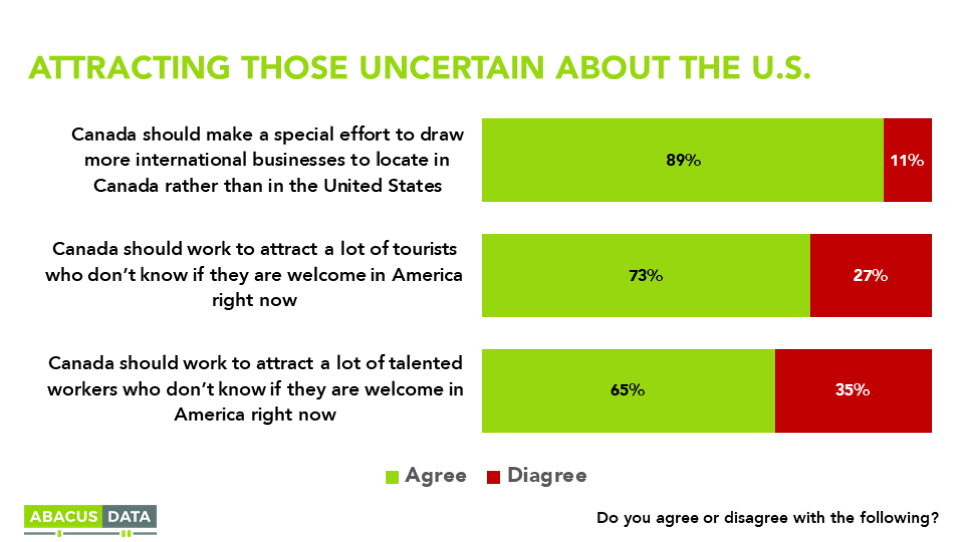
To underscore the fact that Canadians do not believe Canada should take a passive approach in the face of trade threats from the White House, we asked whether Canada should look for opportunities where US policies might create disruption and potential interest in Canada.
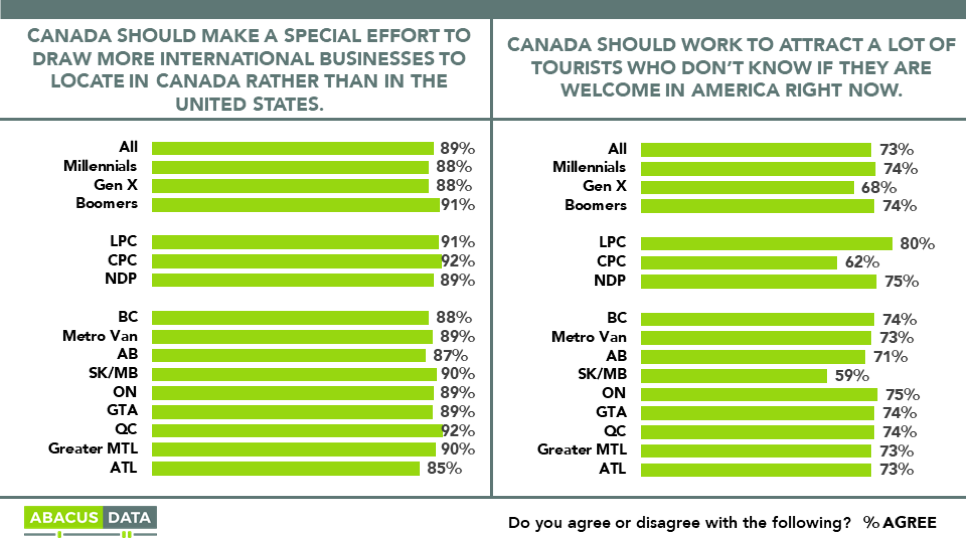
• 89% say Canada should make a special effort to draw more international businesses to locate in Canada rather than the US.
• 73% say Canada should work to attract a lot of tourists who don’t know if they are welcome in America right now.
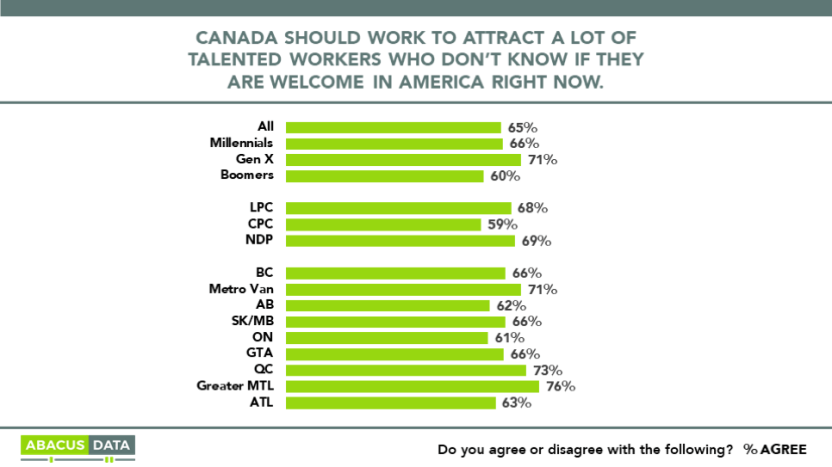
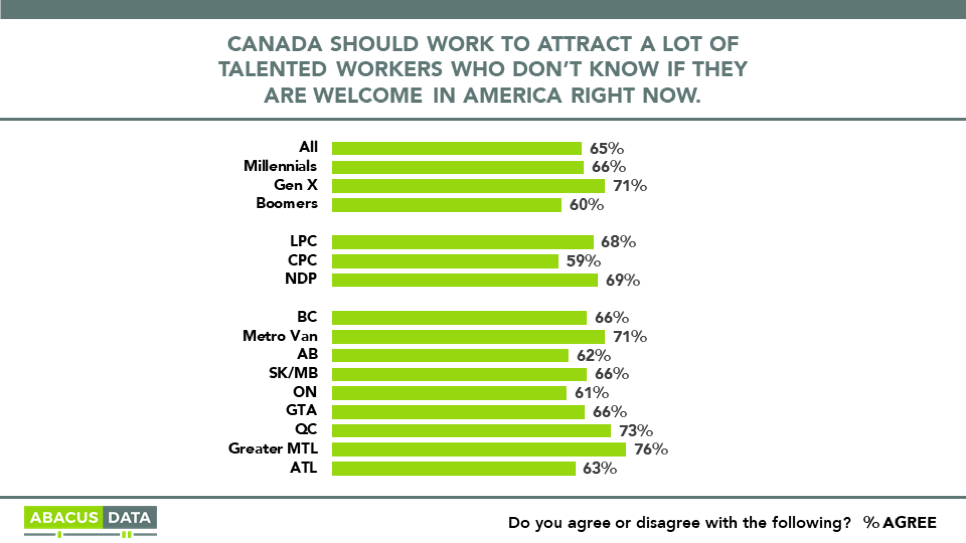
• Two-thirds (65%) say Canada should work to attract a lot of talented workers who don’t know if they are welcome in America right now.
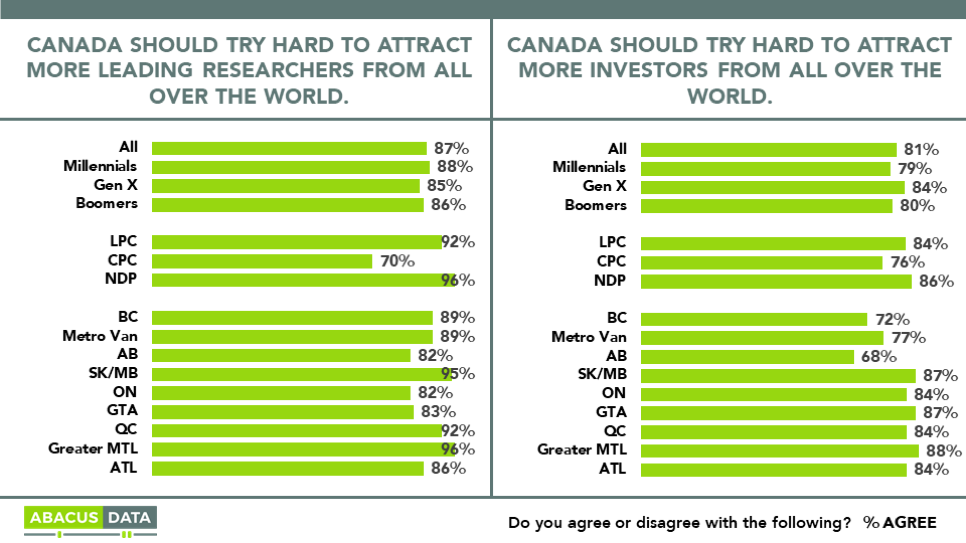
While many economic policy choices can reveal deep partisan or regional cleavages, for the most part, these ideas don’t. The large majority of people in all regions and across the three major parties like the idea of working to attract researchers and investment, and endorse the idea of making a special effort to reach those who may feel unwelcome in the US today.
UPSHOT
According to Bruce Anderson: “Many Canadians think there is a moment of opportunity for Canada, not only a substantial risk of US trade and tax measures that could unsettle conditions in Canada. People see this country as having lots to offer talent and investment capital from around the world, and believe we should make strenuous, special efforts to reach out an attract it, especially since some may feel less certain of the welcome they would receive in the US.
For governments, this is a clear signal that people want our best defense on trade issues, but don’t want Canada to only play defense – in fact the large majority see this as a moment of ambition, and are anxious that our political leadership seize the moment caused by political uncertainty in other parts of the world, to extol Canada’s advantages.”
Interesting survey in the secondary questions on attitudes and beliefs:
The larger the role faith plays in the lives of Canadians, the more likely they are to say they value altruism over self-fulfillment, a new poll has found.
Religion and politics, it is often said, don’t mix. Just because it’s said doesn’t mean it’s true — and in Canada, it’s not true.
Freshly released poll numbers collected by the Angus Reid Institute (ARI) and Faith in Canada 150, in collaboration with think tank Cardus, suggest faith and religious belief do indeed play a hefty role in our views on politics and the world.
The survey, conducted by the Angus Reid Institute in partnership with Faith in Canada 150, is part of a year-long project gauging Canadians’ beliefs and religious practices. It grouped respondents into four categories ranging from non-believers to religiously committed who attend places of worship regularly.
“Caring for others versus personal fulfillment, those are two very different value constructs,” Angus Reid, the institute’s founder and chairman, said in an interview. “And the relationship between them and religiosity is really significant.”
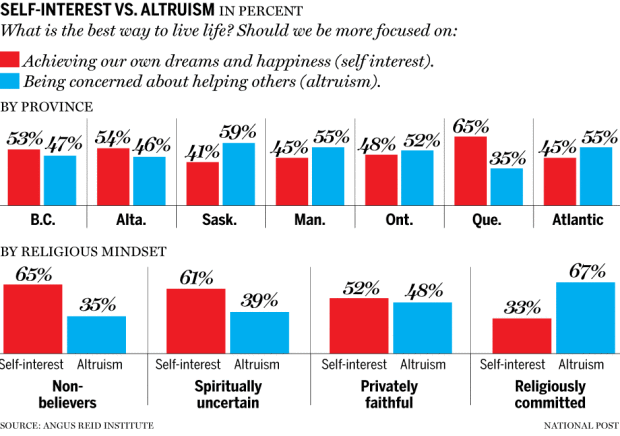
Asked to choose between two approaches as “the best way to live life,” 53 per cent of respondents picked “achieving our own dreams and happiness” over “being concerned about helping others.”
But when the results were broken down along the spectrum of religiosity, 67 per cent of the religiously committed favoured helping others. For non-believers, 65 per cent chose the pursuit of happiness.
The question revealed significant differences across Canadian regions. Quebec had the highest proportion of respondents across the country opting for self-fulfillment, at 65 per cent. Alberta was second at 54 per cent and British Columbia next at 53 per cent. In all other parts of the country, a majority of respondents picked helping others, with Saskatchewan the most altruistic at 59 per cent.
“What this survey proves is that having a faith, being part of a faith community, seems to propel people in the direction of developing higher levels of compassion or caring,” Reid said.
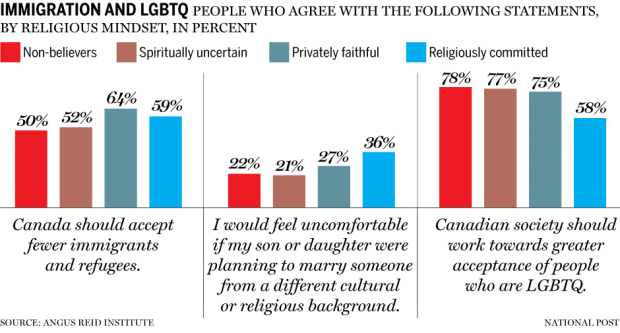
But that compassion has its limits. The 2,006 Canadian adults surveyed were asked a series of moral questions. The responses showed that the two groups on the religious end of the spectrum – the religiously committed and privately faithful – were together the most likely to say:
Canada should accept fewer immigrants and refugees;
They would be uncomfortable if a child planned to marry someone from a different cultural or religious background;
There should not be greater social acceptance of people who are LGBTQ (lesbian, gay, bisexual, transgender, queer);
Preserving life is more important than people’s freedom to choose on issues like abortion and doctor-assisted death.
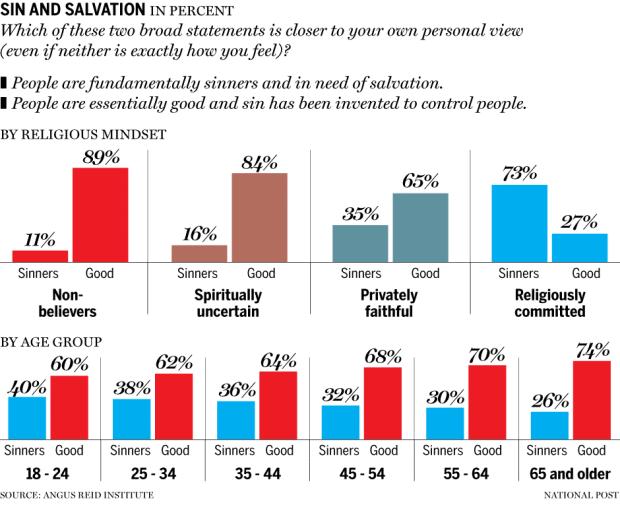
In another question, the poll asked which statement corresponded most closely to respondents’ personal views:
People are fundamentally sinners and in need of salvation; or
People are essentially good and sin has been invented to control people.
Two-thirds of those polled sided with the essential goodness of people. But among the religiously committed – who made up about one-fifth of the survey group – 73 per cent said people are fundamentally sinners.
Another set of questions sought to gauge positions on moral relativism – whether the concept of right and wrong is absolute or can change depending on the situation. A large majority, 68 per cent, said what is right or wrong “depends on the circumstances.” But nearly the same proportion, 66 per cent, rejected the notion that “answers to moral questions will be different for different cultures.” At 74 per cent, the religiously committed were the most likely to say universal rights and wrongs apply to the whole human race.
Ray Pennings, executive vice-president of Christian think tank Cardus, welcomed the poll’s finding that a majority of Canadians say their faith is important to their personal identity (54 per cent) and their day-to-day lives (55 per cent.)
“On the one hand, in contrast to the prevalent public narrative that religion is private and it doesn’t matter, it’s quite clear that for the vast majority of Canadians, it does. Over half say, ‘Religion is actually shaping my identity and my decisions,’ ” Pennings said.
“On the other hand, that engagement is a relatively thin engagement.”
“It is not for Bürgerwehren or self-appointed hobby sheriffs to play at being the police,” Minister of Justice Heiko Maas warned last year, pointedly calling out those who were clicking “attend,” or otherwise loudly making plans to start patrolling neighborhoods at night, apparently on a mission to “bring back order” to inner cities.
Most of those announcements ended up being a lot of talk with little action. Still, gang violence in its most basic form seems to have taken on new inspiration: Last fall, a gang of four beat a 41-year-old acquaintance to death in front of a disco in provincial Waldbröl after getting drunk one night and going into town with baseball bats and some sort of vague plan to “hunt refugees.” Asked to explain the motive in court, one of the accused claimed that he was taking revenge for a girl who had been harassed.
In the United States, they used to call this lynching, with the reasons given often very much the same. And Germany isn’t the only European country that’s had trouble with self-appointed “hobby sheriffs” inventing themselves as “migrant hunters.” Finland has the anti-immigrant street patrol group Soldiers of Odin. And along the southern Bulgarian land border to Turkey there have been numerous incidents of vigilante groups detaining migrants, beating and humiliating them—and sometimes making a show of it in the process.
This year, prosecutors tried and failed to charge 31-year-old Peter Nizamov for “arresting“ three Afghan migrants, in the sense that he and his gang (they call themselves “Civil Squads for the Protection of Women and Faith”) cornered the three travelers, proceeded to rob them and beat them, then tied them up and shouted at them, in broken English, to go back to Turkey.
The state attorney should have had an easy time getting a six-year prison sentence for Nizamov. There was no question about the facts. He had posted a video of the event on Facebook, probably anticipating that it would be a great hit with his followers. And it was. Indeed, the flurry of “likes” was predictable—Bulgaria is mainly a transit country for refugees heading to Northern Europe, and the government itself has taken a harsh line on immigration, using the kind of rhetoric usually reserved for far-right fringe parties.
Then, in March this year, the court decided to acquit Nizamov. The police, who likely expected he would just brag the way he did when he gave an interview to national broadcaster bTV while under house arrest and confess to the charges, had done a sloppy job in gathering evidence: They hardly even bothered (and failed) to find the three Afghans to come to court and testify. And the TV confession was not replicated in court.
Good evidence-based analysis but would have been helpful to have the pre-changes data as well:
Five years after Ottawa rolled out controversial reforms to build a “faster and fairer” asylum system, also meant to boot out failed refugees quickly, the verdict is in.
“The aim of the Balanced Refugee Reform Act and the Protecting Canada’s Immigration System Act was to make the system faster, fairer and more cost effective,” said Ryerson University criminology professor Idil Atak, who co-wrote the review with colleague Graham Hudson at Ryerson and University of Ottawa professor Delphine Nakache.
“But the new system is not faster. It is not fairer. It is not more cost-effective.”
To restore the asylum system’s “integrity,” then Immigration Minister Jason Kenney introduced substantive changes to the process, including truncated timelines in asylum claims’ processing. Those who claim asylum at a port of entry are given 15 days, not the 28 days that applied prior to that, to submit the form setting out the basis of their claim.
For most claimants, refugee hearings are supposed to be held no later than 60 days after the claim is referred to the Immigration and Refugee Board, while those from the government-designated list of “safe” countries will be heard as quickly as within 30 days.
The government did respond to advocates’ demands by establishing a tribunal to hear appeals by applicants whose claims have been rejected.
However, it also introduced a one-year bar to prevent failed refugees from having a pre-removal risk assessment or applying permanent residence under humanitarian considerations to delay deportation.
The researchers examined the system’s performance against its policy goals. They did this based on government data from the refugee board, immigration department, border service officials and the RCMP, and on 47 interviews with officials from those agencies and others.
Despite the drop in the volume of asylum claims by half over the course of one year, from 20,427 in 2012 to 10,322 in 2013, only 55 per cent of the safe-country claims met the 30-day target, compared to seven out of 10 claims from non-safe countries.
According to the refugee board, 30 per cent of asylum hearings had to be rescheduled in 2015, mostly due to lack of time. One-third of the appeals at the refugee appeals tribunal also failed to deliver a decision within the 90-day limit; on average, appeals cases were finalized 44 days beyond the target.
“The administration’s priority was to schedule the initial (refugee) hearings for new asylum applications,” said the 50-page study. “As a result, secondary intake of claims, i.e. claims returned by the appeals tribunal or Federal court, remained unresolved for a period of time.”
There were more than 5,000 so-called “legacy cases,” which were filed before the new system came into effect in 2012, that were languishing in the system as of 2016, said Atak, adding that the refugee backlog has already reached the number that applied before the 2012 reform.
With a spike in the number of irregular land-border crossings via the United States, Canada this year has already received a total of 12,040 claims up to the end of April.
If the trend continues, it could reach 36,000 cases in 2017.
Mario Dion, the refugee board chair, has called on the Liberal government both for more resources and to ease the restrictive process.
The Tories established the one-year bar to pre-removal risk assessments and humanitarian consideration for failed refugees because of the target to kick them out of Canada within one year.
However, the study found only one-third of failed claimants were removed from Canada within 12 months due to many obstacles.
These include lack of co-operation by the home country, inability to locate the individuals and the person’s fitness to travel.
The reforms did not come cheap, said the study; the Tory government allocated a total of $324 million on implementation over five years.
The removal costs almost doubled to $43 million after the reforms, while the number of people deported from Canada dropped from 13,869 in 2012 to 7,852 in 2014, according to the latest data available to the researchers.
CNN reports that top White House adviser Stephen Miller is drafting the speech on Islam that President Trump is slated to deliver in Saudi Arabia later this week. As you may recall, Miller was also at the center of crafting and defending the administration’s controversial immigration ban, which has been blocked by the courts because it unconstitutionally bars people from entering the country based on their religion.
Miller’s role perfectly captures the problem with this speech: Trump and his top advisers captivated his base by engaging in the worst Islamophobic rhetoric, perpetuating slurs about Muslims in the United States and around the world. But if Trump uses this speech to make amends for his past statements, he’ll alienate the very base of supporters who were the targets of this anti-Muslim strategy.
The administration is suggesting that he will, in fact, try to make such amends. National security adviser H.R. McMaster, who is also helping to write the speech, told reporters that it will be “an inspiring but direct speech on the need to confront radical ideology and the president’s hopes for a peaceful vision of Islam to dominate across the world.” McMaster further promised that the speech will “unite the broader Muslim world against common enemies of all civilization” and “demonstrate America’s commitment to our Muslim partners.”
But experts I spoke with today warned that this speech is so fraught with pitfalls that they are surprised Trump is even attempting it. They say handling such a nuanced topic as religion is a challenge even for the most learned minds and skilled orators. Yet Trump faces that problem and the additional challenge of striking a balance that is unique to his political situation.
Should Trump deliver the speech McMaster promises, it might briefly please his Muslim audience in Riyadh, but anger his right-wing base at home — something Trump seems unlikely to risk given his current precarious political and legal circumstances. On the other hand, if he were to say something to irk his Muslim audience that might satisfy his domestic base, he could sabotage the purpose of the trip and the speech itself: to solidify cooperative partnerships between the United States and Muslim countries to jointly combat terrorism.
“The downsides are enormous and the upsides are few,” said Will McCants, director of the Project on U.S. Relations with the Islamic World at the Brookings Institution. “In order to thread that needle, he would have to demonstrate a level of nuance that we have not seen from him.”
“I would shy away from giving a talk like this in this country, much less in Riyadh,” McCants added.
Trump faces all manner of pitfalls. His first test will be whether he says or does anything to erroneously suggest that Saudi Arabia, a repressive regime that enforces Wahhabism, an extreme version of Islam, is representative of the faith. “Much of what Saudi Arabia encourages as proper Islam is not what many Muslims in the West would accept,” said Daniel Byman, a professor in the School of Foreign Service at Georgetown University and a terrorism expert.
The risks are heightened for Trump not just because of his unpredictability, but also because of his — and his inner circle’s — anti-Muslim track record. It’s hard to imagine that Trump would back away from a posture that earned him so much adoration from his base, or from his defense of his immigration ban, in which he has invested substantial domestic political capital.
“I don’t see President Trump as someone who’s going to walk away from that, “said John Espisito, director of the Bridge Initiative, a project at Georgetown University that studies Islamophobia. “He’s not someone who says ‘I got it wrong.’”
But even if Trump were to try to backpedal from his anti-Muslim rhetoric, it still might not necessarily be credible to his audience in Riyadh. As Espisito pointed out, the Trump team’s Islamophobia runs very deep: His top advisers have claimed that Islam is not a religion, but rather a dangerous political ideology. Trump himself has said, “I think Islam hates us” and that the Koran “teaches some negative vibe.” Top strategist Stephen K. Bannon has compared Islam to Nazism, communism and fascism. Trump adviser Sebastian Gorka has refused to say whether Trump himself thinks Islam is a religion.
“With all of that baggage, it’s a pretty tough thing to go in and want to talk about Islam,” said Espisito. “There are going to be an awful lot of people who are going to see it as transparent and hypocritical.”
Beyond this, Trump would have to actually reverse policy — for example, by dropping his immigration ban— to render any possible conciliatory rhetoric even remotely credible. “If the president extends an olive branch but then doesn’t implement any policy changes,” said Byman, “that’s going to send a louder message than a speech.”
Indeed, the risk is that Trump’s speech could make things worse. Byman warned that if Trump commits an accidental misstep or, perhaps worse, is derogatory— which can hardly be ruled out — his speech could potentially further a widespread perception in the Muslim world that the United States is “hostile to Islam.”
Most crucially, said McCants, Trump’s speech could undermine the United States’ relationship with the countries that have agreed to partner with it in combating terrorism. “He doesn’t have to say happy things about Islam to sell them on the partnership,” said McCants. But if he says anything to alienate Muslims, it could “make it harder for Muslim countries to partner with us.”
And that, in the end, could make it harder to achieve Trump’s own stated goal of defeating what he calls “radical Islamic terrorism” than if he had not given a speech on Islam at all.
The recommendations from my brief to the House and Senate Finance Committees and the related article in Policy Options, based in part of how the previous government was able to increase fees twice within a year with minimal scrutiny:
While it is unlikely that the Commons and Senate finance committees will undertake a serious review of the proposed “Service Fees Act,” the following suggestions would reduce the possibility for potential government abuse of fee setting:
Insert a provision that explicitly allows for public interest considerations, rather than just cost recovery, to be applied when fees are set. The Treasury Board included public interest considerations in its guidelines for the User Fees Act. But as a fundamental principle, this should be written into the Act itself, rather than relying on subsequent regulations or guidelines.
Require that any proposed increases that are twice the annual consumer price index adjustment, and that directly impact the public (e.g., passport fees, park fees), be referred to the relevant Parliamentary committee for review in advance.
Ensure that Treasury Board Secretariat regulations and guidelines reflect these two points as good practices, even if the government chooses not to amend the Act.
While there may have been a need to streamline the consultation process for fee increases, the proposed “Service Fees Act” makes it too easy for government to raise fees without any meaningful public consultation and debate. The government needs to ensure a reasonable balance between efficiency and consultation, particularly for those fees that affect the general public.
Which program has the OAG not found problems with?
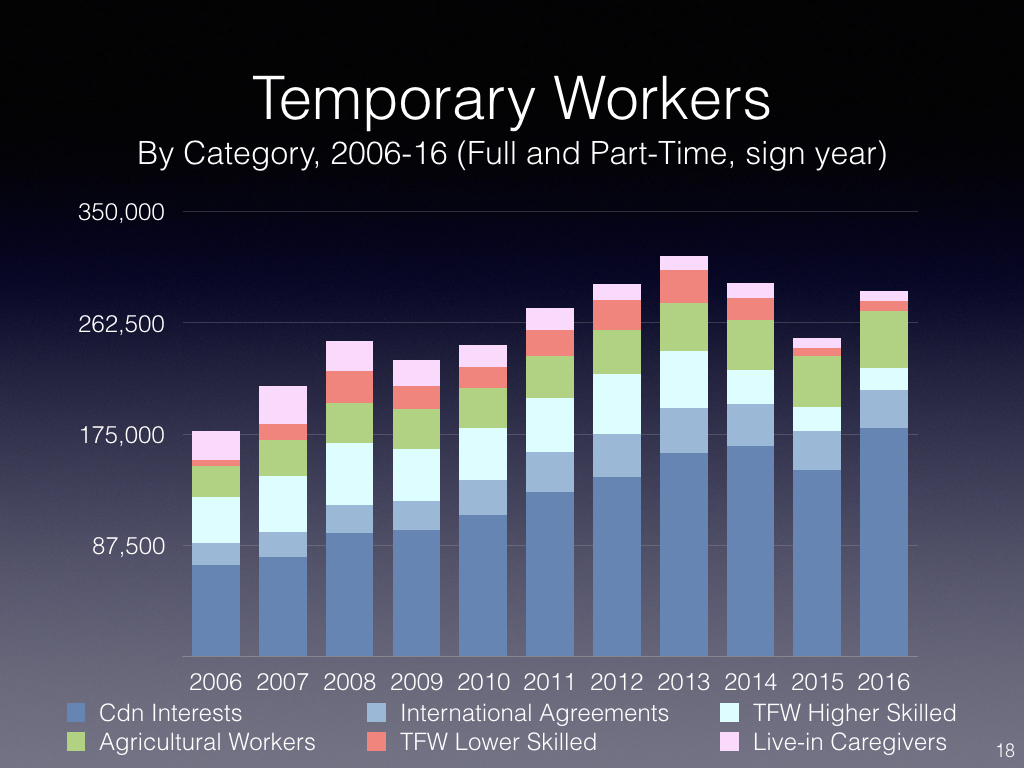
Highlights oversight and enforcement capacity issues within government. Above chart shows both temporary workers under the TFWP and the International Mobility Program:
Canada’s temporary foreign workers program is rife with oversight problems that appear to have allowed lower-paid international workers to take jobs that out-of-work Canadians could fill, the federal auditor general says.
Some companies have effectively built a business model on the program that could be having unintended consequences that the government doesn’t know about, including wage suppression or discouraging capital investment and innovation, said Michael Ferguson’s report on the program, part of a fresh batch of federal audits tabled Tuesday.
Ferguson’s report says the government approved applications for temporary foreign workers even when employers had not demonstrated reasonable efforts to train existing employees or hire unemployed Canadians, including those from under-represented groups, such as First Nations.
Nor did officials effectively crack down on companies that were found to have run afoul of the rules; few on-site inspections or face-to-face interviews with the foreign workers themselves were conducted, the audit found. Even when corrective action was recommended, it took months for all the necessary approvals.
Ferguson is calling for better oversight of the program and more pushback from federal officials to ensure companies applying to hire temporary foreign workers are doing so for the right reasons.
The department overseeing the program, Employment and Social Development Canada, says it plans to implement all of Ferguson’s recommendations.
Ferguson’s report comes months after a Commons committee recommended an overhaul to the program, and three years after the previous Conservative government made changes in a bid to ensure the program worked as intended: to help companies fill job vacancies only when qualified Canadians couldn’t be found for the work, and only when it didn’t negatively affect the local labour market.
Between 2013 and 2015, the number of temporary foreign workers in Canada dropped from 163,000 to just over 90,000, a result of the 2014 changes and the economic downturn.
Despite the drop in numbers, the audit team said it found numerous cases where employers gave dizzying reasons for needing a temporary foreign worker that departmental officials failed to challenge in 40 per cent of the cases reviewed as part of the audit.
As a former public servant who was involved in the final stage of the lease negotiations for the former war museum, nice to see the new home of the GCP open. Had a recent opportunity to attend an event here and, not surprisingly the Aga Khan’s reno is done with taste and style:
The place where Canadians once came to commemorate this country’s contributions to war has been boldly reimagined for the 21st century as a centre that fosters pluralism and celebrates diversity as a new international value.
Built between 1904 and 1906, 330 Sussex Dr. was designed by David Ewart, the chief dominion architect. His other notable buildings include the Royal Canadian Mint and the Canadian Museum of Nature. It served as the dominion archives for 60 years before becoming the Canadian War Museum in 1967.
The three-storey Tudor Gothic stone building has been vacant since 2005, when the war museum relocated to its new space on LeBreton Flats.
Now, a decade after a $35-million restoration led by KPMB Architects — and paid for by the Aga Khan —began, the Global Centre for Pluralism’s international headquarters officially opens on Tuesday.
When the Citizen was given a sneak peek inside late last week, workers were busy with the finishing touches.
Project manager Farhad Mawani explained how Ewart wanted Ottawa to have buildings that befitted a capital city and, for their time, had modern touches, such as open concepts, plain white walls and exposed beams. Some of the materials used, then and now, include white oak and marble.
Considered a classified federal heritage building, the renovations to 330 Sussex — which sits between the National Gallery of Canada and the Mint on a perch overlooking the Ottawa River — had to be minimal and sensitive. “We didn’t just want to start ripping everything out,” Mawani said.
The international headquarters of the Global Centre for Pluralism (formerly the War Museum) at 330 Sussex Drive have undergone a major rehabilitation led by the award-winning architects KPMB and supported by a $35 million investment from the Aga Khan. May 12,2017. ERROL MCGIHON / POSTMEDIAThe international headquarters of the Global Centre for Pluralism (formerly the War Museum) at 330 Sussex Drive have undergone a major rehabilitation led by the award-winning architects KPMB and supported by a $35 million investment from the Aga Khan. May 12,2017. ERROL MCGIHON / POSTMEDIA
Design work was completed in 2013, lead and asbestos were removed the next year, and construction began in earnest the year after that. The Centre’s 14 staff have been working out of it since January.
An addition, built in the 1920s, will be occupied by the Mint. A third wing never materialized, so the building has retained its asymmetrical, L-shape.
Two things now set the building apart from earlier versions of itself.
A new courtyard off Sussex featuring benches and blooming flower beds is intended to draw people in and create a new public space.
“Already, even though it’s been a bumpy start to spring, there are lots of people coming and sitting and chatting, and that’s the idea,” secretary general John McNee said in an interview.
The forecourt, as he called it, is unquestionably lovely, but the building itself feels austere, colonial and stuffy. It doesn’t scream pluralism or diversity.
But McNee said its august location on the ceremonial route between Rideau Hall and Parliament Hill sends a signal that these are important values in Canada. The idea for this centre dates back to the 1990s when the Aga Khan began asking Canadian leaders to explain the success of Canada’s approach to diversity.
Plus, when the building was the war museum, a giant tank greeted visitors. “That’s not terribly welcoming,” McNee said.
The other unique feature, on the building’s back side facing the river, is an angular window that juts out, bathing all three storeys in natural light. Viewed from inside, it acts as a magnet, pulling people to it, compelling them to stare out over the river below.
It symbolizes opening a door to the river and simultaneously acts as a nod to the organization’s raison d’être to position Canada as a country that’s open to the world.
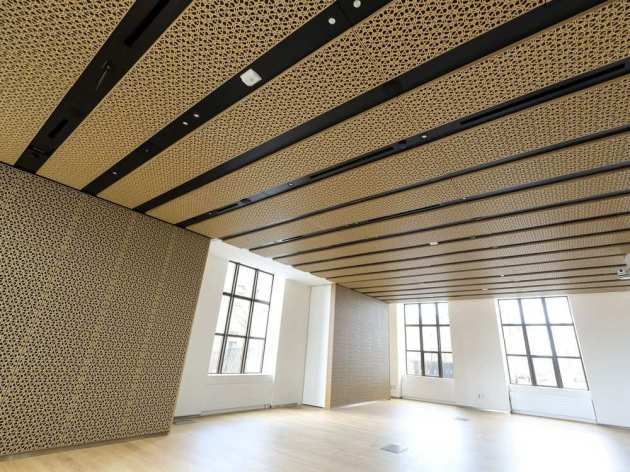
KPMB took the trefoil design that’s repeated on the building’s parapet and reinterpreted it to create a pattern that is used as a screen on part of the window and also for acoustic panelling in one of the centre’s key spaces.
Elsewhere, walls are adorned with Canadian art. The idea was to choose artists or pieces that tell a story of pluralism in Canada. Former Governor-General Adrienne Clarkson, who sits on the centre’s board, was on the committee that selected the art.
The Global Centre for Pluralism is one of 150 buildings participating in this year’s instalment of Doors Open Ottawa. Curious members of the public can visit on June 3 between 10 a.m. and 4 p.m.
Will be interesting to see how this evolves and how many caucuses, and their respective focuses, emerge:
The Senate has just voted for a major shake-up of how members of the Red Chamber align themselves by allowing nine or more members to form a caucus, a substantial break from tradition that has historically seen the place organized along party lines.
Members of the Senate adopted a key recommendation of the modernization committee’s report — released last fall — which removes the requirement that a caucus only be formed by those who are members of a political party registered under the Canada Elections Act.
Thus, in theory, there could now be a proliferation of caucuses along regional lines, something that has been favoured by Peter Harder, the government’s representative in the Senate, in the past for organizational purposes.
There could also be the creation of more narrowly-focused caucus groups, like senators who support environmental causes, or the military, an Indigenous or women’s caucus. The possibilities are nearly endless as long as there are at least nine senators who agree to band together, and their group is created for parliamentary and/or political purposes, requirements that are not overly stringent. (A senator, however, cannot be a member of more than one caucus.)
“I think it’s a victory for the Senate. This is the first major, permanent adjustment to the Senate rules and procedures coming out of the modernization committee,” Harder said in an interview with CBC News. “I just think its important for senators to be given the framework … to form affinities [and] I don’t have a road map or expectations or a design here.”
Harder said regional caucuses could form but he isn’t pushing for that type of division now, adding the process will “play out organically.”
When asked if there was demand by senators within the chamber to form new caucuses, Harder said yes. “Why else would it have been accepted by the Senate?”
The motion directs the Senate rules committee to now formalize the changes, and then requests the internal economy committee — which effectively governs the chamber and adjudicates complaints — to draw-up budgets for these prospective new caucuses, to help hire staff for “secretariats” and pursue research projects. The motion was adopted by a voice vote, so it is not clear how much support it had from the existing parties.
Interesting article and explanation by Nick Cheesman regarding the status of the Rohingas in Burma:
Taingyintha, or ‘national races’, is among the most important political ideas in Myanmar today. Although the term is not well recognised or readily translated in English-language scholarship on Myanmar, it lies at the heart of the country’s contemporary politics. It also helps to explain the so-called ‘Rohingya problem’ on which so much has been written in recent times. So how did the idea of taingyinthabecome politically salient? And what is its relationship to state formation and national identity?
To answer these questions requires a little bit of digging into the recent past. As a term, taingyinthahas neither a long nor glorious history. It was not a significant idea in colonial-era politics, where it seems to have been a signifier of ‘native’ identity. At the end of World War II, taingyintha featured in negotiations on the country’s draft constitution, which was ratified in 1947, but it got only two modest references in the chapter on citizenship, where it is translated as ‘indigenous races’. It wasn’t mentioned in the 1947 Panglong Agreement, which is mythologised as laying the foundations for national unity, and it remained peripheral to politics in the country prior to a military coup in 1962.
But on 12 February 1964, taingyintha went from having limited political salience to becoming a centrepiece in the project for military-dominated statehood. The junta leader, General Ne Win, used the Union Day address to urge ‘national races’ to come together for the good of the nation. In so doing, he inaugurated a new programme of action based on a state-sponsored conception of taingyintha as political community. Within the same year, the government had set up an Academy for the Development of National Races. The following year, staff from universities around the country began state-directed fieldwork to document and publish authoritative studies on national races’ culture.
Although Ne Win’s one-party state collapsed under the weight of nationwide protests in 1988, the idea of national races not only prevailed, but also emerged stronger than ever. A newly comprised military junta that seized control of government announced that ‘non-disintegration of national [taingyintha] solidarity’ was the second of its three main causes. For want of any other unifying motif, national races were invoked on every broadcast and publication, and at every major event.
The new military junta used the term to mean different things. On the one hand, ‘national races’ was used to describe the members of a single political community, united in struggle against common enemies inside and out. On the other, it was used to denote people living in remote parts of the country who had failed to progress due to civil war and ignorance. Between them, these usages worked to justify relentless military campaigns against armed groups operating under the banners of multitudinous national races.
Today, Myanmar’s 2008 constitution cements national races in the country’s formal institutions. It establishes a conceptual relation between taingyintha and citizenship, such that the former is irreducible to the latter. Legally and by definition, national races trump citizenship. To talk of the political community ‘Myanmar’ is to talk of taingyintha, and to talk to that community is above all to address its members not as citizens but as national races.
Because taingyinthaidentity had trumped citizenship, the place of people belonging to groups not recognised as national races, like people identifying or identified as Rohingya, is precarious. The only means available for the Rohingya and other excluded groups to achieve any political recognition within Myanmar is to submit to the politics of domination and insist that they too are taingyintha.
This means that Rohingya advocates must also engage with and support the idea of national races. That is, they must reproduce the idea in order to make a claim for political identity and membership. They must give assurances that if included in the schema of national races, they would be committed to the idea of taingyintha; that, ironically, they would be the most vociferous defenders of ‘national race’ identity.
Myanmar’s problem is not a ‘Rohingya problem’, but a ‘national races’ problem. The idea of taingyintha obligates groups wanting political recognition — like the Rohingya — to acquiesce to its terms as the price demanded for admission to the ‘Myanmar’ political community, only to expose them to the ire of the members of other groups already recognised as national races.



 Multicultural Meanderings