Court case ruling may allow Britons to keep their EU citizenship and rights | The Independent

Interesting wrinkle:

Britons might be able to keep their EU citizenship and rights to live, work and claim healthcare across Europe, even if Theresa May walks out of the negotiations with no deal.

This could depend on the outcome of a legal case brought by four plaintiffs, who are seeking a ruling from the European Court of Justice over whether Article 50 can be revoked without the permission of other EU states.

The case, brought by the Good Law Project, is an attempt to get a ruling over whether Brexit could be reversible until 29 March 2019.

But it will also be asking whether or not UK citizens would remain EU citizens post Brexit.

The argument is based on Article 20 of the Treaty of Lisbon, which states that EU citizenship is additional and separate to national citizenship.

There are no provisions for removing this citizenship and its associated rights from individuals, regardless of whether their nation leaves the EU.

The case will argue that it is unclear from current legislation whether UK citizens can be stripped of their EU citizenship.

Speaking to Buzzfeed, Jolyon Maugham QC, a lawyer helping to bring the case, said: “There seems to be an assumption – convenient both to a particular type of Brexiter and to those voices in the EU that would rather be shot of the UK – that the citizenship rights of UK nationals can be taken away from us.

“Whether that assumption is right is ultimately a question of EU law. And it’s very unclear to us that it is.

“The question is likely to be of particular importance to those – very often British pensioners – who have made their lives abroad in France or Spain.”

Source: Court case ruling may allow Britons to keep their EU citizenship and rights | The Independent

Douglas Todd: How to ensure non-residents pay tax on Canadian real-estate profits

Hard to understand the blindness or unwillingness of the British Columbia Liberals on this issue. Too many donations from those who benefit from the this lack of regulation and appropriate policies?

It should be easy to ensure that offshore property speculators pay capital gains taxes on their Canadian sales, but the B.C. government has given no sign it’s prepared to make the fix.

Immigration lawyers and Opposition politicians are pressing the province to start an information-sharing system that would make it much harder for house sellers to evade capital gains taxes by claiming they are “residents of Canada for tax purposes,” when they are not. Some critics estimate the tax loss at hundreds of millions of dollars.

This tax avoidance was at the centre of a recent B.C. Supreme Court ruling. Justice Kenneth Affleck ordered notary Tony Liu to pay $600,000 to a house purchaser he had represented.

That was to cover the capital gains tax the Canadian Revenue Agency demanded from the buyer, which should have been paid by the non-resident seller of a $5.6-million Vancouver mansion.

A property seller who does not pay income taxes here is required to pay a capital gains tax on 25 per cent of their profit on a house sale. Theoretically, the law is designed to advantage domestic buyers and sellers over speculators, particularly from offshore.

In practice, the capital gains rule is rarely enforced, in large part, lawyers say, because B.C. doesn’t collect or share up-to-date information on whether property sellers pay income taxes in Canada.

That task is inexplicably left to a real-estate industry “honour system”involving buyers, sellers and their agents, says Vancouver immigration lawyer Sam Hyman, who is among several experts offering a simple solution.

“How complicated is it to require a seller to produce proof they paid their income taxes as a Canadian tax resident?” asked Richard Kurland, a lawyer who produces the immigration newsletter Lexbase.

“This really spotlights B.C.’s unchanging position, which is that it refuses to include on government (property-transfer) forms the question: ‘Are you a tax resident of Canada?’” Kurland said.

“B.C. fails to create data that can be checked by Canada Revenue Agency, by not asking the right question. Instead, the B.C. government has begun asking, ‘What is your citizenship?’ But that’s irrelevant.”

In a city in which 45 per cent of the population is foreign-born, Kurland said, it would be straightforward for CRA to run a data match on people who claim they are tax residents of Canada to see if they are really paying income taxes.

“But if B.C. doesn’t go after the data, CRA can’t do its job.”

When B.C. Finance Ministry spokesman Jamie Edwardson was asked Friday if he thought there were problems associated with B.C. buyers being unable to prove sellers pay income taxes, he declined to answer and said the question should be directed to the Canada Revenue Agency.

Source: How to ensure non-residents pay tax on Canadian real-estate profits | Vancouver Sun

Plus d’immigration francophone, plaide la commissaire aux langues officielles | Politique canadienne

Having attended some of the consultation meetings with Francophone community leaders, have an appreciation for the issues and some of the government efforts to address this fear.

Some links of interest: French and the francophonie in Canada, Statistical Portrait of the French- speaking Immigrant Population Outide Quebec (StatsCan):

La langue française va perdre de son influence au Canada sans actions concrètes du gouvernement pour augmenter le volume et la répartition de l’immigration francophone, a estimé vendredi le commissariat aux langues officielles, organisme dépendant du Parlement.

« Il est essentiel que les gouvernements fédéral, provinciaux et territoriaux redoublent d’efforts pour accroître l’immigration dans les communautés francophones » au Canada, a plaidé Ghislaine Saikaley, commissaire aux langues officielles.

Avant tout, « l’immigration doit contribuer au maintien, voire à l’augmentation, du poids démographique des communautés francophones au Canada », selon le commissariat.

Il est nécessaire d’assurer une meilleure répartition de l’immigration francophone, là où l’avenir des communautés de langues françaises est menacé par exemple en Ontario,- la province la plus peuplée avec 39 % des 36 millions de Canadiens -, ou dans les provinces de l’ouest.

« Sans la mise en place de plans d’action concrets et d’un échéancier, nous ne serons jamais en mesure d’atteindre la cible nationale d’immigrants francophones, surtout en Ontario », a jugé François Boileau, un responsable des langues de cette province.

Au Nouveau-Brunswick, unique province canadienne officiellement bilingue, « les communautés anglophone et francophone ont un statut constitutionnel d’égalité » et « la communauté francophone représente un tiers de la population », selon le commissariat.

Chargés de veiller à la bonne application de la loi sur les langues officielles faisant du Canada un pays bilingue au niveau fédéral, les commissaires saluent toutefois la mise en place en juin 2016 d’un programme facilitant l’embauche de locuteurs français en milieux minoritaires.

En 2036, selon des projections de Statistique Canada, près d’un Canadien sur deux sera issu de l’immigration. Les francophones canadiens représenteraient 21 % de la population, contre 23 % à l’heure actuelle.

Les immigrants francophones s’installent majoritairement au Québec. Dans le reste du Canada, seulement 3,8 % de la population avait comme langue maternelle le français en 2011, et ce pourcentage pourrait perdre jusqu’à un point d’ici 2036.

Le ministère de l’Immigration a prévu en octobre d’accueillir environ 300 000 nouveaux immigrants ces prochaines années, dont la grande majorité pour satisfaire aux besoins économiques.

Why Immigrants Do Better At Science And Math : NPR

Intuitively makes sense but nice to have more evidence that it is so:

Seventeen-year-old Indrani Das just won the top high school science prize in the country. Das, who lives in Oradell, N.J., took home $250,000 from the former Intel Science Talent Search, now the Regeneron Science Talent Search, for her study of brain injuries and neuron damage. In her spare time, she’s already working with patients as a certified EMT.

As the Times of India pointed out, Das was one of five Indian Americans among the competition’s top ten finishers. In last year’s contest, according to one study, more than 80 percent of finalists were the children of immigrants.

What is it that spurs so many recent arrivals to the United States to excel in science, technology, engineering and math, or STEM disciplines? Some invoke cultural stereotypes, like that of the “Tiger Mother,” for an explanation.

Not Marcos Rangel. For a new study published in the journal Demography, Rangel, an economist at Duke University, and his co-author, Marigee Bacolod of the U.S. Naval Postgraduate School, looked at U.S. Census data for young adults who arrived in the United States before age 18. The data covers in detail the relative skills required for different occupations, such as physical strength, communication skills, social skills, math and reasoning. For those who went to college, they were also able to see what major they chose.

“If it were just as easy for me to write with my left hand as with my right, I would be using both. But no, I specialize,” Rangel says. In the same way, academically motivated students who have to play catch-up in English class may prefer to zoom ahead in the universal language of mathematics.

(By the way, Das, not a late arrival, is a former spelling bee champion as well as a science whiz.)

Rangel, who came here from Brazil as a young father, has seen this dynamic play out in his own family. “The younger one, who went to Pre-K in English, is different from my kid who came at five already reading Portuguese,” he says. The older one is more inclined toward math.

To be clear, Rangel doesn’t discount the notion that cultural values may also influence immigrants’ career choices. But he is out to tell a more nuanced story — “a movie, not just a photograph,” he says — of how people develop different skills and talents.

Source: Why Immigrants Do Better At Science And Math : NPR Ed : NPR

Immigration: Donald Trump Pushes Silicon Valley to Toronto | Time.com

Smugness alert for Canadians. Nevertheless there is some merit in Salim Teja, EVP of Ventures at MaRS’s arguments and narrative:

 Without immigrants, Silicon Valley would look very different. There would be no Amazon, no eBay. No Reddit, no Intel. Google, Tesla, and Yahoo? Gone. And you can say goodbye to your iPhone.

These are just a few of the biggest names, but half of all billion-dollar U.S. startups were founded by immigrants. Silicon Valley would simply not exist, and the United States’ position as a global tech leader might never have come to fruition.

Under President Donald Trump, we are not far from this hypothetical. Trump’s immigration ban and H-1B visa restrictions will significantly harm the U.S. technology industry, diverting the steady, decades-old stream of foreign tech talent to international competitors.

And there’s no country better positioned to welcome this diverse group of innovators than Trump’s northern neighbor: Oh, Canada. At the center of the country’s identity is Toronto — the fourth-largest city in North America. Boasting a diverse community, booming tech scene, and forward-thinking government, this city is the leading contender to welcome tech talent and become the next epicenter of innovation.

A Culture of Inclusion

It’s easy to talk in generalities when it comes to diversity and inclusion — but I’m actually a product of Canada’s welcoming stance on immigration. My family emigrated to Canada from Tanzania, East Africa. We fled political turmoil and settled in Canada to build a better life. It would also become the place where I eventually began to flourish as an entrepreneur.

 Forty years later, Canada is still a beacon of hope for immigrants, an open society that is welcoming refugees in unprecedented numbers. Toronto was recently named the most diverse city in the world, and has become a cultural haven in which foreign entrepreneurs can pursue innovative ideas. In fact, it’s easier than ever for immigrants to work up north — capitalizing on Trump’s decision to delay H-1 B visas, Canada recently announced an expedited work permit process, allowing foreign talent to be approved for work in a short ten days.

Toronto recognizes that diversity both breedsinnovation and is good for business. As the EVP of Venture Services at a Toronto innovation hub, I’ve seen the power of diversity on the startup teams we are advising. Of the roughly 1,000 startups within our ecosystem, 54% have at least one foreign-born founder – a higher percentage than Silicon Valley.

So, as America tightens its borders and retreats inward, diversity in cities like Toronto will flourish.

Infrastructure for Innovation

Toronto’s diverse community has fostered a rapidly growing startup scene. Recently named one of the world’s most innovative cities, Toronto is home to between 2,500 and 4,100 active tech startups, the world’s largest innovation hub, and world-class academic and research institutions.

And with 150,000 full-time students enrolled in universities in the Greater Toronto Area — many focused on science and engineering fields — the region benefits from a robust pool of entrepreneurial and tech talent. Of course, this hasn’t always been the case: while Canada has historically been victim to a “brain drain” of academic talent emigrating to the U.S., Trump’s policies will undoubtedly lead to more talent staying in Toronto; and we may start seeing the reverse as Silicon Valley talent leaves to head north. University of Toronto has already seen a 70%increase in applications from American students following Trump’s win.

As always, tech follows the money — Toronto’s rapidly developing venture capital community is setting record investment numbers. VC in Canada hit a 15-year high in 2016, with a total of $3.7 billion invested— a whopping 36% increase over 2015. I haven’t seen Canadian VC excel at this rate since the dot-com boom, and every day speak with investors from around the world looking to cash in on Canadian ventures. With names like Shopify and Hootsuite rivaling Silicon Valley successes, I can understand why they’re hedging their bets.

The New Wave of Global Entrepreneurship

Where investors see the most potential, however, is in ventures that scale — ventures that tackle tough problems and provide global solutions.

And as someone who works with fellow immigrants every day, I believe that foreign entrepreneurs are more likely to develop these types of solutions, with the broadened worldview necessary to take on global issues. In fact, amongst our ventures with foreign-born founders — over 70% have some social purpose in mind, developing solutions in areas like healthcare and clean energy. A Syrian refugee creating an open approach to drug discovery.

A Mexican immigrant developing digital solutionsfor mobility impairments. These are the breakthroughs I see from global entrepreneurs in Toronto every single day.

While I believe that Silicon Valley once fostered this type of innovation, somewhere along the way it got stuck in a “move fast and break things” mentality, promoting innovation for innovation’s sake. They stopped caring about true progress and started caring about VC dollars — today, you’re more likely to see the Valley pump out a new photo editing app or subscription box before a clean energy solution or drug therapy. And with Trump’s new restrictive policies, fewer entrepreneurs will be able to come to the U.S. to build the globally impactful ventures that society truly needs.

But as America shuts them out, Canada welcomes them in. Global entrepreneurs can find a home in Toronto — a city that sees beyond borders, and whose tech community leads the world with solutions in cleantech, biotech, and more. For all of Trump’s talk about bringing back jobs to America, he may actually be helping to send them to Canada. And just as it once did for my family,

Toronto welcomes this talent with open arms.

John Ivison: Uber is unlovable, but the federal Liberals were wrong to bash them with a tax

I don’t understand the logic behind Uber being exempt from the HST. The HST is paid by taxis, Uber’s closest competitor, and innovation should not mean an exemption from paying for government services. Uber drivers access medicare and other public services and thus should not be undermining funding for these same services.

Paying HST would not change the fundamentals behind technological disruption, just ensure a more level playing field.

Personally, I was insulted by Uber’s request that I email my MP in support of their position. Instead, I emailed her stating my opposition to Uber’s position:

Travis Kalanick, Uber’s co-founder, has spoken about his desire to eventually move to self-driving cars for Uber vehicles.

Children born in 2017 might never need to learn to drive. As a discussion paper authored by the University of California’s Adam Stocker and Sura Shaheen pointed out recently, automated vehicles and shared mobility applications will have become accepted technology by 2030 and may come to dominate ground transportation by 2050, revolutionizing the car industry in the same way that mobile phones have transformed the telecom industry. This will take millions and millions of cars off the road.

Instead of penalizing Uber drivers and customers, a more sensible way of levelling the playing field with the taxi industry would have been to remove the exceptional circumstance under which all drivers are obliged to pay sales tax if they earn less than $30,000.

If the Liberal government is as keen to innovate as it claims to be, it should reverse the direction of public policy and encourage private transportation companies like Uber and its competitor, Lyft.

Uber has some maturing to do when it comes to the way it treats its employees, its customers and its competitors. But its dynamic pricing, ride-sharing technology is here to stay and it will change global transportation systems for the better. Ottawa should be onside.

Source: John Ivison: Uber is unlovable, but the federal Liberals were wrong to bash them with a tax | National Post

How will we know when police have earned their way back to Toronto Pride?: Robyn Urback

Valid questions by Robyn Urback:

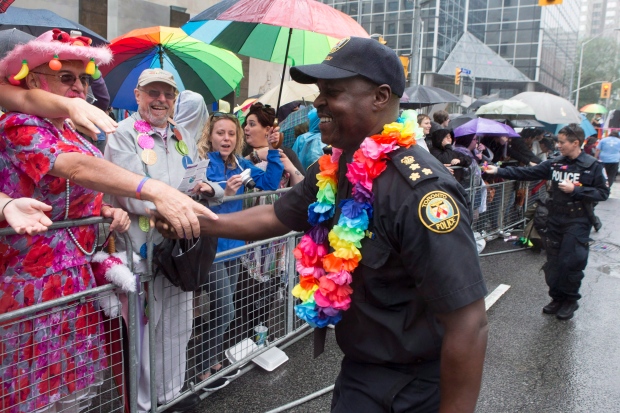
If the issue is more so about visibility, as some BLM supporters say, noting that police are still welcome to participate in Pride as long as they’re not wearing their uniforms, then perhaps Pride should consider also asking clergymen not to wear their collars during marches and parades.

The religious leaders who choose to join in on Pride activities — such as those from the Metropolitan Community Church of Toronto — are obviously open, welcoming and inclusive, though some Pride-goers might find the symbols triggering because of the many religious groups and institutions that are not so open, welcoming and inclusive.

Toronto Pride Parade Mark Saunders

Police Chief Mark Saunders greets the crowd during Toronto’s Pride parade in 2015. (Chris Young/Canadian Press)

But if we accept that the police are being singled out because of the severity of their brutality against Canada’s black and LGBT communities — both past and present — which is a defensible position, then perhaps it would be prudent for BLM to define some sort of tangible criteria delineating how, and when, and by what measure police conduct would be acceptable enough for them to participate in the marches again.

Revoking the ban

At what point will police be distant enough from their past, like the Canadian Forces, innocuous enough in their present, like the education system, and adequately inoffensive in their image, like religious leaders, to once again be able to show their solidarity?

If we accept the notion that individuals have to carry misdeeds of the people before them — and the reputations of the worst among them — then it makes sense to prohibit any uniformed officer from participating in Pride activities.

But if we recognize that people are more than simply facets of the groups to which they belong, we’d know better than to paint them all with the same brush.

Source: How will we know when police have earned their way back to Toronto Pride?: Robyn Urback – CBC News | Opinion

Ryerson Student Union adopts new definition of anti-Semitism

Interesting that they chose the Ottawa Protocol version, which is fairly broad in its description of anti-israeli actions that can be construed as antisemitic (For The Record: The full text of the Ottawa Protocol – CBC):

The Ryerson Student Union has adopted a new, comprehensive definition of anti-Semitism amid reports that the head of a university program resigned over anti-Semitic tweets.

The RSU’s executive on March 29 passed a motion changing its definition of anti-Semitism to add the Ottawa Protocol on Combating Anti-Semitism, adopted by the federal government in 2012.

The Centre for Israel and Jewish Affairs said it’s not aware of any other university student union in Canada to adopt the Ottawa Protocol as its definition of anti-Semitism.

In part, the new wording defines anti-Semitism as: the denial of Jews’ right to self-determination; applying “double standards” by requiring of Jews “behaviour not expected or demanded of any other democratic nation”; using symbols and images associated with classic anti-Semitism and drawing comparisons between contemporary Israeli policy and the Nazis.

The effort was spearheaded by Students Supporting Israel and Stand With Us Canada, founded in 2013 to support, train, and provide resources to university and college students.

The old definition was “prejudice or discrimination based on stereotypes and assumptions about Jewish people. This can include policies, views, or actions that harm or discriminate against Jewish people individually or on an institutional level.”

The latest version keeps the old wording and adds the wide-ranging Ottawa Protocol.

The older version was passed in November 2014, but the RSU rejected references to Zionism after objections from non-Jewish students, SSI president Rebecca Katzman told The CJN.

She said she started working on the resolution last November, when the RSU failed to pass a motion to mark Holocaust Education Week after Muslim, after pro-Palestinian students staged a walkout that triggered a loss of quorum.

The motion was passed in December, and it was later revealed that RSU president Obaid Ullah had orchestrated the walkout, despite earlier denials.

Since then, the student union and the pro-Israel group have worked together to pass the new definition, Katzman said.

“Now I can confidently say that this motion makes it far more difficult for anti-Semites to perpetuate anti-Semitism at the student government level, and now, we are able to hold them accountable,” she added in a statement.

Allysa Moses, associate director of Hillel at Ryerson University, said she hopes other student governments adopt similar motions to help strengthen the fight against anti-Semitism on campus.

The development came the same week as the Eyeopener, a Ryerson student newspaper, reported that Hirra Farooqi resigned as president of the university’s orphan sponsorship program (OSP) in late February after anti-Semitic tweets she had sent out in 2014 were discovered online.

The tweets, forwarded to The CJN by Jewish students, included the following: “My heart burns with hatred for the scums of Israel”; “Nothing pisses me off more than pro Israel pieces of s–t”; and “f—k Israel.”

Farooqi apologized for the remarks “to ensure that people of all different faiths and backgrounds feel safe and welcomed to be involved in OSP,” the Eyeopener reported.

The messages were sent out “in my teenage years” and were “without a doubt, unacceptable and hurtful to entire communities,” wrote Farooqi. She added that she does not stand by the “hateful rhetoric.”

The CJN could not reach her for comment.

Her remarks were posted at Canary Mission, a site that monitors individuals and groups that promote hatred of Israel, Jews and the United States at North American universities.

Founded by Ryerson’s Muslim Students’ Association, the OSP is “designed to unify, raise awareness and leave a positive impact for a humanitarian cause,” according to the group’s website. The group raises money for orphans worldwide and claims that in an earlier year, it raised more than $70,000.

It partners with SOS Children’s Villages, an international group that bills itself as “the world’s largest charity working with orphaned and abandoned children.”

SOS Children’s Villages Canada said it’s not directly involved in the planning or execution of any third-party fundraising activities, which should be “free of religious prejudice and racial discrimination,” spokesperson Kerline Usher said.
Source: Ryerson Student Union adopts new definition of anti-Semitism