A potentially historic number of people are giving up their U.S. citizenship – The Washington Post

More on the increasing number of American expats renouncing citizenship for tax reasons (FATCA), not Trump. Again, while the increase is dramatic, still small in relation to the number of expatriates (State department estimates between three and eight million):

It can be difficult to become a U.S. citizen. A lot of people put a large amount of time, effort and money into the process of gaining an American passport or, failing that, the right to permanent residency.

But to some people, U.S. citizenship can apparently be a burden. And it’s a burden that people seem to be shaking off in increasing numbers. This week, the Treasury Department released its quarterly list of individuals who had chosen to “expatriate” — i.e., renounced their U.S. citizenship or gave up their rights to permanent residence.

The list is notable for a couple of reasons. First off, Britain’s Foreign Secretary Boris Johnson is on it. This means that Johnson, a dual-national who was born in New York City, has finally renounced his citizenship (as he had long promised he would). Secondly — and far more importantly in the grand scheme of things — the list shows that Johnson is just one of a total 5,411 individuals to expatriate in 2016.

The number of people giving up their U.S. citizenship may in fact be higher. Ryan Dunn, a lawyer with Andrew Mitchel LLC, explained via email that his firm has suspicions that the lists released by Treasury are incomplete. However, this would not change the trend. America is seeing what is likely a historically high level of expatriation. And it seems only likely to rise further.

“Given that we’ve seen year-over-year increases in expatriation since 2012, we speculate that the trend will continue,” Dunn explained.

But why would anyone renounce their citizenship to the United States? Dunn said that in his firm’s experience, it wasn’t usually political. “We have not been contacted by anyone saying that they wanted to give up their citizenship because Trump won the election,” he said. Instead the motivation was simpler: money.

The United States is one of the only countries in the world that requires its citizens and permanent residents to file taxes even when they live abroad. Eritrea is the only other country to have a similar policy. This unusual policy a relic of the Civil War and the Revenue Act of 1862, which called for the taxing of U.S. citizens abroad — in part to punish men who fled the country to avoid joining the Union army.

This is no new policy — Americans abroad have always been covered by federal tax laws. However, things changed in 2010, when the Foreign Account Tax Compliance Act (FATCA) was enacted. This law essentially requires foreign financial institutions to check whether an account holder is a U.S. citizen or permanent resident. In some cases, Dunn said, they would ask for proof that the account holder is not a U.S. citizen.

The end result here is that whereas in the past a U.S. citizen abroad might be able to get away with not filing their U.S. taxes, that has become vastly less likely under these new circumstances. In some cases, this can be extremely costly: Johnson was known to have racked up a large U.S. tax bill for the sale of his home in London, even though he had not lived in Britain since he was a small child.

But even for those without Johnson’s wealth, it can be tricky. “FATCA is a dirty word to Americans abroad,” Peter Spiro, a Temple University law professor and the author of “At Home in Two Countries: The Past and Future of Dual Citizenship,” explained. “Think lots of extra forms that have to be filed even by citizens who aren’t wealthy by any standard. Americans abroad used to be able to do their taxes just like Americans at home. Now they have to hire expensive accountants.”

Giving up your citizenship isn’t necessarily cheap either. It can take a long time to get an appointment in some places, and the processing fee is around $2,350. More important, Dunn said, was the “exit tax” that some high-earning or high-net-worth individuals have to pay — and also some people who forget to file their forms correctly too. But evidently, for some people it’s worth it. (Green-card holders have a simpler and cheaper process.)

Source: A potentially historic number of people are giving up their U.S. citizenship – The Washington Post
Shouldn’t Israel Care About Anti-Semitism? – The New York Times

This piece by Shmuel Rosner worth noting post-Trump International Holocaust Remembrance Day deliberately not mentioning Jewish victims:

Occasionally, there is even a temptation for Israel to benefit from anti-Semitism. In recent years, rather than focus on the need to fight anti-Semitism in France, Israel called on French Jews to come live in Israel.

Of course, when Israel encounters a clear-cut case of Holocaust denial, or of persecution of Jews, it does not shy away from making its voice heard. Two years ago, the Israeli foreign minister warned European far-right parties that they must shun neo-Nazis and described Hungary’s Jobbik and Greece’s Golden Dawn as “illegitimate.”

But most of the time, Israel attempts to delicately balance its wish to delegitimize anti-Semitism and its need to maintain foreign relations that advance its causes. Sometimes this means using attacks on Jews to attract Jewish immigration to Israel. Sometimes this means turning a blind eye to anti-Semitism in exchange for political support. Sometimes this means ignoring the trivialization of Jewish deaths in the Holocaust.

This is as unavoidable as it is troubling, even painful. Israel is a state with interests and priorities among which censuring anti-Semitism is one, but not the only one.

David Ben-Gurion, Israel’s founding father, understood this when he agreed to accept reparations from Germany, less than a decade after the Holocaust. Mr. Ben-Gurion’s opponents had a strong moral case against accepting money from the country that had just orchestrated the murder of millions of Jews, but the prime minister thought that his duty as the man in charge of building and defending a new state trumped such considerations. Then, as now, Israel sometimes agreed to help other countries and parties whitewash their images. It’s often a trade: We, Israel, will get what we need in the form of money or arms or political support. You will get the right to showcase Israel as proof that you aren’t an anti-Semite.

This could become much more uncomfortable when the country in question is the United States and when the person accused of tolerating anti-Semitism is the American president. Israel depends on the United States more than it does on any other country for aid, security and diplomatic support. And the American Jewish community is the other main pillar of world Jewry, alongside Israel. More than 80 percent of Jews live and thrive either in Israel or in the United States. This makes the United States the place in which official anti-Semitism cannot be overlooked — and the place where it must be overlooked.

That could result in an irreparable split between Jews. The statement on International Holocaust Remembrance Day — provoking Jewish outcry in the United States, while provoking nothing from Israel — just proved it.

Ottawa looks at user-fee hikes for potential new revenue

While it is appropriate that the government is reviewing the User Fees Act to streamline the process (and increase revenues), there is a risk in providing departments with too much flexibility and too limited public consultations.

A clear case in point is with respect to citizenship fees, set at $100 in 1995.

The previous government obtained an exemption from the Act in Budget 2013 omnibus legislation which allowed it to avoid lengthy consultations and increase the fees to $300 in February 2014 along side Bill C-24’s revamping of the Citizenship Act. The government then did a further increase to $530 January 2015, with the change buried during the Christmas holidays.

This further increase was never mentioned during the Commons and Senate hearings on C-24, highlighting again the risk to public accountability.

There is also the broader risk that the current government may only look at fees from a cost recovery or private interest perspective, and not take into account that some fees reflect a mix of private and public interest.

I have argued elsewhere that citizenship fees have such a mix (see The impact of citizenship fees on naturalization – Policy OptionsC-6 Senate Hearings: Expected Impact on the Naturalization Rate) given the shared interest in encouraging political as well as economic and social integration.

Passports, also part of IRCC, are IMO more of private than public interest, where full cost recovery makes sense. Passport fees are subject to the Act and in testimony, departmental witnesses indicated that it took about two years to obtain approval:

The Liberal government is eyeing the user fees Canadians pay for federal services as a new source of revenue.

Since 2004, fees for everything from fishing licences to campsites have generally fallen farther behind the cost of providing those services. That’s the year the User Fees Act was passed, compelling departments to justify to Parliament any proposed fee increases or new fees.

The requirements under the law have been so onerous, however, that they effectively discouraged departments from applying for increases even as costs rose. The result is that taxpayers are stuck with higher bills for private benefits enjoyed by individuals and corporations.

The federal Treasury Board wants to fix the law to smooth the way for more fee increases, putting the fee-cost arithmetic back into balance — and snaring fresh revenues that could be worth millions of dollars.

The wide-ranging initiative, called the Modernizing of the Management of User Fees, is outlined in an internal document CBC News obtained under the Access to Information Act.

“While fees have not increased over time, costs have,” says the heavily censored Aug. 8 memo for Scott Brison, the Treasury Board president. (Numerous sections of the document, available below, have been whited out.)

“This resulted in an increase in the rate of taxpayer subsidies for government services that benefit private interests,” it says.

The freezing effect of the 2004 User Fees Act was dramatic, says the memo. Prior to the legislation, there were an average of 10 proposals each year to increase fees. After 2004, that dropped to 2.4 proposals annually.

Increased paperwork

Changes brought about by the legislation added “significant time and effort” in paperwork for fee increases or new fees, which discouraged applications. Departments have also since been wary of a provision that requires them to cut fees whenever they fail to meet performance standards, says the document.

As a result, 84 per cent of existing user fees have not been revised in nearly 13 years, and now cover a diminishing fraction of the cost of providing the services.

The memo cites the example of the Canadian Food Inspection Agency, which in 2004–2005 collected $54,999 in user fees for services that cost government $694,641 — or only about eight per cent of the bill.

Nine years later, at $55,988 in fees versus $877,306 in costs, the ratio had worsened to 6.4 per cent.

Other departments, including Health Canada and Industry Canada, have been more successful in keeping the fee-to-cost ratio in balance.

The released sections of the memo do not contain an estimate of potential new revenues.

A spokesman for Treasury Board declined to provide details or timing for the initiative.

‘Strengthening the accountability’

“While the matter of modernizing user fees is still under consideration, we remain committed to strengthening the accountability, oversight, and transparency of user fees,” Alain Belle-Isle said in an email.

Sheila Fraser, then-auditor general of Canada, found in 2008 that there were about 220 federal fees reported publicly, worth about $1.9 billion to the federal treasury. Fees are charged on a wide range of services, including passports, licences for manufacturing drugs, marine navigation, citizenship, and national park entry.

Fraser’s report, which made headlines that spring, criticized the government for overcharging Canadians for consular fees that were attached to passport application fees.

‘Inappropriately subsidizing’

Less noticed was her warning that the government “may be recovering less than an appropriate amount from fee payers, or, depending on the fee, taxpayers may be inappropriately subsidizing a private benefit …”

Source: Ottawa looks at user-fee hikes for potential new revenue – Politics – CBC News

Americans View Islam Less Negatively Than They Did A Year Ago | The Huffington Post

Not sure the extent to which this is positive (fewer negative views) or negative (greater political polarization) but ironic given the words of the Trump campaign and the words and actions of the Trump administration:

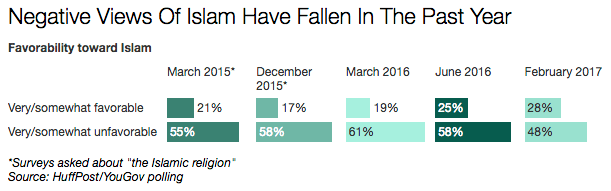
Americans’ view of Islam are, by and large, hostile. But negative opinions of the religion have dropped significantly during the past year, a new HuffPost/YouGov poll finds, despite ― or perhaps in response to ― the anti-Islam rhetoric often espousedby President Donald Trump and his advisers.

Last March, Americans were 42 points more likely to view the religion negatively than they were to view it positively. That gap dropped to 33 points by June, and to 20 points in the most recent survey, the lowest it’s been since HuffPost/YouGov surveys first asked the question nearly two years ago.

HUFFINGTON POST

At least one other pollster has noticed a similar shift. Shibley Telhami, the director of the University of Maryland Critical Issues Poll, wrote in The Washington Post earlier this year about having seen attitudes toward “Muslim people” growing progressively more favorable between November 2015 and October 2016 ― even after Trump’s anti-Muslim rhetoric and the terrorist attacks in San Bernardino, California, and Orlando, Florida.

He attributed some of the change to polarization, noting that the biggest driver was evolving opinions among Democrats, and, to a lesser extent, independents.

“As on almost all issues, partisan divisions intensified during a highly divisive election year,” he wrote. “The more one side emphasized the issue — as happened with Trump on Islam and Muslims — the more the other side took the opposite position. … Trump the president should have more sway. But he is starting at place where partisanship is not diminishing, and where his presidential rhetoric mirrors his words as a partisan candidate.”

Breaking down the two most recent HuffPost/YouGov surveys along party lines yields similar results, suggesting that the Trump administration’s rhetoric has actually galvanized Democrats, and some independents, into greater support of Islam.

HUFFINGTON POST

In June 2016, Democrats, Republicans and independents all held net negative views of Islam, although the gap was most pronounced among Republicans. Since then, Democrats’ opinions of the religion have improved significantly ― favorable opinions have risen by 11 points, while unfavorable opinions have fallen by 13 points.

ICYMI – Hans Rosling: A truth-teller in an age of ‘alternative facts’ – Macleans.ca

Good profile of Rosling, who was so creative and insightful in his presentation of data. Particularly important to note in the context about “alternative facts” and fake news:

… Rosling joined the Karolinska Institute in Stockholm, where he discovered his students, and even his colleagues, had crude and misinformed ideas about poverty. To them, and most policy makers in the western world, the “third world” was one uniform mess of war and starving orphans. They did not understand the vastly different experiences of a family living in a Brazilian favela and one living in the Nigerian jungle, nor did they realize how rapidly these countries and economies were evolving. Without this knowledge, how could people make informed decisions about diseases, aid, or economics? “Scientists want to do good, but the problem is that they don’t understand the world,” he said.

Working with his son, he developed software that explained data through easily understood graphics. He launched the Gapminder site, which allowed people to explore and play with data that was otherwise hidden in the archives of the OECD, the World Bank and the United Nations. And Rosling began giving increasingly popular public lectures. His TED Talks and online videos went viral, as he explained global population growth using plastic boxes, or the relationship between child mortality and carbon dioxide emissions with Lego bricks.

https://embed.ted.com/talks/hans_rosling_shows_the_best_stats_you_ve_ever_seen

Rosling had a natural charm and a ready sense of humour that grabbed your attention and kept it, even if he was talking about the most esoteric elements of statistical science. His message—that the world is getting better but we need to understand the data if we want to help those being left behind—resonated not just with the public, but among philanthropists and government leaders.

From Davos, to the White House, to the offices of the World Bank, Rosling could be found tirelessly preaching the gospel of facts, data, and truth. For generations, aid and charity decisions were taken for reasons of vanity, simplicity or self-interest. Billionaires gave money in ways that would grant them the most publicity. Bureaucrats channelled aid dollars to projects that were the easiest to administer. And western governments built dams in Africa solely to help their own construction companies. The real impact of aid on poverty was rarely considered and almost never measured. Rosling helped change that, by explaining to donors that ignorance is the first battle that must be fought in the war against extreme poverty.

This idea, as obvious as it seems in hindsight, was new. And it mattered. Governments listened. Donors became converts to Rosling’s religion of evidence-based policy. He was not its only apostle, but he was among its most well-known, and the only one with millions of views on Youtube.

Ironically, Rosling had a much more critical assessment of his own influence on the world. He called himself an “edutainer”, and in a 2013 interview he bemoaned the fact that the average Swede still overestimated the birth rate in Bangladesh: “they still think it’s four to five.”

“I have no impact on knowledge,” he said. “I have only had impact on fame, and doing funny things, and so on.”

The deputy prime minister of Sweden, Isabella Lövin, disagreed. After Rosling’s death was announced, she wrote: “He challenged the whole world’s view of development with his amazing teaching skills. He managed to show everyone that things are moving forward … I think the whole world will miss his vision and his way of standing up for the facts—unfortunately it feels like they are necessary more than ever at the moment.”

A few hours after the announcement of Rosling’s death, Betsy DeVos, a Republican donor who believes the American school system should be reformed to “advance God’s Kingdom” was confirmed as Donald Trump’s Secretary of Education.

Source: Hans Rosling: A truth-teller in an age of ‘alternative facts’ – Macleans.ca

Québec veut se rapprocher de Bouchard-Taylor

Bouchard-Taylor remains a good reference point for discussion:

Le gouvernement Couillard cherche une avenue pour se rapprocher des recommandations du rapport Bouchard-Taylor et donner plus de muscle au projet de loi 62, qui vise à proscrire le port du voile intégral pour donner ou recevoir des services publics.

Selon les informations obtenues par La Presse, on a planché sur une voie de passage qui ferait en sorte que le port de signes religieux serait interdit aux employés qui ont un «pouvoir de coercition» et qui doivent porter un uniforme – les policiers et les gardiens de prison tombent dans cette catégorie.

En revanche, en raison de l’indépendance du système judiciaire, les juges ne pourraient être soumis à cette directive. L’absolue indépendance des magistrats est même garantie dans la Charte des droits de l’homme, a rappelé hier un membre du gouvernement.

Mais du point de vue légal, des obstacles paraissent encore insolubles, la liberté de culte étant inaliénable du point de vue de la Charte canadienne des droits et libertés. Certains proposent de faire un renvoi à la Cour d’appel pour tester la solution envisagée.

Proposition de compromis

La réflexion du gouvernement survient après une proposition de compromis soumise mardi par François Legault, chef de la Coalition avenir Québec (CAQ). La CAQ est prête à laisser tomber l’interdiction de signes religieux pour les enseignants et à revenir à la proposition de la commission Bouchard-Taylor, dans l’espoir de dégager un consensus. La CAQ maintiendrait cette disposition pour les enseignants dans son programme électoral. Le chef péquiste Jean-François Lisée avait aussi indiqué qu’une entente serait possible si Québec se rangeait derrière la proposition faite par la commission lancée il y a 10 ans maintenant.

Mais en dépit de ces propositions de compromis, Philippe Couillard avait soutenu qu’il restait sur ses positions. «Encore une fois, on est en train de mettre sur la table un débat sur un enjeu inexistant», avait-il affirmé. La position du gouvernement, jusqu’ici, était une totale liberté pour les juges, les policiers ou les gardiens de prison qui souhaiteraient porter des signes religieux visibles. Le refus de Philippe Couillard de saisir au bond l’offre de compromis a été critiqué par bien des observateurs.

Cette déclaration avait fait bondir le sociologue Gérard Bouchard. En entrevue à Radio-Canada, M. Bouchard a soutenu qu’au contraire, il est «urgent» d’intervenir «de manière énergique», même si c’est «préventif». «On se retrouverait en pleine soupe, encore une fois», si des juges ou des policiers décidaient de porter un signe religieux quand ils sont en fonction, a-t-il observé.

Possibilité de renvoi à la cour d’appel

La position du gouvernement est en mouvance. «On est en train de regarder ça», observe-t-on. La capacité du gouvernement employeur de prescrire l’uniforme pour les policiers et les gardiens de prison pourrait lui permettre de proscrire le port de signes religieux, croit-on. «Quand une autorité hiérarchique peut prescrire un code vestimentaire, cela pourrait faire l’objet de réglementation», explique-t-on au gouvernement.

Mais les experts constitutionnels croient qu’une telle disposition serait inévitablement testée par les tribunaux. «Mais cela pourrait prendre plusieurs années avant que la cour se penche là-dessus.» La Cour suprême a déjà indiqué que le port du turban pour un agent sikh de la Gendarmerie royale du Canada était légal, et la jurisprudence est tout aussi claire pour le port de la kippa juive.

Québec pourrait décider de soumettre de lui-même l’orientation choisie à sa Cour d’appel – seul le fédéral peut faire un renvoi directement à la Cour suprême. Cependant, les tribunaux n’aiment pas être ainsi consultés sur un principe en l’absence de faits pour donner du contexte à la requête.

Le port d’un uniforme est considéré comme une limite raisonnable à la liberté d’expression, mais le port du voile touche à la liberté de culte.

Source: Québec veut se rapprocher de Bouchard-Taylor | Denis Lessard | Politique québécoise

New census technology under close watch as Statcan looks to the future

Looking forward to the results from the long-form census as they come out (short-form provides overview, long-form fills in many details). Makes sense to use existing government data to extent possible (CRA income data should be more reliable than self-reporting):

With just days to go before the very first release of data from the 2016 census, there is an unusual calm outside Marc Hamel’s Statistics Canada office.

A calm before the storm, perhaps.

After all, Wednesday’s release will be watched closely by federal officials, demographers and urban planners — all of whom use the data to help political leaders make myriad decisions that affect the daily lives of Canadians.

This time around, however, some of the keenest observers will be census director Hamel and his staff, watching to see if their new census data-collection methods are hitting their mark.

Statistics Canada has been quietly working on a plan for 2026 to eliminate the mandatory short-form census that goes to every household, instead using existing government databases to conduct a virtual count of the population. The plan, if successful, could mean millions in savings for federal coffers.

The closer the census numbers are to the tests being conducted by Hamel’s team, the more likely that multiple pages of the census questionnaire will be dropped during the next count in 2021, or replaced altogether one day in the future with an electronic count of the population.

This year, for instance, the agency cut two pages about income from the long-form questionnaire and replaced the questions with readily available and, arguably, more reliable Canada Revenue Agency data. Other questions, too, will eventually be replaced with information from existing administrative databases, making it easier to collect the details that comprise the census portrait.

Hamel said the challenge for his staff is to find a way to accurately reflect the Canadian population as it is at any point in time.

“The census as we run it now is very high quality, so anything that we would come up with in the future would have to be as high quality as it is today,” said Hamel.

One particular challenge for an electronic census: address information in various administrative files doesn’t always correspond to where people actually live, making it hard to be confident people are being counted in the right places.

And what about technology?

The majority of Canadians filled out their census questionnaires online, cutting down the time required to input data, and helping to speed up the release of information. Hamel said there might be other technological changes coming for future censuses, but it’s hard to predict what that might entail when census day rolls around again in 2021.

The question that guides planning for the next census and beyond is simple: will this work the same way next time?

“Four years in census terms — for me anyway — it’s short. It’s not a long time to prepare to make sure that we get it right. But at the same time, from a technological point of view, it’s fairly long,” Hamel said.

“It’s always a bit difficult to predict how technology will evolve in a short period of time and how that might have an impact on how the census might be rolled out.”

The questions on the census are also likely to change by 2021, with consultations starting this fall on what things Statistics Canada should and shouldn’t be measuring any more. One question likely to change is about sex and gender, which this year didn’t include a third option for transgender Canadians, Hamel noted.

“Society keeps evolving, so I think that from a census point of view, the census questions and questionnaire should be evolving with it.”

Source: New census technology under close watch as Statcan looks to the future | Toronto Star

Census 2016: Western provinces’ populations are the fastest-growing in Canada – The Globe and Mail

The first batch of Census 2016 results are out from the short-form with basic demographic data. Waiting for the long-form more detailed data how Canadians are doing in relation to economic and social outcomes.

Have excerpted this from the Globe analysis, showing again that population growth continues to be increasingly dependent on immigration:

census_2016__western_provinces_populations_are_the_fastest-growing_in-canada_-_the_globe_and_mail

Roughly two-thirds of the growth in population is due to migration, or the amount by which the number of new immigrants exceed the number of people who leave Canada. The other third comes from what’s known as “natural growth,” the difference between births and deaths. Some countries, such as Germany, Italy and Japan, have already seen the annual number of deaths exceed births, meaning all their growth now depends on migration. Projections show that Canada may reach the point where migration accounts for all population growth around 2050.

Source: Census 2016: Western provinces’ populations are the fastest-growing in Canada – The Globe and Mail

Why Silicon Valley Wouldn’t Work Without Immigrants – The New York Times

Good article by Farhad Manjoo on how Silicon Valley’s success depends on immigrants and why the tech industry is leading the charge against the Trump ban:

The workers of Silicon Valley make unlikely revolutionaries. As a group, they are relatively wealthy, well educated and well connected.

While most here supported Hillary Clinton, tech workers are not the most obvious targets of President Trump’s policy ideas. Many who populate the world’s richest tech companies will be just fine if the Affordable Care Act is repealed. Most will not be personally inconvenienced by the proposed Mexican border wall.

Under Mr. Trump, tech workers could enjoy a windfall. They may get tax credits for child care costs, their companies may be allowed to repatriate foreign profits, and their coming income tax cuts might fund a luxury vacation or two.

This is all by way of saying: The protests that swept through Silicon Valley and Seattle in the last two weeks were not motivated by short-term financial gain. If you want to understand why tech employees went to the mat against Mr. Trump’s executive order barring immigrants from seven Muslim-majority countries, you need to first understand the crucial role that America’s relatively open immigration policies play in the tech business.

And you need to understand why people in tech see something cataclysmic in Mr. Trump’s executive order, and in the other immigration crackdowns waiting in the wings: the end of America’s standing as a beacon for the world’s best inventors.

“Silicon Valley is unlikely, as a phenomenon — it is not the default state of the world,” said John Collison, an immigrant from Ireland who is a co-founder of Stripe, a six-year-old payments start-up based in San Francisco.

One important reason Silicon Valley can exist at all, he said, is that it is welcoming to people from far outside its borders. “I go all across the world, and every other place is asking, ‘How do we replicate Silicon Valley where we are — in London, in Paris, in Singapore, in Australia?’”

The reason those places have so far failed to create their own indomitable tech hubs is that everyone there wants to come here.

“The U.S. is sucking up all the talent from all across the world,” Mr. Collison said. “Look at all the leading technology companies globally, and look at how overrepresented the United States is. That’s not a normal state of affairs. That’s because we have managed to create this engine where the best and the brightest from around the world are coming to Silicon Valley.”

But, Mr. Collison added, “I think that’s kind of fragile.” Under Mr. Trump, the immigrant-friendly dynamic could change — and it could bring about the ruin of American tech.

To outsiders, this may sound alarmist, and perhaps more than a little self-righteous. Silicon Valley gets rightly rapped for talking a big game on its supposed meritocratic openness while failing on basic measuresof diversity and inclusion. Women and non-Asian minorities make up a tiny fraction of the industry’s employees, and an even smaller portion of its executives and venture capitalists. In short, the tech industry is in thrall to white dudes as much as just about any other business.

And yet even a casual trip through most histories of the technology industry reveals an outsize role played by immigrants.

Last year, researchers at the National Foundation for American Policy, a nonpartisan think tank, studied the 87 privately held American start-ups that were then valued at $1 billion or more. They discovered something amazing: More than half of them were founded by one or more people from outside the United States. And 71 percent of them employed immigrants in crucial executive roles.

Collectively, these companies, which include householdish names like Uber, Tesla and Palantir, had created thousands of jobs and added billions of dollars to the American economy. Their founders came from all over the world — India, Britain, Canada, Israel and China, among lots and lots of other points around the globe.

In 2011, an immigration reform group, the Partnership for a New American Economy, found that more than 40 percent of companies in the Fortune 500 were founded by immigrants or the children of immigrants. For the newest members of the Fortune 500, many of them technology companies, the rate of immigrant founders was even higher, the organization said.

That should come as no surprise if you are familiar with the origins of the most iconic companies of the last few decades. One of Google’s founders is an immigrant from Russia, and its current chief executive is an immigrant from India. Microsoft’s chief executive is also from India. EBay and Yahoo were started by immigrants. Facebook’s largest subsidiaries, Instagram and WhatsApp, were both co-founded by immigrants. Apple was started by a child of immigrants.

There are many theories for why immigrants find so much success in tech. Many American-born tech workers point out that there is no shortage of American-born employees to fill the roles at many tech companies. Researchers have found that more than enough students graduate from American colleges to fill available tech jobs. Critics of the industry’s friendliness toward immigrants say it comes down to money — that technology companies take advantage of visa programs, like the H-1B system, to get foreign workers at lower prices than they would pay American-born ones.

But if that criticism rings true in some parts of the tech industry, it misses the picture among Silicon Valley’s top companies. One common misperception of Silicon Valley is that it operates like a factory; in that view, tech companies can hire just about anyone from anywhere in the world to fill a particular role.

But today’s most ambitious tech companies are not like factories. They’re more like athletic teams. They’re looking for the LeBrons and Bradys — the best people in the world to come up with some brand-new, never-before-seen widget, to completely reimagine what widgets should do in the first place.

“It’s not about adding tens or hundreds of thousands of people into manufacturing plants,” said Aaron Levie, the co-founder and chief executive of the cloud-storage company Box. “It’s about the couple ideas that are going to be invented that are going to change everything.”

ICYMI: Berkeley speech fiasco a grotesque theatre of the absurd: Michael Coren

One of the better commentaries on free speech, Berkeley, violence and white supremacists:

The violence at Berkeley, and at other such events for that matter, is completely unacceptable. But there is violence in language as well as action. If one degrades a race, marginalizes a sexuality, condemns a people, there tend to be consequences. Surely the recent obscene events in Quebec City taught us that. One fist can do damage; one broadcast, article or Internet rant can lead to a lot more.

Idiots provoke and idiots are provoked. Milo, and for that matter his banal imitators in Canada, have to establish a false problem if they are to set themselves up as the solution. Build it and they will come.

So if you claim that Islamic extremists are everywhere, that we can no longer speak our minds, that media conspiracies are preventing us from knowing the truth, and that being a white man is considered a crime, enough credulous and insecure people will accept it and act accordingly. Witness the election of Donald Trump.

In actual fact there are genuine dilemmas about speech, tolerance, the meeting place of secular pluralism and religion ideas, and the way we deal with justice and equality issues, and these are intensely sensitive and delicate.

It’s because of that sensitivity and delicacy that we have to respond with empathy, compassion, intelligence and — important this — responsibility. Screaming is easy, listening far more difficult; outrage satisfies hysteria and anger, consideration fulfils the intellect and the soul.

The hoodlums in California will be punished and Milo will fade away before most of us even knew he was there. The same, God willing, will happen to those Canadian rightists who assume they’re being rebellious when they’re just childish conformists. But some of the divisions caused will take longer to heal and that’s difficult to forgive.

Personally, I’d just treat these clownish performers with the derision and contempt they deserve. As for the coins in the coffers, integrity is far more valuable than money.

Source: Berkeley speech fiasco a grotesque theatre of the absurd: Coren | Toronto Star