Diversity in the Senate – My latest in Policy Options

My latest, analyzing the diversity of Senators. Intro teaser below:

With the large number of Senate appointments made by Prime Minister Justin Trudeau and a more independent role for individual senators, a look at the current level of diversity in the Upper Chamber is timely.

In essence, the Trudeau appointments have made the Senate more diverse in terms of gender, visible minorities, and Indigenous peoples and thus more representative of the people it serves.

However, when viewed from the perspective of education and occupation, there is less diversity: more senators with higher degrees, and more senators with an activist background and less with a business background.

Given the increased independence of senators, the increased ethnic and gender diversity and decreased educational and occupational diversity    may play a role in terms of how the Senate responds to legislation and plays its sober second thought role.

This analysis contrasts the various aspects of diversity between the 43 non-affiliated senators (33 form the Independent Senators Group, of whom 28 were appointed by Prime Minister Trudeau),  and the 41 Conservative and 21 Liberal senators (December 2016).

Source: Diversity in the Senate – Policy Options

Une bénédiction pour Couillard | Charles Taylor on Bill 62

Nothing wrong with either remaining in favour of this recommendation in favour of banning religious symbols for police and judges, as Gérard Bouchard, or having second thoughts as Charles Taylor. IMO, Taylor is more attuned to the continued risks of divisiveness of expanding the relatively narrow focus of Bill 62 on face-coverings:

Une volte-face comme une bénédiction pour le gouvernement libéral. Contrairement à ce qu’il soutenait dans le rapport de la commission sur les accommodements raisonnables, le philosophe Charles Taylor a déclaré publiquement qu’il ne croit plus qu’il faut interdire le port de signes religieux, notamment pour les policiers et les juges. De la musique aux oreilles du premier ministre Philippe Couillard, qui a réaffirmé qu’il n’entendait pas légiférer sur le sujet.

Les libéraux rejettent ainsi tout compromis avec les partis d’opposition, qui s’étaient pourtant montrés ouverts à appuyer le projet de loi 62 sur la neutralité de l’État s’il contenait une disposition empêchant le port de tout signe religieux pour les personnes détenant une fonction « coercitive » ou en situation d’autorité. « Nous, on a toujours été opposés à la discrimination vestimentaire. Ce n’est pas la première fois que je le dis ce matin. […] Je crois que ça permet de constater que, quand on a des principes, il faut s’y tenir », a affirmé Philippe Couillard.

Dans une entrevue à Radio-Canada, M. Taylor a dit qu’il était conscient qu’il intervenait dans un débat politique, confortant du même coup le premier ministre dans sa décision. « Si j’avais une intention politique, c’était d’éviter qu’on accepte ce compromis, oui, justement parce que j’y voyais un grand danger. Le but, auquel je tiens de façon passionnée, c’est que les gens commencent à se rallier et à se comprendre. Et j’ai dû intervenir », a-t-il expliqué.

Même s’il en faisait la recommandation dans le rapport Bouchard-Taylor, déposé il y a neuf ans, le philosophe croit aujourd’hui qu’il est « dangereux » de légiférer pour interdire le port de signes religieux, car cela risque « d’exclure les immigrants de certaines zones »« Maintenant, non seulement je vois que cette distinction n’est pas importante […] mais je vois les conséquences de mener ces débats. Il y a des conséquences très sérieuses. Ça crée un effet de stigmatisation. » Un effet qui, selon lui, doit être évité à tout prix dans le contexte du nouveau gouvernement de Donald Trump et celui de la fusillade à la mosquée de Québec. « Ne rouvrons pas les plaies », a-t-il écrit dans une lettre ouverte publiée mardi.

Avec cette sortie publique, M. Taylor marque son désaccord avec son collègue et coprésident de la Commission, Gérard Bouchard. Celui-ci avait précisé à maintes reprises qu’il était important, voire « urgent », de légiférer sur la question. Ce dernier n’a pas répondu à nos demandes d’entrevue. « On n’a jamais vraiment été d’accord là-dessus, parce que pour lui c’était une question de principe, pour moi, plutôt une question de conjoncture. Mais je l’estime beaucoup et je suis d’accord avec lui pour tout le reste du rapport », a dit M. Taylor en entrevue à Radio-Canada.

Source: Une bénédiction pour Couillard | Le Devoir

Globe’s coverage:

Charles Taylor, a leading Canadian intellectual who has been described as one of the world’s greatest living philosophers, said such a ban raises the possibility of stigmatizing the Muslim community. Mr. Taylor was, along with academic Gérard Bouchard, co-chairman of a high-profile commission on reasonable accommodation that recommended in 2008 that figures of coercion in Quebec be prevented from wearing symbols of their faith.

Those figures include police officers, judges, prison guards and prosecutors.

However, Mr. Taylor has now said he has changed his mind. In an unusual move, he has disavowed a key section of his report.

“I did sign the report where this recommendation appears; but nine years later, I no longer endorse it,” he wrote in La Presse.

The mosque attack in Quebec City that claimed the lives of six Muslim worshippers last month created a new context, said Mr. Taylor, an emeritus philosopher at McGill University. Quebec has just started to close the divisions left by the acrimonious debate over the Parti Québécois’s Charter of Values, which would have banned religious headwear in the public service. That debate stigmatized some minorities and even led to verbal and physical assaults against women wearing head coverings, he said.

Quebeckers have now started to rally together in the wake of the mosque assault.

“I believe we cannot afford the luxury of taking new steps that would renew the stigmatization, regardless of the good intentions of some of their defenders,” Mr. Taylor wrote, in French. “Let’s not reopen the wounds. Let’s leave all the room to a time of reconciliation.”

He admitted his stance puts him at odds with Mr. Bouchard, who has pushed for the figures-of-authority ban on a matter of principle. “We disagree,” Mr. Taylor told an interviewer Tuesday about his former co-chairman. “We were never entirely in agreement.”

Quebec is in the throes of yet another discussion over the place of religion in the public realm because the Liberals have introduced Bill 62, legislation that would forbid people from giving or receiving public services with their faces covered. The government presents it as a matter of security and communication.

The opposition Parti Québécois and Coalition Avenir Québec have said they want the bill to include a headwear ban for authority figures.

Mr. Couillard argues that such a step would amount to “clothing discrimination.” He hinted on Tuesday he might propose changes to Bill 62, but has given no indication he is prepared to withdraw it.

Quebec’s Couillard rejects push for ban on officials’ religious headwear

Growing group of Tory leadership hopefuls oppose move to have House of Commons denounce Islamophobia

Funny, I don’t recall any Conservatives expressing concerns about singling out Antisemitism when they were in power and launched a number of initiatives (e.g., hosting an international conference on combatting antisemitism, jointing the International Holocaust Remembrance Alliance) that were sometimes at the expense of general anti-racism and discrimination messaging and programming.

And was there not also a strong political aspect to the Conservative government’s efforts with respect to Canadian Jews? Interim Leader Ambrose should be mindful of stones and glass houses:

A growing number of Conservative leadership rivals are declaring their opposition to a Liberal MP’s motion to have the House of Commons denounce Islamophobia and other forms of systemic racism.

And the interim leader of the party, Rona Ambrose, is also likely to vote against the motion, which will be debated Wednesday, as she accuses the Liberals of purposefully trying to sow division in her party with the initiative.

The opposition to the anti-Islamophobia motion by Kellie Leitch, Maxime Bernier, Andrew Scheer and others is likely to play well with a Conservative base that, according to several polls, is more suspicious and wary of Muslim immigrants than other groups of voters.

But as more Tories oppose the motion, their political opponents will have more of a chance to charge that Conservatives are intolerant at best and bigoted at worse, a resurrection of criticisms that hurt them at the ballot box in 2015 after the party unveiled a promise to institute a “Barbaric Practices Snitch Line” and vowed to repeal citizenship for new Canadians in some circumstances.

“Voting against this motion is simply nonsensical,” said Karl Belanger, who spent 19 years as a top adviser to three leaders of the federal NDP. “‎No matter what the convoluted explanation is, you are voting against condemning Islamophobia and all forms of systemic racism and religious discrimination. That will stick.”

The resolution at hand is known as M-103. It was put before the House of Commons in early December by Iqra Khalid, a first-time Liberal MP who represents Mississauga—Erin Mills, Ont.

The motion is scheduled for an hour’s worth of debate in the House of Commons late Wednesday afternoon. And while there is a chance a vote could be held during that hour, the more likely outcome from a procedural standpoint is that a vote will be put off until early April.

Ambrose said she believes the Liberals will want to keep the issue front-and-centre for weeks before bringing it to a final vote.

“We know they are doing this purely for politics,” she said.

Khalid, who was born in Pakistan, wants to accomplish three things with M-103: First, that the House “condemn Islamophobia and all forms of systemic racism and religious discrimination;” second, that the House of Commons Standing Committee on Canadian Heritage be instructed to study the issue of “eliminating systemic racism and religious discrimination including Islamophobia;” and, finally; that the federal government collect data on hate crimes for further study.

Scheer, in a recent fundraising letter to his supporters, said one of the reasons he will vote against Khalid’s motion is that it could be construed as a move to stifle free speech. He also says the motion does not define “Islamophobia” and, in any event, he says he cannot vote for a motion that singles out one religion for special status.

“It is also important to note that we already have laws that protect Canadians against discrimination based on their faith. We also have laws against inciting violence,” Scheer said.

Bernier cites similar reasons for his opposition to M-103 but, in a Facebook post over the weekend, said he could support the motion if the word “Islamophobia” was removed from motion.

“We should reaffirm everyone’s right to believe in and criticize whatever belief they want, whether it is Islam, Christianity, Judaism, Hinduism, atheism, or any other,” Bernier said.

MP Brad Trost, who is also running for the leadership, said Jews and Christians are more likely to be victims of faith-based intolerance. He called Khalid’s motion “a farce.”

Steven Blaney, too, will vote against the motion: “While I recognize the value of promoting respect for all religion, I intend to oppose M-103, a motion that is not well defined and clearly represents a threat to freedom of expression.”

For his part, Erin O’Toole, another leadership candidate, has reached out to Khalid with some suggestions to modify the amendment so that it might find more support among Conservative MPs.

Khalid was not available for an interview Monday but, when she tabled her motion last December, she told the House of Commons, ” I am a young, brown, Muslim, Canadian woman. When I moved to Canada in the 1990s — a young girl trying to make this nation my home — some kids in school would yell as they pushed me, ‘Go home, you Muslim,’ but I was home. I am among thousands of Muslims who have been victimized because of hate and fear.

“I am a proud Canadian among hundreds and thousands of others who will not tolerate hate based on religion or skin colour. I rise today with my fellow Canadians to reject and condemn Islamophobia.”

Her motion, if it passes, would not change any Canadian laws, as Bernier correctly noted in his Facebook post. Moreover, House of Commons standing committees are often asked to study a particular issue and make recommendations to the government on a course of action.

Governments sometimes act on committee recommendations, but they just as often ignore them.

But Ambrose, in an interview with the National Post Monday evening, said she worries her work trying to empower women and girls in Muslim communities could be branded Islamophobic if she criticizes the views of some Muslim men.

“Our members are really concerned about this as a freedom of speech issue,” Ambrose said. For Conservatives, it will be a “free vote,” which means they may vote as they choose. Ambrose said she is open to amendments that deal with her concerns about speech.

“We absolutely condemn all forms of hatred, racism and violence,” Ambrose said.

Source: Growing group of Tory leadership hopefuls oppose move to have House of Commons denounce Islamophobia | National Post

And David Akin’s latest update and interview with Iqra Khalid, the MP sponsoring the motion:

Liberal MP Iqra Khalid said she is keen to allay the “fear and anxiety” some Canadians have about her attempt to have the House of Commons denounce Islamophobia, systemic racism and intolerance.

In an exclusive interview Tuesday with the National Post, Khalid, a Pakistan-born first-time MP from Mississauga, Ont., said she is not willing to alter her  motion, which has been given the parliamentary designation M-103, even though some Conservative MPs have suggested she do so and even though she says she has been subjected to “a lot of hatred” and abuse since she first proposed the motion last December.

“Watering down the motion will not be in the best interests of Canadians who are working to fight this (intolerance),” Khalid said.

Debate on M-103 is expected to begin at about 5:30 pm ET Wednesday in the House of Commons and run for about an hour. And while it is procedurally possible that a vote could also happen Wednesday, it is much more likely that the vote will be put off until early April.

Khalid will find significant support from her own caucus colleagues and from the NDP but not as much from the Conservative benches. Rona Ambrose, the interim Conservative party leader, in an interview with the National Post Monday, said she is opposed to Khalid’s motion and several of the contenders to become permanent leader also oppose it.

Liberal MP keen to allay ‘fear and anxiety’ on anti-Islamophobia motion but will not change it in face of ‘hatred’

Feminists watching closely for gender-based analysis in Budget 2017

Indeed, something to watch for.

Whether this will be done seriously for key budget initiatives or more generally will indicate the degree to which the government is serious and the public service able to deliver an informative and meaningful assessment of the budget’s impact on women (and which sub-groups of women).

And of course, GBA is only part of the required diversity analysis required for all employment equity and other groups:

When Finance Minister Bill Morneau delivered his fall economic statement, much of the fanfare focused on the deficit, the infrastructure bank and efforts to attract foreign investment.

Something else caught the attention of a select group of people — mainly women — that Morneau never mentioned in his speech.

“To ensure that the government continues to deliver real and meaningful change for all Canadians, it will submit Budget 2017, and all future budgets, to more rigorous analysis by completing and publishing a gender-based analysis of budgetary measures,” said the statement released Nov. 1.

That one sentence, virtually ignored by the rest of the country, caused a flurry of excitement for those whose work touches on issues affecting women and girls.

They are now anxiously awaiting the results of the commitment, and there are some signs of movement.

“It’s historic and it’s important, but there is a lot of work to be done,” said Kathleen Lahey, a professor of tax law at Queen’s University.

The idea behind gender-based analysis is to think about how a certain policy might affect men and women, or boys and girls, in different ways, along with taking age, income, culture, ethnicity and other intersecting factors into account.

If the analysis — ideally done early on in the process — reveals one gender would experience disproportionately negative impacts then policy-makers have the opportunity to reshape things or otherwise mitigate those effects.

Conservative leadership candidate Maxime Bernier reacted strongly to the idea Monday.

“More identity politics nonsense from those who want bigger and more interventionist government pandering to every subgroup of Canadians,” Quebec MP posted to Twitter.

‘Good for the economy’

Isabella Bakker, a political scientist at York University who has done research on gender budgeting, said the process is actually good for the economy.

“There’s a lot of economic good sense to doing a gender-based analysis of budgets, because basically what you’re doing is targeting your policies more effectively,” she said.

“So, you’re asking who is using these services and how are we meeting the needs of the most marginalized?”

There are many different models around the world, but one example of what might be included would be a look at how a tax measure — be it a cut, a hike or a credit — could impact men and women differently based on the fact that a higher percentage of women do not earn taxable income.

It could also involve viewing infrastructure spending through a gendered lens, both in terms of how men are more likely to benefit from the creation of construction jobs and how women are more likely to be the ones to use the infrastructure once it is built.

And then there is the matter of including things specifically aimed at reducing gender inequality, be they relatively inexpensive initiatives aimed at reducing gender-based violence or massive programs aimed at increasing participation in the workforce, such as child care.

An ambitious, overdue goal

Armine Yalnizyan, senior economist at the Canadian Centre for Policy Alternatives, said a federal budget that is truly gender-responsive needs to take this holistic approach to reducing gender inequality.

“They have to watch what kind of narrative they develop around growth, or else it is going to sound tone-deaf,” she said.

“‘We need you to work because we need more money.’ I’m sorry, that’s not gender-responsive. That’s gender-exploitive.”

Prime Minister Justin Trudeau, who has proudly declared himself to be a feminist, is said to have pushed for more rigorous gender-based analysis around the cabinet table — helped along, several senior sources have said, by Labour Minister Patty Hajdu, who was until last month the minister responsible for status of women.

They have a lot of catching up to do. Ottawa committed to using gender-based analysis in 1995, as part of ratifying the UN Beijing Declaration and Platform for Action, but the auditor general revealed last year that relatively few departments and agencies were using it to its full potential — or at all.

The commitment to incorporate gender-based analysis into the federal budget could be seen as the next natural step in that process. But no Canadian finance minister has ever agreed to do it before and experts describe it as an ambitious — even if long overdue — goal.

Source: Feminists watching closely for gender-based analysis in Budget 2017 – Politics – CBC News

Australian Senator proposes a tough new citizenship test | Starts at 60

For those advocating values vetting such as CPC leadership contender Kellie Leitch, this example of an Australian Senator’s idea of what should be asked is revealing.

And perhaps those proposing values vetting might consider what their questions would be, not to mention the broader question is whether this is needed or implementable:

At the moment the citizenship test consists of questions about Australia’s government and justice systems.

But many politicians and other commentators have argued the test is too easy and want it to focus on more people’s ability to integrate into society.

It’s a plan that has been discussed by many politicians including Immigration Minister Peter Dutton and One Nation senator Pauline Hanson, and now Liberal Democrats senator David Leyonhjelm is weighing into the debate.

He’s proposing a new citizenship test with questions that focus more on people’s beliefs than their knowledge of Australia.

Senator Leyonhjelm told NewsCorp he believed there needed to be “extreme vetting” of applicants for citizenship.

“It is only citizens who elect our government and determine what kind of society we create,” he said.

“We should therefore only grant citizenship, and the rights that come with it, to those who have contributed to and assimilated into our society, and who share our values.”

He’s provided a list of his questions, which have been published by NewsCorp and they’re getting plenty of attention.

The questions are:

1. Should there be a law banning slavery?

2. Should tax obligations differ depending on a person’s religion?

3. Should there be a law banning female circumcision?

4. Should there be a law banning women from:

– voting?

– being elected to government?

– driving?

– showing her head hair, arms or legs in public?

5. Should there be a law banning a husband from:

– hitting his wife?

– having sex with his wife without the wife’s consent?

6. Should there be a law banning a wife from:

– leaving the home against the wishes of the husband?

– driving against the wishes of the husband?

– showing her head hair, arms or legs in public against the wishes of the husband?

7. Should there be a law banning adults from:

– drinking alcohol?

– gambling?

– having sex with a child?

– having sex outside marriage?

– holding hands or kissing someone of the same sex in public?

– homosexual acts and relationships?

– owning or viewing pornography?

8. Should there be a law banning children being married?

9. Should there be a law banning a person from refusing to marry according to a parent’s instruction?

10. Should there be a law banning divorce?

11. Where a mother and father of a child are not married, should there be a law granting custody to the father?

12. Should there be a law giving preference to men over women regarding the receipt of inheritances?

13. Should there be a law banning the schooling of boys and girls in the same class room?

14. Should there be a law banning:

– the charging of interest on loans?

– people abandoning their religion?

– blasphemy?

15. Should the punishment for killing be reduced if the killer says it was done for family honour?

So, how do you know what the right answers are?

Well, Leyonhjelm provided NewsCorp with those too.

1. Yes

2. No

3. Yes

4. No

5. Yes

6. No

7. No, except for 7(iii) Yes

8. Yes

9. No

10. No

11. No

12. No

13. No

14. No

15. No

Controversially, he is also arguing that only those who pass the test should be given welfare.

But his citizenship test and comments about welfare have been slammed by some.

Australian Council of Social Services CEO Dr Cassandra Goldie told NewsCorp that Senator Leyonhjelm’s proposal would “take us back to 1909”.

“Australia has the most targeted system of income support in the world and there are already strict rules around eligibility for payments,” she said.

“This proposal would take us back to 1909 when people had to show they were of ‘good character’ to get a pension and automatically exclude large numbers of people from social security and throw them into destitution.”

Source: Senator proposes a tough new citizenship test | Starts at 60

Supporters rally behind McGill student rep who called for Zionists to be punched

McGill’s SSMU really needs to crack down on this kind of hate speech and encouragement of violence, and those who tolerate and accept it should be ashamed:

In this age of trigger warnings and micro-aggressions, a university campus is not where you would expect people to rally behind someone who called for physical violence.

But after McGill University student politician Igor Sadikov last week used Twitter to encourage people to “punch a Zionist,” supporters have defended him while targeting Jewish students who support Israel.

On Monday, the board of directors of the Students’ Society of McGill University (SSMU), on which Sadikov represents Arts students, rejected by a vote of 5-4 a motion calling for his removal from the board.

Students attending an SSMU legislative council meeting last Thursday reported that elected representatives declined to denounce Sadikov but stood by as a Jewish member of the council was singled out for her support of Zionism.

Twitter

Twitter

Jasmine Segal, who represents social work students on the council, said she came under attack for qualifying Sadikov’s tweet as hateful.

“Instead of dealing with this important and distasteful issue, supporters from the gallery for (Sadikov) turned the meeting to attack me and request that I be removed as a representative of SSMU due to my faith,” Segal wrote in a Facebook post on Saturday.

“I was left isolated and alone to respond. My fellow representatives sat in silence and permitted this malicious, prejudicial, and unjustified attack to continue.”

The McGill Daily, a student newspaper that has a policy of not publishing Zionist viewpoints, reported that a pro-Palestinian activist complained at the meeting about the presence of Zionists on council.

“Since SSMU has a social justice mandate, why does it allow Zionist councillors on council, when Zionist ideology is inherently (linked to) ethnically cleansing Palestinians?” the activist asked. Instead of addressing Sadikov’s tweet, the question period became a “heated debate over how exactly to define Zionism, and over who had experienced violence,” the newspaper reported.

Molly Harris, a third-year Arts student who attended the meeting, said she felt targeted as a Jew and a Zionist.

“This tweet and the discourse that followed on Thursday have unleashed a wave of condemnation of Zionists and Jews at McGill and have normalized inciting violence against students who identify as such,” she said by email. “If anything, I feel more unsafe and more singled out now than I did last week because of the campus groups who have used Sadikov’s tweet as an opportunity to express their anti-Zionist, and often anti-Semitic views.”

She criticized the SSMU for failing to act promptly against Sadikov. In a statement on Saturday, the SSMU executive said it condemns violence and apologized “if the abilities of any councillor were questioned on the basis of their personal identity” during Thursday’s council meeting.

“The SSMU recognizes that this is an emotional and contentious issue revolving around differing interpretations of historical and cultural contexts,” it said.

McGill’s administration said last week that its disciplinary procedures are confidential but it is “taking action as required” with respect to Sadikov’s tweet. In a statement Monday addressed to “the McGill community” and sent to alumni, Suzanne Fortier, the principal, said she was “shocked” by the offensive tweet. She said McGill “condemns all expressions of hatred and attempts to incite violence,” but she said the administration does not have the power to intervene in the internal affairs of the SSMU.

Sadikov did not respond to messages seeking comment. On Friday, he wrote on Facebook that he had recently been reminded of tweets he wrote between 2009 and 2012, before he entered university. They contained “violent slurs and discriminatory remarks targeting racialized people, women, queer people, people with disabilities, and people with mental illness,” he wrote. He said he no longer holds those biases and regrets having written the tweets, which have now been deleted along with the rest of his Twitter account.

Source: Supporters rally behind McGill student rep who called for Zionists to be punched | National Post

Apple CEO Tim Cook says fake news is ‘killing people’s minds’ and tech needs to launch a counterattack – Recode

Will be interesting to see what comes to pass but tech does have a role in flagging and addressing fake news:

Although the election is over, the problem of fake news isn’t. Apple CEO Tim Cook said it’s time to do something about it.

“All of us technology companies need to create some tools that help diminish the volume of fake news,” Cook said in an interview with the Daily Telegraph on Friday.

“There has to be a massive campaign. We have to think through every demographic,” Cook said.

While most of the discussion around fake news has centered on fabricated stories and headlines that surface on websites and spread like wildfire through Facebook, earlier this month it was Trump’s own not-official spokesperson Kellyanne Conway who shared news of a “Bowling Green massacre” that never happened.

Conway said the made-up event was orchestrated by two Iraqi refugees, as she attempted to defend Trump’s immigration and refugee travel ban on individuals from seven majority-Muslim countries.

Even though Conway’s false narrative was quickly debunked on Twitter, a recent poll from Public Policy Polling showed that 23 percent of Americans believed the made-up story enough to think it justified Trump’s travel ban. Twenty percent were unsure if the fake news was justification enough for the immigration executive order.

Tim Cook says that the proliferation of fake news is “killing people’s minds.”

Differentiating between fact-checked news and stories that are written to deceive has proven difficult for online readers.

Remember Pizzagate? It was a completely false story that went viral on Facebook late last year that linked Hillary Clinton to a child sex ring run out of pizzeria in Washington D.C. Another poll by PPP at that time showed nearly half of Trump voters thought Pizzagate was true, or at least could be true.

“We are going through this period of time right here where unfortunately some of the people that are winning are the people that spend their time trying to get the most clicks, not tell the most truth,” Cook said in the interview.

Or in the case of Kellyanne Conway, straight-up spouting falsehoods on national news.

Much of the fake news controversy has focused on Facebook, where in recent months fabricated stories have become wildly popular. In January, the social media giant rolled out new filtering tools in Germany for users to flag stories that are potentially fake to be reviewed by fact-checkers.

But Cook called for even wider action. “Too many of us are just in the complain category right now and haven’t figured out what to do,” he said. “We need the modern version of a public-service announcement campaign. It can be done quickly if there is a will.”

Source: Apple CEO Tim Cook says fake news is ‘killing people’s minds’ and tech needs to launch a counterattack – Recode

Canadian citizenship applications decline after processing fees triple

citizenship-metropolis-2017-017

Citizenship Country Comparisons

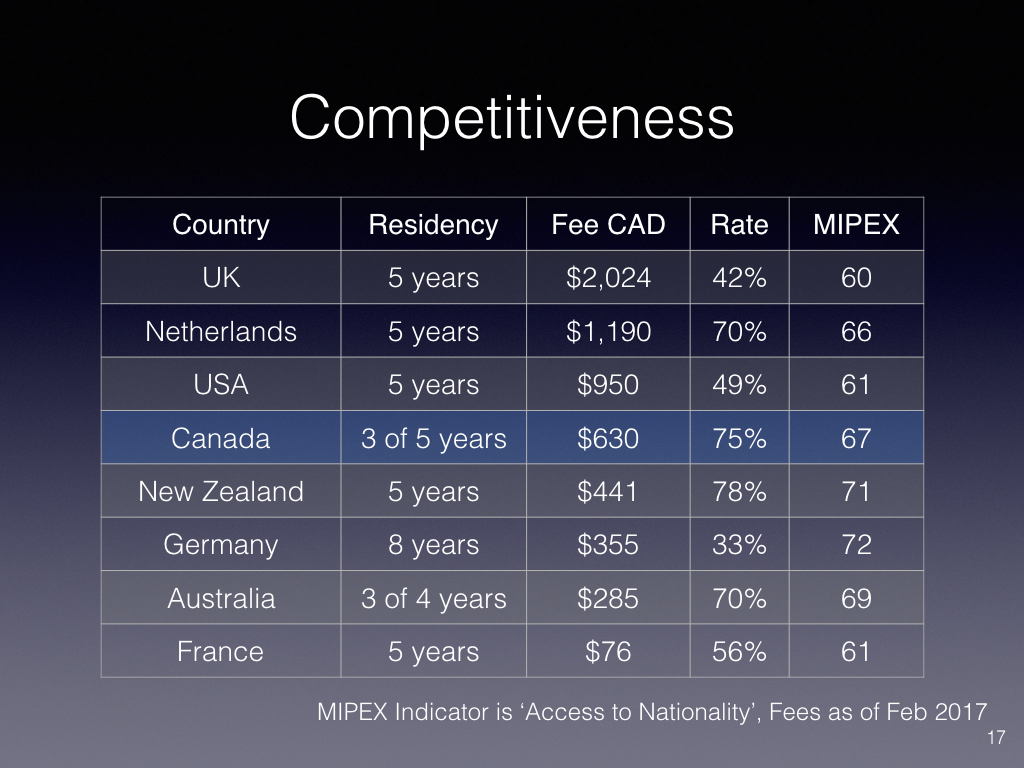
Article based in part on my brief, C-6 Senate Hearings: Expected Impact on the Naturalization Rate.

The IRCC comment that the government has no plan to reduce fees is notable and surprising, given its diversity and inclusion agenda and expanded Immigration levels.

Equally notable that the IRCC spokesperson is incorrect on the level of Australia’s citizenship fee, our most appropriate comparator country (above comparison chart). He also cites that the increase in citizenship fees was not raised in recent consultations on immigration levels despite there being no questions in the consultation document on citizenship (IRCC Discussion guide on immigration: What about citizenship?):

A sharp fee increase has helped fuel a dramatic drop in the number of immigrants applying to become Canadian citizens, according to immigration advocates.

In the first nine months of 2016, there were 56,446 applications filed for citizenship, a decrease of nearly 50 per cent from the same period a year earlier, when 111,993 applications were submitted.

The figures are included in a briefing by former Immigration and Citizenship director general Andrew Griffith prepared for the Senate social affairs, science and technology committee, which begins hearings this week on Bill C-6, a law to amend the Citizenship Act.

Griffith, an author on immigration issues and fellow at the Canadian Global Affairs Institute, calls it an “alarming” trend that can be linked directly to a steep increase in fees.

The processing fee jumped from $100 to $530 in 2014-2015, which amounts to a tripled price tag when the additional $100 “right of citizenship” fee is added.

“If you’re a professional doing reasonably well, you may not like it, but you pay it. It’s important to you,” Griffith told CBC News. “But if you are a struggling immigrant or refugee, suddenly $630 may become prohibitive, and especially if you’re talking about a family of four or more.”

Newcomers face other costs associated with the citizenship process, including language testing, he said. He recommends cutting the processing fee to $300, abolishing the right-of-citizenship fee, and considering a waiver for refugees and low-income immigrants.

Financial and other barriers

Griffith’s brief points to a broader pattern of declining naturalization rates. He warns that a growing part of the population may not fully integrate by becoming citizens due to financial or other barriers and that could lead to marginalization.

“We’ve always prided ourselves where we have a model where we don’t just encourage immigration, but we encourage immigrants to become citizens so they be fully part of society. They can take part in political discussions, they can vote and do all the things that are part of it,” he said.

Bill C-6 reverses reforms brought in by the previous Conservative government and takes steps to streamline and strengthen the integrity of the citizenship process. Those include reducing the time permanent residents have to live in Canada to become eligible for citizenship, counting time for work or study in residency requirements, and reducing the language proficiency requirements for younger and older immigrants.

Oath

A man raises his hand while taking the Oath of Citizenship at a ceremony in Mississauga, Ont. (Jonathan Castell/CBC)

But the government does not appear prepared to reverse the fee hike brought in by the Conservatives.

Bernie Derible, a spokesman for Immigration Minister Ahmed Hussen, said citizenship fees in Canada are “significantly less” than other comparable countries such as the U.K., Australia and New Zealand. Throughout the cross-country consultations last summer, there was little discussion or concern raised about the fee, he added.

Dory Jade, CEO of the Canadian Association of Professional Immigration Consultants, said he has heard from plenty of clients who are delaying citizenship because they can’t afford the fees.

Make process ‘accessible and easy’

“If we want to bring immigrants, especially under a Liberal government which believes in nation builders, making it accessible and easy to become members of your society is a big, big issue,” he said.

Jade has met with officials from Immigration, Refugees and Citizenship Canada to propose a way to address the financial burden.

He said he was told by officials that the current fees are not cost-recovery, which means they are still financed in part by the tax base despite the increase. [Note: IRCC costing study indicated processing cost $555, about the same as the current fee of $530.] But he suggested the government could ease the cost barrier by adopting a tax-like formula based on income, developing a loan program, or capping the total fee for a family.

Stephen Green, a Toronto-based immigration lawyer, said he has not heard of the fee being a significant factor in seeking citizenship. He said many of his firm’s clients who don’t currently qualify under the existing law are anxiously awaiting C-6 to become law so they can apply for citizenship.

The Senate social affairs committee hearings will be held Wednesday and Thursday this week, with a number of immigration and refugee lawyers and academics scheduled to testify.

Étude: la charte des valeurs québécois aurait attisé la discrimination

Not surprising but nice to see this confirmed in a more systematic manner:

Le débat sur la charte des valeurs a-t-il ouvert la porte à plus de racisme ? Depuis l’attentat à la Grande Mosquée de Québec, plusieurs membres de la communauté musulmane accusent le projet du Parti québécois d’avoir alimenté les tensions sociales et engendré des gestes violents à leur endroit. Une très rare étude sur la question, obtenue par La Presse, tend à leur donner raison.

Les jeunes plus sensibles

« La charte a-t-elle généré une solidarité accrue autour d’une identité commune ou a-t-elle sapé l’harmonie sociale ? » Voilà la question à laquelle ont tenté de répondre des chercheurs de l’UQAM et des universités Laval et McGill depuis 2014. Leur étude, qui cible les jeunes, est « très exploratoire », prévient Ghayda Hassan de l’UQAM. « C’est un projet pilote qui n’est pas nécessairement représentatif. » Il s’agit toutefois d’une très rare, sinon de la seule étude scientifique sur le sujet depuis 2014. L’équipe de Mme Hassan a interrogé 441 étudiants de l’UQAM (30,5 % d’hommes, 69,5 % de femmes). Pourquoi l’université ? D’abord parce que « les tensions intercommunautaires ont de graves conséquences pour les jeunes », lit-on. Aussi, « comparativement à la population générale, les étudiants sont plus susceptibles de connaître la charte ».

Discrimination

« Bien que le but de la charte était de placer la laïcité et l’égalité des femmes au coeur du débat public et politique, nos résultats montrent qu’il a eu des conséquences négatives », écrivent les chercheurs. Le tiers des étudiants ont déclaré avoir vécu personnellement ou avoir été témoins d’une forme de discrimination ethnique ou religieuse depuis la charte des valeurs. Un chiffre « plus élevé que prévu », qui a surpris les chercheurs. Les cas de discrimination étaient plus nombreux chez les immigrants, ainsi que chez ceux qui se sont identifiés comme biculturels ou appartenant à des groupes culturels ou religieux minoritaires par rapport aux Québécois « de souche » ou aux personnes s’identifiant comme catholiques. Les participants qui se disaient en faveur de la charte ont rapporté moins de discrimination que ceux qui y étaient opposés.

Perceptions transformées

Bonnes ou mauvaises, les relations intercommunautaires au Québec ? Le débat sur la charte a complètement changé la vision des jeunes sur cette question. Alors qu’ils voyaient majoritairement les relations intercommunautaires comme étant positives avant la charte, leur perception est devenue largement négative après, surtout chez les femmes, les immigrants et ceux qui s’identifient comme des minorités culturelles ou religieuses. C’est plus de la moitié des étudiants qui entrevoyaient un avenir sombre pour les relations entre les communautés. Seulement 20 % croyaient en un avenir positif. « L’étude révèle que la question de l’identité nationale québécoise est très sensible et sous-tend des tensions intercommunautaires importantes », écrivent les chercheurs.

Femmes musulmanes

Les femmes de confession musulmane ont été parmi les plus touchées par la charte, nous explique la chercheuse Ghayda Hassan, notamment parce que le débat sur le projet du PQ a beaucoup tourné autour du port du voile islamique. L’étude démontre que la couverture médiatique, en « dépeignant les symboles religieux comme des menaces au vivre-ensemble », en centrant son discours « autour de la sécularisation préconisée par la charte, a contribué à des manifestations de discrimination et d’ethnicisation dirigées surtout contre des femmes musulmanes immigrées, perçues comme des menaces pour la construction de la nation ».

Encore des séquelles ?

Dans la foulée de l’attentat dans une mosquée de Québec, plusieurs membres de la communauté musulmane ont montré du doigt la charte des valeurs. Visiblement, plus de deux ans après l’abandon du projet, les séquelles se font toujours sentir. Mais ont-elles encore un impact réel dans la société ? « Étant donné que le projet de charte a été abandonné lorsque le gouvernement du Parti québécois a été battu en 2014, les effets négatifs que nous avons observés ont peut-être disparu. Cependant, le débat sous-jacent est encore vivant », écrivent les chercheurs.

Source: Étude: la charte des valeurs aurait attisé la discrimination | Gabrielle Duchaine | National

Switzerland Votes to Ease Citizenship for Third-Generation Immigrants – The New York Times

Good result:

The posters seen in several cities and provinces featured two very similar young women: both born in Switzerland, educated in Swiss schools, now in their 20s and working full time in Swiss jobs. They even share the given name Vanessa.

The point, though, was the crucial way they differ. One Vanessa is a Swiss citizen, while the other is not, and is locked in a lengthy and expensive process to obtain citizenship even though her family put down roots in Switzerland two generations ago.

The posters backed a government-sponsored measure that would ease the path to citizenship for third-generation immigrants like the second Vanessa. And on Sunday, the measure was approved in a nationwide referendum.

The outcome went against the recent tide of right-wing populism and anti-immigrant sentiment in much of Western Europe. Just over 60 percent of votes were in favor, including majorities in 17 of the country’s 23 electoral cantons — a minimum of 12 are required to pass — despite a right-wing campaign that sought to stoke fears of Muslims infiltrating the country.

“We are quite surprised,” said Stefan Egli, a manager of Operation Libero, a politically independent group that campaigned in support of the initiative and organized the poster campaign featuring the two Vanessas, among others. Mr. Egli said he had thought the referendum would win the national popular vote, but he worried that more of the rural cantons would oppose the change.

Swiss law typically requires foreigners to be residents of the country for 12 years before applying for citizenship; after that they must undergo a series of tests and interviews to assess their suitability, and are judged by criteria that differ from one canton to another. Unlike the United States and some European countries, Switzerland does not grant automatic citizenship to children born on its soil.

The measure approved on Sunday will not change those basic rules, but will speed up and simplify the approval process, using uniform criteria, for foreigners under 25 whose parents and grandparents have permanent residence status in Switzerland. “These are people who are at home,” Simonetta Sommaruga, the federal justice minister, said in a statement explaining the government’s position on third-generation immigrants. “The only difference is they do not have a red (Swiss) passport.”

An assessment by Geneva University for the government’s department of migration found that just under 25,000 people could benefit from the changes. Most of them are Italian, it found, and nearly 80 percent are of European extraction.