Turnbull rebukes Labor over citizenship questions, saying ‘get on Australia’s team’ | The Guardian

Never a good idea to make this kind of accusation, reflects poorly on the accuser:

Malcolm Turnbull has attempted to shut down questions from Labor about the validity of the government’s citizenship revocation laws by borrowing a locution from the Abbott era and advising the shadow attorney general Mark Dreyfus to “get on Australia’s team”.

In question time on Monday Labor referenced a media report saying a “notorious terrorist” was set to have their citizenship revoked in the first case to be taken under the government’s citizenship revocation laws.

The report suggested the government was anticipating the move would be tested in the high court.

Dreyfus asked the prime minister whether the case referenced in the Daily Telegraph report would proceed under the same legislation where the attorney general had “incorrectly represented advice from the solicitor-general?”

The solicitor general, Justin Gleeson – courtesy of a bitter public dispute with the attorney general, George Brandis – has said very clearly he did not sign off on the final citizenship bill passed by the parliament, an account which cuts across a suggestion made by Brandis at the time that Gleeson had advised the government its citizenship revocation package had a good prospect of clearing the high court.

“What the shadow attorney general is now doing is taking his feud with the attorney general into an area where he is putting our national security at risk,” Turnbull told parliament on Monday.

The prime minister said Dreyfus needed to “get over these petty personal animosities and get on our team, get on Australia’s team, to ensure that we have the right legislation”.

Source: Turnbull rebukes Labor over citizenship questions, saying ‘get on Australia’s team’ | Australia news | The Guardian

Canada’s diversity model should be defended, not denounced: Hébert

Hébert on Canada’s model of multiculturalism and integration.

Not sure which proponents she is referring to that are not arguing in the model’s favour – there appears to be a fair amount of commentary from both perspectives among the commentariat, and as she notes, the vast majority of Canadian political leaders do argue in its favour:

And yes, it includes most of what one could describe as the country’s political elite. Canada’s federal, provincial and municipal leaders do sit at the top of the pyramid. But it is voters that put them there.

All this is to say that Canada should embrace rather than brace for a challenge to its immigration and integration model.

It is not as if the discussion is going to go away just because it has the potential to be divisive.

This is a debate that already invited itself in the last Quebec and federal elections.

If anything, the refusal of many proponents of Canada’s approach to cultural diversity to argue for it on its merits only weakens their case.

One cannot simultaneously set Canada up as a model to the world and refuse to defend the country’s approach to cultural diversity at home for fear of shattering the societal consensus that sustains it.

In the late ’80s, the Reform party threw down the gauntlet at the supporters of official bilingualism. Preston Manning believed he could tap in to the frustrations of a silent (unilingual) majority.

The Reformers’ opponents castigated them for calling for a debate on Canada’s language policy. This is a boat — they said — that no responsible politician should want to rock.

And yet the discussion the Reform party forced on its rivals ended up strengthening Canada’s linguistic duality.

In time, Manning lost his leadership in no small part because he was unable to become bilingual enough to campaign efficiently in French — and unable to convince enough Canadians that it should not matter.

Source: Canada’s diversity model should be defended, not denounced: Hébert | Toronto Star

President Obama explains the difference between Silicon Valley and the real world – Recode

To be noted:

The final thing I’ll say is that government will never run the way Silicon Valley runs because, by definition, democracy is messy. This is a big, diverse country with a lot of interests and a lot of disparate points of view. And part of government’s job, by the way, is dealing with problems that nobody else wants to deal with.

So sometimes I talk to CEOs, they come in and they start telling me about leadership, and here’s how we do things. And I say, well, if all I was doing was making a widget or producing an app, and I didn’t have to worry about whether poor people could afford the widget, or I didn’t have to worry about whether the app had some unintended consequences — setting aside my Syria and Yemen portfolio — then I think those suggestions are terrific. (Laughter and applause.) That’s not, by the way, to say that there aren’t huge efficiencies and improvements that have to be made.

But the reason I say this is sometimes we get, I think, in the scientific community, the tech community, the entrepreneurial community, the sense of we just have to blow up the system, or create this parallel society and culture because government is inherently wrecked. No, it’s not inherently wrecked; it’s just government has to care for, for example, veterans who come home. That’s not on your balance sheet, that’s on our collective balance sheet, because we have a sacred duty to take care of those veterans. And that’s hard and it’s messy, and we’re building up legacy systems that we can’t just blow up.

Source: President Obama explains the difference between Silicon Valley and the real world – Recode

Tailor immigrant and refugee mental health services for culture, language, report urges

Hard to argue with the overall message of tailoring programming to communities at greater risk but given that government’s need to choose where to allocate resources, I would place more emphasis on improved settlement services to reduce mental health issues.

The article, if not the report, is also silent that many immigrants may be reluctant to access mental health services:

Canada must match its multicultural, open-door immigration policy with tailored mental health services or face inflated costs for crisis care down the road, warns a new report being released today.

The sweeping study by the Mental Health Commission of Canada, obtained by CBC News, finds that immigrants generally arrive with better mental health than the Canadian-born population — something referred to as the “healthy immigrant effect.”

But their condition tends to deteriorate over time, and they don’t get help due to stigma, fear of being removed from the country, or a lack of treatment that meets their cultural or language needs.

Refugees afflicted with post-traumatic stress disorder, anxiety or depression are even less likely to access services.

The report says Canada must “urgently” develop a mental health strategy aimed at boosting service uptake, on the grounds of both equity and cost-efficiency.

Reduce overall costs

“By working to reduce disparities in access to services, the appropriateness of services used, and mental health outcomes, Canada can reduce overall system costs,” the report concludes.

Failure to access early treatment leads to more expensive emergency department visits or hospital admissions. There are also indirect economic effects, such as lost productivity and costs to the criminal justice system.

Entitled “The Case for Diversity,” the report calls for greater investment in programs and treatments that are adapted for culture and language and tailored to trauma and migration stress.

Dr. Kwame McKenzie — director of health equity at the Centre for Addiction and Mental Health, a psychiatry professor at the University of Toronto, and one of the report’s authors — said a newcomer’s ability to make money, land a job, learn the language and find housing and social supports are key factors in mental health.

Mental health problems can often be prevented by easing the resettlement process and breaking down barriers to early treatment, he added.

Early intervention, reduced costs

“If you have evidence-based interventions and they have easy access to it, we’ll be able to get people better and get them on their way,” McKenzie said.

Yet despite evidence early intervention not only helps outcomes and cuts costs over time, a study of data in Ontario in the report shows a “stark disparity” in service use. Only 6.3 per cent of refugees access treatment, compared to 9.6 per cent of immigrants and 12.5 per cent of non-immigrant Canadians.

Pointing to the intake of Syrian refugees to Canada, McKenzie said positive resettlement steps that have been taken could help mitigate mental health problems.

“I think for the Syrian refugees, there’s a lot of evidence accruing that the response, and the particular response in Canada, has been really good,” he said. “So it may be that we’ll see lower levels of mental health problems than we’ve had in other groups because of that.”

Culturally adapted programs

“The Case for Diversity” project reviewed 408 studies involving 41,920 people, offering “significant evidence” that culturally adapted therapies are more effective than programs targeting culturally mixed groups.

“Diversity has been a hallmark of contemporary Canadian society and it should be foundational to the planning and delivery of mental health services at all levels,” the report concludes.

“Meeting the needs of IRER [immigrant, refugee, ethno-cultural and racialized] populations is an urgent priority for the Canadian mental health system and its service providers.”

Source: Tailor immigrant and refugee mental health services for culture, language, report urges – Politics – CBC News

Quebec: Des points de vue divergents sur la laïcité de l’État

Some initial commentary before the start of Quebec’s hearings on Bill 62, which bans face covering (i.e., niqab, burka)in the delivery and reception of public services:

Des points de vue opposés se feront entendre lors des consultations qui s’amorcent mardi en commission parlementaire sur le projet de loi 62 favorisant le respect de la neutralité religieuse de l’État et visant notamment à encadrer les demandes d’encadrements religieux dans certains organismes, réponse du gouvernement Couillard au projet péquiste de charte de la laïcité.

« C’est un débat qui divise mais qui fait avancer, comme les débats sur l’avortement, sur la peine de mort ou sur l’aide médicale à mourir », a souligné la juriste Julie Latour, qui comparaîtra en commission parlementaire au nom du regroupement Juristes pour la laïcité et la neutralité religieuse de l’État.

La Commission des institutions a prévu neuf jours d’audiences cet automne au cours desquelles 42 groupes et individus seront entendus, un nombre qui est appelé à augmenter puisque l’horaire prévoit des ajouts.

C’est la quatrième fois que le gouvernement québécois tente de faire adopter un projet de loi pour préciser la neutralité religieuse de l’État et définir des balises pour l’octroi d’accommodements raisonnables dans le secteur public et parapublic. Les deux projets de loi précédents, 63 et 94, présentés par le gouvernement Charest ont été abandonnés tandis que la défaite du Parti québécois en 2014 a clos l’épisode du projet de loi 60 sur la charte « affirmant les valeurs de laïcité » défendu par le gouvernement Marois.

À l’entrée du Conseil des ministres mercredi dernier, la ministre de la Justice, Stéphanie Vallée, qui pilote le projet de loi 62 a indiqué que le gouvernement avait en main « des avis juridiques solides » à l’appui de cette nouvelle tentative législative. Elle a dit souhaiter que le nouveau chef de l’opposition officielle, Jean-François Lisée, reste fidèle aux propos qu’il a tenus lors de la course à la chefferie : le candidat jugeait que le projet de loi était un pas en avant et qu’il fallait l’adopter.

Pour Louis-Philippe Lampron, professeur de droit à l’Université Laval, le projet de loi 62 consiste pour l’essentiel en « une redite » du projet de loi 94 présenté en 2010. « C’est essentiellement une codification du droit canadien actuel sur la neutralité religieuse de l’État », estime-t-il. À cela s’ajoute la même disposition que dans le projet de loi 94 sur l’obligation d’avoir le visage découvert pour fournir ou recevoir des services de l’État, que ce soit dans les écoles, dans les centres de la petite enfance (CPE) et les garderies subventionnées, dans le réseau de la santé et pour les autres services publics. Un accommodement à ce sujet devra être refusé pour « des motifs portant sur la sécurité, l’identification ou le niveau de communication requis ». Mentionnons qu’il n’est aucunement question de signes religieux.
Au moment des consultations sur le projet de loi 94, la Commission des droits de la personne et des droits de la jeunesse (CDPDJ) avait exprimé un « malaise » relativement à cette interdiction qui portait, sans le dire, sur des signes religieux. « On peut même dire que ça vise explicitement un symbole religieux d’une religion [l’islam] », a fait observer Louis-Philippe Lampron. « Il y a des raisons de croire que ça pourrait être contesté. » Ou que l’interdiction ne s’applique pas en raison de l’octroi d’accommodements.
Pour sa part, Me Julius Grey, bien qu’il s’oppose au multiculturalisme et qu’il soit en faveur de la laïcité, est contre l’interdiction des signes religieux, sauf pour les agents de l’État qui détiennent un pouvoir de coercition (juges, policiers, agents correctionnels, etc.), comme le recommandait la commission Bouchard-Taylor. Il trouve inconcevable qu’on puisse priver quelqu’un de soins médicaux, quelles que soient les circonstances.
Pour Julie Latour, le projet de loi 62 est « un jalon ». À ses yeux, il manque à la neutralité religieuse de l’État et à la laïcité un socle juridique qui passe par l’enchâssement de leur principe dans la Charte des droits et libertés de la personne.

Source: Des points de vue divergents sur la laïcité de l’État | Le Devoir

Some of the notable absences from the hearings:

Faux départ pour la commission parlementaire sur le projet de loi 62 concernant la neutralité religieuse de l’État. Une vingtaine de groupes et d’experts que les députés voulaient entendre ont décliné l’invitation. Et pas les moindres : notamment Gérard Bouchard et Charles Taylor, qui ont présidé la commission sur les accommodements religieux.

La ministre de la Justice, Stéphanie Vallée, y voit malgré tout une bonne nouvelle. Le refus de tous ces groupes «envoie un signal qu’ils sont confortables avec la version présentée par le gouvernement, ce qui n’était pas le cas» pour le projet de charte des valeurs du Parti québécois, a soutenu sa porte-parole, Isabelle Marier St-Onge.

Or, en entrevue à La Presse, Gérard Bouchard a assuré qu’il n’a pas changé d’avis sur le port de signes religieux, une position qui va plus loin que ce que propose Mme Vallée. Comme on peut le lire dans le rapport de la commission qu’il a coprésidée, il recommande d’interdire ces signes chez les agents de l’État dotés d’un pouvoir de coercition (policiers, gardiens de prison, procureurs de la Couronne et juges). Le projet de loi 62 précise seulement que les services publics doivent être donnés et reçus à «visage découver», une mesure qui cible le voile intégral.

«Mes idées sur la laïcité sont bien connues, et je m’en tiens toujours aux propositions que nous avons émises il y a huit ans. Je n’aurais que répété ce qui est écrit dans le rapport pour l’opposer à ce qui peut être écrit dans le projet de loi. Je ne voyais pas mon utilité, parce que je n’ai rien à ajouter», affirme M. Bouchard.

 Horaire modifié

L’horaire des auditions, qui débutent mardi à Québec, a été revu à la toute dernière minute en raison des multiples refus de témoigner. Ce cafouillage est d’autant plus étonnant que le projet de loi 62 a été déposé par Mme Vallée il y a longtemps, en juin 2015.

Une vingtaine de groupes refusent de discuter de neutralité religieuse

And English language coverage in the Globe:

The new legislation, “An Act to foster adherence to State religious neutrality and, in particular, to provide a framework for religious accommodation requests in certain bodies,” tabled by the Liberals last year, would make it illegal to give or receive government services if a person’s face is covered. Since no Quebec public employees mask their faces, according to the government, the bill would effectively target Muslim women who wear the niqab or burka.

 Justice Minister Stéphanie Vallée said when introducing the legislation that it was required “for security, identification and communication purposes.”

She has been unable to say how many women wear face veils in the province.

Bill 62 is the latest iteration of Quebec’s efforts to impose official secularism in the public domain (though the new legislation would allow the crucifix over the speaker’s chair in the National Assembly to remain in place).

The bill is seen as a more moderate version of the former Parti Québécois government’s derided “charter of values,” which had set out to ban turbans, kippas, head scarves and other religious displays among Quebec’s civil servants. The bill is believed to have contributed to the PQ’s defeat at the polls in 2014.

The Liberals’ bill would allow for religious accommodations as long as they fit certain sets of guidelines, such as being “consistent” with the equality of men and women.

Still, some groups question the need for the law and say it unfairly targets minority women, who could be excluded from accessing public services.

“How necessary is all of this?” Amira Elghawaby of the National Council of Canadian Muslims said. “How many women might actually be wearing the face veil in Quebec? I doubt that it’s a huge critical mass.” She said that re-opening the issue creates a “malaise.”

“There should really be no suspension of people’s human rights based on popular sentiment toward a religious practice,” Ms. Elghawaby said.

 Hearings to begin on proposed Quebec law targeting veiled women 

Racial profiling, by a computer? Police facial-ID tech raises civil rights concerns. – The Washington Post

The next frontier of combatting profiling:

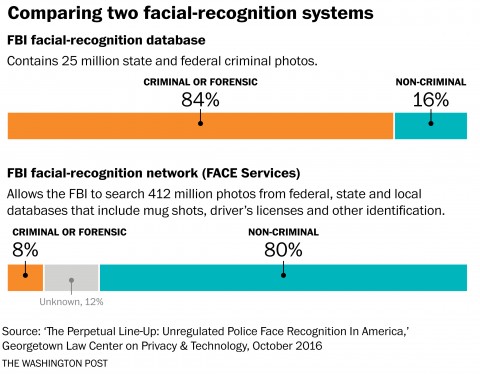
The growing use of facial-recognition systems has led to a high-tech form of racial profiling, with African Americans more likely than others to have their images captured, analyzed and reviewed during computerized searches for crime suspects, according to a new report based on records from dozens of police departments.

The report, released Tuesday by the Center for Privacy & Technology at Georgetown University’s law school, found that half of all American adults have their images stored in at least one facial-recognition database that police can search, typically with few restrictions.

The steady expansion of these systems has led to a disproportionate racial impact because African Americans are more likely to be arrested and have mug shots taken, one of the main ways that images end up in police databases. The report also found that criminal databases are rarely “scrubbed” to remove the images of innocent people, nor are facial-recognition systems routinely tested for accuracy, even though some struggle to distinguish among darker-skinned faces.

The combination of these factors means that African Americans are more likely to be singled out as possible suspects in crimes — including ones they did not commit, the report says.

“This is a serious problem, and no one is working to fix it,” said Alvaro M. Bedoya, executive director of the Georgetown Law center that produced the report on facial-recognition technology. “Police departments are talking about it as if it’s race-blind, and it’s just not true.”

The 150-page report, called “The Perpetual Line-Up,” found a rapidly growing patchwork of facial-recognition systems at the federal, state and local level with little regulation and few legal standards. Some databases include mug shots, others driver’s-license photos. Some states, such as Maryland and Pennsylvania, use both as they analyze crime-scene images in search of potential suspects.

At least 117 million Americans have images of their faces in one or more police databases, meaning their resemblance to images taken from crime scenes can become the basis for follow-up by investigators. The FBI ran a pilot program this year in which it could search the State Department’s passport and visa databases for leads in criminal cases. Overall, the Government Accountability Office reported in May, the FBI has had access to 412 million facial images for searches; the faces of some Americans appear several times in these databases.

Source: Racial profiling, by a computer? Police facial-ID tech raises civil rights concerns. – The Washington Post

‘There seems to be a paralysis’: Trudeau government has backlog of more than 300 appointments

Almost a year in, one would expect more vacancies to have been filled, given the overall policy – greater diversity – is clear. But I can also see the wish to ensure that the details of the policy and its implementation are addressed first.

One of the key things to look for is the degree of transparency in political appointments, with comparable employment equity reporting to the public service and federally-regulated sectors (telecoms, banking, transport). Currently for judges, only gender is tracked. For other GiC appointments, while gender has been tracked comprehensively for 25 years (as has official languages), there has been little systemic tracking of the other groups (visible minorities, Indigenous peoples, persons with disabilities).

And in some cases, there has been backsliding: the GiC appointment index (top view) has less information than previously, requiring more looking at the individual organizations than before.

For my baseline study, see my short ebook, “Because it’s 2015 …” Implementing Diversity and Inclusion, available either in an iPad/Mac version (iBooks) or Windows (pdf) Version.

Prime Minister Justin Trudeau and his cabinet have accumulated a backlog of more than 300 appointments that are due to be filled, a CBC News investigation has found.

Almost 20 per cent of governor in council (GIC) appointments, which include roles with Crown corporations, port authorities, agencies and tribunals, are currently vacant or occupied by a Conservative appointee whose term is past its expiry date.

Overall, 170 GIC positions are listed as vacant. Another 116 are past their appointment’s expiry date but the incumbent has been allowed to remain in the role until he or she is either replaced or renewed.

Currently, 61 federally appointed judge positions are vacant, including one seat on the Supreme Court of Canada.

In the Senate, 20 per cent of the 105 seats are empty. The government has pledged to fill the 21 spots “by the end of the year.” Three more senators are due to retire in January.

Taking a toll

In some cases, incumbents have been temporarily renewed only a day or two before their appointments were set to expire because the government had not yet launched the process to find a replacement.

For example, Graham Fraser’s appointment as commissioner of official languages, which was set to expire Sunday, was extended Thursday for two months. The government has yet to issue a job posting to find his successor.

The backlog has taken a toll on the operations of some boards and government bodies.

The CRTC hasn’t been able to hold a planned hearing on French music since November because it doesn’t have the necessary three French-speaking commissioners.

The parole board, where 21 per cent of positions are currently vacant, says it’s being stretched, with its remaining part-time board members putting in additional hours to ensure the work is done.

Alberta judges warned a Senate committee in late September that the 61 vacant judge positions could affect court proceedings, saying the province’s justice system is so backlogged they are now setting trial dates for 2018. Last week, an Edmonton judge stayed a murder charge against Lance Matthew Regan, citing delays in bringing the case to trial caused in part by the backlog in Alberta’s justice system.

‘Overwhelmed’

Liberal government insiders privately point to the Prime Minister’s Office and the Privy Council Office as the source of the problem, saying “the centre” has been “overwhelmed.”

The government is confident the problem will be resolved soon. It says the backlog was caused in part by the decision to overhaul the appointments process and bring in a more open, balanced, merit-based system. The new system is now up and running and vacancies are being filled, officials say.

Source: ‘There seems to be a paralysis’: Trudeau government has backlog of more than 300 appointments – Politics – CBC News

Sean Fine of the Globe focusses on the impact on the court system:

While Prime Minister Justin Trudeau is considering his first appointment to the Supreme Court of Canada – a vacancy became available on Sept. 1 – the shortage of lower-court judges may make it difficult for some jurisdictions to meet constitutional guarantees of timely criminal trials.

In July, the Supreme Court of Canada set a deadline of 30 months in superior courts (such as the Court of Queen’s Bench) from the time a charge is laid until the trial is completed. In Calgary, the wait is now just short of 15 months – 63 weeks – to schedule a trial of five days or more. (It can take months from the time a charge is laid until a trial is scheduled.) The situation is about the same in Nova Scotia, where the Supreme Court is now booking criminal trials of five days or more for next fall.

Civil trials, too, face long delays, which Chief Justice Wittmann said is especially hard on families seeking resolutions to legal problems. The lead time to schedule a civil or family trial of five days or more in the Court of Queen’s Bench in Calgary is now 138 weeks – bookings are being accepted for April, 2019. The Court of Queen’s Bench is Alberta’s top trial court, and it has seven vacancies and 59 full-time judges in office, according to the Office of the Commissioner for Federal Judicial Affairs. The province’s Court of Appeal has two vacancies and 12 full-time judges in office.

In Nova Scotia, the Supreme Court (the top trial court) has five vacancies and 31 full-time judges in office. The Court of Appeal has one vacancy and seven judges in office.

“On rare occasions in the past we’ve had to cancel matters. However, this is the first time we’ve had to send out multiple letters the month before suggesting that trial dates be rescheduled due to the shortage of judges,” Jennifer Stairs, the communications director for the Nova Scotia judiciary, told The Globe in an e-mail.

“That’s very difficult on the lawyers and on the litigants who are anxious to have their matters heard.”

B.C. has eight vacancies and 82 judges in office on its Supreme Court, and three open spots and 12 judges in office on its appeal court. Five-day criminal trials are available in January, 2017, while five-day civil trials, other than motor-vehicle actions, can be booked from August, 2017, onward. Dates for five-day motor-vehicle action trials are fully booked for the next 18 months, according to Superior Courts communications officer Bruce Cohen.

The Canadian Bar Association, representing the country’s legal profession, is also upset at the delays in appointing judges.

“We are very concerned. Ongoing judicial vacancies have created significant delays in the court system. These delays have a serious impact on separating families and their children, on criminal justice, on business in Canada,” CBA president René Basque said in an e-mail.

Canadian courts languish as vacancies on bench remain unfilled
Glass ceiling still in place for British Columbia public sector employees

Unfortunately (or fortunately, depending on the perspective), there is no equivalent federal ‘sunshine list’ on all public sector salaries.

british-columbia-public-service-2011

However, we do have data on federal Deputy and Assistant Deputy Ministers (for women, 2016 baseline 37.6 percent women and 4.7 percent visible minorities for deputies, 40.8 and 7.2 percent for ADMs). DM appointments by the current government are close to gender parity at 46.9 percent women.

My analysis of GiC appointments showed less representation of women and visible minorities, and a similar gap to British Columbia between senior and junior appointments for crown corporations and administrative tribunals:

GiC Baseline 2016.014

Prime Minister Justin Trudeau may have introduced a gender-balanced cabinet “because it’s 2015,” but that equality does not extend to public servants in B.C., where the vast majority of the highest-paid employees are men.

An analysis of The Sun’s exclusive public sector salary database reveals that of the 200 highest-paid public employees in B.C., during 2014 or the 2014-15 fiscal year, 70 per cent were men and 30 per cent were women. That increases to 77 per cent male when the field is narrowed to the top 100 (By contrast, 94 of the 100 highest-paid corporate executives in 2015 were men, according to Business in Vancouver.)

“There’s an old saying: the higher, the fewer, with respect to women,” said Barbara Arneil, head of the University of B.C.’s political science department. “We have what I think are structural, systemic reasons why women are not reaching the top of their profession, whether that is in the university, whether that’s in government, whether that’s in the private sector. And we’re wasting very good resources.”

Search The Sun’s exclusive public sector salary database.

The Sun analyzed the top 200 public-sector earners in this year’s database, which contains salary information for nearly 77,000 employees, and the top 50 earners in six of the seven sectors: B.C. government, Crown corporations, health authorities, local government, school districts, and colleges and universities. The Sun did not include municipal police in this analysis because forces generally withhold many names to protect undercover officers. The Sun relied on first names for this gender analysis, checking Internet profiles in cases where only a first initial was provided or the name was ambiguous.

The gender divide is most pronounced at colleges and universities, where men represented 41 of the top 50 earners, or 82 per cent, in the 2014-15 fiscal year. But because the University of B.C. accounts for 45 of the top 50 highest-paid employees in the sector in the province, these findings really only reflect that institution. At the University of Victoria, for example, five of the 10 highest-paid employees are women.

Pay equity is an issue UBC takes seriously, university spokeswoman Susan Danard said in an emailed statement.

“Compensation is affected by several factors, including the depth of experience and accomplishment that a faculty or staff member brings with them when they are first hired, and the length of employment with UBC, with people paid more as they progress in their careers,” she said. Faculty and area of specialization are also factors that affect pay equity, she said, noting specialists and top doctors in the faculty of medicine are often the highest paid given the demands and complexity of their jobs.

Source: Glass ceiling still in place for public sector employees | Vancouver Sun

Daphne Bramham picks up on issue:

Canada’s failure is in providing women the opportunities to fully participate in the economy. Not only does Canada lag the Nordic countries, it trails countries like the United States, Namibia, Mongolia, Belarus, Thailand and Burundi.

It’s because women don’t have equal opportunities, Canada’s overall gender ranking dropped to 30th in 2015, down 11 places from 2014.

Among the more troubling findings in the Sun’s gender analysis of B.C. public-sector wages is that the 25 universities and colleges have the fewest women in top-paid positions — only nine among the top 50. Of those, five work at the University of British Columbia.

The excuses/reasons are the usual ones. Prime career-building years coincide with the prime reproductive years and Canadian mothers continue to bear the largest share of the caregiving for both children and aging parents.

Even though 58 per cent of these institutions’ graduates are women, missing are the supports for those young women to succeed in academe. It’s all the more disappointing because post-secondary institutions are supposed to be places of innovation and change, not laggards.

What’s not surprising is that the health services authorities account for the most women on the top-earners’ list with 59; 35 of whom are at the Provincial Health Services Authority.

For more than a decade, the majority of medical school graduates have been women. Among the professionals in the B.C. government, women account for nearly 90 per cent of the nurses and nutritionists and three-quarters of the social workers and counsellors.

But that may be change for the worse because catching up wage-wise isn’t as simple as more women working in traditionally male jobs. When women do that, the pay scale drops. That’s what sociologist Paula England at New York University concluded after analyzing U.S. census data from 1950 to 2000.

When biologists went from being predominately men to women, England found that wages fell 18 percentage points (even accounting for changed value of the dollar over time). When workers in parks and camps went from mostly men to mostly women, the median hourly wages dropped 57 percentage points.

It’s because when women do the work, England told the New York Times, “It just doesn’t look like it’s as important to the bottom line or requires as much skill.”

Daphne Bramham: Few women in B.C. public sector’s top ranks, …

Brampton council says no to electoral reform despite ethnic mismatch with residents | Toronto Star

The gap between representation at the municipal level and other levels of government has been an issue for some time (all federal MPs and provincial MPPs from Brampton are Indo Canadians, over reflecting their share of the population and the first-past-the-post system).

Ranked balloting may be part of the solution but there are likely other factors involved, including the lack of political parties at the municipal level:

On Wednesday — as a federal debate on the issue draws near and with new Ontario legislation that gives cities the option of ranked balloting — Brampton council voted 11-0 against the idea. Meanwhile, Canada’s first-past-the-post electoral method is being used by fewer and fewer democratic nations around the world because it’s recognized as a system that too often puts people in power despite their having little voter support.

“Each city councillor in Brampton has the support, on average, of less than 4 per cent of the city’s voters, yet they’re making decisions that affect the entire city,” says Pat McGrail, chair of Fair Vote Peel, who made a presentation to council Wednesday, advocating for a ranked ballot system whereby candidates would need the support of a majority to get elected.

Brampton councillors who responded to the Star said they voted against ranked balloting because voters might find the system too confusing. It works by allowing voters to rank at least three top candidates (cities can opt to allow more candidates to be ranked on each ballot). The candidate who receives the least first place votes is eliminated in each round and their votes are redistributed until one candidate has a majority.

But critics point to research that shows the current first-past-the-post system often leads to municipal councils that do not accurately reflect the ethnic diversity of cities. In Brampton close to 70 per cent of the city’s residents are visible minorities. Only one out of eleven members of city council is a visible minority.

“That’s not just a Brampton problem,” says Dave Meslin, an expert on the subject who is authoring a book on electoral reform and has helped with the federal government’s current public consultations on the issue being conducted in every riding across Canada. He says Canada is now alone in its use of first-past-the-post for every level of government. “The lack of diverse representation on municipal councils is a glaring problem across Ontario.”

He points to U.S. research that shows ranked balloting in cities has significantly improved representation that more accurately reflects the electorate. Vote splitting, where an incumbent can rely on a concentrated base of supporters, while a number of other candidates fight for the remaining voters — often the vast majority — is something that can’t happen with ranked balloting, Meslin says.

In the 2014 municipal election, of all winners, Brampton Coun. Martin Medeiros received the least number of votes — 4,188, or 22 per cent of the votes cast in his ward. He beat Shan Gill by 100 votes. There were 15 candidates in total who ran for the council seat Medeiros now occupies. With a city-wide turnout of 36 per cent of eligible voters, applying the same rate, Medeiros received the support of about 7 per cent of eligible voters in his ward.

He did not respond when asked to comment on his decision not to support ranked balloting.

The provincial government was asked if its new legislation under Bill 181, which gives cities the option of using ranked balloting for elections, falls short because it leaves the ultimate decision to the very politicians who might get defeated by the new system.

“We feel that municipalities are responsible levels of government and are in the best position to make decisions in the best interest of their communities,” said Ministry of Municipal Affairs spokesperson Conrad Spezowka.

McGrail says low voter turnout is another problem with first-past-the-post. “The central problem of first-past-the-post is divide and conquer while appealing to your base. People become so disenfranchised they don’t even bother to vote.”

Sukhjot Naroo, a Brampton resident and co-founder of the social network Brampton Beats, which has almost 4,000 members who focus on municipal issues, says he doubts Brampton council will accurately reflect the city’s population as long as vote splitting continues. He lists an increasing number of issues accompanying Brampton’s rapid demographic shift, from zoning for places of worship to funding for a variety of culturally specific activities, that don’t get proper representation on council.

“Everyone on council will benefit from vote-splitting. The incumbents don’t want change. They’re just trying to protect the status quo. Out of eleven votes, not one even considered ranked balloting. Not even Gurpreet Dhillon, the only South Asian member of council, because he now has his base of supporters and can grow that through his growing political connections.”

Dhillon did not respond to questions emailed to him.

Toronto’s Katherine Skene says she’s dismayed, but not surprised by Brampton’s 11-0 vote. “I would hope that councils, before voting on the issue, there would be broad public consultation to find out what the voters actually want.”

Skene is co-chair of the Ranked Ballot Initiative of Toronto, where councillors last year voted 25-18 against a provincial option to allow for ranked balloting, a reversal of that council’s earlier position to bring ranked ballots about. Mayor John Tory supported the idea during his election campaign and maintained his support in last year’s vote.

Source: Brampton council says no to electoral reform despite ethnic mismatch with residents | Toronto Star

Nova Scotia’s towns and cities elect more diverse candidates

Nova Scotia is the most diverse province of Atlantic Canada (9 percent visible minorities, the largest group being Black Canadians):

Lindell Smith set out to start a conversation about diversity at Halifax city hall this summer, and it seems people listened: the 26-year-old has now become the first African Nova Scotian elected to city council in 16 years.

“People from all communities went out and voted. The numbers show … something different is needed,” Smith said after Halifax’s municipal elections wrapped up over the weekend. “When someone comes in and starts asking questions, people realize, ‘We don’t know why we still do it that way.’”

Towns and cities across Nova Scotia made modest gains in diversity with the results of municipal elections on Saturday, but Smith and others note the province still has a long way to go.

Smith decisively won a seven-way race for the city’s north-end district with about 52 per cent of the vote.

 The 26-year-old will be the first black city councillor elected since 2000—when Graham Downey, the only other visible minority member to serve in Halifax regional council since its inception in 1996, lost the seat Smith now occupies.

“For the black community, it’s like we have somebody who’s at the leadership table,” Smith says. “It’s almost this sigh of relief like, ‘Wow, it took this long.’ ”

Smith’s predecessor, outgoing councillor Jennifer Watts, did not seek re-election in the north-end district. She expressed hope this election would change the composition of the then all-white, three-quarters male and “predominately older” council to better reflect the city it serves.

Despite having a more diverse roster of candidates this year—including seven visible minorities and the city’s first openly transgender candidate—Smith was the only member of a previously unrepresented group to get elected. Meanwhile, the number of female councillors in City Hall shrunk from four to two.

“It’s great that we have someone who’s not of European descent and is not over fifty, but we need to have all different voices,” Smith says.

In Kentville, about an hour’s drive west of Halifax, political newcomer Sandra Snow defeated outgoing mayor Dave Corkum with 70 per cent of the vote. The retired military aviation contractor looks forward to leading a council with four of its seven seats occupied by women.

“Women tend to lead from the heart,” Snow says. “I think when we’re discussing issues, there will be a lot more collaboration around the table.”

It’s a sight that would make former Kentville mayor Gladys Porter proud, Snow says. Porter became the first woman in the Martimes to be elected mayor 70 years ago, and after 11 years in office, went on to serve as the first female member of Nova Scotia legislature.

“We still have a long while to go,” Snow says. “A woman has a very busy life … and often we don’t prioritize ourselves first and we don’t prioritize the fact that maybe we do have political ambitions.”

Wolfville saw the gender balance in its Town Hall shift dramatically with women clinching five out of six council seats.

Source: Nova Scotia’s towns and cities elect more diverse candidates – Macleans.ca