Oh, So Now I’m Bangladeshi? – The New York Times

British writer Zia Haider Rahman on identity and perceived identity:

It is Britain’s inherent cultural problem with otherness that makes it difficult for the native to call me British, difficult even for those who, one might naïvely hope, should know better.

If you’re not going to call me British when I grew up in Britain; when I hold a British passport and don’t hold a Bangladeshi one; when I don’t even speak Bengali; when, good citizen that I try to be, I help an elderly neighbor with his Ikea bed, or dig out the old lilac that another cannot uproot; when I was educated in Britain, worked in Britain, was “a body of England’s, breathing English air/Washed by the rivers, blest by suns of home”; when I wash the dishes at the local church’s fund-raiser for the homeless (because regardless of faith, we surely all believe in the idea of community); and again — it bears repetition — when I hold a British passport “without let or hindrance,” then you can’t be surprised if, doubting your good faith, I grab my bags and get the hell out.

After all, how much more can I integrate? What more is it you want from us? To be white? To be you?

Source: Oh, So Now I’m Bangladeshi? – The New York Times

The Largest Ever Analysis of Film Dialogue by Gender: 2,000 scripts, 25,000 actors, 4 million lines

The_Largest_Ever_Analysis_of_Film_Dialogue_by_Gender__2_000_scripts__25_000_actors__4_million_linesA really good example of the kind of detailed analysis that provides a more rigorous evidence base for trends, preferences, and biases. Check out the interactive graphics, which are particularly well-designed, informative and effective:

This project was born out of the less-than-stellar response to our analysis of films that fail the Bechdel Test. Commenters were quick to point out that the Bechdel Test is flawed and there are justifiable reasons for films to fail (e.g., they are historic). By measuring dialogue, we have much more objective view of gender in film.

Many of the findings are anecdotally obvious to women in the film industry. But nobody wanted to do the grunt work of gathering the data. We spent weeks just matching scripts to IMDB pages. It’s still not perfect, but we’re now in a much better place than “you know…women are never love-interests when they’re older than 40. ¯\_(ツ)_/¯”

All of our sources are available in this Google Doc and as much data as we can share (without getting sued) is available here on Github. Or if you don’t know how to code, here’s an easy way to comb through every film, genre, and year.

Source: The Largest Ever Analysis of Film Dialogue by Gender: 2,000 scripts, 25,000 actors, 4 million lines

Robyn Urback: On that contentious Black Lives Matter tweet…

One of the better commentaries:

…. I sort of understand why members of the Black Lives Matter Toronto (BLMTO) group all but shrugged this week in response to a controversial tweet put out by one of its co-founders. The tweet was originally posted back in February, but only came to light this week after Jerry Agar, a local Toronto radio host, reported on it on his show. In the tweet, BLMTO co-founder Yusra Khogali wrote, “Plz Allah give me strength to not cuss/kill these men and white folks out here today. Plz plz plz.”

It was a dumb thing to post, especially for a leader of movement that — one would think — would want to covet potential allies rather than ostracize them. And it shouldn’t be surprising that some people found it offensive. But rather than acknowledge the inappropriateness of the tweet, apologize for it and move on, BLMTO members dug in their heels and went on the defence: the group’s other co-founder, Sandy Hudson, refused to comment on it during an interview with a local television station, and instead criticized the reporter for focusing on the tweet, rather than the issues about which BLMTO was trying to get attention. In the Toronto Star, journalist and activist Desmond Cole explained Khogali’s tweet as a “common response to violence and injustice,” “an honest appeal to restraint and wisdom in the face of violence, racism and misogyny.” And Khogali herself refused to comment on the issue altogether.

Meanwhile, critics of the BLMTO movement latched onto the tweet as a sort of “smoking gun,” which supposedly proved the violent intentions of the group. But to make that assertion is a pretty remarkable stretch: people say and post all sorts of hyperbolic things when they’re angry — and despite some progress in recent years, black Canadians still have plenty to be angry about — but that doesn’t mean they actually intend to act on it. And it also doesn’t mean that the group’s core message should be wholly discredited because its co-founder posted one thoughtless, offensive tweet.

None of this is to say that Khogali’s tweet was in any way acceptable, though her defenders have demonstrated some phenomenal mental gymnastics in attempting to explain why it’s somehow OK to post a prayer to God, asking for the strength not to kill people of a certain group and gender. It’s not. The impulse to hunker down in this case is understandable, especially as BLMTO is slammed with criticism, seemingly from all sides. But it’s ultimately disingenuous: no group is, or should be, above criticism — not Black Lives Matter, not Orthodox rabbis in New York, not National Post columnists who, perhaps unwisely, wade into the most contentious of social issues.

BLMTO representatives say they would prefer we talk about carding, or wage discrepancies, or violence against blacks at the hands of police — which are all worthy topics of discussion. But at the same time, there is no better way to get people interested in a tweet than insisting that the media stop talking about it. Had BLMTO led the discussion, and heard the criticism, I suspect the conversation would have been over by now.

Source: Robyn Urback: On that contentious Black Lives Matter tweet…

Europe under siege: Good long read by Paul Wells

Good long read by Wells on the radicalization and other challenges in Europe. Where he ends up of note:

All of which suggests, to me, that the long-term solution to the urban terror of ISIS is not to shut down borders, banish newcomers, bulk up the surveillance state and out-tough the murderers. Certainly there is a market for that prescription. On a Monday night several days after the Brussels bombings, a gang of thick-necked soccer hooligans descended on the square in front of the Bourse, tearing down peacenik banners and picking fights with passersby who seemed, in the eye of the roving strongmen, excessively eager to make nice with Islamists. The police finally saw the counterprotesters off with water cannon. There will be plenty of politicians offering the marchers their brand of tough medicine in the next election, in Belgium and across Europe. There have been for decades.

But if Islamism is vying for the attention and affection of distracted and dissolute kids, whether second-generation rebel sons of moderate Muslims or slapdash converts from Christianity or atheism, then it is not in the West’s long-term interest to try to out-tough the killers. Rather it is to sap the appeal of terror and murder by ensuring, consistently over the long term, that another way of life really does look better.

On that score, I daresay that Europe, for all its strains and its frequent inanity, is doing well. On a bad day you could almost sell the notion that EU and ISIS are funhouse-mirror images of each other: polyglot, border-skipping multinational operations that operate in defiance of history, logic or human nature. But the comparison flatters ISIS and cheats Europe. The foreign fighters who have streamed to Raqqa to join the jihad have as often recoiled in horror as they have been embraced as useful recruits. The murders of innocent dozens in Paris, including Muslims, have badly undercut the appeal of ISIS in the French-speaking world. Cédric Mas, a French analyst, has pointed out that the latest issue of Dar al-Islam, the French-language ISIS propaganda magazine, devotes an unprecedented amount of space to defensive arguments for its terror attacks in Europe—and contains no long-term forecasts about the organization’s future. It is as if, at the moment of its apparent triumph, ISIS has found itself thrown on the back foot among its own clientele.

Europe, meanwhile, is Europe, revelling in its history and culture, refining its admittedly clumsy policing, learning from error. And not incidentally, living as a rich, compelling community—richer in many places, in important ways, than Brussels.

On Monday at a conference organized by the European Policy Centre think tank, Thomas Fabian, the deputy mayor of Leipzig, described the policies his German city of 500,000 people has adopted to integrate the more than 5,000 migrants who moved there last year. The newcomers are distributed throughout the city, including in affluent neighbourhoods, instead of being left in ghettos, Fabian said. The newcomers are obliged to take German lessons. Each family is assigned a city social worker to check in now and again, but for the most part newcomers are encouraged to leave their homes to visit doctors and other services, to strengthen their personal responsibility and self-reliance. The goal of it all, Fabian said, is to make sure the newcomers join Leipzig’s broader community, a community whose residents, 300 years ago, included Johann Sebastian Bach.

This is a better way to act. It is more fulfilling and will, over time, be more attractive. By coincidence I arrived in Brussels on the same Thalys train route, from Amsterdam through Brussels to Paris, on which three vacationing Americans subdued Ayoub El-Khazzani eight months ago. No guard rifled through my bag as I boarded, and the train did not stop at the border between the Netherlands and Belgium.

In my car was an American family. The mother read aloud to her three sons from a Harry Potter book for the duration of the two-hour trip. A society where family, community, technology and security can co-exist that well—most of the time, never perfectly—is stronger than it looks. Stronger than it has been made to feel this year. In the long-term battle between Europe and its assorted tormenters, keep betting on Europe.

Source: Europe under siege

Is ‘counter-radicalization’ just another way of blaming all terrorism on Muslims? – iPolitics

Still in the denial stage: Monia Mazigh and Azeezah Kanji on counter-radicalization. Would be more helpful and useful to suggest or recommend better ways to engage Canadian Muslims and counter-radicalization strategies:

Which leads to the question: What exactly will Canada’s new Office of Counter-Radicalization be countering?

Few answers are to be found in the written output of Canadian security agencies: Their reports are opaque regarding the mythical connection between religious/ideological radicalization and “terrorism” — which seems to be assumed rather than proven. A 2011 CSIS study acknowledged that “the search for patterns and trends on radicalization remains elusive”, even while a report produced the very next year claimed, with surprising confidence, that “the Service has a solid grasp on this topic.”

Questionable as the concept of radicalization is, CSIS publications manage to cast a broad pall of suspicion on Muslims in Canada. “Islamist radicalization,” according to one (unsupported) CSIS assessment, can occur “just about anywhere … these people gather.”

open quote 761b1bCounter-radicalization programs in Western liberal democracies have largely been thinly-veiled exercises in targeting Muslims — even though non-Muslims have been responsible for the majority of political violence in both America and Europe.

Even Muslims’ dreams have been represented as a site of potentially dangerous activity – putting a strange new spin on the concept of “sleeper cells.” The generally overwhelming focus on Muslims is curious, given that CSIS’s own internal documents identify right-wing and white-supremacist violence as a greater threat than violence by Muslims (as described last year in the Toronto Star).

Source: Is ‘counter-radicalization’ just another way of blaming all terrorism on Muslims? – iPolitics

Phil Gurski’s similar and well-expressed take:

I have to admit I feel exasperated when I read things like this. Can we not get past these issues? Can we not at least agree on the following fundamental truths?

a) a small number of people will embrace radical ideologies

b) an even smaller number of these will plan acts of serious violence

c) a subset of b) will be Muslim

d) doing nothing is not an option.

What is so problematic about this? How can anyone who cares about Canada not see this as a priority? No, it is not our top priority and never will be, but that nevertheless does not mean we an ignore it.

I know that a number of serious missteps have been made (i.e. every time Donald Trump opens his mouth) and that the programmes that have been initiated have not been perfect (the UK’s PREVENT strategy comes in for some particularly scathing criticism). But I also know that there are some who seem to stop at complaining and don’t offer anything helpful in exchange. This is not going to help us solve this problem.

A few things need to happen. Governments have to work much more closely with communities, religious leaders, teachers, doctors. social workers, parents and anyone who is in a position to observe radicalisation at work and who wants to play a role in countering it. Communities need to get off their “woe is us” bandwagon, acknowledge there is a problem that needs fixing and stop denying reality. We all must figure out ways to move this dialogue beyond finger-pointing and acrimony.

If we don’t people are going to continue down the path to violent extremism, leaving behind traumatised families and broken communities, and others are going to die.

Source: Borealis Threat & Risk Consulting

Having a Difficult Conversation with Someone from a Different Culture: HBR

A good piece outlining some of the cultural differences and how to be mindful of them, particularly in difficult conversations:

When you think of it this way, having a difficult conversation with someone from another culture can appear perilous — and it can be. So, what can you do about it?

  • Survey the landscape of the conversation you need to have, and identify potential places where these trip wires might ensnare you.
  • Take stock of what you know about the other person and her culture. If you don’t know anything at all, now is a good time to do some research, because chances are that if it’s a difficult conversation you have to have, then it’s also an important one.
  • Look for places where you can overlap with their style. For most people, it’s not all or nothing. Someone from a task-oriented culture can preface what they say with five to ten minutes of tea and conversation about the relationship, for example, and someone from a more formal culture can intentionally dial down the seriousness for one conversation.
  • Focus on the trip wire that matters the most. If it’s too much pressure to sail over all four of these, prioritize the one you think could be most vital in this particular context.

By definition, it’s never easy to have a difficult conversation. However, when we have these across cultures, it can be downright confounding. By being mindful of these trip wires and delicately stepping over and around them, you can prevent the conversation style from getting in the way of the content.

Source: Having a Difficult Conversation with Someone from a Different Culture

More Public Debate on Immigration Needed: Knowles

Good interview with Valerie Knowles (author of one of the classic immigration texts):

“We’ve never had a wide-ranging public debate on what kind of immigrants we need in this country,” says Valerie Knowles, author of Strangers at our Gates: Canadian Immigration and Immigration Policy, 1540 to 2015. “It’s something that’s long overdue,” she adds.

Originally published in 1988, the fourth edition of Strangers at our Gates was recently released by Dundurn Press. Knowles explains that while researching the subject of immigration, it became obvious to her that successive governments have made announcements – for example on the number of immigrants that Canada would accept – without ever engaging the public in a discussion that is so critical to the very fabric of the nation.

“It’s an emotionally charged issue and a difficult portfolio for any [immigration] minister,” she responds, when asked why Canadian politicians and policymakers have shied away from such a public debate.

Leading source on immigration history

Knowles’ book, however, is not a critique of any one government’s immigration policy or practices. Nor does it deal with the stories of individual immigrants or refugees, fascinating as many of them are. Nevertheless, it is a highly readable book.

A wide-ranging survey of Canadian immigration history from a public policy perspective, it is a cross between an academic thesis and a popular narrative. Written in a reader-friendly, high-end journalistic style, its content is substantiated by an extensive bibliography, endnotes, and interviews with key policymakers and academics.

“It’s the standard reference tool and the textbook of choice on immigration,” says Mike Molloy, President of the Canadian Immigration Historical Society. Molloy notes that the book – unlike many others on the same subject – is remarkably free from bitter arguments over minute distinctions or moral judgements taken out of historical context.

Indeed, Knowles is as objective as possible on a subject that can be a political and emotional minefield, carefully avoiding direct criticism of any government’s policy or practices.

Originally published in 1988 in response to a publisher’s request for a ‘survey’ history of Canadian immigration in 200 pages, the latest edition, released in 2016, is intended to cover the years since 2006 under the Conservative government of Stephen Harper.

“I will give Jason Kenney credit for making a concerted effort to woo the ethnic community.”

Too early to assess Trudeau 

Knowles says that she failed to get an interview for the new edition with Jason Kenney, who was Immigration Minister from 2008 to 2013, despite sending him a copy of the earlier version of her book.

Questioned about her opinion on the differences between the Conservative government and the newly elected Liberal government’s approach to immigration, she says carefully: “It’s early days and too soon to form an opinion. I’d like to have a clearer picture before I make any judgement. However, restoring health benefits to refugee claimants is a positive move.”

“I will give Jason Kenney credit for making a concerted effort to woo the ethnic community,” she says. “Kenny embraced the portfolio with an enthusiasm that few immigration ministers ever did. It’s a difficult portfolio to fill.”

Source: More Public Debate on Immigration Needed: Author – New Canadian Media

Religious Accommodation Still a Struggle in Quebec

Some insights from a recent Canadian Race Relations Foundation workshop on faith and social inclusion in Montreal:

There was consensus among the panelists that schools are the best place to be pro-active.

Gagnon gave credit to Quebec’s Spiritual and Community Animation program in elementary and secondary schools. As a former spiritual and community animator at the EMSB, he said focusing on spirituality rather than religion provides “a window to talk about what we have in common.”

The program was introduced after Bill 118 (2000) deconfessionalized public school boards and introduced a mandate to promote diversity and pluralism.

“There’s always this push and pull,” said Poupko. “I think it has do with asking what’s reasonable and expecting a common sense response.”

That’s the approach Cristina Bajenaru takes as Project Coordinator at the Centre d’Encadrement pour Jeunes Femmes Immigrantes, a community organization that helps young immigrant women integrate.

Bajenaru said her clientele comes from 60 countries so she has to take a common sense approach to accommodation. If her training workshops coincide with Muslim holidays, she explained, “I can’t tell them to come, but I can’t tell them not to come either.” She said she lets them decide, and roughly half the class ends up staying home.

Through community consultations, the CRRF compiled dozens of other real scenarios that have come up in workplaces across the country. These are included in the Faith and Belonging Toolkit, a resource for workshop participants to encourage discussion and develop appropriate responses to accommodation.

Using the resource, Gagnon said he was impressed at the ability of the group to come up with solutions to complex scenarios.

“Spirituality in the public sphere, in [the] workplace, in society, when we talk about it reasonably and calmly, we find solutions,” he said.

Source: Religious Accommodation Still a Struggle in Quebec – New Canadian Media

Conservative MP Deepak Obhrai: New Rules Turning Tories Into ‘Elitist And White-Only’ Club

Interesting – and a major risk for the party given the importance of new Canadian voters:

A longtime Conservative MP is blasting his own party for becoming an “elitist and white-only” club.

Calgary MP Deepak Obhrai, the dean of the Tory caucus, told The Huffington Post Canada he is deeply frustrated by new rules the party imposed earlier this year that raised the annual Conservative membership fee to $25 — “the highest of any party” — and set the entrance fees for leadership contestants at $100,000. 

deepak obhrai

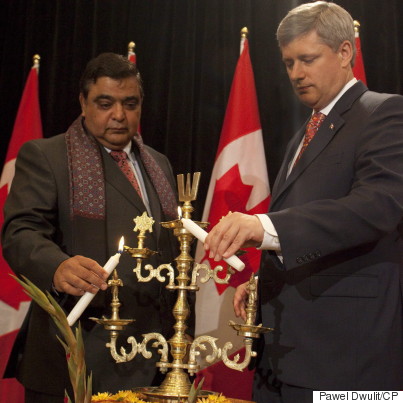
Deepak Obhrai and former prime minister Stephen Harper celebrate Diwali by lighting a candle on Parliament Hill on Oct. 8, 2009. (Photo: Pawel Dwulit/Canadian Press)

“Since we lost power in 2015, I have become very concerned about the direction my party has taken,” he told HuffPost over the phone on Thursday.

“These actions, in my view, have disenfranchised a vast majority of Canadians. Newcomers, immigrants, low-income Canadians, and those economically challenged will be turned off and walk away because they can’t afford these high fees…

“What is concerning me is that, unfortunately, [the Conservatives] will be seen as an elitist and white-only party,” he said.

Ethnic communities’ outreach

Since his election in 1997, Obhrai said he’s been working his “butt off” to bring immigrants to the party, a job that was subsequently taken on with great fanfare by former cabinet minister Jason Kenney. Success in connecting with ethnic communities culminated in the Tories’ majority election win in 2011, Obhrai said.

But that work has been dropped as a priority for the Conservatives under the leadership of party president John Walsh, Obhrai said. He added that the party has lost touch with grassroots members and pointed out that the caucus was not consulted.

“This party has become a party that is seen [to be only] for like rich people, I ask why? Why only for those who can afford it? Why the rich?

“For a family of four, it’s like asking them to give $100, and then also asking them to give through a credit card, which many don’t have. I have had these problems and my EDA [electoral district association] passed a motion telling the national council that we are unhappy with these rules,” the Calgary MP told HuffPost.

Source: Conservative MP Deepak Obhrai: New Rules Turning Tories Into ‘Elitist And White-Only’ Club

L’anglais mieux que le français pour les immigrants

More on language and immigration in Quebec.

No surprise that in Montreal, where most settle, only speaking French is a disadvantage. But the difference is significant, and overall, Quebec immigrant economic integration is the weakest of the larger provinces:

Les nouveaux arrivants qui ne parlent que le français éprouvent plus de difficulté à se dénicher un emploi au Québec que ceux qui ne connaissent que l’anglais. Le taux de chômage de ces immigrants francophones est de 40 % supérieur à celui de ces nouveaux arrivants anglophones.

C’est ce qui ressort de la compilation, obtenue par Le Devoir, que le ministère de l’Immigration, de la Diversité et de l’Inclusion (MIDI) a faite à partir de l’Enquête nationale auprès des ménages de Statistique Canada de 2011 et de 2006.
Ainsi, le taux de chômage des immigrants récents — ceux qui sont arrivés depuis cinq ans ou moins — qui ne parlent que l’anglais atteint 16 %, alors qu’il se gonfle à 23 % chez les mêmes immigrants récents qui ne parlent que le français, pour une différence d’un peu plus de 40 %.

Dans les premières années suivant leur arrivée, les unilingues francophones (comme leur langue maternelle n’est pas le français pour la plupart, ils sont en fait bilingues) sont affligés du même taux de chômage que les immigrants allophones qui ne connaissent ni le français ni l’anglais. En revanche, ces nouveaux arrivants allophones, souvent des femmes, participent peu au marché du travail.
De leur côté, les immigrants récents anglophones qui ne connaissent pas le français font aussi bien sur le marché du travail que les nouveaux arrivants qui connaissent les deux langues officielles du Canada.

Dans la région de Montréal, ces immigrants anglophones peuvent compter sur des entreprises prêtes à les accueillir. Vingt-huit pour cent des immigrants travaillent le plus souvent en anglais, note l’économiste Brahim Boudarbat, de l’Université de Montréal, un des auteurs avec Gilles Grenier, de l’Université d’Ottawa, du volumineux rapport remis au MIDI en novembre 2014 et intitulé L’impact de l’immigration sur la dynamique économique du Québec.

« Les immigrants qui ne parlent que le français n’ont accès qu’à 40 % des emplois » au Québec, relève Brahim Boudarbat.

Bilinguisme exigé

Une des raisons qui expliquent les difficultés dans le marché du travail des nouveaux arrivants francophones, c’est l’exigence généralisée du bilinguisme, surtout dans la région de Montréal. « C’est clair que c’est un problème », a signalé Michèle Vatz-Laaroussi, professeure en travail social à l’Université de Sherbrooke. « Les immigrants francophones qui arrivent n’ont pas cette qualification-là. » Les organismes en immigration réclament depuis longtemps des cours gratuits pour ces francophones, mentionne-t-elle.

Les employeurs ont souvent « la mauvaise habitude » d’exiger le bilinguisme « par automatisme », souligne Anait Aleksanian, directrice générale du Centre d’appui aux communautés immigrantes de Bordeaux-Cartierville (CACI). Il faut souvent « négocier » avec les employeurs afin qu’ils acceptent d’embaucher un immigrant qui ne parle pas anglais quand la connaissance de cette langue n’est pas nécessaire, relate-t-elle. L’organisme donne 43 classes de français par session et cinq classes d’anglais, toutes à temps partiel. Les cours de français sont gratuits, mais il y a des frais d’environ 100 $ par session pour les cours d’anglais.

Georgina Kokoun, coordonnatrice du Regroupement des organismes en francisation du Québec (ROFQ), constate que la plupart des offres d’emplois dans la région de Montréal mentionnent l’exigence du bilinguisme. « On voit rarement des postes où on demande juste le français. Il faut être bilingue. »

« J’ai une amie du Sénégal qui m’a dit : “L’immigration au Québec, c’est du dol, c’est comme une arnaque. On te dit que tu peux travailler au Québec en français comme tu le fais dans ton pays.” »

Discrimination

La discrimination est un autre facteur qui explique la situation. Dans une correspondance avec Le Devoir, le MIDI le reconnaît d’emblée.

Les immigrants francophones qui ne parlent pas anglais proviennent essentiellement du Maghreb ou de l’Afrique noire. « Ce sont des minorités visibles et on fait le lien entre Maghreb et musulmans, fait observer Michèle Vatz-Laaroussi. Il y a plusieurs études qui le démontrent : il y a vraiment un phénomène de discrimination [à l’endroit] de ces populations dans l’emploi. »

Source: L’anglais mieux que le français pour les immigrants | Le Devoir