Express entry, foreign worker reforms attract ‘fewer’ skilled workers: chamber report

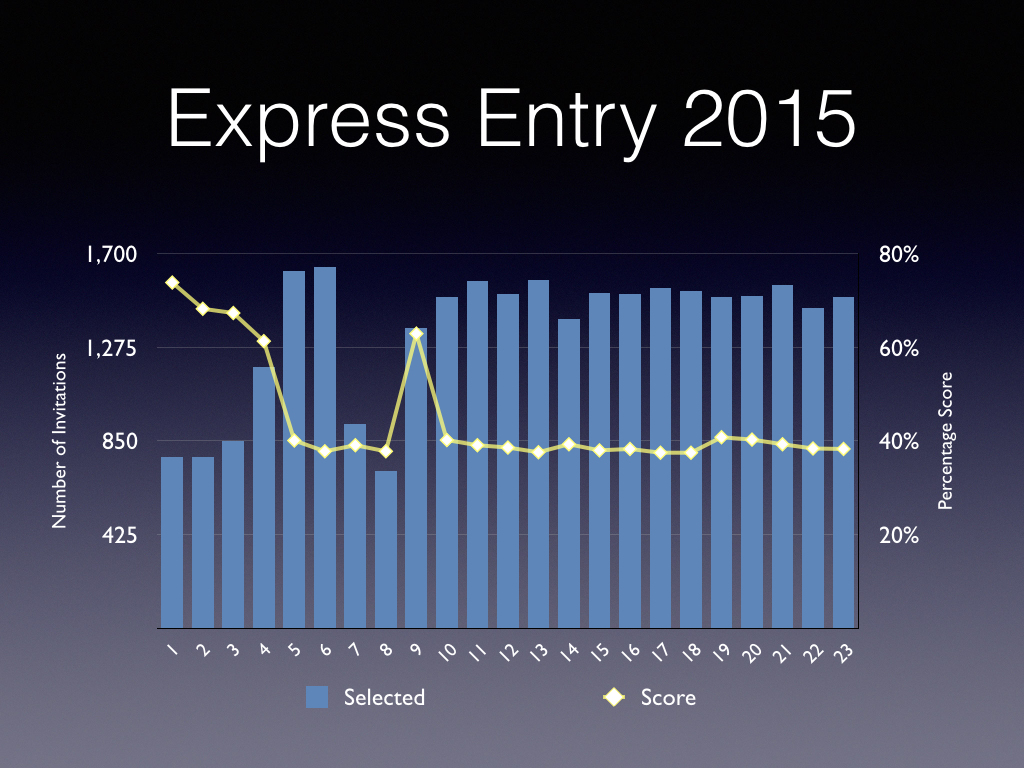
Express Entry Draws 2015.001Another item on Minister McCallum’s to do (or at least consider) list, passage below on Express Entry (the above chart shows the 23 rounds in 2015, and how the program has settled at around 1,500 invitations per draw, with a minimum score of about 40 percent of the total possible 1,200 points):

“The concept of attracting ‘the best and the brightest’ is missing in action,” says the new report, “as the competitive model of Express Entry is currently undermined by the protectionist policy embodied in the labour market impact assessment tool.”

As CBC reported in September, businesses say the labour market impact assessment (LMIA) — a new requirement borrowed from the newly reformed Temporary Foreign Worker Program — is the biggest flaw with Express Entry.

Under Canada’s new immigration system, highly-skilled foreign workers not only have to line up a job before applying to come to Canada but their job offer has to be backed by what the government calls a positive LMIA. That assessment is a document all employers now need to hire a foreign worker over a Canadian one.

The chamber calls the introduction of this new requirement a “misstep” that has made it “extremely challenging” for businesses to attract highly-skilled workers such as video game developers, top-flight researchers and workers in the trades.

Chamber calls for ‘sober, thoughtful review’

The 32-page report titled “Immigration for a Competitive Canada: Why Highly Skilled International Talent Is at Risk” lays out what Canadian businesses see as “missteps” with the immigration changes and offers 20 recommendations.

The recommendations include:

  • Removing the new requirement of a labour market impact assessment from the Express Entry system.

  • Tweak the points system under Express Entry to benefit high skilled workers applying under the International Mobility Program.

  • Reduce processing times for study permits and visas.

Source: Express entry, foreign worker reforms attract ‘fewer’ skilled workers: chamber report – Politics – CBC News

Halifax man helped thousands pretend they were in Canada to get around citizenship rules

Good detailed account of citizenship application fraud and how it worked (in the overall context, CIC data suggests that the percentage is low – see “Protecting Canadian Citizenship” – Citizenship Fraud Update – Numbers Still Small). Sentence appears small in relation to the scale of the fraud committed:

If anyone dialed the Halifax phone number Mohd Morelley wrote in his application for citizenship as proof he was integrating in Canada, it would ring out in an office on the outskirts of Halifax. Someone might answer, but it wouldn’t be Morelley or his wife or three children, who all wanted to be Canadians.

They were all living in Kuwait.

Along with the bogus phone number, Morelley and his family bought a full-service bogus citizenship package from an immigration consultant, including a Halifax address for a home he never lived in, tax returns and employment records for a job he never held, payment of utility bills he never used, ATM withdrawals to show local transactions he didn’t make and a letter from a local Islamic society saying he was deeply involved in the activities at a mosque he didn’t attend.

Morelley’s phantom phone — and fake life — were far from unique: more than 140 cell phones, labeled with the number and name of a client, were organized in the Bedford Highway office of the Canadian Commercial Group, run by immigration consultant Hassan Al-Awaid.

At least 1,244 clients were listed in Al-Awaid’s files, most accompanied by family members.

And he is but one of several crooked consultants caught recently peddling easy ways around the residency (and other) requirements for foreigners to gain Canadian citizenship.

Here is how they did it.

Hassan Al-Awaid, 62, an Iraqi national, worked in public relations and marketing for a government-owned petrochemical company in Kuwait before immigrating to Canada in 1992 and settling in Nova Scotia, where he and his wife had three children, including twin girls.

He might have once been a legitimate immigration consultant when he started, at least as far back as 1997. He was a member of the Canadian Society of Immigration Consultants until he was suspended in 2006. And he didn’t join the Immigration Consultants of Canada Regulatory Council, Canada’s current regulatory body, making him another “ghost consultant,” working in the shadows.

Increasingly, Al-Awaid shifted to black market services and relied on referrals from clients, since his specialization was hard to advertise.

“My office is one of the famous offices in Nova Scotia and my services differ from any other office, especially after arrival, and everyone know that,” he boasted in an email to a client.

…Al-Awaid’s furtive and sometimes frantic business began to unravel in 2007, when Shawna Woodin, an intelligence officer with the Canada Border Services Agency in Halifax, noticed two different signatures for the same person in a citizenship application.

The CBSA and the RCMP started a lengthy investigation. Several of his clients confessed to investigators of the duplicity. Searches in 2010 at Al-Awaid’s office, home and car revealed his meticulous record keeping.

Police found more than 140 labelled cell phones and a stack of ATM cards with their PINs among the 20 filing cabinets of records seized, including reams of emails with clients and detailed records.

He was arrested in 2011

Al-Awaid eventually pleaded guilty to eight offences under the Immigration and Refugee Protection Act and ten under the Citizenship Act, for cases stretching from 2002 to 2011.

At his sentencing this summer, court heard he was being treated for hypertension, hypothyroidism, elevated cholesterol, gout and diabetes.

“I am simply not satisfied that the Correctional Service of Canada can safely and effectively monitor and treat Mr. Al-Awaid’s very significant health issues,” provincial court of Nova Scotia judge Anne Derrick said.

That allowed him to avoid jail, instead getting a conditional sentence of two years less a day, a $4,000 fine and 240 hours of community service.

Prosecutors lamented the growing presence of citizenship fraud.

“That these ‘address of convenience’ cases went from virtually unheard of a short number of years ago to making regular appearances in news reports across Canada is indicative that the scheme has served to foster an overseas industry that thrives on immigration fraud,” prosecutors Timothy McLaughlin and Ronda Vanderhoek told court.

For the charges against Al-Awaid, police focused on 53 clients who used eight Halifax addresses to falsify residency. Of those 53, seven provided states to police; nine of the applicants had already obtained their citizenship, 19 withdrew from the process, while the rest were still in the application process at the time his case went to court.
Source: Halifax man helped thousands pretend they were in Canada to get around citizenship rules

Anti-Semitism review: The flaw at the heart of Frederic Raphael’s argument

Richard King on how Raphael’s conflating criticism of Israel with antisemitism undermines his account of the history of antisemitism:

Rejecting the argument that anti-Semitism owes as much to the Enlightenment as it does to Christianity, Raphael suggests that the Jews’ original crime was the historically unique one of deicide, which is to say the murder of God Himself. It is this that led to their reputation for treachery and furnished the world with a reliable scapegoat for everything from epidemics to economic catastrophe.

From the death of Jesus to the Black Death, it is on the heads of the Jews that blame falls – a trend that reaches its apogee with the “stab in the back” myth of post-First World War Germany and the “last crusade” of Nazism (a subject so large, as Raphael notes, that its history has a history of its own).

All of this is perfectly sound. But Raphael runs into serious problems when he tries to expand the phenomenon of Jew-blaming to include criticism of modern Israel. For while it is undoubtedly true that the miasma of anti-Semitism surrounds much dark talk about the Israel “lobby”, and true too that many liberals and left-wingers are apt to downplay the anti-Semitism extant within the Muslim community for fear that they will sanction anti-Muslim prejudice, it is not true to say that Israel is “the sole licensed target for unguarded malice” in the West.

Disproportionate our emphasis on Israel may be, but this imbalance stems as much from a desire to highlight Western hypocrisy as it does from any loathing of “the Judas state”. As for Raphael’s suggestion that the images of Palestinian children injured or killed in the Gaza war were a modern version of the “blood libel” according to which Jews used the blood of Christian children to make the matzo bread eaten at Passover – such a thought is unworthy of an intelligent author.

Though Raphael is right to say that anti-Semitism and “anti-Zionism” cannot always be neatly separated and that criticism of modern Israel is not without its sinister elements, his determination to make these things identical is profoundly wrong-headed. Intended or not, its effect is to make Prime Minister Benjamin Netanyahu’s crimes against the Palestinians into the expression of Jewish identity. Many are the Jews (not all of them “self-hating”) who would regard that proposition as evil.

Source: Anti-Semitism review: The flaw at the heart of Frederic Raphael’s argument

ICYMI: Michael Smolander: Canadian literature is intimately linked to multiculturalism | Ottawa Citizen

On how multiculturalism is reflected in, and reflects multiculturalism, and some of the limitations and mixed nature of Canadian literature and the multiculturalism narrative:

It is unsurprising that Canada’s literature reflects the practical challenges of multiculturalism. Queen’s University professor Will Kymlicka says that although multicultural policies are difficult to implement and maintain, they are necessary to sustain a well-functioning democracy.

Kymlicka argues that multicultural policies can take many forms such as re-tooling education curriculums “to include the history and culture of minority groups” and even “teaching police officers, social workers and health-care professionals to be sensitive to cultural differences in their work.”

In this way, novels expressing dissatisfaction with the level of inclusion immigrant groups experience are an important measure of democratic vitality and can act as a guide for policy reformers.

Frances Brooke, the English essayist, correctly described Canadian literature as “bilingual, multicultural, multiracial, multiethnic, postcolonial, postmodern and even multinational.” The many examples of novels by Canadian writers detailing their experiences with immigration and cultural difference give weight to Brooke’s definition.

Indeed, Canada’s literary identity crisis can be relaxed given the persistence of the uniquely Canadian theme that highlights the challenges associated with the multicultural mission.

While works by Choy and Ondaatje reflect a less-than-rosy history of immigration in Canada prior to the widespread legal guarantees of free cultural expression, Hage has since advanced the idea that inclusion into Canadian society remains an elusive challenge for many immigrants.

To forge a more inclusive and democratic order, it is crucial that Canadian literary works exposing the shortcomings of the multicultural project be understood and addressed.

Source: Michael Smolander: Canadian literature is intimately linked to multiculturalism | Ottawa Citizen

ICYMI: I Asked A Computer To Be My Life Coach – Going Beyond Word Clouds

IBM Tone_AnalyzerThis is an interesting application of big data.

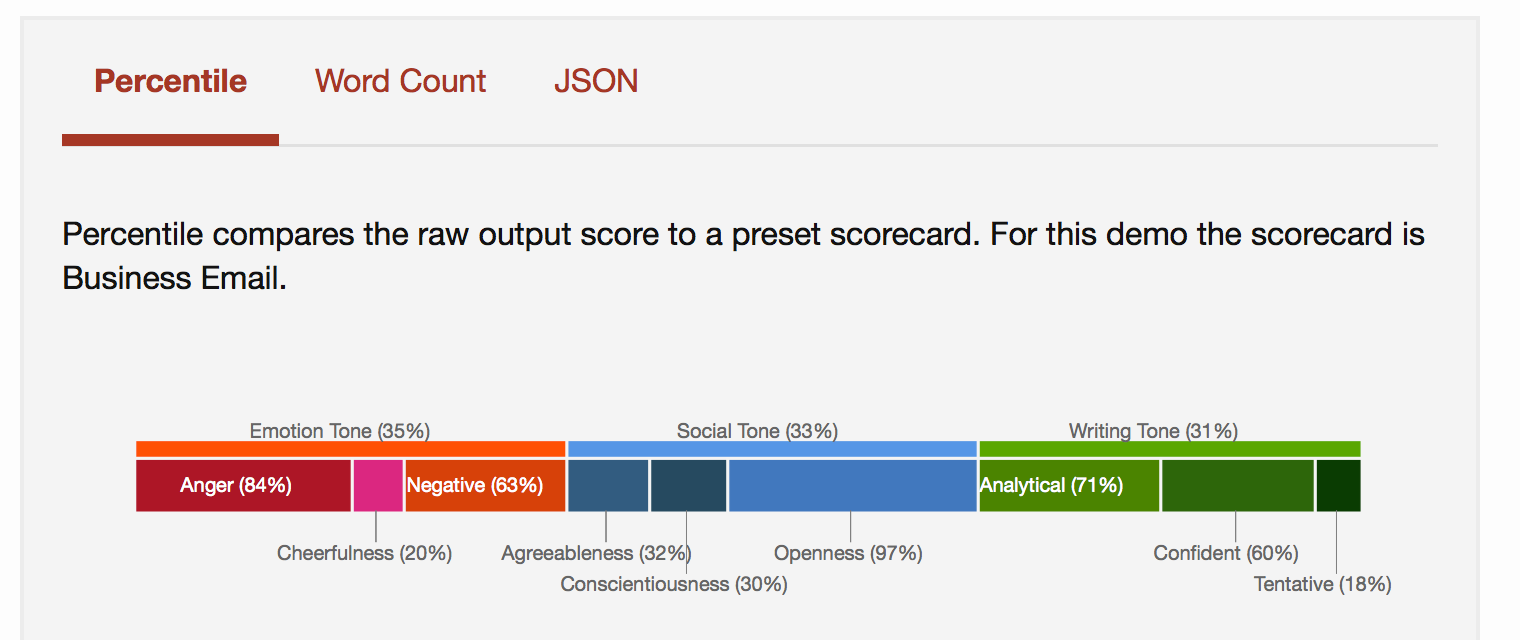
For fun, I tried the demo, which is based upon a business email model, on my post, Implementing diversity and inclusion in Parliament: A more complete picture | My piece in the hilltimes.com.

The above analysis was the result. Readers may wish to experiment with their own texts:

The words you use betray who you are.

Linguists and psychologists have long been studying this phenomenon. A few decades ago they had a hunch that the number of active verbs in your sentences or which adjectives you use (lovely, sweet, angry) reflect personality traits.

They have painstakingly pinpointed various insights. For example, suicidal poets, in their published works, use more first-person singular words (like “me” or “my”) and death-related words than poets who aren’t suicidal. People in positions of power are more likely to make statements that involve others (“we,” “us”), while lower-status people often use language that’s more self-focused and ask more questions. Comparing genders, women tend to use more words related to psychological and social processes, while men referred more to impersonal topics and objects’ properties.

(This 2010 paper in the Journal of Language and Social Psychology goes into great detail about the “psychometrics” of words.)

This research suggests that Internet companies such as Facebook and Google, with their troves of written expressions, are sitting on powerful insights about us as people. But if you ask them, “Hey, can you give me the take on me that you’ve got in-house or that you’ve built for advertisers, with my anonymized data?” — they won’t give it to you. I actually did ask, and they don’t have that kind of offering.

But I’ve found someone who does: IBM’s Watson division. Researchers there have taken the personality dictionaries already created by scientists, dropped them into Watson (the computer that won Jeopardy!), and sent it off to apply it to people on Twitter, Facebook, blogs. That forms a digital population of people and personality types. Over time, more text from more people will help Watson get smarter. (Yes, this is machine learning.)

In its own studies, IBM found that characteristics derived from people’s writings can reliably predict some of their real-world behaviors. For instance, people who are less neurotic and more open to experiences are more likely to click on an ad, while people who score high on self-enhancement (meaning, seek personal success) like to read articles about work.

For IBM, these kinds of interpretations can become a business opportunity.

Understanding people to sell them things is obviously a very big business for marketers. IBM senior researcher Rama Akkiraju suggests other uses: by public relations firms looking for journalists who sound friendly on a specific topic; by editors who want their writers to set a certain tone; by employers looking for a worker who fits their corporate culture.

“We’re moving to make it easier for people to consume insights,” she says.

This use of Big Data, of course, raises serious privacy concerns, which we have examined in many stories. In this exploration, I decided to take a deep dive into Watson’s personal insights — what they can teach me about my career choices and my love life (yep, really went there).

Source: I Asked A Computer To Be My Life Coach : All Tech Considered : NPR

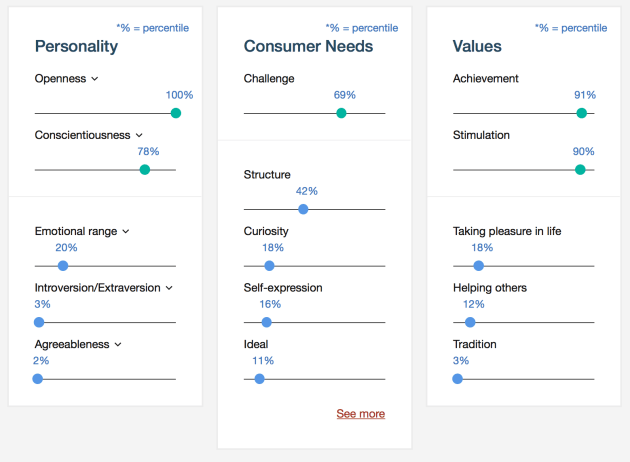
And the Personality Insights tool with respect to the Executive Summary of my book, Multiculturalism in Canada: Evidence and Anecdote:

Personality_Insights_Summary

Personality_Insights_-_Details

Mainstreaming Multiculturalism: Implementing Diversity and Inclusion Deck

For those interested, a slightly modified version of the deck I presented to the Centre on Public Management and Policy, University of Ottawa to mid-level government executives, highlighting the key findings of my book, Multiculturalism in Canada: Evidence and Anecdote, the history and evolution of multiculturalism, and the implications and opportunities of the Government’s diversity and inclusion agenda:
Mainstreaming Multiculturalism – Implementing Diversity and Inclusion

Advise to the Liberal government on security oversight and countering violent extremism: Gurski

Phil Gurski’s advice to the Liberal government on oversight and countering violent extremism:

a) whatever model is chosen it has to be a made in Canada one.  I see that the Minister of Public Safety, Ralph Goodale, is visiting some of our Allies to see how they do things.  This is a good start, but in the end we have to come up with our own solution. We can certainly learn, both the good and the bad, from what others have done.  Yet we have this Canadian tendency to defer to others (“let’s just do what the US is doing!”).  I saw it so many times when I worked for the federal government.  Maybe it’s good ol’ Canadian deference, I don’t know.  But it has to stop.  We have good people and good ideas too.

b) we need to build on what we already have started.  Especially on the CVE front, Public Safety Canada – specifically the Citizen Engagement section – had a wonderfully successful outreach programme in place that was paying off huge dividends before some – ahem, unfortunate – government-led incidents brought it to a standstill.  I know that there are community leaders across Canada who want to restart this.  Not only was it successful here but other countries had expressed interest in learning from ushow to do CVE.  Let us use this as our new jumping off point.

c) we need to inform Canadians.  Yes there are aspects to security intelligence that cannot be disclosed, but regular messaging from the government, and preferably from the heads of CSIS and the RCMP, will serve to keep Canadians in the loop on the nature of the threat we face and avoid the vacuum that currently exists and which is filled by those with little insight or knowledge of what is happening.

d) we need to hear from Canadians at all levels: federal, provincial, territorial, first nations, municipal and average Joes and Jills.  There are some amazing efforts currently in force at the city police level with respect to early intervention – Calgary Police’s Redirect programme and Toronto Police’s Focus Rexdale are but two examples – that are working and should be picked up on.  The solutions we need often begin locally so we need to bring in local, knowledgeable partners.  Let us also ask Canadians what they think.  Perhaps another public Parliamentary set of hearings is warranted.

There.  That’s my two-cents’ worth.  Have at ‘er.  At the end of the day we can do this and do this well.  We already have world class security intelligence and law enforcement agencies. Let’s match that when we create oversight and CVE capability.

Source: Borealis Threat & Risk Consulting

Montreal Program Works To Prevent Violent Radicalization | Vermont Public Radio

Profile on the approach of the Montreal The Center for Prevention of Radicalization Leading to Violence:

The center runs a 24-hour hotline, and all calls are confidential. Social workers, psychotherapists and even a psychiatrist are available to go into the field and meet with people if “we need to go further,” Rebbani-Gosselin says, and the center offers free, unlimited follow-up counseling sessions.

“We only intervene when the person is engaged in a radical thinking process and they see violence as a way to reach their means. And what we do is to try to disengage a person from violence,” she says.

Since the hotline was launched in March of 2015, the center has received nearly 570 calls, according to Rebbani-Gosselin, and followed up on about 115.

“When we get a call about a specific individual, if through our evaluation [we] really believe that there is indeed a risk, then we automatically meet with the with the individual,” Rebbani-Gosselin says. “But … we don’t contact the individual directly.”

That’s because the goal is always to avoid confrontation, Rebbani-Gosselin says.

“Confrontation does not work. You really have to take different means to reach out to that individual to make sure that she or he is in position to listen to what you have to say.”

“Confrontation does not work. You really have to take different means to reach out to that individual to make sure that she or he is in position to listen to what you have to say,” she says. Sometimes meetings are arranged through parents, or schools, or a coach or friend of the person in question.

The center also doesn’t use the phrase “de-radicalization.”

“Because that’s not what we feel that we do,” says Rebbani-Gosselin. “Individuals are entitled to their ides, obviously, and being radical is a positive thing … Throughout history, we had radical thinkers. You know, the feminist movement, Martin Luther King or Gandhi, and these are important. You know, it’s important in democratic society that people are entitled to their ideas. So we don’t do de-radicalization. What we do is disengagement from violence.”

Sometimes, though, circumstances that appear to be immediately dangerous do warrant contacting the police and other agencies.

“We operate like a suicide hotline,” Rebbani-Gosselin says. “When you call a suicide hotline, if the person on the other end feels like you are going to commit suicide in a very imminent, very short period of time, then they will call 911. And in that sense we operate the same way. If we feel like there’s an imminent threat, then we definitely will transfer.”

Source: Montreal Program Works To Prevent Violent Radicalization | Vermont Public Radio

On the Saudis and human rights, Canada needs to stop contradicting itself: Mendes

Errol Mendes’ suggestion to broaden the mandate of the Ambassador for Religious Freedom to Ambassador of Human Rights:

The Harper government earned itself a lot of criticism for creating its Office of Religious Freedom, a quasi-diplomatic operation which is supposed to promote the cause of faith rights around the world. This office, run by Christian scholar and public servant Andrew Bennett with a budget of $5 million, has a narrow mandate — and while Mr. Bennett has met with many diplomats, officials and groups from many religions in Canada and around the world, he hasn’t really achieved much.

Many want his office abolished. I have a better idea: replace it. Establish one with a wider mandate — an Office of the Ambassador for Human Rights. This office could go beyond merely shining a light on the persecution of religious minorities abroad by taking on a mandate to keep the Government of Canada itself honest. It could engage with the relevant government departments, conduct proactive analysis of Canadian interests abroad and seek ways to reconcile our vital diplomatic and economic interests with our principles.

While there are officials in Global Affairs whose job it is to focus on human rights matters as they affect our economic and diplomatic interests, an ambassador’s office could go outside the hierarchy and directly challenge individual ministerial decisions that could undermine Canada’s reputation. It could help establish a whole-of-government policy framework on human rights, and engage in outreach with civil society groups advocating a principled approach to trade and human rights. That could be useful to public servants too overburdened by management and accountability duties to see the bigger picture.

A human rights ambassador could be Canada’s eyes and ears abroad, monitoring — for example — how these Canadian-made armoured vehicles are being used in Saudi Arabia, and whether they’re being used against civilians. It could help the government frame its response to any evidence the Saudis were using these weapons against civilians.

Had such an office been in place when the previous government was negotiating the Saudi deal, it might have lobbied against it — or not; we’ll never know. But setting it up now would go a long way to ensuring the federal government is more transparent and accountable with future arms export deals.

Our economic and diplomatic interests are vitally important to us as a nation. So is our international reputation. We shouldn’t have to sully one to support the other.

And Errol Mendes says it’s time for Ottawa

Germany’s Post-Cologne Hysteria – The New York Times

Good nuanced commentary by Anna Sauerbrey, an editor on the opinion page of the newspaper Der Tagesspiegel:

… precisely when the country needs a coolheaded conversation about the impact of Germany’s new refugee population, we’re playing musical chairs: Everybody runs for a seat to the left and to the right, afraid to remain in the middle, apparently undecided.

The irony is that the Cologne attacks, by highlighting the issue of refugees and their culture, raise an incredibly important question and at the same time make it almost impossible to have a reasonable conversation about it.

This isn’t the first wave of migrants to postwar Germany, and it’s not the first time that the left and the right have played their respective roles of under- and overestimating the challenges of integration.

The left has long ignored the established correlations between crime and the poverty and poor education that plague refugee communities; the right has long overestimated the link between the refugees’ culture and criminal activity, even when studies show no such link exists (excepting so-called crimes of honor, which are extremely rare).

The real question we should be asking is not whether there is something inherently wrong with the refugees, but whether Germany is doing an effective job of integrating them — and if not, whether something can be done to change that.

None of this, however, fits into a TV sound bite or a tweet. Even if it did, it would probably fail to reach its audience in the heated atmosphere of the moment.

Assumptions have replaced observation, assertion has replaced assessment, and ideology has replaced evidence. With its vision thus distorted, Germany is speeding toward a multicultural society, chased by the mob on the Internet, without any idea of what that society should look like.

We need to regain our sense of balance — or it’s just a question of time until we hit a wall.

Source: Germany’s Post-Cologne Hysteria – The New York Times

Much more nuanced than the Globe’s Margaret Wente:

Germany’s brutal immigrant awakening