Mohamed Fahmy Says Tory Law Made Him Fear Losing Canadian #Citizenship

Not surprising, given his circumstances and how C-24 was drafted:

As he languished in an Egyptian prison, Mohamed Fahmy feared he might lose his Canadian citizenship under a controversial and recently enacted law, the since-freed journalist said Monday.

While behind bars, Fahmy read the former Conservative government’s new law, which allows for the revocation of citizenship of someone convicted of terrorism, treason or espionage.

“It hit right home with me because it surfaced during my imprisonment, and I was a candidate,” Fahmy said in an interview Monday prior to a speaking engagement at Carleton University in Ottawa.

“I panicked and I asked the ambassador to bring me the literature – the bill – and I read it in prison. I was worried.”

Fahmy, 41, was freed in September after spending more than 400 days behind bars on terrorism charges in Egypt after a court case that was the subject of broad international criticism.

Fahmy also said he will soon present the Liberal government with a proposed charter of rights on how to deal with citizens imprisoned abroad. He’s working on it with Amnesty International and his lawyers.

The new charter stresses something that didn’t happen in his case – direct leader-to-leader intervention to put pressure on a foreign government to force a Canadian prisoner’s release.

Source: Mohamed Fahmy Says Tory Law Made Him Fear Losing Canadian Citizenship

Celebrating Sikh soldiers on Remembrance Day

Poppy

Timing is perfect with Canada’s first Sikh Defence Minister:

When Pardeep Singh Nagra was a kid in Mississauga, he didn’t see Sikh soldiers in his history textbooks.

Now, the 45-year-old is standing in a room where you can read about the first Sikh soldier to win a Victoria Cross (Captain Ishar Singh, 1921), look at propaganda posters extolling the virtues of the mighty Sikh whiskers, and admire row upon row of toy soldiers in turbans.

Nagra is the director of the Sikh Heritage Museum of Canada, and he was still up at 4:30 a.m. Sunday morning, putting the finishing touches on the museum’s “Outwhiskered” exhibit for Remembrance Day. The exhibit covers the 1800s to present, with a major focus on the two world wars, highlighting a history that is often forgotten.

“Let me tell you, I’m going to be all over the place, so don’t mind me,” Nagra says before launching into a whirlwind tour of several centuries of history.

“There is an Indian man in Flanders, but we’ve never been raised or nurtured here, even in our education systems, with this type of stuff,” he says, pausing by a photo of an Indian soldier in Ypres.

Pardeep Singh Nagra, the museum’s Executive Director, poses in front of a 1944 edition of the Picture Post, a British photojournalism magazine.

LUCAS OLENIUK/TORONTO STAR/ TORONTO STAR

Pardeep Singh Nagra, the museum’s Executive Director, poses in front of a 1944 edition of the Picture Post, a British photojournalism magazine.

In Canada, 10 Sikh soldiers enlisted for the First World War. None enlisted in the Second World War, fed up with a country that hadn’t given them the right to vote, he said. (That would come in 1947.)

More than 65,000 Sikh soldiers fought in the First World War as part of the British Army and over 300,000 Sikhs fought with the Allies in the Second World War. Their reputation as fierce military men was a staple of Allied propaganda and even Kellogg’s cereal box inserts.

“They wear beards and a long moustache. And all of them wrap their heads in turbans. The Sikhs ride and shoot well. A great many are in the Imperial forces,” reads the back of one Sikh trading card, possibly from the 1940s or 1950s.

At the entrance to the museum, images of Canada’s newest Defence Minister Harjit Sajjan line the walls, drawn recently by students at Khalsa Community School in Brampton. One student has given Sajjan the acrostic poem treatment — H for “Helpful to Sikh community,” A for “Amazing progression in politics and military,” and on from there.

Source: Celebrating Sikh soldiers on Remembrance Day | Toronto Star

Multiculturalism in Canada: Evidence and Anecdote – Lulu 30 % Flash Sale Extended to Nov 12

For those interested in the print version of Multiculturalism in Canada: Evidence and Anecdote or Policy Arrogance or Innocent Bias: Resetting Citizenship and Multiculturalism (topical again given the account of the transfer to CIC from Canadian Heritage in 2008, now reversed).

One of Lulu’s better sales, 30 percent off, extended for two days.

The direct link to my book page is: My Author Spotlight.

Lulu 11 Nov

Conservative refugee health care cuts were ‘economically foolish,’ John McCallum says

New IRC Minister McCallum’s priorities (while he did not discuss citizenship in this article, he has mentioned dropping revocation for dual nationals in other interviews):

The new Liberal government has committed to reverse the cuts. McCallum said that while that change won’t happen overnight, it’s high on the government’s priority list when Parliament resumes on Dec. 3.

“I don’t know if it will be on the parliamentary agenda before Christmas, but what I can tell you is that certain things will happen quickly — in a few months, if not a few weeks. And one of those is refugee health care.”

Also high on McCallum’s priority list is the Liberal plan to speed up processing times for family reunification, as a part of a renewed approach to immigration.

“Probably the biggest commitment in our platform in the medium term … is to bring down those processing times for families,” said McCallum. “We’ve promised to have a new attitude where we welcome newcomers with a smile and not with a scowl.”

In the short-term, McCallum said the most pressing issue for his department is the Liberal commitment to resettle 25,000 Syrian refugees in Canada by year’s end.

He said the government is still working toward that target, but is also determined to do proper security and health checks along the way. He said the public service is working “around the clock,” looking at every option to get Syrian refugees to Canada.

Source: Conservative refugee health care cuts were ‘economically foolish,’ John McCallum says | CTV News

La laïcité à la française se cherche: Abdennour Bidar

Reflections on the French model of laïcité, of importance given its reflection is some Quebec discourse:

Beaucoup de Québécois vouent un culte quasi religieux à la laïcité à la française. Allons-y voir. Comment se porte-t-elle ? « Mal », répond Abdennour Bidar, lui-même pur produit de la république laïque, docteur en philosophie, enseignant (2004-2012), membre de l’Observatoire de la laïcité et chargé de mission pour la « pédagogie de la laïcité » à la direction de l’enseignement scolaire du ministère de l’Éducation nationale.

Mais encore ? « La laïcité en France se porte mal au sens où on ne trouve pas un consensus national sur la façon d’appliquer son principe, de telle sorte qu’il nous serve dans une société multiculturelle, qu’il prouve son efficacité à nous faire vivre ensemble, à la fois avec et au-delà de nos différences, autour d’un certain nombre de valeurs partagées. Il n’y a pas du tout consensus autour de cette question qui nous divise sans arrêt. »

M. Bidar était à Montréal la semaine dernière à l’invitation de l’organisme Pour les droits des femmes du Québec. Il a donné des conférences et participé à des débats dans le cadre du Festival du monde arabe, notamment sur le thème du blasphème, de la censure et de l’autocensure.

« Notre modèle est en crise, poursuit-il. On tient toujours au principe qui permet, selon la formule, à ceux qui croient au ciel et ceux qui n’y croient pas de vivre ensemble avec les mêmes droits et devoirs. Seulement, on n’arrive pas à l’appliquer et ça tire de tous les côtés. »

Pour lui, deux extrêmes « phagocytent » le champ du débat public. Il y a d’un côté les tenants d’une laïcité extrêmement dure qui voudraient chasser toute expression du religieux hors des espaces publics. De l’autre côté, il y a un certain nombre de mouvements religieux qui voudraient faire de la laïcité un principe de neutralité laissant s’exprimer dans l’espace public à peu près n’importe quelles revendications religieuses.

Résultat : la laïcité qu’il dit « équilibrée » se retrouve coincée entre les deux extrêmes. Cette option « ferait justice à l’unité et la multiplicité », selon la formule du philosophe. L’équilibre idéalisé reconnaîtrait le droit à la différence et se soucierait en même temps de fabriquer du commun.

N’est-ce pas l’option multi ou interculturaliste développée ici, au Canada et au Québec ? « C’est vraiment la recherche de l’équilibre qui m’importe, répond le Français. Je ne sais pas si ici vous y arrivez. Mais je peux dire qu’en France on n’y arrive pas du tout. Ce n’est pas seulement une question d’organisation spatiale, de ghettos ou pas. Est-ce qu’on vit vraiment les uns avec les autres ? Après Charlie [Hebdo], on s’est rendu compte qu’on n’arrivait plus à fabriquer du commun. »

Source: La laïcité à la française se cherche | Le Devoir

Doing Countering Violent Extremism (CVE) right: Gurski

Phil Gurski’s sensible advice:

Which brings me back to the new government and its CVE plans (see article here).  For what it is worth, here are my suggestions, based on 32 years as an intelligence analyst and 18 months as an outreach advisor/participant”

  1. Keep the government role low-key.  “I’m from the government and I’m here to help” does not work on this file.

  2. Leverage community leaders.  They know their communities best

  3. Use Muslim youth. They have a wealth of energy and good ideas

  4. Make sure CVE covers the entire ideological spectrum, even if the single greatest national security threat today is from violent Islamists

  5. I know this one is nigh impossible but here it is anyway: do whatever you to ensure that senior public officials do not say anything really stupid (like equating wearing the hijab with terrorism – yes it was done!).

Source: Borealis Threat & Risk Consulting

Australian Race Discrimination Commissioner Tim Soutphommasane labels Hizb ut-Tahrir views ‘absurd’

A reminder that non-violent extremism can be equally dangerous to a country’s social fabric:

Australia’s race discrimination commissioner has slammed a controversial Islamic group over its claims “de-radicalisation” amounts to forced assimilation.

Hizb ut-Tahrir held a large conference at Bankstown in south-western Sydney on Sunday and told the more than 500 men, women and children who attended that Muslims were being demonised over their faith.

“Deradicalisation has come to mean making Muslims less Islamic, more Western, more secular, more submissive to secular, Liberal political … norms,” Hizb ut-Tahrir spokesman Uthman Badar said.

“It is nothing more than an agenda of forced assimilation justified by exaggerated fears of a security threat.”

But Race Discrimination Commissioner Tim Soutphommasane said this was “absurd”.

“Hizb ut-Tahrir’s views on citizenship are a rejection of our liberal democratic values and a denial of Australian multiculturalism,” he said.

“They further confirm this group’s extremist agenda.”

Dr Soutphommasane said that when migrants became citizens, they chose to become a part of the Australian community.

“There’s nothing oppressive about committing to our democracy, abiding by the law, and respecting the rights of others.

“Our multiculturalism means that everyone has a right to express their cultural heritage but also accepts the responsibilities of being an Australian citizen.”

Source: Race Discrimination Commissioner Tim Soutphommasane labels Hizb ut-Tahrir views ‘absurd’

UK Catholic schools to shun Islam in new GCSE courses 

Odd, given the common roots of Christianity, Judaism and Islam:

Catholic schools will no longer teach Islam as part of GCSE religious studies, but will be directed to teach Christianity and Judaism.

Changes to the new religious studies GCSE specification mean schools must teach two religions as part of the course, with each weighted equally in the exam.

The Bishops Conference has decreed that all Catholic secondary schools teach Judaism alongside Christianity at GCSE, regardless of whether teachers are trained to teach other religions, such as Islam.

The 2011 census shows that Judaism is the fifth most popular religion in England, with 0.5 per cent of the population saying that it is their faith. This compares with 5 per cent identifying themselves as Islamic.

A teacher at a Catholic secondary school, who wished to remain anonymous, told Schools Week the decision was made for purely “academic” reasons. “There is a real need for understanding of Islam, but . . . the argument coming from the dioceses is that we shouldn’t sway with the times.”

According to information on the Catholic Education Service (CES) website, the body overseeing all Catholic schools, 2,156 Catholic primary and secondary schools in England educate more than 800,000 pupils.

Approximately 30 per cent of children educated at the school are of no faith or other faiths.

The teacher continued: “The bishops say Judaism is an academic study of religion rather than a social study, however, we would argue that Islam is both.”

Source: Catholic schools to shun Islam in new GCSE courses | Schools Week

Multiculturalism in Canada: Evidence and Anecdote – Flash Sale 30 percent off

For those interested in the print version of Multiculturalism in Canada: Evidence and Anecdote or Policy Arrogance or Innocent Bias: Resetting Citizenship and Multiculturalism (topical again given the account of the transfer to CIC from Canadian Heritage in 2008, now reversed).

One of Lulu’s better sales, 30 percent off.

The direct link to my book page is: My Author Spotlight.

Lulu Flash Sale 10 Nov

Justin Trudeau joyfully mobbed by federal civil servants

PM Trudeau at the rebranded Global Affairs department. Unprofessional but understandable:

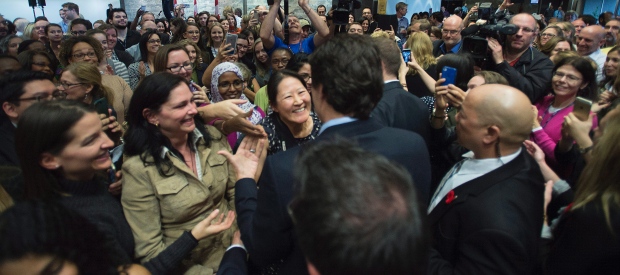
Suddenly there was a buzz and the crowd moved forward.

Trudeau appeared and began to make his way out of the building. He was swarmed. Many took photos and even selfies along the way.

Liberal Cabinet 20151106

Trudeau was mobbed as he tried to leave the Lester B. Pearson building Friday. He told the crowd his government would need the civil service’s absolute best. (Sean Kilpatrick/Canadian Press)

The prime minister was hugged. Cheers erupted. He smiled, waved and stopped by the door.

He thanked the crowd for supporting the members of his cabinet, who had just left.

Then he continued: “We’re going to need every single one of you to give us, as you always do, your absolute best.”

They applauded and cheered some more. Some yelled back: “You’ve got it.”

One longtime staffer nearby said he’d never seen anything like it. Not in all of his years.

And it might not be the only instance of a crowd forming to welcome a minister Friday.

On Facebook, a photo circulated of civil servants at another location waiting to greet Sajjan.

Source: Justin Trudeau joyfully mobbed by federal civil servants – Politics – CBC News

And Donald Savoie puts it into context:

Donald Savoie, a public administration expert at the University of Moncton, said public servants are gripped by “the euphoria” of working for a government that promises renewed respect.

He said many hope they are returning to their “days in the sun” when public servants worked on policy and were listened to. He likened it to when Pope John XXIII opened the Vatican and liberalized the Catholic Church.

As a result, bureaucrats’ heckling and cheering, and unions revelling in their political campaigns, may not be appropriate but isn’t unexpected.

“Don’t try to make sense of this. School’s out and people are beside themselves with joy,” Savoie said. “Stay tuned, it’s too fresh. Wait until things calm down in a few months.

“I wouldn’t get too worked up because what happened today doesn’t define the public service and its non-partisanship.”

Public servants shed cloak of impartiality – at least for the day