Immigrants in America More Likely Self-Employed, Study Finds | TIME

A marginal difference:

A new Pew Research Center study shows that 10 percent of Americans are self-employed, compared to 11 percent of immigrants.

… self-employed Americans and their employees accounted for 44 million jobs in 2014 or 30 percent of the national workforce.

Canadian data that I have seen shows a larger difference between Canadian-born and immigrants (Immigrants took the brunt of recession-year turn toward self-employment).

Source: Immigrants in America More Likely Self-Employed, Study Finds | TIME

My article: Visible minorities elected to Parliament close to parity, a remarkable achievement

My article in today’s Hill Times (note updated 25 Oct with the addition of one Conservative MP):

In contrast to the 2011 election, where 9.4 percent of all MPs were visible minorities, 2015 representation is aligned to the number of visible minority citizens (14 percent compared to 15 percent). Moreover, the success of the Liberal Party in decisively winning the visible minority vote  suggests that the Conservative Party’s extensive outreach to immigrant and visible minority communities had limited impact in stemming losses, and that concerns over the impact of changes to citizenship and immigration may have played a part.

Moreover, the percentage of visible minorities elected was identical to the percentage of visible minority candidates, which also had increased to 14 percent from 10 percent in the elections of 2004, 2006, 2008 and 2011 (see Visible Minority Candidates – 2015 Election – Background Note for details). The Liberal party had the most visible minority candidates (16 percent) with the Conservative party and the NDP had slight under-representation (13 percent)

For comparison, the number of women and Aboriginal MPs only slightly increased in 2015. Analysis by Equal Voice shows the number of elected rose from 25 percent in 2011 to 26 percent today (88 women). Representation of Aboriginal peoples also increased to 10 seats (3 percent) from 7.

To assess visible minority representation I have used candidate names, photos and biographies to identify visible minority candidates. Although not as exact as identifying women candidates (e.g., subjectivity in analyzing photos), it nevertheless provides a reasonably accurate indication of how well Canadian political party candidates represent the population of visible minorities who are also Canadian citizens (15 percent). I was not able to break this down by those who are first generation immigrants and those who were born in Canada (second generation).
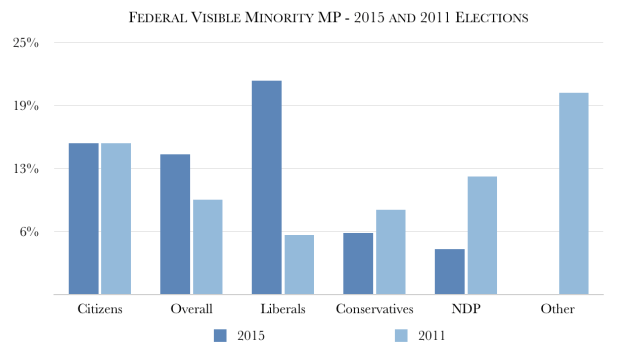
 

Federal Election 2015 and 2011 ComparisonThe chart above contrasts the 2015 visible minority representation with the 2011 election results. Not surprisingly, the Liberals, given their overall strong election result, will have the caucus with the largest number of visible minority MPs: 39 or 21.2 percent, significantly above the percentage of visible minority citizens (and Liberal candidates). Conversely, given their poor results, both the Conservatives and the NDP elected less than half of their visible minority candidates.

Federal Election 2015 VisMin Mps GenderLooking at 2015 results only, the chart above provides the comparative numbers for each party in the 47 ridings that elected visible minority MPs, minority, broken down by gender. As others have noted, given that the overall number of visible minority MPs is comparable to the number of visible minority candidates (14 percent), visible minority candidates ran in ridings where they can be elected,.

While 23 of these 47 MPs come from ridings where 50 percent are visible minority, 15 come from ridings between 20 to 50 percent visible minority. Surprisingly, nine come from ridings with less than 20 percent visible minority, and five of those with less than five percent. In other words, visible minorities were even elected in ridings where over 80 percent are non-visible minorities.

Visible minority MPs are 68 percent men, 32 percent women, higher than the percentage of all women MPs (26 percent).

Liberal visible minority candidates won 39 seats (83 percent), the Conservatives five (13 percent), the NDP 2 (4 percent).

Table 1 2015 Election – List of Visible Minority MPs lists the ridings, their percentage of visible minorities, and the MPs elected.

Turning to the 33 ridings where visible minorities comprise more than 50 percent of the population  (which we will call visible majority ridings), the following characteristics emerge:

  • Both two-thirds of candidates (68) and two-thirds of elected MPs (23) are visible minority;
  • 48 percent are visible minority men, 21 percent visible minority women;
  • The Liberals took all but three of these ridings (two went Conservative, one NDP);
  • The popular vote for these 33 ridings shows stronger support for Liberals among visible majority ridings (52.3 percent) compared to overall results (39.5 percent). Riding-by-riding, the winning Liberal candidate won over 50 percent of the vote, a majority not just a plurality;
  • In contrast, the popular vote for the Conservatives in these ridings is virtually identical (31.6 percent) to their overall results (31.9 percent). It would appear their base vote is the same among visible minorities as the general population.
  • The NDP did less well in these ridings (15.9 percent) compared to their overall results (19.7 percent);
  • Out of the 9 ridings where Chinese Canadians formed the dominant group, 3 Chinese Canadians were elected. In contrast, out of the 14 ridings where South Asians formed the dominant group, 8 were elected, mainly Sikh Canadians; and,
  • 10 non-visible minority MPs were elected in these ridings.

Table 2 2015 Election – 33 Ridings more than 50 percent visible minorities provides the demographics of these ridings, along with the names of elected MPs and their share of the popular vote.

Implications

In many ways, this is a remarkable achievement, achieving close to parity in parliamentary representation of visible minorities. No other comparable country is as representative of its population.

Visible minority MPs, as all MPs, will be expected to play not only on the issues of interest to their constituents but also on broader policy issues and debates. And hopefully, the incoming government will provide greater latitude for all MPs for debates and discussion, rather than the excessive reliance on centralized talking points under the Conservative government.

They can be expected also to play on foreign policy and diaspora issues of interest to their community, much as other ethnic communities such as Ukrainian Canadians and Canadian Jews continue to do.

Secondly, with 39 visible minority MPs in the incoming Liberal government, we will need to see how many are appointed to cabinet and to which positions, and how this is balanced against other cabinet representation issues like regional representation (PM Trudeau has already committed to gender parity). The Conservative government relegated visible minorities to junior positions (multiculturalism, sport, seniors) and it remains to be seen whether Liberal Prime Minister Trudeau will appoint a visible minority member to a more senior position.

Thirdly, the Conservative party needs to reflect on the effectiveness of the extensive outreach of Minister Kenney and others to new Canadian communities. Being 20 percent behind the Liberals in many of these ridings means that ‘being there’ is not enough. While some of this shift reflects the general trend in urban Canada, it also likely reflects changes to citizenship and immigration policy which impact on these communities (e.g., more difficult family reunification and citizenship). And overplaying the niqab and related issues in such an obvious wedge politics manner can hardly have helped.

One thing is clear. Visible minorities are an intrinsic part of electoral and political strategies. No party can afford to ignore them, given their size and political weight. And one of the election’s lessons is that the divisiveness of wedge politics is not a winning strategy among visible minority and other voters. Hopefully, that will be an enduring lesson, sparing Canadians of whatever origin, of such approaches in the future, and strengthening overall integration.

Source: Visible minorities elected to Parliament close to parity, a remarkable achievement | hilltimes.com
Long-form census could be reinstated for 2016, experts say

An early test  of the incoming Liberal government, one that looks like it could be done:

The return of the long form, promised by Justin Trudeau during the election campaign, would yield vastly more reliable data and cost less than running another national household survey, the former heads of the agency say.

“It should be possible. I am certainly very hopeful. But [the decision] needs to be done very soon. It’s an enormous logistical operation,” said Ivan Fellegi, chief statistician from 1985 to 2008.

It’s “no problem” to reintroduce the long form in time for the 2016 census, said Munir Sheikh, head of the agency from 2008 to 2010. The questions needn’t change, he said – just the instructions at the top. “All they need to do is put on the front page that this is mandatory.”

The other step is for “cabinet to approve it as a census, which they can do at any time – it would take a matter of seconds.”

Researchers are already pressing for action. “Undoing these mistakes cannot wait; the time for action is now as Statistics Canada is on the cusp of launching the 2016 census,” says a letter signed this week by 61 academics and directors of research centres, including Statscan’s former assistant director Alain Bélanger.

Issuing an immediate order in council “is the only way to implement the long form in time for the census six months from now,” they said. “This must be one of the first moves made ​​by the Liberal government of Mr. Trudeau. It would mark a clear break with the previous government and ensure that future social policies can be made on scientific grounds rather than ideological dogmatism.”

….The Liberal platform pledges to “immediately” restore the mandatory long form – and make Statistics Canada “fully independent.”

Mr. Sheikh, who resigned over the controversy in 2010, said having the agency operate at arm’s length to the government is an even more crucial step. “I would say that is more important than restoring the long-form census, because that really was the cause of the problem, that the government can interfere with Statscan on issues like this.If you have an independent agency, the census in the future wouldn’t be the cabinet or minister’s problem, it would be the chief statistician’s problem.”

Mr. Sheikh said “anyone who uses data” will benefit from the return of the census. The biggest beneficiaries would be governments at all levels, “which have to base their policies on reliable data. And then of course researchers, who use this data to determine social outcomes, the condition of households in terms of income, poverty, unemployment, the state of housing, transportation needs, the needs of ethnic minorities, language, the employment equity act. Any kind of social and economic policy issues you can think of really are related to the census.”

As well, “the census provides an anchor to all other surveys, will have much more reliable data to check all other survey results against that.”

Both former chief statisticians said the switch could save money by reducing printing costs and expenditures associated with the labour required to administer and analyze the separate household survey. The NHS was sent to about 4.5 million Canadian households while the 2006 long-form census was sent to 2.5 million dwellings. Running any census is a massive undertaking that typically takes years to plan. The total projected budget for the 2016 census – which had been planned as a mandatory short form and voluntary NHS – is $701.8-million.

Statistics Canada wouldn’t comment on whether it’s possible to make the changes in time for the 2016 census. “It’s a policy matter, and we can’t comment,” said spokesman Peter Frayne.

Other experts say it can be done. “It is inherently easier to return to a well-tested methodology” such as the traditional census, said Ian McKinnon, chair of the National Statistics Council. “If any statistical agency in the world can do it, Statistics Canada can.”

Reinstating the census “soon, both sends a signal of change of policy, and interest in basing policy on evidence – evidence-based decision-making, which I think is very healthy,” said Charles Beach, professor emeritus at Queen’s University and head of the Canadian Economics Association. Moreover, “doing something that is both cost effective and more useful, it’s an economic no-brainer.”

Source: Long-form census could be reinstated for 2016, experts say – The Globe and Mail

Ethnic voters in 905 expecting action on Liberal promises

More hints on what will be the Liberal government’s citizenship and immigration priorities:

After decades of virtually blind allegiance to the Liberals from newcomers to Canada, who benefitted from the party’s immigration and multicultural policies, those supporters, along with their now grown children, began to ask, “What have you done for me lately?” as many struggled to fulfill the Canadian dream.

The Conservatives, sensing this growing resentment, swept in during the 2011 election and played on the “taken for granted” mood, despite offering little in the way of actual policy. They targeted so-called “ethnic ridings” in places such as Brampton and Markham.

The approach worked.

Now, Liberals in the suburban regions around Toronto are saying they won’t let it happen again.

“I will acknowledge that, in the past, we did take these communities for granted, and we paid the price,” says John McCallum, who on Monday won the newly created riding of Markham-Thornhill. In 2011, he was the only Liberal who won in the 905 area code.

“I was called an endangered species.”

 In 2011, almost three-quarters of Markham residents, 72.3 per cent, were visible minorities. McCallum undertook an extensive outreach to help his party reconnect with ethnic communities.

“First, a large number of our new MPs in the 905 are from those communities (11 of the 25 Liberal ridings in the 905 portion of the GTA will now be represented by visible minorities.) They know what’s important in their communities. The Conservatives had policies that were bogus and the people in the so-called ethnic communities caught on to that.”

McCallum says it will now be up to his party to repeal some of those policies, such as parts of Bill C-24 that created different citizenship rights based on national origin. “We have to deliver what we promised … I think the Conservatives have taken the ethnic communities to be fools.”

McCallum mentions recent Conservative advertisements in Punjabi and Chinese languages that misrepresented Liberal promises, claiming they would lead to drug-injection sites and “brothels in our communities.”

But he says that to counter the Conservatives’ “disrespect” for ethnic voters, the Liberals will have to quickly deliver on their promises such as speedier processing of family-class applicants.

Navdeep Bains will return to Ottawa to represent Mississauga-Malton after being defeated in 2011.

Navdeep Bains, who will return to Ottawa to represent Mississauga-Malton after being defeated in 2011, agrees with McCallum. He had represented a riding that included parts of Mississauga and Brampton, cities where the visible minority population is more than 60 per cent. The Conservatives swept all the seats in the two cities last election. On Monday, Liberals won all 11 of them.

One of the issues Bains wants to take action on is foreign credential recognition, a file that has languished in Ottawa at the expense of the economy, as highly skilled immigrants end up toiling in jobs that don’t utilize their skills. “This came up time and time at the doors,” he says.

Bains says that under Trudeau his community’s deepest concerns will finally be dealt with. “This issue is absolutely critical to our economy.”

Bains and McCallum both emphasized that many of the concerns they hear in their diverse communities are the same as those voiced across Canada — job creation, health care, infrastructure and inclusiveness.

“The prime minister wants us to be a strong voice for our constituents,” Bains says, adding that if he and other MPs are able to do that, the Liberals will be just fine. “That’s the big difference between Mr. Trudeau and Mr. Harper. Mr. Harper, he muzzled his MPs.”

Source: Ethnic voters in 905 expecting action on Liberal promises | Toronto Star

Nancy Peckford and Grace Lore: When it comes to gender parity in Parliament, better is always possible

More from Equal Voice on women representation in Parliament:

But there is one change that we at Equal Voice hoped for that did not happen. The percentage of women elected to the House of Commons did not meaningfully increase. It is just one point higher than the last time, at 26 per cent. How could this be? Many remarkable women were elected. Eighty-eight in fact. Fifty of them Liberal women. Further, the Conservative party, which fielded the lowest percentage of women, lost. Resoundingly. And yet, still the percentage of women barely increased.

In short, we can’t elect more women unless far more of them are on the ballot. More women won’t win unless many more women run. While overall in this election, there was a small uptick in the percentage of female candidates for the major five parties (33 per cent), it wasn’t enough. The significant variability among parties produced, in the end, a House of Commons whose gender balance is no different. While the NDP has a much smaller caucus of over 44 MPs, 18 are women (41 percent). The Conservatives, now with 99 MPs, elected 17 per cent women, the same as when they were in government. The Greens, despite hopeful projections, elected only the party’s leader Elizabeth May. The Bloc Québécois elected two women out of 10.

The women-held NDP seats that were lost in Quebec went to largely male contenders from the other parties. In Ontario, while Liberal women won far more seats, 28, it wasn’t enough to make up the difference. In Alberta and B.C., while the raw numbers stayed the same even with the addition of new seats, proportionally, women won fewer of them than they did last time. Other than Ontario, only in the Atlantic and Saskatchewan did we see an increase in the proportion of women elected.

Election after election, the uneven addition of women candidates to party slates has meant very small incremental gains when it comes to women in the House. And while the dramatic turnover in party fortunes means the addition of some incredibly talented newly elected women, in addition to the return of some high performers from all sides, the pace of change is incredibly slow. Given this rate of change over the last five elections, it will take 89 years before we reach parity.

We know we can and must do better than this. According to the Inter-Parliamentary Union, Canada’s ranking has changed from 50 to 48 among 190 countries when comparing elected women in national Parliaments. Equal Voice has a plan to change this. Our multi-partisan national board has committed to encouraging and equipping up to 5,000 women to run over the next five years. This way, political parties won’t have to do all of the heavy lifting. We will recruit and help prepare hundreds, if not thousands, of prospective women candidates. So that more women will self identify as candidates, say yes when approached to run or, even better, not wait to be asked.

We know the next prime minister, Justin Trudeau, who understands the merit of a cabinet that is 50 per cent women, wants to make his own mark on the just society to which he believed so many Canadians wished to return. We can imagine no better goal than ensuring gender parity in the House during his lifetime. In his words, better is always possible.

Source: Nancy Peckford and Grace Lore: When it comes to gender parity in Parliament, better is always possible | Ottawa Citizen

Robyn Urback and Barbara Kay on the backfiring of wedge politics

Two contrasting views in the details (niqab or snitch line), starting with Robyn Urback on the niqab):

And there, in the 905, was where the second profound impact of the niqab debate seemed to reverberate Monday night. The region, which was Conservative blue in 2011, switched to almost entirely red, except for the ridings of Vaughan and Markham-Unionville. The 905 had been, at one time, a symbol of Conservatives’ immigrant-outreach success, led by one-time minister of immigration, citizenship and multiculturalism Jason Kenney. When the Conservatives swept the region in 2011, taking almost all of the Liberals’ seats in York region, Kenney attributed his success to support from new Canadians. “Our appeal to them has been honest,” he said. “New Canadians increasingly realize that their values are Conservative values.”

Whereas in 2011 the Tories were talking to immigrant communities, in 2015 they were talking about them

Four years later, the Tories were singing a different tune, making a point of listing the ways in which immigrant values are incompatible with Canadian values. While the Liberals spoke about removing unnecessary barriers to immigration and accelerating family reunification, the Tories attacked the niqab, defended bottlenecks in Syrian refugee process and mused about launching a hotline to report “barbaric cultural practices.” Whereas in 2011 the Tories were talking to immigrant communities, in 2015 they were talking about them.

The 905 responded on Monday by giving the boot to many of its once-prominent Tories, including citizenship and immigration minister Chris Alexander, who lost by more than 10,000 votes. It became clear that while the Conservatives may have been correct in pegging the niqab as a wedge issue, they left themselves on the wrong side of it.

Certainly there were other factors at play in the last 78 days: the trial of Senator Mike Duffy, Mulcair’s flip-flopping on pipelines and free trade, Trudeau’s personal gregariousness and aspirational vision for the country. But in Quebec and the 905, two regions that arguably mattered most this election, the niqab — and discussions thereof — appeared to be the foremost factor to tip support away from the Tories, either directly, or by extension. It seems one or two people — specifically, two veiled women — really can make a difference.

Barbara Kay states it was the snitch line:

I think Harper’s big mistake was in taking discontent with the niqab for permission to go big on all culturally-rooted misogynist practices. His proposal for a tip line to report “barbaric cultural practices” like forced marriages to the RCMP was overkill, and struck a sour note, even amongst those Canadians – like me – who were his staunchest supporters for a face-cover ban.

No policy is more likely to make entire communities feel singled out as inherently suspicious than a snitch line

Face cover is a very specific, very public practice that is quite separate from “barbaric” cultural customs carried out in private. Face cover is more than the sum of its single part. As I have argued in many columns over the past few years, face cover is charged with so much negative political, ideological and cultural baggage, it does indeed cause “harm” to the social fabric. I firmly believe Quebec is abiding by a precautionary principle that is wise. Endorsing face cover in situations where the public has no option, and must deal with a covered representative of the government – nurse, policewoman, teacher, passport control officer – is to endorse a barbaric custom entirely at odds with the principles of openness and social reciprocity we take for granted as a social right, but which need protection. Harper recognized this wisdom, and that is where he should have stopped.

Don’t get me wrong. I am very troubled by practices like forced marriage, which is a retrograde, tribal custom that should have no place in our society. We know it is happening in certain cultural communities in Canada, and I applaud any government that tackles the problem.

But there was no pressing need to bring it up at this time, and no public incident that facilitated its organic emergence into public debate. Unlike the niqab, nobody from South Asia was demanding that the government recognize forced marriage as commensurate with Canadian values. And the “tip line” has odious Orwellian connotations to it. It had a seriously chilling effect, and did indeed seem to cast Harper’s “popular” niqab stance in the light of “populism,” even “ugly populism.”

The result was that people who quite defensibly resist face cover in the citizenship ceremony – or in the giving and getting of pubic services – now found themselves in the highly uncomfortable position of seeming to endorse Stasi-era tactics of social control. No strategy is more calculated to bring out racist mischief-makers and vengeful false allegers than a snitch line. No policy is more likely to make entire communities feel singled out as inherently suspicious than a snitch line. And no policy is more likely to make the party that proposes it look imperious, bullying and nativist.

The Conservatives blew it. They occupied what was perceived as the moral high ground by most Canadians, and then, thinking that was base camp rather than a distinctive summit, kept climbing into thin air. They ran out of oxygen, and deserved to.

Barbara Kay: It was the snitch line, not the niqab stance, that hurt Harper

Change in Tone: Highlights of PM-Elect Trudeau’s Victory Speech

Excerpts from PM-Elect Trudeau, signalling a major change in tone with inclusive language and reaffirmation of multiculturalism, as well as a rebuke to the politics of division (as the election itself was as well):

Conservatives are not our enemies, they’re our neighbours. Leadership is about bringing people of all different perspectives together.

You want a Prime Minister who knows Canada is a country strong, not in spite of our differences, but because of them, a PM who never seeks to divide Canadians, but takes every single opportunity to bring us together. You want a Prime Minister who knows that if Canadians are to trust their government, their government needs to trust Canadians, a PM who understands that openness and transparency means better, smarter decisions. You want a Prime Minister that knows that a renewed nation-to-nation relationship with indigenous peoples that respects rights and honours treaties must be the basis for how we work to close the gap and walk forward together.

Au cours des trois dernières années, j’ai passé beaucoup de temps à aller à votre rencontre et à vous écouter. Vous m’aviez dit que vous vouliez un gouvernement ouvert et transparent, un gouvernement qui fait confiance en ses citoyens, un gouvernement au service de tous les Canadiens et les Canadiennes. Ce soir, c’est l’engagement que je prends devant vous : je serai le Premier ministre de tous les Canadiens. Nous formerons un gouvernement intègre qui respectera les institutions et qui fera de la collaboration avec les provinces le principe premier de ses actions.

There are a thousand stories I could share with you about this remarkable campaign, but I want you to think about one in particular. Last week, I met a young mom in St. Catharines, Ontario. She practises the Muslim faith and was wearing a hijab. She made her way through the crowd and handed me her infant daughter, and as she leaned forward, she said something that I will never forget. She said she’s voting for us because she wants to make sure that her little girl has the right to make her own choices in life and that our government will protect those rights.

To her I say this: you and your fellow citizens have chosen a new government, a government that believes deeply in the diversity of our country. We know in our bones that Canada was built by people from all corners of the world who worship every faith, who belong to every culture, who speak every language.

We believe in our hearts that this country’s unique diversity is a blessing bestowed upon us by previous generations of Canadians, Canadians who stared down prejudice and fought discrimination in all its forms. We know that our enviable, inclusive society didn’t happen by accident and won’t continue without effort. I have always known this; Canadians know it too. If not, I might have spoken earlier this evening and given a very different speech.

Have faith in your fellow citizens, my friends. They are kind and generous. They are open-minded and optimistic. And they know in their heart of hearts that a Canadian is a Canadian is a Canadian.

Mes amis, nous avons battu la peur avec l’espoir. Nous avons battu le cynisme avec le travail acharné. Nous avons battu la politique négative avec une vision rassembleuse et positive.

My friends, we beat fear with hope. We beat cynicism with hard work. We beat negative, divisive politics with a positive vision that brings Canadians together. Most of all, we defeated the idea that Canadians should be satisfied with less, that good enough is good enough and that better just isn’t possible. Well, my friends, this is Canada, and in Canada better is always possible.

Full text can be found here: For the record: A full transcript of Justin Trudeau’s speech

Multiculturalism in Canada: Evidence and Anecdote – 30 percent sale at Lulu today only

For those interested in the print version of Multiculturalism in Canada: Evidence and Anecdote or my other books, Lulu has one of its better sales, 30 percent off.

The direct link to my book pages is: My Author Spotlight.

Lulu 22 Oct

The Canadian election

I provided some articles that I thought were interesting and helpful to international readers. Other suggestions welcome.

Arun's avatarArun with a View

Justin Trudeau and Sophie Grégoire-Trudeau, Montreal, October 19th (photo: Kevin Van Paassen/Bloomberg) Justin Trudeau and Sophie Grégoire-Trudeau, Montreal, October 19th
(photo: Kevin Van Paassen/Bloomberg)

I have been aware, like any geopolitically informed person, that Canada was going to have a national election this fall, though didn’t realize it was happening this Monday until it was already underway. Like any person with left-of-center views, I was pleased by the smashing victory of Justin Trudeau’s Liberals (though would have been equally pleased if the New Democrats had won it). Normally those of us south of the border or outre-Altantique ou Pacifique don’t care much which party wins a Canadian election, regardless of our political parti pris. But this one was different, in view of Canada’s PM, Stephen Harper, who pulled the Conservative party there to the right during his nine years in office. When US Republicans start praising Canada and its prime minister, then you know something’s not right. And nine years is…

View original post 539 more words

Canada federal election candidates include more visible minorities in 2015 than in the past four votes | National Post

More on visible minority candidates, with good commentary by Erin Tolley, Chris Cochrane and Priya Ramanujan:

Notably, this is the first time that the proportion of visible minority candidates in Parliament reflects the per cent of visible minority candidates who ran for election. Usually, a far greater proportion runs than is actually elected, said Erin Tolley, an expert on visible minorities in Canadian politics at the University of Toronto.

“It’s great to benchmark how many arrive in Parliament, but also to think about the mechanism through which they got there,” added Tolley, explaining that the success of visible minority MPs may have had more to do with the Liberal wave than with conscious effort. In 2011, the NDP were hailed for bringing several young MPs into Parliament, but they had “won by accident, by surprise” because of an unexpected surge of support in ridings they hadn’t expected to win.

Thirty nine visible minority MPs, the bulk of those elected yesterday, belong to the Liberal party, which has long had the support of more visible minorities than the other major federal parties.

“A Liberal victory like we saw last night unsurprisingly is going to return a particularly high number of visible minority candidates to Parliament,” said Cochrane.

“As visible minorities become more entrenched, they’re here for many generations. They’ve been living in their neighbourhoods for decades. That’s all a recipe for increased engagement in federal politics,” he added.

Priya Ramanujam, production editor of New Canadian Media, a news website focused on immigrants, said she’s seen such change unfold in her own neighbourhood, which is part of the GTA’s Scarborough North riding.

Until 2011, the area, where more than 70 per cent of voters belong to visible minorities, was represented by a non-visible minority MP. This year all three major parties ran visible minority candidates. And it’s not just the parties who are trying to get more in tune with locals.

“I have definitely noticed an increase in people getting involved in politics, both young people and adults right up to seniors, and that’s across ethnicities,” said Ramanujam, who says that youth are far more engaged than when she was in high school in the late 1990s and early 2000s.

But Tolley said what happens next will dictate how much influence visible minorities have in practice. “To me, a commitment to diversity and equality goes beyond just putting people in the House of Commons. It means giving them a voice of power,” she said.

Visible minorities held token positions under the previous government, she said. “There were visible minorities sitting in cabinet, but those visible minorities had cabinet portfolios that were extremely limited.”

“The visible minorities that tend to get access to power are not the full range of people of colour that we see in Canada,” added Tolley, warning that advancements for minorities in general can distract from the plight of marginalized groups, such as Black Canadians, very of few of which have been elected to parliament.

The Oct. 19 election saw the three major parties field more visible minority candidates than in the past four federal elections, according to a study by Andrew Griffith, former director general for citizenship and multiculturalism at Citizenship and Immigration Canada. The National Post used data from the study to tally the number of visible minority MPs.

In total, 143 of the 1014 candidates that ran for the Conservative, Liberal and NDP parties belong to a visible minorities with 68 of them running in 33 ridings where more than half of residents belonged to visible minorities.

Source: Canada federal election candidates include more visible minorities in 2015 than in the past four votes | National Post