When the Conservatives won government in 2006, the federal public service was not prepared for the ideological change to public policy-making, says a former top mandarin and author of the new book Policy Arrogance or Innocent Bias: Resetting Citizenship and Multiculturalism.
“One of the funny things about the relationship between the political level and official level is that we’re both equally certain in our own truth,” said Andrew Griffith, a former 30-year veteran of the public service, in an interview with The Hill Times. “A party comes in, they’ve developed a platform, they’re absolutely convinced they’re right and that they have the truth and they were elected on that platform and, similarly, we in the public service are convinced that we’re absolutely right, we have the studies, the research, the evidence—how can anybody disagree with us?”
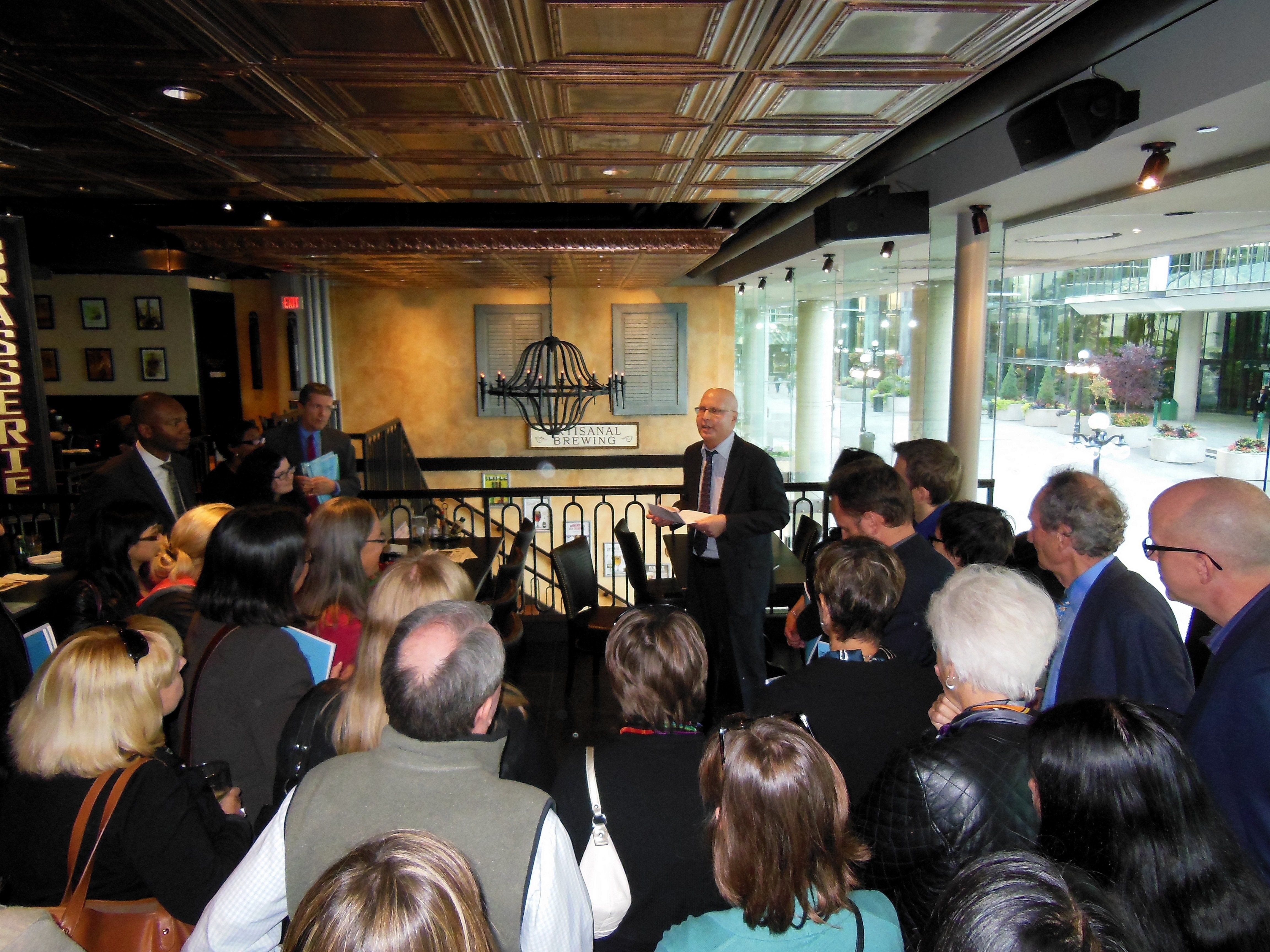
Mr. Griffith, a former director general at the Canadian Heritage Department who worked on multiculturalism policy, is launching his new book in Ottawa on Sept. 23 at The Three Brewers, 240 Sparks St., from 5 to 7 p.m.
He moved over to the Citizenship and Immigration department when Jason Kenney (Calgary Southeast, Alta.) was named the minister in 2008 and took the multiculturalism files with him. Using his experience with implementing multiculturalism and citizenship policy, Mr. Griffith wrote an insider’s account about the major cultural shift in the public service when the Conservatives formed government.
“In this particular transition, the perspective, or worldview, of both sides was so different. We had the Calgary crowd—by and large the Conservative Party wanted smaller government, less government intervention and was more skeptical of the power of government to actually do good,” Mr. Griffith told The Hill Times in a phone interview last week. “We live in the Ottawa bubble, Central Canada, and, by and large, civil servants are small ‘l’ liberals. You know, you don’t join government because you want to shrink it generally, maybe the people in Finance do, but, generally speaking, the people who join government have a belief in the power of government to do good. It doesn’t mean they’re big government people, it’s just a different world view.”
Mr. Griffith said the differing worldviews “sharpened tensions” between the public service and the new government.
“Previous transitions hadn’t had, I don’t think, such a sharp tension. I don’t recall that during the Mulroney government, because, again, it was more of a Central Canadian government,” he said. “They came with strong ideas and knew what they didn’t like.”
In the case of multiculturalism and citizenship policy, he said, the Conservative government’s worldview was a complete departure from that of former prime ministers Pierre Trudeau, Brian Mulroney, and Jean Chrétien.
“They didn’t like much of the traditional approach in multiculturalism and everything like that, sort of the old-style focusing on visible minority issues. On citizenship, it was very clear they wanted a stronger reference to Canadian history, military, Crown, etc., and so the way they would come at the issues is we’d have a meeting, and they’d say, ‘Here’s what we want,’ and we’d initially figure it out. In many cases, it appeared very foreign to us in terms of what we knew about Canada, so it took us time to absorb it and react to it and find a way to say, ‘Now we understand it so we can actually work with you,’ ” he said.
Mr. Griffith said several of the policies generated were based on anecdotes that the minister or his staff would bring back and attempt to fix.
For example, in Policy Arrogance, he outlined that in the case of making changes to citizenship rules around “birth tourism”—or dealing with people who planned trips to Canada so that their baby would be born on Canadian soil and be granted automatic citizenship—anecdotes “trumped” evidence he said, because there was very little data to begin with.
“The minister admitted that he did not know the extent of the problem even as he made the case to crack down on birth tourism,” Mr. Griffith wrote. “Officials struggled with this lack of hard numbers as stories emerged in the Quebec and B.C. media.”
Mr. Griffith wrote that the CIC later engaged with medical associations and hospitals to “ascertain the extent of the issue,” but did not consult with provincial health systems that would have allowed them to see how many births were paid or not paid through the public system for which citizens and permanent residents are eligible.
“Such analysis would help quantify the extent of the issue, and help inform cost-benefit analysis of any change to citizenship legislation to align Canadian policy with other jurisdictions that no longer allow automatic citizenship upon birth,” Mr. Griffith wrote. “In developing policy and program advice, the paucity of data and analysis made it hard to provide advice on the likely impact of any policy changes. More, the minister’s wishes for early implementation meant there were limits to appropriate due diligence.”
Mr. Griffith told The Hill Times that public servants couldn’t discount Mr. Kenney’s anecdotes, however, because he went to at least 20 community events three weekends out of four.
“His anecdotes had a reasonable amount of weight,” he said, noting that officials did not take the anecdotes wholly; as the people Mr. Kenney was seeing was not entirely representative of the Canadian population.
“He was more in touch with the communities than we were. Our evidence tended to be large-scale research and surveys, which are very valid, and his evidence tended to be anecdotal, but it was such a large base of anecdotes that it was something that we actually had to take into account.”
When it came time to rewrite the citizenship guide, Discover Canada, the public servants working on it “didn’t get it right at all,” so the ministerial and political staff “actually wrote it for us” and the department went from there, Mr. Griffith said.
“Normally that isn’t done,” he said, adding that later, the minister’s office would have “a challenge session” going through each page one by one. “We were able to understand why they wanted it and the why is actually more important than the what because if you understand the why, then you can figure out a way to make it work. It would be difficult at the beginning … and then as you got through those discussions, you could get to more pragmatic ‘okay, now that we understand what you want, we can move in this direction.’ It served as a bit of a dance.”
Mr. Griffith said that while he was “never afraid” to give advice under these circumstances, his four years at Citizen and Immigration Canada was a “real learning experience.”
Writing that experience down “was actually satisfying and cathartic,” he said.
“My intent was actually to provoke a bit of a discussion initially within the public service about the relationship issue between the government and the public service because my sense was that we didn’t manage the relationship very well at the beginning,” Mr. Griffith said about writing the book.
“We weren’t responsive enough to the change in direction of the government so we appeared obstructive at best or resisting or even disloyal perhaps to the incoming government so I think there were some lessons learned for the public service in terms of how we manage that transition that hopefully by having a more open discussion about how we actually deal with a situation where we have an incoming government that has a very different worldview from our worldview in a way that actually doesn’t exacerbate tensions, but actually sort of helps develop a more normal working relationship.”
There was a difficult line between the public servants giving “fearless advice” and putting into practice the “loyal implementation” role, he said.
In the end, Mr. Griffith said, he felt at CIC that public servants were able to balance both, despite going through the “Kübler-Ross stages of grief and loss—denial, anger, bargaining, depression, and acceptance—in dealing with the traumatic challenge to their role, as well as to the long-standing consensus between previous Liberal and Conservative parties on citizenship and multiculturalism issues.”
Mr. Griffith told The Hill Times that, for the most part, Mr. Kenney was “actually quite good” at listening to advice, although “he wouldn’t necessarily accept it.”
While he couldn’t say whether this was widespread in other departments, Mr. Griffith said politicians are likely more drawn to anecdotes than scientific evidence and statistics because they are people’s people.
“This government is more ideological than previous governments. This government does tend to discount evidence. This government does actually tend to cut things that do provide evidence, like the census. All that’s on the public record,” Mr. Griffith said.
“How it works in individual departments, I’m not close enough to know that. I do know from some people that yes, some ministers are more receptive to listening to advice but again that always gets run by ‘The Centre’ [the PMO]. In the end, whether the minister listens or not is almost less important than whether ‘The Centre,’ i.e. the PMO, listens to it,” Mr. Griffith said.
As for whether things will change if and when a new government is elected, Mr. Griffith said it would likely be easier under a non-Conservative government.“My sense is that this Conservative government situation with the public service is probably fairly unique,” he said, noting that if the Liberals or NDP formed a government, they would likely have more confidence in the public service. “But either way, the public service has to be prepared to respond to whatever decision Canadians make at the polls. That’s always the bottom line in terms of the loyal implementation part.”



 Multicultural Meanderings