Good long-read on US immigration policies and their impact by Dara Lind (thanks to Arun with a View):
But one effect was clear: After IIRIRA, deportation from the United States went from a rare phenomenon to a relatively common one. “Before 1996, internal enforcement activities had not played a very significant role in immigration enforcement,” sociologists Douglas Massey and Karen Pren have written. “Afterward, these activities rose to levels not seen since the deportation campaigns of the Great Depression.”
This particular law was passed during an era where Congress and the Clinton administration were both working to increase the amount of spending and agents on the US–Mexico border.
And after 9/11, the way the federal government handled immigration changed in two major ways. The bureaucracy was reorganized — and moved from the Department of Justice to the Department of Homeland Security. And the funding for immigration enforcement got put on steroids.
The combination of those gave rise to what Meissner and the Migration Policy Institute have called a “formidable machinery” for immigrant deportations — a machinery that took the US from deporting 70,000 immigrants in 1996 to 400,000 a year though the first term of the Obama administration. But that machine was built on the legal scaffolding of the options IIRIRA opened up.
“Both of those things have had so much more force because of this underlying statutory framework that they were able to tap into,” says Meissner. In retrospect, “it was sort of a perfect storm.”
After ’90s immigration reform, the unauthorized population tripled
But even though deportations exploded after the passage of IIRIRA, it didn’t keep the population of unauthorized immigrants in the US from growing. It went from 5 million the year IIRIRA was passed to 12 million by 2006. (By contrast, during the decade between the Reagan “amnesty” and IIRIRA, the unauthorized population grew by only 2 million.)
These two things didn’t happen despite each other. More immigration enforcement is one big reason why there are so many unauthorized immigrants in the US today.
A lot of this is because of the increase of enforcement on the US–Mexico border — something that was happening even without IIRIRA. Many unauthorized immigrants used to shuttle back and forth between jobs in the US and families in Mexico. Once it got harder to cross the border without being caught, they settled in the US — “essentially hunkering down and staying once they had successfully run the gauntlet at the border,” as Massey and Pren write — and encouraged their families to settle alongside them.
(This wasn’t the only reason unauthorized immigrants started settling in the US around this time. The types of jobs available for unauthorized workers were changing, with seasonal agricultural jobs being replaced by year-round service-industry ones, for one thing. But it was certainly a major factor.)
But if border enforcement encouraged families to stay, IIRIRA prevented them from obtaining legal status. By this point, a majority of the unauthorized-immigrant population of the US has been here 10 years — more than enough time to qualify for cancellation of removal, if IIRIRA hadn’t made it so difficult to get. Millions of them have children who are US citizens.
The 3- and 10-year bars alone have caused millions of immigrants to remain unauthorized who’d otherwise be eligible for green cards or US citizenship by now. According to Douglas Massey’s estimate, if those bars hadn’t been instituted in 1996, there would be 5.3 million fewer unauthorized immigrants in the US today. In other words, the population of unauthorized immigrants in the US would literally be half the size it is now.
Something for the Canadian government to consider given the quintupling of citizenship fees in 2014-15 ($630 plus language assessment cost):
In a rule published in the Federal Register Wednesday, the Department of Homeland Security is proposing changes to the fee schedule that it says would ensure that U.S. Citizenship and Immigration Services — a largely fee-funded branch of DHS — can cover the cost of its immigration processing mission. The total adjustment amounts to an average 21 percent increase in the fee structure.
Largely exempt from the increases are, however, low income immigrants who wish to become U.S. citizens. Under the proposed rule, “DHS would charge a reduced fee of $320 for naturalization applicants with family income greater than 150 percent and not more than 200 percent of the Federal Poverty Guidelines.”
“DHS is proposing this change to increase access to United States citizenship,” the proposed rule explains.
The allowance effectively cuts in half the current cost of naturalization — $680, including the $85 biometric fee. The rule, however, also seeks an additional $45 increase in the cost of naturalization applications for immigrants who can afford it.
USCIS last adjusted its fee schedule in 2010 and the proposed rule will be open to public comment for 60 days.
Rep. Luis V. Gutiérrez (D-IL), who has been promoting naturalization and voter registration across the country as a means for immigrants to “Stand Up to Hate,” cheered the rule.
“Right now, a lot of immigrants face a difficult choice: pay $700 or so for the chance to take all the tests and apply for citizenship, or pay $450 to renew a green-card for five years,” Gutiérrez said in a statement.
“Now, the math is much better,” he continued. “You can apply for citizenship and a fee waiver and become an American citizen – with all the rights, duties and honor of citizenship – for a more attainable price or maybe even for free. The new calculation is going to mean that millions of those who are already eligible can finally take the step and apply for citizenship.”
Applicants can apply for a fee waiver if their income is below or 150 percent of the poverty line, they are receiving a means-tested benefit, or they are experiencing a “financial hardship.”
Without data, hard to know where the issues are and what to do about them:
As a counterexample, he pointed to Kaya Henderson, the chancellor of Washington’s public schools, who has made it a requirement that all second graders learn how to ride a bicycle.
Ms. Henderson, in an interview, said she believed that, in the transition to the Common Core learning standards, states and districts had not been “as aggressive as they need to be in terms of changing their curriculum and professionally developing teachers and principals to really understand how to teach differently.”
Her own district, she said, spent four years developing a curriculum in which students hone their reading and math skills while studying a wide variety of subjects, including science and social studies.
She added that it was the responsibility of state and district leaders to emphasize the importance of field trips and extracurricular activities and to tell principals that “holding kids back from those kinds of things doesn’t help them on the test.”
“I’ve had to at some points remind my principals that kids should have a well-rounded experience all throughout the year, and it’s not O.K. to say no field trips until after the test,” she added.
But she also said that doing away with the tests would be most damaging to black and Latino students and those with disabilities. “Before No Child Left Behind, there were lots of schools where parents thought their kids were going to great schools, but after you disaggregated the results, you figured out that black kids and Latino kids or special-ed kids were actually worse off” than similar students in less high-performing schools, she said. “We need to know that kind of information. I don’t ever want to go back to a time when we don’t know.”
Sonja Brookins Santelises, vice president of K-12 policy and practice at the Education Trust, an organization that advocates for high academic achievement for poor and minority students, said she had watched the video produced by the Baltimore Algebra Project and been shaken by the students’ disappointment in their education and feelings of marginalization.
She said it was educators’ responsibility to speak to students about testing in a positive way. Ms. Brookins Santelises recalled an experience from when she was a middle schoolteacher, when she showed a student named Tabitha her test scores and explained to her that she was significantly below grade level in reading.
“She said to me, ‘Oh, my God, nobody told me I couldn’t read,’ ” Ms. Brookins Santelises recalled. “I watched how she started to internalize it, and I immediately said, ‘Wait a minute, hold up, this test is not Tabitha. But what this says is we’ve got some real work to do, and I am here to help you.’ ”
If students are being made to feel inferior, she said, it is because educators — from teachers to district officials — aren’t taking responsibility for their own failures and instead are sending low-income students the message that their poor performance is their fault.
The US equivalent to the debate in Canada over investor immigration, essentially bad programs that distort local economies with little long-term benefit to the economy:
Big, high-profile real estate developments in America are scooping up funding from an unusual and controversial source: foreign investors angling to become Americans. The EB-5 visa program offers a path to citizenship to those rich enough to invest at least half a million dollars here. But there’s a growing debate about the program, with fierce defenders and critics who cut across traditional partisan lines.
Hudson Yards, a massive complex of office, retail, residential and park space coming together on Manhattan’s far west side, is one current project that benefits from these investments. The $25 billion project—the largest private development in American history—has brought in $600 million from EB-5 visa investors. That number could double by the time the whole project finishes in the middle of the next decade. Related Companies, which is developing Hudson Yards, said the EB-5 money was a “critical component.”
“Think back to when we started this,” said Jeff Blau, Related’s CEO. “In 2009-2010 the economy wasn’t so strong and so that EB-5 capital filled that gap for us.”
Supporters of the program, like Blau, point to the jobs and economic impact their developments create. The buildings at Hudson Yards will house private equity firms and luxury shops, but their bones are steel, manufactured in Virginia and welded into place by workers earning middle-class pay.
The program began in the early 1990s with the goal of bringing in job-creating investments from abroad. For many years it was tiny, well below its annual cap of 10,000 visas. But after the financial collapse, the program exploded, with a wave of Chinese applications.
As the program has grown, critics say too much money is going to real estate projects that benefit the wealthy, such as Manhattan skyscrapers and Vegas hotels.
“It is a program with a lot of flaws,” said Audrey Singer, a senior fellow at the Brookings Institution who has studied EB-5 financing. “It is easy to exploit.”
Foreigners who invest in high-unemployment areas get a break on how much money they have to put in: $500,000 versus $1 million. But developers have found ways to use that money for projects in wealthy areas, through creative drawing of districts called targeted employment areas (TEAs). By creating TEAs that include ritzy neighborhoods along with struggling ones, developers make it easier for foreign investors, but can still build in rich areas. Though legal, critics see this kind of gerrymandering as against the spirit of the law.
Singer says the EB-5 program can be a positive force, but it needs to tighten rules so more benefits go to neighborhoods that need them most. A bipartisan attempt to make changes recently failed, beaten down by the real estate lobby and Congressional supporters in both parties.
So for now, a pricey express lane to American citizenship remains open and the argument will rage on over whether it’s the right way to go.
Does undermine the American right’s characterization of American Muslims:
Three American imams got put on ISIS’s hit list for promoting the idea that Islam and the West can coexist.
The terrorist group’s latest issue of propaganda Dabiq attempts to theologically justify an attack on the religious leaders in an article titled “Kill the Imams of Kufr in the West.” The men are worse than hypocrites, ISIS says, because they say Muslims can thrive in America.
“The person who calls himself a ‘Muslim’ but unapologetically commits blatant kufr [disbelief] is not a munafiq [hypocrite], as some mistakenly claim. Rather, he is a murtadd [apostate],” Dabiq claims.
The Daily Beast will identify two of the Americans with pseudonyms because of the direct threats on their lives. A third, who gave The Daily Beast permission to use his name, responded with dark humor.
“Nothing like a death threat with a danish and a latte in the morning,” Suhaib Webb told The Daily Beast.
This is the first time ISIS has put out a direct hit on U.S. imams.
Webb is treated with contempt by jihadists who call him “the joke of al-Azhar,” a reference to his time at the esteemed Islamic university in Egypt.
“I mean, it’s certainly concerning,” he said, adding that he’s been contacted by the Department of Homeland Security about the threat. “They maybe want to brief me on things to look for, to be cautious of,” he said.
The irony of being on the most extremist group’s hit list isn’t lost on Webb, who for years has been accused of Islamic extremism by the far right in America.
“In a way, [Dabiq]’s attacking what many of us think makes our country awesome. And at the same time, it repudiates people on the right,” he said. “If people like myself are radical extremists, then why is ISIS putting a death threat on us?”
Just days after celebrating cultural bridges, a Toronto imam has been targeted in a Daesh hit list.
The self-declared Islamic State called out Shaykh Abdullah Hakim Quick along with other Muslims in the West, urging followers to kill them for speaking out against the group and betraying their interpretation of Islam.
Quick works with the Canadian Council of Imams, which hosted its first annual dinner on Monday night, honouring political leaders and community members.
“It was a really good vibration that came out of that meeting, a lot of unity between people of different faiths,” Quick told the Star.
“So here comes the devil, as we would say, screaming out against us the next day.”
Quick first learned of the threat on Wednesday from a fellow imam in the council, but though he says he has contacted law enforcement and is taking precautions, he will not be intimidated.
“I will continue to do what I have to do,” he said. “Putting my trust in God. This is what Muslims do when they find themselves in difficulty, and continue on to do what’s right.”
Michael Zekulin, a terrorism researcher at the University of Calgary, says the threat is typical of Daesh’s propaganda tactics, but not necessarily legitimate.
Daesh has implored its followers to go after others in the past, he says, like Calgary-based cleric Syed Soharwardy and UFC fighter Tim Kennedy.
“It never resonated,” Zekulin said. “It’s not something you dismiss and laugh off, but at the same time I’m not sure that simply because they mentioned this individual all of a sudden (he) is a serious immediate target.”
He says more than anything the threat demonstrates the sophisticated, extensive nature of Daesh’s communication network.
The United States Government has cautioned Caribbean countries offering a Citizenship by Investment Programme (CIP) to be extra cautious about who they give their passports to, and ensure that recipients have no terrorist or crime links.
It gave the advice, in a statement issued by the US Embassy in Barbados yesterday, even as it made it that it was not advising regional countries on whether or not they should offer economic citizenship.
Under the CIP offered by countries like Antigua and Barbuda, St. Kitts and Nevis and Dominica, foreign nationals are granted citizenship in exchange for a substantial investment in the country.
“The United States does not approve or disapprove individual aspects of citizenship by investment programmes,” the US statement said. “The United States strongly believes that all countries have an inherent responsibility to their citizens and the international community to review fully all applicants who seek a nation’s citizenship.”
“While the United States Government is willing to consult with governments on their citizenship investment programmes, the ultimate decisions to offer and how to operate such a programme, including the issuance of citizenship and related identifying documents, such as passports to applicants, lie with each individual government and not with the United States.”
But, the statement added, the US Government encourages and expects governments to be confident, beyond a reasonable doubt, that applicants are bona fide and their identities have been fully validated, and they have no ties to transnational criminal or terrorist organizations, before handing over citizenship.
The US Embassy did not identify any specific country in its statement.
However, there has been concern in Antigua and Barbuda about the government’s recent decision to remove Iraq from the list of countries whose nationals are barred from obtaining citizenship under the twin-island nation’s CIP.
The main opposition United Progressive Party (UPP) is strongly against it. Political leader Harold Lovell said late last month that given the entrenchment of Islamic State in Iraq and Syria (ISIS) in the Middle Eastern country, that move and the decision by the Gaston Browne administration to establish a presence in Iraq, expose Antigua & Barbuda to danger and compromise the integrity of the country’s passport.
Last November, the St. Kitts and Nevis Government announced an immediate suspension of the processing of new CBI applications from citizens and residents of Syria.
The announcement came less than two weeks after ISIS carried out attacks in Paris, and also followed the arrest of Syrian nationals with fake passports in Honduras and St. Maarten, although the government did not publicly identify those developments as contributing to its decision.
While the US Citizenship and Immigration Services likely had to make this ruling, it appears that the complainant wants religious rights to trump other rights, as seen in many of the US state initiatives against LGBT and other rights:
At issue was a segment of the exam’s study guide that suggested the First Amendment protects the citizens’ right to “freedom of worship,” rather than freedom of religion. Lankford, who is co-chairman of the Congressional Prayer Caucus and the first senator to join it, first learned of the incorrect wording in June of last year, which prompted a letter to CIS Director Leon Rodriguez.
Lankford explained his issue with the wording again Friday in his announcement applauding the change:
“At first glance, it appears like a small matter, but it is actually an important distinction for the Constitution and the First Amendment. The ‘freedom of religion’ language reflects our right to live a life of faith at all times, while the ‘freedom of worship’ reflects a right simply confined to a particular space and location.”
In a letter sent to Lankford’s office Friday, Rodriguez explained the reversal, saying that “upon further consideration,” CIS determined the change could be made because it didn’t involve adding or deleting content. Approximately 40 web-based and printed materials will be changed as a result of the decision.
“In accordance with agency policy, if the applicant’s answer to a civics question is ‘an alternative phrasing of a correct answer,’ U.S. Citizenship and Immigration Services officers will continue to accept both ‘freedom of religion’ and ‘freedom of worship’ as correct answers to question 51 when administering the naturalization exam,” Rodriguez wrote.
Question 51 reads, “What are two rights of everyone living in the United States?” The study guide originally offered the following correct answers:
freedom of expression,
freedom of speech,
freedom of assembly,
freedom to petition the government,
freedom of worship and
the right to bear arms.
The study materials will now read ‘freedom of religion’ as the correct response. Based on reprinting schedules, they expect all materials to be updated by the end of 2016.
“I applaud the Department of Homeland Security for listening to me and deciding to change their material to reflect our First Amendment right of freedom of religion,” Lankford said after receiving the notification. “We live in a great nation that allows individuals to live out their faith, or have no faith at all. To protect freedom and diversity, we must carefully articulate this right throughout the federal government.”
Students can benefit in many ways from having teachers who look like them, but in many schools around the country the math doesn’t add up.
In recent years, attention to the issue has been increasing, with national teachers’ unions and the U.S. Education Department, among others, trying to raise awareness and drum up more diverse recruits.
One man working in the private sector to address this problem — or at least a slice of it — is a former elementary school teacher named Orpheus Crutchfield. He’s the president of Stratégenius LLC in Berkeley, Calif (yes, it’s spelled with the accent over that first e). It’s been around for 15 years. And to his knowledge, it’s the only search firm in the country that specializes in placing underrepresented candidates in schools.
If your school is looking for a male kindergarten teacher, a female physics teacher or a person of color in any position, Crutchfield says, he can help.
But it’s going to cost. The firm typically works with between 55 and 65 schools at a time, charging each one a $1,650 annual retainer.If you happen to call upon their help between December and June, when most schools are hiring, there’s an additional “high season fee” of $750. And, if they present you with a successful candidate, the one-time fee is 14 percent of that person’s annual salary up front — paid by the school, not by the teacher, of course.
In July, Courtney Martin, a Stratégenius candidate who is African-American, will become head of lower school at Hawken, a progressive private school in Cleveland. It’s a promotion over her previous position, and she’ll be the first person of color to be hired at that level at the school. “He knew who I was and what I believed as an educator,” Martin says. “Anything he suggested, I trusted his advice.” Since Crutchfield started working with Hawken a year ago, he’s matched them with candidates for three separate positions who have each become finalists.
The vast majority of Crutchfield’s clients over the years have been private schools like Hawken, with the occasional charter school. The obvious reason would seem to be the price tag, but Crutchfield says there’s also the matter of who is empowered to make the call to use a firm like his.
“Independent schools are very nimble. Decisions get made immediately,” he explains. “Whereas dealing with districts is very complicated. I’ve tried.”
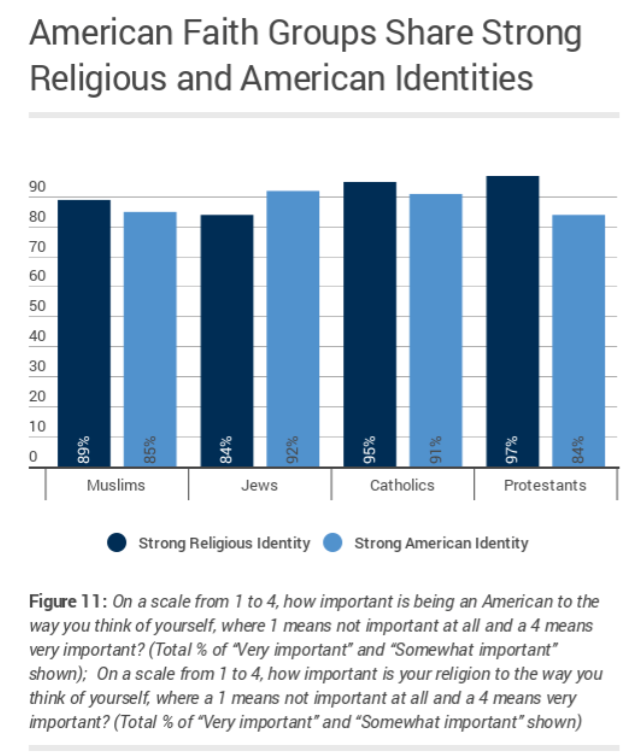
Donald Trump’s calls for a ban on Muslim immigration and the closing of American mosques seem to reflect suspicion that Islam and American citizenship are incompatible. But religion and patriotism are not opposing forces for American Muslims; in fact, they’re strongly correlated.
That’s one of the key findings of a first-of-its kind poll conducted by the Institute for Social Policy and Understanding, a non-profit focused on studying this section of the American population. The poll compares Muslims to American Jews, Protestants, and Catholics with respect to their levels of religiosity, patriotism, activism, and general outlook on the state of the country and on their lives. “In this election cycle, specifically, Muslims have been a topic of debate but seldom participants in that discussion,” said Dalia Mogahed, ISPU’s research director.
“We found that there was no correlation between mosque attendance and support of violence,” Mogahed said. On the contrary, she suggested, the results indicate that mosques are ideal places where community organizers might start engaging people because those who attend regularly “are more receptive to a message of civic engagement.”
“The research shows that mosques are actually a force for moderation. Muslims frequent a religious service as much as Protestants, and those who do go more frequently are not in any way more likely to condone violence,” Mogahed said. Muslims who said they attend services more frequently were more likely not to condone violence, with 65 percent saying “it is never justified,” compared to 45 percent of similarly devout Jews, 43 percent of Catholics, and 40 percent of Protestants.
The survey also found that American Muslims were more likely than members of other faith communities to reject attacks on civilians by the military, and as likely as any other group to also reject attacks on civilians by an individual or a small group, Mogahed said. They are “at least as likely as other faith communities to reject violence unequivocally,” she said.
Not surprising, given the focus of his campaign and the demographics of those who support him:
If Donald Trump somehow falls three delegates short of reaching the magic 1,237 delegates needed for the Republican nomination, he may be haunted by an obscure outcome from the primary voting in Illinois on Tuesday. There’s clear evidence that Trump supporters in Illinois gave fewer votes to Trump-pledged delegate candidates who have minority or foreign-sounding names like “Sadiq,” “Fakroddin” and “Uribe,” potentially costing him three of the state’s 69 delegates.
This pattern appears to be a phenomenon unique to Trump’s supporters.
Illinois Republicans hold a convoluted “loophole” primary: The statewide primary winner earns 15 delegates, but the state’s other 54 delegates are elected directly on the ballot, with three at stake in each of the state’s 18 congressional districts. Each campaign files slates of relatively unknown supporters to run for delegate slots, and each would-be delegate’s presidential preference is listed beside his or her name. As a result, the top presidential candidate in each congressional district usually claims all three of the district’s delegates.
Except on Tuesday, a handful of congressional districts split their delegates in ways that cast doubt on voters’ racial motivations. Did voters have genuine personal preferences for the mostly anonymous individuals running for these slots, or was it a case of “what’s in a name?”
A FiveThirtyEight analysis of the dozen highest vote differentials within district-level Trump slates reveals a startling pattern: In all 12 cases, the highest vote-getting candidate had a common, Anglo-sounding name. But a majority of the trailing candidates had first or last names most commonly associated with Asian, Hispanic or African-American heritages. Of the 54 Trump delegate candidates in the state, two of the three worst-trailing candidates were the only two Trump candidates with Middle Eastern-sounding names.
Douglas Massey/Julian Simon Lecture Series
Douglas Massey/Julian Simon Lecture Series


 Multicultural Meanderings