Broken Melting Pot Is No Alternative To Canadian Multiculturalism | Jack Jedwab

Good commentary by Jedwab.

Reality in many parts of USA is closer to multiculturalism than melting pot, given strong ethnic communities and identities, despite political discourse and posturing:

Those driving the melting pot rhetoric might argue that it refers to the immigrant experience and is therefore not about the American-born black population. That observation however makes illusory the melting pot objective of creating a harmonious whole. As regards immigrant acceptance in the American melting pot, the success of Donald Trump’s campaign has also served as a reminder of the high levels of anxiety and hostility towards immigration and diversity. Then again, perhaps the melting pot theorists were thinking about melting white European and not Hispanic immigrants. Well, so much for the idea that the American model of diversity seeks to make one out the many.

In a thoughtful essay in a 2012 edition of the journal National Identities , northeastern University political science professor David Michael Smith notes that the success of the melting pot rhetoric is attributable to the concept’s ambiguity. It simultaneously represents both uniformity in its end product and the presence of diversity which it must somehow incorporate. Smith observes that “…in the first instance, attention is focused on the creation of a ‘new race” or ”new compound’ which is nonetheless homogeneous in character.” It by virtue of this ambiguity that the concept it used across a spectrum of Americans that rally those who are favorable to immigration and those opposed to it.

Paradoxically, when it comes to describing cultural pluralism in the United States, the trend amongst several American thinkers is towards some variant on the idea of multiculturalism. For some time, the tired melting pot adage has been giving way to a depicting the country as a “salad bowl” with a mixture of various ingredients that keep their individual characteristics. Even the most ardent American proponents of the melting pot acknowledge that it is increasingly difficult to defend the idea.

Sure Canadian multiculturalism has historically and continues to confront a set of important challenges, but it’s difficult to give credibility to misinformed critics that point south of the border to offer a better alternative.

Source: Broken Melting Pot Is No Alternative To Canadian Multiculturalism | Jack Jedwab

Surprising New Evidence Shows Bias in Police Use of Force but Not in Shootings – The New York Times

Surprising_New_Evidence_Shows_Bias_in_Police_Use_of_Force_but_Not_in_Shootings_-_The_New_York_TimesUnderlying bias and discrimination remains of concern, but useful nuance to current debates:

new study confirms that black men and women are treated differently in the hands of law enforcement. They are more likely to be touched, handcuffed, pushed to the ground or pepper-sprayed by a police officer, even after accounting for how, where and when they encounter the police.

But when it comes to the most lethal form of force — police shootings — the study finds no racial bias.

“It is the most surprising result of my career,” said Roland G. Fryer Jr., the author of the study and a professor of economics at Harvard. The study examined more than 1,000 shootings in 10 major police departments, in Texas, Florida and California.

The result contradicts the image of police shootings that many Americans hold after the killings (some captured on video) of Michael Brown in Ferguson, Mo.; Tamir Rice in Cleveland; Walter Scott in South Carolina; Alton Sterling in Baton Rouge, La.; and Philando Castile in Minnesota.

The study did not say whether the most egregious examples — those at the heart of the nation’s debate on police shootings — are free of racial bias. Instead, it examined a larger pool of shootings, including nonfatal ones.

The counterintuitive results provoked debate after the study was posted on Monday, mostly about the volume of police encounters and the scope of the data. Mr. Fryer emphasizes that the work is not the definitive analysis of police shootings, and that more data would be needed to understand the country as a whole. This work focused only on what happens once the police have stopped civilians, not on the risk of being stopped at all. Other research has shown that blacks are more likely to be stopped by the police.

Photo

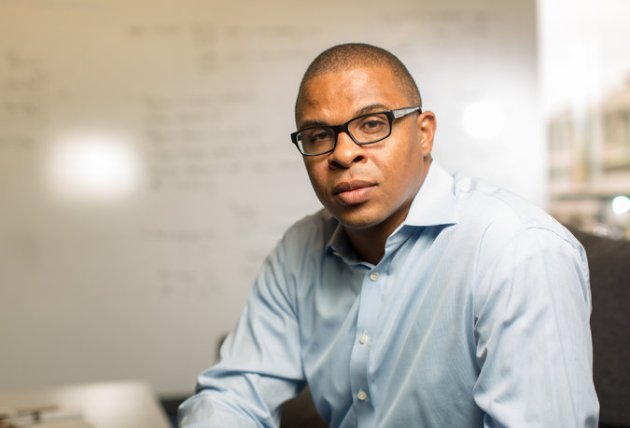
Roland G. Fryer Jr., a professor of economics at Harvard. CreditErik Jacobs for The New York Times 

Mr. Fryer, the youngest African-American to receive tenure at Harvard and the first to win a John Bates Clark medal, a prize given to the most promising American economist under 40, said anger after the deaths of Michael Brown, Freddie Gray and others drove him to study the issue. “You know, protesting is not my thing,” he said. “But data is my thing. So I decided that I was going to collect a bunch of data and try to understand what really is going on when it comes to racial differences in police use of force.”

Source: Surprising New Evidence Shows Bias in Police Use of Force but Not in Shootings – The New York Times

Christie Blatchford: We need light, not heat as violence by and toward police grows

One of her better columns:

As Martin Luther King, Jr. said in the very first speech that brought him to wide American attention, “There comes a time when people get tired.”

Well then, let’s hope we are all there now — the frightened and furious young black men whose brothers are shot and killed by U.S. police in staggering numbers and in sometimes galling circumstances, the scared and beleaguered police, and yes, the mass media and social media with our giddy group embrace of violence in all its forms.

As the CNN commentator Van Jones said Friday, if you bleed for Alton Sterling and Philando Castile (the black men killed by police this week in Baton Rouge, La., and near Minneapolis, Minn.) but not for the five dead Dallas police officers murdered during a Black Lives Matter protest Thursday night, “you need a heart check.” If you bleed for the slain police but not for Sterling and Castile, Jones said, “You need a heart check.”

It is, in other words, time for empathy, that great saving human ability to feel the pain of another without having to have walked in his actual shoes.

The great American civil rights leader made his speech on Dec. 5, 1955.

It was long ago and far away.

King was in Montgomery, Ala., about 585 kilometres from Baton Rouge, where Sterling was killed, and almost twice that to Falcon Heights, Minn., where Castile was shot to death.

But what he said, in part, to a thousand black Americans crowded into the Holt Street Baptist Church that night was this: “We are here this evening to say to those who have mistreated us so long that we are tired — tired of being segregated and humiliated; tired of being kicked about by the brutal feet of oppression.

“There comes a time my friends when people get tired of being plunged across the abyss of humiliation, when they experience the bleakness of nagging despair.”

Segregation ended, though it was another nine years before the Civil Rights Act of 1964 put an official end to it, and while much has changed, does that language not sound an awful lot like the same general bone weariness heard in recent weeks from black residents in U.S. city after U.S. city and even in Toronto? It does.

This week, former Canada AM news anchor and co-host Marci Ien was a guest host on The Live Drive, a Newstalk 1010 radio show.

Conflict-of-interest declaration, I do a bit on the show, but listened afterwards as Ien spoke with tremendous eloquence of her experiences as a smart young black woman growing up in Toronto.

In her quiet voice, she said, “There isn’t a man in my life, from my father who’s in his 70s to my husband to my brothers-in-law, who hasn’t been stopped by police (in effect, for driving while black) at some point.”

Born and raised in Scarborough, Ont., and proud of it, Ien had a girl seven years before she learned her second child was a boy. “My heart skipped a beat,” she said, “when I realized I was having a son. I was worried. No mother should ever feel that.”

Now, as her little boy grows up, Ien said, she is braced for the conversation she will have to have with him — about the clothes she wonders if he can wear (“Can he wear a hoodie? Low-slung jeans?”) and how he’s to behave if he’s stopped by police. “The utmost respect should be there anyway,” she said, meaning she and her husband would teach that as a matter of course, but their son will be told to ramp it up.

“These are the conversations black families have with their sons and the young men they care about,” she said. If this great woman has to have this sort of discussion with her son, that’s something the rest of us, including the police, have to accept.

Ien was commenting on Tuesday, after Sterling’s death, but before Castile’s and before the shocking Dallas mass murder.

The officers — seven others were wounded — were slain by what the FBI says now was a lone sniper, 25-year-old Micah Xavier Johnson, a former U.S. Army reserve veteran.

Dallas Police Chief David Brown said that before he was essentially blown apart by a bomb-laden robot the police force dispatched, Johnson told hostage negotiators “he was upset about Black Lives Matter. He said he was upset about the recent police shootings. The suspect said he was upset about white people. The suspect stated he wanted to kill white people, especially white officers.”

Armed to the teeth, better equipped than the unsuspecting police watching over the protest, Johnson did just that.

The ambush came everywhere as a terrible shock to police officers, who, as Chief Brown said drily at one point, “aren’t very accustomed to hearing thank you, sometimes from the citizens who most need our help.” That’s putting it kindly; even at peaceful protests, even in Canadian cities, police are routinely faced with people spitting at them, cursing them and trying to provoke them.

Yet few of them would have predicted what happened in Dallas.

It was Newstalk host Jay Michaels who suggested Friday that just as hateful ISIL propaganda and violent beheading videos on the web have served to radicalize unhappy young men in the West and turn them into homegrown terrorists, so perhaps the constant inflamed rhetoric about police violence in the press and the ghastly cellphone videos of police shootings may have inspired Johnson.

It feels as though we’re on a precipice. We need to be accountable for what we collectively have sown: the bad and racist police officers and the forces that employ them, the empty violent rhetoric of the mob, and the media and web airing of every grievance anywhere in the world and making it local.

What we need is light, not heat, and we need to do Van Jones’ heart check.

Source: Christie Blatchford: We need light, not heat as violence by and toward police grows | National Post

Shootings raise unanswered life-or-death question for black men in America: Neil Macdonald

Good column by Macdonald:

In the racially electrified fog of fear and rage following the events in Dallas Thursday, one question remains conspicuously unanswered: If you are a black man in America, how are you supposed to cope?

President Barack Obama has no real answer, nor do the members of Congress who bowed their heads in memory of the slain Dallas police officers, nor does Dallas’s anguished police chief, a black man himself.

The deadly consequences of carrying while black
#SayHisName: Americans react to videos of police killings
The only advice black Americans seem to get is to respectfully submit when some cop calls them out on the street, or looms at the door of their car, or shows up at their home, no matter how terrified they may be.

‘Comply, comply, comply’

For heaven’s sake, don’t give the officer any lip, or try to run away, even if you aren’t guilty of anything, and no matter how abusive the cop may become.

Because if you are black, that policeman is far more likely to gun you down, or choke you to death, or Taser you, or beat you into a coma.

“Comply, comply, comply,” Philando Castile’s mother says she used to tell him. “Comply — that’s the key thing in order to try to survive being stopped by the police.”

‘When is it going to stop?’: Philando Castile’s family speaks out1:10

Perhaps Alton Sterling’s parents gave him the same counsel. It’s as common for black parents to have that talk with their kids as it is for white parents to warn about talking to strangers.

But of course supine compliance does not guarantee survival at the hands of police if you are black in America (or, to be honest, if you are Indigenous in some parts of Canada, but that’s a separate discussion).

Philando Castile was evidently complying with the Minnesota policeman who’d pulled him over for a broken tail light this week when that policeman opened fire through the driver’s window. The police force has not said otherwise.

And a day earlier, Alton Sterling was pinned down, hands free of weapons, when two Louisiana cops shot him in the back and chest.
After the Castile killing, Minnesota Gov. Mark Dayton stated the obvious: “Would this have happened if those passengers, the driver and the passengers, were white? I don’t think it would have …”

There is simply no question that your race can determine whether you live or die at the hands of police in America. If you are black, you are several times more likely to be killed.

Benefit of the tiniest doubt

And, chances are, your killer will walk away, unpunished, and likely consoled by his fellow officers for having had to go through such trauma.

Source: Shootings raise unanswered life-or-death question for black men in America: Neil Macdonald – Politics – CBC News

Donald Trump Is Mainstreaming Anti-Semitism and White Supremacy | Nicole Hemmer

All too true and worrisome:

The friendly relationship between Trump and the alt-right represents a genuine reversal of conservative and Republican politics. In the 1950s, conservatives at the journal National Review made a concerted effort to expel anti-Semites from their ranks, banning anyone from the magazine who wrote for anti-Semitic publications. A decade later the magazine extended its ban to members of the John Birch Society, which, while not primarily an anti-Semitic organization, welcomed a number of prominent anti-Semites as spokespeople.

Conservative leaders believed this sort of distancing was necessary in order to gain respectability, and thus political power, in mid-century America. And by and large, that has been true ever since. It’s why code words and dog-whistles became so important – because open anti-Semitism and racism had become so disqualifying.

As a candidate, Trump has dropped the dog whistle and started speaking in openly prejudiced terms. His decision to do so did not keep him from winning the Republican nomination. Some have argued that he won because of his racism; I think it’s more complicated than that. But either way, he has become the Republican nominee, thus legitimating his decision to un-code his language.

Trump certainly sees no reason to change course. Since capturing the nomination, he has doubled-down on political racism and anti-Semitism. There’s the Star of David tweet, the attacks on Judge Gonzalo Curiel’s Mexican heritage. And there’s a telling incident that unfolded a few days ago on the campaign trail, when an audience member asked Trump to fire TSA workers wearing “heebee-jabis” and give their jobs to veterans. Trump said he was looking into it.

The incident was useful not only because Trump expressed openness to religious discrimination, but because the incident had a close parallel to the 2008 campaign. Then, John McCain fielded a question from a woman who said she could not trust Obama because she had heard he was an Arab. McCain visibly blanched, shaking his head and defending Obama as a “decent family man” and “citizen.”


How times have changed.

There are no longer the sort of gatekeepers that can keep groups like the alt-right far on the fringes of American politics. Republican leaders tried to stop Trump. They failed. National Review came out hard against him. It failed, too.

And political journalists, who have cataloged the many incidents of racism and anti-Semitism in the Trump campaign, now face a tough choice. Because Trump is the nominee, there is going to be tremendous pressure to air “both sides” of these controversies in order to appear balanced. CNN, for instance, gave former Trump campaign manager Corey Lewandowski, who it has hired as a commentator, airtime to call criticism of Trump’s Star of David tweet “political correctness run amok.”

If that’s the kind of coverage that dominates this campaign season – rank anti-Semitism met with largely unquestioned “on the one hand, on the other” reporting – then the mainstreaming of prejudice will continue unabated over the next several months. And if that happens, win or lose, Trump’s legacy will be secure: making America hate again.

Source: Donald Trump Is Mainstreaming Anti-Semitism and White Supremacy | US News Opinion

Conservative Christians Grapple With Whether ‘Religious Freedom’ Includes Muslims : NPR

A real test for US evangelicals in terms of their advocacy and their interpretation of religious freedom:

…. Southern Baptist leader Russell Moore warned that letting the government restrict Muslims could lead to restrictions on Christians. He believes Christianity is the only true faith, and people must choose it freely.

“Sometimes we have really hard decisions to make — this isn’t one of those things,” Moore said. “What it means to be a Baptist is to support soul freedom for everybody.”

Moore leads the Southern Baptist Convention’s Ethics and Religious Liberty Commission, which recently signed on to a legal brief supporting the right of a group of Muslims in New Jersey to build a mosque. His answer was met with enthusiastic applause — but he has also faced criticism from some fellow conservatives, including Wofford.

On a recent Sunday morning, after a fire-and-brimstone sermon, Wofford said he believes the U.S. Constitution protects all religions, including Islam. But Wofford doesn’t believe Southern Baptist leaders, who draw their salaries from dues paid by local congregations, should be advocating for the rights of Muslims.

“So what I am actually doing if I support and defend the rights of people to construct places of false worship, I am helping them go to hell. And I do not want to help people go to hell,” Wofford said.

Some Christian groups dedicated to defending religious freedom argue for equal treatment for all faiths, out of the principle that discriminating against one religion could threaten them all.

“It’s a double-edged sword,” said Matt Staver, founder and chairman of Liberty Council, which focuses on religious freedom litigation on behalf of Christians but has also represented at least one Jewish client.

“Religious freedom is for all of us or it’s for none of us,” Staver said. “If we want to pick and choose, what’s the standard? And if it’s only that might makes right, then that means it’s a political struggle and whoever is the ruling class at any particular time, they’re the ones that have their say.”

In a tense presidential election year, such debates have a tendency to become political. After the meeting with Trump in New York last week, several evangelical leaders held a press conference, where they praised Trump’s promise to protect religious liberty.

Asked how that pledge applies to Muslims, conservative columnist Ken Blackwell responded that he favors freedom for all faiths, but his primary concern is the rights of Christians.

“I was more interested in hearing Donald Trump say that he was willing and ready to defend religious liberty not just for Christians, but including for Christians, in the public square,” he said.

Pressed on Trump’s call to temporarily ban Muslim immigration — a proposal that has appeared to shift over time, but which Trump has yet to explain in detail — Blackwell said that issue will be part of an ongoing “conversation” between Trump and evangelical leaders. He said many conservative Christians see the real estate developer as more favorable to their concerns about religious freedom and other issues than his Democratic rival, Hillary Clinton.

“We’re not going to, in fact, throw him overboard” over the Muslim ban issue, Blackwell said.

Source: Conservative Christians Grapple With Whether ‘Religious Freedom’ Includes Muslims : NPR

This Chart Shows the Future of America | TIME

White Non-White USAPretty compelling chart and analysis of the changing nature of the USA:

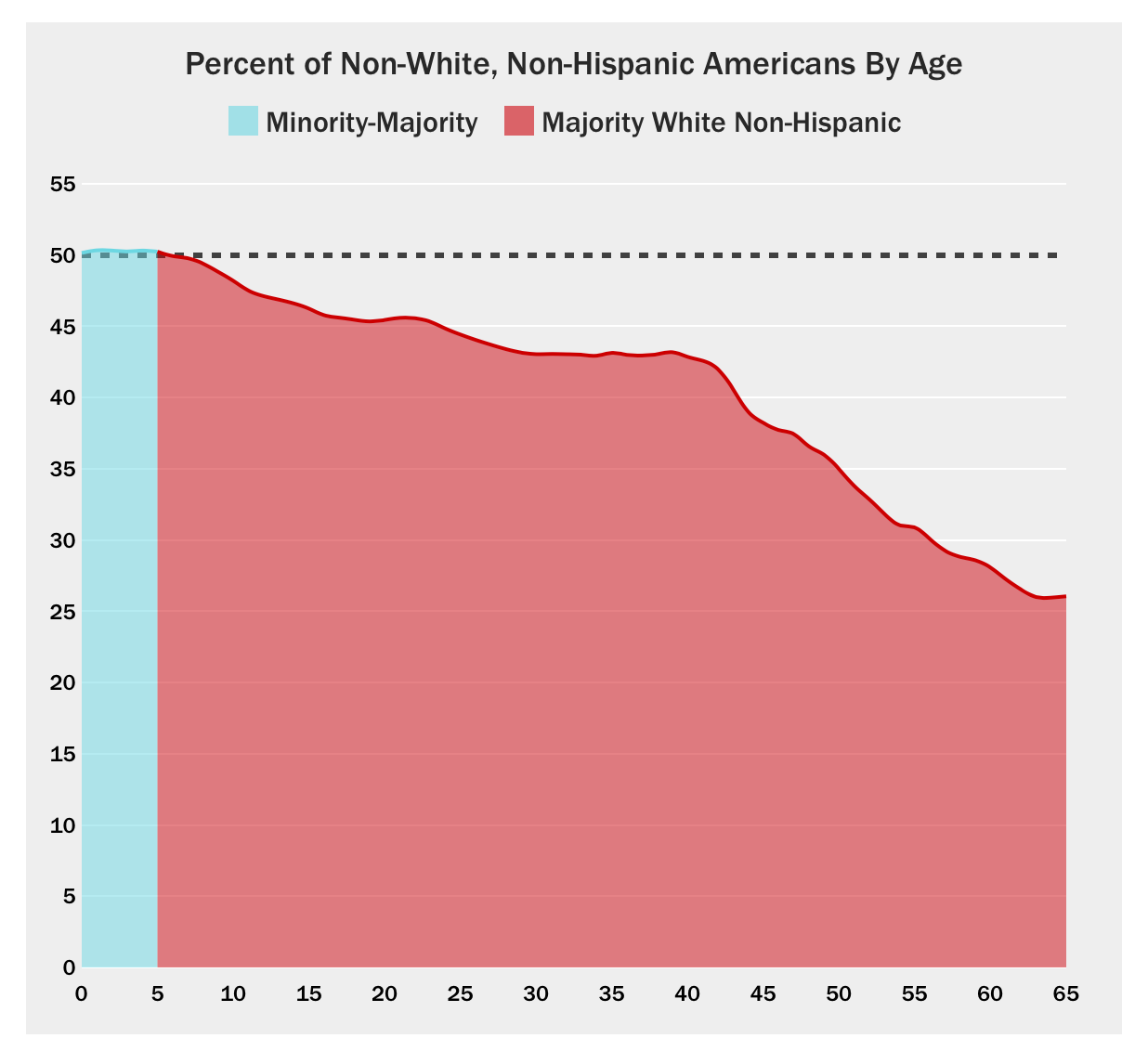
For the sixth straight year, babies born in 2015 belong to a mini-generation that is “minority-majority,” meaning fewer than half of them are white and non-Hispanic, according to new figures released this week by the Census Bureau.

The nation as a whole is not expected to reach this distinction until 2044. But we can see the future by looking at the youngest Americans, who are naturally ahead of the curve.

It’s important to note that this data shows the diversity of Americans by their current age, not the historical data about the diversity of their cohort when they were born. Since data clearly shows that minorities still have shorter life expectancies, we would expect the figures for older Americans to be slightly exaggerated in the form of higher percentages for white, non-Hispanics.

Source: This Chart Shows the Future of America | TIME

Former Intel. Official: American Hate Is a Bigger Threat Than Foreign Terrorism | TIME

As the 2016 elections play out across America, it has become impossible to ignore just how fractured our country has become. Regardless of who wins the election, I fear we have gone too far down the road of anger and hate to heal as a nation, without some form of severe intervention or collective awakening.

What if we could establish a National Reconciliation Task Force? We could repurpose some of the same “hearts and minds” types of campaigns that we wage in war zones, deploy people to towns and cities across the country to host engagement sessions. Unfortunately, that would require government action, a departure point that is already laden with so much distrust that it would be impossible to convince much of the country to participate or believe in the intentions.

So that leaves it to us, private citizens. It is up to us to push ourselves to engage in open dialogue, to bring people together in discussion groups, around dinner tables, on television, in movies. While the cable news networks may continue to seek profit over the greater good, I am certain there are enough private citizens, philanthropists and activists who care as much as I do about this issue to start a movement, however small, to start healing this nation.

The tech industry, in particular, could play a pivotal role. And imagine if movies started showing more diversity of political, religious and social viewpoints in characters that also manage to get along. What if reality TV shows introduced us to a wider variety of our fellow Americans and brought people together to discuss true hot-button issues, without throwing things at each other? What if public universities encouraged all viewpoints, instead of creating “safe spaces”?

I am not suggesting that we all go have dinner parties with leaders of Neo Nazi groups and Westboro Baptist Church members. I have no desire to try to find mutual understanding with someone who advocates violence, just as I never had a burning desire to shake hands and chat with an ISIS or al-Qaeda leader.

But what about the rest of America? Put aside the outliers who preach violence, the fringe who are the most extreme form of bigots. What about everyone else: the millions of people in our country who are disillusioned, angry, or just confused about what the best solutions are for our country? Why shouldn’t my former Texas neighbors (who were a huge part of my ability to open my mind to gun-owning Republicans), my most liberal New York friends and I share a meal and a beer and talk about why we each believe what we do, or why we each support certain policies or candidates? I have no doubt that the conversation would come from a place of respect, even if nobody’s political views are changed.

With millions of Americans so deeply entrenched, and the political rhetoric and media complacency appearing past the point of no return, these ideas may sound futile. But the alternative is to just give up, to let the extreme voices become the mainstream, and to toss our ideals to the wind. Throwing in the towel is not the American way. It’s time for the reasonable voices to stand up and take back our country.

Source: Former Intel. Official: American Hate Is a Bigger Threat Than Foreign Terrorism | TIME

L.G.B.T. People Are More Likely to Be Targets of Hate Crimes Than Any Other Minority Group – The New York Times

L_G_B_T__People_Are_More_Likely_to_Be_Targets_of_Hate_Crimes_Than_Any_Other_Minority_Group_-_The_New_York_TimesIn Canada (2013), 51 percent of hate crimes were motivated by race or ethnicity, 28 percent by religion , and 16 percent by sexual orientation.

So while the focus of this article is correct following Orlando, the data is presented in a manner that over-emphasizes the storyline – racial and ethnicity hate crimes are 59 percent, religious 19 percent and sexual orientation 19 percent:

FBI hate crimes

Even before the shooting rampage at a gay nightclub in Orlando, Fla., lesbian, gay, bisexual and transgender people were already the most likely targets of hate crimes in America, according to an analysis of data collected by the Federal Bureau of Investigation.

L.G.B.T. people are twice as likely to be targeted as African-Americans, and the rate of hate crimes against them has surpassed that of crimes against Jews.

Politicians have been divided on how to define the Orlando tragedy. President Obama called it both “an act of terror and and an act of hate.” But some Republican officials have refused to acknowledge that it could be considered a hate crime.

Senator Mitch McConnell of Kentucky, the majority leader, has omitted any mention of gays when talking about the massacre, and Representative Pete Sessions of Texas has said the site of the shooting was not a gay club.

According to a CBS News poll released on Wednesday, however, most Americans call the attack both a hate crime and terrorism. And the nightclub, Pulse, on its Twitter account, billed itself as “Orlando’s premier gay ultra lounge, nightclub and bar.”

As the Country Becomes More Accepting, Some Become More Radical

Nearly a fifth of the 5,462 so-called single-bias hate crimes reported to the F.B.I. in 2014 were because of the target’s sexual orientation, or, in some cases, their perceived orientation.

Ironically, part of the reason for violence against L.G.B.T. people might have to do with a more accepting attitude toward gays and lesbians in recent decades, say people who study hate crimes.

As the majority of society becomes more tolerant of L.G.B.T. people, some of those who are opposed to them become more radical, said Mark Potok, a senior fellow at the Southern Poverty Law Center.

The flip side of marriage equality is that people who strongly oppose it find the shifting culture extremely disturbing, said Gregory M. Herek, a psychology professor at the University of California, Davis, who is an expert on anti-gay violence.

“They may feel that the way they see the world is threatened, which motivates them to strike out in some way, and for some people, that way could be in violent attacks,” Mr. Herek said.

Source: L.G.B.T. People Are More Likely to Be Targets of Hate Crimes Than Any Other Minority Group – The New York Times

The big problem with calling it ‘radical Islam’: McWhorter – CNN.com

Great piece by John McWhorter of Columbia on the semantics of what to call and not to call, terrorism and extremism carried out by Muslims:
Still, the right claims the two are ignoring the fact that a disproportionate number of men who perpetrate acts such as Mateen’s are Muslims infuriated at the West.
They assert further that as long as we say “radical Islam” rather than “Islam” alone, we are suitably specifying that we don’t hate Muslims. But that isn’t how it would appear to Muslims themselves, and — if we break the language down to its structure and meaning — they’re right.
In a sentence such as “We must eradicate radical Islam,” the object of the verb eradicate is technically “radical Islam,” yes, but the core object, the heart of the expression “radical Islam,” is “Islam.” Radical Islam is a kind of Islam. The object of the eradication in the sentence is “Islam,” modified — not redefined into something else — by “radical.”
That truth affects how one processes such a sentence. The adjective can come off as a kind of decoration — it feels parenthetical, even when talking about something innocuous. Take the sentence, “I’m thinking about one of those juicy steaks.” We process the speaker mainly as thinking about steak, not steaks with the particular quality of being juicy.
We must take heed of such qualities of language, especially when the object in question is already loaded with pungent associations. Perhaps if Islam were something most of us had little reason to think about, then qualifying its name with an adjective could qualify as neutral expression. “Restorationist Zoroastrianism” — OK, maybe.
But this is the real world. Let’s face it: These days, most of us need reminding that Islam is a religion of peace. Human beings generalize; we harbor associations. In such a climate, it’s particularly easy to interpret “radical Islam” as a summation of Islam in general. It’s how many of us might guiltily hear it, and how many Muslims would process it. Certainly Islamist terrorists would: Of all the qualities one might attribute to them, subtlety of interpretation is not one of them.
Suppose someone decided to battle “radical Christianity”? Note that whatever justifications that person offered along the lines of “We don’t mean all Christians,” they’d sound a little thin. Note also that in modern American English, “radical” can mean not only “extreme,” but also, by extension, “genuine.” After all, the “radical” Islamist considers himself to be the “true” Muslim just as the “radical” feminist might consider herself more devoted to her cause than someone who would shirk that label. Meanwhile, with the pop-culture exclamation “Rad!” thrown into the mix, there’s an even finer line between its connotation “Amazing!” and the implication “That’s the way it should be!”
There actually is room for terminological compromise here. “Radical Islam” is an unhelpful term because it sounds too much like “Islam” and has been used so much that it practically sounds like “Islam” alone at this point. However, one could get the point across with something like “violent Islam” as some have tried. “Violent Islam” actually sounds like a subset of Islam rather than the thing itself, and “violent” has no alternate connotation of “authentic,” as “radical” does.
It’s important to stress, however, that semantics — used one way or another — will not change any terrorists’ minds. Omar Mateen did not shoot up the Pulse because people said “radical Islam” instead of “Islam.” Accounts of ordinary, seemingly secular Muslims mysteriously but implacably deciding to leave comfortable existences in Western Europe to join ISIS in Syria likewise make it plain that word choice will not win or lose this battle for us.
Rather, we must maintain the cognitive equipoise that refuses to revile members of a worldwide religion because of the actions of a small band of amoral true believers. In doing so, we are embodying a more enlightened worldview than ISIS and its sympathizers.
We must resist overgeneralization — a tendency hardwired into human nature — not because we think it would have restrained an Omar Mateen, but because it makes us better human beings, and possible models for future ones. Virtue, Aristotle called it. And not in the sense of stalwartly refusing to call someone a dirty name a la Dudley Do-Right, but in the sense of cultivating personal excellence simply because, in the end, it’s a perfect foundation for an existence, especially if as many people do it together as possible.
So, the indignant right-wing columnists who yearn for America to express a more direct, religiously inflected contempt for terrorists are missing the strength in what they misread as a sign of weakness. In saying we are battling “terrorists” rather than “radical Islam,” we reveal ourselves as better than the barbarians who wish to harm us.
The alternative that the right would prefer would be a nyah-nyah contest, what we might euphemistically call a competition in the distance one can cover via the act of urination. Make no mistake: I detest what people like Mateen do — the mere thought of that man this week, for example, nauseates me. Neither Sykes-Picot, nor American support for Israel, nor brown skin, nor any other historical or present-day factor justifies actions like his. But that’s why we must do better than they do, including in how we use language. I’m glad that many of us are.
And I, for one, am not against using language that allows us to refer to the painfully obvious fact that so many of these attacks stem from a perversion of the doctrine of a particular religion. Those who feel that the mere observation of this reality constitutes racism or incivility carry their own burden of justification here.
However, I highly suspect that the people who despise the President and Hillary Clinton for not saying “radical Islam” wouldn’t be quite satisfied with “violent Islam.” Why? Because it doesn’t sound like an insult, and that would reveal, again, what these detractors are really seeking — to win a competition, not to solve a problem. Like I said, we can — and must — do better than that.

Source: The big problem with calling it ‘radical Islam’ – CNN.com