Race, School Ratings And Real Estate: A ‘Legal Gray Area’ : NPR

Not surprising that neighbourhoods become a proxy for race:

With her infant son in a sling, Monique Black strolls through a weekend open house in the gentrified Shaw neighborhood of Washington, D.C. There are lots of factors to consider when looking for a home — in this one, Monique notices, the tiny window in the second bedroom doesn’t let in enough light. But for parents like Black and her husband, Jonny, there’s a more important question: How good are the nearby schools?

It’s well-known in the real estate industry that highly rated schools translate into higher housing values. Several studies confirm this, and even put a dollar figure on it: an average premium of $50 a square foot, in a 2013 national study.

In Chappaqua, N.Y., an affluent bedroom community for New York City, the town supervisor recently went so far as to declare that, “The schools are our biggest industry — whether you have kids in the school or not, that’s what maintains our property values.”

But some advocates for fair housing see a potential problem with the close ties between school ratings and real estate. They say the common denominator, too often, is race. And they argue that the problem has intensified in the last decade with new web platforms bringing all kinds of information directly to homebuyers.

“A school rating map mirrors a racial dot map,” showing patterns of segregation and diversity, observes Sally Santangelo, the executive director of Central New York Fair Housing, a group that provides education and legal assistance to oppose housing discrimination.

Which, in turn, raises some complicated questions about how factors like test scores and school ratings are used to influence home-buying decisions.

Characteristics like safety and parent involvement — the qualities Monique and Jonny say they value in a school— can be hard to quantify. Most states base their school ratings primarily on more easily measured factors, like standardized test scores and graduation rates. And these indicators, in turn, are heavily influenced by inequities of race and class.

There’s a large, persistent, and well-documented gap in test scores between black and Hispanic students and their white and Asian peers. There are many reasons for these disparities: income and wealth gaps, disciplinary policies that “push out” black students from school systems, less experienced teachers, the early-learning gap between high- and low-income children. But they all end up reflected in one number: a school rating.

“A lot of time, with schools that serve majorities of students of color, you get a negative rating because the test scores are low,” says Genevieve Siegel-Hawley, an assistant professor who studies race and housing at Virginia Commonwealth University. But, she says, “most of the variation in test scores is explained by the kids’ own poverty or the poverty of their school.”

Housing patterns and school ratings, of course, also reinforce each other. In most places around the country, school budgets are partly linked to local property taxes. Highly rated schools beget higher housing values, which in turn beget more richly resourced schools.

It’s a virtuous cycle for a town like Chappaqua, but a vicious cycle elsewhere.

What does all this mean for potential homeowners like Monique Black? Or for realtors who see school quality as a selling point?

For a realtor, directly discussing the racial composition of a neighborhood with homebuyers is against the law. In 1968, the Fair Housing Act outlawed the practice of racial “steering” by realtors. This can mean showing different properties to a white family and a black family who have the same requirements, or telling them different things about the desirability of a given property or neighborhood, in a way that tends to maintain segregation or perpetuate discrimination.

The National Fair Housing Alliance, an advocacy group, conducts “mystery shopper” sales tests, sending out people of various backgrounds to pose as house hunters and determine whether they hear different messages.

In a 2006 report, the NFHA documented some form of steering in 87 percent of these encounters. And, says Morgan Williams, the organization’s general counsel, this steering included discussions of school quality.

“A striking pattern regarding schools emerged from these sales tests,” the report states. “Instead of making blatant comments about the racial composition of neighborhoods, many real estate agents told whites to avoid certain areas because of the schools. It is evident from the investigation that schools have become a proxy for the racial or ethnic composition of neighborhoods.”

For example, white testers reported that they were told to avoid the Tarrytown, N.Y., schools, which are predominately Hispanic. In several cases, the report says, agents there told whites that the schools were “bad,” but Latinos were told that the same schools were “good.”

In Philadelphia, an agent told a white tester that the schools in a particular town were very good, then added, “But don’t tell anyone I told you that.”

Source: Race, School Ratings And Real Estate: A ‘Legal Gray Area’ : NPR Ed : NPR

Study Finds Students Of All Races Prefer Teachers Of Color

Interesting and unexpected:

During the time that Cherng, who is of Chinese descent, taught in an 85 percent African-American middle school in San Francisco, he enjoyed a good rapport with his students, and he wondered what role his own identity played in that.

Now Cherng is a sociologist at New York University and he’s just published a paperwith colleague Peter Halpin that addresses this question. It seems that students of all races — white, black, Latino, and Asian — have more positive perceptions of their black and Latino teachers than they do of their white teachers.

Cherng and Halpin analyzed data from the Measure of Effective Teaching study sponsored by the Bill & Melinda Gates Foundation, which also supports coverage of education at NPR.

They looked at a group of 1,700 sixth- through ninth-grade teachers from more than 300 schools in cities around the country. The students had completed 30-question surveys, asking about a variety of different dimensions of teaching.

For example:

  • How much does this teacher challenge his students?
  • How supportive is she?
  • How well does he manage the classroom?
  • How captivating does she make the subject?

Although NPR Ed has reported before on the pitfalls of student evaluations used in many undergraduate classrooms, this particular student self-report measure may be more valid because of its thoroughness; it’s been independently linked to student learning gains on standardized tests.

Cherng and Halpin found that all the students, including white students, had significantly more favorable perceptions of Latino versus white teachers across the board, and had significantly more favorable perceptions of black versus white teachers on at least two or three of seven categories in the survey.

The strongest positive relationship was the flipside of what Cherng experienced in his own classroom: Asian-American students had very rosy views of their black teachers.

The relationship persisted after controlling for students’ age, gender, their free and reduced-price lunch status and their academic performance. The researchers also controlled for other factors like the teacher’s level of experience and education, their gender, and even outside expert ratings of the teachers’ effectiveness, based on classroom observations.

No matter what, students had warmer perceptions of their teachers of color.

Cherng calls the findings “surprising.”

“I thought student awareness of the racial hierarchy would influence the results,” in favor of whites, he says.

Other studies have found evidence for “race matching,” or the idea that students and teachers of the same race or ethnicity perceive each other more favorably. And NPR Ed recently covered research on “implicit bias,” the idea that teachers of all races look less favorably on students of color.

“We’re not done,” investigating this finding, Cherng says.

His working theory is that teachers of color score more highly because of their ability to draw on their own experiences to address issues of race and gender, which, he says, can be highly germane even to teaching subjects like math, especially in America’s majority-minority public schools. He’s currently working on a series of studies that look at preservice teachers and teacher training, to provide more evidence about the relationship between teachers’ multicultural beliefs and awareness and their effectiveness in the classroom.

As a math teacher, and now a sociology professor, Cherng was never prepared to really understand or address race or gender dynamics in the classroom. But, he says, there may be good evidence that these are essential tools to being a good teacher, period.

Source: Study Finds Students Of All Races Prefer Teachers Of Color

Number of babies born in U.S. to unauthorized immigrants declines | Pew Research Center

This is the most authoritative data I have seen on anchor babies (distinct from birth tourism as anchor babies generally refer to children of long-term residents rather than short-term visitors).

The numbers are significant, reflecting the large number of unauthorized immigrants in the US (and comparative lack of pathways to citizenship), and explain in part political discourse around immigration:

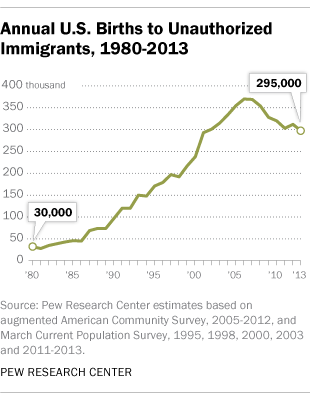
About 295,000 babies were born to unauthorized-immigrant parents in 2013, making up 8% of the 3.9 million U.S. births that year, according to a new, preliminary Pew Research Center estimate based on the latest available federal government data. This was a decline from a peak of 370,000 in 2007.

Annual U.S. Births to Unauthorized Immigrants, 1980-2013Births to unauthorized-immigrant parents rose sharply from 1980 to the mid-2000s, but dipped since then, echoing overall population trends for unauthorized immigrants. In 2007, an estimated 9% of all U.S. babies were born to unauthorized-immigrant parents, meaning that at least one parent was an unauthorized immigrant.

The 14th Amendment to the U.S. Constitution, adopted in 1868, grants an automatic right of citizenship to anyone born in the United States. But in recent years, some politicians have called for repeal of birthright citizenship, including Republican presidential candidate Donald Trump, who says that so-called anchor babies are a magnet for illegal immigration.

A Pew Research survey in February 2011 found that a majority of Americans (57%) opposed changing the Constitution to end birthright citizenship, while 39% favored such a change. That same survey found that most Americans (87%) said they were aware of the constitutional guarantee of birthright citizenship.

Number and Share of U.S. Births to Unauthorized Immigrants, 1980-2013There were an estimated 11.3 million unauthorized immigrants living in the U.S. in March 2013, according to a preliminary Pew Research estimate. They make up 4% of the population, but their share of births is higher because the immigrants include a higher share of women in their childbearing years and have higher birthrates than the U.S. population overall.

These estimates are based on data from the U.S. Census Bureau’s Current Population Survey and American Community Survey, using the widely accepted “residual methodology” employed by Pew Research for many years.

Most children of unauthorized immigrants in the U.S. are born here, and therefore are citizens. In 2012, there were 4.5 million U.S.-born children younger than 18 living with unauthorized-immigrant parents. There also were 775,000 children younger than 18 who were unauthorized immigrants themselves and lived with unauthorized-immigrant parents. These totals do not count U.S.-born children of unauthorized immigrants who do not live with their parents.

The nation’s unauthorized immigrants are more likely than in the past to be long-term residents of the U.S., and are increasingly likely to live with U.S.-born children. In 2012, there were 4 million unauthorized-immigrant adults who lived with their U.S.-born children, both minor and adult. They made up 38% of unauthorized immigrant adults. By comparison, in 2000, 2.1 million unauthorized-immigrant adults, or 30% of this group, lived with their U.S.-born children, minor and adult.

These new estimates, which include a 2008 estimate of 355,000 births to unauthorized-immigrant parents, differ slightly from a previous estimate for 2008 of 340,000 births to unauthorized parents, because they use different data sources and methodology.

Source: Number of babies born in U.S. to unauthorized immigrants declines | Pew Research Center

A Wide Gulf Persists Between Black And White Perceptions Of Policing : NPR

Not surprising but nevertheless revealing, both in terms of the differences and the similarities:

A new study highlights differences between the races as they view the recent spate of deadly encounters between blacks and law enforcement.

A survey by the Pew Research Center finds only a third of blacks and nearly three-quarters of whites say police in their communities do an excellent or good job using appropriate force.

From Pew’s report:

“Most whites (75%) say their local police do an excellent or good job when it comes to using the right amount of force for each situation. Only 33% of blacks share this view; 63% say the police do only a fair or poor job in this area. About six-in-ten Hispanics (62%) say their community’s police are doing at least a good job in this area, while 35% say they are doing only a fair or poor job.

When it comes to treating racial or ethnic groups equally, 35% of blacks say the police department in their community does an excellent or good job, compared with 75% of whites. Conversely, about a quarter (23%) of blacks say their police department does only a fair job and about four-in-ten (38%) say they do a poor job. (Among whites, about a quarter – 24% – say their department does only a fair job or a poor job in treating racial and ethnic groups equally.) Roughly six-in-ten Hispanics (58%) say their local police are doing an excellent or good job in this area, while 38% say they are doing only a fair or poor job.”

The two races come to different conclusions about the reason for fatal incidents. About 8-in-10 blacks (79 percent) say the recent deaths are a sign of systemic problems between police and the black community, compared to 54 percent of whites.

The survey was conducted online and by mail with 4,538 U.S. adults between Aug. 16 and Sept. 12. The poll came before protests of a Sept. 16 shooting in Tulsa, Okla., as well as the fatal shooting of a black man in Charlotte, N.C. That shooting on Sept. 20 set off two nights of protests.

Both groups favor the use of body cameras by police to record encounters when dealing with the public. Overall, only about a third of all those surveyed have a “lot of confidence” in their own police department.

USA: The black-white wage gap can be explained in a word: discrimination : NPR

The latest of studies showing the impact of discrimination:

Racial discrimination, it seems, is like the salt that’s left in a pot after water boils away — much easier to identify in the absence of the other things.

That was one of the big takeaways from a report released this week by the Economic Policy Institute, a think tank in Washington, D.C. Researchers were studying the longstanding black-white wage gap, and their findings were grim: The distance between what white Americans and black Americans earn is larger than it’s been in almost 40 years.

I talked to Valerie Wilson, who analyzes race and the economy for the institute. She told me that the wage gap has grown and shrunk over the years and has lingered in both boom and lean times. While it once varied by region — smallest in the Midwest and largest in the South — the gap is now more or less uniform across the country. It’s been a chronic blemish on our economy.

And the major reason, Wilson said? Not education. Not work experience. Not whether you live on a farm or in a downtown apartment complex. It’s discriminationand it’s borne out in the data.

I was curious when she said this. How would you even measure discrimination when the people doing it don’t tend to advertise it, and the people being discriminated against often don’t know it’s happening? How do you detect something that is essentially invisible?

“The way that we measure discrimination in this report,” Wilson said, “is that it’s the portion of the gap that remains after we control for all the other factors that would reasonably influence one’s earnings.”

Here’s the crux of the matter via the report:

“During the early 1980s, rising unemployment, declining unionization, and policies such as the failure to raise the minimum wage and lax enforcement of anti-discrimination laws contributed to the growing black-white wage gap. During the late 1990s, the gap shrank due in part to tighter labor markets, which made discrimination more costly, and increases in the minimum wage. Since 2000 the gap has grown again.”

The researchers didn’t try to describe the ways widespread discrimination caused the wage gap, but we have some ideas. There’s the much-cited 2003 study where applicants with resumes boasting “black-sounding” names — Lakisha, say, or Jamal — were less likely to get callbacks for jobs. And then there’s this 2014 study by three prominent economists that analyzed the job searches of nearly 5,200 newly unemployed people in New Jersey:

“First, black job seekers were offered significantly less compensation than whites by potential new employers. Second, blacks were much more likely to accept these lower offers than their white counterparts.”

Interestingly, the economists also found that the racial gap in pay narrowed over time if employees stayed at the same company; that is, once the company became more comfortable with those black hires. But that also means that black folks have to stay with one employer longer to catch up with the wages of their white coworkers.

That finding dovetails with data from the EPI study, which pointed out that black college graduates enter the workforce making less than white college graduates. Taken together, black people are starting their work lives with potential employers deciding whether their names disqualify them, with fewer job prospects and with lower entry-level wages. Discrimination, then, is part of the experience of black workers long before and long after they’re hired.

Source: The black-white wage gap can be explained in a word: discrimination : Code Switch : NPR

Immigrants Aren’t Taking Americans’ Jobs, New Study Finds – The New York Times

Worth noting, but unlikely to convince those who believe otherwise:

Do immigrants take jobs from Americans and lower their wages by working for less?

The answer, according to a report published on Wednesday by the National Academies of Sciences, Engineering and Medicine, is no, immigrants do not take American jobs — but with some caveats.

The question is at the heart of the furious debate over immigration that has divided the country and polarized the presidential race. Many American workers, struggling to recover from the recession, have said they feel squeezed out by immigrants.

Donald J. Trump, the Republican nominee, has called for a crackdown on illegal immigrants, saying they “compete directly against vulnerable American workers.” He promises to cut back legal immigration with new controls he says would “boost wages and ensure open jobs are offered to American workers first.”

Hillary Clinton, his Democratic rival, takes an upbeat view, saying immigrants contribute to the economy whether they are here legally or not, by providing labor for American employers and opening businesses that create jobs for Americans rather than taking them.

The report assembles research from 14 leading economists, demographers and other scholars, including some, like Marta Tienda of Princeton, who write favorably about the impacts of immigration and others who are skeptical of its benefits, like George J. Borjas, a Harvard economist. Here’s what the report says:

• “We found little to no negative effects on overall wages and employment of native-born workers in the longer term,” said Francine D. Blau, an economics professor at Cornell University who led the group that produced the 550-page report.

• Some immigrants who arrived in earlier generations, but were still in the same low-wage labor markets as foreigners just coming to the country, earned less and had more trouble finding jobs because of the competition with newer arrivals.

• Teenagers who did not finish high school also saw their hours of work reduced by immigrants, although not their ability to find jobs. Professor Blau said economists had found many reasons that young people who drop out of high school struggle to find work. “There is no indication immigration is the major factor,” she said.

• High-skilled immigrants, especially in technology and science, who have come in larger numbers in recent years, had a significant “positive impact” on Americans with skills, and also on working-class Americans. They spurred innovation, helping to create jobs.

“The prospects for long-run economic growth in the United States would be considerably dimmed without the contributions of high-skilled immigrants,” the report said. It did not focus on American technology workers, many of whom have been displaced from their jobs in recent years by immigrants on temporary visas.

The report asked another question Americans are debating: Do immigrants burden government budgets?

That answer is “more mixed,” Professor Blau said.

• The first generation of newcomers generally cost governments more than they contribute in taxes, with most of the costs falling on state and local governments, mainly because of the expense of educating the children of immigrant families.

For those governments, total annual costs for first-generation immigrants are about $57 billion. But by the second generation in those families, immigrants, with improved education and taxpaying ability, become a benefit to government coffers, adding about $30 billion a year. By the third generation, immigrant families contribute about $223 billion a year to government finances.

• In the last two decades, the number of immigrants in the country increased 70 percent to about 43 million people; they are now 13 percent of the population. One in every four Americans is either an immigrant or the child of one. And since 2001, about one million immigrants have come legally to the United States each year.

The report called immigration “integral to the nation’s economic growth” because immigrants bring new ideas and add to an American labor force that would be shrinking without them, helping ensure continued growth into the future.

Jersey hospital selling U.S. citizenship with ‘AmeriMama program’ – Trump was right about abuse! | BizPac Review

While I don’t believe that the numbers show that birthright citizenship abuse is so widespread (certainly not in Canada), it is not surprising that there are some institutions and consultants that ‘market’ birthright citizenship.

In general, better data collection and  regulatory approaches are needed before abandoning birthright citizenship:

Donald Trump called attention to abuses of birthright citizenship for children of illegal immigrants early on in the Republican primary and a story out of New Jersey shows just how right the GOP nominee is on the issue.

A New Jersey hospital is tempting pregnant women in Russia to come to America to deliver their babies, and for a paltry sum of $10,000 or less, not only will they get superior medical care, but their children are born American citizens with all the privileges that come with it, Fox News reported.

“Childbirth in New York is the best investment in the future of your family!” reads the Russian-language AmeriMama website.

The “AmeriMama” program at Meadowlands Hospital Medical Center, first reported by NJ Spotlight, is part of a lucrative and controversial business called “birth tourism,” the practice of soliciting pregnant women from other countries to deliver their children in the U.S. — automatically making them American citizens — before they return home.

But the Secaucus, N.J., hospital has taken it to a brazen new level, say immigration experts.

For fees ranging from $8,500 to $27,500, the Russian-language website for AmeriMama promised to secure citizenship papers, passports, and travel visas for the baby, according to NJ Spotlight, which reported on the program in August.

The Center for Immigration Studies says this may be the first American for-profit hospital to openly market U.S. citizenship.

“They claim they’re selling their hospital services, but the unspoken benefit of this is that the child gets a U.S. passport and U.S. citizenship,” explained Jessica Vaughan, the center’s director of policy studies.

“This is essentially U.S. citizenship up for sale,” she added. “And this is the first time I’ve seen a hospital itself market to this customer base.”

The AmeriMama website and its Facebook page were removed soon after being exposed last month by NJ Spotlight.

Source: Jersey hospital selling U.S. citizenship with ‘AmeriMama program’ – Trump was right about abuse! | BizPac Review

US temporarily freezes EB-1 citizenship visa for China and India as applicants hit the limit – Firstpost

Does appear to be shortsighted and the number of 7 percent maximum per country arbitrary:

A sought-after visa that offers a speedy path to US citizenship is temporarily closed to Chinese and Indian nationals. The US State Department announced it would stop processing EB-1 applications from Indian and Chinese nationals until later in October.

Immigration lawyers explained that the EB-1 visa is available to three categories of candidates: people with extraordinary abilities in arts, science and business; researchers and professors; and multinational business executives and managers.

EB-1 visas are typically limited to 40,135 for this fiscal year, and no more than 7 percent can go to immigrants from any one country. Currently, we have a problem because there are too many Indian and Chinese trying to get their hands on the EB-1, exhausting the limit. The last time this happened was back in 2007.

Representational image. Reuters

Representational image. Reuters

“Why do we continue to artificially limit this program?” asked immigration lawyer David Parker. “It defies logic that we are turning away extraordinary and outstanding artists, scientists and business people from India and China,” he added.

The EB-1 visa typically results in a green card in less than a year — one of the quickest pathways to receive one. And unlike many visas, some kinds of EB-1 visas don’t require applicants to be sponsored by employers. This is a godsend as it gives talented artists and brilliant scientists frustrated with the more traditional path to US citizenship, like the H-1B visa, a speedy alternative.

The H-1B is one of the most heavily used visas by Indian techies and professionals. Demand far exceeds the annual allotment. The H-1B requires workers to be sponsored by an employer and leaves applicants at the whim of lotteries. This year demand for H-1B visas surpassed the entire year’s allocation within five days and the US government ultimately awarded H-1Bs through a computer generated random lottery.

“A lot of people saw the EB-1 as the light at the end of the tunnel,” Shah Peerally, who heads up an immigration law firm in Newark, California, told CNN.

Source: US temporarily freezes EB-1 citizenship visa for China and India as applicants hit the limit – Firstpost

Study: The Growing, Disproportionate Number Of Women Of Color In U.S. Jails : NPR

In Canada, 15 percent of those admitted to provincial/territorial prisons are women. For Indigenous peoples, the number is 20 percent for federal admissions, 24 percent for provincial/territorial admissions (Indigenous females accounted for a higher proportion of female admissions to provincial/territorial sentenced custody (36%) than did Aboriginal males (25%):

To be sure, the jail population is mostly male. Women represent 15 percent of the jail population in smaller counties, and slightly less in larger counties. But according to the study, the overall population of women in jails has ballooned since the 1970s, from just under 8,000 to nearly 110,000 nationwide in 2014, with low-income women of color disproportionately represented — 64 percent of women in jails across the country are women of color.

And while local jail populations are among the fastest growing correctional populations for both men and women, the U.S. Department of Justice reports that from 2000 to 2010, the female jail population grew at a faster rate than the male population.

….Swavola said existing research does not clearly explain the fast growth of the women’s population in small-county jails, but she pointed out that smaller counties can have fewer resources for social services, mental health resources and employment opportunities. “In those communities, they rely on incarceration to deal with people with mental and behavioral challenges,” says Swavola.

Laurie Garduque, director of Justice Reform for the MacArthur Foundation, which funded the study, says in many places around the country, jails have essentially become warehouses for the poor. Like men, most women in jail ended up there for nonviolent offenses. The study found that in Davidson County, Tennessee, for example, 77 percent of women were booked into jail on misdemeanor charges. The most common charge was failure to appear after receiving a citation.

“Much of the problems that bring women into the criminal justice system…tend to be low-level offenses or nuisance behavior that do not pose a risk to public safety,” says Garduque.

In their analysis, the researchers also found that 32 percent of women in U.S. jails suffer from serious mental illness, including major depression, bipolar disorder and schizophrenia. Garduque says the trauma of being in jail can make it harder to cope with existing mental health problems. She says police officers, corrections officers and other employees in the criminal justice system need better training on how to interact with people with mental illnesses, and that this new research shows that mental health programs need to be more accessible outside of jail.

“Our aim here is not to improve mental health programs in jails,” says Garduque. “Our aim is to provide those resources on the community-based level to prevent women from penetrating the system.”

What’s more, many women enter the jail system having already experienced significant trauma. “There is a history of physical and domestic abuse for a lot of our moms,” says Samuel Luddington, deputy director of programs at Children of Inmates in Miami, which helps incarcerated parents stay connected with their children. Luddington says the current system wasn’t set up to provide that sort of care.

As for life after jail, re-entry programs that are developed with gender in mind are among the most effective, says Swavola, the co-author of study. For instance, Connecticut tried out a pilot probation program along those lines from 2007 to 2010. The project was based on the Women Offender Case Management Model developed by National Institute of Corrections. It was designed to take into account risk factors that girls and women tend to face at higher rates, such as domestic violence and mental illness. and partner abuse. It also encouraged women to have a voice in their own case management.

A review of women on probation who participated in the Connecticut program found those women were about 11 percent less likely to be arrested again after one year compared to women who did not participate in the program.

Source: Study: The Growing, Disproportionate Number Of Women Of Color In U.S. Jails : Code Switch : NPR

Helping College-Bound Native Americans Beat The Odds : NPR

Not as familiar with similar initiatives in Canada as I should be, but university graduation rates for Indigenous peoples in Canada are 13 percent, half of the average rate for all Canadians:

Native American students make up only 1.1 percent of the nation’s high school population. And in college, the number is even smaller. More than any other ethnic or racial group, they’re the least likely to have access to college prep or advanced placement courses. Many get any little or no college counseling at all. In 1998, College Horizons, a small nonprofit based in New Mexico, set out to change that through five-day summer workshops on admissions, financial aid and the unique challenges they’ll face on campus. Its director, Carmen Lopez, sat down with NPR to talk about the obstacles that bright, talented Native students face.
You say there’s an implicit bias among college admissions officials who seldom, if ever, deal with Native American students. Is that why you’ve partnered with 50 top-tier institutions, to “educate them” by inviting them to the student retreats?

Something happens when you’re sitting face to face with a teenage native student and you’re hearing their story.

We give counselors an appreciation for what Native students experience, the inequities they face. Admissions counselors realize, “My gosh, you have only two AP classes you’ve been offered! Your school has never offered any test preparation or you’re not getting any advising!”
After spending time at one of your retreats, I noticed that you repeatedly told students: “You are desirable. Colleges want you. You’re not a number.” But don’t admissions officers rely heavily on GPA, class ranking and standardized test scores?

I want you to want my students because they’re going to contribute to your institution.

A test score, the GPA, the ranking, are things that an admissions officer doesn’t remember. l’m not just looking for a diamond in the rough or the hard-knock life. They’re not always in crisis. They’re doing beautiful, amazing things. And I want colleges to recognize that.

Source: Helping College-Bound Native Americans Beat The Odds : NPR Ed : NPR