Trump win produces only tiny bump in numbers of Americans applying for Canadian #citizenship

Not surprising:

The number of Americans applying for Canadian citizenship jumped slightly after Donald Trump’s election, but numbers are still only half what they were five years ago.

New statistics from Immigration, Refugees and Citizenship Canada obtained by the National Post show an average of 400 U.S. citizens put in their applications in each the first four months of this year, compared to an average of 264 per month in 2016 — including a spike in applications in November, the month Trump was elected.

But overall — despite reports of the immigration website crashing on election night, and earnest tourism campaigns sprouting in Cape Breton, N.S. — the trend line has gone down in the past couple of years.

In the decade since 2007, applications peaked in 2011, with an average of 564 Americans per month applying to become Canadians.

A batch of data to the end of 2016 was obtained through the access-to-information system and newer numbers were provided by Immigration spokesman Rémi Larivière. The numbers do not include Americans who may have moved to Canada recently to become permanent residents, or who already live here — just those who are applying for citizenship to seal the deal.

The website for Immigration, Refugees and Citizenship Canada crashed Nov. 8 while Americans were voting in their presidential election.

In the lead-up to the election, the idea of moving to Canada became a popular tongue-in-cheek reaction to the prospect of either electoral outcome — with Americans deeply divided between supporting Donald Trump or Hillary Clinton, and many apparently voting against one or the other rather than for them. It appeared some were taking it more seriously when the immigration website crashed.

All of the traffic was not necessarily election-related, however. The first day of a new system requiring visa-free travellers to apply for Electronic Travel Authorizations was Nov. 10, and had visitors heading to the site to fill out forms and pay $7 fees.

Source: Trump win produces only tiny bump in numbers of Americans applying for Canadian citizenship | National Post

Donald Trump defies calls to appoint envoy to combat anti-Semitism around the world | The Independent

Interesting that his issue is getting more widespread coverage (Jewish and Israeli media have been covering this extensively). Hard to understand the reluctance to appoint both the envoy and maintain the staff (one can make the argument, as Tillerson has, that special envoys let other officials off the hook but overall, the absence of an envoy and staff means a lower profile domestically and internationally):

Donald Trump has defied calls to appoint a special envoy to combat anti-Semitism across the world despite growing pressure from Jewish groups and Congress.

The two remaining staffers in the US State Department’s office to Monitor and Combat Anti-Semitism are reportedly set to be reassigned next month, which will leave the branch completely unstaffed after 1 July.

Officials are yet to comment on the reported move, but insist they remain committed to fighting discrimination against Jews.

President Trump is legally required to appoint a Special Envoy to Monitor and Combat Anti-Semitism, a position created under former president George W. Bush.

Members of Congress from the Republican and Democrat parties have urged his administration to strengthen the office’s status in letters and proposed bills.

But earlier this month Secretary of State Rex Tillerson told them special envoys were not productive and said appointing one could weaken efforts to tackle anti-Semitism.

The US State Department said they had produced annual reports about human rights and religious freedom before the office was created in 2004, according to the Jewish Telegraphic Agency(JTA).

They told the JTA: “We want to ensure the Department is addressing anti-Semitism in the most effective and efficient method possible and will continue to endeavor to do so.

“The Department of State condemns attacks on Jewish communities and individuals. We consistently urge governments around the world to address and condemn anti-Semitism and work with vulnerable Jewish communities to assess and provide appropriate levels of security.

“The Department, our Embassies, and our Consulates support extensive bilateral, multilateral, and civil society outreach to Jewish communities.

“Additionally, the State Department continues to devote resources towards programs combating anti-Semitism online and off, as well as building NGO coalitions in Europe.

“We also closely monitor global anti-Semitism and report on it in our Country Reports on Human Rights Practices and International Religious Freedom Report, which document global anti-Semitism in 199 countries.”

The Anti-Defamation League has launched an online petition calling for the White House to fill the position.

The group’s CEO John Greenblatt said “maintaining the special envoy for anti-Semitism seems like a no-brainer” in an interview with the JTA.

“The idea of having a dedicated envoy who can travel around the world to raise awareness on this issue is critical,” he added.

Source: Donald Trump defies calls to appoint envoy to combat anti-Semitism around the world | The Independent

Census Finds A More Diverse America, As Whites Lag Growth : NPR

Canadian immigration and diversity numbers will be released this October:

America’s diversity remains on the rise, with all racial and ethnic minorities growing faster than whites from 2015 to 2016, the U.S. Census Bureau says in a new snapshot of the national population. The agency also found the U.S. median age has risen to nearly 38.

Asian and mixed-race people are the two fastest-growing segments of the U.S. population, the U.S. Census Bureau says. Both groups grew by 3 percent from July 2015 to July 2016. In the same 12 months, the non-Hispanic white population grew by just 5,000 people.

Non-Hispanic whites remain the only segment of the U.S. population where deaths outpace births, the agency reports.

“While all other groups experienced natural increase (having more births than deaths) between 2015 and 2016,” the Census says, “the non-Hispanic white alone group experienced a natural decrease of 163,300 nationally.”

The report adds new detail to a picture that’s been coming into focus in recent years. Last summer, for instance, the Census Bureau reported a shift in America’s youngest population, as babies of color outnumbered non-Hispanic white babies.

…In terms of national diversity, here’s the Census Bureau’s rundown. We’ve reordered the agency’s list to sort the groups by growth rate:

  • The Asian population grew by 3.0 percent to 21.4 million.
  • People who identified as being of two or more races grew by 3.0 percent to 8.5 million.
  • The Native Hawaiian and Other Pacific Islander population grew by 2.1 percent to 1.5 million.
  • The Hispanic population (including all races) grew by 2.0 percent to 57.5 million.
  • The American Indian and Alaska Native population grew by 1.4 percent to 6.7 million.
  • The black or African-American population grew by 1.2 percent to 46.8 million.
  • The white population grew by 0.5 percent to 256.0 million.
  • The non-Hispanic white alone population grew by 5,000 people, remaining at 198.0 million.

U.S. Can’t Revoke Citizenship Over Minor Falsehoods, Supreme Court Rules – The New York Times

Same logic would apply in Canadian cases of misrepresentation, whether it was material or not:

The justices unanimously rejected the government’s position that it could revoke the citizenship of Americans who made even trivial misstatements in their naturalization proceedings.

During arguments in April, several justices seemed indignant and incredulous at the government’s hard-line approach in the case, Maslenjak v. United States, No. 16-309.

They asked about a form that people seeking American citizenship must complete. It requires applicants to say, for instance, whether they had ever committed a criminal offense, however minor, even if there was no arrest. A government lawyer, in response to questioning, said that failing to disclose a speeding violation could be enough to revoke citizenship even years later.

Writing for the majority, Justice Elena Kagan said that the law required a tighter connection between the lie and the procurement of citizenship.

“We hold that the government must establish that an illegal act by the defendant played some role in her acquisition of citizenship,” she wrote. “When the illegal act is a false statement, that means demonstrating that the defendant lied about facts that would have mattered to an immigration official, because they would have justified denying naturalization or would predictably have led to other facts warranting that result.”

The case concerned Divna Maslenjak, an ethnic Serb who said she had faced persecution in Bosnia. She was granted refugee status, at least partly on that basis, and became a United States citizen in 2007.

In the process, she made a false statement about her husband, saying she and her family had also feared retribution because he had avoided conscription by the Bosnian Serb military. In fact, he had served in a Bosnian Serb military unit, one that had been implicated in war crimes.

When this came to light, Ms. Maslenjak was charged with obtaining her citizenship illegally. She sought to argue that her lie was immaterial, but the trial judge told the jury that any lie, however significant, was enough. Ms. Maslenjak was convicted, her citizenship was ordered revoked, and she and her husband were deported to Serbia.

The Supreme Court, having ruled that Ms. Maslenjak had been convicted under the wrong standard, returned the case to the lower courts to consider whether the government may try the case again under the stricter standard.

Given the significance of Ms. Maslenjak’s lie, she may lose again in a retrial.

Tillerson retreats from pledge to fill anti-Semitism envoy post | The Times of Israel

While I understand Tillerson’s arguments (Canada has had similar debates over special ambassadors/envoys in the past), the politics will be interesting to watch:

Secretary of State Rex Tillerson retreated from his department’s commitment to fill the post of envoy to combat anti-Semitism, saying the effort may be more effective without one.

“One of the questions I’ve asked is, if we’re really going to affect these areas, these special areas, don’t we have to affect it through the delivery on mission at every level at every country?” Tillerson said in testimony Wednesday to the foreign operations subcommittee of the US House of Representatives Appropriations Committee. “And by having a special envoy, one of my experiences is, mission then says, ‘oh, we’ve got somebody else that does,’ and then they stop doing it.”

Since Congress established the position with a 2004 law, the role of the envoy has been to train career State Department officers and diplomats in identifying and combating anti-Semitism and to encourage embassies and bureaus to more closely monitor anti-Semitism. The envoy has not functioned as a stand-alone entity but rather is part of the Bureau of Democracy, Human Rights and Labor, and supervises about five career State Department staffers.

European Jewish community officials have said that having an envoy has delivered a message to their governments that the United States is focused on anti-Semitism.

At the subcommittee hearing, Rep. Grace Meng, D-N.Y., asked Tillerson for a timeline for the hire. Earlier this year there were reports that the Trump administration, eyeing massive budget cuts to the State Department, planned to eliminate the role. National Jewish groups and Congress members expressed outrage, and in April a State Department spokesman told JTA that the department did not in fact plan to eliminate the position and was reviewing candidates to fill it.

Lawmakers have noted that because the role was created by statute, the Trump administration cannot eliminate the post. Tillerson said he would seek to persuade Congress to cut the position if he deems it necessary.

“Those that are mandated by statute, we will be back to talk with you about those as to whether we think it’s good to have it structured that way or whether we really think we can be effective on those issues in a different way,” he said at the hearing.

Rep. Nita Lowey, D-N.Y., the ranking Democrat on the foreign operations subcommittee, was appalled by the possibility of the position being eliminated.

“It is outrageous and offensive that Secretary Tillerson would even suggest appointing a Special Envoy for Monitoring and Combating Anti-Semitism is unnecessary, particularly given that his State Department committed to filling the post back in April,” she said in an email to JTA. “As reports of hate crimes against Jews continue to rise in the United States and around the world, it is essential that Secretary Tillerson fill the Special Envoy position immediately.”

Bipartisan legislation under consideration would enhance the position to ambassador level.

Source: Tillerson retreats from pledge to fill anti-Semitism envoy post | The Times of Israel

How Interracial Love Is Saving America – The New York Times

Good article by Sheryll Cashin, a law professor at Georgetown, on how increasing rates of inter-marriage and mixed unions is impacting on society and attitudes:

Today, the “ardent integrators” who pursue interracial relationships are motivated by love and are our greatest hope for racial understanding. Although America is in a state of toxic polarity, I am optimistic. Through intimacy across racial lines, a growing class of whites has come to value and empathize with African-Americans and other minorities. They are not dismantling white supremacy so much as chipping away at it.

Fifty years ago next week, on June 12, 1967, Mildred and Richard Loving won their landmark Supreme Court case, Loving v. Virginia, ending state bans on interracial marriage. Mildred was a homemaker of indigenous and black heritage, cast as a Negro by Jim Crow. Richard was a white brick mason who drag-raced cars with similarly mixed-race friends. They lived in Central Point, a rural hamlet with a history of racial mixing that began in the colonial era, and they were considered felons under Virginia’s Racial Integrity Act of 1924.

Such miscegenation bans were a relic of slavery. When wealthy planters transitioned from largely white indentured servitude to black chattel slavery in the second half of the 17th century, they feared that poor whites who labored alongside slaves and sometimes took them as lovers would rebel with them or help them escape.

Miscegenation laws in as many as 41 states helped to keep these dangerous whites from subverting slavery, and later Jim Crow. As Chief Justice Earl Warren wrote in the unanimous Loving opinion, such laws were an instrument of “White Supremacy” — the first time the Supreme Court used those words to name what the Civil War and the 14th Amendment should have defeated.

Today the race mixing that supremacists feared is growing apace, and interracial dating, marriage, adoption and friendship are occurring at rates that were unfathomable 50 years ago.

As of the 2010 census, the most reliable recent source, around 24 percent of adopted children in the United States were placed with a parent of a race different from their own, up from 17 percent in 2000. Christian groups in red states are part of this trend.

About 17 percent of new marriages and 20 percent of cohabiting relationships are interracial or interethnic. About one-quarter of Americans have a close relative in an interracial marriage. In the most recent Pew Research Center survey, 91 percent of respondents said that interracial marriage was a change for the better or made no difference at all.

Whites and blacks are still less likely to intermarry — they make up about 11 percent of newlywed heterosexual couples — but acceptance is growing. For whites in particular, intimate contact reduces prejudice. Whites with reduced prejudice, in turn, have a worldview similar to that of many minorities; that is, they support policies designed to reduce racial inequality.

Those who think of white people in monolithic terms miss this nuance. A small study of whites married to blacks documented increased understanding of racism. And those married to nonblack minorities were likely to experience a shift in their thinking about immigration.

This transition from blindness to sight, from anxiety to familiarity, is a process of acquiring “cultural dexterity.” Love can make people do uncomfortable things, like meeting a black lover’s family and being the only white person in the room. Culturally dexterous people have an enhanced capacity for intimate connections with people outside their own tribe, for recognizing and accepting difference rather than pretending to be colorblind. And if one undertakes the effort, the process is never-ending.

One need not marry or adopt a person of another race to experience transformational love. Close friendships across group boundaries have been shown to reduce prejudice, ease anxiety and enhance willingness to engage in the future.

Ardent integrators also transfer benefits to the less dexterous people in their tribe. Attitudes can be improved merely by knowing that someone has a close friend from another group.

Social psychologists have even documented that people can develop virtual ties with a fictional character or, say, a black president, in ways that reduce prejudice. As the media represents more diverse racial experiences with shows like “Black-ish,” it will further humanize others.

A Bargain Price on American Citizenship – Diplomatic Courier

Another good analysis of the US EB-5 immigrant investor program:

Of all the innovations and new products that have breached the competitive global market, U.S. citizenship is now one of them. As part of a sales pitch presented at an investment conference in Beijing, Nicole Kushner Meyer (sister of Jared Kushner, President Trump’s son-in-law and a top White House adviser) offered American citizenship in return for a $500,000 investment.

The only scandal about this is that the offer is completely legal. How? Through the EB-5 visa program. According to U.S. Citizenship and Immigration Services website, this 25-year-old EB-5 Immigrant Investor Program grants immigrants a path to a green card if they invest $1 million into a project that creates 10 or more U.S. full-time jobs. However, the minimum investment price drops to $500,000 if the development is “within a high-unemployment area or rural area in the United States.”

After two years, a foreign investor with an EB-5 visa can prove he or she put $500,000 into a developing or high unemployment area and created ten American jobs. Once that proof is confirmed, the investor is finally issued a Green Card, meaning permanent residency status that transforms into citizenship after five years. Fast and easy, if you have the money.

While Nicole Kushner Meyer’s dropping of her brother’s name and political ties have stirred up an ethical debate, the United States is not the only nation to advertise residency via an EB-5-esque immigration program. So you want to be a citizen of the Netherlands? That’ll $1.4 million, please. What about France? $10 million and a two-month wait. According to a studyby Allison Christians, citizenship by investment around the world range from $5.4 million in Russia to as low as $5,000 in Paraguay. On average, the price of citizenship is approximately $1 million internationally. However, the program has been accused of being susceptible to fraud and abuse with little oversight. Developers, such as the Kushner Company, can get investments offering very low rates of return because the investors are getting something they care about even more: U.S. citizenship.

While the EB-5 offers a simplified and expedited route to citizenship, the unfortunate truth is that for many entering the United States, $1 million is not exactly petty pocket cash that can be thrown into an ambiguous investment. It seems that the path to citizenship is different for those bringing economic capital and jobs into the country. Their stimulation of the domestic economy is so valued that the government rewards their investment in America’s continued growth with U.S. citizenship. A Department of Commerce review of EB-5 shows that in calendar years 2012 and 2013, more than 11,000 immigrant investors provided $5.8 billion in capital, roughly 35% of the total investment ($16.7 billion), for 562 EB-5 related projects, creating an estimate total of 174,039 jobs. In essence, the government is financing private real estate developers.

Although the EB-5 visa program received bipartisan support for its termination at the end of April, President Trump recently signed a bill to extend that program through the end of September. While attracting foreign investment and generating jobs in the U.S. is undoubtedly supported, advocates for the end of EB-5’s exploitation propose better options, like thoughtful tax and regulatory policies that open the U.S. for more pro-business opportunities rather than through the sale of something quite invaluable: the right—and privilege—to be an American citizen.

Source: A Bargain Price on American Citizenship – Diplomatic Courier

USA: Why Colleges Already Face Race-Related Challenges In Serving Future Students : NPR

Good analysis, showing ongoing stratification in post-secondary education and an interesting nuance of the Asian American ‘myth of being a model minority’:

Today, more Americans graduate high school and go on to college than ever before. But as the country becomes more diverse — the Census Bureau expects that by 2020 more than half of the nation’s children will be part of a minority race or ethnic group— are colleges and universities ready to serve them?

“If you look at the past 50, almost 60 years, you see we have made a lot of progress as a country in terms of high school seniors deciding to go to college in the 1.5 years after graduating,” says Andrew Nichols, director of higher education research and data analytics at the Education Trust, a nonprofit. “And that isn’t just white students. It’s also for black and Latinos. You’re seeing that increase for everybody.”

The National Center for Education Statistics reports that in 2015, 88 percent of seniors – nearly 3 million students – graduated high school. By the following October, 69 percent of them – or more than 2 million people – were enrolled in college.

But where are they attending? And do they graduate?

The same is true for Asian Americans, says Robert Teranishi, a professor of education at UCLA and the director of the National Commission on Asian American and Pacific Islander Research in Education (CARE). The largest concentration of Asian-American students – about half – attends community colleges, he says. It’s also where enrollment of Asian Americans is increasing the fastest.

But because community colleges have low six-year graduation rates (39 percent according to a report by the American Association of Community Colleges), this means that few of those students will actually earn degrees. “The problem is there’s not a lot of expansion in higher education,” Teranishi says. As a result, some students end up in subpar schools where they may never earn a degree. “A lot of students are relegated to two-years or they’re ending up in four-year institutions that are not doing a good job at helping students succeed and earn a degree,” he says. “They’re being set up in a bad situation.”

Meanwhile, the nation’s selective institutions — the Ivy Leagues and flagship public universities — are becoming even more selective, and remaining mostly white. According to the 2013 report “Separate & Unequal” from the Georgetown Center for Higher Education and the Workforce, since 1995, 80 percent of America’s white college students have enrolled in the country’s 468 most well-funded, selective four-year colleges and universities. These schools spend two to nearly five times as much per student as do the 3,250 less resourced, open-access colleges (which do not require applications) where students of color are concentrated.

The study also found that while inequalities of race and class overlap quite a bit, race has a distinctive negative effect. Even after controlling for academic achievement in high school, black and Latino students attend selective institutions at far lower rates and drop out of college more often.

As a result, whites have higher graduation rates and are more likely to attain advanced degrees and higher future earnings, even among equally qualified students. Anthony Carnevale, the director of the center and one of the authors of the report, told NPR in 2013 that, “We found … that while more and more minorities are going on to college, that the system itself was becoming even more unequal. That is, we were getting more and more access, and access was bringing more and more inequality, and the inequality mattered.”

For Asian Americans, a false perception persists that they’re universally high achieving. Teranishi says that they’re treated as a homogenous group even though there are many ethnic subgroups, and that there’s not enough data tracking subgroups. A 2011 report by CARE found that up to two-third of Southeast Asians and Pacific Islanders in the United States don’t have any form of post-secondary education and that for the ones who do enter college, half drop out.

“They’re generally overlooked and underserved when it comes to college opportunity programs, college access, or even student services or programs on campus,” Teranishi says. “And really, it’s rooted in this model-minority myth. There’s not a lot of understanding about their actual experiences or outcomes.”

Teranishi finds it disconcerting that Asian Americans are used as a wedge group against other people of color and says these claims of discrimination have scant evidence. “It’s not like Harvard can admit every student who is in the top of their class with a 4.0 GPA or who has a perfect SAT. That outnumbers the number of students Harvard admits each year. There’s a lot more criteria involved in the selection process,” he says.

“The other thing that concerns me is that this narrative … removes Asian Americans from the broader discourse about the importance of diversity and equity in higher education. So that’s concerning because Asian Americans, like other students, they benefit from being exposed to students of other racial backgrounds.”

Several studies have shown that diverse student bodies benefit students of all races by improving intellectual engagement, citizenship, and cognitive skills. The positive effects stay with them even after they graduate college.

Source: Why Colleges Already Face Race-Related Challenges In Serving Future Students : Code Switch : NPR

New Jersey Town Used Zoning to Discriminate Against Islam – The New York Times

Courts worked:

At issue was an official demand that the mosque provide 107 parking spots for its 150 worshipers, instead of the ratio of one spot for every three users required of the township’s churches, synagogues, restaurants and auditoriums.

The Planning Board’s parking requirement for the mosque set off an avalanche: If the Islamic Society were to devote as much of its land to parking as the board demanded, it would not be able to comply with mandates for drainage and lighting.

“Are both synagogues and mosques considered churches under the definitions that the township operates under?” Judge Shipp asked.

Photo

Mohammad Ali Chaudry, president of the Islamic Society of Basking Ridge, at the site of the proposed mosque last year. CreditKarsten Moran for The New York Times

Mr. Mankoff: “No.”

Judge Shipp: “Is a mosque considered a church?”

Mr. Mankoff: “No.”

Judge Shipp: “So it is different?”

Mr. Mankoff: “Yes, your Honor.”

How so, the judge wanted to know. Mr. Mankoff said that mosques were busy on Friday evenings, rather than on Sundays.

Judge Shipp probed the implications of that answer.

“Is the board, in essence, adopting a policy that expressly applies different standards based on religion?” he asked.

“It’s not based on religion,” Mr. Mankoff said. “It’s based simply on the parking needs of the applicants.”

The judge did not accept that. “Counsel, you just stood there and told me that when you look at a mosque, you’re looking at a Friday worship,” Judge Shipp said. “When you look at Christian churches, you’re looking at a weekend worship.”

A lawyer for the Islamic Society, Adeel A. Mangi of Patterson Belknap Webb & Tyler, pointed out that the township’s synagogues did not have the same severe parking requirements. “They pray on a Friday, too,” Mr. Mangi said.

Over nearly four years, the proposed mosque was the subject of 39 hearings. Beneath the technical land-use discussions in public, a sulfurous tone was captured in emails that the Justice Department uncovered.

“As a religion, Islam owes its size and influence to a tradition from Day 1 of forced conversions through violent means,” wrote John Malay, who served on both the Planning Board and the Township Committee. Members of the two bodies discussed ways to exclude the president of the Islamic Society, Mohammad Ali Chaudry, a former mayor of the township, from a Sept. 11 commemoration. John Carpenter, a member of the Township Committee, wrote of President Obama: “Man child. The product of fools, raised by idiots and coddled by affirmative action. Behold the beast.”

None of these materials were part of Judge Shipp’s decision, which was based entirely on the filings made by the township itself.

Michael Turner, a spokesman for the township, said that many people served their township without compensation. They have the power and responsibility to shape the place where they live. In the case of Bernards Township, Judge Shipp found, it was too much.

“The Parking Ordinance unambiguously provides the Planning Board with unbridled and unconstitutional discretion,” he wrote.

Steep Rise In Interracial Marriages Among Newlyweds 50 Years After They Became Legal : NPR

Integration:

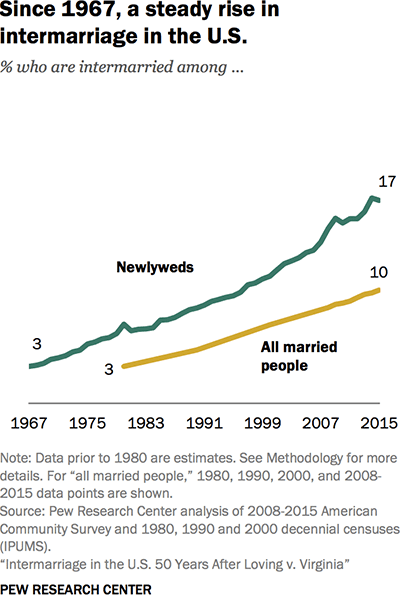
Close to 50 years after interracial marriages became legal across the U.S., the share of newlyweds married to a spouse of a different race or ethnicity has increased more than five times — from 3 percent in 1967, to 17 percent in 2015, according to a new report by the Pew Research Center.

Chart: Intermarriage among newlyweds has risen from 3% to 17% since 1967

The Pew report comes about a month before the 50th anniversary of the U.S. Supreme Court ruling in Loving v. Virginia. Mildred Loving, a part-Native American, part-black woman, and Richard Loving, a white man, landed in a Virginia county jail for getting married. Today, one in six newlyweds marry someone outside their race, which appears to allude to a more accepting society.

Among adults who are not black, there’s a shrinking share of those who say they would be opposed to having a close relative marrying someone who is black — from 63 percent in 1990, to 14 percent in 2016. The share of people who oppose marriages with Asian or Hispanic people has also dropped from about one in five to around one in ten adults not in those groups. Among those who are not white, the share opposed to a relative marrying a white person has dropped from 7 percent to 4 percent.

Here are some of the other interesting findings from Pew about interracial and interethnic marriages:

Asian and Latino newlyweds are more likely to marry outside of their race or ethnicity than black and white newlyweds

More than a quarter of Asian newlyweds (29 percent) and Latino newlyweds (27 percent) are married to a spouse of a different race or ethnicity. Those rates go up even higher for those born in the U.S. — to 46 percent for Asian newlyweds and 39 percent for Hispanic newlyweds.

Interracial and interethnic marriages are more common among college-educated black and Latino newlyweds, but not among white or Asian newlyweds

While educational level is not a major factor for white newlyweds, black and Latino newlyweds with at least a bachelor’s degree are more likely to have a spouse of a different race or ethnicity than those with some college experience or less education. That educational gap is starkest among Latino newlyweds. As the authors of the Pew report, Gretchen Livingston and Anna Brown, write: “While almost half (46 percent) of Hispanic newlyweds with a bachelor’s degree were intermarried in 2015, this share drops to (16 percent) for those with a high school diploma or less – a pattern driven partially, but not entirely, by the higher share of immigrants among the less educated.”

But among Asian newlyweds, those with some college experience (39 percent) are more likely to marry someone of a different race or ethnicity than those with a bachelor’s degree or higher (29 percent) or with a high school diploma or less (26 percent). “Asian newlyweds with some college are somewhat less likely to be immigrants, and this may contribute to the higher rates of intermarriage for this group,” the Pew report suggests. But it also notes that this trend also holds true for Asian newlyweds who were not born in the U.S.

Democrats are far more likely than Republicans to say that the increase of interracial marriages is good for society

There is a stark political split in how people feel about interracial marriage. About half (49 percent) of Democrats and Democratic-leaning independents say that growing numbers of people marrying others of different races is good for society, compared to more than a quarter (28 percent) of Republicans and Republican-leaning independents. Most Republicans (60 percent) say the rise of interracial marriages doesn’t make much of a difference.