Haitian asylum seekers are about to test Canada’s refugee system in a big way – Macleans.ca

Test for the government in terms of public confidence in the immigration system and the degree to which its outreach and other efforts, particularly in dealing with claims expeditiously, succeed in reducing the flow:

A sixth borough of New York City might just exist; it could be a realm called Limbo. Twenty thousand Haitians live throughout other neighbourhoods but in a state of temporariness, waiting every couple of years to see if the federal government will allow them to renew their temporary protective status—and stay in the United States—for a processing fee of US$495 per person.

In subway stations, a Brooklyn advocate named Herold Dasque distributes flyers asking New Yorkers to lobby government officials to extend the Haitian status America-wide, at least one more time. “You will have 50,000 Haitians who will try to go in hiding,” says Dasque about the consequences of terminating the designation. “They will not go to work, not go to church,” he says. “You don’t go outside.”

Dasque’s campaign didn’t sway the Department of Homeland Security. It announced in late November that it will end the temporary protective status for Haiti, though it will delay deportations until July 2019.

Since the U.S. first warned in May 2017 that it might end the protected status, thousands of asylum seekers, many of them Haitian, have headed for Canada. In 2018, even more are expected to follow, adding pressure to an already backlogged refugee processing system.

Canadian members of Parliament have already begun meeting face-to-face with Haitians and officials in New York, as well as in Florida, attempting to end illegal crossings into Canada—17,000 asylum claimants from around the world were intercepted by the RCMP this year.

Among the recipient cities and towns, Montreal converted its Olympic Stadium into an emergency shelter in August, and about two weeks before that the Canadian Forces set up tents in Cornwall, Ont. As Canada attempts to warn asylum seekers against going with the flow, 2018 may be the year Canada flips its metaphorical welcome mat.

“They have to be aware of the robust immigration law we have in Canada,” says MP Emmanuel Dubourg, a Quebecois Liberal who was born in Saint-Marc, Haiti, and moved to Canada at age 14. He recently travelled to New York where he spoke with city hall officials, held meetings at the Canadian consulate and did an interview with Radio Soleil, the local Haitian radio station. “The goal, it’s to inform them, to tell them what the consequences are if they cross the border illegally.” Canada welcomes immigrants, he tells them, but “it’s not a free ticket to cross the border like this.”

“I don’t even think people would go to that meeting,” says Jeffry House, a human rights lawyer in Toronto, about Ottawa’s outreach efforts. “The number of illegal people who would go to a library to hear some MPs talk about why it’s not a good idea to come—it doesn’t strike me as a crowd-pleaser.” In Montreal, Warren Creates, an immigration and refugee lawyer, also says the delegation won’t reverse the trend. “It’s not going to stop it; it’s not going to stem it; it’s not going to mitigate it,” says Creates. “They’re wise, these communities of people who are fearful. They’ve figured out where they need to go. They’ve figured out the path of least resistance.”

While the number of illegal border migrants is still relatively small, Canada’s refugee system is not equipped to process them. The Immigration and Refugee Board of Canada (IRB) predicts that if its backlog grows as anticipated, claimants arriving in 2021 could wait 11 years for hearings. Between February and October, 6,304 Haitian refugee claims were referred to the IRB and just 298 cases were concluded.

Creates says most migrants won’t start presenting themselves at ports of entry, aware they’d be turned away at those sites due to the Safe Third Country Agreement, which allows Canada to turn back an asylum seeker coming from the U.S. who fails to make a claim first in that country, but only if he or she arrives at an official port of entry. “What worries me most is that in darkness, and storms and winter months, people ill-equipped and not properly clothed . . . they’re being forced into a procedure that they know will allow them entry into Canada and have this fair chance, but at the same time they’re risking their health and their lives.”

The delegation to New York, Creates says, only embellishes the Liberal image of taking action. Haitians will not agree to present themselves at official border crossings, as they are not travelling for business or pleasure, but rather for a home more certain than Limbo.

via Haitian asylum seekers are about to test Canada’s refugee system in a big way – Macleans.ca

The White House Is Seeking a Major Shift of Opinion on Immigration

Moving towards the Canadian and Australian models given priority to the economic class with, of course, falsehoods regarding the percentage of immigrants in jailed (less than non-immigrants) and exaggerations regarding links to terror:

The White House is embarking on a major campaign to turn public opinion against the nation’s largely family-based immigration system ahead of an all-out push next year to move toward a more merit-based structure.

The administration was laying the groundwork for such a drive even before an Islamic State-inspired extremist who was born in Bangladesh tried to blow himself up in Midtown Manhattan on Monday. It is assembling data to bolster the argument that the current legal immigration system is not only ill-conceived, but dangerous and damaging to U.S. workers.

“We believe that data drives policy, and this data will help drive votes for comprehensive immigration reform in Congress,” said White House spokesman Hogan Gidley.

White House officials outlined their strategy this week exclusively to The Associated Press, and said the data demonstrates that changes are needed immediately. But their effort will play out in a difficult political climate, as even Republicans in Congress are leery of engaging in a major immigration debate ahead of the 2018 midterm elections.

The issue is expected to be prominently featured in the president’s Jan. 30 State of the Union address. The White House also plans other statements by the president, appearances by Cabinet officials and a push to stress the issue in conservative media.

The administration was beginning its campaign Thursday with a blog post stressing key numbers: Department of Homeland Security data that shows nearly 9.3 million of the roughly 13 million total immigrants to the U.S. from 2005 to 2016 were following family members already in the United States. And just one in 15 immigrants admitted in the last decade by green card entered the country because of their skills.

Other planned releases: a report highlighting the number of immigrants in U.S. jails, assessments of the immigration court backlog and delays in processing asylum cases, and a paper on what the administration says is a nexus between immigration and terrorism.

Critics have questioned the administration’s selective use of sometimes misleading data in the past.

The proposed move away from family-based immigration would represent the most radical change to the U.S. immigration system in 30 years. It would end what critics and the White House refer to as “chain migration,” in which immigrants are allowed to bring a chain of family members to the country, and replace it with a points-based system that favors education and job potential — “merit” measures that have increasingly been embraced by some other countries, including Britain.

Gidley said that for those looking to make the case that the U.S. is ill-served by the current system, “transparency is their best friend.”

“The more people know the real numbers, the more they’ll begin to understand that this is bad for American workers and this is bad for American security. And quite frankly, when these numbers come out in totality, we believe it’s going to be virtually impossible for Congress to ignore,” he said.

The public is sharply divided on the types of changes President Donald Trump is advocating.

A Quinnipiac University poll in August found that 48% of voters opposed a proposal that Trump has backed to cut the number of future legal immigrants in half and give priority to immigrants with job skills rather than those with family ties in this country. 44% of those polled — including 68% of Republicans — supported the idea.

The White House hopes to see Congress begin to take up the issue early in 2018 — though it has yet to begin discussions with congressional leaders over even the broad strokes of a legislative strategy, officials said.

Trump has laid out general principles for what he would like to see in an immigration bill in exchange for giving legal status to more than 700,000 young people brought to the U.S. illegally as children. These include the construction of a border wall, tougher enforcement measures and moving to a more merit-based legal immigration system. In September, Trump gave Congress six months to come up with a legislative fix to allow the young immigrants known as “Dreamers” to stay in the country, creating an early-2018 crisis point he hopes will force Democrats to swallow some of his hardline demands.

Source: The White House Is Seeking a Major Shift of Opinion on Immigration

Americans revoking travel visas from visitors who plan to claim asylum in Canada

Another push factor for asylum seekers:

American authorities say an ongoing operation along their northern border has led them to revoke U.S.-issued travel visas for thousands of people, most of whom were headed to Canada to claim asylum.

Some, according to a U.S. State Department report, are associated with terrorist groups.

The revocations happened as part of what’s called Operation Northern Watch, which focuses on criminal activity such as visa fraud, human smuggling and terrorist threats at the Canada-U.S. border.

Since the operation began in January 2015, authorities have revoked approximately 2,400 visas that were issued from 85 different American diplomatic posts abroad.

“Although some suspects have committed crimes in the United States, the vast majority of the individuals referred through Operation Northern Watch are individuals intending to claim asylum in Canada or have already claimed asylum,” reads the annual report of the State Department’s diplomatic security service (DSS).

“Included in this group were individuals with ties to designated terrorist organizations.”

In an email, a U.S. State Department official told CBC News the DSS is unable to release information about the terrorist groups and any alleged ties people may have had with them.

The DSS also would not specify how many of the revoked visas belonged to people headed to Canada.

“When speaking to law enforcement, some of the identified subjects admitted that they either attempted to claim asylum in Canada or stated that it was their intention to claim asylum in Canada. For others, the diplomatic security service had reason to believe that they planned to claim asylum in Canada,” wrote the official.

The DSS says every prospective traveller to the United States undergoes extensive security screening but that in some cases “derogatory information” surfaces after someone enters the country.

In late October, Public Safety Minister Ralph Goodale told CBC News how Canadian officials had identified trends where documents identified from certain U.S. embassies and consulates are being misused.

“We have asked them to go back upstream and examine the pattern of these travel documents being issued and how come the people to whom they were issued appear to have had no intention of staying in the United States, but were simply using the documents as vehicles to get into the United States and then make a beeline for the Canadian border,” he said at the time.

Undermines narrative

National security expert Christian Leuprecht said Operation Northern Watch demonstrates how the U.S. understands and is acting on loopholes in its travel visa system.

“At the moment, the Americans realize there’s a Canadian dimension to this,” said Leuprecht, who teaches at Queen’s University and the Royal Military College in Kingston, Ont.

Leuprecht said the annual report also undermines the long-standing narrative that people with ties to terrorist organizations easily enter Canada and head to the United States.

“There’s not really much of a problem in terms of people coming from Canada to the U.S., certainly not since 9/11, because of all the measures we’ve put in place. But we continue to have a challenge with people who are inadmissible and who have ties to illegal organizations, who find their way to the United States and then make their way to Canada,” he explained.

Karine Côté-Boucher, an assistant professor at the University of Montreal criminology school, cautions that terrorist ties aren’t always as scary as they sound.

“What are those ties? To know someone or [be] related to [someone], is sometimes enough to put you on a terrorist watch list. We have kids in Canada who are on no-fly lists right now,” she said.

Côté-Boucher added that just because someone used criminal means to enter Canada, does not mean they intend to do harm.

“Do they have criminal intent? That’s different, right? That’s a different question. There’s nothing in there that suggests to me that people have criminal intent in Canada,” she explained.

Travel visa harmonization

But Leuprecht believes, given the ongoing pattern of human migration, that it’s time for North American leaders to take a co-ordinated approach to travel visas to prevent people from abusing the travel visa system.

After all, he said, Canada and the U.S. already share data on land, sea and air ports of entry.

“We probably need to start sharing data on people who request visas into North America, show that we can jointly assess whether the claims that people are making and the intelligence people are providing are effective, because we can see that people are trying to exploit the travel regime,” he said.

For her part though, Côté-Boucher said she can’t see a good reason to give up sovereignty over who gets to come to Canada. She explained how she feels Canada’s tight border control mechanisms are partly responsible for the rise in irregular border crossings by migrants who are looking for a safe place to live.

“We have introduced so many border control mechanisms in North America right now that we have forced people to go through human smuggling networks, to go through visa fraud,” said Côté-Boucher.

As for Operation Northern Watch, the DSS initiative has already expanded beyond its offices in New York State to Minnesota and Detroit as well as its regional security offices in Ottawa, Montreal, Vancouver and Toronto, where it works with Canadian authorities.

No one from the Canadian departments of Public Safety or Immigration responded to requests for more information about the operation.

via Americans revoking travel visas from visitors who plan to claim asylum in Canada – Politics – CBC News

Poll: Discrimination Against Women Is Common Across Races, Ethnicities, Identities : NPR

Another in the series of NPR polls on discrimination, with the usual richness of data including the “intersectionality” between race and gender:

Discrimination in the form of sexual harassment has been in the headlines for weeks now, but new poll results being released by NPR show that other forms of discrimination against women are also pervasive in American society. The poll is a collaboration with the Robert Wood Johnson Foundation and the Harvard T.H. Chan School of Public Health.

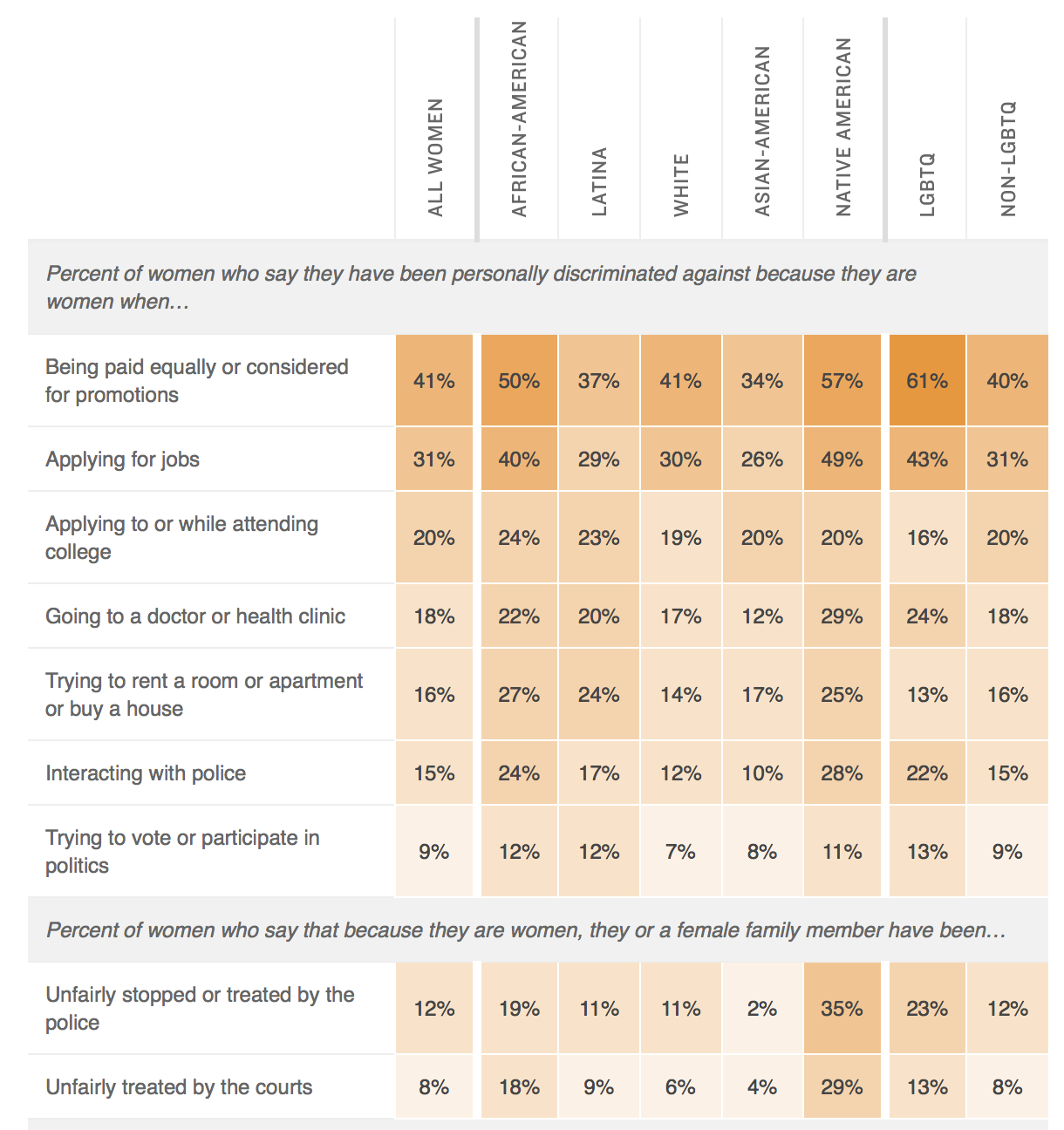
For example, a majority (56 percent) of women believe that where they live, women are paid less than men for equal work. And roughly a third (31 percent) say they’ve been discriminated against when applying for jobs because they are women.

Overall, 68 percent of women believe that there is discrimination against women in America today.

The chart below shows that the experience of gender discrimination is not monolithic — women in each racial, ethnic and identity group have particular problems in employment, education, housing and interactions with law enforcement, the courts and government. Several groups of women also avoid seeking health care out of concern they will face discrimination.

On nearly every measure, Native American women had the highest levels of discrimination based on gender. In our series, “You, Me and Them: Experiencing Discrimination in America,” we have highlighted several of these situations, including unfair treatment by the courts in majority-Native areas.

NPR will livestream an expert panel discussion on Native American issues at noon ET on Tuesday.

One of the patterns that emerged from the poll and our subsequent reporting is a gulf between high- and low-income areas when it comes to experiences of discrimination. This gap is also apparent in the gender data crunched by our Harvard team. The graph below illustrates the stark differences based on income when it comes to several everyday experiences people have in their own neighborhoods.

A snapshot in time

Our poll — which was fielded from late January to early April — before this fall’s intense news coverage of sexual harassment — also captures what women were feeling and experiencing before the recent scandals.

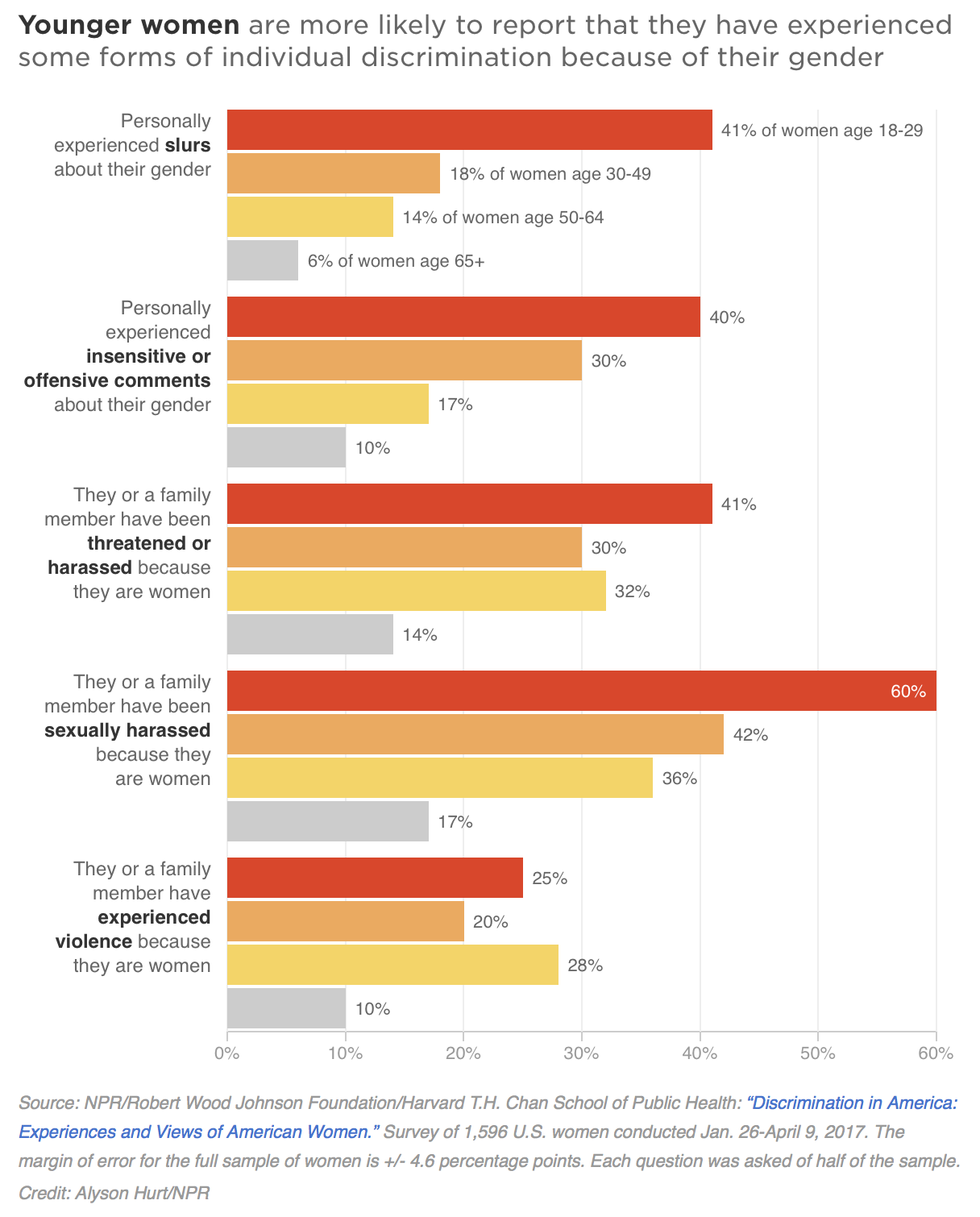
We found that 37 percent women overall reported they or a female family member had been sexually harassed because they are women at some point in their lives. But there was a wide range of responses based on age, with 60 percent of those 18 to 29 years old saying they or a female family member had been sexually harassed because they are women, versus 17 percent of women 65 and over.

“Our survey highlights the extraordinary level of personal experiences of harassment facing women today, as reflected in the news,” says Robert Blendon, co-director of the poll and professor of health policy and political analysis at the Harvard Chan School. “These national conversations may have affected how people viewed or responded to their own experiences in our survey, or their willingness to disclose these experiences.”

Indeed, a poll released last week by Quinnipiac University, asking specifically about sexual assault, suggests women may be more comfortable reporting such experiences now that more women are coming forward and revealing past abuse. (Our poll differs from Quinnipiac in that we asked a broader question: “Do you believe that you or someone in your family who is also a female has experience sexual harassment because you or they are female?”)

The survey from NPR, the Robert Wood Johnson Foundation and the Harvard Chan School was conducted from Jan. 26 to April 9, 2017 among a nationally representative probability-based telephone (cell and landline) sample of 1,596 women. The margin of error for total female respondents is 4.6 percentage points at the 95 percent confidence interval. Complete methodological information is in the full poll report.

via Poll: Discrimination Against Women Is Common Across Races, Ethnicities, Identities : NPR

US expat groups vow to continue fight to end citizenship-based tax regime, repeal FATCA

Despite the efforts, too small an interest group, and not domestically-based, to effect change to date:

After the US Senate voted early on Saturday morning to approve a version of a major tax reform bill that failed to include certain fiercely-fought-for changes that would have benefited expatriate Americans, spokespeople for some of the organisations that lobbied on behalf of these changes said they didn’t regard the battle as over – and that in any event, the fight would go on.

They also stressed that much had been achieved in terms of educating Americans at home and abroad to the issues, and organising and building groups that will continue to work for a change. Said Marylouise Serrato, executive director of the American Citizens Abroad, one of the organisations at the centre of the campaign: “Thanks to everyone’s efforts, the awareness and interest in the topic of residency-based/territorial taxation for Americans overseas is the highest its ever been.”

As reported,  the ACA, along with such other organisations as the Republicans Overseas, the Democrats Abroad, Americans for Tax Reform, the Heritage Foundation and a number of American chambers of commerce have fought hard for months to convince US lawmakers to do away with the current US system of citizenship-based taxation.

Some of these and others, including the Campaign to Repeal FATCA, and certain members of Congress such as Republican Senator Rand Paul of Kentucky, have been campaigning for the US to get rid of the Foreign Account Tax Compliance Act, which has made life difficult for expatriate Americans since it was signed into law by president Obama in 2010.

Saturday’s Senate vote saw 51 Republican lawmakers vote to approve the Senate version of the so-called Tax Cuts and Jobs Act, and 49 senators – all Democrats – voting against it.  Neither a proposal to replace the current citizenship-based tax regime nor one that would have called for the repeal  of FATCA was included in the version that was passed, even though, as reported, such key lawmakers as the Republican head of the House Ways and Means committee, Kevin Brady, had publicly indicated that Washington officials were taking “seriously” the call for a shift away from the citizenship-based income tax system.

via US expat groups vow to continue fight to end citizenship-based tax regime, repeal FATCA

USA: 2020 Census May Ask White People To Get Specific About Their Ethnicity | 90.1 FM WABE

Canada has collected ethnic origin/ancestry data for over 30 years:

“White” has been a constant of the U.S. census.

Other racial categories for the national headcount have come and gone over the centuries. But “white” has stuck ever since U.S. Marshals went door-to-door by horseback for the first census in 1790, tallying up the numbers of “free white males” and “free white females,” plus “all other free persons” and “slaves.”

Census takers determined who counted as “white” or any other race. That changed in 1960, when U.S. residents were first allowed to self-report their race. Since then, just answering “white” has been enough to respond to the race question.

But the upcoming census in 2020 may ask those who identify as white to explore their family tree to share their ethnic background as well. Anyone who checks off the “white” box could also mark boxes for groups such as “German,” “Irish” and “Polish” or write in another option.

That change depends partly on whether the White House approves proposals to modify how the federal government collects race and ethnicity data. They originated when President Obama was still in office, and now it’s up to the Trump administration to approve or reject them. If approved, the Census Bureau may move forward with this new way of asking people of all races about their identities on the 2020 questionnaire.

Friday is the deadline for the White House’s Office of Management and Budget, which sets standards for this kind of data for all federal agencies, to announce its decisions on the proposals. Any policy changes would come at a time of heightened awareness of white nationalist calls against multiculturalism and growing partisan divides over issues about race in the U.S.

Research by the Census Bureau suggests the proposals could produce a more accurate count in 2020. In a report released in February, the bureau’s researchers write that the suggested changes are responding to a public “call for more detailed, disaggregated data for our diverse American experiences as German, Mexican, Korean, Jamaican, and myriad other identities.”

‘It could change the discussion’

Asking white people about their ethnic background is not a new concept for the census. Recent census forms, including the questionnaire used in 2010, have asked all recipients about their ethnicity specifically in terms of “Hispanic, Latino, or Spanish origin.” A question about a person’s ancestry or ethnic origin was first included in the 1980 Census and remained on some forms as recently as 2000. Past forms have asked for a person’s place of birth, the countries where the person’s mother and father were born and languages spoken other than English.

via 2020 Census May Ask White People To Get Specific About Their Ethnicity | 90.1 FM WABE

The French Origins of “You Will Not Replace Us” | The New Yorker

Good long read:

The Château de Plieux, a fortified castle on a hilltop in the Gascony region of southwestern France, overlooks rolling fields speckled with copses and farmhouses. A tricolor flag snaps above the worn beige stone. The northwest tower, which was built in the fourteenth century, offers an ideal position from which to survey invading hordes. Inside the château’s cavernous second-story study, at a desk heavy with books, the seventy-one-year-old owner of the property, Renaud Camus, sits at an iMac and tweets dire warnings about Europe’s demographic doom.

On the sweltering June afternoon that I visited the castle, Camus—no relation to Albert—wore a tan summer suit and a tie. Several painted self-portraits hung in the study, multiplying his blue-eyed gaze. Camus has spent most of his career as a critic, novelist, diarist, and travel essayist. The only one of his hundred or so books to be translated into English, “Tricks” (1979), announces itself as “a sexual odyssey—man-to-man,” and includes a foreword by Roland Barthes. The book describes polyglot assignations from Milan to the Bronx. Allen Ginsberg said of it, “Camus’s world is completely that of a new urban homosexual; at ease in half a dozen countries.”

In recent years, though, Camus’s name has been associated less with erotica than with a single poignant phrase, le grand remplacement. In 2012, he made this the title of an alarmist book. Native “white” Europeans, he argues, are being reverse-colonized by black and brown immigrants, who are flooding the Continent in what amounts to an extinction-level event. “The great replacement is very simple,” he has said. “You have one people, and in the space of a generation you have a different people.” The specific identity of the replacement population, he suggests, is of less importance than the act of replacement itself. “Individuals, yes, can join a people, integrate with it, assimilate to it,” he writes in the book. “But peoples, civilizations, religions—and especially when these religions are themselves civilizations, types of society, almost States—cannot and cannot even want to . . . blend into other peoples, other civilizations.”

Camus believes that all Western countries are faced with varying degrees of “ethnic and civilizational substitution.” He points to the increasing prevalence of Spanish, and other foreign languages, in the United States as evidence of the same phenomenon. Although his arguments are scarcely available in translation, they have been picked up by right-wing and white-nationalist circles throughout the English-speaking world. In July, Lauren Southern, the Canadian alt-right Internet personality, posted, on YouTube, a video titled “The Great Replacement”; it has received more than a quarter of a million views. On great-replacement.com, a Web site maintained anonymously, the introductory text declares, “The same term can be applied to many other European peoples both in Europe and abroad . . . where the same policy of mass immigration of non-European people poses a demographic threat. Of all the different races of people on this planet, only the European races are facing the possibility of extinction in a relatively near future.” The site announces its mission as “spreading awareness” of Camus’s term, which, the site’s author concludes, is more palatable than a similar concept, “white genocide.” (A search for that phrase on YouTube yields more than fifty thousand videos.)

“I don’t have any genetic conception of races,” Camus told me. “I don’t use the word ‘superior.’ ” He insisted that he would feel equally sad if Japanese culture or “African culture” were to disappear because of immigration. On Twitter, he has quipped, “The only race I hate is the one knocking on the door.”

…Such revolutionary right-wing talk has now migrated to America. In 2013, Steve Bannon, while he was turning Breitbart into the far right’s dominant media outlet, described himself as “a Leninist.” The reference didn’t seem like something a Republican voter would say, but it made sense to his intended audience: Bannon was signalling that the alt-right movement was prepared to hijack, or even raze, the state in pursuit of nationalist ends. (Bannon declined my request for an interview.) Richard Spencer told me, “I would say that the alt-right in the United States is radically un-conservative.” Whereas the American conservative movement celebrates “the eternal value of freedom and capitalism and the Constitution,” Spencer said, he and his followers were “willing to use socialism in order to protect our identity.” He added, “Many of the countries that lived under Soviet hegemony are actually far better off, in terms of having a protected identity, than Western Europe or the United States.”

Spencer said that “clearly racialist” writers such as Benoist and Faye were “central influences” on his own thinking as an identitarian. He first discovered the work of Nouvelle Droite figures in the pages of Telos, an American journal of political theory. Most identitarians have a less scholarly bent. In 2002, a right-wing French insurrectionary, Maxime Brunerie, shot at President Jacques Chirac as he rode down the Champs-Élysées; the political group that Brunerie was affiliated with, Unité Radicale, became known as part of the identitairemovement. In 2004, a group known as the Bloc Identitaire became notorious for distributing soup containing pork to the homeless, in order to exclude Muslims and Jews. It was the sort of puerile joke now associated with alt-right pranksters in America such as Milo Yiannopoulos.

…The United States is not Western Europe. Not only is America full of immigrants; they are seen as part of what makes America American. Unlike France, the United States has only ever been a nation in the legal sense, even if immigration was long restricted to Europeans, and even if the Founding Fathers organized their country along the bloody basis of what we now tend to understand as white supremacy. The fact remains that, unless you are Native American, it is ludicrous for a resident of the United States to talk about “blood and soil.” And yet the country has nonetheless arrived at a moment when once unmentionable ideas have gone mainstream, and the most important political division is no longer between left and right but between globalist and nationalist.

“The so-called New Right never claimed to change the world,” Alain de Benoist wrote to me. Its goal, he said, “was, rather, to contribute to the intellectual debate, to make known certain themes of reflection and thought.” On that count, it has proved a smashing success. Glucksmann summed up the Nouvelle Droite’s thinking as follows: “Let’s just win the cultural war, and then a leader will come out of it.” The belief that a multicultural society is tantamount to an anti-white society has crept out of French salons and all the way into the Oval Office. The apotheosis of right-wing Gramscism is Donald Trump.

On August 11th, the Unite the Right procession marched through the campus of the University of Virginia. White-supremacist protesters mashed together Nazi and Confederate iconography while chanting variations of Renaud Camus’s grand remplacement credo: “You will not replace us”; “Jews will not replace us.” Few, if any, of these khaki-clad young men had likely heard of Guillaume Faye, Renaud Camus, or Alain de Benoist. They didn’t know that their rhetoric had been imported from France, like some dusty wine. But they didn’t need to. All they had to do was pick up the tiki torches and light them. ♦ 

via The French Origins of “You Will Not Replace Us” | The New Yorker

For LGBTQ People Of Color, Discrimination Compounds : NPR

More on challenges among visible minority LGBTQ, both internal and external:

Nancy Haque’s parents understood discrimination — after moving to the U.S. from Bangladesh, they endured threats, even glass under the tires of the family car. But Haque says the discrimination she faces as a queer woman is different.

“As the child of immigrant parents, it’s not like I had to come out as being South Asian,” Haque laughs. “But I think that we didn’t talk about discrimination.”

She talks about it now. Haque is co-director of Basic Rights Oregon, an LGBTQ advocacy group based in Portland. She is committed to bringing civil rights issues to the forefront of LGBTQ organizing.

In 2017, Haque says, “if you’re an LGBTQ organization that hasn’t taken on racial justice as a key part of who you are and what you do, then you’re irrelevant.” That is because the discrimination that LGBTQ people of color experience and the resources they have to combat it are compounded by their intersecting identities.

According to a new poll by NPR, the Robert Wood Johnson Foundation and the Harvard T.H. Chan School of Public Health, LGBTQ people of color are more than twice as likely as their white counterparts to say they’ve been discriminated against because they are LGBTQ in applying for jobs and interacting with police.

The National Black Justice Coalition focuses on the intersection of racial justice and LGBTQ rights. Isaiah Wilson, the coalition’s director of external affairs, says LGBTQ people of color are “the most impacted communities” when it comes to discrimination, “be it trans military service, be it access to health care, or if you look at employment.”

And according to demographic data collected by the Williams Institute, black LGBTQ people are more likely to live where other black folks live — many of them in the South, says Wilson, “where we don’t have state and local protections to be out.”

Wilson says given this compounded discrimination, LGBTQ people of color need support. But they don’t always get it — because the LGBTQ movement at large has had different priorities. Namely, organizing around the fight for marriage equality that culminated with the Supreme Court’s 2015 ruling that legalized same-sex marriage nationwide.

“When you’re continuing as a community to face discrimination, harassment, even violence,” Wilson explains, “marriage is a luxury. Surviving, being able to participate in community, being able to provide for our families — if I can’t do that, who’s thinking about a marriage certificate?”

And while communities of color come together around the discrimination and harassment they face, they may not always see LGBTQ issues as part of the same struggle.

In the Latino community, for example, “the perception … is that it’s always been a conservative community,” says Ingrid Duran, founder of Familia Es Familia, a group that aims to increase LGBTQ acceptance among Latinos.

And, she adds, “that conservative element comes along with religious beliefs” — primarily those of the Catholic Church, which regards homosexuality as a sin.

But Duran says that is changing. The U.S. Latino population is very young, and young people are increasingly moving away from organized religion — and the Catholic Church itself is changing. And, Duran says, the Latino community is changing on queer issues, especially when there has been outreach and education from groups like Familia es Familia, because of the cultural priority on family.

“Nine times out of 10, a grandparent or a parent is going to accept their child. Because it is their family,” Duran says. “And they still hold the same values that they held five minutes before they came out to you.”

via For LGBTQ People Of Color, Discrimination Compounds : NPR

Poll: Majority of LGBTQ Americans Report Harassment, Violence Based On Identity : NPR

Not too surprising:Poll__Majority_of_LGBTQ_Americans_Report_Harassment__Violence_Based_On_Identity___NPR

More than half of lesbian, gay, bisexual, transgender and queer Americans say they have experienced violence, threats or harassment because of their sexuality or gender identity, according to new poll results being released Tuesday by NPR, the Robert Wood Johnson Foundation and the Harvard T.H. Chan School of Public Health.

“There are very few nationally representative polls of LGBTQ people, and even fewer that ask about LGBTQ people’s personal experiences of discrimination,” says Logan Casey, deputy director of the survey and research associate in public opinion at the Harvard Chan School. “This report confirms the extraordinarily high levels of violence and harassment in LGBTQ people’s lives.”

Majorities also say they have personally experienced slurs or insensitive or offensive comments or negative assumptions about their sexual orientation. And 34 percent say they or an LGBTQ friend or family member has been verbally harassed in the bathroom when entering or while using a bathroom — or has been told or asked if they were using the wrong bathroom.

The poll, conducted earlier this year, looked not only at violence and harassment but also at a wide range of discrimination experiences. We asked about discrimination in employment, education, in their interactions with police and the courts and in their everyday lives in their own neighborhoods. We’re breaking out the results by race, ethnicity and identity. You can find what we’ve released so far on our series page “You, Me and Them: Experiencing Discrimination in America.”

via Poll: Majority of LGBTQ Americans Report Harassment, Violence Based On Identity : NPR

In An Era Of Colorlines, Are East Asians ‘Brown’? : NPR

Interesting discussion on “yellow” vs “brown” identities:

It’s time for another Ask Code Switch. This week, we’re getting into the gray area between yellow and brown.

Amy Tran, from Minneapolis, asks:

Can light-skinned Asians (East Asian) call themselves “brown”? I am East Asian, and have a friend who is South Asian. She is much darker than me, and told me that because of my skin color, I cannot identify as brown. I acknowledge that even though I am not technically brown, I do face similar challenges that people under the “brown” umbrella face – gentrification, unfair labor conditions, xenophobia, not to mention micro-aggressions and stereotypes, etc. – and that to exclude me from this “group” is excluding all light-skinned Asians from the oppression we face. What’s your take?

Hi Amy,

I think there are actually two different questions — both very important — that we have to parse out here. One of them is about skin color, and the other is about political identity. And in the conversation about who gets to claim the term “brown,” those are very different things.

So, to begin with, let’s get one thing straight — the colors that people use to differentiate people of different races have never really been about skin color. Black, white, brown, yellow, red? Those terms bear little resemblance to the actual spectrum of coloring found in humans, not to mention they create false distinctions between groups of people who have always overlapped.

And, of course, there are plenty of East Asians who have very brown skin, just as there are tons of South Asians who have very light skin. This cuts across racial groups. Some black people have skin the color of a chestnut, and others have skin the color of pink sand. In the U.S., Latinos with all different coloring refer to themselves as brown.

The racial categories we use today were largely the brainchild of eighteenth and nineteenth century European “racialist anthropologists,” who used things like skull measurements and hair texture to divide people into racial groups. For years, many of these anthropologists referred to four races: red, yellow, black and white. Then in 1795, Johann Blumenbach, a German naturalist, wrote about a fifth brown race (the “Malays”,) consisting of Southeast Asians and Pacific Islanders.

All that is to say, the way someone identifies racially has never been strictly about physical appearance and always about drawing (arbitrary) lines between groups of people.

So, the idea that you shouldn’t refer to yourself as brown because of your literal skin color, I think, is a bit misguided.

Having said that, Amy, there is a pretty compelling reason not to call yourself brown.

As you’ve rightly pointed out, identifying as “brown” (or black, or white, or yellow) is a political statement. To you, and many others, being brown is about a set of shared experiences, that include things like being subjected to discrimination and stereotyping.

But there’s some important history here, and it goes back to the Yellow Power Movement of the 1960s and ’70s. The Yellow Power Movement was instrumental in fighting for the civil rights of Asian-Americans. But not all Asian-Americans felt represented by the movement. And that’s where the East Asian/”Brown Asian” divide comes in.

The brown Asian movement was a response to the fact that “brown Asians are still really forgotten and marginalized within the Asian American umbrella, to this day,” says E.J.R. David. He’s a professor at the University of Alaska, Anchorage who studies the mental health consequences of colonialism. He also wrote Brown Skin, White Minds, a book about the psychological experiences of Filipino Americans.

David says that when people in the United States talk about Asian-Americans, they’re almost always referring to people of Chinese, Japanese, or Korean descent. But today, those groups only make up about half of all Asian-Americans. And those East Asians, David says, have different educational outcomes, income levels, immigration histories, health outcomes, access to resources and refugee status than brown Asians. (Brown Asians include Filipinos and South Asians, David has written.)

So while there certainly may be similarities between the experiences of East Asians and other Asian Americans, David says that the term brown Asians is meant to differentiate people who have felt invisible. It makes sense, he says, that some people might be offended if the term is taken on by someone of East Asian descent.

“To me, there are terms that only, because of the history of it, and because of the current reality of our situation, I think are best reserved for some people to be able to use, especially if they’re using it for their own empowerment, and for their own group’s empowerment,” David says. And for those people who are not part of it, he adds, “We cannot appropriate that if it’s not ours.”

via In An Era Of Colorlines, Are East Asians ‘Brown’? : Code Switch : NPR