A Citizenship Question on the Census May Be Bad for Your Health – The New York Times

Context matters. While having a citizenship question should be a no brainer, introducing it at a late stage during aggressive ICE immigrant round-ups, and ongoing gerrymandering and other ways to depress non-white voters, make the critiques understandable:

As the Census Bureau finalizes the questions for the 2020 census, key voices in the Trump administration are pressing for surveyors to ask one critical question: Are you a United States citizen?

Advocates of the so-called citizenship question say it is merely clerical, an effort to ascertain how many noncitizens reside in the United States. But the question would have broad ramifications, not only for the politics of redistricting that will emerge from the census but for an issue that goes beyond partisanship: public health.

The fear is that immigrants — even those in the country legally — will not participate in any government-sponsored questionnaire that could expose them, their family members or friends to deportation. But low response rates from any demographic group would undermine the validity of the next decade of health statistics and programs, health experts warn. Scientists use census data to understand the distribution of health conditions across the United States population. In turn, officials use the data to target interventions and distribute federal funding.

“Data is the lifeblood of public health; it needs to be transparent and objective,” said Edward L. Hunter, the former chief of the Centers for Disease Control and Prevention’s Washington office and now the president of the de Beaumont Foundation, which focuses on public health. “The census will have cascading effects upon every rate, every percentage, every trend we monitor over time. It’s very unsettling for people who need to use that data.”

The debate is heating up as a critical deadline approaches: The Census Bureau says it must submit a final list of the 2020 census questions to Congress by March 31.

In a December document first reported by ProPublica, the Department of Justice argued that inquiring about citizenship status in the decennial census was critical to enforcing Section 2 of the Voting Rights Act, which protects against racial discrimination in voting. Measuring the total number of citizens of voting age in a region is vital to understanding voting rights violations, the department argued.

On Monday, 19 Democratic and independent state attorneys general and one governor, John W. Hickenlooper of Colorado, sent a 10-page letter to Commerce Secretary Wilbur Ross, who oversees the Census Bureau, arguing that the change to the census could “risk an unconstitutional undercount.” The decennial census has not had a citizenship query since 1950, they said.

And, they argued, “adding a citizenship question at this late date would fatally undermine the accuracy of the 2020 census, harming the states and our residents.”

The Justice Department is standing by its request.

“The Justice Department is committed to free and fair elections for all Americans and has sought reinstatement of the citizenship question on the census to fulfill that commitment,” a Justice Department spokesman, Devin M. O’Malley, said in a statement.

Even without the citizenship question, minorities have been undercounted in the national census, with undocumented immigrants and their legal relatives among the least responsive. Amid a fiery immigration debate — including Immigration and Customs Enforcement raids nationwide — the inclusion of a citizenship inquiry could make it worse.

“It’s all about trust,” said Mr. Hunter, who earlier in his career oversaw confidentiality policy at the C.D.C.’s National Center for Health Statistics. “The government is legally bound not to reveal the identities of individuals who participate — and yet at a time like this, you would need the individual to believe that.”

When census results are released, scientists often measure the impact of a disease by comparing its prevalence to the total population. With skewed census data, public health officials may invest in solving a problem that does not exist — or worse, may overlook one that does.

“This is completely foundational,” said Michael Fraser, the executive director of the Association of State and Territorial Health Officials. “We take for granted that we have a really accurate understanding of who lives in this country: their ages, ethnicities, where they live.”

Dr. Fraser added, “The bottom line is, if we are handed baseline numbers that aren’t accurate, everything we do for program planning and what we do for implementation will be inadequate.”

via A Citizenship Question on the Census May Be Bad for Your Health – The New York Times

Fewer Americans gave up their citizenship in 2017 | New York Post

The latest numbers:

For the first time in five years, the number of Americans renouncing their citizenship decreased in 2017, government records show.

Renunciations for the year fell 5.1 percent, to 5,133 — after a four-year climb to a record 5,411 in 2016, according to the IRS.

But the real story lies in the fourth quarter, when the number of renunciations tumbled 71 percent from the same period in 2016.

While a direct cause for the decline is not known, it was in the fourth quarter that buzz began to build around a tax cut.

Taxes, and the fact that citizens living abroad still owe the IRS, are often cited by those giving up their citizenship as the reason for the move. President Trump signed the tax overhaul bill into law on Dec. 22.

Fewer Americans feel they must employ the life-altering tactics of Facebook co-founder Eduardo Saverin, pop star Tina Turner and socialite-songwriter Denise Rich — all of whom cut their US tax liabilities by renouncing their US citizenship.

The departures so angered Sen. Chuck Schumer (D-NY) that he introduced the Ex-Patriot Act in 2012, aka the Saverin Bill, in an unsuccessful attempt to keep tax dodgers from stepping on US soil again.

Marc J. Strohl of international tax firm Protax Consulting Services, sympathizes with Schumer.

“We have every right to be upset with Americans who walk out of here with millions in their pockets,” Strohl said.

The CPA also noted that since 2010 the number of expatriates exceeded 1,000 in every year but one.

“Most everyone who wanted to leave has already left,” he concluded.

via Fewer Americans gave up their citizenship in 2017 | New York Post

GOP Ignores Scandals, Keeps Funding U.S. Citizenship-for-Investment Visa – Breitbart

Sometimes there are nuggets in Breitbart:

The scandal-plagued EB-5 visa, which allows foreign investors and their families to essentially buy U.S. citizenship, is continuing to be funded by the Republican-controlled Congress.

Under the EB-5 visa, wealthy foreign nationals can claim that they will invest at least $500,000 and thus receive Green Cards for their family for at least two years, with pathways to citizenship available as well. The only requirement is that the EB-5 holder creates ten U.S. jobs. Currently, 10,000 foreign nationals and their families are allowed to enter the U.S. every year on the EB-5 visa.

Despite the visa program being a magnet for corruption and scandal, the Republican-backed budget that averts a shut down of the federal government continues funding the program.

Less than a month ago, five companies with Vermont’s Jay Peak resort developments reached a settlement after the Securities and Exchange Commission (SEC) accused resort owner Ariel Quiros of embezzling tens of millions of dollars by using the EB-5 visa.

The SEC accuses Jay Peak owner Ariel Quiros of embezzling tens of millions of dollars from foreign investors using the controversial EB-5 visa program, through which foreigners, usually Chinese, can obtain U.S. green cards if they invest $500,000 in certain American-based projects. Since 2008, it is alleged Quiros took more than $50 million dollars of the $350 million he raised from EB-5-seeking foreigners for his own personal expenses, in effect using the promise of U.S. permanent residency to run a massive “ponzi-type” investment fraud.

The SEC seized Jay Peak’s assets as they brought suit against Quiros in 2016, alleging he was using EB-5 investor funds to “(1) Finance his purchase of the Jay Peak resort; (2) back a personal line of credit to pay his income taxes; (3) purchase a luxury condominium; (4) pay taxes of a company he owns; and (5) buy an unrelated resort.”

Wednesday’s settlement involved five contractors who worked with Quiros on the water park at Jay Peak: Black River Design Architects PLC; DEW Construction Corp.; VHV Co.; FabricAir Inc.; and Ramaker and Associates Inc. According to Law360, the companies deny wrongdoing but agreed to settle the case for $45,000 each.

In 2016, Breitbart News reported on an EB-5 visa fraud case where a wealthy Chinese national was able to land an EB-5 visa by promising to invest in a New York development, but then allegedly ended up using the investment money on personal expenses like buying a boat, a luxury car, and a home.

Last year, Breitbart News reported how investment firms are now pushing the EB-5 visa in India, trying to get wealthy Indian nationals to promise an investment in order to gain U.S. citizenship for themselves and their family.

When wealthy foreign investors come to the U.S. on the EB-5 visa, it only takes them two years of being in the country before they and their families can apply for permanent legal residency. From there, they can later apply for U.S. citizenship and become naturalized citizens.

Critics of the EB-5 visa, like Center for Immigration Studies analyst David North, who has testified before Congress on the corruption involved in the EB-5 process, says the visa is a way for U.S. citizenship to essentially be sold.

via GOP Ignores Scandals, Keeps Funding U.S. Citizenship-for-Investment Visa – Breitbart

So What Exactly Is ‘Blood Quantum’? NPR

As Lawrence Hill recounts in his Massey Lectures Blood, there was similar classification among African Americans, including terms such as “octoroon” for those with one-eighth African American blood and thus not considered white. Bloodline is a narrow way of defining one’s identity:

If you’re Native American, there’s a good chance that you’ve thought a lot about blood quantum — a highly controversial measurement of the amount of “Indian blood” you have. It can affect your identity, your relationships and whether or not you — or your children — may become a citizen of your tribe.

Blood quantum was initially a system that the federal government placed onto tribes in an effort to limit their citizenship. Many Native nations, including the Navajo Nation and the Turtle Mountain Band of Chippewa Indians, still use it as part of their citizenship requirements.

And how tribes use blood quantum varies from tribe to tribe. The Navajo Nation requires a minimum of 25 percent “Navajo blood,” and Turtle Mountain requires a minimum of 25 percent of any Indian blood, as long as its in combination with some Turtle Mountain.

Blood quantum minimums really restrict who can be a citizen of a tribe. If you’ve got 25 percent of Navajo blood — according to that tribe’s blood quantum standards — and you have children with someone who has a lower blood quantum, those kids won’t be able to enroll.

So why keep a system that’s decreasing your tribe’s rolls and could lead to its demise?

“I use the term ‘Colonial Catch 22’ to say that there is no clear answer, and that one way or another, people are hurt,” says Elizabeth Rule. She’s a doctoral candidate at Brown University who specializes in Native American studies, and also a citizen of the Chickasaw Nation.

“The systems are so complicated,” she explains, “but it’s all part of tribes deciding on their own terms, in their own ways, utilizing their own sovereignty [to decide] what approach is best for them.”

As we explored blood quantum in this week’s episode, we thought a primer of what, exactly, this system is and how it works — or doesn’t — might be useful. Here’s my interview with Elizabeth Rule, edited and condensed for clarity.

First of all, what’s blood quantum?

Blood quantum simply is the amount of “Indian blood” that an individual possesses. The federal government, and specifically the Department of the Interior, issues what is called a “Certified Degree of Indian Blood,” and that is a card similar to an ID card. So the way that blood quantum is calculated is by using tribal documents, and usually it’s a tribal official or a government official that calculates it.

But really it’s a mathematical equation. So the quantum is a fraction of blood that is derived going back to the original enrollees of a tribe who were counted on Census rolls, and then their blood quantum was documented, and usually those original enrollees had a full blood quantum. Typically.

How did people know that those original enrollees had “full blood quantum”?

Well, they didn’t. And that’s that’s one of the major problems with blood quantum today is that a lot of times, the people taking the rolls were federal government officials who were unfamiliar with Native ways of establishing and defining their own communities.

And so, for example, these officials would mark someone potentially as “full blood” when potentially that person was not. And that assumption was based on their appearance, on their level of cultural involvement with their community.

But a great example for how to understand this problem in real life is that there is a history of freedmen who are black individuals who were living as fully incorporated members of Indian tribes. And when these original roles were taken, oftentimes these freedmen were not included, even though those individuals may be of mixed heritage: black and Indian. Because of their black appearance, they were listed on a separate roll. And today, the ramification is that they do not have that original enrollee [in their past]. They do not have enough blood quantum, and therefore oftentimes cannot be extended tribal membership.

Can you talk to me about how the concept of blood quantum came to be used for Native tribes?

Certainly, American Indians have been racialized. But our primary identity continues to be a political one. Blood quantum really emerges as a way to trace race between generations of Native people starting at the turn of the 20th century. And again, I think it’s helpful to understand the way that blood quantum works through another example that people may be more familiar with — and that’s the “one drop rule.”

The one drop rule measured the amount of “black blood” that black people had in society. And that ensured that every person who had at least one drop would be considered black and would be covered under these discriminatory laws and, even in the earlier days, enslaved.

Blood quantum emerged as a way to measure “Indian-ness” through a construct of race. So that over time, Indians would literally breed themselves out and rid the federal government of their legal duties to uphold treaty obligations.

One of the questions that kept coming up is: OK, so why don’t tribes just ditch these blood quantum requirements and switch to an enrollment requirement that uses lineal descent? (Lineal descent basically means that, if your ancestors were enrolled in a tribe, you can be, too.)

That is the question of the century. And first, I want to be clear that I don’t intend to speak on behalf of any specific tribes or even on behalf of my own, but I’m happy to walk you through some of those arguments that exist in support of maintaining blood quantum requirements for tribal membership. …

The thing that I’ve found to be most interesting about both arguments — in support and against blood quantum requirements — is the language of survival. So, lineal descendant supporters think about high memberships through the lens of existence as a resistance right. And so there’s a desire to build up tribes’ numbers and capacity in order to survive and perpetuate the tribe.

On the other side, those who defend blood quantum requirements also evoke this language of survival, and they look upon those blood quantum minimums as a way to preserve an already existing closed community that’s very close and … usually very culturally connected.

Even though they’re using what a lot of people say is a “Colonialist construct”?

Yes. And I don’t think that anyone would argue that it isn’t that. That history is very clear. But, tribes today of course have to adapt, and blood quantum for some tribes in their view has been a way to preserve their community.

I also want to emphasize that it is the tribe’s sovereign right to determine their own membership and whether that involves a blood quantum minimum or lineal descent system.

Ultimately their decision has to be respected in order to uphold tribal sovereignty.

You’ve used the phrase “personal gains” before to refer to some people who might’ve claimed Indian heritage. Can you walk me through what specifically those personal gains look like?

You hear every time a tribe changes over to lineal descent, or that there is a newly recognized tribe, for example, that usually there’s a mass group that’s interested in joining. And potentially, some of those incentives would be financial gain if the tribe, for example, has gaming revenue or other industries. Of course, there is a desire on some individuals’ part to claim an identity for affirmative-action purposes. But again, I would say that is certainly the minority of this side of the cases. But it does happen and I just want to point it out again to show that there are difficulties on both sides and that there’s not a clear-cut answer yet.

If each tribe is able to determine their own their own enrollment requirements, are there any tribes out there that you’ve heard of that are deciding to forego lineal descent and blood quantum — and deciding to use another completely different method?

I have heard of one example in Canada, where a First Nation has decided to open enrollment to people who have no Indian ancestry at all. Meaning that those individuals don’t meet the federal Canadian requirements of being a “status Indian,” and they also don’t have that blood quantum or descendancy from an original enrollee. It’s an extremely progressive and interesting move, and they’re really changing the game.

via So What Exactly Is ‘Blood Quantum’? : Code Switch : NPR

Some of Congress’s Fiercest Immigration Critics Lead Groups That Celebrate Immigrants – Mother Jones

Fun article, with the time old nostalgia for older waves of immigrants in contrast to anti-immigration views for newer non-European waves:

Rep. Andy Harris (R-Md.) thinks President Donald Trump’s immigration framework goes too easy on undocumented immigrants. Appearing last week on a Baltimore radio program, he blasted Trump’s proposed pathway to citizenship for Dreamers—undocumented immigrants who came to United States as children—as an “amnesty” plan. Instead, along with 87 colleagues, he supports a more extreme House Republican proposal that would sharply curtail legal immigration and treat Dreamers as criminals if they fall into poverty.

So it might come as a surprise that Harris is a leader of a group that celebrates an immigrant tradition. The son of immigrants who fled Hungary and Ukraine after World War II, Harris co-chairs the Congressional Hungarian Caucus, a bipartisan group that aims to “represent interests of Hungarian American constituents.”

Harris is not alone among immigration hardliners in his advocacy for existing immigrant populations. He is just one of 11 co-sponsors of the House Republican bill who chair one of the more than 60 congressional caucuses that advocate on behalf of other nations, their immigrants, and those immigrants’ descendants. These lawmakers celebrate their own immigrant heritage as they voice support for ending the legal immigration practices that helped bring most of those immigrants to America in the first place.

Congressional caucuses are informal bodies that direct policy activity around a particular issue and serve as forums for information exchange, says Matt Glassman, a senior fellow at Georgetown University’s Government Affairs Institute who studiedcaucuses for the Congressional Research Service. The ethnic- and country-focused groups, like the Congressional Italian American Caucus and the Congressional Friends of Ireland Caucus, are typically bipartisan, serving to highlight immigrants’ contributions while also strengthening diplomatic ties with their countries of origin. Members of Congress might join one because of their own personal heritage, or to show support for an ethnic group that dominates their districts. Unlike powerful legislative blocs like the House Freedom Caucus or the Congressional Black Caucus, however, these caucuses typically serve as “interest group box-checking,” says Glassman. “I think of the vast majority of caucuses as signals to voters, more so than influencing the legislative processes.”

Some of the fiercest critics of immigration are among the most vocal cheerleaders of immigrant heritage, including their own. Rep. Lou Barletta (R-Pa.)—a grandson of Italian immigrants and member of the Congressional Italian American Caucus, who has supported legislation to celebrate Italian Heritage Month—recently wrote an op-ed urging an end to “chain migration,” a term used by immigration opponents to describe the practice of allowing immigrants to join their families in the United States. Rep. Glenn Thompson (R-Pa.), a co-chair of the German-American Caucus who has said Pennsylvania is “proud of its German heritage,” called Trump’s immigration plan “reasonable” and said in 2009 that “if they [immigrants] are here illegally, it may be a good time for them to go home.” And Rep. Jim Sensenbrenner (R-Wis.), a co-chair of both the Congressional Friends of Norway Caucus and the Congressional Friends of Liechtenstein Caucus—roles his office says stem from diplomatic efforts, cultural interest, and family relations—introduced his own hardline immigration bill in 2005, which would have criminalized living in the United States as an undocumented immigrant. All three are co-sponsors of the House Republican immigration bill, which has little chance of becoming law.

GOP hardliners have attempted to reconcile this conflict by separating the past from the present. “If people coming into the United States don’t have a job, that weighs on local resources,” says an aide to Barletta, arguing that today’s 327 million Americans strain land and economic opportunity more than ever before. Barletta, who previously served as mayor of Hazleton, Pennsylvania, passed the nation’s first local ordinance that punished employers and landlords for hiring or leasing to undocumented immigrants, a response to Central American immigrants settling in the small city. The aide said these measures help keep revenue and population growing at the same rate.

Thomas Guglielmo, a scholar of American immigration history at George Washington University, says the tendency to celebrate old immigrant populations while demonizing new ones has a long history. In the 1920s, Congress established a policy that set quotas based on the number of immigrants already in the United States from each country. The system significantly restricted southern and eastern European immigrants while favoring those from northern and western Europe, which had sent the first mass wave of immigrants to the United States in the mid-19th century. As the second wave of immigrants—who came from eastern and southern Europe in the early 20th century—gained political power, they advocated for a new system that prioritized family ties, giving immigrants from their homelands a leg up over those from elsewhere in the world.

After the 1965 Immigration and Nationality Act curtailed immigration from Europe, Irish- and Italian-American lawmakers led the push to establish the diversity immigrant visa lottery, which provides visas to people from countries with low rates of immigration to the United States. Thanks in part to the lottery, the share of immigrants from outside Europe has increased from one out of eight in 1960 to nine out of 10 in 2010. Republicans are now trying to end the diversity lottery.

Guglielmo says many lawmakers fail to recognize the similarities in the struggles of the European immigrants of the past and the immigrants from elsewhere in the world today. “These folks who revel in their Euro-ethnic heritage don’t really understand that history at all,” he says. “To the extent that they see difficulty in the past, it’s held up as this badge of honor.”

via Some of Congress’s Fiercest Immigration Critics Lead Groups That Celebrate Immigrants – Mother Jones

After the ‘Trump effect’ slowed illegal immigration, numbers rise again as Central Americans fear conditions at home

Good reporting of the fluctuations and the push factors:

Illegal crossings along the U.S.-Mexico border, after declining in early 2017, began an unexpected upturn last spring that only recently receded, according to new government figures.

The figures reflect the up-and-down nature of illegal immigration and are reminders that multiple factors — from politics to weather to conditions in home countries — influence who tries to come to the United States and when.

Apprehensions on the southern border in October 2016, a month before Donald Trump’s election, topped 66,000. After Trump’s victory, the number of migrants trying to enter the U.S. illegally reached a 17-year low.

Monthly apprehensions continued to drop into 2017, hitting 15,766 in April, when the downward trend reversed. Apprehensions rose each month to 40,513 in December. Migrant advocates said the “Trump effect” discouraging illegal immigration might be wearing off.

But last month, apprehensions decreased again. It’s not clear whether the post-holiday decrease is seasonal, or whether it will continue.

There were 35,822 migrants apprehended on the southern border in January, according to figures released Wednesday by U.S. Customs and Border Protection. That’s not as many as in December, but it’s more than were apprehended each month last February to October.

 
  ()


The number of families and unaccompanied children caught crossing the border, which rose nearly every month since last spring, also dropped slightly last month to 25,980, but remained more than twice April’s total, 11,127.

In releasing the numbers Wednesday, Homeland Security spokesman Tyler Houlton noted the apprehension figures for children and families were still high.

“Front-line personnel are required to release tens of thousands of unaccompanied alien children and illegal family units into the United States each year due to current loopholes in our immigration laws. This month we saw an unacceptable number of UACs [unaccompanied children] and family units flood our border because of these catch and release loopholes,” he said. “To secure our borders and make America safer, Congress must act to close these legal loopholes that have created incentives for illegal immigrants.”

In Texas’ Rio Grande Valley, so many migrant families with small children arrive daily — more than 15,500 family members so far this fiscal year — that volunteers at a local shelter set up a play area in the corner.

When the number of unaccompanied migrant children caught crossing began to increase in April, fewer than 1,000 were apprehended a month. By last month, that had grown to 3,227. The number of family members caught crossing grew even faster during that time, from 1,118 in April to 5,656 last month.

When Elvis Antonio Muniya Mendez arrived at the shelter last month from Honduras with his 15-year-old son, the playpen was packed with the children of 100 fellow Central American migrants caught crossing the border illegally and released that day. Muniya, 36, had fled a gang that killed his 26-year-old brother the month before. He was hoping to join another brother in Indiana. He and his son were released with a notice to appear in immigration court, which he planned to attend.

“I want to live here legally, without fear,” he said.

Trump administration officials have proposed detaining more families, but that’s not happening in the Rio Grande Valley, where many are released like Muniya with notices to appear in court. The border shelter where Muniya stopped, Sacred Heart, saw the number of migrants arriving drop at the end of last year only to increase recently, said the director, Sister Norma Pimentel.

“I’ve never seen so many children be part of this migration,” Pimentel said as she surveyed the shelter, which had welcomed 60 migrants the day before.

Children who cross the border unaccompanied by an adult are sheltered by the federal Office of Refugee Resettlement and placed with relatives or other sponsors in the U.S. The agency has about 9,900 shelter beds spread out at various facilities. As of this week, the agency was sheltering 7,800 youths.

Children who cross the border with a parent may be released with notices to appear in court or held at special family detention centers. Trump administration officials have proposed detaining more of the families. But space is limited. As of Monday, the detention centers held 1,896 people. Only one of them can hold fathers, and attorneys said it’s always full, so men who cross with children are often released with a notice to appear in court.

Advocates for greater restrictions on immigration say more needs to be done to hold parents who cross with their children accountable. They say such parents put their children at risk by making the dangerous journey. Andrew Arthur, a former immigration judge now serving as a resident fellow in law and policy at the conservative Washington-based Center for Immigration Studies, said the way migrants are treated on the border encourages family migration.

“The reason the children are there to begin with is this belief that a parent with a child will not be detained,” Arthur said. That assumption, he said, is wrong.

He said Congress and the Trump administration’s unwillingness to end the Deferred Action for Childhood Arrivals program has also encouraged migrant families to make the trip now in hopes of benefiting from a “DACA amnesty,” even though the program is limited to those who grew up in the U.S.

But migrants and advocates said they were driven to cross the border more by conditions in Central America — gang violence and economic downturns — than by U.S. policies.

Ruben Garcia is director of Annunciation House, an El Paso shelter for recent migrants that saw arrivals spike at the end of last year into early January, then dip recently.

“Until there is a greater capacity to detain everyone who comes in, you’re going to see these periodic surges, waves,” Garcia said. “Many of these countries, you just cannot live in them. People will tell you ‘It’s just dangerous to walk around in our neighborhood, you can’t make a living, you’re afraid someone’s going to extort you, you’re afraid to send your kids to school.’ “

Trump immigration plan could keep whites in majority for up to 5 more years – Washington Post

Another example of good data-based analysis:

President Trump’s proposal to cut legal immigration rates would delay the date that white Americans become a minority of the population by as few as one or as many as five additional years, according to an analysis by The Washington Post.

The plan, released by the White House last month, would scale back a program that allows people residing in America to sponsor family members living abroad for green cards, and would eliminate the “diversity visa program” that benefits immigrants in countries with historically low levels of migration to the U.S. Together, the changes would disproportionately affect immigrants from Latin America and Africa.

Currently, the Census Bureau projects that minority groups will outnumber non-Hispanic whites in America in 2044. The Post’s analysis projects that, were Trump’s plan to be implemented, the date would now be between 2045 and 2049, depending on how parts of it are implemented.

(The Post’s methodology for estimating the annual impact of Trump’s proposed cuts is explained in more detail at the bottom of this story. Projecting this far into the future based entails certain assumptions that could alter the range, but demographic experts said The Post’s approach was reasonable.)

All told, the proposal could cut off entry for more than 20 million legal immigrants over the next four decades. The change could have profound effects on the size of the American population and its composition, altering projections for economic growth and the age of the nation’s workforce, as well as shaping its politics and culture, demographers and immigration experts say.

“By greatly slashing the number of Hispanic and black African immigrants entering America, this proposal would reshape the future United States. Decades ahead, many fewer of us would be nonwhite, or have nonwhite people in our families,” said Michael Clemens, an economist at the Center for Global Development (CGD), a think tank that has been critical of the proposal. “Selectively blocking immigrant groups changes who America is. This is the biggest attempt in a century to do that.”

Trump’s plan calls for eliminating all family-based visa programs that are not used for sponsoring either minor children or spouses. That means several current family-based visa programs – including those that allow sponsorship for siblings, adult parents and adult children – would be canceled. It also calls for the elimination of the diversity visa lottery, and the reallocation of its 50,000 visas to reduce the number of immigrants already on a backlog and to go to a new visa based on “merit.”

The Post analyzed a low-end and high-end estimate for cuts to legal immigration under the Trump plan. The low-end estimate, provided by Numbers USA, a group that favors limiting immigration, suggests that about 300,000 fewer immigrants will be admitted legally on an annual basis. A high-end estimate from the Cato Institute, which favors immigration, suggests as many 500,000 fewer immigrants would be admitted. Cato bases its number, in part, on assumptions that more family visa categories will be cut.

Last August, Trump endorsed a Senate bill written by Sens. Tom Cotton , R-Ark., and David Perdue, R-Ga., that would cut legal immigration levels by close to 500,000 people annually, according to estimates by the bill’s authors. The White House has not released any estimates of its own plan.

If Trump’s plan is not implemented, the white share of the population is expected to fall from above 60 percent in 2018 to below 45 percent in 2060. The Post’s lower estimates of the impact of Trump’s proposal show whites staying the majority group until 2046.

To its defenders, the White House proposal offers a reasonable compromise. Trump would move America to an immigration system based less on bringing families together or encouraging diversity and more on bringing in those with skills proven to the economy. (He also proposes protecting about 1.8 million young immigrants known as “dreamers” in exchange for a significant boost to funding for border enforcement and a border wall.)

“It is time to begin moving toward a merit-based immigration system – one that admits people who are skilled, who want to work, who will contribute to our society, and who will love and respect our country,” Trump said in his State of the Union address last week.

But by reducing the country’s overall population, the plan would eventually reduce the overall growth rate of the American economy. Under Trump’s plan, the American economy could be more than $1 trillion smaller than it would have been two decades from now. That’s largely because the economy would have fewer workers.

The plan could also raise the median age of the American worker. About four of every five immigrants is projected to be under the age of 40, while only half of the country’s overall population is that young, according to Census Bureau data. A demographic crunch is already expected due to millions of upcoming retirements from the aging “baby boomer” generation, raising concerns about the long-term solvency of programs such as Social Security and Medicare that rely on worker contributions.

The plans could have long-term ramifications for America’s political system, given that about 54 percent of all immigrants are naturalized within 10 years and thus able to vote, although naturalization rates vary widely based on immigrants’ country of origin, according to the latest data from U.S. Citizenship and Immigration Services.

Hispanic immigrants who are registered voters favor Democrats over Republicans by a 70 to 18 margin, and registered voters who are Asian immigrants favor Democrats by a 50 to 33 margin, according to the most recent data available from the Pew Research Center. (Similar data was not available for African immigrants.) Approximately 78 percent of immigrants from Africa and 65 percent of immigrants from Asia were naturalized within 10 years.

But while these effects of delaying America’s diversification would be significant, they would not fundamentally change the country’s demographic destiny. Experts say the main driver of diversification in America is the native-born Hispanic population, which grew by about five million from 2010 to 2016, just as the native-born white population shrank by about 400,000 over the same time period, according to Census Bureau data.

Among young Americans, the share of the non-Hispanic white population is already under 60 percent – a number that falls close to 50 percent among newborns and toddlers.

“You can shut the door to everyone in the world and that won’t change,” said Roberto Suro, an immigration and demography expert at the University of Southern California. “The president can’t do anything about that. If your primary concern is that the American population is becoming less white, it’s already too late.”

But if Trump’s plan were put in place, many of the family immigrants who would eventually be exposed to the cuts come from Latin America. In fiscal year 2017, about 28,000 Mexicans received family-based visas, with immigrants from Asia receiving almost 90,000 and immigrants from Central America and the Caribbean receiving more than 60,000, according to State Department data.

The changes to legal immigration could vary widely depending on unforeseeable events, including increased economic development in Asian and African countries, dislocation caused by climate change or decisions made by future administrations.

William Frey, a demographer at the Brookings Institution , produced a separate estimate of the impact of Trump’s proposed cut to legal immigration. He found that the plan would delay the arrival of a “minority-majority” nation by three years, to 2047, and stressed his projections were the best possible with the publicly available information.

Another big factor is what happens to the population of roughly 11 million undocumented immigrants, including the “dreamers,” currently in the country. The Post’s calculations (like the Census Bureau’s) currently assume they will stay. But their future status is unresolved, and if any significant number of them are forced to leave the country, it could push back the minority-majority date as well.

“The President has laid out a reasonable framework that addresses the key security issues identified by the frontline men and women” of the Department of Homeland Security, said Tyler Houlton, an agency spokesman, in a statement. “It secures the borders and ensures we can remove those we apprehend, including criminal aliens. It also seeks to protect nuclear family migration while ending two problematic visa programs that do not meet the economic or security needs of the country.”

Trump’s proposal is unlikely to be implemented in its current form. It requires congressional approval, and Democratic leadership opposes it.

“These historically high levels of legal immigration only date back a few decades,” said Chris Chmielenski, director of content and activism at NumbersUSA. “The numbers we’ve seen recently are abnormal, and Trump’s proposal would eventually return us closer to historical levels.”

Immigration advocates say the percentage of the foreign-born population has been higher at several points in American history, even if the overall number of incoming immigrants has increased. Looking at the share of the population, which accounts for overall population growth, recent levels of legal immigration appear roughly in line with historical averages, with a decrease after World War II an outlier, according to Migration Policy Institute statistics.

“Recent immigration flows have been a small fraction of historical levels,” said Clemens of CGD.

Others who favor immigration restrictions have pointed to the necessity of reducing what they call the social disruption of high levels of immigration, which strikes some liberal critics as code for keeping America’s white population in the majority.

“We can’t restore our civilization with somebody else’s babies,” Rep. Steve King, R-Iowa, an immigration restrictionist in Congress, said on Twitter last year.

One of the biggest unknowns is how long new immigrants will identify as racial minorities.

Some academics, as Duke Professor William Darity Jr. wrote in The American Prospect, argue that many Latino immigrants “identify less as Hispanic and more as non-Hispanic white” the longer they stay in America – a phenomenon similar to the absorption of Irish and Italian immigrants into the idea of “whiteness.”

Other demographers say a real and important shift is underway, with important consequences for American politics. They note that many Hispanics already identify as white and yet still vote like a minority group. “The contention that [Hispanics] will think of themselves as white in the future is unsettled,” said Ruy Teixeira, a senior fellow at the Center for American Progress and author of a book about how demographic changes will affect American politics. “It definitely seems like they’re a different breed of cat.”

But perhaps the most lasting impact of Trump’s policies would be not to America, but to the millions of immigrants from poor and developing countries that the United States would be denying entry to, said Angélica Cházaro, a law professor at the University of Washington who specializes in questions of immigration.

“We’re talking about susceptibility to pain and violence and economic and social instability for millions of black and brown people,” Cházaro said. “People have organized their lives around the possibility of legal immigration, and this forecloses that route.”

Methodology

In 2014, the Census Bureau projected the U.S. population by race, ethnicity, sex, age and nativity. Those projections, the most recent available, are the basis for the prediction that the country will become “majority minority” in 2044.

To adjust those forecasts, we assumed cuts of between 300,000 and 500,000 per year and we assumed the cuts would be applied proportionally to each race and ethnicity based on their forecast representation in the immigrant population. The 300,000 estimate from NumbersUSA comes from projections of the Trump administration’s plan to cut several kinds of family-based immigration visas – those for siblings (65,000 visas annually), those for adult children (another 50,000) and those for adult parents of immigrants (another 125,000). NumbersUSA also projects a 55,000 reduction in annual visas awarded from the elimination of the diversity visa lottery.

The high estimate of Trump’s proposal found by the Cato Institute starts with all of the cuts found by NumbersUSA. But Cato also says other family-based visa programs are likely to be cut under Trump’s plan. For instance, Cato says a program for visas for children of non-citizens will be cut, because a Senate proposal similar to the White House framework eliminates it. That accounts for an additional 95,000 fewer visas annually between the groups’ projections. Cato also projects the annual impact of cutting visas for adult parents will be far greater than NumbersUSA does, because Cato looked at the number of these visas awarded in 2016, whereas NumbersUSA took a 10-year average of these visas. That accounts for an additional difference of 50,000.

We projected children that the lost immigrants would have had based on Census Bureau estimates of their female population of childbearing age, plus Pew Research projections of first-generation immigrant fertility by race and origin. In some cases, when it was the only data available, we used Census Bureau figures for “black only” and “Asian only” as a rough analog for “black, non-Hispanic” and “Asian, non-Hispanic.” Other groups were treated similarly.

The Census Bureau made no distinction between documented and undocumented immigrants. Our estimates only include the policy’s direct effect on legal immigration, but our models of the race, age and sex of immigrants are based on the full immigrant population. We found that more complicated models produced similar results.

We arrived at rough estimates of GDP growth by comparing our predictions for the country’s entire population under various scenarios with forecasts of per-person economic output by PwC , a global consulting firm. The estimates don’t account for how the exclusion of certain groups of immigrants would change the overall age, education and skill level of the labor force.

via Trump immigration plan could keep whites in majority for up to 5 more years – Chicago Tribune

Trump’s Chain-Immigration Plan Takes Aim at Asia – Bloomberg

Noah Smith provides a detailed analysis of Asian “chain migration,” nicely contrasting the negative narrative with respect to Mexico and Central Americans with the strong economic outcomes of Asian immigrants admitted under the US equivalents to family class:

“Chain migration.” It’s a term that’s on the lips of lots of people in the immigration debate. Stephen Miller, the Trump aide who has been the most forceful proponent of immigration restriction, uses the term constantly. Originally, “chain migration” referred to the repeated use of family-reunification immigration — a man brings in his wife, who brings in her sister, who brings in her husband, who brings in his brother, and so on. Now, though, restrictionists have begun to use the term to refer to any and all family-reunification immigration.

Reducing legal family-based immigration is such a huge priority for the Trump administration that President Donald Trump offered to give unauthorized immigrants a path to citizenship — something Republicans have long opposed — in exchange for cuts to family reunification. Restrictionists’ primary target is shifting from those who enter illegally to those who enter to be with their families.

Family reunification has been one of the main ways to enter the U.S. since the reforms of 1965. Whether you want to label it “chain migration” or not, there’s no doubt that it has changed the face of the country. One of those big changes has been the creation of an important new group — Asian Americans.

In 1960, before the immigration reform, there were fewer than 1 million people of Asian descent in the U.S. — less than half a percent of the population. As of 2016, there were more than 21 million, representing almost 7 percent of the population. That’s about three times the number of Jewish Americans, and about half the number of black Americans. In states such as California and Hawaii, the Asian percentage is even larger.

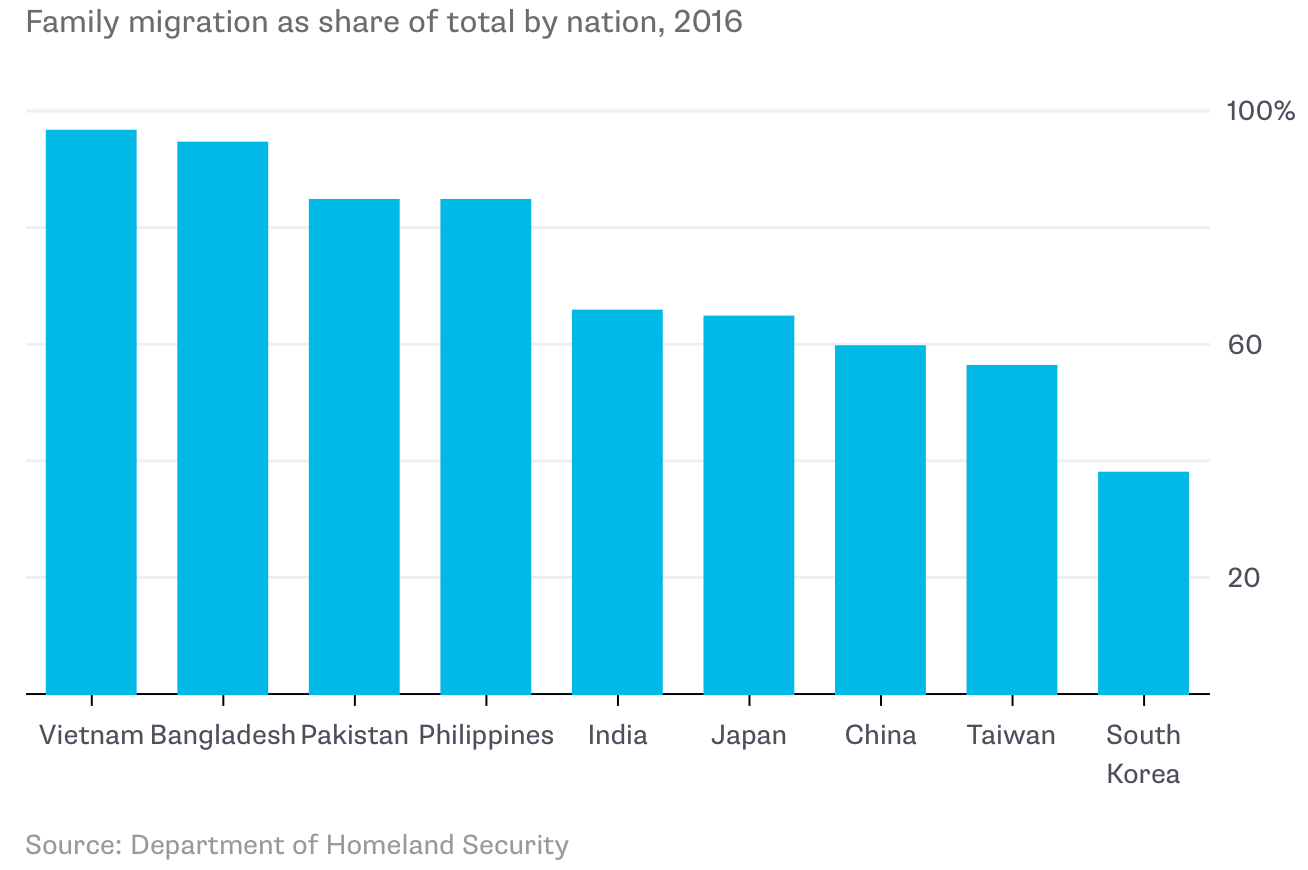
Unlike Mexico, Asian countries don’t share a land border with the U.S. This means that there are two main ways for Asians to move to the country — employer-sponsored visas like the H-1B, or family reunification. In 2016, Asians were the biggest users of family preference immigration — one kind of legal immigration that Trump would mostly do away with:

Family Planning

Without family-reunification immigration, there would still be many Hispanic Americans and black Americans, but there wouldn’t be nearly so many Asian Americans. Combined, family preference and immediate family immigration (which includes spouses, minor children, and parents) accounts for a very large percent of the growth of Asian minorities:

Almost All in the Family


If adult children, parents and siblings of U.S. citizens were barred from immigrating, as under Trump’s plan, the growth of Asian America would slow dramatically. The slowdown would be even worse than these graphs show, because some highly skilled employer-sponsored immigrants would refuse to come work in the country if they couldn’t bring their elderly parents with them.

That would certainly be a slap in the face to Asian Americans, since many would take the restriction as a declaration that they are undesirable as a group. What’s more, to repudiate family-based immigration is tantamount to wishing that Asian America as we now know it had never come into existence.

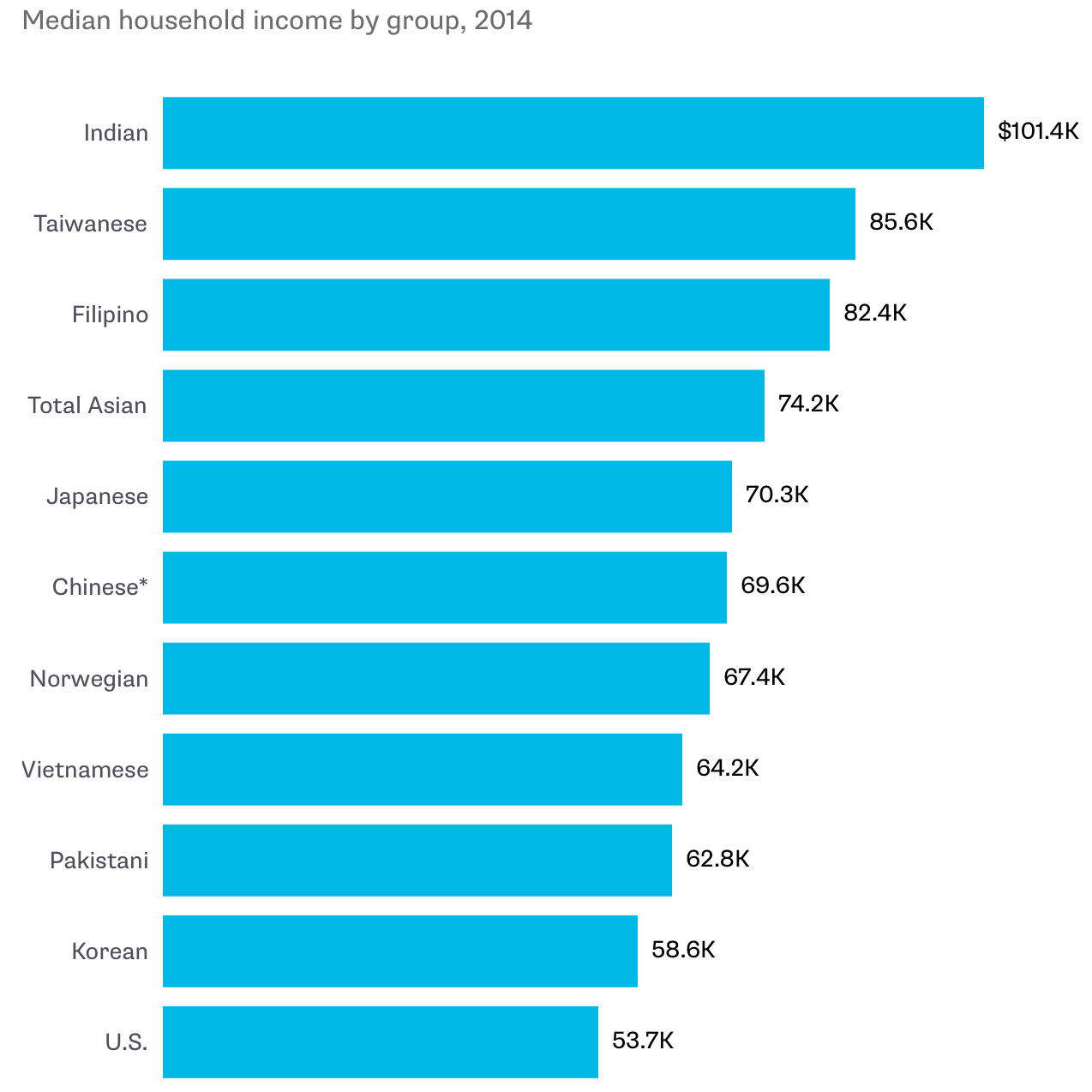
Though high-skilled immigrants come from all regions of the globe, and all have been successful in the U.S., the achievements of Asian Americans are particularly well-known. Despite language barriers and lack of local ties, Asian Americans tend to be economically successful, comparing favorably to the Norwegian immigrants Trump declared he wanted:


*Excludes Taiwanese
Asian Americans also have persistently lower unemployment rates than white Americans, and their average wealth has been increasing rapidly. Beyond these blunt economic statistics, Asian Americans have contributed to the fabric of American society in countless key ways — starting companies such as YouTube, Yahoo and NVIDIA; inventing the birth control pill and AIDS treatment; directing Hollywood movies; serving in the U.S. Senate; and helping defeat the country’s enemies on the battlefield. And those are only a few famous individuals — there are many more, in addition to the countless less famous Asian Americans who have added in a million small positive ways to the fabric of the country. Meanwhile, this new group of people been integrating rapidly and deeply into American society — 46 percent of U.S.-born Asian Americans intermarry with Americans of other backgrounds.

The point here is not to glorify Asian Americans over other immigrant groups, or to imply that only famous or high-earning individuals contribute to America. The point here is merely to illustrate one clear example of a case where “chain migration” added something special to the U.S. that wouldn’t even exist otherwise.

When Miller and Trump say the words “chain migration,” you shouldn’t imagine a faceless horde of invaders coming to claim welfare benefits and live off of the largesse of the native-born. Instead, you should imagine all the good and noble human beings who have made America what it is today — the mothers and fathers, the workers and inventors, the good neighbors and friends. Before changing the country’s immigration system, we should stop and reflect on all the real benefits we wouldn’t have without it.

via Trump’s Chain-Immigration Plan Takes Aim at Asia – Bloomberg

This is what an immigration policy for the 21st century should actually look like – The Washington Post

Robert Samuelson on the weaknesses of current US immigration policies and advocating for a shift towards more highly skilled workers:

….First, the existing system has increased U.S. poverty, driven by inflows of poorly skilled legal and illegal workers. It’s as if there were an agency called the Unskilled Workers Bureau dedicated to increasing U.S. poverty.

Consider. From 1980 to 2016, the number of people with incomes below the government poverty line rose by 11.3 million (from 29.3 million to 40.6 million). Fully two-thirds of those, or 7.6 million, were Hispanic. Much of this increase clearly reflected the impact of immigrants and their children.

Second, the status quo promotes lawlessness and repression that, rightly, offend — for different reasons — those on all sides of the immigration debate. One side sees undocumented immigrants as lawbreakers who should admit their crime and suffer the consequences by being deported. Given the estimated 11 million people here illegally, this seems doubtful. The other side views the unending enforcement actions — raids on homes and businesses — as the terrifying tactics of a police state that are unworthy of the United States. There is no real way of breaking this stalemate except by starting anew.

Third, skilled immigrants are good for the economy. True, they can’t single-handedly boost annual economic growth to 3 or 4 percent from the 2 percent-plus of recent years. But every little bit helps. One area where immigrants shine is entrepreneurship. In a study of new firms, the husband-wife team of economists William Kerr of Harvard University and Sari Pekkala Kerr of Wellesley College found that about one-quarter of company founders were immigrants.

All this is increasingly relevant, because after declining for a few years, immigration is again growing. Steven Camarota of the Center for Immigration Studies, a group favoring tighter immigration policies, estimates that new immigrants in 2016 totaled nearly 1.8 million, which — if confirmed by the final count — would tie with 1999 as the highest in history.

As a group, there are now more than 43 million immigrants in the United States, legal and illegal, representing about 13 percent of the population, reports the Migration Policy Institute, which generally supports looser policies. The U.S.-born children of immigrants constitute a group almost the same size. This means that about a quarter of the total U.S. population are either immigrants or their offspring.

What matters is how easily these new Americans integrate with the old Americans. There’s some good news. The National Academies of Sciences, Engineering and Medicine recently released two studies reporting significant gains among immigrants. Compared with U.S.-born workers, they are experiencing rising wages. More are going to college. Their English proficiency is advancing at historic rates.

But there’s a paradox. To make past immigration succeed, you need to limit present immigration. Otherwise, the pressures of coping with new groups becomes more contentious. How is poverty to be reduced if the ranks of the poor are constantly replenished with new immigrant poor? Admitting more low-paid workers makes it harder for the last wave of low-paid immigrants — their main competitors — to advance.

Similarly, more poor immigrant children will strain state and local school budgets. And there’s a whole array of cultural and historic differences between natives and immigrants — and among immigrants themselves. The ability to absorb new immigrants is one of the glories of the American project, but it is not infinite. It must give way to practical realities.

The outline of a common-sense immigration policy exists. What’s unclear is whether the Trump administration and its critics have the political courage to translate the general principles — many of which seem to command support — into a workable system that balances the needs of new and old Americans.

via This is what an immigration policy for the 21st century should actually look like – The Washington Post

The Necessary Immigration Debate: Ross Douthat

Further to my earlier post on Noah Smith (@Noahpinion) and Jeremy Bickles (To Ross Douthat, white immigration is the only good immigration – Salon.com) Douthat continues his arguments, placing too much weight IMO on Putnam’s social cohesion and trust theories and not enough on economic factors and the general fragmentation enabled and accelerated by social media.

Equally striking that his emphasis on the societies that have major social cohesion issues and political impacts while being silent on the exceptions (to date) like Canada, where GSS, Census and other data indicate much less of a problem:

One important task for a columnist is figuring out which ideas can be usefully argued over and which ones can’t. The responses to my column last week urging Democrats to negotiate with Stephen Miller and Donald Trump on immigration, because a deal hammered out with restrictionists would have more durability and democratic legitimacy, were helpfully divided between the first category and the second.

The argument-ending rejoinders ran as follows: Trump is a racist, Miller is a racist, and making major deals with them normalizes presidential bigotry. Since I agree that Trump’s race-baiting is disgraceful, I respect that rejoinder, and I don’t think my own arguments are likely to dislodge people from a firm point of moral principle.

But another kind of response is worth disputing. Instead of making a moral judgment, it purports to make an empirical one, implying that the serious case for immigration restriction is all but nonexistent, and that negotiating with restrictionists is therefore like negotiating with flat-earthers.

I want to challenge this view by expanding on two points that I mentioned last week, both of which offer reasons to regard immigration as a normal policy question with costs as well as benefits to any course you choose.

First, as mass immigration increases diversity, it reduces social cohesion and civic trust. This is not a universal law, as the economics writer Noah Smith has pointed out; there are counter-examples and ways to resist the trend. However, it is a finding that strongly comports with the real-world experience of Europe and America, where as cultural diversity has increased so has social distrust, elite-populist conflict, and the racial, religious and generational polarization of political parties.

Moreover, the trust problem is not a simple matter of racist natives mistrusting foreigners, since social trust is often weakest among minorities — which is one reason why the most diverse generation in American history, the millennials, is also the least trusting. So you can see the political effects of distrust even if you ignore the Trump Republicans entirely: It’s one reason why campus politics are so toxic, why Democrats struggle to keep their diverse coalition politically engaged, and why the Bernie-Hillary contest produced so many cries of racism and sexism.

Then linked to these ethno-cultural tensions are the tensions of class, where mass immigration favors stratification and elite self-segregation. In the United States, as in France and England, regions and cities with the largest immigrant populations are often the wealthiest and most dynamic. But this doesn’t mean that poorer regions are dying from their own xenophobia, as is sometimes suggested. The hinterlands are also filled with people who might want to move to wealthier regions (or who used to live there) but can’t because an immigrants-and-professionals ecosystem effectively prices out the middle class.

It is a testament to immigrants’ grit and determination that they can thrive working long hours for low wages while living in crowded housing with long commutes. But the social order of, say, the Bay Area or greater Paris is not one that can serve for an entire country — and it ill-serves not only lower-middle-class natives but also the descendants of the immigrants themselves, whose ability to advance beyond their parents is limited by a continued arrival of new workers who compete with them for jobs and wages and housing.

Thus our rich and diverse states also often feature high poverty rateswhen their cost of living is considered, while second and third-generation immigrants often drift into the same stagnation as the white working class …

… And they do so out of sight and mind for the winners in this system, who inhabit a world where they only see their fellow winners and their hard-working multiethnic service class. Which in turn encourages them toward mild contempt for their fellow countrymen who don’t want to live under a cosmopolitan-ruled caste system, who feel alienated from the Californian or Parisian future.

For some pro-immigration Republicans this contempt is Ayn Randian: We’ll all be better off with more hard-working immigrants and fewer shiftless mooching natives. For pro-immigration liberals it’s the predictable cultural triumphalism: The arc of history is long, but thanks to immigration we won’t have to cater to heartland gun-clingers any longer.

In both cases there’s a fantasy of replacement that’s politically corrosive, and that’s one reason why Donald Trump is president and Jeb! and Hillary are not.

Now all of the foregoing is one-sided. It leaves out the real advantages of immigration, economic and humanitarian, which are part of the policy calculus as well — as is the recent decline in illegal immigration, and the fact that the problems I’ve identified are more manageable in America than Europe. Hence my own view that keeping current immigration levels while bringing in more immigrants to compete with our economy’s winners and fewer to compete for low-wage work represents a reasonable middle ground.

But the calculus is not simple, a middle ground is actually worth seeking, and recent immigration plays a role not only in America’s greatness, but in our divisions and disappointments as well.

via The Necessary Immigration Debate – The New York Times