USA: Military Families May Soon Lose Key Immigration Protections

Really hard to understand the ongoing cruelty of some of the Administration’s policies:

The Trump administration is considering changes to immigration policies that had previously protected the spouse and dependents of military service members from deportation, a U.S. Citizenship and Immigration Services official confirmed Monday.

“Parole in Place” is an immigration policy implemented at the height of the Iraq War to help deployed soldiers not worry that their undocumented family members would be deported while they were overseas.

It is one of several immigration options made available to the military in recognition of “the important sacrifices made by U.S. armed forces members, veterans, enlistees and their families. To support these individuals, we provide discretionary options such as parole in place or deferred action on a case-by-case basis,” the agency says on a web page for service members.

Parole in Place grants undocumented dependents and spouses a reprieve to be able to legally adjust their immigration status without having to leave the United States or be deported first. The program was rarely used until senior military leaders and then-members of Congress — including Vice President Mike Pence — urged in 2010 that the Department of Homeland Security increase access to the program.

A USCIS official confirmed exclusively to McClatchy, on condition of anonymity, that the agency is now reviewing the program. Any changes would be limited to dependents of service members, the official said.

Retired Army Reserve Lt. Col. Margaret Stock, an attorney who specializes in military immigration issues, said the administration is expected to issue a decision on whether or not to end Parole in Place at the end of July. She first became aware of the proposed changes when attorneys for some of the service members who could lose their dependents to deportation began expediting requests to get the reprieves for their family members.

The policy review comes at a time when it has become more difficult overall for service members to pursue U.S. citizenship. The number of military naturalizations has plummeted since President Donald Trump took office, and service members are now rejected for citizenship at a higher rate than civilian applicants, according to the most recent USCIS data available.

In the last several years, Parole in Place has been used sparingly, and has not protected all of the dependents of service members from deportation. The federal agency responsible for all adjudication of immigration cases does not track the number of waivers or deportations of service members or their dependents that it has processed.

Source: Military Families May Soon Lose Key Immigration Protections

Higher Asylum Grant Rates Predict Higher Family Appearance Rates in Top Immigration Courts

Interesting study. Similar findings to those of Sean Rehaag, with high variance among judges (thestar.com/…/getting-refugee-decisions-appealed-in-court-the-luck-of-the-draw-study-shows):

TRAC Immigration, a project of Syracuse University, published a report this week, showing that 81 percent of recently released families apprehended at the border showed up for all of their hearings. Some immigration court locations did much better than others in obtaining compliance from immigrant families. San Francisco’s court had almost zero no-shows, while two and five skipped out in Atlanta.

TRAC’s report hypothesized that it was possible that “the lowered appearance rates in some courts arose from particular deficiencies in the recording, scheduling or notification systems there.” While this could be, there is no way to test for such variation. Another strong hypothesis, suggested by Aaron Reichlin-Melnik of American Immigration Council, is that immigrants are much more likely to fail to appear in courts where they have a lower probability of receiving asylum.

Fortunately, TRAC also reports asylum grant rates by immigration court, allowing us to test this.

Figure 1 shows the relationship between asylum grant rates in FY 2019 and family appearance rates in the ten immigration courts that received the most family docket cases (in order of the courts with most cases). These ten court were initially designated to track “family unit” cases in November 2018, and while this practice has expanded to several other courts, 87 percent of the family cases tracked by the government are still in these ten courts.

The five courts with the highest appearance rates had asylum grant rates on average 55 percent higher than the five courts with the lowest appearance rates (37 percent to 23 percent). The five most successful courts had 89 percent of their immigrant families appear at all hearings compared to 75 percent at the other five courts.

The asylum grant rate in 2019 predicted a very significant portion of the variance in appearance rates between courts—42 percent to be precise—that year, and a 10 percentage point increase in the asylum grant rate in a court is associated with almost a 3 percentage point increase in the appearance rate for that court. There are other ways to measure the asylum grant rate. The immigration courts include asylum cases that were closed without a decision being made on the merits. But using that metric doesn’t change the association.

Higher failure to appear rates do not explain the higher denial rates, as just 1.4 percent of asylum denials are a result of a failure of the immigrant to appear. People who skip almost always do so before they officially file for asylum. It could be that immigrants who go to certain courts like Atlanta have worse asylum claims to begin with, but as TRAC notes, “there seems little reason for families with different strengths of asylum claims to migrate to some parts of the country and avoid others.”

Ultimately, the identity of the judge seems like the most important factor in winning asylum. The Government Accountability Office in 2016 found that even controlling for other relevant factors, “the defensive asylum grant would vary by 57 percentage points if different immigration judges heard the case of a representative applicant with the same average characteristics we measured.” It would be very useful if TRAC published data on the appearance rates by judge to determine if it’s the location or the judge that matters the most.

Obviously, because we only have data for a few courts in 1 year, it is impossible to nail down this relationship with certainty, but it appears that if every court had the same asylum grant rate as San Francisco (68 percent), the appearance rate for families would have increased to 90 percent. It may seem obvious that the likelihood of success in court makes people more likely to follow the legal process. But many people’s impression is that every asylum applicant has no case, so they have no reason to show up. That’s false, but unfortunately, some courts are turning this theory into a self-fulling prophecy.

Source: Higher Asylum Grant Rates Predict Higher Family Appearance Rates in Top Immigration Courts

A growing source of Canadian asylum-seekers: US citizens whose parents were born elsewhere

Sean Rehaag, who has done some good work analyzing trends of decision making by IRB adjudicators, looks at the recent rise in the number of asylum seekers from the US:

Jokes about moving to Canada became common among progressives in the United States during Donald Trump’s presidential bid. When he won, a spike in U.S. citizens seeking information about how to relocate crashed Canada’s immigration website.

I’m a scholar of Canadian immigration law and will soon become the director of the Centre for Refugee Studies at York University in Toronto. My friends and colleagues in the United States, who still make those jokes, are often surprised when I fill them in on how U.S. immigration patterns in Canada have changed during the Trump administration.

Overall, the number of U.S. citizens who have immigrated to Canada for any reason rose from 7,522 in 2015 to 9,100 in 2017. In contrast with this modest 21% increase, the number of U.S. citizens applying for refugee protection during the same two years spiked by more than 1,000%. It grew from 69 in 2015 to as much as 869 in 2017.

The more than 1,500 U.S citizens who have sought a safe haven in Canada are mainly the children of people fearing deportation due to a change of their immigration status after spending years in the United States. Even with the recent increase, they still account for a small share of total applicants for refugee protection in Canada – only 1% in 2018, for example. Nonetheless, the dramatic growth in the number of refugee claims by U.S. citizens illustrates some of the differences between Canadian and U.S. immigration policies.

Long history

People from the U.S. have been seeking asylum in Canada since at least the 18th century.

Fearing mistreatment in the newly established United States, and drawn by offers of free land, as many as 100,000 British Loyalists fled to what is now Canada during and after the American Revolution.

Many enslaved people seeking liberty via the Underground Railroad, prior to the Civil War, headed to Canada. Around 20,000 to 40,000 made lives for themselves there.

In the 1960s and 1970s, some 100,000 young U.S. men, many with wives and children, came to Canada during the Vietnam War to avoid being drafted into military service – or in some cases after deserting. Canada enacted a law that let these “draft dodgers” immigrate with lawful status. Even though President Jimmy Carter issued a blanket pardon for them when he took office, about half remained in Canada.

More recently, dozens of U.S. soldiers who had voluntarily enlisted in the military and served in the wars in Iraq and Afghanistan sought asylum in Canada to avoid jail time when they deserted because they came to object to those wars. This time, the Canadian government denied most of their refugee claims, saying that they could have possibly qualified for conscientious objector status back home. However, the Canadian public expressed substantial support for these war resisters.

Change of status

The more recent wave of asylum applicants is related to changes in U.S. immigration policy.

Before Trump took office, the U.S. had granted hundreds of thousands of immigrants without papers from Sudan, Nicaragua, Haiti, El Salvador and other countries temporary protected status. These policies protected formerly undocumented immigrants from deportation and let them work legally.

The Trump administration has tried to end temporary protected status for eligible immigrants of many nationalities, despite evidence that many of their countries remained dangerous or their economies were still too unstable for them to return.

For example, the Inter-American Commission on Human Rights, an autonomous agency of the Organization of American States, asserts that Nicaragua operates as “police state” with government-sponsored repression that is resulting in hundreds of deaths and thousands of injuries. The UN Refugee Agency estimates that 62,000 Nicaraguans have fled to neighboring countries in the past year.

For now, the fate of about 300,000 of these immigrants from multiple countries awaits resolution in the courts.

A big share of the families with U.S. citizen-children seeking asylum in Canada today are immigrants from Haiti and other countries who fear losing their temporary protected status. Some people with this status from Nicaragua and Honduras have had it since 1999. Qualifying Sudanese immigrants have been shielded from deportation since 1997. The U.S. granted 59,000 Haitians temporary protected status in 2010, following a big earthquake.

Canada will probably deny the refugee claims of the U.S. citizen children because the system requires applicants to prove a well-founded fear of persecution in their country of origin. In this case, that would be the United States rather than, say, Haiti, Sudan or El Salvador.

But parents who obtain refugee protection in Canada will be able to obtain permanent residence for their children as well, putting them on the path to citizenship in Canada. Many likely will succeed with their claims. Canada approved about half of the refugee claims made in 2018after migrants crossed the U.S. border.

Indeed, some of the families with U.S. citizen children seeking asylum in Canada may figure that they are more likely to succeed in Canada than in the U.S. For example, Canadian refugee law is more permissive than U.S. asylum law for people fleeing gender-based violence or gang violence – both common types of claims for Central American asylum-seekers.

Different policies

Canadian and U.S. immigration policies have always been distinct but the contrast is becoming more stark.

Trump campaigned on an anti-immigrant agenda, while Canadian Prime Minister Justin Trudeau promised voters he would increase the number of resettled Syrian refugees welcomed in Canada. On the same day that Trump first decreed a Muslim travel ban, Trudeau famously tweeted out his hospitality: “To those fleeing persecution, terror & war, Canadians will welcome you, regardless of your faith.”

Under Trudeau’s leadership, the Canadian government has decided to boost the number of immigrants it grants permanent resident status yearly, from 286,000 in 2017 to 340,00 in 2020.

The U.S., with a population that is nearly nine times bigger than its northern neighbor, grants permanent resident status to 1.1 million newcomers. The Trump administration is trying to overhaul the nation’s immigration policy in ways that could cut that number considerably and it has slashed refugee admissions. In April 2019, Trump addressed the rising number of asylum-seekers arriving at the U.S.-Mexico border. “We can’t take you anymore,” he said. “Our country is full.”

As long as these sorts of divergences persist, I believe that immigrants who have been living in the United States for years, some with children who are U.S. citizens, will keep coming to Canada seeking asylum.

Source: A growing source of Canadian asylum-seekers: US citizens whose parents were born elsewhere

US envoy decries lack of foreign response to China’s attack on Islam

Valid critique (and understatement of their human rights record):

The US envoy on religious liberty has said he is “disappointed” at the response of governments in the Islamic world to China’s mass incarceration of Uighur Muslims, suggesting they had been threatened by Beijing.

Sam Brownback, ambassador at large for international religious freedom, said some majority-Muslim states did not want to draw attention to their own human rights record. He was hopeful that the more Muslim populations around the world heard about the imprisonment of an estimated more than 1 million Uighurs, the more they will put pressure on their governments to speak out.

The Trump administration has severely criticised Beijing for its campaign against Islam in Xinjiang province, western China, where more than two dozen mosques and Islamic shrines have been razed since 2016. But Washington, in the midst of a tense trade dispute with China, has yet to impose sanctions, and Brownback said he could not say whether any punitive measures were pending.

Meanwhile, Washington’s closest allies in the Islamic world – Saudi Arabia, the United Arab Emirates and Egypt – have been silent in the face of the mass incarceration of Muslims in Xinjiang.

At the beginning of March, the Organisation of Islamic Cooperation passed a resolution which praised China for “providing care to its Muslim citizens”.

The Saudi crown prince, Mohammed bin Salman, has also defended China’s “right to carry out anti-terrorism and counter extremism work for its national security”.

In an interview with the Guardian, Brownback said that the US has been “in discussion” with Riyadh about its response to China, but did not single out the Saudis for criticism, arguing it was an issue for the whole Islamic world.

He applauded Turkey for taking a outspoken approach, and “a number of western countries that have spoken out aggressively on this”.

But Brownback, a former Kansas governor, added: “I have been disappointed that more Islamic countries have not spoken out. I know the Chinese have been threatening them and but you don’t back down to somebody that does that. That just encourages more actions.

“If China is not stopped from doing this they’re going to replicate and push this system out in their own country and to other authoritarian regimes,” he said.

Brownback did not specify what kind of threats China is alleged to have made, but after the Turkish foreign ministry called the incarceration of Uighurs a “great shame for humanity”, China scaled down diplomatic ties and warned of damaged economic relations.

Brownback suggested another reason for reticence of some governments in the Islamic world was they felt vulnerable on their own record on religious rights.

“I think a number of who are concerned about their own human rights record and then they’re saying look: we don’t want people criticizing us [so] we’re not going to criticize somebody else,” he said.

But Brownback said he was hopeful that governments would increasingly come under pressure from their own people to take a stand on the abuses in China.

“I think as more information gets out and particularly as it gets out to the population in some of these places that you’ll see more of their governments act and react,” he said.

Source: US envoy decries lack of foreign response to China’s attack on Islam

5 Takeaways About The Trump Administration’s Response To Far-Right Extremism

Of note:

Lawmakers on the House Oversight Committee questioned senior FBI and Homeland Security officials this week about their response to white supremacist violence.

This was the latest in a series of hearings, led by Democrats, to gauge the Trump administration’s commitment to fighting a threat that federal agencies deem the most lethal and active form of domestic extremism.

There were no bombshell revelations, but lawmakers did get a few details on some key questions.

Here are five takeaways:

There is no national policy to combat the far-right threat

Rep. Jamie Raskin, the Maryland Democrat who led the hearing, started by asking what he called the fundamental question: “Do we have an overall strategic plan to counter and prevent the threat of white supremacist violence? I fear the answer is no.”

Raskin was right. After more than two hours of questioning, it was clear that, unlike the government’s quick and sweeping response to Islamist militant groups, there’s no comparable national strategy to fight white supremacist and other far-right movements.

Elizabeth Neumann, a senior threat prevention official at Homeland Security, told lawmakers that federal authorities were still adapting to the evolution of both far-right and Islamist extremists: They now self-radicalize online, with little or no direction from organized groups like al-Qaida, which had a clear hierarchy and staged attacks that took months or years to plan.

“Our post-9/11 prevention capabilities, as robust as they are, were not designed to deal with this type of threat,” Neumann said.

She said Homeland Security was developing “a prevention framework” to be implemented in coming years, but she offered no details. Raskin, the lawmaker, said it was “very late in the game” to still be in the development stage of a national strategy, given the deadly far-right attacks in Charleston, S.C., Pittsburgh, Charlottesville, Va. and elsewhere.

Neumann said the delay is partly because “things haven’t been institutionalized” through legislation, an executive order or a national security presidential memorandum focused on domestic terrorism. She noted that the Obama administration also lacked those tools.

“We know we’re not doing enough,” Neumann said.

Federal agents do take this seriously – even if the White House doesn’t

President Donald Trump consistently downplays the threat of white nationalist extremism, which he’s dismissed as “a small group of people.”

Michael McGarrity, assistant director of the FBI’s counterterrorism division, bristled when lawmakers suggested that, given the apparent disinterest from the top, federal authorities might not be taking the far-right threat seriously enough. McGarrity bluntly stated, more than once, that racially motivated violent extremists are the deadliest and most active of domestic terrorists.

“We’re not playing with the numbers here,” McGarrity said. “We arrest more domestic terrorism subjects [before they stage an] attack in the United States than we do international terrorism.”

He said the FBI is using many of the same tactics historically used to thwart international groups like the Islamic State: working sources, staging undercover operations and asking courts to authorize wiretaps. McGarrity added that the FBI considers racially motivated extremists a transnational threat, and that the agency shares intelligence with counterterrorism partners overseas.

Homeland Security won’t say much about its prevention effort

In 2015, Homeland Security opened a small office devoted to an approach known as “CVE,” countering violent extremism. The idea is to use community partnerships and other tools to interrupt the radicalization process before it turns to violence. Critics call it ineffective, and say it leads to the stigmatization and surveillance of ordinary Muslims.

Under the Trump administration, the CVE-focused office lost about 90 percent of its old budget and about half its staff, and it’s been renamed twice to signal a shift away from community partnership work. (Some Muslim activists joke that scrapping CVE was the only Trump administration move they supported.)

But it might be premature to declare the government’s CVE program dead. Neumann said CVE-style prevention work will be part of a broad counterterrorism strategy that Homeland Security plans to have ready by this fall. But she gave few details about the program or what’s going on with the restructured office that’s supposed to handle it.

“There’s still more questions than answers at this point,” Raskin complained. “What are the office’s precise functions? Who’s in charge? How many personnel will be assigned to prevent white supremacy violence?”

Debate is heating up over a domestic terrorism law

If a U.S.-based suspect is accused of involvement with an international terrorist organization such as ISIS or al-Qaida, prosecutors have an array of charges to consider that aren’t available for most cases involving white supremacist suspects.

Without a domestic terrorism statute, said McGarrity of the FBI, authorities are restricted as to how much they can police speech and conduct that’s offensive, but protected under the First Amendment.

“The FBI does not investigate rallies or protests unless there’s a credible belief that violent criminal activity may be occurring,” he said.

In some quarters of Congress, support is building for a domestic terrorism statute, ostensibly to correct the double standard in extremist prosecutions. But several rights groups already have rejected the idea, arguing that enforcing existing laws is better than giving even more power to federal authorities.

This debate is one to watch in coming months.

It’s official: Black Identity Extremism is no longer a thing

In the early months of the Trump administration, a leaked FBI report warned about a new kind of homegrown threat: black identity extremists.

The warning reportedly came after six unrelated attacks on police around the country; the FBI portrayed the threat as “an increase in premeditated, retaliatory lethal violence against law enforcement” by people with “perceptions of police brutality against African Americans.”

The claim was widely endorsed by conservative news media outlets but viewed with equally widespread skepticism as a move reminiscent of the FBI’s demonization of black activists in the civil rights era.

Rep. Ayanna Pressley, a Democrat from Massachusetts, asked McGarrity if there’s a single killing the FBI could link to Black Lives Matter or similar activist groups. McGarrity’s reply: “To my knowledge, right now, no.”

Pressley continued her attack on “this absurd designation” until McGarrity divulged that the category had been retired at the FBI.

“The designation no longer exists?” Pressley asked, sounding skeptical.

“It hasn’t existed since I’ve been here for 17 months,” McGarrity answered.

To recap: The FBI created a new category of threat and two years later quietly abandoned it without explanation.

Source: 5 Takeaways About The Trump Administration’s Response To Far-Right Extremism

Strict US immigration laws make Canada more attractive to tech workers

Yet another article on the attractiveness of Canada. Can’t buy this kind of coverage:

The tech industry in the US is booming. Foreign interest in tech jobs is not.

That’s because despite the country’s acute need for highly skilled tech workers, its immigration system has become increasingly unwelcoming.

Since the beginning of 2018, the share of interest from abroad in US tech jobs has remained about the same, according to new data from the global job listing site Indeed, but by most accounts it should be growing.

“All things equal, with the really strong US job market, you’d expect continued growth in foreign interest in US tech jobs,” Indeed economist Andrew Flowers told Recode.

In the past year, foreign interest in Canadian tech jobs has also been flat, according to Indeed’s data, but Canadian jobs had a higher rate of such interest than US ones. In May, 14 percent of all clicks on Canadian tech jobs posted on Indeed were from foreigners, while 9 percent of US tech jobs had attracted clicks from candidates abroad.

Foreign interest as a share of all interest in Canadian tech jobs has shot up precipitously — 55 percent — in the past four years, according to Indeed. The company’s US data doesn’t go back as far as its Canadian data, so we can’t do a long-term comparison of the two.

The absence of growth in foreign tech job interest likely stems from stricter immigration procedures — including those for high-skilled tech workers, who use a visa called H-1B — that have been enacted following President Donald Trump’s Buy American and Hire Americanexecutive order in 2017. The increased difficulty and duration of the US immigration process, which can now take from months to years, have made some tech workers less likely to consider the US an employment option.

Some experts say the US and Canada have been facing a dearth in native-born high-skilled workers that threatens to inhibit their growing technology industries. But while the US has made it more difficult to employ tech workers from abroad, Canada has streamlined its own tech immigration policies. In turn, Canada has become a technology hub. Recently a number of US tech companies, like Amazon and Microsoft, have expanded their offices in Canada. Presumably that’s easier than dealing with ever-tightening US immigration laws. This indicates that in effect, a fear of foreigners taking US jobs has lead to some US jobs going abroad.

That’s presented a challenge for the US’s most dominant industry. Indeed, CEOs from many tech companies have been clamoring for immigration reform.

Tech companies have been asking the government for years to ease the immigration process and increase the quotas on new H-1B applicants — which has remained at 85,000 and is only a tiny fraction of a percentage of the overall job market — since 2006. In that time, the technology industry has ballooned to be by far the biggest segment of the US economy.

Smaller tech companies are facing steeper challenges

“For super-unique, hard skills, you have to look as wide as possible to find the best possible set of candidates to meet the needs of the company,” Ben Schmitt, of information security at Dwolla, a Des Moines, Iowa-based online payments software company, told Recode.

“Someone with specific advanced knowledge of cryptography is tough to hire for,” Schmitt said.

A year and a half ago the company found the perfect candidate, but he’d need an H-1B visa to work in the states. “The person had worked under a well-known cryptographer; he had experience in really hard skills that nicely aligned with our requirements,” Schmitt said.

Dwolla was able to make the hire because Schmitt and the 100-plus person company’s general counsel have had experience with H-1B applications, and were able to get an approval on the first try. The process can take upwards of a year or two — famously, it took the CEO of the now-public US tech company Zoom nine tries to get approved for a visa.

“It takes a lot of time and there are a lot of unknowns,” Schmitt said. “It requires luck and skill, especially for a small company trying to move fast.“

Bart Lorang, founder and CEO of FullContact, has had much less luck with H-1Bs.

In the past few years Lorang’s Colorado-based identity resolution company has acquired a series of other software companies — in Latvia, India, and Tel Aviv — but has since been unable to move most of those tech workers here.

“Literally we flew every employee in the Latvia office here and gave them the pitch on moving to Colorado.” Those six or so employees all agreed to relocate, but most weren’t able to get H-1Bs for various reasons, including lacking what United States Citizenship and Immigration Services deemed unique enough skills or the right level of education. The company now employs 30 people in Latvia.”

“It got worse in the last couple of years, so we sort of gave up,” Lorang told Recode. “What we ended up doing instead of trying to get people to the states is, we’ve grown our staff in other countries, although that wasn’t our initial strategy. We wanted to bring jobs to the US.”

FullContact now employs about 250 people, many of whom are software engineers. Eighty are in the US. Only one has an H-1B visa.

How the government is adding more hurdles

The Trump administration has systematically stymied immigration at multiple levels, by making criteria more strict, asking for more documentation and generally taking longer to process immigration applications.

Although Trump has stressed the need for high-skill tech workers in the US, at the same time he has made it harder for those workers to come here.

In its latest annual report, the US Citizenship and Immigration Services’ director drew attention to the increasing absolute number of visas processed, but the processing rate has actually gone down, according to calculations made using the organization’s own data. The USCIS discouraged calculating a rate.

“They frame this report to show they are adjudicating more of these petitions than ever before. But when you look at the amount being adjudicated as percentage of the backlog plus new receipts, it’s actually down,” Sarah Pierce, an analyst at the Migration Policy Institute think tank, told Recode.

As Doug Rand, cofounder of Boundless Immigration, a company that helps people navigate the US immigration system, told Recode: “That’s like the DMV bragging that they processed a record number of appointments today, even though the line is still going out the door and around the block.”

The USCIS is funded almost entirely on processing fees, so it’s not dependent on government allocations to do its job.

India is seeing the brunt of immigration reform

Indeed’s data also delved into how interest in US tech jobs has changed by country.

India, the country that receives by far the most H-1B visas, had an 8 percent decline in interest in US tech jobs from Q1 2018 to Q1 2019, according to Indeed. Meanwhile, interest from Germany, France and Russia increased more than 25 percent in that time. This flip is also one of the reasons that the overall interest in US tech jobs has stayed level.

The change may be connected to new immigration rules that have been directed at outsourcing companies by specifically targeting companies that place workers at third-party sites or where 15 percent or more of their workforce is on H-1Bs. Many of those types of companies are based in India and hire Indians.

Stricter rules geared at Indian tech companies could be having a chilling effect on Indians’ interest in US jobs.

“It’s possible, especially if these groups we’re attacking with higher scrutiny are disproportionally groups that hire Indians, that the general sentiment is that the US is closed for Indians,” Pierce said.

She added that the effect wouldn’t just impact outsourcing companies: “Within those groups, they’re also punishing legitimate companies that are just trying to hire the best and brightest and use programs as intended.”

Meanwhile, Indian interest in Canada tech jobs is up.
Source: Strict US immigration laws make Canada more attractive to tech workers

Why are the U.S. immigration norms being tightened?

US immigration checking of social media noted in Indian media (a reminder to us all to more mindful when on social media):

The story so far: On May 31, 2019, the U.S. Department of State introduced a change in online visa forms for immigrant (form DS-260) and non-immigrant visas (form DS-160) requiring applicants to register their social media handles over a five-year period. The newly released DS-160 and DS-260 forms ask, “Do you have a social media presence?” A drop-down menu provides a list of some 20 options, including Facebook, Instagram, Sina Weibo and Twitter. There is also a “NONE” option. Applicants are required to list their handles alone and not passwords. All sites will soon be listable according to an administration official who spoke to The Hill, a Washington DC-based newsletter. The policy does not cover those eligible for the visa waiver programme and those applying for diplomatic visas and certain categories of official visas.

How did it come about?

The policy is part of U.S. President Donald Trump’s intent to conduct “extreme vetting” of foreigners seeking admission into the U.S. In March 2017, Mr. Trump issued an Executive Order asking the administration to implement a programme that “shall include the development of a uniform baseline for screening and vetting standards and procedures for all immigrant programs.”

In September 2017, the Department of Homeland Security started including “social media handles, aliases, associated identifiable information, and search results” information in the files it keeps on each immigrant. The notice regarding this policy said those impacted would include Green Card holders and naturalised citizens. In March 2018, the State Department proposed a similar policy, but for all visa applicants — this is the policy now in effect. Earlier, only certain visa applicants identified for extra screening were required to provide such information. Asking visa applicants to volunteer social media history started during the Obama administration which was criticised for not catching Tashfeen Malik, one of those who carried out a mass-shooting in San Bernardino, California, in 2015. Malik had come to the U.S. on a K-1 fiancé visa, and had exchanged social media messages about jihad prior to her admission to the U.S.

How will it impact India?

Most Indians applying for U.S. visas will be covered by this policy. Over 955,000 non-immigrant visas (excluding A and G visas) and some 28,000 immigrant visas were issued to Indians in fiscal year 2018. So at least 10 lakh Indians — and these are just those who are successful in their visa applicants and not all applicants — will be directly impacted by the policy.

What lies ahead?

The new policy is expected to impact 14 million travellers to the U.S. and 700,000 immigrants worldwide according to the administration’s prior estimates. In some individual cases it is possible that the visa policy achieves what it is (ostensibly) supposed to — allow the gathering of social media information that results in the denial of a visa for an applicant who genuinely presents a security threat. However, the bluntness of the policy and its vast scope raise serious concerns around civil liberties including questions of arbitrariness, mass surveillance, privacy, and the stifling of free speech.

First, it is not unusual for an individual to not recall all their social media handles over a five-year period. Consequently, even if acting in good faith, it is entirely possible for individuals to provide an incomplete social media history. This could give consular officers grounds for denying a visa.

Second, there is a significant degree of discretion involved in determining what constitutes a visa-disqualifying social media post and this could stifle free speech. For instance, is criticising the President of the United States or posting memes about him (there are plenty of those on social media these days) grounds for visa denial? What about media professionals? Is criticising U.S. foreign policy ground for not granting someone a visa?

Third, one can expect processing delays with visas as social media information of applicants is checked. It is possible that individuals impacted by the policy will bring cases against the U.S. government on grounds of privacy or on grounds of visa delays. The strength of these cases depends on a number of factors including whether they are brought by Green Card holders and naturalised citizens (who were impacted by the September 2017 policy not the May 31 one) or non-immigrants. The courts could examine the intent of the U.S. government’s policy and ask whether it has discriminatory intent.

Source: Why are the U.S. immigration norms being tightened?

Trump’s tariff threat to Mexico is based on all the wrong data

Good overview of the data, and making the case that it is more a capacity issue of the asylum system (as in Canada):

For years Americans have looked at how many people border patrol agents catch as an indicator of undocumented immigration.

Since October, those numbers—known officially as “apprehensions”—have more than doubled compared to the same period the previous year to nearly 600,000 people. The surge prompted US president Donald Trump to threaten Mexico with import tariffs if authorities in that country don’t intercept more immigrants before they cross the Rio Grande.

“This sustained influx of illegal aliens has profound consequences on every aspect of our national life—overwhelming our schools, overcrowding our hospitals, draining our welfare system, and causing untold amounts of crime,” he said in a statement last week announcing the tariff strategy.

The strategy is questionable, both legally and in practice. And so is Trump’s math.

He is missing some pretty crucial figures, starting with the number of undocumented immigrants who actually settle and live in the United States. For years, that population has been shrinking. He also needs to subtract asylum seekers, who account for a large share of the intercepted immigrants. Under US and international law, they have a right to legally stay in the United States until a judge rules on their case, regardless of whether they entered the country illegally.

We took a historic dive into immigration data and found why Trump’s narrative doesn’t add up. Here are the holes, in seven charts:

The long view

The number of border crossers is rising, but remains historically low. The reason for this is the collapse in the number of Mexicans trying to sneak into the United States. Better opportunities and lower fertility rates in Mexico cut down the number of people desperate to leave. On the US side, the Great Recession dried up jobs, and increased border security made it harder to get in.

It would take many more Central American caravans for the the number of border apprehensions to reach the historic high of nearly 1.7 million from the 1980s.

Other than Mexican

These days, it is people from other countries who are shaping border traffic. They include Central Americans, who now account for well over half of apprehensions along the border. That’s partly because US immigration authorities are taking more Central Americans into custody, but mostly because they are arresting fewer Mexicans.

Most of these migrants are fleeing violence and poverty in the Northern Triangle, the trio of countries that include Guatemala, Honduras, and El Salvador.

The number of apprehended immigrants from that region is up, but that doesn’t mean illegal immigration is rising.  Trump is leaving out a key distinction between apprehensions in the past and today. What they reflect is changing.

Back when Mexican economic migrants were the most common type of border crosser, apprehensions acted as a proxy for undocumented immigration—if not a very good one. At that time, it was much easier to evade the Border Patrol. So, observers looked at the number of people being caught for clues on how many people overall were making the trip north.

These days border patrol agents are far more effective at intercepting immigrants. In fact, they don’t even have to chase after them. Many Central Americans actually turn themselves in to request asylum.

The profile of “apprehended” immigrants has also changed. More than half of the Central Americans intercepted at the border since last October were families traveling with children, not men looking for work as in the past.

Many among this new group have pending asylum cases. They shouldn’t be considered undocumented unless a judge decides they’re not eligible to stay permanently. Subtract them from the number of apprehensions, and the total looks much smaller.

Many are deported

The crisis at the border is not really a numbers crisis. It’s a bureaucratic emergency because the United States has failed to adapt to the shift in immigration flows from Mexican men seeking work to Central Americans seeking asylum.

Unlike Mexican men, whom it could quickly deport, it is obligated by law to give those who fear going back to their country a day in court. It’s a much longer, back-office-heavy process that immigration authorities are ill-equipped to do. For years, they’ve directed much of their funding towards border agents and fences. That’s why they’re struggling now, even though the number of immigrants is significantly smaller than what they handled in the past.

Even taking into account that mismatch, the US deports thousands of immigrants every year.

That’s another group of people that should be removed from Trump’s tally of undocumented immigrants.

Border crossers vs. residents

Even after those adjustments, apprehensions are not the best statistic to look at if what’s worrying Trump are undocumented immigrants. (Those who are caught and have no permission to be in the United States will be deported. As we said above, asylum seekers are allowed to stay.)

He should instead focus on people who live in the United States without permission. That number has come down from a pre-Great Recession peak of more than 12 million to less than 11 million in 2016, according to analysis by the Pew Research Center.

Again, the drop in the number of Mexican immigrants coming to the United States is partly behind that math. In addition, many immigrants are leaving, whether through deportation or on their own. Add to that the number of undocumented residents who die and those who get papers to legally live in the county, and you get more immigrant residents exiting the undocumented column than entering it.

Data from the Center for Migration Studies show that’s been the case in recent years:

Most don’t enter illegally

Of the undocumented population living in the United States, not all entered illegally. In recent years, more than half of the people settling in the country without permission entered on a visa and overstayed it. “It’s hard to walk here from India,” said Jeffrey Passel, senior demographer at Pew.

While many asylum seekers show up in the apprehension figures, visa overstayers don’t at all. That’s another reason why the number of people border patrol agents catch shouldn’t drive the immigration debate.

Does the border crisis change the math?

Immigration hawks fear that the asylum seekers showing up at the border will eventually become undocumented immigrants. US authorities have been releasing many of the new arrivals because there’s not enough detention space. And there are rules that limit how long officials can keep immigrant children in custody.

Immigration statistics lag, so we won’t know for a while how many of those people end up living in the United States illegally. Robert Warren, a senior visiting fellow at the Center for Migration Studies, doesn’t believe they’ll make much of a difference given recent trends. The potential impact of border crossers has shrunk along with their share of the undocumented population.

A look at border crossers who were caught and those who settled in the United States sheds some light on what we might see. The number of immigrants requesting asylum started to swell a few years before Trump took office, and so did the number of apprehensions. The number of undocumented immigrant residents who entered the country illegally went up too, but remained well below apprehensions.

That’s not to say Trump should discard apprehension statistics. He just needs to work on the takeaway. Apprehensions don’t equal undocumented immigrants. What they’re showing these days is that the asylum system is clogged up. That’s keeping the United States from protecting Central Americans at risk, and encouraging more of them to come.

“It is a very serious situation when you have so many families and children coming up to apply for asylum,” Warren said. “The thing that might be getting missed is we haven’t set up our capacity to handle that situation.”

Source: Trump’s tariff threat to Mexico is based on all the wrong data

Recently arrived U.S. immigrants, growing in number, differ from long-term residents

More analysis of the changing nature of immigrants to the USA:

Recently arrived U.S. immigrants are a growing part of the nation’s foreign-born population, which reached a record 44.4 million in 2017. Overall, their profile differs from immigrants who have been in the country longer.

About 7.6 million immigrants have lived in the country for five years or less. They make up 17% of the foreign-born population, a share that has returned to 2010 levels after a slight dip. Recently arrived immigrants have markedly different education, income and other characteristics from those who have been in the U.S. for more than a decade. Proposed changes to U.S. immigration lawscould favor highly skilled immigrants, which could further change the demographics of the nation’s foreign-born population. U.S. adults support encouraging highly skilled people to immigrate and work in the U.S., according to a 2018 survey from Pew Research Center.

View interactive charts and detailed tables on U.S. immigrants.

Related: A statistical portrait of the nation’s foreign-born population, which includes historical trends since 1960

Here are several ways the differences between shorter- and longer-tenured U.S. immigrants have changed over time:

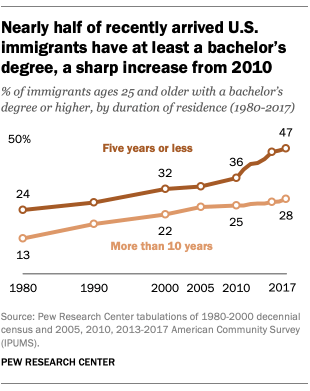
1Nearly half of recently arrived U.S. immigrants have at least a bachelor's degree, a sharp increase from 2010. Short-term residents have more education than long-term residents, and the gap between these immigrant groups has widened. Almost half (47%) of immigrants ages 25 and older who arrived in the U.S. during the previous five years have a bachelor’s degree or more as of 2017, compared with just 28% of those who have lived in the country for more than 10 years. The share among newer arrivals has grown since 2010, when 36% had a college degree, compared with 25% of longer-tenured immigrants. Overall, the education levels of U.S. immigrants have increased, due in part to growing numbers of international students and highly skilled workers. By contrast, 32% of the U.S.-born population has a bachelor’s degree or higher.

2. Recently arrived immigrants have higher unemployment rates than longer-term immigrants. Immigrants who arrived in the past five years have a 7.1% unemployment rate, compared with a 3.9% unemployment rate for immigrants who have lived in the country for more than 10 years, according to Pew Research Center analysis of American Community Survey. Both groups have seen declines in unemployment since 2010, when their rates were 12.8% and 9.7%, respectively. More-recent arrivals have for decades had higher unemployment rates than longer-term residents, despite having more education. The opposite is true for the U.S. population overall: Those with more education have lower unemployment rates.

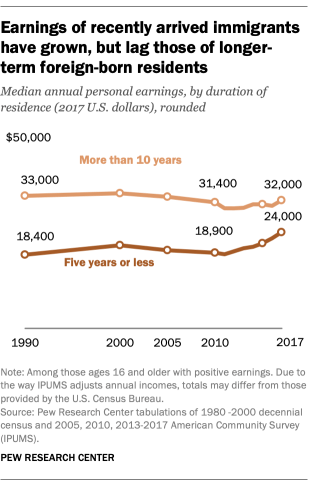
3. Earnings of recently arrived immigrants have grown, but lag those of longer-term foreign-born residentsThe personal earnings of recently arrived U.S. immigrants have increased, but trail those of longer-term immigrants. Those who arrived in the past five years had median annual personal earnings of $24,000 in 2017, compared with $32,000 among those who have lived in the country more than 10 years. For decades, more-recent arrivals have lagged longer-term residents in personal earnings despite having higher levels of education. For the U.S. population, by contrast, those with a college education have higher earnings. Since the Great Recession, the personal earnings of newer arrivals have increased while those of longer-tenured residents have remained flat.

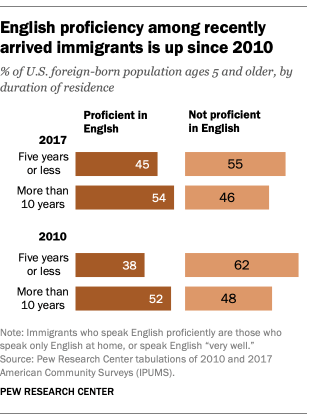
4English proficiency among recently arrived immigrants is up since 2010. English proficiency among recently arrived immigrants is on the rise. Among those who arrived in the U.S. in the past five years, 45% said in 2017 that they either speak only English at home or speak English very well, up from 38% in 2010. Due to this increase, recent arrivals are closing the gap with longer-term immigrants, who have seen little change in their English proficiency. About half of immigrants who have lived in the U.S. for more than 10 years said in 2017 that they either speak only English at home or speak English very well, a share little changed from 2010.

5, South and East Asia is approaching Latin America and the Caribbean as the top origin region of recently arrived immigrants. Latin Americans account for 38% of U.S. immigrants who have arrived in the past five years, as of 2017, compared with 35% from Asia. This has changed since 2010, when immigrants from Latin America (48%) made up a far higher share of recent arrivals than Asia (30%).

Latin America and the Caribbean is by far the largest origin region among immigrants who have lived the country for more than 10 years. In 2017, immigrants from Latin America accounted for more than half (54%) of longer-term residents, compared with 25% among those from South and East Asia.

Republican operative was behind U.S. census citizenship question: filing

Why I am not surprised:

The Trump administration concealed evidence that its proposal to add a question about citizenship to the 2020 U.S. census was intended to help Republicans draw favorable electoral maps, according to immigrant advocacy groups that sued the administration over the question last year.

In a filing in Manhattan federal court on Thursday, the groups said that the administration hid the fact during the course of the lawsuit that went to trial last year that Thomas Hofeller, a longtime Republican specialist on drawing electoral districts, played a “significant role” in planning the citizenship question.

The conservative-majority Supreme Court is due to issue a final ruling by the end of June on whether the question can be added in time for next year’s census.

The challengers notified the high court about the new documents in a letter filed at the court on Thursday afternoon. They did not ask the Supreme Court to take any specific action.

The plaintiffs, which include the Arab-American Anti-Discrimination Committee and Make The Road New York, learned of Hofeller’s role after his files came to light in separate litigation in North Carolina in which Republican-drawn electoral districts are being challenged.

A Justice Department representative said the allegations were a “last-ditch effort to derail the Supreme Court’s consideration of this case.”

“The Department looks forward to responding in greater detail to these baseless accusations in its filing on Monday,” the person said.

Manhattan-based U.S. District Judge Jesse Furman blocked the question’s inclusion following the trial, but the Supreme Court appeared poised to overturn that ruling at April’s oral argument.

According to Thursday’s filing, Hofeller concluded in a 2015 study that asking census respondents whether they are U.S. citizens “would clearly be a disadvantage to the Democrats” and “advantageous to Republicans and Non-Hispanic Whites” in redistricting.

Hofeller went on to ghostwrite a draft letter from the U.S. Department of Justice to the Department of Commerce, asking for a citizenship question on the grounds it would help enforce voting rights, according to the plaintiffs.

The plaintiffs, represented by the American Civil Liberties Union, said that administration officials gave false testimony about the origin of the question during the lawsuit, and have asked Furman to consider imposing unspecified sanctions against them.

Furman has scheduled a hearing on the request for June 5.

Reuters reported in April that the Trump administration believed its citizenship question could help Republicans in elections by enabling states to draw electoral maps based only on citizen population, rather than total population.

Opponents have said a citizenship question would cause a sizeable undercount by deterring immigrant households and Latinos from filling out the census forms, out of fear the information would be shared with law enforcement. That would, they argue, cost Democratic-leaning areas electoral representation in Congress and federal aid, benefiting President Donald Trump’s fellow Republicans and Republican-leaning parts of the country.

Source: Republican operative was behind U.S. census citizenship question: filing