USA Data: Citizenship shrinks economic gap

Haven’t done a similar analysis on Canadian participation and employment rates but income data shows similar pattern, but which reflects length of time in Canada. Similar pattern regarding eduction as well:

Foreign-born residents had higher rates of full-time employment than those born in the United States last year, and naturalized immigrants were more likely to have advanced degrees than the native-born, according to figures released Monday by the U.S. Census Bureau.

The new figures show that the economic gap between the native-born and the foreign-born in the United States appears to narrow with citizenship.

Immigrants who weren’t citizens had higher rates of poverty, lower income and less education compared with native-born citizens last year. But immigrants who were citizens had less poverty, close to equal earnings and higher rates of advanced degrees than native U.S. citizens.

“Usually immigrants start off in the U.S. lagging behind a bit in terms of income, as they need to find the right job, learn local skills and so on and then catch up,” said Giovanni Peri, an economist at the University of California, Davis. “Immigrants also are very different among each other, and those naturalized may be a selection of those more educated and with better jobs.”

Naturalized immigrants had a full-time employment rate of about 83 percent last year, noncitizens had about 81 percent and native citizens had 77 percent.

“Some immigrant groups have to be employed to stay in this country — those on work visas, which would raise the proportion,” said Stefan Rayer, a demographer at the University of Florida.

About 1 in 6.5 naturalized immigrants have a master’s degree or higher, while that is true for only about 1 in 8 native-born citizens and noncitizens.

The 2018 Current Population Survey figures offer a view of immigrants’ education levels, wealth and jobs as the U.S. engages in one of the fiercest debates about the role of immigration in decades.

Stopping the flow of immigrants into the U.S. has been a priority of President Donald Trump’s administration, which has proposed denying green cards to immigrants who use Medicaid and fought to put a citizenship question on the decennial census questionnaire.

Monday’s figures also look at differences between naturalized immigrants and those who aren’t citizens. In 2018, the U.S. had 45.4 million foreign-born residents, or about 1 in 7 U.S. residents.

Education appears to play a role in narrowing the income gap between the native-born and the foreign-born.

Overall, naturalized immigrants had a slightly smaller median income than the native-born — $50,786 compared with $51,547 — but noncitizen immigrants trailed them both with a median income of $36,449.

But naturalized immigrants with a college degree surpassed college-educated natives’ income, and both naturalized immigrants and noncitizens with advanced degrees had higher median incomes than U.S. natives with advanced degrees.

“Immigrants with advanced degrees, whether naturalized or not, may be more clustered in occupations with higher pay than the native population,” Rayer said.

About half of the U.S. foreign-born came from Latin America, less than a third came from Asia and 10 percent came from Europe. European immigrants’ median age — 50 — was roughly six years older than other immigrants.

More than a quarter of noncitizen immigrants were in service jobs, while almost a quarter of immigrants who were citizens were in professional jobs, according to the Census Bureau figures.

Asians and Europeans had the highest rates of advanced degrees — about a quarter of both immigrant groups had a master’s degree or higher. About 1 in 20 immigrants from Latin America had a master’s degree or higher.

Immigrants, both naturalized and noncitizens, were overwhelmingly urban and suburban dwellers. Less than 1 in 20 immigrants lived outside of a metropolitan area last year, compared with about 1 in 7 for native-born citizens, according to the figures.

Source: Data: Citizenship shrinks economic gap

The Irony Of Conservative Christians’ Opposition To Immigration

Interesting take:

President Donald Trump’s base simultaneously cares deeply about defending Christianity and restraining immigration.

It’s a stance we’ve come to expect, but there’s an irony to this. At a moment when more and more Americans are unaffiliated with religion, immigration is providing a counterbalance.

In fact, nothing would do more to strengthen Christianity than embracing undocumented immigrants. Most undocumented immigrants come from Latin America, so 83 percent are Christian. If they were all expelled, the United States would lose 9 million Christians. By contrast, legal immigrants tend to come from countries like India, Pakistan and China, with majority non-Christian populations.

Beyond that, it is well known that for the past few decades Latino immigration has energized, and in some ways saved, the Catholic Church in the United States. About 40 percent of American Catholics are Hispanic, and they’re more likely to say religion is “very important” in their lives than white Catholics.

What’s less acknowledged is that Latinos have also bolstered evangelical communities. Some 16 million evangelicals are Hispanic, and about 15 percent of all immigrants are evangelical.

Beyond the specifics, I’d argue that immigration has been a key factor in strengthening religious freedom in the U.S. New immigrants are more likely to be religious and to say it’s important in their lives than the general population.

Going back through history, immigration has repeatedly injected energy and piety to the American religious landscape.

From our country’s founding, diversity has been important to ensuring religious liberty. When James Madison guided the creation of the First Amendment, he believed that a “multiplicity of sects” would be more important than “parchment barriers.” Having a variety of religions or Christian denominations would prevent one religion from dominating the others, and therefore help create a fluid religious marketing place that would encourage religious vibrancy.

In the United States, religious diversity has flowered in three different ways: homegrown religious entrepreneurship (American-created religions like Mormonism, Seventh Day Adventism or Jehovah’s Witnesses); denominational splintering, and finally, immigration.

In the case of immigration, the positive effects may not be evident right way. Throughout American history, the arrival of new immigrants practicing minority religions has often prompted backlash, as happened throughout the 19th century with Irish Catholics. In 1835, Samuel Morse, who would later invent the telegraph, warned that foreign countries were sending us “their criminals” because America hadn’t erected the right “walls.” He also complained that he and his allies were being unfairly attacked by a liberal media that was “on the side of your enemies.”

But the Catholic influx not only enriched American life in countless ways, it strengthened religious freedom by making it impossible for Protestant majorities to impose their faith approach on others. For instance, until Catholics objected, public schools in the 19th century had insisted on teaching the Protestant translation of the Bible to children. Catholics demanded that if the Bible were to be taught, their translation had to be included too. This established the idea that religion can only live in public places if other religions are invited to participate too.

At another point in the 19th century, Protestants became worried about a different group of immigrants flooding across the border – Mormons coming from Canada. Horrible persecution ensued. In 1838, the governor of Missouri proclaimed that “the Mormons must be treated as enemies, and must be exterminated or driven from the State if necessary for the public peace.” Over time, the growth and persistence of the Mormons forced Americans to expand their definition of religious freedom.

In the 1920s, efforts to restrict immigration were driven in part by the fear that too many Jews had arrived from Eastern Europe. By World War II, though, America decided that Jews needed to be incorporated as full partners in the pluralistic model and that their presence demonstrated something inspiring about the nation. Presidents Roosevelt, Truman and Eisenhower cast religious freedom and pluralism as a sign of America’s moral superiority over fascism and communism.

Eisenhower became the first president to use the term “Judeo-Christian.” He explained, “Our form of government has no sense unless it is founded in a deeply felt religious faith, and I don’t care what it is. With us of course it is the Judeo-Christian concept, but it must be a religion that all men are created equal.”

In 1993, Congress proposed the Religious Freedom Restoration Act, which more deeply enshrined key modern principles of religious liberty. Tellingly, the bill’s main sponsors were religious minorities with immigrant ancestors: Charles Schumer and Stephen Solarz, both Jewish, in the House, and Ted Kennedy, an Irish Catholic and Orrin Hatch, a Mormon.

Over America’s history, immigration has helped fuel a virtuous cycle for religious freedom. Immigration has brought energy to religious institutions – and has prevented just one denomination from becoming powerful enough to squelch liberty.

Madison didn’t argue explicitly for immigration as a lubricant for religious freedom’s mechanisms. But he did argue for variety. It turns out that immigration has been a major reason this system has worked so well.

Source: The Irony Of Conservative Christians’ Opposition To Immigration

Trump’s Impact On Federal Courts: Judicial Nominees By The Numbers

Significant longer-term impact:

President Trump can be a master of distraction, but when it comes to judges, his administration has demonstrated steely discipline.

In the 2 1/2 years that Trump has been in office, his administration has appointed nearly 1 in 4 of the nation’s federal appeals court judges and 1 in 7 of its district court judges.

The president recently called filling those vacancies for lifetime appointments a big part of his legacy. Given the relative youth of some of his judicial picks, experts say, those judges could remain on the bench for 30 or even 40 years.

Legal observers say Trump and his Republican allies in the Senate have placed an unmistakable stamp on the federal judiciary, not only in ideology but in identity.

“What stands out to me is that President Trump is deliberately nominating the least diverse class of judicial nominees that we have seen in modern history,” said Kristine Lucius, executive vice president for policy at the Leadership Conference on Civil and Human Rights. “It is stunning to me that 2 1/2 years in, he has not nominated a single African American or a single Latinx to the appellate courts.”

In all, around 70% of Trump’s judicial appointees are white men. Dozens of those nominees have refused to answer whether they support the Supreme Court’s holding in Brown v. Board of Education, the 1954 opinion that said racial segregation of public schools is unconstitutional.

Civil rights advocates say those nonanswers should be disqualifying. But with Republicans holding 53 seats in the Senate and on board with Trump’s program to confirm as many judges as possible, these nonanswers usually aren’t.

Conservative legal analyst Ed Whelan said there are good reasons why some judicial candidates balk at those questions.

“I think there’s a game being played here, and the critics are part of that game,” said Whelan, who leads the Ethics and Public Policy Center in Washington, D.C. “It’s quite clear that what Democratic senators aim to do with that questioning is say, ‘Well, if you can answer questions about Brown, why won’t you answer questions about Roe?”

Whelan was alluding to Roe v. Wade, the decision that legalized abortion.

Consequences of courts transformed

Abortion-rights groups worry that Roe is now in peril from the new generation of judges with ties to the conservative Federalist Society, whose leader has consulted with the White House to select two Supreme Court justices and many other candidates for the lower courts.

With all his judicial appointees, however, Trump has not transformed the courts as much as he could have, legal analysts say. If more Democratic vacancies had been open, Trump’s impact could have been even more dramatic.

Russell Wheeler, a visiting fellow at the Brookings Institution, said Trump has mostly replaced judges appointed by Republican presidents with his own candidates, adding to conservative majorities in courts based in the South and narrowing the margin in the 9th Circuit in San Francisco — a frequent target of the president’s attacks.

All the same, Wheeler said, the new judges of the Trump era are generally more conservative than the older ones winding down their careers.

“When you replace a 70-year-old George W. Bush appointee who is slightly to the right of center with a 45-year-old movement conservative, obviously you’re not trading apples for apples,” Wheeler said.

A high-water mark?

Trump and Senate Majority Leader Mitch McConnell, R-Ky., may have reached a “high-water mark” on the federal appeals courts, Wheeler said.

They may have filled vacancies so quickly that there are unlikely to be many more openings on the circuit courts in the year ahead — unless judges appointed by Democrats decide to retire in large numbers.

That means attention is turning to the lower courts, which handle cases on civil rights, the environment, financial regulation and federal crimes.

On July 30 and 31, the Senate confirmed 13 district court judges before leaving the Capitol for its August recess. The Senate Judiciary Committee, run by Chairman Lindsey Graham, R-S.C., is poised to pick up the district court judge process again this fall.

Whelan, of the Ethics and Public Policy Center, said evangelicals and other conservatives are delighted with that pace — and with the White House for delivering on its promises to prioritize the judiciary.

In a few cases, Republican senators have brought down the president’s own nominees, getting the candidates to withdraw sometimes because they’re not conservative enough.

For progressive activists, that only highlights the need for Democrats to take judicial appointments more seriously. The subject has so far not been a focus in any of the Democratic presidential debates, in which 2020 hopefuls are making the case for why they should be the Democratic Party’s nominee to take on Trump.

But as Brian Fallon of the group Demand Justice pointed out, the Democratic presidential candidates are campaigning on ambitious ideas — climate change policies, health care and financial regulation.

Those things, he said, will be disputed in court and will need to survive judicial review in front of judges — many of whom were appointed by Trump.

Fallon has this to say to Democrats vying for the White House: “They actually owe it to the voters to explain very clearly what they’re going to do to take back the courts and who they’ll nominate in order to do that.”

Source: Trump’s Impact On Federal Courts: Judicial Nominees By The Numbers

Statistics of anti-Semitism in US are misleading

Good serious comparison of the various datasets available. The observations regarding the limitations of ADL statistics also apply to B’nai Brith as to those on FBI data also apply to StatsCan complication of police reported hate crimes.

With respect to the National Crime Victimization Survey, the closest Canadian equivalent is the currently underway General Social Survey – Canadians’ Safety (GSS) which includes self-reported victimization, to be released winter 2020-21:

On Sunday, a Jewish man standing outside a synagogue was shot in the leg in what police are investigating as a possible hate crime. It was only the latest in a string of anti-Semitic attacks this year.

These attacks have brought in their wake headlines declaring “a spike in hate crimes” and “increased anti-Semitic attacks all across this country,” based on episodes like Sunday’s as well as data. Earlier this year, the FBI reported the largest increase in hate crimes since 2001, and the Anti-Defamation League reported that anti-semitic incidents rose by 57% in 2017.

As a result, a consensus has developed around the idea that hate crime and anti-Semitism are rising, and that Jews are no longer safe in the U.S. Leaders across the political divide agree.

But I’ve found myself skeptical of these claims of rising hate. Partly, this is because of a rather personal reason: Since moving to the US over a decade ago, I have never personally experienced hate or a hate crime.

But I was skeptical for a professional reason too. As a mathematician by training, I spent my PhD years working with messy crime data. And the truth is, it cannot be trusted at face value.

I couldn’t help but wonder if the data on hate crimes, especially those pertaining to the Jewish community, might have similar problems.

And it does. Big time.

To dig deeper, I looked at all the available data on hate crimes, which included incidents of hate by year, surveys, and reports. I sought out datasets, what are in their ideal form collected methodically year after year by faceless government statisticians. I also downloaded spreadsheets and mined the numbers myself.

What I found will probably surprise you: We have a real anti-Semitism problem in this country. But it’s not getting worse.

It’s important to keep in mind that hate crimes are not a leading cause of injury or death; in the same year 37,000 people were killed on the roads, and 2.3 million injured or disabled.

But you can’t compare hate crimes to road accidents; with a hate crime, like with terrorism, the victim is targeted because of their group identity, and the entire group feels threatened. Hate crimes select symbolic targets, such as community buildings, whose significance far exceeds their property value.

And research indicates that being in a targeted group is not just discomforting but can have a tangible effect how people behave. We know from Europe that attacks on Jews can trigger a wave of immigration to Israel, and it should not be assumed that the same cannot happen to American Jews.

Even more disturbingly, research on fertility data from 170 countries found that during waves of terrorism there is a decline in births.

All of this made me even more anxious to find out if there was actually a wave of anti-Semitism sweeping through America. So I sought out the two most frequently-cited sources of hate crime data: reports from the ADL and the FBI.

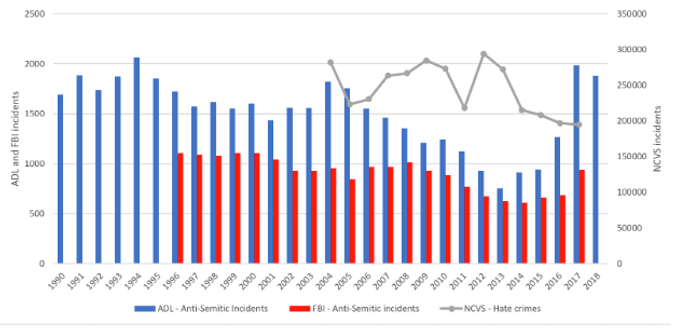
Let’s start with baselines. According to the FBI’s most recent data, 2017 saw 7,175 hate crimes nationwide, including 15 hate murders. Anti-Jewish hate crime incidents represented 13% of all incidents – 923 – coming in second only to Anti-Black hate crimes, which numbered 2,013 incidents.

There were also more anti-Semitic incidents than “anti-gay” crimes, for example. Most importantly for our purposes, because Jews make up just 1-2%of the US population, these numbers mean that the Jewish community is targeted by hate crimes disproportionately to its numbers by a factor of ten.

The ADL has been tabulating data on anti-Semitic hate crime for an impressive 40 years, and it receives data both from the police and the public. The ADL has built out a modern data center and has interactive online visualizations.

In its most recent audit, the ADL reported that 2018 had the third-highest number of incidents of the past four decades, with 1,879 incidents. The 2018 total is 48% higher than the number of incidents in 2016, and 99% higher than in 2015. Both 2017 and 2018 had far more incidents than typical for the previous eight years. This is, indeed, alarming.

However, these numbers should be taken with a mild dose of the proverbial salt. The problem with hate data is that only 20% of hate crimes are reported to the police, and, one suspects, even fewer to the ADL. So the statistics give just the tip of an iceberg; the majority of hate times are not included in this count.

This makes them somewhat unreliable. To rely on 20% of the data to determine if there is a wave of anti-Semitic hate crimes would be like looking at the top shelf of your fridge, and finding it overflowing, deciding that you need to buy a larger fridge (I would suggest looking at the other four shelves first).

And you can’t just compare the 20% of reported crimes each year to the 20% from last for the simple fact that the reporting rate is not a constant 20% of all crimes. Reporting goes up and down along with public concern. An increase in concern about hate crimes can increase the number of reports by the public, and even the number of police investigations, making more of the “iceberg” (or fridge) visible and inflating the numbers.

To put it plainly, if many people started to believe, fairly or not, that we are in the midst of a wave of hate, they would also start to report more hate crimes, making the data inconsistent with the past.

This is not to say that the jump in anti-Semitic hate crimes reported by sources like the ADL is a statistical mirage. But the reality is probably different from what the numbers suggest.

Independently of the ADL, the FBI has been reporting hate crime data since the 1990s through its Hate Crime database. It has developed impressive guidelinesto judge if a crime incident is indeed a hate crime, and its reports are available online. Surely, here we can expect to finally find deep databases processed by standard and reliable statistical methods!

But alas, the FBI’s numbers also need to be taken with a little grain of kosher salt. The problem is that crimes are generally reported to the local police department and not to the FBI directly, so the FBI’s data is only as good as the reports it receives.

In some states, less than 10% of the police agencies bother to report to the FBI at all, and likely only report the more severe crimes. As a credit to the system, the FBI provides consistent data that goes back to the 1990s, and thus is well-suited to recording if there are any national trends.

But charting the FBI data from 1996 to 2017 suggests that we are far from having achieved new heights of anti-Semitism. Rather, anti-Semitic incidents peaked in 1999 at 1,109 per year, then declined from 2008 to 2014, and have been trending up since then, reaching 976 in 2017.

As with the ADL numbers, the data quality is not great, thanks to under-reporting. But even taking that into account, we appear to still be well below the numbers of the 1990s.

Fortunately, there is another government crime tracking program that has been all but forgotten by the press: the National Crime Victimization Survey. Unlike the ADL and the FBI, who collect reports, the NCVS goes out to the communities and interviews some 160,000 people every year, asking them if they were victims of various crimes.

Because the NCVS uses a representative sample, it can reliably estimate the number of crimes in the entire country, including hate crimes. If there is a wave of hate in America, the NCVS would detect it in its survey.

In its most recent report, NCVS estimated that 204,000 hate crimes occur in the US annually, of which just 15,000 are confirmed by the police.

The NCVS also shows that hate crime rates have been steady every year since 2015, and were probably higher ten years ago.

There is no data specifically on anti-Semitism in NCVS, but if we assume per the FBI’s estimate that about 13% of hate crimes are anti-Semitic, then there are a staggering 26,000 anti-Semitic crimes every year in the US — 30 times more than reported by the FBI and 14 times more than the ADL.

What we can learn from these statistics is both good and bad. For all the problems of the last few years, there is no reason to fear a wave of hate, because the wave, if it exists, is a small one.

Today’s Jewish America has probably the safest existence of any Jewish community in history. In this generation, a Jew is much more likely to suffer a car accident than a hate crime.

But to believe naively in the American utopia is to ignore the truth: Hate is alive and well in America, and Jews are often the target of it.

Source: Statistics of anti-Semitism in US are misleading

The Fairness for High-Skilled Immigrants Act is anything but fair | TheHill

How the removal of country caps may impact on other groups:

Much of our community, the Iranian-American community, owes its citizenship to the green card process. However, a bill moving through Congress would slam shut that pathway for countless Iranians and communities like ours, shifting outrageous backlogs onto nationals from Iran and other smaller countries.

Unfortunately, the House of Representatives recently passed a bill, known as the Fairness for High-Skilled Immigrants Act of 2019 (H.R. 1044/S. 386) which would eliminate caps that prevent any one country from receiving more than 7 percent of green cards for highly-skilled workers. These caps were put in place, according to the State Department, to guard against the monopolization of the green card process by a few larger countries. While eliminating the caps would reduce the backlog for nationals from large countries, like India and China, it would shift that backlog onto nationals from smaller countries—adding years of delays. For Iranian nationals, who are already separated from loved ones due to the president’s cruel travel ban, this would extend their separation by up to a decade.

Why is this legislation moving so fast? At a time when Congress has been unable to pass any meaningful reforms to address the multitude of crises in our immigration system, how are lawmakers on the verge of passing such a fundamental overhaul of the immigration system with almost zero debate on the unanticipated consequences? Because nationals who would benefit from the bill are vocal and backed by corporate interests who would also benefit, while the many who would be affected negatively by the change have been quiet by comparison. That needs to change if we want to safeguard the green card process for all nationalities.

In working with our community, NIAC has heard from many Iranian high-skilled workers in the U.S. who would be affected by this legislation. Their very future, and the American dream, is at stake. Worse yet, the vast majority of these individuals are also impacted by Donald Trump’s Muslim travel ban—unable to have their family secure a visa to visit, and unable to return home to visit family without jeopardizing their future in the United States.

Despite its name, the Fairness for High-Skilled Immigrants Act is not a fair way to deal with backlogs. Congress must consider a solution that actually addresses the problem instead of shifting the backlog from one group to another. One option would be to increase the number of green cards issued, which recent legislation introduced by Sen. Rand Paul (R-Ky.) would accomplish. Paul’s BELIEVE Act would quadruple the number of employment-based visas to address the backlog problem that particularly affects nationals from large countries. Additional measures proposed by this bill would exempt dependents and certain categories of specialists from the cap altogether.

As an Iranian-American organization, NIAC is tasked with the responsibility to not just advocate for our community and protect their civil rights, but also to protect the American dream that allowed our community to be built here in the first place. That means we must fight to keep the path to green cards open to all and ensure Congress passes a solution to the green card backlog that actually is fair.

Jamal Abdi is the president of the National Iranian American Council.

Source: The Fairness for High-Skilled Immigrants Act is anything but fair | TheHill

Stephens: The New Conservative Pyrite “National conservatism” is another road to serfdom

Good post by Stephens on the bankruptcy of contemporary American conservatives:

Friedrich Hayek, whose thoughts used to count for something among well-educated conservatives, made short work of nationalism as a guiding principle in politics. “It is this nationalistic bias which frequently provides the bridge from conservatism to collectivism,” he wrote in “The Constitution of Liberty.”

That point alone ought to have been enough to dim the right’s new enthusiasm for old-style nationalism. It hasn’t.

A three-day public conference this month on “national conservatism” featured some bold-faced right-wing names, including John Bolton, Tucker Carlson and Peter Thiel. The Wall Street Journal’s editorial page published a piece from Christopher DeMuth, a former president of the American Enterprise Institute, on the “nationalist awakening.” Yoram Hazony, an Israeli political theorist, has gained wide attention among U.S. conservatives with his book, “The Virtue of Nationalism.

And, of course, Donald Trump: “You know, they have a word, it sort of became old-fashioned, it’s called a nationalist,” the president said last October. “And I say, really, we’re not supposed to use that word. You know what I am, I’m a nationalist.”

From immigration limbo to liberty: Canada sees surge of non-American migrants

Interesting shift but not surprising given the impact of the Trump administration on US immigration policy and practices:

After spending almost all her life in immigration limbo in the United States, Paras Pizada can finally set down roots and plan for a future … in Canada.

The 27-year-old woman is part of a surge of non-American citizens arriving here legally from south of the border where they’ve faced an increasingly hostile environment since President Donald Trump was elected in 2016.

Canada’s new biometrics visa requirements, however, could prove a deterrent for undocumented migrants in the U.S. who, like Pizada, try to come here legally.

Since January, applicants worldwide must provide fingerprints and have their photos taken at facilities designated by Canadian immigration.

In the U.S., almost all facilities are operated by American immigration officials. Undocumented migrants fear this will put them at risk of arrest and deportation. Indeed, the Canadian immigration website warns biometric applicants that they must be legally in the U.S. to go to a centre.

These biometrics requirements could potentially drive up irregular migration into Canada which has dropped by half to 5,140, between January and May, compared to the same period last year.

“Since these people can’t get fingerprinted to apply for Canadian work permits and study permits legally, they will all just walk across the border. Ottawa has made it impossible for the majority of undocumented U.S. residents who want to apply legally for Canada to do so,” said Winnipeg-based immigration lawyer Vanessa Routley.

According to Canadian immigration data revealed for the first time, in 2018, non-Americans in the U.S. accounted for 85 per cent or 13,754 of the 16,158 permanent residence applicants from south of the border, up from just 48 per cent or 1,477 of the total 3,077 applicants in 2015, with India (10,556), China (768) and Nigeria (337) being the top three source countries in 2018.

In 2015, non-Americans made up just 14 per cent or 4,664 of 33,062 applicants in the U.S. for Canadian work permits and student visas.

In 2018, the number almost doubled to 26 per cent or 11,840 of all 45,202 applicants.

It is not known how many of these applicants were actually undocumented in the U.S., because that data is not collected.

Pizada was two when her family arrived as visitors to the United States from Pakistan in 1994. They never left, moving from place to place to evade detection by immigration enforcement officials. Though both Pizada and her sister later qualified to remain temporarily in the U.S. under a special program for undocumented children launched under then-President Barack Obama, they had had no access to permanent residence and citizenship.

When Trump was elected in 2016 and stepped up the removal of undocumented migrants, the sisters started looking for places to go outside the U.S. In June, Pizada, who has a master’s degree in media studies from Pratt Institute in New York, came to Canada as a permanent resident under the federal skilled workers program, following in the steps of her sibling, Mahaik, who had arrived here the year before.

“We are so relieved,” said Pizada, who now lives in Niagara Falls. “I can finally put down roots and have a place to call home. I’m allowed here and no one can kick me out.”

Pizada was lucky she could avoid the biometrics dilemma presented by Canadian immigration because she had already been known to American homeland security officials by having registered with the Obama administration’s program that offered her a renewable temporary residence in the U.S. every two years. Most undocumented migrants didn’t meet that program’s criteria and are off the enforcement officials’ radar.

Of the 133 facilities in the U.S., only two, one in Los Angeles and the other in New York City, are run by private contractors, which means most undocumented applicants must either travel long distances to those two offices or take the risk of going to their local centres and potentially be intercepted by American immigration authorities.

Sharma, who asked that her full name not be used because she is undocumented in the U.S., has been accepted by four Canadian universities — these are Waterloo, Concordia, New Brunswick and Dalhousie — in their graduate programs, but is afraid of setting foot in her local centre run by the U.S. Department of Homeland Security as it collects fingerprints.

“There is definitely a heightened fear of getting arrested with all these government raids against migrants,” said Sharma, 21, who arrived in the U.S. from Indian with her family 12 years ago.

She graduated in May with an undergrad degree in biomedical engineering.

“This biometrics requirement is hindering our ability to regularize our status in Canada. We just want to make a better life.”

Canada is doing everything it can to make the biometrics collection process as smooth as possible for all applicants, according to Canadian immigration department spokesperson Nancy Caron.

“In a situation where an applicant is unable to comply with the biometric requirement, these individuals can self-identify themselves by contacting the department and provide a supporting rationale for their situation. Canadian migration officers have the discretion, in specific circumstances, to exempt an applicant from providing biometric information,” Caron told the Star in an email.

“It is important (for us) to be aware of an applicant’s previous immigration history and their compliance with immigration laws, including their current immigration status. This helps in determining whether an applicant is admissible to Canada and whether they are likely to respect the conditions of their visa.”

Officials said the data on biometrics exemptions requested and granted is unavailable.

Source: From immigration limbo to liberty: Canada sees surge of non-American migrants

Tech Companies Say it’s Too Hard to Hire High-Skilled Immigrants in the U.S. — So They’re Growing in Canada Instead

The latest in a series of articles. Perhaps the only upside for Canada of the Trump presidency:

On a recent Tuesday, Neal Fachan walked down a dock in Seattle’s Lake Union and boarded a blue and yellow Harbour Air seaplane, alongside six other tech executives. He was bound for Vancouver to check on the Canadian office of Qumulo, the Seattle-based cloud storage company he co-founded in 2012. With no security lines, it was an easy 50-minute flight past snow-capped peaks. Later that day, Fachan caught a return flight back to Seattle.

Fachan began making his monthly Instagram-worthy commute when Qumulo opened its Vancouver office in January. Other passengers on the seaplanes go back and forth multiple times a week. Fachan says his company expanded across the border because Canada’s immigration policies have made it far easier to hire skilled foreign workers there compared to the United States. “We require a very specific subset of skills, and it’s hard to find the people with the right skills,” Fachan says as he gets off the plane. “Having access to a global employment market is useful.”

In the fractious battle over immigration policy, most of the attention has been directed at apprehending migrants at the southern border. Some tech executives and economists, however, believe that growing delays and backlogs for permits for skilled workers at America’s other borders pose a more significant challenge to the U.S.’s standing as a wealth-creating start-up mecca. The risk of losing out on the fruits of innovation to Canada and other countries that are more welcoming to immigrants might be a bigger problem for our economic future than a flood of refugees. Half of America’s annual GDP growth is attributed to rising innovation.

“Increasingly, talented international professionals choose destinations other than the United States to avoid the uncertain working environment that has resulted directly from the agency’s processing delays and inconsistent adjudications,” testified Marketa Lindt, president of the American Immigration Lawyers Association, at a House hearing last week about processing delays at U.S. Citizenship and Immigration Services (USCIS). Lindt’s organization finds that USCIS processing time for some work permits has doubled since 2014, a fact cited in a May letter signed by 38 U.S. Senators on both sides of the aisle asking USCIS to explain the processing delays.

The backlogs in processing have particularly benefited our neighbor to the north. Canada has adopted an open-armed embrace of skilled programmers, engineers and entrepreneurs at the same time the U.S. is tightening its stance. Research shows that high-skilled foreign workers are highly productive and innovative, and tend to create more new businesses, generating jobs for locals. So each one who winds up in Canada instead of America is a win for the former, and a loss for the latter. “Really smart people can drive economic growth,” says Robert Atkinson, president of the Information Technology and Innovation Foundation, a think tank in Washington, D.C. funded in part by cable, pharmaceutical, television, and tech companies. “There are not that many people in the world with an IQ of 130, and to the extent that we’re attracting those people rather than the Canadians doing so, we’re better off.”

With the unemployment rate hovering below at or below four percent for the past 18 months, tech companies are long used to battling for talent by offering $100,000-plus starting salaries and perks like onsite gyms and all the kombucha you can drink. Recruiting foreign talent is one way for them to find new hires. There are a number of ways companies can hire skilled workers from India, China, and other countries, including applying for L-1 and H-1B visas, which allow foreigners to temporarily work in the United States. Demand for these visas, which are awarded by lottery, is intense. Since 2004, 65,000 H-1B visas are issued annually: this year’s ceiling was hit in only four days. (The government allows 20,000 additional visas for workers who have a master’s degree or PhD from a U.S. university.)

Amid the wider crackdown on immigration under the Trump Administration, the application process for employment-based visas appears to have gotten even tougher. The government denied 24% of all initial H-1B applications in 2018, up from six percent in 2015, according to an analysis of data from the National Foundation for American Policy, a pro-immigration think tank. It’s not just H-1B applicants who are experiencing delays. Applicants for all employment-based green cards now have to appear in person at a field office, a new policy that has created long delays, according to the American Immigration Lawyers Association, which says immigration officials under Trump are focusing more on enforcement than on processing legal applications for benefits. And despite a backlog of 5.7 million cases in 2018, USCIS has been providing surge resources to Immigration and Customs Enforcement field offices across the country, diverting more staff away from processing visa applications.

Canada’s policies, in contrast, offer an alluring alternative. Canada permits companies with offices in the country to hire skilled foreign workers in positions such as computer engineers, software designers, and mathematicians, and have their visas processed within two weeks. These workers can soon after apply to be permanent residents and, within three years, become full-fledged citizens. (The path to permanent residency for foreign workers in the U.S., by contrast, can take decades.) Officials at the Canadian consulate in Seattle work with two to three companies a week trying to set up offices in Canada.

“The visa process is just completely unpredictable for us, and we were wrestling with it for so long, we decided we needed to have some certainty,” says Thor Kallestad, the CEO of DataCloud, which uses technology to help mining companies better assess land potential. He already had offices in Silicon Valley and Seattle, but decided to open up shop in Vancouver and close his Silicon Valley office so he could more easily hire foreign workers. “In the U.S., we just couldn’t get clear answers about what the process looked like, what we as a company needed to do to rectify it.”

The Canadian option offers workers more certainty — and a near-guaranteed path to citizenship — while many U.S. skilled workers have no idea when and if they will get approved to stay in the United States. Given the choice, talented entrepreneurs with cutting-edge companies are choosing Canada. “They really make it easy to come in and start a business,” said Nat Cartwright, one of the founders of Finn.AI, an artificial intelligence company that powers virtual assistants for banks around the world. Cartwright and her two business partners, who are from Australia and India, met in business school in Spain. When they graduated, they considered locating their new company in Silicon Valley, but ultimately chose Vancouver because they knew they would qualify for a start-up visa there, and that they would be able to quickly hire AI experts from around the world. Of the company’s 60 workers, 60% were born outside Canada. Seven of Cartwright’s business school classmates from Spain have since relocated to Canada.

Canadian officials have deftly responded to the changing climate in the U.S. In 2017, the Trudeau government announced Global Skills Strategy, the program that allows companies to get work permits for foreign talent in less than two weeks. Their spouses can also receive work permits; the U.S. Department of Homeland Security this year proposed revoking work permits of the spouses of skilled foreign workers in the U.S. In 2018, the Trudeau government also made permanent the Start-Up Visa program, which allows immigrant entrepreneurs to live and work in the country provided their start-up has secured funding from venture capitalists or angel investors. A similar start-up visa program in the United States was approved in the last days of the Obama administration, but the Trump administration is in the process of ending it. “By helping Canadian companies grow, this strategy is creating more jobs for Canada’s middle class and a stronger Canadian economy,” said Ahmed Hussen, Canada’s Somali-born Minister of Immigration, earlier this year.

Even the biggest American tech companies are expanding their Canadian operations in a quest for high-skilled labor. Software engineer Janko Jerinic moved to Canada after attending an Amazon recruiting fair in his home country of Serbia. He wanted a job in New York or Seattle, but his wife hoped to work as well, and an Amazon recruiter said it would be hard for her to get a visa. The recruiter steered the couple to Vancouver, where Jerinic has worked for Amazon since 2015. The office, which opened in 2013, rapidly grew from about 500 people when he started to triple that now. A map in Jerinic’s Vancouver office shows employees’ places of birth. There are hundreds of pins from places like India, Russia, Brazil, and Belgium. But “you have to use a flashlight to find people from Canada,” he jokes. Amazon said in April 2018 that it was building a 416,000 square foot office in downtown Vancouver that will open in 2022; it plans to hire 3,000 more people there.

That technology companies are growing across America’s border has big implications for the U.S. economy. Since World War II, the U.S. has been the epicenter of the entrepreneurial universe. But America’s entrepreneurial dominance is waning. While 95% of global start-up and venture capital activity took place in the United States in the mid-1990s, today it’s about half, according to a report from the Center for American Entrepreneurship (CAE), a nonprofit that advocates for start-ups and is funded by banks and financial institutions. And the number of start-ups still paying employees a year after their founding fell 42% between 2005 and 2015, the most recent year for which there is data available.

The innovation economy creates jobs outside of tech, too. Research by the Berkeley economist Enrico Moretti suggests that every high-paying tech job created in an economy results in five more openings, including positions like lawyers, nurses, and hairdressers. The United States allows about 140,000 immigrant skilled workers to become permanent residents annually; Canada, a company with one-tenth of the population, welcomed 160,000 skilled workers on the track to permanent residency in 2017 and hopes to get that number to nearly 200,000 by 2021. Its goal of making immigrants 1% of its population by 2021 would increase annual GDP growth by 0.6%, with immigrants driving one-third of that expansion, according to a report by the Conference Board of Canada.

Making it easier for high-skilled immigrants in the United States could help jump-start America’s innovation economy, said Ian Hathaway, a Brookings Institution fellow who studies entrepreneurialism and technology. Immigrants are twice as likely as native-born Americans to start businesses. Immigrants or children of immigrants founded almost half of America’s Fortune 500 companies. More immigration could also bring benefits beyond the country’s traditional tech hubs, boosting businesses in the countryside and suburbia that are short on skilled tech talent. Most of the start-up activity that has occurred since the Great Recession has been concentrated in only 20 counties, a startling contrast to the economic recovery of the 1990s, when new businesses were sprinkled across the country.

VannTech, a recruiting platform, recently brought 126 Brazilian workers to a company in the Canadian prairies whose native workers kept moving to Toronto and Vancouver. The platform has 70,000 skilled tech workers looking to relocate to Canada and Europe; it does not help these people go to the United States because the process is too difficult, said Ilya Brotzky, VannHack’s CEO. “If U.S. companies are putting 5,000 tech jobs in Canada, when they could be putting them in places like St. Louis or Indianapolis, that’s a huge deal to those local economies,” says Atkinson.

At the same time, Trump himself has advocated for rethinking the system. In 2017, he backed the Raise Act, a bill introduced by Senate Republicans that would have cut legal immigration in half, while also establishing a points system designed to give priority to skilled workers and investors. While the bill would not have dramatically increased the number of visas available to in-demand workers, it did signal a preference for skilled workers over other migrants. The bill stalled out after opposition from politicians whose constituencies include agriculture and tourism companies, which rely heavily on unskilled immigrants. Trump reintroduced the merit-based immigration idea this year in a Rose Garden speech, and his staff is considering a new immigration plan that would revamp the current system to prioritize skills over family ties. “We want immigrants coming in,” he said in May. “We cherish the open door that we want to create for our country, but a big proportion of those immigrants must come in through merit and skill.”

Harbour Air, the seaplane company, used to fly buyers in and out of remote log booms across the Pacific Northwest. As that business waned, the company pivoted to tourism. Now, pilot Reggie Morisset says that tech industry demand is filling up planes once again. When the Vancouver-Seattle route launched last year, tech companies bought tickets in bulk so their employees could easily go back and forth between Canada and the United States, he said. “It’s catching fire,” he said. “If anything, it is just going to get busier.”

Source: Tech Companies Say it’s Too Hard to Hire High-Skilled Immigrants in the U.S. — So They’re Growing in Canada Instead

Before the 2020 Census Citizenship Fight, a Parallel Crisis

Another historical reminder:

After months of headlines, presidential tweets and a Supreme Court decision, the 2020 Census will not ask people about their citizenship status.

President Donald Trump and his advisers tried to add the question, claiming it was necessary to help enforce the Voting Rights Act, while Census Bureau officials, civil rights advocates and a coalition of dozens of states and cities argued the real intent was to scare immigrants and prevent a growing portion of the U.S. population from being counted. The Supreme Court ultimately blocked the citizenship question and ruled the Administration’s justification was “contrived” — but the controversy is far from over, and is sure to come up when the Director of the U.S. Census Bureau, Steven Dillingham, testifies before Congress on Wednesday.

But this is not the first time such debates have surfaced. The census has always been political, since the framers of the Constitution created it as a tool for determining political representation, and today’s controversy over the 2020 Census specifically echoes a crisis that occurred almost exactly 100 years ago.

Then, as now, the controversy centered on the presence of immigrants and the rising importance of cities. These changes were key because the Census not only counts how many people live in the U.S., but it also determines how much voting power and funding different areas of the country receive; as populations change, so do they. Those measurements are supposed to be updated as each Census is conducted every 10 years, and it has long been understood that a correct update requires counting all residents, not just all citizens.

But when the 1920 Census results came out, Congress was so unhappy with its results that they ignored the numbers for nearly a decade, refusing to adjust even as the composition of the American population was clearly changing.

The years leading up to that Census had already seen a rise of anti-immigrant fervor, concern over labor unions and other “radicals,” and race riots igniting across the Midwest. It was in this context that the 1920 Census determined that the U.S. not only already included a large number of immigrants, but also that the majority of Americans officially lived in cities for the first time in the nation’s history. This represented a major shift from just a few decades earlier, when most Americans lived in the countryside and many worked on farms. Now, the country had become industrialized and the government had evidence that people were flocking to urban areas from their rural surroundings and from abroad. Applying the results of the Census would mean moving power and funding to cities, which leaned toward the Democratic Party.

This all proved too much for the Republican-dominated Congress, many of whom were elected from rural districts. So the members of Congress claimed the census numbers simply had to be wrong.

Source: Before the 2020 Census Citizenship Fight, a Parallel Crisis

What Americans Know About Religion | Pew Research Center

Good in-depth survey, as typical of Pew. Worth doing the test quiz (for the record, got 11 out of 15 or 73 percent):

Most Americans are familiar with some of the basics of Christianity and the Bible, and even a few facts about Islam. But far fewer U.S. adults are able to correctly answer factual questions about Judaism, Buddhism and Hinduism, and most do not know what the U.S. Constitution says about religion as it relates to elected officials. In addition, large majorities of Americans are unsure (or incorrect) about the share of the U.S. public that is Muslim or Jewish, according to a new Pew Research Center survey that quizzed nearly 11,000 U.S. adults on a variety of religious topics.

Our surveys often ask people about their opinions, but this one was different, asking 32 fact-based, multiple-choice questions about topics related to religion (see here for full list of questions). The average U.S. adult is able to answer fewer than half of them (about 14) correctly.

The questions were designed to span a spectrum of difficulty. Some were meant to be relatively easy, to establish a baseline indication of what nearly all Americans know about religion. Others were intended to be difficult, to differentiate those who are most knowledgeable about religious topics from everyone else.1

The survey finds that Americans’ levels of religious knowledge vary depending not only on what questions are being asked, but also on who is answering. Jews, atheists, agnostics and evangelical Protestants, as well as highly educated people and those who have religiously diverse social networks, show higher levels of religious knowledge, while young adults and racial and ethnic minorities tend to know somewhat less about religion than the average respondent does.

Most Americans correctly answer basic questions about Christianity, atheism and Islam; fewer know about Judaism, Hinduism or what the Constitution saysOverall, eight-in-ten U.S. adults correctly answer that in the Christian tradition, Easter commemorates the resurrection of Jesus – rather than the Crucifixion, the Ascension to heaven or the Last Supper. A similar share know that the Christian doctrine of the Trinity holds that there is one God in three persons – the Father, the Son and the Holy Spirit. Eight-in-ten Americans correctly identify Moses as the biblical figure who led the Exodus from Egypt, and David as the one who killed an enemy by slinging a stone, while seven-in-ten know that Abraham is the biblical figure who exhibited a willingness to sacrifice his son in obedience to God.

Most Americans also are familiar with two different terms that indicate a lack of belief in God. Almost nine-in-ten correctly identify the definition of “an atheist” (someone who does not believe in God), and six-in-ten correctly select the definition of “an agnostic” (someone who is unsure whether God exists).

Even some of the basics of Islam are familiar to a wide swath of the public. Six-in-ten U.S. adults know that Ramadan is an Islamic holy month (as opposed to a Hindu festival of lights, a Jewish prayer for the dead, or a celebration of the Buddha’s birth) and that Mecca (not Cairo, Medina or Jerusalem) is Islam’s holiest city and a place of pilgrimage for Muslims.

Most Americans are familiar with key elements of Christianity, terminology of nonbelief, basics of IslamOn the other hand, Americans are less familiar with some basic facts about other world religions, including Judaism, Buddhism and Hinduism.2 Just three-in-ten U.S. adults know that the Jewish Sabbath begins on Friday, one-quarter know that Rosh Hashana is the Jewish New Year, and one-in-eight can correctly identify the religion of Maimonides (an influential Jewish scholar in the Middle Ages).

Roughly one-in-five Americans (18%) know that the “truth of suffering” is among Buddhism’s four “noble truths,” and just 15% correctly identify the Vedas as a Hindu text.

Many Americans also struggle to answer some questions about the size of religious minorities in the U.S. and about religion’s role in American government. For instance, most U.S. adults overestimate the shares of Jews and Muslims in the U.S. or are unaware that Jews and Muslims each account for less than 5% of the population.3 And when asked what the U.S. Constitution says about religion as it relates to federal officeholders, just one-quarter (27%) correctly answer that it says “no religious test” shall be a qualification for holding office; 15% incorrectly believe the Constitution requires federal officeholders to affirm that all men are endowed by their Creator with certain unalienable rights, 12% think the Constitution requires elected officials to be sworn in using the Bible, 13% think the Constitution is silent on this issue, and 31% say they are not sure.

Three-in-ten or fewer Americans know when Jewish Sabbath begins, that Rosh Hashana is the Jewish New YearOne-in-five Americans know Protestantism (not Catholicism) traditionally teaches that salvation comes through faith aloneNine of the survey’s questions were moderately difficult for respondents; more than three-in-ten but fewer than six-in-ten respondents were able to answer them correctly. These questions include one about the Ten Commandments (58% know that the golden rule is not one of the Ten Commandments), one about the Gospel account of the Sermon on the Mount (51% know it was delivered by Jesus rather than by Peter, Paul or John), and one about the Catholic teaching on transubstantiation (34% know the Catholic Church teaches that during the Mass, the bread and wine used for Communion are not symbolic, but actually become the body and blood of Jesus).

Roughly half of Americans know Jesus delivered the Sermon on the Mount, that yoga has roots in HinduismThese are among the key findings of a survey conducted online Feb. 4 to 19, 2019, among 10,971 respondents. The study was conducted mostly among members of Pew Research Center’s American Trends Panel (a nationally representative panel of randomly selected U.S. adults recruited from landline and cellphone random-digit-dial surveys and an address-based survey), supplemented by interviews with members of the Ipsos KnowledgePanel.4 The margin of sampling error for the full sample is plus or minus 1.5 percentage points.

The survey was designed to measure the public’s knowledge about a wide range of religious subjects. The religious knowledge section consisted of 32 questions in total, including 14 about the Bible and Christianity, 13 about other world religions (four about Judaism, three about the religious composition of particular countries, two each about Islam and Hinduism, and one each about Buddhism and Sikhism), two about atheism and agnosticism, two about the size of religious minorities in the U.S. adult population, and one about religion in the U.S. Constitution. For a list of all the questions, see here.

The average respondent correctly answered 14.2 of the 32 religious knowledge questions. Just 9% of respondents gave correct answers to more than three-quarters (at least 25) of the questions, and less than 1% earned a perfect score.

At the other end of the spectrum, one-quarter of respondents (24%) correctly answered eight or fewer questions, and a clear majority (62%) got half (16) or fewer correct. This includes 2% of respondents who did not answer any questions correctly, mainly because they checked “not sure” in response to most or all the questions.

Most respondents got between 25% and 75% of questions right; very few gave all correct answers

How various religious groups fare on the survey

U.S. Jews among the most knowledgeable about religion On average, Jews, atheists, agnostics and evangelical Protestants score highest on the new survey of religious knowledge, outperforming members of other Protestant traditions, Catholics, Mormons and Americans who describe their religion as “nothing in particular.”

Jews get 18.7 questions right, on average. Self-described atheists and agnostics also display relatively high levels of religious knowledge, correctly answering an average of 17.9 and 17.0 questions, respectively.

Protestants as a whole correctly answer an average of 14.3 questions, with members of the evangelical Protestant tradition (15.5) doing best within this group.5

Catholics (14.0) and Mormons (13.9) perform similarly to one another and to U.S. adults overall.

The survey does not include enough interviews with Muslim, Hindu, Buddhist or Sikh respondents to permit analysis of their levels of religious knowledge.6

Evangelical Protestants get the most questions right about Christianity; Jews are most well-versed in world religionsLooking only at questions about the Bible and Christianity, evangelical Protestants give the highest number of right answers (9.3 out of 14, on average). Atheists and Mormons are among the next highest performers, getting an average of 8.6 and 8.5 questions right, respectively. Atheists and agnostics do about as well on questions about the Bible and Christianity as do Christians overall.

Jews are the top performers on questions about other world religions, getting 7.7 questions right, on average, out of 13 questions about Judaism, Islam, Buddhism, Hinduism, Sikhism and global religious demography.7 Atheists (6.1) and agnostics (5.8) also do well on these questions compared with the national average (4.3).

Other factors associated with religious knowledge

Education strongly linked with religious knowledgeBeyond religious affiliation, what other factors are linked with how much religious knowledge a person has? The survey indicates that educational attainment – how much schooling an individual has completed – is strongly associated with religious knowledge. College graduates correctly answer 7.2 more questions, on average, than people with a high school education or less schooling.

One possible explanation for why Jews, atheists and agnostics score among the highest on this survey is that all three of these groups are highly educated, on average. However, Jews, atheists and agnostics display greater religious knowledge than other groups even after controlling for education and other demographic characteristicsassociated with knowing more about religion. (For additional discussion of statistical regression analysis exploring the factors associated with religious knowledge, see Chapter 3.)

Another educational factor linked with religious knowledge is having taken a class on world religions. Those who say they have taken a world religions class (e.g., in high school or college) answer 17.3 questions correctly, on average, compared with 12.5 among those who have not taken such a class.

Christians who spend time learning about their religion get more questions right about ChristianityAmong Christians, knowledge of the Bible and Christianity is closely linked both with the amount of effort respondents say they invest in learning about their faith and with their religious background. Christians who say they regularly spend time learning about their own religion (for example, reading scripture, visiting websites, listening to podcasts, reading books or magazines, or watching television) answer more questions correctly about the Bible and Christianity than do those who say they make such efforts to learn about their faith less often (9.4 questions right out of 14 total, vs. 6.8).

The survey also finds that Christians who attended a religious private school while growing up answer 9.4 questions about the Bible and Christianity correctly, on average. By comparison, Christians who attended a public school or a nonreligious private school get fewer of those questions right.8 Similarly, Christians who spent many years attending Sunday school or a similar type of religious education (for example, CCD for Catholics) correctly answer more questions about the Bible and Christianity than do Christians who never attended Sunday school.

The survey did not include enough interviews with Jews, Muslims, Buddhists, Hindus or members of other religions to permit reliable analysis of the connection between their religious education and knowledge of their respective religions.

Americans who know more people of different faiths have higher levels of religious knowledgeIn addition to educational factors, the religious diversity of Americans’ social networks also appears to have a connection with levels of religious knowledge.

The survey included a set of questions asking respondents whether they personally know someone who is an evangelical Christian, a Catholic, a Mormon, a Jew, a Muslim, an atheist, a Buddhist, a Hindu or a mainline Protestant. Respondents who know someone who belongs to a religious group tend to correctly answer more questions about that religion. For example, those who personally know someone who is Muslim are far more likely than those who do not know anyone who is Muslim to identify Ramadan as an Islamic holy month (76% vs 46%). And while 71% of respondents who know someone who is Hindu also know that yoga has its roots in the religion, just 43% of those who do not know a Hindu are aware of yoga’s Hindu roots.

Overall, Americans with the most religiously diverse social networks earn the highest scores on the religious knowledge survey. On average, respondents who know someone from at least seven different religious groups answer 19.0 questions right, on average, while those who know someone from three or fewer religious groups average 8.6 right.

Religious knowledge linked with more favorable views of religious groups

The survey also asked respondents to rate nine different religious groups on a “feeling thermometer” ranging from 0 (coldest and most negative) to 100 (warmest and most positive). Overall, Americans give Jews an average rating of 63 degrees. Catholics and mainline Protestants each receive an average rating of 60 degrees, followed closely by Buddhists (57 degrees), evangelical Christians (56 degrees) and Hindus (55 degrees). The average ratings given to Mormons, atheists and Muslims hover near the 50-degree mark.9

More religious knowledge tied to colder feelings toward evangelical ChristiansThose who are most knowledgeable about a religion (and are not members of that religion) tend to rate the religion’s adherents most favorably. For instance, Buddhists receive an average thermometer rating of 67 degrees from non-Buddhists who correctly answer both of the survey’s Buddhism-knowledge questions correctly, but just 53 degrees from those who answer neither Buddhism-knowledge question correctly. The average rating given to Hindus is 11 degrees warmer among those who know a lot about Hinduism than among those who know little about Hinduism.

Moreover, higher scores on the overall (32-point) religious knowledge scale tend to be associated with warmer evaluations of most religious groups. Jews, for instance, receive an average thermometer rating of 70 degrees from non-Jews who answer 25 or more religious knowledge questions correctly, compared with just 54 degrees from those who answer eight or fewer questions correctly. One exception to this pattern is evangelical Christians, who are rated most warmly by those at the low end of the religious knowledge scale.

Other findings from the survey include:

    • Half of Catholics in the United States (50%) correctly answer a question about official church teachings on transubstantiation – that during Communion, the bread and wine actually become the body and blood of Christ. The other half of Catholics incorrectly say the church teaches that the bread and wine used in Communion are just symbols of the body and blood of Christ (45%) or say they are not sure (4%).
    • Christians who attend religious services at least once a week correctly answer nearly 10 of the survey’s 14 questions about the Bible and Christianity, on average (9.6). By contrast, Christians who say they seldom or never attend religious services correctly answer an average of 7.2 of these questions.
    • Just one-in-five Americans (20%) know that Protestantism traditionally teaches that salvation comes through faith alone, a key theological issue in the Protestant Reformation.10 One-in-ten incorrectly believe that Catholicism teaches that salvation comes through faith alone, while the remainder of adults declined to offer a response in the survey (38%) or wrongly state that both Protestantism and Catholicism teach this (23%) or that neither Christian tradition teaches this (8%). Evangelical Protestants are more likely than other groups to know the traditional Protestant teaching, though even among evangelicals, far fewer than half (37%) answer the question correctly.
    • When asked to choose the best description of the “prosperity gospel” from a list of options, roughly one-in-five adults (22%) correctly identify it as the idea that those of strong faith will be blessed by God with financial success and good health. Half of Americans (49%) say they are not sure what the prosperity gospel is. About one-in-eight (12%) incorrectly believe that the prosperity gospel is the teaching that it is easier for a camel to go through the eye of a needle than for a rich person to enter the kingdom of God. An additional 8% think it is the belief that God’s blessing is given to the poor in spirit who shall store up treasures in heaven, and 7% say the prosperity gospel reflects the notion that “to whom much is given, much is expected.”
    • Three-in-ten Americans overestimate the size of the U.S. Jewish or Muslim populationThree-in-ten U.S. adults (29%) overestimate the size of the U.S. Jewish or Muslim populations, incorrectly stating that one or both of these groups make up more than 5% of the U.S. population. This includes 12% who think the size of both groups exceeds 5%, 13% who think Jews account for more than 5% of U.S. adults, and 4% who believe the Muslim population is larger than it is. Just 14% of respondents know that the Jewish and Muslim communities in the U.S. each make up less than 5% of the overall U.S. population.11 And slightly more than half of U.S. adults (54%) say they are unsure about the size of both the Jewish and Muslim populations.
    • Questions about different religions not only vary in difficulty, but also focus on specific aspects of religions and do not cover the breadth of knowledge people may have about any specific religion. As a result, the survey cannot definitively state that Americans are more knowledgeable about Islam than they are about other non-Christian religions. Still, respondents were more likely to correctly answer the questions about Islam in this particular survey than they were to choose the correct answers about Judaism, Hinduism, Buddhism and Sikhism. Indeed, roughly six-in-ten Americans know that Ramadan is an Islamic holy month and that Mecca is Islam’s holiest city, roughly double the share of U.S. adults who know when the Jewish Sabbath starts or what the Jewish holiday of Rosh Hashana celebrates.
    • Men get more questions right, on average, than women (15.5 vs. 13.0).12 And Americans who are 65 or older correctly answer about 16 questions, on average, while those under 30 get fewer right (11.9). 13 Non-Hispanic white respondents score higher (15.4 questions right, on average) on the survey’s religious knowledge questions than black respondents (10.5) and Hispanic respondents (11.7). These gender, age, and racial and ethnic differences are statistically significant even after controlling for education, religious affiliation and the religious diversity of respondents’ social networks (see Chapter 3 for more details).

This is the second time Pew Research Center has tested how much U.S. adults know about religion. The first survey, conducted in 2010, found that atheists, agnostics, Jews and Mormons were the top performers, while in the new survey, atheists, Jews, agnostics and evangelical Protestants scored highest. However, there are several important differences between the two surveys that make them not directly comparable. To begin with, many of the questions asked in the new survey were not asked in 2010. Just 12 of the 32 current knowledge questions appeared on the 2010 survey, and all the repeated questions have been modified in ways that make direct comparisons impossible.

Another difference is that the 2010 survey was conducted on the phone by live interviewers, while the current survey was conducted online with respondents entering their own answers. Sometimes when the same question is asked in two different modes, such as over the phone and online, there is a difference in results attributable to what survey methodologists call a mode effect. In other words, the presence of a live interviewer may encourage people to answer questions differently than they would if no one was observing their (self-recorded) responses.

Also, the 2019 survey included a “not sure” response to every religious knowledge question; respondents were given the explicit option of clicking “not sure” and skipping to the next question whenever they were unsure of an answer. By contrast, in the 2010 survey, respondents did not have an explicit “not sure” response option read to them over the phone. Instead, respondents were able to say they “don’t know” only if they volunteered it as a response.14 As a result of all these differences, the results cannot speak to whether Americans have become more or less knowledgeable about religion over the past decade.

Moreover, there is no objective way to determine how much the U.S. public should know about religion, or what are the most important things to know. As with the 2010 survey, the questions in the 2019 survey are intended to be representative of a body of general knowledge about religion; they are not meant to be a list of the most essential facts.

Roadmap to the report

The remainder of this report explores these and other findings in more detail. Chapter 1 takes a step-by-step look at how people from a variety of religious traditions performed on each of the survey’s religious knowledge questions. Chapter 2 goes a step further and examines which factors beyond religious affiliation are linked with higher and lower levels of religious knowledge. Chapter 3 reports the results of multiple regression models that assess the relative impact of religious, social and demographic factors on religious knowledge. And Chapter 4 examines the results of the survey’s “feeling thermometer” questions, with a focus on how religious knowledge is linked with positive and negative attitudes toward a variety of religious groups.

Religious knowledge questions

Questions below have been paraphrased for brevity; most response options were randomized. Correct answers are noted in bold. See topline for exact wording and question order.

Bible
• Which Bible figure is most closely associated with leading the Exodus from Egypt? Moses, Daniel, Elijah, Joseph
• Which figure is most closely associated with killing an enemy with a stone? David, Isaiah, Joshua, Solomon
• Who is most closely associated with willingness to sacrifice his son to obey God? Abraham, Jacob, Cain, Levi
• Who is most closely associated with saving Jews from murder by appealing to king? Esther, Ruth, Sarah, Rebecca
• Which of these is NOT in the Ten Commandments? Golden rule, no adultery, no stealing, keep Sabbath holy
• Who delivered the Sermon on the Mount? Jesus, Peter, Paul, John
• Where did Jesus live during his childhood and young adulthood? Nazareth, Bethlehem, Jerusalem, Jericho

Elements of Christianity
• Easter Sunday commemorates what? Resurrection, Ascension, Crucifixion, Last Supper
• Which best describes the Trinity? One God in three persons (Father, Son, Holy Spirit), there are three patriarchs (Abraham, Isaac, Jacob), coming of Christ foretold by three prophets (Elijah, Ezekiel, Zechariah), there are three Gods (Father, Mother, Son)
• Which is the Catholic teaching about bread and wine in Communion? They become actual body and blood of Christ, they are symbols of the body and blood of Christ
• In Catholicism, purgatory is … where souls are purified before entering heaven, an offering made during confession, purification process made during self-reflection, where souls go for eternal punishment
• Which group traditionally teaches that salvation comes through faith alone? Protestantism, Catholicism, both, neither
• Prosperity gospel teaches … strong faith leads to financial success and good health, easier for camel to go through eye of needle than for rich person to enter the kingdom of God, to whom much is given much is expected, God’s blessing is given to the poor who store up treasures in heaven
• What was the religion of Joseph Smith? Mormon, Catholic, Jewish, Buddhist, Hindu

Elements of Judaism
• What best describes Rosh Hashana? New Year, Day of Atonement, candles lit for eight nights, end of Torah reading
• Which religious tradition is Kabbalah most closely associated with? Judaism, Hinduism, Islam, Zoroastrianism
• What was the religion of Maimonides? Jewish, Mormon, Catholic, Buddhist, Hindu
• When does the Jewish Sabbath begin? Friday, Thursday, Saturday, Sunday

Elements of world religions
• What is the holiest city in Islam, to which Muslims are expected to make a pilgrimage? Mecca, Jerusalem, Medina, Cairo
• Ramadan is … an Islamic holy month, Hindu festival of lights, Jewish prayer for the dead, festival for Buddha’s birth
• What is the religion of most people in Indonesia? Islam, Buddhism, Hinduism, Christianity, Sikhism
• Which religious tradition is yoga most closely associated with? Hinduism, Judaism, Islam, Zoroastrianism
• Which text is most closely associated with Hindu tradition? Vedas, Tao Te Ching, Quran, Mahayana sutras
• Which is one of Buddhism’s four “noble truths”? The truth of suffering, every being has immortal soul, Buddha was perfect, monotheism
• What is the religion of most people in Thailand? Buddhism, Hinduism, Islam, Christianity, Sikhism
• What is the religion of most people in Ethiopia? Christianity, Buddhism, Hinduism, Islam, Sikhism
• Which religion requires men to wear a turban and carry a ceremonial sword? Sikhism, Islam, Hinduism, Buddhism

Atheism and agnosticism
• An atheist … does NOT believe in God, believes in God, is unsure whether God exists, believes in multiple gods
• An agnostic … is unsure whether God exists, believes in God, does NOT believe in God, believes in multiple gods

Religion and public life
• What does the U.S. Constitution say about religion as it relates to federal officeholders? No religious test necessary for holding office, sworn in using Bible, must affirm that all men are endowed by Creator with unalienable rights, does not say anything
• How many adults in the U.S. are Jewish? Less than 5%, one-in-ten, one-in-four, half or more
• How many adults in the U.S. are Muslim? Less than 5%, one-in-ten, one-in-four, half or more

Source: What Americans Know About Religion | Pew Research Center