ICYMI: Biden outpacing Trump, Obama with diverse judicial nominees

Of note.

In Canada, the Trudeau appointments 2016-22 are (2016 baseline in parentheses): 56 percent women (36 percent), 10 percent visible minorities (2 percent), and 3 percent Indigenous peoples (1 percent):

For the Biden White House, a quartet of four female judges in Colorado encapsulates its mission when it comes to the federal judiciary.

One of the judges, Charlotte Sweeney, is an openly gay woman with a background in workers’ rights. Nina Wang, an immigrant from Taiwan, is the first magistrate judge in the state to be elevated to a federal district seat. Regina Rodriguez, who is Latina and Asian American, served in a U.S. attorney’s office.

Veronica Rossman, who came from the former Soviet Union with her family as refugees, is the first former federal public defender to be a judge on the 10th U.S. Circuit Court of Appeals.

With these four women, who were confirmed during the first two years of President Joe Biden’s term, there is a breadth of personal and professional diversity that the White House and Democratic senators have promoted in their push to transform the judiciary.

“The nominations send a powerful message to the legal community that this kind of public service is open to a lot of people it wasn’t open to before,” Ron Klain, the White House chief of staff, told The Associated Press. “What it says to the public at large is that if you wind up in federal court for whatever reason, you’re much more likely to have a judge who understands where you came from, who you are, and what you’ve been through.”

The White House and Democratic senators are closing out the first two years of Biden’s presidency having installed more federal judges than Biden’s two immediate predecessors. The rapid clip reflects a zeal to offset Donald Trump’s legacy of stacking the judiciary with young conservatives who often lacked in racial diversity.

So far, 97 lifetime federal judges have been confirmed under Biden, a figure that outpaces both Trump (85) and Barack Obama (62) at this point in their presidencies, according to the White House and the office of Senate Majority Leader Chuck Schumer, D-N.Y. Among them: Supreme Court Justice Ketanji Brown Jackson, that court’s first Black woman, 28 circuit court judges and 68 district court judges.

Three out of every four judges tapped by Biden and confirmed by the Senate in the past two years were women. About two-thirds were people of color. The Biden list includes 11 Black women to the powerful circuit courts, more than those installed under all previous presidents combined.

“It’s a story of writing a new chapter for the federal judiciary,” said Paige Herwig, a senior White House counsel.

The White House prioritized judicial nominations from the start and Democratic leaders in the Senate moved quickly on them. Particular focus was placed on nominees for the appellate courts, where the vast majority of federal cases end, and those coming from states with two Democratic senators, who could find easier consensus in a process where there’s still significant deference given to home-state officials.

Democrats hope to speed up confirmations next year, a goal more easily accomplished by a 51-49 Senate that will give them a slim majority on committees. In the past two years, votes on some of Biden’s more contested judicial nominees would deadlock in committee votes.

Schumer said he also hopes to install more judges in appeals courts that shifted rightward under Trump, an effort that the majority leader described as rebalancing those courts.

“Trump loaded up the bench with hard right ‘MAGA’ type judges who are not only out of step with the American people, they were even out of step with the Republican Party,” Schumer said in an interview, using shorthand for Trump’s 2016 campaign slogan, “Make America Great Again.”

Despite their limited power to derail Biden’s judicial picks, some Republicans have fought ferociously against many of them, arguing that their views were out of the legal mainstream. The precarious 50-50 Senate meant several Biden nominees languished for months and were never confirmed before the Senate wrapped up its work this year.

Democrats also say certain judicial nominees, particularly women of color, were unfairly made into lightning rods by their GOP critics.

“The Republicans have just got a problem with this,” Sen. Dick Durbin, D-Ill., chairman of the Judiciary Committee, told the AP. “Not all of them, some do.”

Sen. Josh Hawley, R-Mo., a committee member, said Biden’s picks were “very, very left, but unapologetically so” and that his colleague’s assertions about Republicans were “absurd.”

Despite the strengthened Democratic majority. the White House could nonetheless struggle to seat some judges over the next two years.

For instance, Biden has made barely a dent in the number of vacancies for district court judges in states that have two Republican senators, confirming just one such person: Stephen Locher, now a judge in the Southern District of Iowa. Home-state senators still get virtual veto power over district picks. Advocates want Democrats to discard that tradition, arguing it only allows for Republican obstructionism.

Durbin has said he would reconsider the practice if he sees systematic abuse of it. But such roadblocks have been rare, he said, and influential Republicans give some deference to Biden on judges.

One matter Biden has not been willing to address: the structure of the Supreme Court.

Any push to reshape the high court has found little footing at the White House despite its the court’s tilt farther right under Trump.

In June, the 6-3 conservative majority overturned the landmark decision Roe v. Wade, eliminating the constitutional protections for abortion that had existed for nearly 50 years. In the same term, it also weakened gun control and curbed the U.S. Environmental Protection Agency’s ability to manage climate change.

Biden has argued the court is more of an “advocacy group these days.” But he has not embraced calls to expand the court, impose term limits or mandatory retirement, or subject justices to a code of conduct that binds other federal judges.

“I wouldn’t, in any way minimize the progress and the importance of what President Biden is doing on the lower courts,” said Chris Kang of Demand Justice, an advocacy group leading the push to expand the court. But “we need to look at the core problem, which is the Supreme Court.”

Source: Biden outpacing Trump, Obama with diverse judicial nominees
Indian tech workers in Silicon Valley protest immigration discrimination

Of note, another potential advantage for Canada;

With thousands of Central America refugees converging on the U.S. southern border, the issue of immigration is heating up this week.  It’s a fight that usually centers on a fear of Americans losing their jobs. But there are some immigrants who were invited here specifically because their skills are needed and they say even they are being let down by the system.

The thirty or so people who marched in San Jose Sunday were not immigrants demanding to enter this country. They’ve already been here — some for decades. They were recruited from India to work in the Silicon Valley tech industry using H1B visas.  Using H1Bs, employers can legally hire foreign workers who have specific skills and, once here, they usually qualify for a permanent green card within a year or two.  Unless, that is, they come from India…

“We all have applied for a green card and it has been approved.  Only thing is, we need to wait 150 years to get a green card,” said Akhilesh Malavalli.  “A hundred fifty years!  I’ll be dead.  I’ll be dead by the time we see a green card.”

There is a cap on the number of skills-based green cards that can be issued to any one country of origin and there are so many workers from India, getting one has become practically impossible.

Sunday, the workers protested in front of the San Jose home of congresswoman Zoe Lofgren, demanding that she fulfill a promise to bring a bill to the House floor for a vote.  HR 3648 would remove national origin as a consideration for getting a skilled-worker green card.

Source: Indian tech workers in Silicon Valley protest immigration discrimination

Mayorkas in El Paso: U.S. Immigration System Is Broken

Noteworthy reference at the end to Canada being a model:

As El Paso struggled Tuesday to cope with a growing migrant influx, the U.S. Homeland Security secretary visited the city and said the nation’s immigration and asylum systems were “broken.”

Alejandro Mayorkas met with Border Patrol agents, local government officials and nongovernmental organizations providing services to migrants. He spoke for about 15 minutes with reporters for KTEP public radio, El Paso Matters and the El Paso Times to talk about the ongoing challenges and the end of Title 42, a public health law that has been used since early 2020 to expel many migrants without giving them an opportunity to apply for asylum. A federal judge has ruled the program must end Dec. 21.

Mayorkas gave few specifics of how the Biden administration planned to address the soaring number of migrants arriving at the border. This interview has been lightly edited for clarity.

Question: We’re already seeing huge numbers of people crossing and some of the stress and strain on local resources. So what would you want to say about the preparations for the end of Title 42?

Mayorkas: So we’ve been preparing since late last year for the end of Title 42. I think it was in April of this year that we published an outline of all of our planning to give confidence to the American public that we indeed will be prepared for the end of Title 42. That’s what we do in the Department of Homeland Security. We are operational, we prepare for different scenarios and execute accordingly. (Sunday), of course, El Paso experienced a very significant influx by essentially a caravan of buses and we’ve been working immediately thereafter with our partners to the south with Mexico to ensure that doesn’t happen again.

Q: Do you expect there to be any new limits on asylum for migrants whether that’s by nationality or a different process in place other than arriving at the border?

Mayorkas: So we believe in the asylum system, we’ve worked very, very hard to reconstruct it after it was dismantled by the prior administration. There are a lot of discussions about different ideas and how to address the number of encounters that we’re experiencing at the border. No decisions have been made. But one of the things that we’re very devoted to and we’ve been devoted to since the very outset of this administration is not only rebuilding our asylum system, rebuilding our refugee processes, rebuilding much of legal immigration, but also building lawful, safe, orderly humane pathways. So individuals who are desperate do not feel that they must place their lives, their life savings, in the hands of smugglers who only exploit them for profit.

Q:  Can you elaborate on discussions with Mexico or other programs that you’re considering to manage that?

Mayorkas: So the reality is that the challenge that we’re experiencing at the border is not exclusive to our border. I was just in Ecuador and Colombia this past week, and they were speaking of the challenges that they themselves face. In Colombia, for example, they cited the fact that they have 2.5 million Venezuelans in the country. And so what we’re experiencing is a challenge of migration throughout the hemisphere, throughout the region, and it requires a regional solution. And we really kicked that off most forcefully, I think, at the Summit of the Americas in Los Angeles. Subsequent to that, we’ve been speaking with our partners in a bilateral and multilateral context. Because a regional challenge requires partnership and a regional solution.

Q: Any specifics?

Mayorkas: I think it’d be premature because no specific plans have been determined.

Q: Do you have a date for announcing those specific plans for ending Title 42 that would expand upon the six-point plan from April based on new developments?

Mayorkas: So we’re mindful of the fact that Title 42 is going to end early next week. We’re also mindful of the fact that we have to coordinate with our partners, not just the nonprofit organizations with which we work very closely, not just cities along the border, like El Paso, but also our international partners. So we’re moving as quickly as we can. These are very important decisions. They’re very complex. The migration challenge is very, very complex. So we’re moving as quickly as we can.

Q: Any thoughts of standing up something like for the Afghan refugees to manage huge numbers of other migrants or asylum seekers here, maybe at Fort Bliss?

Mayorkas: So no decision has been made. We’re looking at a whole host of things. One of the options that of course we’re taking a look at is the success with our program for Venezuelans that we’ve built on our success for Ukrainians. How can we build a lawful pathway for individuals so that they don’t have to traverse dangerous terrain in the hands of smugglers, but rather, we can prequalify them if you will. We can vet and screen them beforehand, assess their eligibility, and then have them travel safely to the United States to ports of entry in the interior by plane, which is what we’ve seen in a tremendously successful program for Venezuelans.

Q: What would you want to tell people away from the border who see these images of people just walking across wading across the river and say “it’s out of control”?

Mayorkas: Well, remember, what we are seeing is people who are claiming asylum. And we see them surrendering themselves to Border Patrol to assert their claims for humanitarian relief, as our laws provide. And what I would say is, so be mindful of that, number one, but quite frankly, it’s an extraordinarily powerful picture of why we need our immigration system reformed through legislation. Our asylum system is broken. Our immigration system as a whole is broken. It hasn’t been updated or reformed in more than 40 years. We look to our partner to the north that has a much more nimble immigration system that can be retooled to the needs at the moment. For example, Canada is in need of 1 million workers and they have agreed that in 2023, they will admit 1.4 million … immigrants to fill that labor need that Canadians themselves cannot. We are stuck in antiquated laws that do not meet our current needs. And they haven’t been working for many, many years.

Source: Mayorkas in El Paso: U.S. Immigration System Is Broken

The Danger of America’s Woefully Incomplete Hate Crimes Data

Of note. Canada’s reporting is more comprehensive of police forces although there is underreporting by the public:

The FBI’s annual report on hate crime in America, released Monday,shows that about 7,300 hate-crime incidents were reported in the United States in 2021. That number represents a drop of nearly 1,000 incidents from 2020—but experts say it’s a woefully incomplete picture of hate crimes in America.

That’s because nearly 7,000 of the country’s more than 18,000 law-enforcement agencies—including the New York Police Department and Los Angeles Police Department—failed to submit any hate crime data to the federal report. Only 15 of the 750 agencies in the state of California participated, and the state of Florida only reported a single hate crime for 2021. For the 2020 report, more than 80% of jurisdictions participated.
[time-brightcove not-tgx=”true”]

“Hate crimes tear at the fabric of our society and traumatize entire communities,” said Jonathan Greenblatt, the CEO of the Anti-Defamation League, in a statement. “The failure by major states and cities across the country to report hate crime data essentially—and inexcusably—erases the lived experience of marginalized communities across the country.”

Huge gaps in hate crime stats

The FBI defines a hate crime as a “criminal offense which is motivated, in whole or in part, by the offender’s bias(es) against” a victim’s race, religion, disability, gender—or other characteristic. A 1990 law requires the government to track hate crimes, but it remains up to individual law-enforcement agencies whether they tell the FBI how many and what kind of hate crimes they encountered during a given year. This year fewer than two-thirds of police departments provided their hate crime data—a problem that was also seen months ago when the FBI released its 2021 overall crime report.

The biggest problem this year is down to a change in the way that the FBI is collecting crime data from local agencies. The National Incident-Based Reporting System (NIBRS), a new software that seeks to “improve the overall quality of crime data collected by law enforcement” is the big culprit. The FBI announced several years ago that it would transition to the NIBRS by 2021, and about $120 million was distributed to agencies to help phase out the previous Summary Reporting System.

Despite having ample time to make the transition, many jurisdictions waited too long and were unable to make the deadline to submit hate-crime numbers, says Richard Rosenfeld, the Curators’ Distinguished Professor Emeritus of criminology and criminal justice at the University of Missouri–St. Louis.

“The FBI had a choice,” he says. “It could either permit those agencies to submit data they had compiled under the old system so we’d have at least bottom-line measures for major crimes, or the FBI could have done what it did and insist that if you don’t meet the deadline, that your data will not be included.”

Rising hate crimes

Despite the FBI reporting a drop in total reported hate crimes in 2021, the previous year saw the highest number of hate-crime incidents recorded since 2001. The agency itself has issued guidance discouraging comparisons between the 2021 report and those of recent years, and noted in releasing the data that, in the jurisdictions that did participate, hate-crime incidents did not seem to fall.

“Although the hate crime statistics reported to us are lower in 2021, hate crime statistics overall are not decreasing, meaning of the agencies that are reporting to us, they are reporting an increase in hate crime,” the FBI said in a press call before the report’s release, according to VOA News. And states like New Jersey that previously released state-level hate-crime data found that 2021 saw record highs for reported bias incidents locally. California’s state count saw reported hate crime events increase by nearly a third from 2020 to 2021.

The missing data won’t just affect statisticians. It could also have an important impact on vulnerable communities across America.

Susan Corke, Director of the Intelligence Project at the Southern Poverty Law Center, which monitors the radical right in the U.S., warns that the lack of data is especially devastating in the context of armed white-nationalist groups backing candidates for election and winning positions of power. The FBI itself recognizes that these statistics are necessary to help provide lawmakers with “justification for certain legislation” and “help law enforcement address issues for their communities.”

“We want our political debates about crime and hate crime to be based on complete and accurate data,” Rosenfeld tells TIME. “When the data is subject to such uncertainties, then political leaders, advocacy groups, and others are simply able to concoct their own narrative.”

Rosenfeld and Corke both say that making it mandatory for local law enforcement to provide hate-crime statistics to the FBI would be a huge step in helping adjust the numbers in coming years. That decision could only be made by Congress.

President Biden previously signed a law that helped make the reporting of hate crimes more accessible in 2021, and created hotlines for hate crime reporting for non-English speakers.

For now, the Justice Department—which oversees the FBI—maintains that it will be committed to prioritizing the “prevention, investigation and prosecution of hate crimes.”

“No one in this country should be forced to live their life in fear of being attacked because of what they look like, whom they love, or where they worship,” said Associate Attorney General Vanita Gupta in a statement on Monday. “The department will continue to use all of the tools and resources at our disposal to stand up to bias-motivated violence in our communities.”

Source: The Danger of America’s Woefully Incomplete Hate Crimes Data

Adams and Parkin: Surveys show Canadian are less polarized and angry than Americans

Of note:

We are living in an era of populism and polarization. Our politics is divided and angry. And if anything is changing, it is changing for the worse. Or so we are often told.

As usual, the U.S. sets the tone. Our recent surveys — run on both sides of the border — bring this into focus. Compared to 1986, in the midst of Reagan era, Americans today are much less likely to be satisfied both with opportunities to get ahead in their country, and with their system of government. Republicans, in particular, are losing faith in the American dream and in their democracy.

Perhaps surprisingly, over the same period of time, there has been no noticeable change of opinion in Canada. Not everyone here is satisfied with opportunities to advance, or with our system of government. But, on average, Canadians are no more dissatisfied than they were in the mid-1980s. Certainly Conservative party supporters are more dissatisfied now that the Liberals are in power. But this is offset by growing satisfaction among Liberals.

A big shift has occurred in Canada, however, when it comes to social programs. In the mid-1980s, Canadians were almost twice as likely as Americans to be satisfied with social services for the poor and the elderly in their country. Today, there is no difference — while satisfaction in the U.S. has remained low, satisfaction in Canada has fallen sharply. And it has fallen among partisans on both the left and the right of the political spectrum.

This hardly fits the narrative of the rise of populism. Yes, there is evidence of growing dissatisfaction in Canada, but the focus of this dissatisfaction is our failure to better protect the most vulnerable in our society. 

If this seems too rosy, consider opinions on two other questions. In 1986, about 3-in-4 people in both Canada and the United States agreed that government should reduce the income gap between the rich and the poor, and that government should do much more to make sure racial minorities are treated fairly. Since then, agreement on both questions has declined in the U.S. In Canada, there has been no change.

True, there are signs of polarization in both countries, as the gap in agreement between the those on the left and right has widened. But the gap today between Republicans and Democrats in the U.S. is about twice as wide as that in Canada between Conservatives and Liberals. On these questions, the opinions of Canadian Conservatives resemble those of American independents much more that those of their Republican “cousins.”

Then there is the notable absence of division in Canada between the views of racialized and non-racialized citizens. Predictably, in the U.S., African-Americans are much more likely than whites to call on government to act to promote both economic and racial equality; the gap emerges because white Americans are much less likely to favour these actions. 

Not so here, where equally large majorities of white and racialized Canadians call for government to act to reduce inequalities. 

Canadians must avoid looking upon these findings with smugness. Public opinion aside, we struggle to confront racism in our society. If Canadians have grown less satisfied with social services, it is a sign not only of social solidary, but also of the failure of our governments to deliver.

Pointing out that we are less polarized or angry than our American neighbours may be reassuring, but it does little to solve the problems we face. However, we at least can tackle these problems with an awareness that our history, society, culture and institutions are our own, with plenty of weaknesses, but also with undeniable strengths.

Source: Surveys show Canadian are less polarized and angry than Americans

USA: A more equitable distribution of the positive fiscal benefits of immigration

Interesting suggested approach to compensate states for the associated costs. Unlikely to change the politics, however. Quebec has a case with respect to Roxham Road arrivals but given the lop-sided nature of the Quebec grant, hard to have much sympathy:

The economic benefits of immigration are well documented. Immigrants boost economic activity, promote innovation, and improve the productivity of native-born workers. Increases in immigration raise both tax revenues and fiscal costs. The mix of revenue types and benefits provided across the federal, state, and local levels mean that tax revenues increase the most at the federal level and costs increase the most at the subnational level. The result is a net fiscal benefit to expanded immigration at the federal level and a net fiscal cost at the state and local levels for the average immigrant.

THE CHALLENGE

Immigrants have a direct positive fiscal impact to the extent that they pay taxes and an indirect one if the increase in economic activity they create generates government revenue. The federal government provides a relatively small share of the public services that immigrants receive while accruing much of the revenue. The fiscal costs to immigration are disproportionately paid for by state and local governments, largely owing to the top two state and local expenditure categories: education and health care. Children of immigrants have access to public schools regardless of their own or their parents’ immigration statuses, and schools are mainly financed at the state and local levels. In addition, health-care benefits for immigrants are partially financed by states or localities.

THE PATH FORWARD

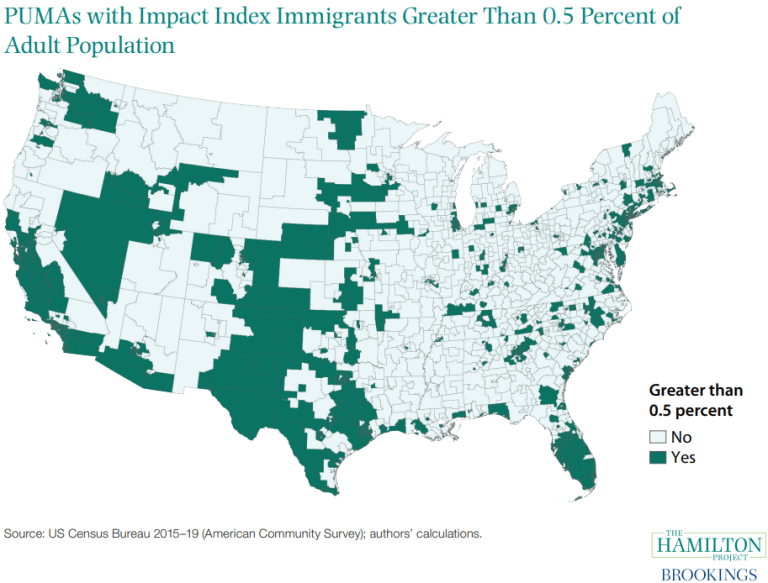
To ensure that the local communities affected by federal immigration policy receive more of immigration’s fiscal benefits, the authors propose to redistribute some of the fiscal gains of immigration to defray the immediate net fiscal costs that arise from welcoming newly arrived, less-educated immigrants. This proposal creates a method for determining the communities that qualify for funds, the Immigration Impact Index, and justifies an evidence-based dollar value per immigrant ($2,500) to be remitted to Immigration Impact Index communities by the federal government. These funds would visibly and transparently flow through education- and health-based federal funding channels: namely Impact Aid (education) and Federally Qualified Health Centers (health).

Figure showing PUMAs with Impact Immigration Immigrants Greater than 0.5% of Population

Source: A more equitable distribution of the positive fiscal benefits of immigration

Gibson: Immigration reform that Republicans can love, or at least vote for

We’ll see:

Congress is in the middle of an active lame-duck session. A bipartisan coalition of senators has affirmed marriage equality and 16 Republicans in the upper chamber have signaled they’ll join Democrats in supporting the Electoral Count Reform Act. With the dust settling on the midterm elections and a few retirements around the corner, cooperation is in the air.

Immigration advocates are seizing on this rare burst of bipartisanship to push for legislative possibilities that have been lurking near the finish line for the past two years. While a permanent resolution for Dreamers might grab the most headlines, the pending bill with the potential for broadest bipartisan support is the Farm Workforce Modernization Act.

Having passed the House with the support of 30 Republicans and all but one Democrat, it is now before the upper chamber, where Democrat Michael Bennet of Colorado and Republican Michael Crapo of Idaho have been negotiating a Senate version that could meet the threshold for a floor vote any day.

The House legislation represents hard-fought compromises. It aims to provide a path for legalization for the millions of undocumented agriculture workers currently in the United States. At the same time, it simplifies and enhances the existing “guest worker,” H-2A visa program for the agricultural sector, making it easier for farmers and ranchers to import foreign labor and making improvements in some working conditions for temporary employees.

Broad Democratic support is a given. The party has long sought to address the precarious status of undocumented farm laborers and to reform aspects of the H-2A guest worker program. Some Democrats would prefer more and faster benefits for immigrant farmworkers, but they still delivered an almost unanimous vote in favor of the compromise act.

There are also compelling reasons why 13 Republicans in the House co-sponsored the bill, and their party colleagues in the Senate should join them in supporting it. The Farm Workforce Modernization Act addresses a multitude of conservative values and concerns.

According to the U.S. Department of Labor Consumer Price Index November report, Americans haven’t faced food inflation this high since 1979, with prices rising 11.4% in the last year. Inflation has been front and center for nearly every Republican over the last year and the proposed legislation has the potential to help address rising food costs in a meaningful way.

A September report from the Cato Institute detailed how reforms built into the legislation would reduce agricultural labor costs by about $1 billion in the first year and $1.8 billion in the second, “which would lead to more workers hired, more productivity, and lower prices for consumers.”

Republicans also champion E-Verify, the web-based system that allows employers to confirm that employees are eligible to work in the U.S. This bill makes an E-Verify program mandatory for all agricultural workers 30 days after the executive branch sets the final rules for administering the legislation. It also outlines changes to the verification process, including a photo-matching system, that will likely make it better at identifying unauthorized workers.

Also important to the prevailing Republican position, the legislation underscores that certified agricultural workers remain ineligible for many forms of federally funded public benefits, such as healthcare subsidies, while at the same time, bringing many more agricultural workers into the tax-paying world, increasing revenue for states as well as the federal government.

Finally, it will be rural America, where the GOP thrives, that will benefit most directly from this legislation. In addition to increasing tax revenue in some deeply red states, the legislation will stimulate rental and real estate markets throughout rural communities with 10 years’ worth of farmworker housing vouchers and grants, as well as funding for new housing developments.

Here’s how the legislation passed by the House would work:

Longtime, law-abiding undocumented agricultural workers will be able to apply for certified agricultural worker status, which means they could come out of the shadows and work legally.

CAW candidates would not be subject to deportation while their applications are considered and employers would not be sanctioned for having previously hired them.

Certification would grant 5½ years of legal residency (including for workers’ dependents), with the possibility of an extension. Certified agricultural workers who meet further residency and work history requirements could apply to become permanent legal U.S. residents, and after that, they could apply for citizenship.

Those who don’t qualify for CAW status would be given access to H-2A visas, like newly hired foreign workers. Those already here would not be required to return to their home country to apply for the H-2As, as they are today. This common-sense change would cut down on labor supply disruptions.

The legislation also streamlines the H-2A process for employers, sets wage standards for agricultural workers, and establishes the rate at which those wages can grow — all tools for stabilizing labor costs — in the long term.

Under the new law, H2-A agricultural workers are guaranteed minimum hours, implementation of “heat illness protection” plans to avoid serious injuries while working, and the freedom to leave one employer to work for another — something they’re currently prohibited from doing, which suppresses wages for all workers. Not only is housing addressed for farmworkers, but so is transportation in and out of the fields.

Republicans often emphasize that immigrants should have to “get in line and wait their turn.” The Farm Workforce Modernization Act honors that idea but also acknowledges the crucial undocumented workforce that is already here. Through the proposed CAW program and changes in H-2A visa rules, the legislation establishes serious residency and work requirements before immigrants can gain a safe and stable place in society.

This legislation is an opportunity to address an important piece of our broken immigration system, to fill farm labor gaps and meet priorities for both parties. Because the bill has already passed the House, it creates a special opportunity during the lame-duck session for the Senate. If the upper house does not act, the opportunity dies when the session ends.

DW Gibson is the research director at Ideaspace.com and the author of “14 Miles: Building the Border Wall.”

USA: Asylum rates drop as immigration cases are fast-tracked, research finds

Balance between speed/efficiency and fairness, there are trade-offs:

Fast-tracked immigration cases appear to be hurting migrants’ chances of being granted asylum, researchers are finding.

“The big takeaway message is that the Biden administration really is trying to speed up cases but data shows when you speed up cases they lose,” Syracuse University professor and researcher Austin Kocher told Border Report as he toured the South Texas border on Wednesday.

Syracuse University’s Transactional Records Access Clearinghouse, orTRAC, one of the nation’s leading researchers on immigration court cases, on Tuesday released a study that found that since July, asylum grant rates have fallen and it “coincides with the extremely rapid increase in expedited cases.”

Although Fiscal Year 2022 had the largest number of individuals granted asylum of any year in immigration court history, in digging into the data, researchers found that the quicker the cases went through the courts, the lower the asylum seekers’ chances.

TRAC found that when asylum cases were completed within three to 18 months, only 31% of cases were granted asylum.

“More asylum cases were granted last year than any other year but the grant rate is actually going down in recent months,” Kocher said.

(TRAC Graphic)

Border Report met up with Kocher on Wednesday as he was on day 5 of his visit to South Texas as part of a seven-week research tour of the entire Southwest border.

He said immigration cases require collecting massive amounts of evidence and documents, and TRAC data has found that migrants who retain lawyers have a higher chance of being granted asylum. He said the rushed cases could be limiting and preventing asylum-seekers from gathering all the data they need to present full cases to the judges, and it could be preventing them from getting legal counsel altogether.

“We definitely know that the Biden administration has tried to accelerate these cases to try to clear out the backlog,” Kocher said. “They really are taking the backlog seriously and they really do want asylum cases to get decided more quickly but the problem is, as the data shows, that if you really speed cases up individuals don’t always have time to get attorneys and they don’t always have time to gather the full application materials that are necessary.”

Kocher crossed into Reynosa, Mexico, early Wednesday, and said he spoke with several migrants there who expressed their lack of resources and lack of legal aid as they wait across the border due to Title 42 restrictions.

Source: Asylum rates drop as immigration cases are fast-tracked, research finds

In major SCOTUS immigration case, both sides look to academia to untangle three knotty questions

Good explainer:

Can the Biden administration issue guidelines setting priorities in the enforcement of immigration law? Do states have standing to challenge these guidelines? And if the guidelines are unlawful, does the Administrative Procedure Act give lower courts the power to vacate them — a universal remedy that goes beyond the parties to the case? These are the three questions before the Supreme Court in United States v. Texas, set to be argued on Nov. 29. Legal scholars have addressed all three issues, and their work is prominently cited in the briefing on both sides.

In her book Beyond Deportation: The Role of Prosecutorial Discretion in Immigration Cases(NYU Press, 2015), Professor Shoba Sivaprasad Wadhia of Penn State Law observes that discretion in immigration enforcement is unavoidable in a system that lacks the resources to remove more than a few percent of the nation’s 11 million undocumented immigrants. The debate over how that discretion should be exercised has created a sharp policy divide between the Obama and Biden administrations, on the one hand, and that of former President Donald Trump on the other.

In 2011, John Morton, then the director of Immigration and Customs Enforcement, issued a seriesof memos setting enforcement priorities. Morton explained that his agency “only has resources to remove approximately 400,000 aliens per year, less than 4 percent of the estimated illegal alien population in the United States.” Accordingly, he declared that ICE would prioritize apprehension and removal of certain categories of undocumented immigrants, such as those who had committed crimes or were recent arrivals. In contrast, undocumented immigrants without criminal records, who had lived in the United States for many years, and who had U.S. citizen family members were low priorities for removal.

The “Morton Memos” were often ignored by ICE officers, and in any case did not give legal protection from removal to those undocumented immigrants categorized as lower priorities. But if nothing else, they set the tone.

That tone changed abruptly when Trump took office in 2017. Within the first week of his administration, Trump replaced the Morton Memos with an executive order directing immigration officials “to ensure the faithful execution of the immigration laws of the United States against all removable aliens.” The goal, Trump explained, was to end “exempt[ions] [for] classes or categories of removable aliens from potential enforcement.” To be sure, the Trump administration also lacked the resources to deport the vast majority of undocumented immigrants. But the new executive order sent the message that no one in the United States without status was safe from removal.

The Trump administration followed an “attrition through enforcement” approach proposed in 2008 by Kris Kobach, who was at that time a professor at the University of Missouri-Kansas City School of Law and later became Kansas’ secretary of state. (Earlier this month, he was elected as Kansas’ incoming attorney general.) Acknowledging the limited resources to remove undocumented immigrants, Kobach advocated for policies that encouraged self-deportation.  Accordingly, he opposed any categorical use of prosecutorial discretion, advocating instead for enforcement policies that would leave all undocumented immigrants in fear that they were imminently removable.

Now, in United States v. Texas, Texas and Louisiana have asked the court to weigh in on this debate. At issue is whether the Immigration and Nationality Act permits the Biden administration to adopt guidelines prioritizing removal of certain categories of undocumented immigrants over others, just as Obama did before him. These states also argue that the guidelines violate the Administrative Procedure Act.

The case is perhaps even more important for its challenge to states’ standing to sue the federal government. A glance at the court’s docket in recent years reveals the rapid rise in state challenges to executive branch changes in policy, with red states taking the lead under Presidents Obama and Biden and blue states doing so during the Trump administration. In April of 2022, Texas issued a press release celebrating its 27th lawsuit against the Biden administration (the number is certainly higher by now). Likewise, California filed 122 lawsuits against the Trump administration during Trump’s four years as president, averaging one new lawsuit every 12 days.

Many of these cases challenged executive branch changes to immigration policy. In United States v. Texas, Texas and Louisiana argue that the new enforcement priorities will increase the number of undocumented immigrants in their states, and so increase their incarceration, education, and health care costs. They claim these higher costs are a cognizable injury that gives them standing to sue.

In its brief, the United States cites University of Virginia Law Professors Ann Woolhandler and Michael Collins’ recent article, Reining in State Standing, which argues in favor of a “return to [states’] traditional disfavored status as plaintiffs.” Under the tripartite requirements for standing, a plaintiff must show an “injury in fact” that is traceable to the challenged action and redressable by a court. But that standard gives states enormous leeway to claim injury on behalf of themselves as sovereigns or to their parens patriae interests (that is, the interests of their citizens), because almost any change to federal policy will have a fiscal impact on a state and its residents. Woolhandler and Collins propose that state standing to sue should be limited to cases in which states are “the direct regulatory objects of federal statutes and regulations,” which would fit more comfortably with states’ traditionally limited role as litigants before federal courts.

Finally, the Supreme Court is asked to decide the scope of the permissible remedy if the guidelines violate federal law. Over the past few years, courts and commentators have debated the power of lower federal courts to enter universal injunctions — that is, injunctions that bar defendants from enforcing a challenged law against anyone, not just the plaintiffs. United States v. Texas raises an offshoot of this question: whether a court’s power “to hold unlawful and set aside agency action” under Section 706(2) of the APA permits courts to vacate agency action such that it cannot be applied to anyone.

The United States cites a recent article by Professor John Harrison of University of Virginia Law arguing that Section 706(2) does not give courts authority to issue universal remedies, but rather only allows courts to decline to enforce unlawful agency action in cases before them. Texas and Louisiana rely on University of San Diego Law Professor Mila Sohoni’s article, “The Power to Vacate a Rule,” asserting that Section 706(2) authorizes (but does not require) vacatur, and citing longstanding precedent in the U.S. Court of Appeals for the District of Columbia Circuit and other lower federal courts supporting that position.

As Sohoni puts it, perhaps the most “astonishing” aspect of the case is that the scope of Section 706(2)’s remedy remains uncertain nearly 80 years after that statute’s enactment. That uncertainty will likely be resolved by the court’s decision this term.

Source: In major immigration case, both sides look to academia to untangle three knotty questions

Diversity Initiatives Are Failing the U.S. Muslim Community

Interesting new term for me, “crisis diversity:”

Over the past decade, the Muslim community has become included in diversity initiatives in the United States. Hollywood is finally producing shows that feature Muslim characters, such as Hulu’s Ramy, Netflix’s Mo, and Disney+’s Ms. Marvel. Universities are adjusting dining hall hours to accommodate Muslim students who fast during Ramadan, and they are increasing the number of reflection spaces on campus to facilitate Muslim ritual prayer. Nike launched its Pro Hijab, a headscarf for Muslim women athletes, and Olympic medalist Ibtihaj Muhammad became its model. Muhammad also served as the inspiration for the first Muslim Barbie doll.

These initiatives enhance our sense of belonging as Muslims in the U.S.—but they are not enough to actually challenge Islamophobia.

How did Muslims come to be included in diversity plans in the U.S.? My research shows that this happened in the wake of crises, or moments that made it clear that Islamophobia was a problem. Diversity initiatives born out of crisis can produce important social change, but responding to a momentary flare up as opposed to longstanding structural inequality limits the extent of possible change. Social change requires addressing the root of the problem primarily located in a history of U.S. foreign policies that dehumanize Muslims.

Islamophobia, itself, is far from new. Scholars trace forms of it as far back as the 7th century, with the emergence of Islam as a religion. But the term found new popularity in the late 20th century. Many point to the 1997 report published by the Runnymede Trust in the UK as the first influential use of the word Islamophobia, since it was the first to highlight it as a social problem. But the term did not enter the U.S. lexicon until about a decade after 9/11.

Muslims have long been constructed as threats to U.S. national security, but this intensified after 9/11. Think of the USA PATRIOT Act, Special Registration, U.S.-led wars in Afghanistan and Iraq, and the Abu Ghraib prison scandal as prime examples of this.

But in the 2010’s, as the nation grappled with a history of racism and inequality, a new rubric of “diversity, equity, and inclusion” created an opening for Muslims to be seen as a beleaguered minority. Muslims became included in conceptions of diversity and social justice through a series of crises, such as the 2010 “ground zero mosque” controversy, the establishment of the Islamophobia Industry, and Donald Trump’s 2015 announcement to ban Muslims from entering the U.S.

These moments led to widespread recognition that Muslims are demonized and targets of individual hate and repressive state policies. This phenomenon is a prime example of crisis diversity—where a precipitating event leads to the recognition of racism or discrimination and an ensuing flurry of concerted action.

Crisis diversity produces a domino effect of responses: The general public becomes aware of a long-standing problem (Islamophobia); people of that particular identity group (Muslims and experts on Islam) are called upon to urgently educate the public and advise leaders on how to make changes; media conglomerates, corporations, universities, and other organizations respond by issuing statements or embarking on new diversity initiatives. The crisis moment then passes, and little attention is paid to the issue until the next crisis emerges, restarting the cycle.

Crisis diversity is not solely a response to Islamophobia. One need only look at how the police killing of George Floyd in the spring of 2020 led to nationwide protests, reigniting public debate about police brutality and putting anti-Black racism firmly on the agenda of the criminal justice system, as well as universities and a wide array of corporations and industries. That same year, the football team the Washington Redskins was finally renamed the Washington Commanders after decades of refusing to change the name, despite protests from American Indian communities. NASCAR finally banned use of the Confederate flag, and Quaker Oats finally retired its brand based on the Aunt Jemima racial stereotype. At the same time, the number of Black people killed by police has not decreased.

In similar, yet distinct ways, Islamophobia is discovered anew each time an instance of it manages to capture public attention. How much social change is accomplished through these crises-responses is varied and debatable.

For Muslims, crisis gave us Mo and Ms. Marvel. It gave us prayer rooms on college campuses. It gave us Rashida Tlaib and Ilhan Omar, the first Muslim women in Congress. These progress markers are an important start; however, the crisis-response approach is limiting. While Hollywood sticks it to Trump by finally including Muslims in roles that have nothing to do with terrorism, it does so without acknowledging how the industry itself has demonized Muslims for over a century.

Perpetrators of hate crimes against Muslims are given life sentences, without addressing how the same criminal justice system subjects Muslims to surveillance, deportation, and detention, that fuel hate crime violence. Racial and religious stereotypes are also used to criminalize Muslim men. Prosecutors used Adnan Syed’s identity as Pakistani and Muslim to argue that his religion and culture influenced him to murder his 18-year-old girlfriend, Hae Min Lee, and be prone to violence. In Sept. 2022, after spending over two decades of a life-in-prison sentence for murder, robbery, kidnapping, and false imprisonment, the charges were dropped, and Syed was released.

Crisis diversity focuses our attention on only the most overt, public, and often seemingly sudden expressions of racism, obscuring its longevity and reach well beyond crisis moments. In doing so, it obscures the enduring causes of Islamophobia, rooted in national security policies that demonize Muslims.

Real change requires understanding and approaching the problem as part of longstanding practices that will not evaporate with quick fixes during momentary crises. It requires a paradigm shift in our understanding of the problem and its magnitude. If leaders in Hollywood, corporations, universities, and the government consistently considered the long history of inequality in the U.S. when devising solutions (rather than responding to a momentary crisis), a more just and inclusive future would be possible.

Alsultany is an Associate Professor of American Studies and Ethnicity at USC’s Dornsife College and the author of Broken: The Failed Promise of Muslim Inclusion

Source: Diversity Initiatives Are Failing the U.S. Muslim Community