Fewer Americans Calling Themselves Christians, Survey Finds

Similar to Canadian numbers:

The share of Americans calling themselves Christians has dropped sharply in recent years, according to a new Pew Research Center survey — while the population of religiously unaffiliated adults has risen.
Though more Christians call America home than any other country, the percentage of American adults identifying as Christians has fallen from 78.4% in 2007 to about 70.6%. Meanwhile, over one in five (22.8%) say they are unaffiliated with any faith, a 6.7% percentage point jump since 2007.
Pew finds the Millennial generation is leading the decline in religious affiliation, though adults of all ages and across all demographic groups are steering away from Christianity. About 36% of Americans between 18 and 24 claim to be religiously unaffiliated, along with some 34% of Americans between 24 and 33.

http://time.com/3855277/american-christianity-poll-nones/

A half-century of progress and black America’s still burning: Saunders

Doug Saunders on the endemic problem of racism and studies that show the impact of deprived neighbourhoods on outcomes:

The answer is found in the cities and towns where these explosions of violence and deprivation are taking place: Once an institution (a city, a police force, a school system, an economy) is set up to create a racial divide, it will continue to do so, regardless who’s running it, unless there’s a dramatic intervention.

Too many Americans don’t see these institutions, but only their victims, who then get blamed for the outcomes: It has become popular again on the North American right to claim, in pseudo-scholarly language, that “that’s just how they are” – that African-American culture, or families, must be to blame (even though culture and family structures are always consequences, not causes, of larger ills).

This view has been decisively disproven this month in a vast and expensive study by economists Raj Chetty, Lawrence Katz and their colleagues at Harvard University, in which thousands of randomly selected low-income (mainly black) families were given vouchers in the nineties to move out of deprived neighbourhoods (and thousands more stayed put as control groups).

The results, a generation later, found that poor, crime-addled families prone to intergenerational poverty and broken homes become, within a generation of leaving their context, prosperous, educated and marriage-prone families, with outcomes similar to those of average Americans.

The Obama administration has attempted the sort of big interventions (such as the ones of the sixties and nineties) that are needed turn around this trajectory of inequality. The post-2008 stimulus and the “Obamacare” medicare system have stopped the rise in inequality and poverty. But many large urban-policy and education programs have been blocked by a recalcitrant U.S. Congress. It might take flames from the cities, as it did 50 years ago, to provoke a change.

A half-century of progress and black America’s still burning – The Globe and Mail.

A Record Number of Americans Are Renouncing Their Citizenship

Expat-ExpressWhile the numbers are small, the trend is clear:

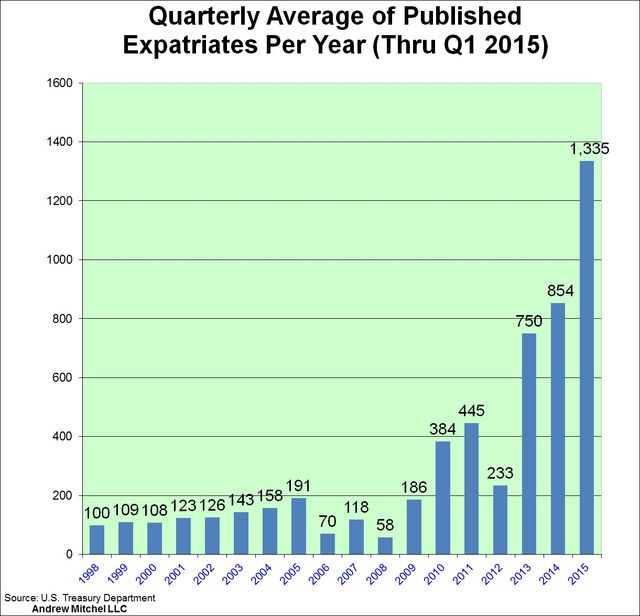
People giving up their nationality at U.S. embassies rose to 1,062 in the fourth quarter from 776 in the year-earlier period, according to Federal Register data. That’s the highest quarterly total since the second quarter of 2013, according to Bloomberg News calculations based on records starting in 1998.

The annual total reached 3,415 in 2014, from 3,000 in the year-earlier period, according to Federal Register data. The five highest totals have been recorded since the U.S. Congress passed the 2010 law.

There are an estimated 6 million U.S. citizens living abroad. More than 10,000 Americans living overseas have given up their passports over the past five years.

A Record Number of Americans Are Renouncing Their Citizenship – Bloomberg Business.

New Un-American Record: Renouncing U.S. Citizenship

Baltimore shows police killings America’s real state of emergency

Neil MacDonald on police killings in the US and the relative risk of being killed in the US by the police is much greater than being killed by terrorists. Of course, as all the numbers show, the likelihood is much greater for Blacks:

Today, though, even the conservative voices that have for so long defended law enforcement are wavering.

Take some time and browse the libertarian Cato Institute’s online National Police Misconduct Reporting Project.

It’s a scholarly work, and evidence gathered is weighed carefully; in fact, the last full year for which they have issued a definitive report is 2010.

That report identified 4,861 formal incidents of police misconduct involving 6,613 law enforcement officers and 247 civilian fatalities for that year alone.

If just a fraction of those fatalities were criminal, then the inescapable conclusion is that more people have been murdered by police in America in the last 10 years than by terrorists.

Of course, we are told, we don’t know how many terrorists have been thwarted by vigilant behind-the-scenes enforcement.

Well, true. But given the minuscule number of prosecutions, let alone convictions, neither do we know how many of the people who are supposed to be guarding us have gotten away with murder.

Baltimore shows police killings America’s real state of emergency – World – CBC News.

Inside the shadowy world of birth tourism at US ‘maternity hotels’

More on birth tourism, US perspective. Still relatively light on the numbers (Canadian numbers are very small – see earlier post What happened to Kenney’s cracking down on birth tourism? Feds couldn’t do it alone | hilltimes.com):

Birth tourism companies have flourished in recent years, according to federal officials — and many of them prefer hard-to-track cash to fuel their operations.

That money, federal officials allege, is being pocketed by a group of individuals who have skirted tax law, flouted immigration laws and helped their clients defraud U.S. hospitals of tens of thousands of dollars for each baby born.

On Tuesday, federal agencies, including Immigration and Customs Enforcement and the IRS, along with the Los Angeles Police Department, conducted a massive operation to raid more than 30 California locations operated by “birth tourism businesses.” Officials collected piles of evidence that will likely be used against some of the “maternity hotel” operators in future prosecutions.

The companies advertise their services online — and no foreign language skills are necessary to guess the subtext.

…According to court documents, birth tourists were told to avoid traveling directly to Los Angeles International Airport from overseas, to avoid raising suspicion. They might even consider studying U.S. culture and booking recreational visits in order to make their travel seem more legitimate, the company advised. Alternate arrival ports such as Hawaii or Las Vegas were preferable.

You Win paid more than $60,000 a year to rent Southern California apartments that housed the women, according to court documents. Federal officials believe that StarBabyCare operated a “maternity hotel” from at least 10 units at one complex.

via Inside the shadowy world of birth tourism at ‘maternity hotels’ – The Washington Post.

U.S. Muslims Take On ISIS’ Recruiting Machine – NYTimes.com

More on efforts within the US Muslim community to counter radicalization messages and recruitment:

Ms. Khan, who has four degrees from M.I.T., left lucrative consulting work to develop a prevention program that addresses extremism and the way that technology can be used for manipulation. At one of her events last year, about 30 young Muslims, both high school and middle school students, gathered at the Farmington Valley American Muslim Center in Avon, Conn., for what was billed as a “cybersafety workshop,” with Ms. Khan moving swiftly from how to detect online pedophiles to how to detect Islamist extremists.

“They are telling you, ‘Let’s go fight.’ They are asking you to share gruesome images,” said Ms. Khan, who wore a blue floral-print head scarf. “Be very careful. These people are not your friends.” She told the students, who were quick to raise their hands and ask questions, to avoid contact with strangers online, or with anyone who demanded secrecy. The sexual predators are usually male, she told them, but the extremist recruiters can be male or female, and some of them can be, or can pretend to be, teenagers, too. Her presentation included a picture of a wolf zipped into a sheep’s skin.

“Have you guys heard of grooming?” she asked them, using a term more often used in relation to sexual predators. “They will try to be your friend. They will be nice to you, spend lots of time with you. Some of them will be sending you gifts.”

Programs like this have not been embraced as a widespread priority by American Muslims, at least until recently, in part because the problem seemed to be overseas, not here, Muslim leaders say. And since many American Muslims are immigrants or African-Americans, there is substantial fear and suspicion of law enforcement officials, along with simple defensiveness and denial.

“The family says, ‘It’s not going to happen to me,’ ” said M. Saud Anwar, a pulmonologist and the first Muslim to be elected as a mayor in Connecticut, where he serves South Windsor.

Imam Magid, speaking upstairs at his Muslim center while a team of Muslim girls pounded out a basketball game below, said that real prevention meant programs that give young people as much purpose and inspiration as extremists promise. Once young Muslims buy into the ideology, he said, it is very hard to pry them loose. “You have to reach them before it happens,” he said.

U.S. Muslims Take On ISIS’ Recruiting Machine – NYTimes.com.

Student killings a rallying cry for alienated Muslim Americans

A Muslim American Ferguson moment?

Among the millions of posts about the killing, there quickly appeared clear themes. Many users wondered how much more news coverage the killings would have received had it been a Muslim man who’d shot three white students dead. Others asked white Americans to vocally condemn the alleged killer, and make an effort to find out how he became radicalized – a sardonic reversal of something many Muslims complain they are continually asked to do. Many, including some of the victims’ family members, rejected the claim that the killing was prompted solely by a dispute over a parking space, calling it an obvious hate crime.

(It is a testament to the perceived consequences of the phrase “hate crime” that the alleged killer’s wife held a press conference to assure the public that the murders of which her husband is accused were in fact not motivated by hatred for the victims’ religion. In a bit of a non sequitur, she backed this claim by mentioning that many of Mr. Hicks’s posts on Facebook were in support of such causes as abortion and gay rights. She did not mention his many anti-religion posts, but their content suggests one torturous defence may ultimately be that the killings he is alleged to have committed were not hate crimes against his Muslim victims because he hates all religious equally).

In many ways, the volume and tenor of the Muslim American community’s reaction to the killing is similar to the outcry that sparked the “Black Lives Matter” movement. Multifaceted, it is nonetheless a response anchored in the belief that injustices, when perpetrated against victims of a particular minority, are simply considered less serious. But whereas the Black Lives Matter movement drew on hundreds of years of examples, the Muslim-American response is focused almost solely on the events of the past 14 years.

Broadly, the grievances of many Muslim Americans exist in one of two categories – the grand geopolitical outrages over two full-scale wars and their myriad repercussions, and the more immediate, day-to-day frustrations to which belong such issues as the Duke prayer controversy, the uproar over the so-called Ground Zero Mosque in New York City and the spike in accusatory harassment that tends to follow every barbarity committed by terror groups half a world away.

The two categories are related, but for most Muslim Americans, the former is relatively abstract – the chances of any American being shipped off to the Guantanamo Bay detention camps today is essentially nil. But the latter complaints – harassment, accusation, a sense of otherness – are not. And, once extrapolated, such concerns reach their sad apex in the prospect of a hateful neighbour at the front door, gun in hand. Like the killing of Mr. Brown in Ferguson last summer, the murder of the three Chapel Hill students is a single rock that, dislodged, triggers a landslide.

Student killings a rallying cry for alienated Muslim Americans – The Globe and Mail.

The American tradition of multiculturalism – The Washington Post

An American take on what multiculturalism means in the US context by Eugene Volokh:

These aren’t just multiculturalist values. They are long-standing, deeply rooted American values. And they have been (or at least could be) seen as serving at least four different goals.

1. Multiculturalism as increasing minority members’ happiness: Religious tolerance — coupled with federalism and localism — has often let people live, be free, and pursue happiness in America without having to sacrifice or hide their belief systems.

2. Multiculturalism as an engine of the search for truth: Both federalism and religious diversity often produce a wide range of options — ideological and governmental — that then compete with one another. In federalism, this is known as the “states as laboratories of democracy” model. For religious and other ideologies, this best fits the metaphor of the “marketplace of ideas.”

3. Multiculturalism as a source of valuable citizens: The tolerance for a wide range of religious belief systems has drawn more people to this nation, and has avoided forcing people into exile. Recall the old joke, “who was the most successful German general of World War II?,” with the answer being “Eisenhower.” More seriously, America’s development of the atomic bomb during World War II, which relied heavily on European (and often Jewish) scientists who had fled Hitler, is one illustration — one of many — of the value to America of ethnic and cultural tolerance.

4. Multiculturalism as a source of knowledge for dealing with a multicultural world: The world is filled with lots of different cultures, whether we like it or not. Experience with different cultures within the U.S. helps us deal with different cultures outside the U.S. — for instance, by giving us a pool of American citizens who actually know the foreign language and culture, and more generally by making our citizens more familiar with people of other cultures.

… And it should also be obvious that, because of this, we should properly calibrate our tolerance for multiculturalism with our insistence on also supporting a unified national culture. We shouldn’t try to completely stifle all rival identities (whether Catholic, Jewish, or Baptist; Irish-American, Chinese-American, or Mexican-American; or whatever else), but neither should we neglect the building of an American identity. We should accommodate some religious or cultural objections to generally applicable laws, as we have done for centuries in countless ways. But we shouldn’t (and generally don’t) accommodate objections when the accommodation would substantially harm others.

Still, it’s also important to recognize that many forms of multiculturalism are not valueless, alien, or new. Even without reference to specific valuable aspects of specific cultures, they have some general value. And they are deeply linked to fundamental aspects of our American constitutional culture.

It’s a mistake, I think, to condemn multiculturalism in general, just as it’s a mistake to praise multiculturalism in general. Rather, we should think about which forms of toleration, accommodation, and embrace of differing cultural values and behaviors are good for America — in the light of American legal and social traditions — and which are bad.
The American tradition of multiculturalism – The Washington Post.

The Data Behind Radicalization

Findings of a recent study of 1,500 individuals radicalized in the US since WW II:

Compared to violent domestic terrorists on the Far Left and Far Right, Islamists stand out. They’re more likely to be young (between 18 and 28 years old), unmarried and unassimilated into American society. They are also more likely to be actively recruited to an extremist group.

But in other important ways, Islamist extremists in the U.S. as a whole — violent and nonviolent — are not so different from other extremists. People in the three groups were equally likely to have become radicalized while serving time in prison — complicating the narrative that Muslim prisoners are unusually likely to commit to extremism from behind bars — and to be composed of individuals who have psychological issues, are loners, or have recently experienced “a loss of social standing.”

“Social networks are incredibly important to radicalization, but that’s not unique to Islamists at all,” [researcher Patrick] James said. “There’s almost always a facilitator — a personal relationship with a friend or family member who’s already made that leap.”

The Data Behind Radicalization « The Dish.

Judging The Beards Of Believers – SCOTUS decision

The latest US SC ruling on religious freedom, this time with respect to beards. Similar to Canadian approach. Commentary below by Carrie Severino:

[This ruling] emphasizes that it is the religiously-motivated view of an action, not the unbelieving bystander’s judgment of its importance, that determines whether a burden is substantial. That is particularly important where, as here, courts are dealing with a minority or unpopular religion.

The Court also clarified some key points respecting substantial burdens. First, it noted that permission to engage in many other aspects of religions exercise – here, praying daily, keeping a prayer rug, corresponding with religious advisors, keeping a halal diet, and observing religious holidays – does not cancel out the effect of denying Holt the ability to carry out his simultaneous religious obligation to grow a beard. Additionally, the Court corrected a misunderstanding below that only “compelled” religious practices could be substantially burdened or that disagreements within the Muslim community about the necessity of growing a beard meant curtailing that ability was not a substantial burden. After all, courts have no business making a judgment call about the fundamentally theological questions of how much religious practice is “enough” or which view of a certain religion is correct.

Judging The Beards Of Believers « The Dish.