Theo Argitis: Canada’s great immigration experiment is ending 

Good take:

For nearly the first time in our history, Canada’s population growth has come to a near standstill. Remarkably, the state of things is such that we are celebrating this as a policy success and long-overdue correction.

Statistics Canada released its quarterly population estimates, showing the country grew by 20,000 people in the first three months of this year. That’s the third weakest quarterly increase in data going back to 1946—and less than one-tenth the average quarterly gain over the past three years.

Four provinces and one territory—Newfoundland and Labrador, Quebec, Ontario, British Columbia, and Yukon—actually posted population declines.

The numbers reflect the dramatic reversal of policy late last year by the former Trudeau government, when it abruptly tightened permit approvals for international students and foreign workers after overseeing record immigration levels since 2021.

Under the plan, the intake of new permanent residents, or what the government calls immigrants, would be lowered from 485,000 in 2024 to 365,000 by 2027.

The number of non-permanent residents living in Canada—which had increased five-fold since 2015 to more than 3 million—would be cut by about one million over two years.

That post-pandemic rush of newcomers exacerbated housing shortages, strained public services, and disrupted the job market. It was perhaps the worst policy error of the past two decades, and in need of correction.

But, ironically, the sharp reversal in policy is now creating its own problems, impacting everything from demand for cell phones and banking services to funding for universities and colleges.

The whole episode has been a mass social experiment that will be studied for years.

“You’re going to see a ton of research on this, no question, because it’s like this little experiment here in Canada that no other country has done to this extent,’’ said Mikal Skuterud, a labour economist at the University of Waterloo and director of the Canadian Labour Economics Forum. “And there’s all kinds of dimensions to how this impacted the economy.”

The latest numbers suggest the government’s curbs are beginning to work. While still elevated, the number of non-permanent residents has started to decline—down almost 90,000 from its peak in September. The number of permanent residents, or immigrants, is now running at an annual pace closer to 400,000, down from nearly half a million.

Prime Minister Mark Carney has essentially adopted the Trudeau plan, which if successful will keep the current population steady at about the current 41.5 million level over the next two years. It would mark the first time since Confederation in 1867 that the country saw zero population growth.

Yet when viewed over the full horizon, the curbs will simply bring the average population growth rate for the decade back to about 1.3 percent, which is much closer to historical norms. We’re simply correcting a major policy anomaly.

Looking back, it’s too early to know for certain what effect the population surge had on wages and joblessness, according to Skuterud, who notes that younger Canadians, in particular, may have borne the brunt of it, given they tend to compete with newcomers for entry-level jobs.

What’s less in dispute is how the immigration surge lowered average living standards.

The evidence suggests that looser entry requirements over recent years brought in lower quality workers. Because of this, the economy failed to grow in line with population. The size of the pie didn’t grow fast enough to keep up with the number of people trying to take a slice.

The end result was the erosion of public confidence in immigration, which could linger in Canadian politics for years.

This is particularly true among younger Canadians, who now appear more open to curbing immigration levels. For many, tighter labour markets and more affordable housing—not higher population numbers—are the priority. Slower immigration supports those goals.

So, how did the government misjudge the situation so badly? And is there a lesson here for the Carney government?

Part of the problem stemmed from the unique distortions of the pandemic. The government overestimated labour shortages and then overcompensated by opening the immigration floodgates.

But there was also a broader miscalculation. Trudeau emerged from the pandemic with renewed ambitions and a belief that he had an expanded mandate to pursue transformative change, including on the immigration front.

Ambition, however, has a way of outpacing reality. And overshooting is always a risk when leaders grow too confident in their ability to enact change.

Carney is now putting forward an ambitious agenda of his own. Whether he’ll draw any lessons from Canada’s great immigration experiment remains to be seen.

Source: Theo Argitis: Canada’s great immigration experiment is ending
More commentary on the immigration levels plan

The Axworthy comment is particularly biting with respect to immigration and the [mis] functioning of cabinet government and ministerial responsibilities:

Argitis: Trudeau’s new policy upshot? First population decline since 1867: It was a spectacular economic policy error, followed by a spectacular reversal.

Prime Minister Justin Trudeau’s government announced on Thursday that it will implement sharp cuts to immigration flows, bringing Canada’s rapid population growth to an abrupt halt. The move, aimed at easing a housing crisis after an unprecedented increase in immigration over the past two years, could have significant effects on wages, interest rates, and the broader economy.

With immigration cuts, Ottawa is rethinking its economic principles: For many years, the federal Liberal Party made strong immigration a central plank of its economic plan for Canada, inviting scores of skilled workers to the country to slow demographic aging. In a policy U-turn, the government’s pro-growth ethos is now on pause.

Ottawa announced at a news conference Thursday that it’s cutting back immigration levels over the next three years, breaking a trend of steady increases. Combined with efforts to reduce temporary resident numbers, Canada’s population is set to post small declines in 2025 and 2026.

It amounts to a dramatic reversal. The country’s population grew by 3.2 per cent last year – the quickest pace since the late 1950s – or nearly 1.3 million people. Canada has ranked among the fastest-growing countries in recent years, easily outpacing its Group of Seven peers.

Axworthy | Justin Trudeau has infantilized his ministers. They need more power for our government to work: That trust has been shattered. Economic consultants from McKinsey promoted population growth as an economic lever. Business lobbies pushed for temporary foreign workers to meet labour shortages, and provincial governments used international students to solve funding shortfalls in higher education. Immigration policy became a tool to solve non-immigration issues, and ministerial leadership was sacrificed in favor of PMO decisions. The result is a system that is now crumbling under the weight of limited ministerial guidance  and misaligned priorities.

Wherry: Trudeau’s Liberals are trying to save the Canadian consensus on immigration — and their legacy: It’s too early to say whether the last few years have done any lasting damage to the public’s attitude toward immigration — or whether any future government will see something to be gained from cutting the flow of newcomers even more. But it’s possible that both the broad direction established by the Liberals and the basic imperatives that underpinned the Canadian consensus will prevail.

The federal government’s new targets represent a significant decrease from recent years. In each of the last three years, more than 400,000 people have become permanent residents; that annual intake number is now set to fall to 365,000 by 2027. But that still represents an increase over immigration levels during the previous Conservative government’s time in office — from 2006 to 2015, annual totals were never lower than 237,000 and never higher than 272,000.

While Conservative Leader Pierre Poilievre has heaped scorn on the Liberals over their handling of the immigration file, he also has stopped short of saying he would implement actual cuts. He has said only that he would use an unspecified “mathematical formula” — one that takes into account housing construction and access to health care services — to determine Canada’s immigration targets.

It’s also notable (though perhaps not surprising) that, the swing in public opinion notwithstanding, the federal government’s announcement this week has drawn some criticism and concern — from economists and business groups, but also provincial politicians.

Trudeau can’t keep juicing the economy with more spending

Some interesting nuggets in this op-ed by Argitis and Asselin, suggesting that some of their “cheerleading” of increased immigration may be undergoing a rethink. Needed greater emphasis on productivity and per capita GDP is an implicit admission that their support for the government’s permanent and temporary immigration has run counter to increased productivity.

And their suggestion for a slowdown in immigration, albeit not for economic class, to give housing a chance to “catch up” again is an implicit admission that their focus on levels (“more”) neglected the very real impacts on housing (in addition to healthcare and infrastructure).

Further (needed) cracks in the overall consensus?

The unexpected pick up in Canadian inflation last month — even if it turns out to be a blip — is a fresh reminder that Prime Minister Justin Trudeau’s government is facing a more perilous economic policy landscape going forward, with difficult trade-offs on the horizon.

The natural economic instinct of this government has been generous budget spending and open international migration.

Yet, Trudeau doesn’t need to look much further than Statistics Canada’s inflation numbers or last week’s call from the G7 for global “de-risking” to see how things are changing.

With the world entering a period of scarcity — from more expensive money to supply constraints — the rationale to juice the nation’s economy is weakening.

The housing crisis is a manifestation of that, as are broader price pressures and the Bank of Canada’s historically aggressive run of interest rate hikes.

Trudeau came to power in 2015 on an anti-austerity platform to reverse his Conservative predecessor’s sluggish growth record which, as the Liberals were quick to remind Canadians at the time, was the weakest since R.B. Bennett was prime minister in the 1930s.

The economics were sound at the time, even if the growth dividend didn’t pay off.

Canada’s economy was demand deficient early in Trudeau’s mandate as commodity prices slumped, while the extra spending helped ease financial stability risks by taking some pressure off the Bank of Canada to stoke growth.

Higher international migration drove gains in labour income and provided support to a housing market that was still largely within reach of affordability. Inflation wasn’t a worry. In fact, the concern for policymakers was it may not have been high enough.

New social programs, meanwhile, allowed the government to make significant strides on equality and redistribution — particularly with respect to lowering poverty.

The Trudeau administration’s weighty policy objectives were synergetic to the economic environment. Policies were rowing more or less in the same direction.

The current post-pandemic environment, though, is no longer as accommodating.

While many policymakers and economists still buy into a moderately optimistic outlook, with continued growth and inflation brought into check, less favourable outcomes are increasingly plausible.

There is a real possibility that inflation and interest rates will remain well above pre-pandemic levels, growth becomes more anemic, budget dynamics worsen and the climate transition proves costly.

Instead of working in concert, the government’s three core economic policy objectives — growth, equity and price stability — could become increasingly in conflict.

For example, increasing immigration is a long-term positive for an economy threatened by aging demographics. And more social spending is typically associated with less inequality.

But higher borrowing costs stoked by large increases in population and government spending will impact disproportionately lower income Canadians and young families, potentially creating divisions and threatening new sorts of inequality.

Add energy transition to the mix and national security issues and the landscape becomes a minefield.

The policy arena will be more ambiguous and the government pulled in multiple directions. Policy paralysis, wasted effort and poor allocation of resources are real risks.

There are certain fundamentals and policy guardrails, however, that can help the government navigate this challenge.

First, policymakers should prioritize growing GDP on a per capita basis and increasing productivity over expanding the overall aggregate economy. Both are important, but the former is where true prosperity lies and where Canada is failing. Masking underlying weakness with gains in national income is just a recipe for stagnant wages. Enhanced productivity also helps dampen inflationary pressures.

Second, toolkits and policy precision matter.

For example, supply side solutions are critical to productivity, but policymakers also need to be cognizant of short-term impacts in an inflationary world. Focusing more on economic migration and temporarily slowing the pace of new entrants to allow housing supply to catch up appears a reasonable solution to the current housing crisis.

Another example is industrial policy, which needs to become more sophisticated. Advanced economies will compete in advanced industries, where there is a concentration of R&D and skilled workers. Quick fixes through corporate subsidies, however, are not the answer. Canada needs a modern science and technology architecture that translates ideas into economic outputs, higher wages and better living standards.

The third guardrail is the most Canadian: be reasonable and pragmatic.

This seems obvious but we should not take this principle for granted, particularly as we rush (rightly) to meet ambitious climate targets. Canada remains a resource economy. The sector pays a lot of bills, keeps our currency stable and government finances flush with cash.

It’s also where any global power we may have as a nation lies. That makes an orderly climate transition paramount.

Theo Argitis is managing director at Compass Rose Group. Robert Asselin is senior vice-president, policy at the Business Council of Canada.

Source: Trudeau can’t keep juicing the economy with more spending

Theo Argitis: Why economists – not politicians – are raising alarms around immigration

More questioning of increasing levels of immigration and their impact on housing and productivity, along with legitimate worry regarding ongoing support for high levels:
One of the most encouraging national polls in recent weeks was a survey done by Nanos Research for Bloomberg News that showed large flows of international migration into Canada continue to be widely supported by the public.
This is a relief. I’ve been worried, and not because I’m an immigrant.

Source: Theo Argitis: Why economists – not politicians – are raising alarms around immigration

Argitis: Canada’s population advantage offset by weak productivity

Good comments on the productivity conundrum and how the current focus in increased immigration is not addressing productivity and in fact is weakening productivity. But Argitis only states the issue and offers no approaches or solutions to address the issue:

Canada’s population grew by a whopping 362,453 people in three months through Oct. 1, a quarterly gain of 0.9 per cent. That’s the fastest quarterly increase since 1957. Canada’s population is up 2.3 per cent from a year ago—double the historic annual average over the past half century.

Almost all the growth came from non-Canadians moving here, illustrating how there is no greater competitive advantage we have as a country than open immigration policies free of the hang-ups and complexities that hamper population growth elsewhere.

The latest data shows the country hit a minor milestone sometime over the summer, surpassing the 39 million mark.

Since the start of the pandemic, our population has grown by one million people.

At the current pace, Canada will hit the much bigger milestone of 40 million people no later than 2025, which would represent an increase of about 10 million people in the first quarter of the current century. That would be almost a one-third increase in population, which blows past most of Canada’s peers.

Canada’s fast population growth, however, is masking deeper economic problems around productivity and underlying competitiveness.

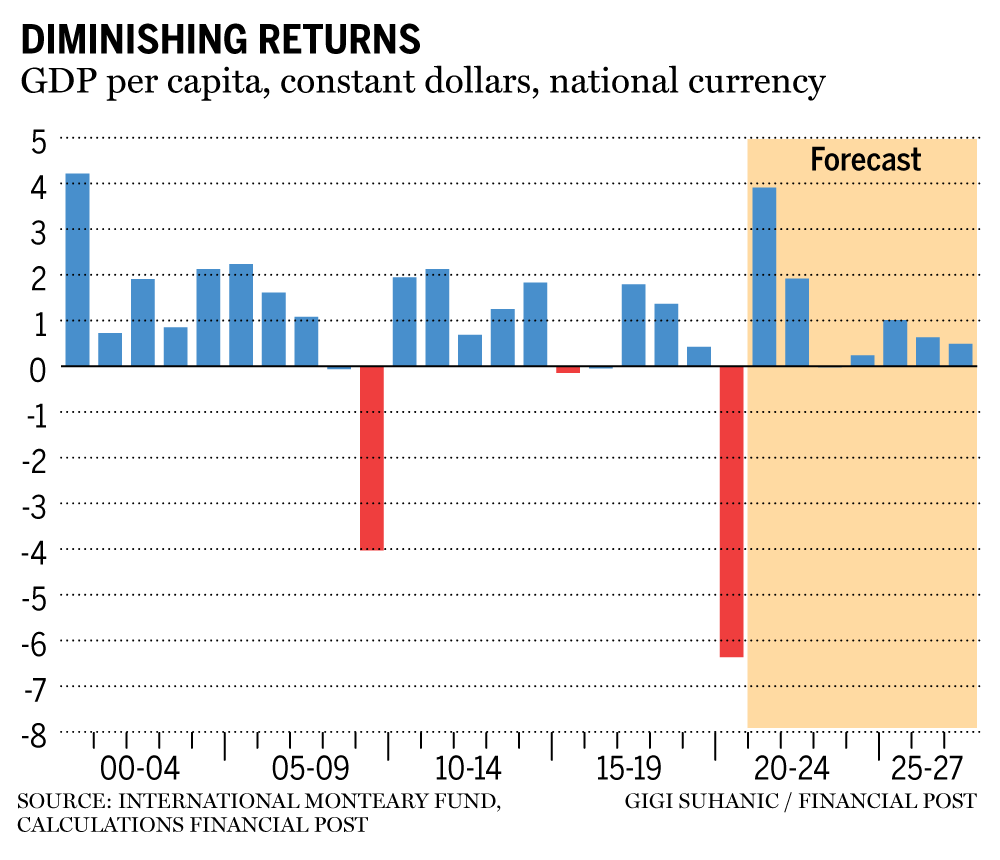
The same quarterly population numbers released last month to measure per-capita output reveal a disturbing trend. When factoring out population, our economy has been completely stagnant over the past four years. There’s no growth outside of immigration.

For example, while real GDP increased 0.7 per cent in the third quarter, the economy shrank by 0.2 per cent on a per capita basis. In fact, there’s been no increase in per-capita output since 2018.

I can think of no bigger threat to the consensus around immigration than Canada’s inability to increase productivity and improve living standards of people already living here. …

Theo Argitis is the managing director of Compass Rose, a public affairs firm in Ottawa.

Source: Canada’s population advantage offset by weak productivity