Dispatch from the Front Lines: Peace, order and really bad governmenting [sic, immigration]

Hard to disagree “The upshot of all this is that Canada’s immigration system is no longer the prized coconut of old. Today, it’s more like a post-Halloween pumpkin — rotten all the way through.:”

…Eight years later, it is all in tatters. After letting in record numbers of immigrantspost-pandemic, the federal government has lost almost complete control of who comes into the country, and who stays. Unsurprisingly, for the first time in a quarter century, popular opinion has turned sharply against our still-high immigration levels. And a populist policy backlash is brewing in the form of Pierre Poilievre’s Conservatives or, worse, Donald Trump’s MAGA crazies. 

And so after nine years of smugly lecturing the world and their fellow Canadians about their superior virtue, it seems to be slowly dawning on the Liberals just how badly they have screwed things up. But as night follows day, as sunshine follows rain, as the Leafs lose in the first round of the playoffs, everything the Liberals do to fix the problem only makes things worse. 

In October, the government turned on a dime and realised that maybe their target of 500,000 newcomers per year for the next two years might be a bit more than the system could take. So they cut that figure by about a fifth, targeting 395,000 permanent residents in 2025, with that number dropping to 365,000 by 2027. 

This came after an announcement earlier in the year that Ottawa would be capping international student visas, which come with a highly prized post graduate work permit. While there was no guarantee this would lead to permanent residency, the promise that this would be the case was pretty much implicit. Come here and study, stick around and work, bring your family over and stay — that was the Canadian dream for hundreds of thousands of foreign students, encouraged ad nauseaum by federal politicians. But in September, Ottawa announced that it would not be renewing the work permits for current permit holders, with 200,000 of those set to expire by the end of 2025. 

Anyone think those 200,000 former students are going to just pack up and head home next year? Don’t make us ell oh ell. 

Indeed, count us amongst the ranks of the completely unsurprised when it was reported this week that so far this year, 14,000 people here on international student visas had filed refugee claims between January 1 and September 1 of this year. It was already a record, surpassing the 12,000 asylum claims filed in 2023. And the final 2024 number will be almost an order of magnitude higher than the 1,800 such claims that were filed in 2018. 

Immigration minister Marc Miller was quick to denounce these as largely false claims, filed in bad faith by students advised to do so by unscrupulous consultants. Well, maybe. But hey, if they are false claims, the feds can always just deny them and send these fraudsters home, no?

Well, no. Because in addition to losing control of the immigration system, Ottawa has also lost control of the refugee claimant system. As the Globe writes in an excellent editorial this weekend, when the Liberals came to power in 2015, the backlog of refugee claimants was a hair under 10,000 claims. Today, there are well over a quarter of a million (!!!) pending cases, and the IRB is losing ground every day, not gaining. The wait for a refugee hearing is now in the ballpark of four years, during which claimants are entitled to both work and study. And on the off chance Ottawa denies your claim four years from now, what are the odds you will actually get put on a plane and sent home? Almost zilch. The result is a vicious cycle where the more claims that are made, the longer they will take to be processed, which raises the incentive for making a claim, and so on. 

The upshot of all this is that Canada’s immigration system is no longer the prized coconut of old. Today, it’s more like a post-Halloween pumpkin — rotten all the way through.  

It’s not clear what is to be done about this, short of simply closing the border for a few years until we get things under control. One possibility would be for Canada to declare something like immigration bankruptcy: Every non citizen in the country on a certain date, regardless of the status as a student, immigrant, or refugee claimant, gets permanent residency. After that, visa requests and refugee claims get processed as they come in under a new set of hard and transparent rules.

More than likely, though, the Liberals will keep muddling along, making the problem worse and worse and worse as they continue to play whack a mole with each new unintended side effect of their ad hoc policy making. You can be sure the Trump people are paying close attention….

Source: Dispatch from the Front Lines: Peace, order and really bad governmenting

More commentary on reduced immigration levels

More of the commentary that I found interesting and relevant:

The Line: Dispatch from The Front Lines: Have a great trip, Jen! And where are they moving? Right now, public opinion is probably fairly reasonably grounded in reality. We think it would be broadly true today to say that Canadians still see value in immigration in the abstract, and remain good at welcoming newcomers into their own communities. We suspect that most of us have direct relationships with immigrants, and have better lives for those relationships. But we are very worried. Many of the problems that our recently unchecked immigration rates have caused or (more fairly) contributed to — including overwhelmed social services and the housing crisis — are going to continue getting worse for a number of years, since so much is already baked in. This is scary, and could mean that we see anti-immigration sentiment evolve explicitly into anti-immigrant sentiment. That would take what we have today, an embarrassing public-policy failure, and turn it into a genuine social nightmare, one from which it could take many years to recover, as newcomers pay the price for our policy failures and report back home that Canada is a place to avoid at all costs.

So, great. It’s nice to have something to look forward to. Right?

But there was one other issue that jumped out at us after the announcement this week. Both Prime Minister Trudeau and Immigration Minister Marc Miller made all-too political acknowledgments of responsibility. The prime minister went so far as to concede that his government “didn’t get the balance quite right.” Not to be outdone in the race for the most fearless and blunt mea culpa, Miller said, “Did we take too long to adjust? I think there is some responsibility there to assume.”

Wow! By whom? Tell us more, minister!

Look, let’s be blunt about this. Both your Line editors support immigration. And we both know that there is plenty of blame to go around. Many business interests and provincial leaders were desperate for more people. The federal government didn’t come up with the idea of ramping up growth to unsustainable levels all on its own. They had a lot of friends and a lot of help. The buck does stop with them. And we’re not going to let them get away with their attempts to deflect the blame. But it is fair to note that a lot of people were demanding this, and that our failure to roll out enough housing and social services to keep up with the demand rests on us, not on the people we invited to start new lives in this country. They are victims here. We sold them a bill of goods we had no ability or willingness to deliver upon. And we should be ashamed of ourselves for that. We have essentially defrauded people who just wanted to build a better lives for themselves and their families so that we could keep reaping the economic benefits of their arrival, and we kept doing that until the moment that it stopped being a good deal for us. Some future descendent of Justin Trudeau is probably going to have to offer up a tearful apology for this in a century or so. 

And it’ll take that long, clearly. This was the feds’ responsibility, and they screwed it up. It would not kill them to admit as much, openly and clearly, with a bit less of a masterclass in the passive voice than what Miller just offered the voters.

Globe editorial: Canada’s past and present were built on immigration. Our future will be too. Ottawa responded too slowly to rectify its mistakes but last week moved past tinkering. Count it as a turning point. The changes will help start to restore broad confidence in an immigration system that was long embraced by Canadians, respected around the world – and helped to build this country over many decades.

Immigration changes a ‘black eye’ for businesses, families, students, warns B.C. lawyer
“Businesses are going to suffer. The people on the ground right now — the workers here, the people on temporary status — are suffering. The students (are) totally gutted,” said Victoria immigration lawyer David Aujla. “We had a really pro-refugee, pro-humanitarian outlook, accepting people who were in crises. I think that’s going to take a big hit. I think Canada’s now got a black eye.”

The new changes will be very difficult for some newcomers waiting to bring relatives to Canada, said Jonathan Oldman, CEO of the Immigrant Services Society of B.C.

The reductions, though, will make the new levels of permanent residents similar to what happened before COVID-19, said Oldman, whose agency helps settle more than 25,000 people each year who come to B.C. for humanitarian, economic or family reunification reasons.

Will Tao, an immigration lawyer with the Burnaby law firm Heron, worries these changes are designed to “nudge” people to leave Canada if they’re facing long waiting times to become permanent residents.

“They’re obviously scared and concerned,” he said of his clients.

Prime Minister Justin Trudeau said his government didn’t get the “balance quite right” when it increased immigration targets over recent years. But Tao said achieving that balance isn’t as simple as slashing targets, which affect people from countries ranging from war-stricken Ukraine to Afghanistan where women and girls are at risk.

The impact includes post-secondary schools losing a “cash cow” of funding by losing international students, who pay far higher tuition than Canadian youth.

Tao also said some employers in the last week have pulled their support for a Labour Market Impact Assessment, a document that’s necessary to hire foreign workers, because they can’t afford the new federally mandated increase in wages for temporary foreign workers.

And while fewer immigrants may lead to less competition for affordable housing, will Canada also lose the temporary residents who are construction workers building the much-need housing?

“Immigration is a driver of economic growth and is the primary source of population growth in the near term,” Fiona Famulak, the chamber’s president, said in a statement last week. “Decreasing the labour pool will therefore add to (businesses’s) burden, not improve it, in the coming years.”

High-profile Vancouver immigration lawyer Richard Kurland said his email inbox has been clogged with messages from clients, lawyers and immigration consultants looking for solutions to this “fiasco” created by the federal government.

Those wanting to increase their chances of permanent residency should “look at your options seriously and immediately.”

C.D. Howe Institute Advisory Group on Immigration Targets: In conclusion, the Advisory Group agreed that Canada’s immigration system requires reform to better balance population growth with the country’s economic capacity. With some members supporting an annual intake of under one percent of the population for permanent immigration, the group broadly supported a gradual reduction in both permanent and temporary immigration over the coming years, with a focus on maintaining sustainable, long-term levels. Members stressed the need for a stable, transparent immigration policy that prioritizes high-skilled immigrants, addresses housing and healthcare challenges, and restores public confidence. They called for a more rigorous assessment of immigration programs and improved enforcement capacity, urging the government to set realistic, evidence-based immigration targets.

St-Arnaud : Ottawa’s cut to immigration flow may lead to economic challenges: The recent years are an example of how Canada’s immigration policies can dramatically affect the economy. The government went from one extreme, the population growing too fast, to another, growing too little. This volatility shows that both extremes can lead to economic challenges.

Orsini: Canada has lost its reputation for bringing in the best and brightest students: So what can the federal government do to rebuild Canada’s global reputation? First, when in a deep hole, stop digging. The blunt policy changes have created confusion and uncertainty, which is discouraging students from coming to Canada. We need the world’s top scientists, researchers and innovators to help grow our economy and to make up for our slowing labour-force growth rate.

Second, the federal government needs to accelerate its targeted approach to international student enrolment through a simplified and streamlined “Recognized Institutional Framework” that incentivizes good performance and focuses on quality programming and students applying to Canada. Unfortunately, including master’s and PhD students under the international student cap will further discourage highly skilled students from coming to Canada, and add further delays to an already lengthy process.

Third, the federal government needs to work with the provinces, industry and the postsecondary sector to rebuild our brand so that Canada once again becomes a destination for top talent from around the world. Our country has lost our global reputation as a top destination for talent because of changes like the latest student-permit cuts.

Alicia Planincic: What will the cut in immigration mean for Canada’s economy?  The result, however, is that at least 40 percent of the now more limited spots available for permanent residency (395,000 in 2025) will be granted based on whether a candidate is already in Canada rather than who brings the most value to the Canadian economy, longer-term. Though it’s difficult without more information to determine the extent of the impact, many current temporary residents work in lower-skill positions, meaning that higher-skill candidates—the engineers, scientists, entrepreneurs, and skilled tradespeople—who don’t yet live here could be passed over as a result.

Blit: Ottawa’s immigration cut is a chance to boost productivity: Ottawa’s policy shift sends the right signal. But further changes to immigration policy are needed. It’s time to end the recently introduced category-based immigrant selection process, which encourages companies to invest in lobbying rather than in technology. We need a full return to the “points system,” one that’s data-driven and targets the most highly skilled talent to fuel innovation and growth. The best and brightest knowledge workers are not only productive themselves, they can make others around them more productive as well.

Last week’s announcement, then, is more than just a return to sensible immigration levels. It’s a rallying cry to Canadian businesses: no more shortcuts. If Canada’s economyis going to thrive in the 21st century, it will be through ingenuity, investment and the right kind of talent – not an endless supply of cheap labour.

Century Initiative | Slashing immigration is a political shortcut, not a real solution: When a country faces large-scale social or economic change, as Canada does, we need leadership from government, and a vision based on where we are today and where we can aspire to go. Instead, we’re seeing our policymakers swing from month to month based on the opinion environment, chasing after the low-hanging fruit to reduce demand for housing over the nation-building need to plan for supply.

It doesn’t have to be this way. We can replace these fragmented, whack-a-mole efforts with a long-term, national smart growth framework — one that builds inroads between immigration targets and housing, workforce, and infrastructure.

It’s not enough to change the tires; we need to rebuild a more resilient economic engine for Canada’s future. [I almost have pity for the CI given how rapidly the debate has turned]


Dispatch from the Front Line: We need an antidote, not more poison in a blue bottle

Good commentary from the Line (Jen Gerson and Matt Gurney). If you haven’t subscribed already, you may wish to consider doing so given the relevance and overall balance in their discussion of various issues:

No politician should need to be told this to have a bone-deep understanding of it. A politician’s personal feelings about any of these groups or events is irrelevant; they understand that once elected, they represent more than just themselves. These rituals are necessary to social cohesion. 

Likewise, no politician should need to be told the symbolism of not showing up for one of these groups. Of cleaving one religious minority from the herd. 

We cannot remove one without damaging the polity as a whole. This politician doesn’t show up for the Jews; the next one won’t show up for the Muslims. The one after that makes a public stink about Pride; the fourth scores points with his base by abstaining from Christian events, and so on. And so on. When politicians shirk their duty to represent the polity as whole, they instead become instruments of power for specific groups within that polity. 

Where does that lead us? 

When we lose a shared national identity that recognizes us primarily as individuals and citizens, what’s left is democratic tribalism. We revert to more ancient forms of identity — race and religion. Democracy becomes a matter of managing the interests of competing power blocs built on immutable characteristics like skin colour and on irresolvable sectarian divides. Absent a shared identity, it’s all just will to power, and the crass use of violence, bureaucracy, and capital to dominate other sub-groups. 

This is the outcome that white nationalists openly seek. They’ve done the math, and they believe that if white people understand themselves primarily as White People, then this majority tribe will begin to operate in the interests of a narrow ethnic identity rather than a shared national one. 

Ironically, this is also the outcome sought by many identitarian leftists as well, who seem to believe that will to power is an accurate reflection of our democracy right now. We at The Line disagree; friends, our politics gets so much worse if we continue down this path. This will become a self-fulfilling prophecy if we allow it to be. 

Both the extreme right and the extreme left understand that cleaving Jews from the polity is an effective way to shatter the experiment of postmodern nationhood. Of course it’s the Jews. It’s always the Jews. A perpetual religious minority in all nations on earth save one, the Jews have served as scapegoats for internal grievance for centuries. 

This is why growing antisemitism is such an alarming signal of trouble historically. It’s a sign of a society that has fallen into a state of deep spiritual and moral confusion. That red warning light is blinking bright and fast on the Canadian dashboard right now. 

This is not the outcome that your Line editors want for ourselves or our children. We believe in liberal democracy; we believe in the story of Canada, and the ability of this concept of a nation to bind disparate peoples. You know us mostly through our work, but if you knew us personally as well, you’d know that we love and are loved by people of different ethnicities and faiths — something that may not have been possible a few generations ago, and for which we are deeply grateful is possible today. If we backslide, we might lose those gains, and our kids may have a harder time enjoying the kind of lives we both grew up thinking were normal.

It’s not too late to pull ourselves from this brink, as long as enough of us understand that we’re upon it. 

Source: Dispatch from the Front Line: We need an antidote, not more poison in a blue bottle

CRTC CBC License Renewal: “equity-seeking communities” requirements

Of interest and thanks to Sarkonak for noticing this change and The Line for bringing it to wider attention.,

Significant change from softer encouragement to hard targets, one that suggests the government may adapt a similar approach to employment equity in the public service and possibly federally-regulated sectors (e.g., bank, communications and transport), even if the original policy based on self-declaration and annual reporting has resulted in a much more diverse public service.

I also think their caution that such overt political goals run the risk of undermining the perceived independence of the CRTC and the CBC, one that a future government may use for its own political priorities:

We at The Line have a confession: we don’t slavishly follow every item coming and going out of the CRTC — although it is becoming increasingly clear that we ought to. So we admit that we missed, in June, the decision that came from this regulatory body that renewed CBC’s broadcasting license for another five years. 

Because, frankly, this is usually pretty rubber stamp stuff. 

So credit where it is due, we must tip the hat to Jamie Sarkonak for noticing some pretty significant changes in this renewal notice. 

Jamie Sarkonak @sarkonakjThe CRTC @CRTCeng just imposed DEI requirements onto CBC programming. CBC must dedicate 30% of its independent programming budget to the following identity categories: Indigenous, language minorities, visible minorities, disabled, and LGBTQ. #cdnpoli crtc.gc.ca/eng/archive/20…

Image

We read through the renewal notice ourselves and, yeah, she is correct. The CBC has a vague public mandate to inform and entertain Canadians for the purpose of creating a kind of shared national identity. Implicit in this mandate is the notion that the public broadcaster ought to broadly reflect and represent the Canadians who pay its bills. To that end, although previously the CBC could certainly choose to devote resources to “Canada’s equity-seeking communities” (and it certainly has!) never before to our knowledge has it been required to devote specific expenditure requirements to those communities as part of its license renewal. 

From the ruling: 

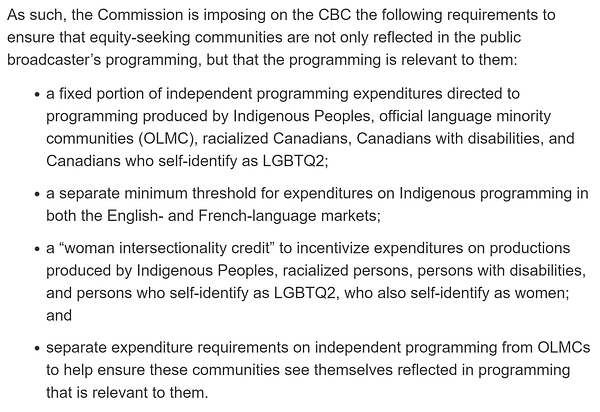
“As such, the Commission is imposing on the CBC the following requirements to ensure that equity-seeking communities are not only reflected in the public broadcaster’s programming, but that the programming is relevant to them.”

The CRTC is demanding a “fixed portion of independent programming expenditures directed to official language minority communities (OLMC), racialized Canadians, Canadians with disabilities, and Canadians who self-identify as LGBTQ2.” Additionally, it will grant a: “‘woman intersectionality credit’ to incentivize expenditures on productions produced by Indigenous Peoples, racialized persons, persons with disabilities, and persons who self-identify as LGBTQ2, who also self-identify as women.”

There are additional requirements for French language programming, of course. 

This line also caught our attention from the notice: 

“The Commission supports the Government of Canada’s commitment to renewing the relationship with Indigenous Peoples, based on the recognition of rights, respect, co-operation and partnership. On a broader level, the Commission also recognizes that Call to Action 84 of the Truth and Reconciliation Commission and the United Nations Declaration on the Rights of Indigenous Peoples (UNDRIP) tie into some of the objectives of the Broadcasting Act in that they refer to the reflection of Indigenous Peoples in the programming broadcast by the CBC.” 

The CRTC is demanding changes to the election of the CBC ombudsman to ensure he or she is “sensitive to issues surrounding Indigenous people, racialized Canadians and other equity-seeking communities.” 

It is also setting out “new expectations regarding the CBC’s Journalistic Standards and Practices to help ensure that journalists can provide relevant feedback and equity-seeking communities are consulted in any future review of the JSP.” 

(The JSP is basically the bible of CBC journalism and guides its employees in how it approaches reporting, analysis and opinion. The JSP has come under particular scrutiny in recent years when it was alleged that the expectation of “objective” journalism would distort how the outlet approaches racism. Attentive readers will note the obvious allusion to “moral clarity” here.)

Whether or not you agree with the outcomes being sought, what is clear is that the CRTC (which is appointed by the governor general, on advice of the privy council) is having explicitly political goals written into its license renewals. 

Now, don’t misread us, here. The CBC ought to be free to pursue equity goals in programming, or reviews of its JSP, or whatever it feels necessary to meet its mandate according to its own discretion. We happen think these outcomes are best exercised by trusted leaders and experienced producers who have the latitude to use editorial discretion, rather than by rigid quota or expenditure goals. 

To have these demands placed on it by an external regulator in order to fulfil the political goals of that regulator and, ultimately, its political masters, is playing with fire in the worst kind of way. 

For starters, one of the first pieces we ran here at The Line was from a documentary filmmaker who noted the ways in which diversity quotas shifted incentives in filmmaking. Just as students write to the test, quotas of this sort shift the focus in content production, forcing creators to produce content that checks a box, rather than fulfil a real audience desire. This creates a CBC that is dooming itself to be less relevant to the general public even as its relevance is growing more crucial thanks to the economic collapse of private media. The system is all the more insulting considering there is, in fact, a real audience desire for different voices and perspectives in our media landscape. 

(The Line can think of two such examples of CBC shows that were compelling and worth watching regardless of their diversity requirements: check out Sort Of and Trickster if you haven’t already. Unfortunately, the latter was cancelled when it was revealed that director Michelle Latimer was not as Indigenous as previously stated.) 

The second most obvious problem with all of this falls under the maxim “Do not give your enemies the weapons they will use to kill you.” In other words, having established this norm, do you not think that Prime Minister Pierre Poilievre, having done his damndest to stack the CRTC, will not do the same thing in turn? What is the CBC going to do when its license renewal is subject not to fulfilling the requirements of UNDRIP, but rather to concepts like “viewpoint diversity” and “journalistic objectivity,” as defined by Poilievre’s crew? The pendulum always swings back, friends, and it usually swings back harder when pushed. 

Source: The Line Dispatch 13 August

The Line: Latest US mass shooting

One of the better and most realistic, sadly so, commentaries on the Uvalde etc shootings:

Your Line editors have, between them, many decades of journalism experience. More than we honestly like to admit. And one of the types of stories that we have covered or in some way responded to more than any other is a catastrophic mass-casualty shooting in the United States.

We won’t bother recapping the details of the disaster in Texas this week, or the one in Buffalo just days before that. What point would it serve? They’re all basically the same. We really don’t have anything left to say that we haven’t said already. Worse, we’ve said it all many times. The towns, the pictures of the victims, the powerful statements by survivors … they’ve all blurred together. They blurred together years ago. 

Honestly, folks, we’re just plain out of helpful suggestions or novel insights or calls to action we think would have the slightest chance of actually working.  America’s problem with guns is not actually a gun-control problem. Now before you think we’re about to go on some NRA-inspired discussion about mental health or video games or a broken society or anything like that, you should know that we agree that the American status quo on guns is appalling. And your Line editors like guns a lot more than the average Canadian.

It’s not that guns aren’t a problem in the U.S. The access-to-firearms differential between the U.S. and everyone else is the only meaningful outlier, so yes, it’s clearly the guns. But the focus on gun control is misplaced not because the status quo is good, but because the gun dysfunction is a symptom of the actual problem: America’s political culture and systems are broken. 

Americans like their guns. A lot. Millions of them support the gun lobby for that reason. There’s no denying that, and probably no changing it. But the American policy status on guns is way, way to the right of where even the pro-gun, Second Amendment-loving population of the good ole U.S. of A want it to be.

This is often overlooked. A supermajority of Americans would support many reasonable limits on access to firearms. Just this week, for example, a poll found 88-per-cent national support for mandatory background checks before the sale of a firearm in the U.S. They’re not going to become Canada or Japan overnight, but again, an overwhelming majority of Americans would support at least some basic gun control measures that have absolutely zero chance of being enacted into law because the Republican party is captured by one of the more extreme factions of its base. 

This is an easy enough problem to identify. Doing anything about it is the hard part. The gun lobby in the United States has become something of a self-sustaining machine, and it is more than powerful enough to keep one of the two parties in a two-party system bent to its will.

Any conversation about how to prevent the next gun massacre in the United States that does not start from a position of understanding that this is fundamentally a problem within the Republican Party is a nonstarter. We don’t care about your memes comparing gun violence in America to gun violence in the rest of the Western world. Do not tell us about Britain after Dunblane or Australia after Port Arthur. Don’t inform us that all we need to do is get rid of the AR-15s. Withhold your video clips of Jacinda Ardern. All of these things are quite literally as useful as noting that we could zero out gun violence in America overnight if we just got Americans to be nice and stop shooting each other, because they all exist in a make-believe world where the GOP was not, 1. Powerful enough to impede meaningful change, and, 2. In the pocket of the gun lobby. The Brits, Aussies and Kiwis aren’t the United States, do not have the United States’ problems and specifically did not have the GOP blocking what a huge majority of Americans would want, at least in terms of basic things like background checks. If your bright idea doesn’t account for that, it ain’t that bright.

Your Line editors are worried about the United States, and our worry comes from a place of love. We love America, we love Americans. We are regular visitors there and have many friends and family in that country. We are admirers of its culture and especially its history. But it is a very sick place right now. And it is really hard to see how it is going to be able to begin to fix its problems without some kind of catastrophic system reset. We are not hoping for one (because we think it would have to be really catastrophic). Far from it. But we honestly don’t know what else would work.

Barring that, our friends to the south, whom we truly do care about deeply, are going to continue converting happy children full of all the potential of life into unrecognizable lumps of state evidence at an alarming rate, and it doesn’t matter how horrified anyone is by this or how earnestly you tweet about it, because until the Americans crack the political problem, it’s not that they won’t change, it’s that they can’t


We have different problems up here. In the aftermath of the San Antonio debacle, coming so quickly as it did on the heels of the Buffalo massacre, Justin Trudeau has said his Liberal party will be bringing out another round of gun control proposals shortly.

Because of course they are.

Friends, we don’t expect you to be experts in the various regulatory policies that, in combination, make up our gun-control regime. It’s really complicated stuff that the average person simply does not have any reason to know. But your Lineeditors do know it. Very well. And we can tell you, with all honesty and certainty, that most of what the Liberals have proposed in recent years, always in the aftermath of a high-profile tragedy, is entirely theatrical. Utterly and epically for show. A lot of what they announce is just re-announcing stuff they’ve already said they will do, or in some cases actually already exists. The rest is stuff that won’t actually address the factors that are the overwhelming contributor to firearms homicides in Canada (mainly mostly, smuggling of guns into Canada from the U.S.)…

Source: The Line Dispatch: Uvalde and other shootings