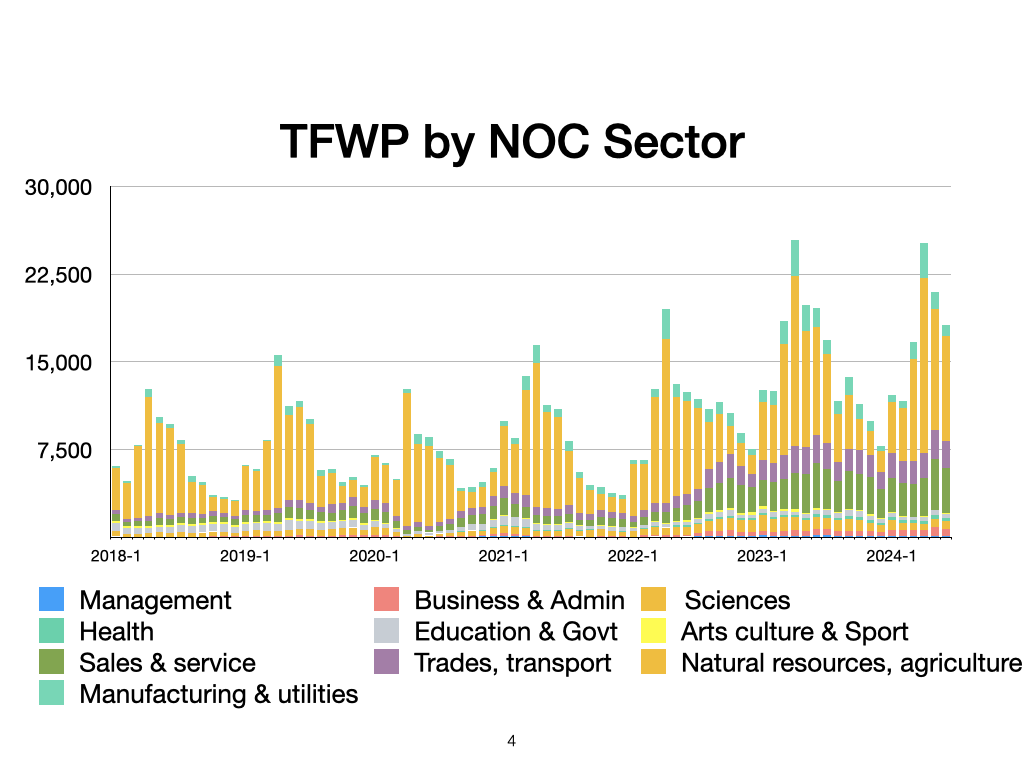
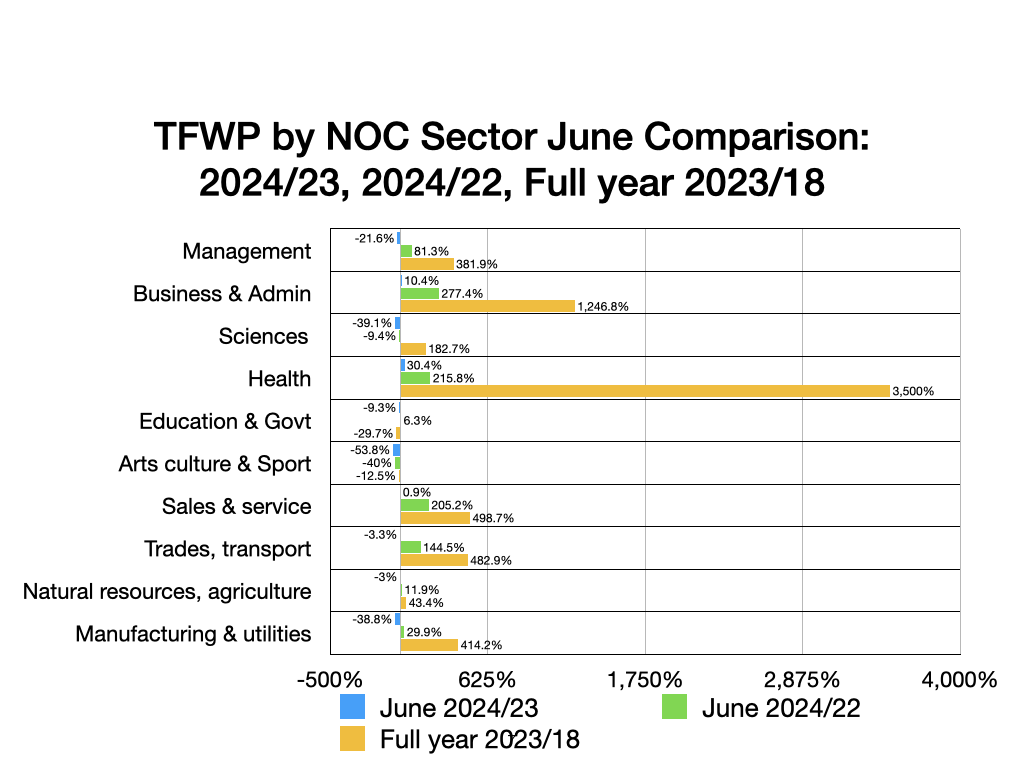
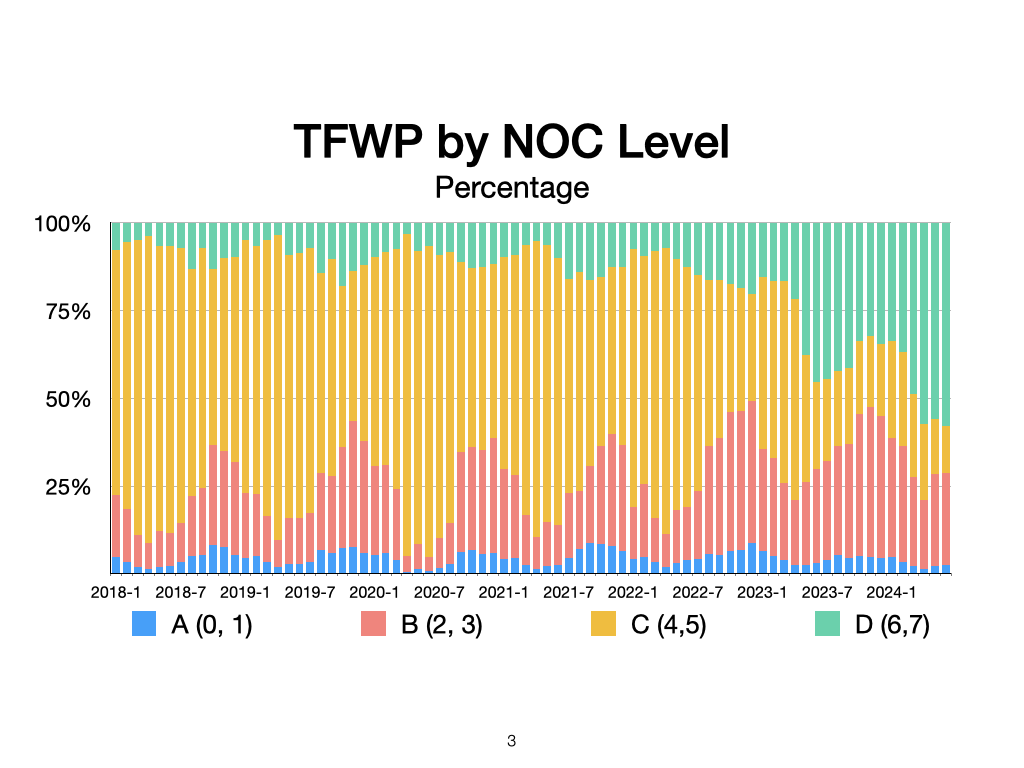
Worswick: Ottawa needs to abolish the temporary foreign worker program

Worth consideration:

…While these statements, at first glance, may seem at odds, there are valid economic reasons to be in favour of skilled (permanent) immigration but opposed to less-skilled temporary foreign worker programs.

We must therefore redesign our international migration policies. Ottawa’s announcement on Monday to further restrict the temporary foreign worker (TFW)program is a step in the right direction but not enough. Canada needs to go further and abolish the program.

We need to quickly phase out the low-skill stream of the TFW program, which the government has expanded to let companies fill perceived labour shortages. Then we should merge the higher-skill part of the program into our economic immigration program.

This would retain the advantages of the TFW program for higher-skilled workers, which is that it provides for a trial period for prospective immigrants. It would also ensure the temporary foreign workers are admitted in line with the goals of the economic immigration program: that they have high-enough skills to become immigrants whose presence greatly benefits the Canadian economy.

This must be done to reverse a long-standing, concerning trend. With support from the provinces and the business lobby, the federal government has greatly increased the numbers of immigrants and the number of temporary foreign workers coming to Canada, with 2022 levels that are more than 50 per cent higher than the 2017 levels in each case (according to the Immigration, Refugees and Citizenship Canada Annual Report to Parliament on Immigration). Given that these remarkable increases have coincided with both a health care crisis and a housing crisis, it naturally raises the issue of redesigning our international migration programs….

Source: Ottawa needs to abolish the temporary foreign worker program

Ottawa resserre davantage que Québec le recours aux travailleurs temporaires à bas salaire

Quebec comparison:

Ottawa va resserrer l’accès aux travailleurs étrangers temporaires à bas salaire davantage que Québec. Le premier ministre Justin Trudeau a annoncé trois changements en ce sens lundi matin, en marge de la retraite du cabinet fédéral, qui constituent un retour aux règles d’avant la pandémie.

Cette annonce suit celle faite par le premier ministre François Legault la semaine dernière, mais elle couvre plus large, tant géographiquement que pour les plafonds dans chaque industrie.

Québec va geler pour six mois l’accès au Programme des travailleurs étrangers temporaires (PTET) dès le 3 septembre, mais seulement pour l’île de Montréal. Les resserrements d’Ottawa entreront quant à eux en vigueur le 26 septembre et s’ajoutent à ceux déjà annoncés le printemps dernier, a évalué plus tard en matinée le ministre de l’Emploi, Randy Boissonnault.

Les mesures fédérales vont s’appliquer sans une fin déterminée : la révision du programme continue, précise plutôt le cabinet du ministre.

Les grands secteurs exemptés du resserrement fédéral seront les mêmes que ceux choisis par Québec : construction, santé, transformation alimentaire et du poisson. L’agriculture fait l’objet d’un autre volet du programme, et elle est donc également exclue.

Le « bas salaire » est défini par province selon le salaire médian, et est fixé à 27,47 $ l’heure pour le Québec.

Selon le taux de chômage

Les assouplissements ayant suivi la pandémie ont bien servi la communauté d’affaires, mais « l’économie d’aujourd’hui est différente », a dit M. Trudeau, citant l’inflation qui diminue et le chômage qui augmente.

C’est d’ailleurs le taux de chômage qui servira à déterminer les zones métropolitaines qui ne pourront plus participer au programme. Le gouvernement du Canada refusera de traiter les études d’impact sur le marché du travail (EIMT), la première étape pour les entreprises qui embauchent à l’étranger, qui concernent les villes où le taux de chômage est de 6 % ou plus.

D’après ce critère, et selon le taux de chômage au 1er juillet 2024, les villes de Laval et de Gatineau seraient exclues du programme, mais Québec ne les a pas mentionnées dans son annonce.

« Nous n’avons plus besoin d’autant de travailleurs étrangers temporaires. Nous avons besoin d’entreprises qui investissent dans la formation et les technologies, pas qui augmentent leur dépendance à une main-d’oeuvre à bas coût », a déclaré le premier ministre Trudeau. Il est temps d’investir dans les travailleurs canadiens, a-t-il rétorqué à « ceux qui se plaignent de la pénurie de main-d’oeuvre ».

C’est l’une des « pièces du casse-tête » pour faire passer de 7 % à 5 % la proportion totale d’immigrants temporaires par rapport à la population, a quant à lui déclaré le ministre de l’Immigration, Marc Miller, lors d’un point de presse tenu avec deux autres ministres, dont M. Boissonnault. D’autres mesures restent à annoncer, ont-ils précisé.

Cette proportion est d’environ 6,6 % au Québec, ce qui représente 597 000 immigrants temporaires, selon les dernières estimations de Statistique Canada.

Des plafonds différents

Le deuxième changement important constitue un autre retour en arrière : les employeurs pourront embaucher jusqu’à 10 % de leur effectif total dans le cadre du programme, comme c’était le cas de 2014 à 2022. La limite actuelle est de 20 % dans la plupart des industries.

La santé et l’agriculture ne connaissent pas de plafond à l’échelle du Canada.

Au Québec, les secteurs de la fabrication de produits en bois, de meubles et de produits connexes ainsi que les services d’hébergement et de restauration sont encore affichés à 30 % en raison de certaines exemptions.

Il y a en outre 267 professions exemptées de ces plafonds dans la province, dont une partie sont à bas salaire. Cette liste de professions s’est élargie dans les dernières années, à la demande du gouvernement Legault. L’an dernier, en dehors de l’agriculture, ce sont 63 % des dossiers de travailleurs temporaires au Québec qui sont passés par ce traitement simplifié, sans que le poste soit d’abord affiché pour les travailleurs locaux.

Le cabinet de M. Boissonnault a néanmoins confirmé que les changements s’appliqueraient au Québec, tout en disant vouloir « travailler en étroite collaboration avec le gouvernement du Québec ».

Enfin, le dernier changement annoncé lundi concerne la durée maximale d’emploi, qui passera de deux ans à un an à l’échelle du Canada.

D’autres mesures demandées

Le volet des postes à haut salaire du même programme est aussi sous la loupe du gouvernement, dans le cadre d’un examen général accéléré qui va durer 90 jours. Le cabinet discutera du nombre de résidents permanents et des possibilités d’adapter les cibles, a aussi avancé le premier ministre Trudeau.

« Le fédéral suit l’exemple de notre gouvernement, soit de réduire le nombre de travailleurs étrangers temporaires là où de la main-d’oeuvre est disponible », a quant à elle écrit sur X la ministre provinciale de l’Immigration, Christine Fréchette.

Comme la semaine dernière, elle a exhorté Ottawa à agir sur les autres résidents non permanents, en particulier sur l’autre grand programme de travail temporaire, le Programme de mobilité internationale.

Ce retour aux règles prépandémiques n’est pas sans rappeler la réforme de 2014 du même programme de travailleurs étrangers temporaires. Le fédéral déplorait alors qu’un programme de « dernier recours » n’eût pas connu assez de limites et que certains employeurs aient, « au fil du temps, bâti leur modèle d’entreprise en fonction du [PTET] ».

Dominer l’ordre du jour

Pour Catherine Xhardez, professeure de science politique à l’Université de Montréal, ce n’est pas un hasard si les deux ordres de gouvernement agissent sur les mêmes « rouages » : « Ce sont comme des boulons qu’on peut resserrer. Et c’est le PTET qui en a le plus, même s’il y a des forces contraires sur la question à savoir si on veut les resserrer ou non. »

Le gouvernement est « sous pression populaire et économique », décrit-elle, et veut montrer qu’il agit, tant à Québec qu’à Ottawa. Les deux « jouent sur ce qu’ils peuvent », le levier étant toujours les EIMT. « C’est sûr qu’il y a un effet de communication, de vouloir se mettre à l’agenda pour montrer qui avance en premier », analyse la politologue.

Les autorités ont desserré ces rouages de l’immigration temporaire durant la pandémie, tant pour relancer l’économie que pour rattraper la baisse migratoire des années 2020 à 2022. Toutefois, c’est une addition de petites mesures, « sans vision globale », qui ont été mises en places, « sans qu’on se rende compte à quel point les chiffres étaient importants », voit-elle. Il y a bel et bien eu « un recours massif pas toujours très raisonné », selon elle.

L’immigration a contribué à relancer l’économie, ont souligné MM. Boissonnault et Miller en conférence de presse. La réplique viendra donc rapidement d’un acteur important de la politique d’immigration, souligne Mme Xhardez : les employeurs.

Les employeurs catastrophés

Le Conseil du patronat du Québec (CPQ) n’a en effet pas tardé à réagir à cette nouvelle annonce, à l’image du mécontentement affiché la semaine dernière. « Une nouvelle tuile s’abat sur les entreprises cette semaine. Elles auront peu de temps pour s’adapter, car les changements annoncés entreront en vigueur d’ici un mois », a déclaré Karl Blackburn, président et chef de la direction du CPQ.

Les dernières prévisions économiques étant « optimistes », dit-il, la demande en travailleurs pourrait repartir à la hausse. Ce programme n’est qu’un « dernier recours », à cause de la « paperasse et des procédures » qu’il représente, indique-t-il.

Le CPQ propose par ailleurs qu’on « facilite le maillage avec les entreprises » pour développer des compétences correspondant au marché du travail, notamment celles des demandeurs d’asile.

Source: Ottawa resserre davantage que Québec le recours aux travailleurs temporaires à bas salaire

Computer translation:

Ottawa will tighten access to low-wage temporary foreign workers more than Quebec. Prime Minister Justin Trudeau announced three changes in this direction on Monday morning, on the sidelines of the retirement of the federal cabinet, which constitute a return to pre-pandemic rules.

This announcement follows the one made by Prime Minister François Legault last week, but it covers more widely, both geographically and for the ceilings in each industry.

Quebec City will freeze access to the Temporary Foreign Workers Program (PTET) for six months as of September 3, but only for the island of Montreal. The Ottawa tightening will take effect on September 26 and are in addition to those already announced last spring, assessed Employment Minister Randy Boissonnault later in the morning.

Federal measures will apply without a specific purpose: the revision of the program continues, says the Minister’s office instead.

The major sectors exempted from federal tightening will be the same as those chosen by Quebec: construction, health, food processing and fish. Agriculture is the subject of another part of the program, and it is therefore also excluded.

The “low salary” is defined by province according to the median salary, and is set at $27.47 per hour for Quebec.

According to the unemployment rate

The relaxations that followed the pandemic have served the business community well, but “today’s economy is different,” said Mr. Trudeau, citing declining inflation and rising unemployment.

It is also the unemployment rate that will be used to determine the metropolitan areas that will no longer be able to participate in the program. The Government of Canada will refuse to deal with labour market impact studies (LMIAs), the first step for companies that hire abroad, which concern cities where the unemployment rate is 6% or more.

According to this criterion, and according to the unemployment rate as of July 1, 2024, the cities of Laval and Gatineau would be excluded from the program, but Quebec did not mention them in its announcement.

“We no longer need so many temporary foreign workers. We need companies that invest in training and technology, not that increase their dependence on a low-cost workforce, “said Prime Minister Trudeau. It’s time to invest in Canadian workers, he replied to “those who complain about the shortage of labor”.

This is one of the “pieces of the puzzle” to increase the total proportion of temporary immigrants in relation to the population from 7% to 5%, said Immigration Minister Marc Miller at a press briefing with two other ministers, including Mr. Boissonnault. Other measures remain to be announced, they said.

This proportion is about 6.6% in Quebec, which represents 597,000 temporary immigrants, according to the latest estimates by Statistics Canada.

Different ceilings

The second important change is another step backwards: employers will be able to hire up to 10% of their total workforce under the program, as was the case from 2014 to 2022. The current limit is 20% in most industries.

Health and agriculture do not have a ceiling across Canada.

In Quebec, the manufacturing of wood products, furniture and related products as well as accommodation and catering services are still displayed at 30% due to certain exemptions.

There are also 267 professions exempt from these ceilings in the province, some of which are low-wage. This list of professions has expanded in recent years, at the request of the Legault government. Last year, outside agriculture, 63% of temporary worker files in Quebec went through this simplified treatment, without the position being first posted for local workers.

The office of Mr. Boissonnault nevertheless confirmed that the changes would apply to Quebec, while saying he wanted to “work closely with the government of Quebec”.

Finally, the last change announced on Monday concerns the maximum duration of employment, which will increase from two years to one year across Canada.

Other measures requested

The high-wage positions part of the same program is also under the government’s scrutiny, as part of an accelerated general review that will last 90 days. The cabinet will discuss the number of permanent residents and the possibilities of adapting the targets, Prime Minister Trudeau also said.

“The federal government is following the example of our government, namely to reduce the number of temporary foreign workers where manpower is available,” Provincial Immigration Minister Christine Fréchette wrote on X.

Like last week, she urged Ottawa to take action on other non-permanent residents, in particular on the other major temporary work program, the International Mobility Program.

This return to pre-pandemic rules is reminiscent of the 2014 reform of the same temporary foreign workers program. The federal government then deplored that a “last resort” program had not known enough limits and that some employers have, “over time, built their business model according to the [PTET]”.

Dominate the agenda

For Catherine Xhardez, professor of political science at the Université de Montréal, it is no coincidence that the two levels of government act on the same “cogs”: “They are like bolts that can be tightened. And it is the PTET that has the most, even if there are opposing forces on the question of whether we want to tighten them or not. ”

The government is “under popular and economic pressure,” she describes, and wants to show that it is acting, both in Quebec City and Ottawa. The two “play on what they can”, the lever is always the LMIAs. “It is certain that there is a communication effect, of wanting to put yourself on the agenda to show who advances first,” analyzes the political scientist.

The authorities loosened these workings of temporary immigration during the pandemic, both to revive the economy and to make up for the decline in migration from 2020 to 2022. However, it is an addition of small measures, “without a global vision”, that have been put in place, “without us realizing how important the figures were,” she sees. There was indeed “a massive recourse not always very reasoned”, according to her.

Immigration has helped to revive the economy, stressed Mess. Boissonnault and Miller at a press conference. The reply will therefore quickly come from an important player in immigration policy, stresses Ms. Xhardez: employers.

Employers devastated

The Conseil du patronat du Québec (CPQ) was indeed quick to react to this new announcement, like the discontent displayed last week. “A new tile is falling on companies this week. They will have little time to adapt, as the announced changes will take effect within a month, “said Karl Blackburn, President and CEO of the CPQ.

The latest economic forecasts being “optimistic”, he says, the demand for workers could rise again. This program is only a “last resort”, because of the “paperwork and procedures” it represents, he says.

The CPQ also proposes to “facilitate networking with companies” to develop skills corresponding to the labour market, in particular those of asylum seekers.

Government officers told to skip fraud prevention steps when vetting temporary foreign worker applications, Star investigation finds

Sigh….

As the Trudeau government promises to crack down on a temporary foreign worker program it admits has been abused, a Star investigation has revealed the government is fast-tracking applications by directing processing officers to skip crucial steps designed to prevent fraud. 

Beginning in January 2022, Employment and Social Development Canada (ESDC) directed staff to apply “streamlining measures” when evaluating the legitimacy of applications by employers who want to hire temporary foreign workers.

According to internal ESDC documents obtained by the Star and interviews with a current ESDC employee, routine checks meant to ensure the system is not abused by unscrupulous employers have been suspended in an effort to process applications faster.

Those checks include contacting employers to confirm they actually applied to hire a worker, verifying that lawyers and consultants applying on behalf of employers are in good standing with their regulator, and clarifying the overtime, vacation and benefits promised to the worker.

“This really shows a complete contradiction between the public-facing government policies and how the program is actually run,” said Catherine Connelly, a professor at McMaster University’s DeGroote School of Business who has been studying the temporary foreign workers program for more than a decade who examined the internal ESDC documents.

“On one hand, we’re told the government will crack down on everything, and then on the other hand, we see from the documents that this is clearly a rubber stamp,” she said. “If the government is not going to do even basic checks, how can the public have any confidence in anything?”…

Source: Government officers told to skip fraud prevention steps when vetting temporary foreign worker applications, Star investigation finds

The sudden rise of temporary foreign workers in entry-level office jobs

Another example of how the program was mismanaged:

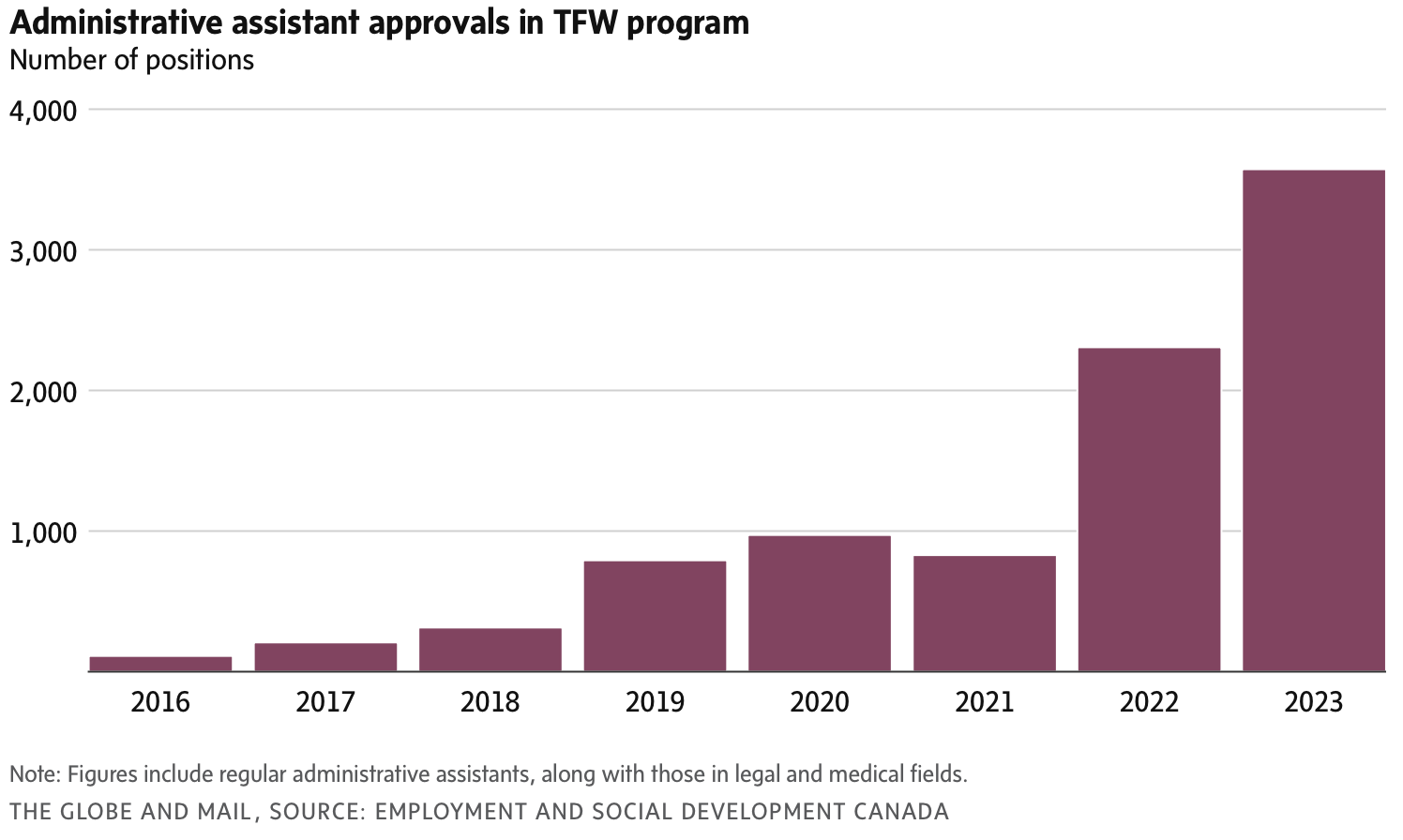
Temporary foreign workers are no longer a rare presence in entry-level office roles.

Last year, employers were approved to hire more than 3,500 administrative assistants via the Temporary Foreign Worker Program, up from just 112 of those roles approved in 2016, according to figures published by the federal government. In addition, companies were authorized to hire nearly 2,000 administrative officers in 2023. (The TFW program accounts for a small share of foreign labour in Canada, so it’s likely that other pathways are being tapped for admin workers, too.)

The TFW program has soared in use over the past few years, including more recruitment of low-wage workers in hospitality, construction and other fields. But this trend has brought greater scrutiny to the program, particularly as the unemployment rate has risen and some groups — notably young people and recent immigrants — have struggled to find jobs.

The federal government has said it’s trying to scale back the TFW program, and earlier this week, it announced a pause in using it to hire certain low-wage workers in the Montreal region.

Source: The sudden rise of temporary foreign workers in entry-level office jobs

Travailleurs étrangers temporaires: Ottawa va resserrer les règles et les critères d’admissibilité 

The most comprehensive report I have seen so far (no doubt various commentaries will emerge in coming days). As the saying goes, better late than never but the Liberal government’s (mis)management of immigration has to rate as one of its biggest policy failures, substantively and in political terms.

But this policy reversal, one among a number, has the advantage that it demonstrates that restrictions cannot be automatically portrayed as xenophobic, nor can criticism of any proposed immigration restrictions in the Conservative 2025 platform be labelled as such by the Liberals and NDP.

We should expect to see the impact starting in October, with the final quarter numbers providing a good indication of their effectiveness:

Le premier ministre Justin Trudeau a annoncé lundi des changements au Programme des travailleurs étrangers temporaires (PTET) lundi matin, alors que le cabinet ministériel effectue sa retraite à Halifax. 

« Nous allons réduire l’utilisation du programme pour faire entrer des travailleurs étrangers temporaires faiblement rémunérés », a-t-il dit. 

« Nous regardons également les modifications au volet des postes à haut salaire. » 

Le premier ministre a justifié cette décision en expliquant qu’en raison de l’inflation, la situation n’était plus la même qu’il y a deux ans et que le Canada n’avait plus autant besoin de main-d’œuvre étrangère. Il a ajouté que le temps était à la formation et à l’investissement dans la technologie, et non plus à une dépendance croissante à la main-d’œuvre étrangère, parfois « exploitée » et « maltraitée ». 

Il a invité les entreprises à engager leur personnel parmi la population canadienne. « À ceux qui se plaignent de la pénurie de main-d’œuvre, voici mon message : il n’y a pas de meilleur moment pour investir et pour embaucher des travailleurs canadiens. » 

Les domaines de la santé, de la construction et de la sécurité alimentaire sont exemptés des nouvelles mesures du PTET qui seront appliquées dès le 26 septembre.

Selon les changements mis de l’avant, les employeurs ne devront pas dépasser un apport de travailleurs étrangers temporaires équivalent à 10 % de leur effectif. Ce seuil s’appliquera aux postes à bas salaires seulement.

Les travailleurs embauchés dans cette proportion pourront être employés pour une période maximale d’un an plutôt que de deux.

Par ailleurs, Ottawa signale qu’il ne traitera pas les études d’impact sur le marché du travail qui sont nécessaires pour justifier l’embauche de travailleurs étrangers temporaires si ces demandes sont faites pour des postes à bas salaire dans des zones métropolitaines où le taux de chômage est d’au moins 6 %.
Selon le ministre de l’Emploi, Randy Boissonnault, les changements entraîneront une réduction d’environ 65 000 travailleurs étrangers temporaires.

« Le PTET a toujours été conçu pour s’ajuster à l’économie et c’est ce que nous faisons : nous regardons les données économiques et nous y répondons », a-t-il affirmé.

Un « premier pas »

M. Trudeau a présenté l’annonce de lundi comme une « première étape » en réponse à l’importante hausse d’immigrants temporaires. 

Cet automne, nous allons présenter, pour la première fois, un plan de niveaux d’immigration qui ne parle pas juste de résidents permanents, mais aussi de résidents temporaires, qu’il s’agisse de travailleurs étrangers ou d’autres [catégories d’immigration].

 le premier ministre Justin Trudeau

L’objectif est de « s’assurer que l’ensemble a le plus de sens possible en fonction des besoins des Canadiens et de notre économie », a fait valoir le premier ministre. 

Les niveaux pancanadiens annuels de nouveaux résidents permanents – 485 000 en 2024 et 500 000 en 2025 ainsi qu’en 2026 — incluent des cibles chiffrées de dossiers à être approuvés par Ottawa dans des programmes économiques et de regroupement familial, par exemple, mais pas pour les volets d’une immigration dite « temporaire » et marquée, selon Statistique Canada, par une croissance fulgurante depuis 2022. 

« Je pense que l’époque des voies d’entrée au Canada qui ne sont pas plafonnées en vient à être révolue. C’est une question de planification et de prévision appropriées », a déclaré le ministre de l’Immigration, Marc Miller.

Parmi les nouveaux arrivants non permanents exclus des cibles actuelles, on compte les étudiants internationaux et les travailleurs étrangers qui peuvent vouloir, à plus long terme, élire domicile au Canada. On y retrouve aussi tous les demandeurs d’asile se trouvant déjà au pays qui attendent, face à de longs délais, une décision de la Commission de l’immigration et du statut de réfugié du Canada (CISR) sur leur requête ou la conclusion de leur appel après avoir essuyé un refus. 

En tout et pour tout, Statistique Canada évalue qu’il y avait 2 793 594 résidents non permanents partout au pays au deuxième trimestre de 2024. Au Québec seulement, l’agence estime qu’il y en avait 597 140, mais la CISR, qui s’en remet à une définition moins large et une méthodologie différente, en dénombrait plutôt 388 959, a précisé l’équipe du ministre fédéral de l’Immigration, Marc Miller. 

Ottawa a signalé en mars qu’il prévoit réduire le nombre de résidents temporaires à 5 % de la population au cours des trois prochaines années, contre 6,2 % au moment de l’annonce. 

M. Miller a ouvert la porte lundi à ce qu’Ottawa considère de réduire ses cibles de nouveaux résidents permanents dès 2025. « Je dirais que toutes les options sont en ce moment sur la table », a-t-il dit.

Des annonces au Québec

Le Québec, qui détient certains pouvoirs en matière d’immigration, a aussi annoncé récemment des changements au PTET. 

À compter du 3 septembre, le gouvernement imposera un moratoire de six mois concernant les demandes et les renouvellements en lien PTET sur l’île de Montréal. Le gouvernement de François Legault a présenté l’initiative comme une façon de protéger le français. 

Cette décision visera des emplois dont le salaire offert est inférieur au revenu médian du Québec, soit 57 000 $ par an ou 27,47 $/heure. Le gouvernement prévoit des exceptions qui touchent les secteurs de la santé, de l’éducation, de la construction, de l’agriculture et de la transformation alimentaire. 

Le premier ministre Legault a aussi indiqué qu’un projet de loi sera déposé cet automne afin de donner au gouvernement le pouvoir de limiter le nombre d’étudiants étrangers dans certains établissements d’enseignement « où il y a eu des abus ». 

Depuis plusieurs mois, Québec réclame au fédéral une baisse « significative et rapide » du nombre d’immigrants temporaires sur son territoire, plaidant que la province a dépassé sa capacité d’accueil. 

Source: Travailleurs étrangers temporaires Ottawa va resserrer les règles et les critères d’admissibilité

Translation:

Prime Minister Justin Trudeau announced on Monday changes to the Temporary Foreign Workers Program (TFTP) on Monday morning, as the ministerial cabinet is retiring in Halifax.

“We will reduce the use of the program to bring in low-paid temporary foreign workers,” he said.

“We are also looking at the changes to the aspect of high-wage positions. ”

The Prime Minister justified this decision by explaining that because of inflation, the situation was no longer the same as two years ago and that Canada no longer needed foreign labor as much. He added that the time was for training and investment in technology, and no longer for a growing dependence on foreign labor, sometimes “exploited” and “mistreated”.

He invited companies to hire their staff among the Canadian population. “To those who complain about the labor shortage, here is my message: there is no better time to invest and hire Canadian workers. ”

The areas of health, construction and food safety are exempt from the new PTET measures that will be applied from September 26.

According to the changes put forward, employers will not have to exceed a contribution of temporary foreign workers equivalent to 10% of their workforce. This threshold will apply to low-wage positions only.

Workers hired in this proportion may be employed for a maximum period of one year rather than two.

In addition, Ottawa reports that it will not deal with labour market impact studies that are necessary to justify the hiring of temporary foreign workers if these applications are made for low-wage positions in metropolitan areas where the unemployment rate is at least 6%.

According to the Minister of Employment, Randy Boissonnault, the changes will result in a reduction of about 65,000 temporary foreign workers.

“The PTET has always been designed to adjust to the economy and that’s what we do: we look at economic data and respond to it,” he said.

A “first step”

Mr. Trudeau presented Monday’s announcement as a “first step” in response to the significant increase in temporary immigrants.

This fall, we will present, for the first time, an immigration level plan that is not just about permanent residents, but also about temporary residents, whether foreign workers or other [immigration categories].

Prime Minister Justin Trudeau

The objective is to “ensure that the whole makes the most sense possible according to the needs of Canadians and our economy,” said the Prime Minister.

The annual pan-Canadian levels of new permanent residents – 485,000 in 2024 and 500,000 in 2025 and 2026 – include quantified targets of files to be approved by Ottawa in economic and family reunification programs, for example, but not for the components of so-called “temporary” immigration and marked, according to Statistics Canada, by meteoric growth since 2022.

“I think the days of entry routes into Canada that are not capped are over. It is a question of appropriate planning and forecasting, “said Immigration Minister Marc Miller.

Among the non-permanent newcomers excluded from current targets are international students and foreign workers who may want, in the longer term, to take up residence in Canada. It also includes all asylum seekers already in the country who are waiting, in the face of long delays, for a decision by the Immigration and Refugee Board of Canada (IRB) on their request or the conclusion of their appeal after being refused.

In all, Statistics Canada estimates that there were 2,793,594 non-permanent residents across the country in the second quarter of 2024. In Quebec alone, the agency estimates that there were 597,140, but the IRB, which relies on a smaller definition and a different methodology, counted 388,959, said the team of the Federal Minister of Immigration, Marc Miller.

Ottawa reported in March that it plans to reduce the number of temporary residents to 5% of the population over the next three years, from 6.2% at the time of the announcement.

Mr. Miller opened the door on Monday for Ottawa to consider reducing its targets for new permanent residents by 2025. “I would say that all the options are currently on the table,” he said.

Announcements in Quebec

Quebec, which has certain immigration authorities, has also recently announced changes to the PTET.

As of September 3, the government will impose a six-month moratorium on PTET-related applications and renewals on the island of Montreal. The government of François Legault presented the initiative as a way to protect French.

This decision will target jobs whose salary offered is lower than Quebec’s median income, i.e. $57,000 per year or $27.47/hour. The government provides for exceptions that affect the health, education, construction, agriculture and food processing sectors.

Prime Minister Legault also indicated that a bill will be tabled this autumn to give the government the power to limit the number of foreign students in certain educational institutions “where there have been abuses”.

For several months, Quebec City has been demanding from the federal government a “significant and rapid” decrease in the number of temporary immigrants on its territory, arguing that the province has exceeded its reception capacity.

Ottawa agrees to pause low-wage stream of Montreal temporary foreign worker program – with several exceptions 

Exceptions are reasonable. The degree to which these restrictions are enforceable, or are enforced, remains to be seen. But, as some Quebec commentators have noted, major step in giving Quebec a larger say with respect to Temporary Foreign Workers:

Ottawa has approved a Quebec request to impose a six-month pause on new applications to the low-wage stream of the temporary foreign worker program in Montreal, with exemptions for several sectors.

Employment Minister Randy Boissonnault announced the decision on Tuesday, saying the pause will not apply to the construction, agriculture, food-processing, education and social-services sectors.

Quebec Premier François Legault said the six-month pause would only apply to about 3,500 workers filling low-wage jobs on the Island of Montreal. During a Tuesday news conference, Mr. Legault presented this as a first step and acknowledged that it represents only a small fraction of Quebec’s temporary residents….

Source: Ottawa agrees to pause low-wage stream of Montreal temporary foreign worker program – with several exceptions

‘Structural solutions not inflammatory conclusions’ required to fix foreign worker program: Senator Omidvar

More balanced than the special rapporteurs language and reasonable recommendations for the current and likely future government to consider, although finding the right balance between employers and workers remains a challenge:

…While the government and groups like the Canadian Chamber of Commercemay reject the UN rapporteur’s characterization of the program, the recent Senate report found similar abuses within the program. 

On May 21, the Senate Committee on Social Affairs, Science, and Technology released its own report on Canada’s migrant labour infrastructure, which it said is failing both workers and employers. 

Beginning its study in November 2022, the committee heard evidence and testimony from temporary foreign workers and employers, academics, policy experts, and government officials. Members also visited workplaces in New Brunswick and Prince Edward Island on a fact-finding mission. 

While Obokata did not visit any farms or fisheries—as the Senate committee did—Omidvar said the Senators who worked on the report were able to come to their findings with “clear eyes,” having accounted for all perspectives. 

Fittingly, those perspectives informed the first of the committee’s recommendations to provide what Omidvar said are “structural solutions” to a program that has grown in a rapid, disorganized, and often piecemeal manner for decades.

In its report, the committee offered six recommendations, the first of which is the establishment and funding of a tripartite Migrant Work Commission, modelled after the Canada Employment Insurance Commission, that would include a commissioner representing migrant workers, employers, and the federal government. 

“Right now, there is no single place where either an employer or a migrant worker can go to address their issues,“ Omidvar explained. “In particular, there are not enough avenues of complaints for migrant workers that are nimble, effective, and worker-friendly.”

The second recommendation mirrors the UN report, but Omidvar said the committee recommends the full phase-out of closed work permits in the next three years, rather than immediately.

“You cannot go from extreme heat to extreme cold without creating severe cracks and fissures in the system,” Omidvar said, explaining that while the committee had identified closed work permits as an area of concern, the federal government would need time to negotiate with provinces to create regional, sector-wide permits to replace them.

Omidvar said the third most important recommendation is that workplace inspections be unannounced as a standard, adding that the current practice allows for unscrupulous employers to engineer a compliant workplace to give the illusion of compliance when inspectors arrive.

While Omidvar recognized that could also be true for the workplaces the committee visited—or at the very least, that only already compliant “good workplaces” would have even accepted their request for a visit—she said the workplaces she did see were undoubtedly having a positive impact on its workers and community.

At one seafood processing plant, Omidvar recalled speaking with employees who had arrived as temporary workers and successfully applied for permanent residency with the aid of sponsorship from their employer. She said that the new influx of residents had reinvigorated and revitalized the community with “new families, teachers, and parishioners” filling the local church every Sunday.

On the other side of the spectrum, Omidvar said the committee also met with migrant workers in closed-door meetings in other communities who detailed instances of abuse, including withholding access to health care. She explained that those abuses can be particularly problematic in rural and remote communities without nearby doctors or medical facilities.

Additionally, many of those workers said that there was a lack of clarity on the pathways to permanent residency, she noted. 

“They’re operating in a fog of information, and we need to make those pathways crystal clear,” Omidvar said, adding that Canada needs an annual migrant worker level plan, as it has for annual immigration. 

“The whole system post-COVID has been kind of bent out of shape with exceptions that we made to meet various needs,” Omidvar said. “Now, we need to get back to the drawing board and reconfigure this in a sensible, pragmatic, and doable manner that ensures the rights of migrant workers are paramount.”

Source: ‘Structural solutions not inflammatory conclusions’ required to fix foreign worker program: Senator Omidvar

Canada to pause approval of temporary foreign workers for low-wage jobs in Montreal

Of note. Will be interesting to see the details of which groups most affected (e.g., fast food restaurants or personal support workers):

Canada will freeze the approval of new temporary foreign workers in low-wage jobs in the Montreal area starting in September, CBC News has learned.

A senior government source said the processing of Labour Market Impact Assessment (LMIA) applications will be suspended for six months, starting on Sept. 3, for job offers with wages below $27.47 per hour — currently Quebec’s median hourly wage.

The decision is expected to be made public on Tuesday.

Premier François Legault and Quebec Immigration Minister Christine Fréchette are scheduled to make an announcement about the temporary foreign worker program tomorrow at 10 a.m.

Low-wage temporary foreign workers in Quebec must both be approved by the province and have their employer’s LMIA application approved by the federal Immigration Ministry.

Ottawa says the move is an attempt to “ensure the integrity of the temporary foreign worker (TFW) program” which is designed to be used when workers already in Canada aren’t able to fill vacancies.

Quebec Premier François Legault has been asking Ottawa to curb temporary immigration in the province for months.

Canada will freeze for six months the approval of new temporary foreign workers in low-wage jobs in the Montreal area starting in September, CBC News has learned. The announcement is expected Tuesday morning.

Source: Canada to pause approval of temporary foreign workers for low-wage jobs in Montreal

Où sont passées les clés de notre système d’immigration ?

Good article in La Presse (translation below):

Aujourd’hui, le Canada perd la face sur la scène internationale.

La mécanique qui permet aux employeurs canadiens de faire venir des travailleurs étrangers à bas salaire crée un « terreau fertile » pour l’esclavage contemporain, déplorait le rapporteur spécial l’ONU, Tomoya Obokata, cette semaine1.

Le constat est dur. Mais il ne révèle qu’une partie du problème. En fait, le Canada a perdu le contrôle de l’immigration temporaire.

Au fil des ans, Ottawa comme Québec ont laissé émerger un système d’immigration à deux vitesses, dans la plus grande hypocrisie.

Devant les projecteurs, Québec impose des plafonds chiffrés et des critères précis pour l’immigration permanente. « En prendre moins, mais en prendre soin », clamait la Coalition avenir Québec (CAQ) quand elle a été élue pour la première fois. 

Mais en coulisses, le gouvernement laisse entrer sans compter les résidents non permanents qui ont été trois fois plus nombreux à arriver au Québec (174 000) que les permanents (52 800), en 2023.

Devant les micros, Québec fait grand cas de l’augmentation des demandeurs d’asile. Il est vrai que la province fait plus que sa part et on se réjouit de voir Ottawa réfléchir à un plan pour mieux répartir l’effort à travers le pays. Mais Québec se garde bien de dire que la croissance dans les autres catégories de résidents non permanents (étudiants, travailleurs temporaires) a été encore plus forte (+44 %) que celle des demandeurs d’asile (+37 %) depuis un an.

Cela fait l’affaire des cégeps et universités sous-financés par l’État, qui ont trouvé là un filon pour regarnir leurs coffres et maintenir en vie des programmes en manque d’étudiants locaux. Cela fait aussi le bonheur des employeurs, qui veulent des bras pour accomplir des tâches ingrates au salaire minimum.

Mais pour l’ensemble de la société, c’est contre-productif.

Qu’à cela ne tienne, Québec et Ottawa ont accordé une série d’assouplissements, sans considérer leur effet cumulatif, qui a fait exploser l’immigration temporaire depuis 2015.

Ils ont en quelque sorte donné les clés de notre système d’immigration aux établissements d’enseignement et aux employeurs qui déterminent le nombre et le profil des étrangers qui arrivent chez nous, selon leurs besoins à eux.

Cela a fait dévier le système d’immigration de son objectif d’attirer des travailleurs qualifiés. Et c’est ainsi qu’on se retrouve avec un niveau de vie à la baisse, comme en témoigne le PIB par habitant, qui descend depuis plusieurs trimestres.

Le ministre fédéral de l’Immigration essaie maintenant de remettre le dentifrice dans le tube. En mars, Marc Miller a annoncé son intention de réduire d’environ 20 %, d’ici trois ans, le nombre d’immigrants temporaires qui atteint 2,8 millions au Canada.

Ce ne sera pas simple.

Va-t-on leur montrer la porte ? Il y a un risque que les non-résidents qui perdent leur permis restent au Canada quand même, sans papiers, un statut qui peut mener à des abus encore pires. Et cela ne réduirait pas le nombre d’étrangers sur le sol canadien… à moins de mettre en place un système de déportation à l’américaine. Franchement, ça ne serait pas chic.

Va-t-on leur accorder la résidence permanente en vrac ? Cela ferait en sorte que des immigrants temporaires qui n’ont pas le meilleur profil passeraient devant les candidats plus qualifiés. Pas fort. 

Remarquez, on pourrait aussi relever les plafonds d’immigration permanente pour leur faire de la place. Mais dans ce cas, on ne réduirait pas réellement la croissance de la population.

On le voit, il n’y a pas de solution magique pour diminuer rapidement le nombre de non-résidants déjà au Canada.

Voilà pourquoi il est crucial d’agir en amont, en resserrant les critères d’immigration temporaire.

Auparavant, les demandes d’immigration permanente étaient acheminées de l’étranger. Quand les immigrants étaient acceptés au Canada, ils entraient par la grande porte, avec des services structurés. 

Désormais, les étudiants et les travailleurs arrivent avec un statut temporaire, dans l’espoir de rester à long terme. On ne peut plus continuer avec ce système à deux étapes qui crée des frustrations et des goulots d’étranglement.

Il est crucial de mieux arrimer les immigrations temporaire et permanente, qui sont des vases communicants.

Il est aussi nécessaire de sevrer graduellement les employeurs de la main-d’œuvre étrangère à bas coût, une solution de dernier recours. C’est une chose de recruter des travailleurs saisonniers dans le secteur agricole. C’en est une autre quand le secteur manufacturier, la restauration ou le commerce de détail pourvoient avec des immigrants temporaires… des postes permanents.

Le recours trop facile à la main-d’œuvre bon marché peut avoir l’effet pervers de freiner les investissements en technologie et en machinerie qui permettraient d’améliorer la productivité du Québec, souligne un rapport de l’Institut du Québec2.

Il est temps de donner un bon tour de vis à l’immigration temporaire.

Québec, qui a favorisé abondamment le recours aux immigrants à bas salaire, a le devoir de présenter une vision d’ensemble, claire et logique. Il ne suffit pas d’attendre les mesures d’Ottawa pour ensuite crier à la victime en réclamant les pleins pouvoirs.

Source: Où sont passées les clés de notre système d’immigration ?

Today, Canada is losing face on the international scene.

The mechanism that allows Canadian employers to bring in low-wage foreign workers creates a “fertile breeding ground” for contemporary slavery, lamented the UN Special Rapporteur, Tomoya Obokata, this week1.

The observation is hard. But it only reveals part of the problem. In fact, Canada has lost control of temporary immigration.

Over the years, both Ottawa and Quebec City have allowed a two-speed immigration system to emerge, in the greatest hypocrisy.

In the spotlight, Quebec City imposes numerical ceilings and precise criteria for permanent immigration. “Take less, but take care of it,” said the Coalition avenir Québec (CAQ) when it was first elected.

But behind the scenes, the government lets in without counting non-permanent residents who were three times more likely to arrive in Quebec (174,000) than permanent residents (52,800), in 2023.

In front of the microphones, Quebec City makes a big case for the increase in asylum seekers. It is true that the province is doing more than its part and we are delighted to see Ottawa thinking about a plan to better distribute the effort across the country. But Quebec is careful not to say that growth in other categories of non-permanent residents (students, temporary workers) has been even stronger (+44%) than that of asylum seekers (+37%) over the past year.

This is the case of CEgeps and universities underfunded by the state, who have found there a vein to replenish their chests and keep programs alive in need of local students. It also makes employers happy, who want arms to perform ungrateful tasks at the minimum wage.

But for society as a whole, it is counterproductive.

Never mind, Quebec and Ottawa have granted a series of relaxations, without considering their cumulative effect, which has exploded temporary immigration since 2015.

They have somehow given the keys to our immigration system to educational institutions and employers who determine the number and profile of foreigners who arrive with us, according to their needs.

This has diverted the immigration system from its objective of attracting skilled workers. And this is how we find ourselves with a declining standard of living, as evidenced by GDP per capita, which has been falling for several quarters.

The Federal Minister of Immigration is now trying to put the toothpaste back in the tube. In March, Marc Miller announced his intention to reduce by about 20%, within three years, the number of temporary immigrants to reach 2.8 million in Canada.

It won’t be easy.

Will we show them the door? There is a risk that non-residents who lose their license will still remain in Canada, without papers, a status that can lead to even worse abuses. And this would not reduce the number of foreigners on Canadian soil… unless an American-style deportation system is set up. Frankly, it wouldn’t be chic.

Will they be granted permanent residence in bulk? This would ensure that temporary immigrants who do not have the best profile would pass in front of more qualified candidates. Not strong.

Note, we could also raise the permanent immigration ceilings to make room for them. But in this case, population growth would not really be reduced.

As we can see, there is no magic solution to quickly reduce the number of non-residents already in Canada.

This is why it is crucial to act upstream, tightening the criteria for temporary immigration.

Previously, permanent immigration applications were sent from abroad. When immigrants were accepted into Canada, they entered through the big door, with structured services.

From now on, students and workers arrive with a temporary status, in the hope of staying in the long term. We can no longer continue with this two-step system that creates frustrations and bottlenecks.

It is crucial to better stick up temporary and permanent immigration, which are communicating vessels.

It is also necessary to gradually wean employers of low-cost foreign labor, a solution of last resort. It is one thing to recruit seasonal workers in the agricultural sector. It is another when the manufacturing sector, catering or retail supply temporary immigrants… permanent positions.

The too easy use of cheap labor can have the perverse effect of slowing down investments in technology and machinery that would improve Quebec’s productivity, says a report from the Institut du Québec2.

It’s time to give a good turn of the screw to temporary immigration.

Quebec, which has widely favored the use of low-wage immigrants, has a duty to present an overall, clear and logical vision. It is not enough to wait for Ottawa’s measures and then shout to the victim by demanding full powers.

John Ivison: How do the Liberals fix skyrocketing immigration? By lowering the entry standards

Beyond the header and the analysis, there is a need for a number of lower-skilled immigrants, both temporary and permanent. The question revolves around the level and the percentage of all immigrants and of course, many family class and refugees already provide a source of lower skilled levels, as does the Provincial Nominee Program in some cases.

Hopefully, the annual immigration plan will provide some clarity and not result in any further deskilling of economic immigrants as Skuterud fears.

But all too true about the aversion of the government to deport visa overstayers and undocumented migrants, noting correctly that “every single one has the potential to be a front-page Toronto Star sob story.”

…But the growth in college-level foreign student enrolments and the expansion of the low wage stream of temporary workers mean there are many migrants who would not meet the requirements of the skills-based points system.

Ottawa has now revealed its solution — that from this fall, it will create a new economic class of permanent residency candidates for people with high school education or less, who would not otherwise have qualified to stay.

Mikal Skuterud, a professor of economics at the University of Waterloo, said this is a first for Canada. He said he believes the measure is, at least in part, a “release valve” to address the bulging population of visa overstayers.

“Many of these non-permanent residents will never obtain skilled jobs and the current economic class selection system makes it difficult to prioritize applicants working in less-skilled jobs over high-skilled applicants. That’s the trade-off being made to avoid a growing undocumented population,” he said.

It is not clear yet how many of the 300,000 slots allocated for economic immigrants in 2025 will be filled from the new stream, but every one that is will be at the expense of a higher qualified person applying from abroad and going through the Comprehensive Ranking skills-based points system that has been the backbone of Canada’s successful immigration policy.

OECD data from 2021 showed that Canada was by far the most successful of its peers in picking immigrants with high levels of education — more than 70 per cent — compared to just 20 per cent with medium (high school level) education. That could soon change.

As Skuterud notes, there are going to be many frustrated foreign computer science graduates from Canada’s top universities who find their chances of coming to Canada permanently are now much reduced. “That’s not good if we’re genuinely concerned about labour productivity in this country,” he said.

The Immigration Department said no information is available on numbers or a timeline because “this initiative is at the proposal stage, with no certainty of being implemented.” But it is hard to see what else the government can do.

Ottawa obviously has no stomach to dramatically increase outflows of undocumented immigrants — deportations reached 16,205 in 2023 and every single one has the potential to be a front-page Toronto Star sob story.

The Liberals have already cut student visas by 35 per cent and limited the percentage of any given workforce that can be made up of low-wage foreign workers to 20 per cent from 30.

But these measures will take time to work — most students are here on multi-year visas and are eligible for a three-year work permit after graduation.

Against that background, turning temporary workers and students into permanent residents looks like a work of political genius.

But at a stroke, it undermines the integrity of a skills-based immigration system; reduces Canada’s ability to attract the best and brightest; and, rewards those who have overstayed their visa by providing them with an option to permanent residency.

“The deskilling of Canadian economic immigration continues,” said Skuterud.

No wonder the public is losing confidence.

Source: John Ivison: How do the Liberals fix skyrocketing immigration? By lowering the entry standards