Few ethnic minorities among Syrians sponsored by Canadian government

Contrast between Government messaging and rhetoric and action:

Syrian refugees who came to Canada through private sponsorship this year were far more likely to be from ethnic or religious minorities than the ones who were directly sponsored by the government, the Citizen has learned.

Since January, almost 90 per cent of those privately sponsored were ethnic or religious minorities, as compared to only about five per cent of those directly sponsored by the government.

The government said in January that ethnic and religious minorities would be a priority as it announced plans to resettle another 10,000 Syrian refugees, on top of 1,300 already promised. Largely overlooked was that an unspecified majority would be privately sponsored.

Conservative leader Stephen Harper reiterated the focus on minorities last month, explaining at a Coptic Orthodox church on Aug. 10 that “ISIS targets innocent men, women and children of the most vulnerable ethnic and religious minorities.”

The government has never revealed how many of the approximately 2,500 Syrians who have arrived in Canada since 2013 were ethnic or religious minorities. But the Citizen has learned that nearly half of the 1,000 admitted this year were categorized as belonging to a vulnerable ethnic or religious minority.

That, however, is only half the story. Only about five per cent of the nearly 400 Syrian refugees sponsored by the government since January were vulnerable ethnic or religious minorities. In contrast, almost 90 per cent of the approximately 600 Syrians who were privately sponsored fit into that category.

When the idea of prioritizing certain groups was first raised, the United Nations said its policy was to help the most vulnerable, no matter their religious background. The government’s policy also prompted allegations of an anti-Muslim bias, with suggestions it would cherry-pick which refugees it accepted.

The figures appear to refute suggestions the government would outright cherry-pick non-Muslims from lists of refugees needing resettlement provided by the UN High Commission for Refugees. But why are privately sponsored refugees overwhelmingly from ethnic and religious minorities, particularly Christians?

Refugee advocates say there are no signs Citizenship and Immigration Canada (CIC) is discriminating against Sunni or Shiite Muslims when it comes to private sponsorship applications. Rather, they say the numbers reflect which organizations are better organized and more experienced with private sponsorships.

Source: Few ethnic minorities among Syrians sponsored by Canadian government | Ottawa Citizen

Mr. Harper, think big on the refugee crisis: Former Ministers and Deputy Ministers

Reprinted in entirety (see article for impressive list of signatories):

Bravo that Conservative Leader Stephen Harper is now preparing a new plan for Canada’s response to what has emerged as the worst refugee crisis in Europe and the Middle East since the end of the Second World War. Perhaps he has heard the many voices across Canada – provincial premiers, mayors of municipalities, faith leaders, non-profit organizations and ordinary citizens – wanting to act but stymied by the reality that the key lever for further progress is within the hands of the federal government.

As former federal ministers and deputy ministers, appreciative of what it takes to translate political announcements into realities, we urge Mr. Harper to think big and not let the exigencies of the election campaign diminish the call to action. There is nothing in the caretaker convention, followed during election campaigns, to stop government from responding to a crisis – particularly when there is all-party support.

Mr. Harper can turn to his professional public servants with their past successful history of managing Bosnian, Ugandan, Kosovo, and Indochinese mass movement of refugees. He can ask them to determine Canada`s maximum capacity for absorption of individuals now streaming into Lebanon, Turkey, Jordan and Europe. Under the Public Policy provisions of the Immigration and Refugee Protection Act, the government can launch a significant new humanitarian Syrian refugee resettlement program. Its goal should be to increase the overall Canadian commitment to numbers of refugees and significantly simplify administrative burdens for both private sponsors and immigration officials.

Mr. Harper can ask officials in the Departments of Finance, Treasury Board, Citizenship and Immigration, Defence and Foreign Affairs to ascertain the financial and human resources required and set those aside. The public record of the contributions of the previous waves of past refugee settlement programs demonstrate the long-term returns to Canada from what may, in the short term, look like significant costs. The government can engage with provincial governments, who are also committing resources, to maximize the effectiveness of all efforts. It is short term investments which will be critical to the success of the program: there will be ample payback for an adequate number of visa and security officers in the field for refugee selection, for professionals to expedite medical clearances and security assessments, and for transportation costs and staging areas in Canada when the refugees arrive. Pending full program implementation, the government can ensure ”all hands on deck” in fast-tracking existing applications, particularly those with family connections in Canada.

We appreciate that the world has changed. We share concerns about the protection of the security of Canadians in the post-Sept. 11 world – but security cannot be an excuse for inertia. In addition to providing adequate screening personnel in the field, security risks can be mitigated by a focus on women at risk, families with children, and families with Canadian connections. Canada can also now benefit from positive changes since earlier humanitarian programs. Social media and other information technologies now exist that were not dreamt of 30 years ago to enable rapid information sharing and decision-making – whether in identifying security risks or refugee resettlement. In contrast to the 1970s, there is a substantially increased cross-Canada network of highly experienced and motivated municipal, provincial and non-profit newcomer settlement agencies ready to act and be proactive partners.

Nor should Canada’s commitment to continuing the fight against Islamic State stop humanitarian initiatives. Public policy often has multiple objectives and there is no reason the two cannot proceed on parallel tracks. We understand that the challenge seems daunting when one considers there are now more than four million refugees. Perhaps in this context, a quote from Mother Teresa is appropriate: “I alone cannot change the world, but I can cast a stone across the waters to create many ripples.” Will Mr. Harper lead Canada in throwing that stone?

Source: Mr. Harper, think big on the refugee crisis – The Globe and Mail

Eight steps to get more Syrian refugees into Canada: Adelman, Alboim, Molloy and Cappe

Best and most comprehensive advice I have seen so far from Howard Adelman, Naomi Alboim, Mike Molloy and Mel Cappe:

1. The government should authorize the admission of Syrian refugees under a special program without the need for individual determination by the United Nations High Commissioner for Refugees (UNHCR) or another state. This has been done for other major refugee movements in the past. This one step would expedite the selection of refugees and reduce the paperwork burden for sponsor groups.

2. The actual number and time frame will have to be negotiated or determined by the government when elected in October, but the method for speeding up the process must be introduced as soon as possible. We believe that it is not unrealistic to call for 25,000 government-assisted and 25,000 privately sponsored Syrian refugees to be admitted each year for the next two years.

3. The vast majority of Syrian refugees should be resettled to Canada from four target countries: Turkey, Lebanon, Jordan and Egypt . This will relieve the pressure on these countries of first asylum and will reduce the desperation that is compelling people to risk their lives to get to Europe.

4. First priority should be given to displaced Syrian families with children in the four target countries. These would include families with significant Canadian connections, which would include relatives of Canadian citizens or of permanent residents. The fundamental rule (applied during the Indochinese movement) would be that extended family groups that have fled or taken refuge together would be processed and travel to Canada together. Families would not be broken up.

5. In addition to those with significant Canadian connections, the new program should target (but would not be restricted to) cases referred by the UNHCR.

6. Canadian visa offices in the field should be reinforced significantly and instructed to accelerate the selection rate for refugees referred by the UNHCR or with Canadian connections so that they can be referred to both the large umbrella sponsor groups (sponsorship-agreement holders) and local sponsor groups (groups of five) in large numbers expeditiously.

7. An increased number of government-assisted refugees should be selected from the pool of refugees referred by the UNHCR or other reputable agencies and should be destined to communities with reinforced agencies providing immigrant and refugee services. Humanitarian considerations should be paramount and provision should be made for hardship cases and those most in need.

8. Early outreach to employers will be essential; the temporary foreign worker program for low-skilled workers should be severely curtailed, freeing up jobs for incoming refugees.

Now is the time for all political parties to demonstrate to Canadians that they can work together to address a crisis of enormous proportions and to reclaim our leadership role on the world stage that reflects our values as a caring and compassionate society. We have the experience and expertise. We did it before and we can do it again. All we need now is the political will.

Group calls for streamlined refugee process in Canada

Significant, both substantively and in the wide range of people with different partisan affiliations involved. Will see what the Harper government comes up with to respond to these calls for a more compassionate approach:

A committee of prominent Canadians that includes Louise Arbour and Ed Broadbent is calling for an urgent, de-politicized response to the Syrian refugee crisis that would see Canada push for a ceasefire in Syria, cut its immigration red tape and send visa officers into the field to speed refugee processing.

The group, chaired by former immigration minister Ron Atkey, aims to provide the non-partisan advice that could enable Canada to more quickly welcome large numbers of Syrians displaced by civil war. Its stated aim is to admit “as many Syrians as possible as quickly as possible.” It also calls for Canada to step up its diplomatic efforts to broker a ceasefire by convening an international peace conference that would work toward an enduring solution in the region.

“It’s a cri-de-coeur that’s coming out from many parts of the country,” Ms. Arbour said. The former United Nations human-rights commissioner and chief prosecutor at the international criminal tribunals for Rwanda and the former Yugoslavia, said she’s not rosy-eyed about the prospect of a diplomatic solution to the Syrian civil war, but said Canada should lend its voice to the effort.

Mr. Atkey, who oversaw immigration at the time of the Vietnamese crisis of 1979 when Canada welcomed 60,000 refugees, said Canada should take immediate action to put visa officers into the field to evaluate and process refugee applications. It also needs to streamline its refugee process, he said, to give Syrians access to visas that would allow them to travel more quickly, rather than being stuck in a process that can take years to complete. Canada has responded quickly to previous crises, such as the exodus from Kosovo in 1999, he said.

Source: Group calls for streamlined refugee process in Canada – The Globe and Mail

Here’s Why Germany Is Welcoming Migrants With Open Arms

Good analysis behind some of the considerations behind Germany’s welcoming large numbers of Syrian refugees:

But what’s the economic effect of so many migrants streaming into Germany? The country expects to receive 800,000 refugees and migrants by the end of 2015. That could cost as much as 10 billion euros, according to local government estimates. Next year, German officials estimate that as many as 460,000 more people could be entitled to social benefits.

Some anti-immigration groups argue foreigners are a drain on a country’s economy, as they seek to avail themselves of government services before contributing to the state themselves. But Germany has a long history of outsiders representing a net positive for the country’s economy. The 6.6 million people living in Germany with foreign passports paid $4,127 more in taxes and social security on average than they took in social benefits in 2012–generating a surplus of 22 billion euros that year, according to one report. German officials are hopeful that, in the long run, this summer’s new flood of refugees could result in a similar economic gain.

“We will profit from this, too, because we need immigration,” German Labor Minister Andrea Nahles said. “The people who come to us as refugees should be welcomed as neighbors and colleagues.”

Part of Germany’s rationale for allowing hundreds of thousands of migrants through the doors lies in demographics. Germany has one of the world’s most rapidly aging and shrinking populations. With one of the world’s lowest birthrates, the country relies on immigration to plug a growing workforce hole. According to one expert quoted in Deutsche Welle last year, the German economy needs to attract 1.5 million skilled migrants to stabilize the state pension system as more Germans retire. An influx of young migrants could improve the country’s dependency ratio, a measure of those over 65 compared to those of general working age between 15 and 64. According to current official estimates, every third German could be over 65 by 2060, leaving two workers to support each retiree.

Still, the jury is still hung on whether immigrants overall serve as drains or boosts to economies. According to one 2011 working paper from Harvard Business School, immigrants in Northern Europe have traditionally started off as a drain on state resources, though some of their wages tend to increase over time, allowing them to contribute back to the state.

Ultimately, whether or not this new wave of migrants helps or hinders Germany’s economy depends heavily on the skillsets they bring. Many of Germany’s current working foreigners — the ones that created the surplus mentioned above — are high-skilled workers from other European countries like Greece. In contrast, the migrants flooding into Germany right now may not be as well-trained. Though the research on the subject is thin, one estimate pegs more than half of refugees lack professional training. That means German policymakers will have to do a very good job of taking unskilled workers and incorporating them into the German labor force in a way that makes sense for long-term growth, whether that’s by incentivizing them to take low-skilled jobs or training them to do higher-level work.

Highlights of Media Coverage of the Politics of the Syrian Refugee Crisis

Canadians_divided_along_political_lines_over_whether_to_accept_thousands_of_refugees_in_current_crisis_-_Angus_Reid_InstituteMuch of the focus has been on Minister Alexander’s handling of the crisis. Starting with Calgary Mayor Nahid Nenshi:

“Minister Alexander should have been a star. He was an incredible diplomat. By all accounts he’s a brilliant man, but he’s also the minister behind Bill C-24, which I remind you means that me — born at St. Mike’s hospital in downtown Toronto — could have my Canadian citizenship stripped,” he said.

Calgary mayor lashes out at immigration minister on refugee crisis

Both Robin Sears and Scott Reid attribute his approach to the numbing effect of the overall Conservative party approach:

As one friend put it, he must have been given a Pierre Poilievre blood replacement treatment, so thoroughly have they crushed his humanity. Since becoming minister he has spoken in a wooden, angry snarl in interview after interview. Perhaps frustrated at the nonsense he has been instructed to deliver, he repeats it in a surlier tone. Few of us are able to be smiling, convincing liars in public. It is perhaps a testament to the angst he feels about the role he has been ordered to play that he does it so woefully.
The refugee story looks as if it might now become the pivot issue of the campaign. It speaks to the deep humiliation that many Canadians have come to feel about the harsh vision of Canada the Harper government flaunts to the world. (Alexander’s TV meltdown made the BBC’s front page online.) It speaks to their ferocious defensive attack in response to any criticism from any quarter. And it underlines how far their mean-spirited response to this crisis is from the values of a majority of Canadians.

Sears: The cost of mindless, heartless message control

But it’s not the first time he’s played the part of the unthinking partisan. Watching Wednesday night’s spectacle, one had to wonder what’s gone wrong. Where did that original Chris Alexander go? Up there on the screen that might as well have been Paul Calandra or Pierre Poilievre, government spokespersons that we’ve come to associate with transparent posturing.

That’s the really troubling thing. Alexander, a knowledgeable, talented and presumably well-motivated person, someone whose history and abilities once inspired sincere hopes for great things has allowed himself to become just another one of “them.” A snapping, snarling partisan.

Not because he’s a bad person. Not because he’s taken this particular stand on this particular issue. But because that’s what politics – specifically politics as it’s currently practiced on Parliament Hill – does to people. It brings them low.

If the Conservatives lose this election, don’t underestimate how much this sort of thing contributes to their downfall. When even the likes of Chris Alexander can be so diminished people can see that something about our politics simply has to change.

Reid: Chris Alexander the latest example of how politics debases even the best of us

Both Sears and Reid’s commentary recalls an early piece by Konrad Yakabuski on the almost Faustian bargain Alexander appears to have made (Chris Alexander balances his portfolio and power).

Turning to commentary on the Government and party leaders as a whole), Andrew Coyne calls for a combined non-partisan response by the three main parties (which has been echoed by Liberal leader Trudeau):

Into the void have stepped the country’s mayors. Toronto Mayor John Tory, in particular, has been attempting to organize some sort of coordinated municipal campaign, nationwide. The emphasis, it would appear, would be on encouraging private sponsorship. “I believe we should mobilize to sponsor Syrian refugees. This is who we are as Canadians,” he said Friday. “This will not happen by itself. It will happen when Torontonians step up.” Indeed, the mayor had reportedly already personally sponsored a refugee family, even before the events of recent days.

The thought occurs: what if our national leaders were to put themselves on the line in the same way? What if they were all to get behind the same campaign? What if they were to put politics aside, even for one day, and appear together on the same stage, exhorting the whole country to “step up”? What might we do then?

Andrew Coyne : It took a photo of a dead child to capture our attention. What matters is what we do next

One of the few to defend the PM and Government (silent on Minister Alexander) was Christie Blatchford:

Harper’s view is that only a three-pronged effort has a chance in Syria: accept more refugees and do it faster; give more humanitarian aid; continue to participate in the military campaign.

As he said once, “Laureen and I had the same reaction, but it doesn’t lead to the same conclusion. Our message is (also) we need to help people who are actually there, who can’t get away, and stop the violence being directed at them. I do not know for the life of me how you can look at that picture and say ‘Yeah, I want to help that family’ and say walk away from the military coalition. … It’s incomprehensible to me to see an image like that and conclude you do more of one thing and less of another.”

It wasn’t perfect, but it was a responsible, intelligent and reasoned response to that picture, and on a day when others took an easier path, the one strewn with flowers, teddy bears, balloons and sentiment. Alan Kurdi’s story certainly should galvanize the world, not only to be stricken and weepy, but to fury.

Blatchford: Alan Kurdi’s story should galvanize the world — but Harper can’t be blamed for this tragedy

Tasha Kheiriddin explains a likely factor in the Government’s reluctance:

Harper’s words reveal the unspoken subtext of fear in the Syrian refugee crisis: this new wave of migrants and refugees come from a country where the West is not only directly involved in a war, but in a war with an organization that threatens to take the fight beyond its borders, to our own shores. The fear isn’t simply that these refugees pose a security threat because there could be terrorists among them. The fear is that they pose a social threat — by bringing with them a worldview that could be at odds with the pluralist, secular and socially-liberal societies in which they seek sanctuary.
The fear is that even though the refugees are fleeing the depredations of ISIS, they will not integrate, but seek to change the fabric of their new societies against the will of the current citizenry. It’s a fear grounded in the experiences of European nations like Great Britain, France, the Netherlands and Sweden, which have witnessed social problems ranging from demands for gender-segregated swimming pools, to Islamic “takeovers” of local public schools in Birmingham, to riots in the banlieues of Paris.
It is grounded here at home in the debate over the former PQ government’s Charter of Values in Quebec, incidents of segregation at a Toronto public school and the federal government’s opposition to the wearing of niqabs during citizenship ceremonies.
No one wants to acknowledge the elephant in the room, but if the Syrian refugees are to be saved, someone must. It would be fallacious to deny that practices such as gender segregation, the wearing of the niqab and the subordination of man-made law to that of the divine would make it difficult for any immigrant to integrate into mainstream western society. But it’s just as wrong-headed to assume that all Muslims live this way, or that other religious groups already established in our country, such as the polygamous sect members of Bountiful, B.C., don’t also hold beliefs that conflict with those of the majority.
The answer is not to turn our backs on refugees from Syria, or refugees from any Islamic country, but to impress upon them and on all immigrants that immigration is a two-way street. Newcomers have the rights to their religion, beliefs and practices — but not if those practices violate the norms of the societies to which they must adapt. Values such as equality of the sexes, equal treatment for persons of different sexual orientation, freedom of association, and separation of church and state are not up for negotiation. Any “reasonable accommodation” must be just that: reasonable.
It’s the task of a mature democracy — and compassionate leadership — to find a way forward in this and future refugee crises, and to re-establish Canada’s reputation as a haven for those who need our help.

What’s holding us back from helping the Syrians? Fear.

Public opinion polling helps explain the different party positions.
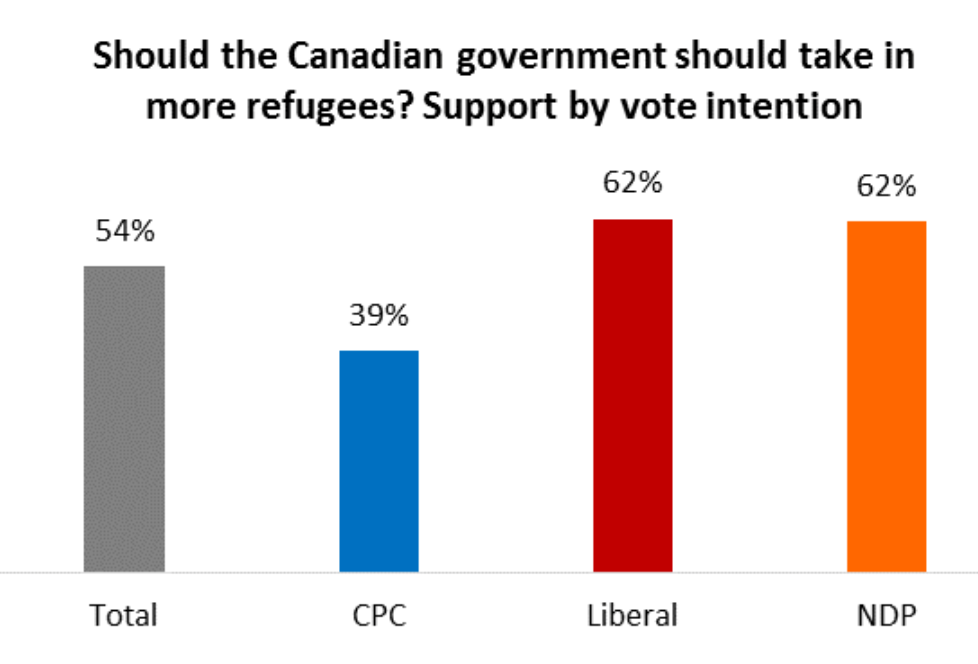
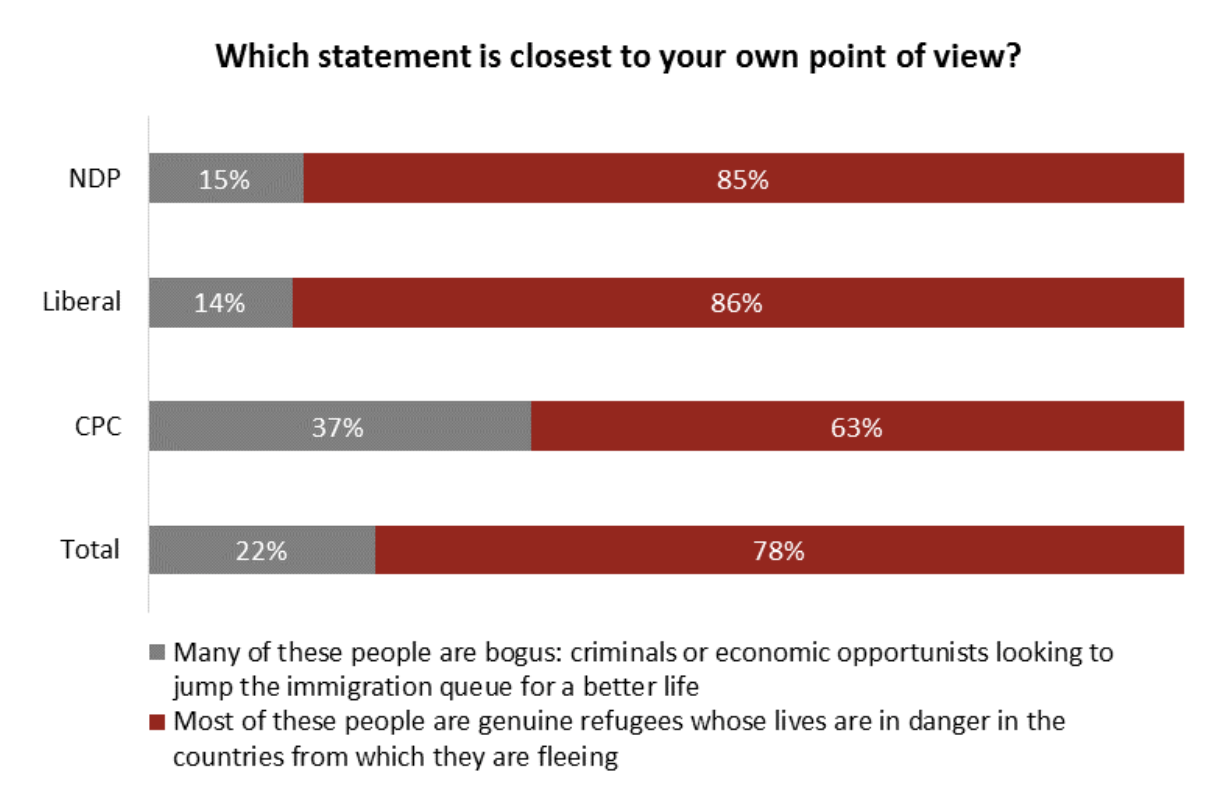
Bogus_refugees_or_notAngus-Reid conducted a useful poll, breaking down opinion by party affiliation, showing the Government’s position is aligned to the Conservative party base and messaging of “bogus refugees”, with the overall key findings being (all parties):

  • Overall, most Canadians (70%) say Canada has a role to play in the migrant crisis, but are divided on increasing the number of refugees the government sponsors and resettles here, and on seeing government spend more to make it happen. (54% and 51% support each, respectively)
  • A significant gender difference exists on whether the people fleeing to Europe from the Middle East are seen as “genuine”: Canadian men are twice as likely as women to say the migrants are “bogus”
  • As to what exactly this country should do, Canadians are most supportive of sending medical and armed forces professionals into the affected European countries areas to assist refugees, divided on taking more refugees and least supportive of “doing nothing”

Canadians divided along political lines over whether to accept thousands of refugees in current crisis
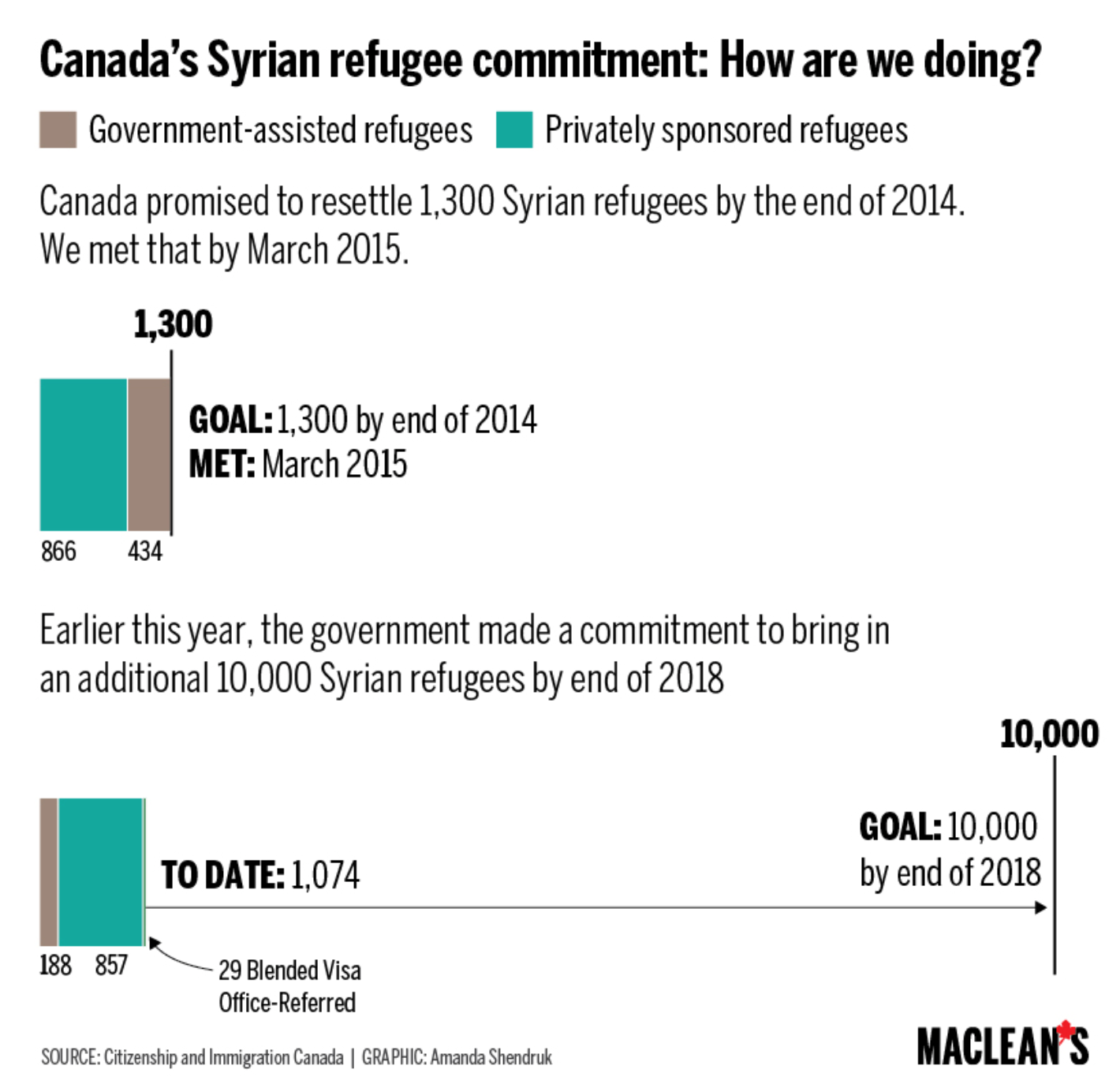
How has Canada fared on resettling Syrian refugees? And government not releasing information.

On how the Government avoids providing information that the public is entitled to:

It was clear, though, that the government had details about the number of arrivals on hand throughout the process. In December 2014, Alexander tabled in the House of Commons a written response to a question by NDP MP Paul Dewar indicating, as of three weeks previous, how many Syrian refugees had arrived and, of those, how many were privately sponsored and how many came with government assistance.

Alexander or his spokesman also made public statements in December and January updating these figures.

It stands to reason, then, that the government knows how many of the 10,000 promised spaces for Syrian refugees have so far been filled. They just won’t say.

Earlier this month, a spokesperson for Citizenship and Immigration (CIC) told me the information was “not available publicly.” The email from CIC went on to provide a link to make a request under the Access to Information Act.

This act is one of those creatively named pieces of legislation that don’t mean what their titles suggest they should. You file a request; weeks, months or sometimes years pass. What you finally receive is heavily redacted. Eventually, you stop asking. If it didn’t suggest such boggling cynicism on the part of the government, I’d swear that was the point.

I decided to play along and filed a request asking how many Syrian and Iraqi refugees have arrived in Canada since January, how many are privately sponsored, and how many came with government assistance.

Today I received a letter from CIC’s Access to Information and Privacy Division, informing me that the information I sought is excluded from the act because it concerned “published material or material available for purchase by the public.”

The letter continued: “Regulation 314 of the Immigration and Refugee Protection Regulations (attached) allows for the production of customized reports for immigration statistical data that have not been published by the Department.”

That’s right: I could buy my answer. The attached regulation informed me that the cost of processing my application for data would be $100 for the first 10 minutes or less of access to the department’s database, plus $30 for each additional minute or less of access.

Or maybe Chris Alexander could publicize that information, because he made a promise, and Canadians have a right to know what progress he’s made toward keeping it.

Given the Minister’s performance on Power and Politics Wednesday, he would be well advised to follow Petrou’s advice.

Source: How has Canada fared on resettling Syrian refugees? – Macleans.ca

Canada vows to accept 13,000 more refugees from Syria and Iraq

Good commitment – finally, now the challenge will be in implementation:

Canada has already accepted 20,000 Iraqis and since mid-2013 has brought 1,060 Syrian refugees to Canada. Total approvals for resettled Syrian refugees now exceed 1,275, with thousands more applications still being processed. This number doesn’t include the many more Syrians who’ve been accepted as refugees after making “inland claims” from within Canada.

The government also announced another $90-million in humanitarian assistance for people affected by the intensifying violence in both Iraq and Syria, home to a long-running civil war as well as battles between Islamic jihadis and government forces. The assistance will be distributed via UN agencies, the Red Cross and aid groups.

Mr. Alexander said the 10,000 new Syrian refugees will be resettled in Canada through both government and private-organization sponsorship. He said he expects roughly 60 per cent will be supported by private sponsors such as church groups and 40 per cent through government arrangements – “roughly the same proportions we’ve always had.”

Refugee sponsor groups said it will be a huge task to help 6,000, or 60 per cent of Syrian refugees, settle in Canada over 36 months. This is on top of the 3,000 additional Iraqi refugees Canada is now accepting.

Some said they hadn’t been officially informed of the proportion that private sponsors are expected to shoulder.

“Over three years, it will be probably on the edge of possible,” Alexandra Kotyk, director of sponsorship at AURA, a charitable organization representing the Anglican Diocese of Toronto and the Toronto Conference of the United Church of Canada.

I have less of an issue than some critics on the issue of need and possible preference given to Christian refugees, as it is hard to argue that Christians, and other minorities, are not likely at more risk than others.

Canada vows to accept 13,000 more refugees from Syria and Iraq – The Globe and Mail.

UNHCR counting on Canada to increase commitment to Syrian refugees

Will Canada respond? Will Canada meet its existing commitment?:

“Canada is a very important country to the UNHCR not only for the support it gives to refugee programs but also for the leadership that it provides in terms of international standards of global protection,” De Angelis said.

“This is another occasion for countries who have a leading role in global refugee protection to really show their strength.

”The UNHCR is making a pitch at meetings in Geneva on Tuesday for countries to help resettle more than 100,000 refugees from the Syrian civil war over the next two years.

The plea follows formal requests that began in 2013 for direct help getting some of the most vulnerable people out of refugee camps in Turkey, Lebanon, Jordan, Iraq and Egypt.

That year, Canada agreed to take in 1,300 refugees.

Private sponsorship groups were allotted 1,100 spots and the government agreed to directly resettle the rest.

While the government’s promise to settle 200 people has been met and exceeded, only 163 people being sponsored by private groups have made it to Canada as of the middle of November.

UNHCR counting on Canada to increase commitment to Syrian refugees – The Globe and Mail.

457 Syrian refugees resettled in Canada, but pledge was for 1,300

Sharp contrast between the Minister’s statements and the reality. Other countries (e.g., Sweden, with over 30,000) have done much better.

Not exactly inspiring and in keeping with best of the Canadian tradition (e.g. the Vietnamese boat people):

The document says that as of Nov. 13, 457 Syrian refugees have landed in Canada. That number includes 163 refugees sponsored by private groups and 294 sponsored by the government.

Alexander has repeatedly said more than 1,150 Syrians “have received Canada’s protection” in response to questions both inside and outside the House of Commons.

Groups working with refugees in Canada have said that figure is misleading as it likely includes Syrians who have arrived in Canada on their own and claimed asylum.

They have urged Alexander to do more to increase the number of refugees being resettled in Canada. So far, the government has only committed to 1,300 by the end of 2014.

That promise was made in July 2013 by Jason Kenney, who was then the immigration minister. Refugee sponsorship groups have warned for months the promise would be difficult to keep, given delays that already existed in processing applications.

The newly released document says the first privately sponsored refugee to land in Canada under the government’s promise only arrived in March of this year.   Another figure though, suggests there is a large number of Syrians who want to come to Canada as refugees.  It states that the immigration department received 2,343 applications for privately sponsored refugees from October 2013 to September 2014.

“It is important to note that the scale and scope of the Syrian refugee crisis will not be solved by resettlement alone,” the document said, echoing statements made by Alexander.

457 Syrian refugees resettled in Canada, but pledge was for 1,300 – Politics – CBC News.