Changing Immigrant Characteristics and Entry Earnings: StatCan Study

Key takeaway of this study: Canadian work experience makes the largest difference in short-term (less than 2 years) economic outcomes, and provides an evidence-base for policy changes that reward it (e.g., Express Entry points). In the longer-term, education and age are more significant (View):

Immigration selection policies changed significantly during the 1990s and 2000s, at least in part to improve immigrant entry earnings. After the decline in both relative (to the Canadian-born) and absolute entry earnings during the 1980s and early 1990s, there was a strong desire to improve the economic outcomes of immigrants shortly after their landing. Changes in selection policies and other factors altered immigrants’ characteristics across a number of dimensions, including demographics, source region, work experience and geographic distributions. This paper examines whether immigrants’ earnings immediately after their landing improved as a result of these changes and, if so, which characteristics contributed the most to this improvement.

Among all new immigrants, abstracting from economic cyclical variation, entry earnings—defined as earnings in the first two full years after landing—remained more or less constant throughout the 1990s and 2000s. The situation was very similar for principal applicants (PAs) in the economic class. During the 1990s, rising educational attainment at landing and the increasing share of immigrants in the economic class increased entry earnings. During the 2000s, a much more complex period in terms of immigrant selection, the factors that positively influenced immigrant entry earnings included changing distribution by immigration class, notably the rise of the Provincial Nominee Program (PNP); changing source region; and, for immigrant women, rising educational attainment at landing. These factors were offset by less favourable economic conditions in destination cities and regions in the late 2000s.

However, one factor dominated all others: the rise in the share of new immigrants who had Canadian work experience, often in high-paying jobs, prior to obtaining permanent residency. Changes in this factor tended to increase entry earnings during the 2000s far more than any other variable studied. The increase in pre-landing Canadian work experience accounted for most of the positive effect of the rise of the PNP on entry earnings during the 2000s, since the increase in work experience was heavily concentrated among provincial nominees. Furthermore, differences in pre-landing Canadian work experience between provincial nominees (with more Canadian work experience) and skilled workers (SWs) (with less) accounted for virtually all of the entry earnings advantage that the provincial nominees held over the SWs during the 2000s. While other factors, such as differences in geographic distribution (more settled in the West), educational attainment at landing, unemployment in the destination regions and cities, and source region, contributed, either in a small positive or negative manner, to the entry earnings differences between provincial nominees and SWs, their contribution paled in comparison with the pre-landing Canadian work experience factor. Once adjusted for differences in pre-landing Canadian work experience, entry earnings were virtually identical between provincial nominees and SWs. These conclusions were found for all new immigrants, as well as for PAs in the economic class, and were evident for both men and women.

It is likely that the pre-landing Canadian work experience variable used here captures at least three effects. First is the effect of Canadian work experience on earnings early in immigrants’ working life after landing. Employers appear to be more willing to remunerate such experience relative to foreign work experience. Second, this variable may also reflect a selection effect. When immigrants are selected from the pool of temporary foreign workers, they come with information regarding how well they performed in their jobs in Canada. If an employer seeks to change the status of temporary foreign workers to a permanent one, it is likely because they have done well in their jobs. Hence, much of the effect on entry earnings could be because of this selection process. Third, during the 2000s, many of the workers on temporary visas who attained permanent status worked in high-paying jobs.

Source: Changing Immigrant Characteristics and Entry Earnings
Labour Market Participation of Immigrant and Canadian-born Wives, 2006 to 2014 (StatsCan study)

A good detailed StatsCan study comparing labour market participation of immigrant and non-immigrant women with an abundance of detailed data and breakdowns.

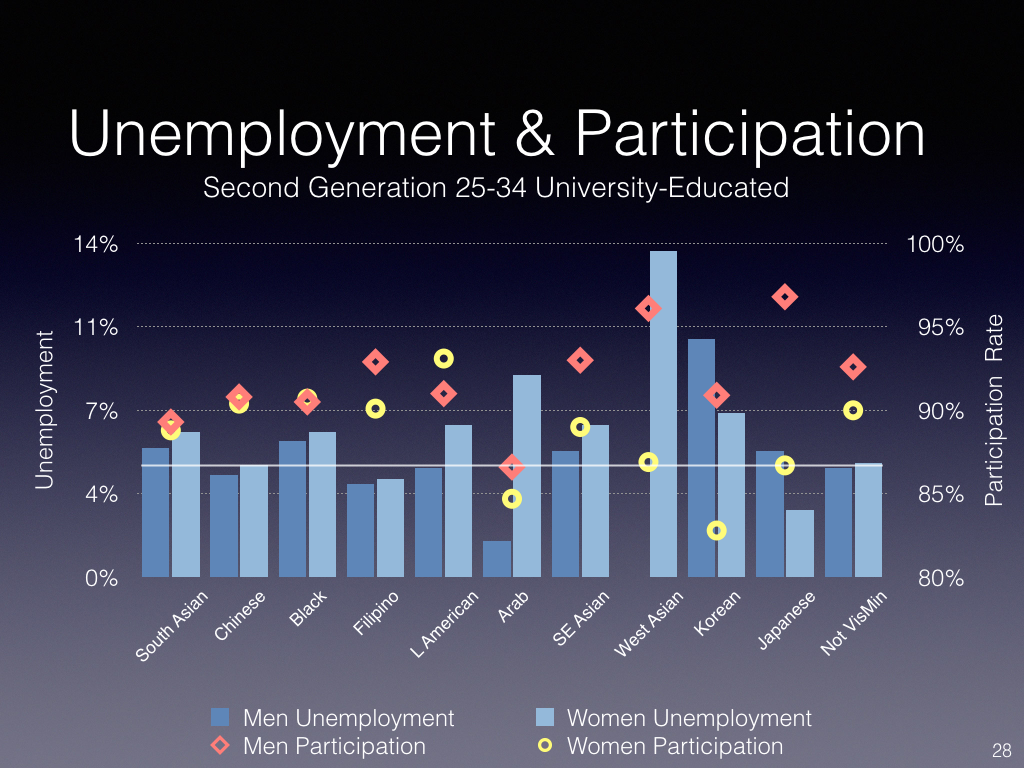
MiC Deck - Dec 2015.028The chart above compares 2011 NHS unemployment and participation rates for visible minority groups with non-visible minorities for second-generation, aged 25-34, university-educated, which shows some interesting gender differences between groups.

Summary of the StatsCan study:

Immigrant wives participate in the Canadian labour market less than do Canadian-born wives. Because this lower participation has implications for the income and living standards of immigrant families, understanding the sources of the difference is important.

This study shows that differences in socioeconomic characteristics account for about half of the difference in labour market participation between immigrant wives and their Canadian-born counterparts observed for the 2006-to-2014 period. The results indicate that female-to-male labour market participation ratios in the source country and, to a lesser extent, family size are key drivers of the difference in participation observed between the two groups of women. The lower wages received by immigrant women in the Canadian labour market appear to play a role, but their contribution is difficult to quantify.

The results raise the question of which factors country-level female-to-male labour market participation ratios capture. Frank and Hou (2015) show that these ratios remain statistically significant in models of the labour market participation of immigrant women even after source-country gender-role attitudes are controlled for. This finding suggests that these ratios capture, at least partly, other influences that affect the participation of immigrant women.

Overall, the study shows that a thorough understanding of differences in family income between immigrants and the Canadian-born requires an understanding not only of wage differences―as most Canadian studies have achieved so far―but also of differences in the labour market participation of wives.

Source: Labour Market Participation of Immigrant and Canadian-born Wives, 2006 to 2014

StatsCan to unveil new ‘efficient’ long-form census for 2016

Good example of the public service doing its job and preparing for a possible change:

When the Liberals were sworn into office in November, one of their first orders of business was to announce the reinstatement of the long-form census.

The timeline seemed very tight — the first forms are to go out to residents in the North in February.

But Marc Hamel, the census program director general, says the agency had planned for risks associated with the 2016 census. One of those risks was if a new government decided to bring back the long questionnaire.

“It had already been in the public sphere that opposition parties last year were saying, if they were elected, they would bring back the mandatory long-form census, so we had started to look at how that would be possible,” Hamel said in an interview.

The agency decided to design the questionnaire in a more adaptable format.

Rather than sending selected households separate pieces of mail with the short form and then the National Household Survey, the questionnaires were integrated into one document.

“That design was going to be efficient and it was going to work for both approaches,” said Hamel. “From that perspective, no redesign was required. We were simply able to move ahead with the same questionnaires that we had already designed for 2016.”

Also, because most Canadians fill out the census online — 64 per cent in 2011 — changing details in a computer system was not a major overhaul.

The letter that accompanies the questionnaires will allow the agency to underline that the long part is mandatory again. Census staff will also drive home the message.

Fewer people will have to fill out the long form than last time, one in four households rather than one in three with the NHS. Statistics Canada has had to print more short-form questionnaires as a result of the change.

The agency doesn’t think it will save money with fewer people getting the bigger package. It expects it will have more responses to process because of the return to the mandatory format.

The main challenge will come from adjusting to the data logistics of bringing back the long-form census. Bar codes help the agency keep track of where they drop off which forms and some of that work will have to be rejigged.

There will also be a public awareness campaign to make sure that people realize they need to fill out the forms. Hamel says the agency never really emphasizes the penalties associated with not filling out the forms — a $500 fine or up to three months in jail, or both.

“Census information is really important, and that’s where we put the focus,” said Hamel.

“What do we use the census information for, why is it important for communities, and why is it important for people to participate.”

Source: StatsCan to unveil new ‘efficient’ long-form census for 2016 – The Globe and Mail

And one of the new challenges:

Quinn Nelson wants to be counted in the 2016 long-form census, but when it comes to the question of gender identity there’s a problem: Nelson is transgender and identifies as neither male nor female.

“As a non-binary person, often when I fill out forms there’s only two options given to me and that’s not enough for me,” Nelson said in an interview on CBC’s Power & Politics.

In November, Nelson wrote an email to Navdeep Bains, the minister responsible for Statistics Canada and the census. Nelson didn’t want to violate the law by not filling out the questionnaire.

The University of Calgary sociology student also wanted to make sure Statistics Canada was going to provide an accurate reflection of the country.

The census assumes that 100 per cent of the respondents can answer that they are either male or female, “and that’s not accurate,” Nelson said.

“The census is used by a lot of policy makers, sociologists and government officials to make decisions. They really need to know what their population is. That’s the point of the census.”

….Bains hasn’t responded to Nelson, but Statistics Canada did. Deputy chief statistician Connie Graziadei said the 2016 census questionnaire had already been approved and published, but there is an option for Nelson.

“I was told to answer neither, to leave the question blank; also to answer in the comments why I found the question inadequate.”

Transgender student says some Canadians need 3rd option for gender on census

Income and mobility of immigrants, 2013

Latest from Statistics Canada. Striking that median income differences are relatively small, save for Canadian Experience Class, Skilled Workers and Provincial Nominees (above the median), Business Class below the median and below Refugees):

Employment income of immigrant taxfilers varies by the category under which they were admitted

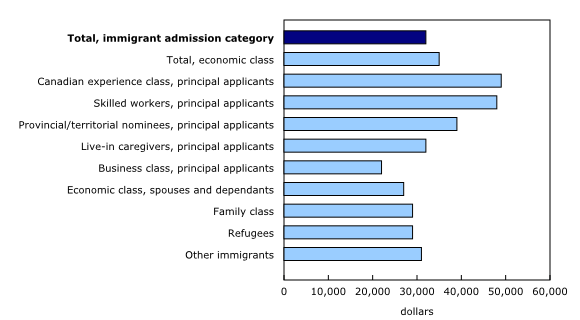
The immigrant taxfilers who landed in Canada since 1980 as principal applicants under the Canadian experience class and skilled workers categories earned more in 2013 than other immigrants. Their median employment income was estimated at $49,000 and $48,000 respectively, while it was $29,000 for those admitted under the family and refugee classes.

Chart 1  Chart 1: Median employment income of immigrant taxfilers by immigrant admission category, 2013
Median employment income of immigrant taxfilers by immigrant admission category, 2013

Chart 1: Median employment income of immigrant taxfilers by immigrant admission category, 2013

Employment income of immigrant taxfilers increases over time since landing in Canada

The median employment income of immigrant taxfilers who landed in 2003 was estimated at $15,800 in 2004 (one year after landing). For the same cohort, it increased to $26,000 in 2008 and rose to $32,000 in 2013.

The median employment income of refugees who landed in 2003 also increased over the same period. While it was $13,800 in 2004, it increased to $18,600 in 2008 and rose to $23,000 in 2013.

The retention of immigrant taxfilers is lower in the Atlantic provinces than in other provinces

In 2013, 91% of immigrant taxfilers who had landed one year earlier filed taxes in their province of landing. The proportions were the highest in Alberta (96%) and Ontario (94%). The Atlantic provinces had lower retention: 79% in Nova Scotia, 70% in New Brunswick, 68% in Newfoundland and Labrador and 43% in Prince Edward Island.

Source: The Daily — Income and mobility of immigrants, 2013

Regional differences in the educational outcomes of young immigrants

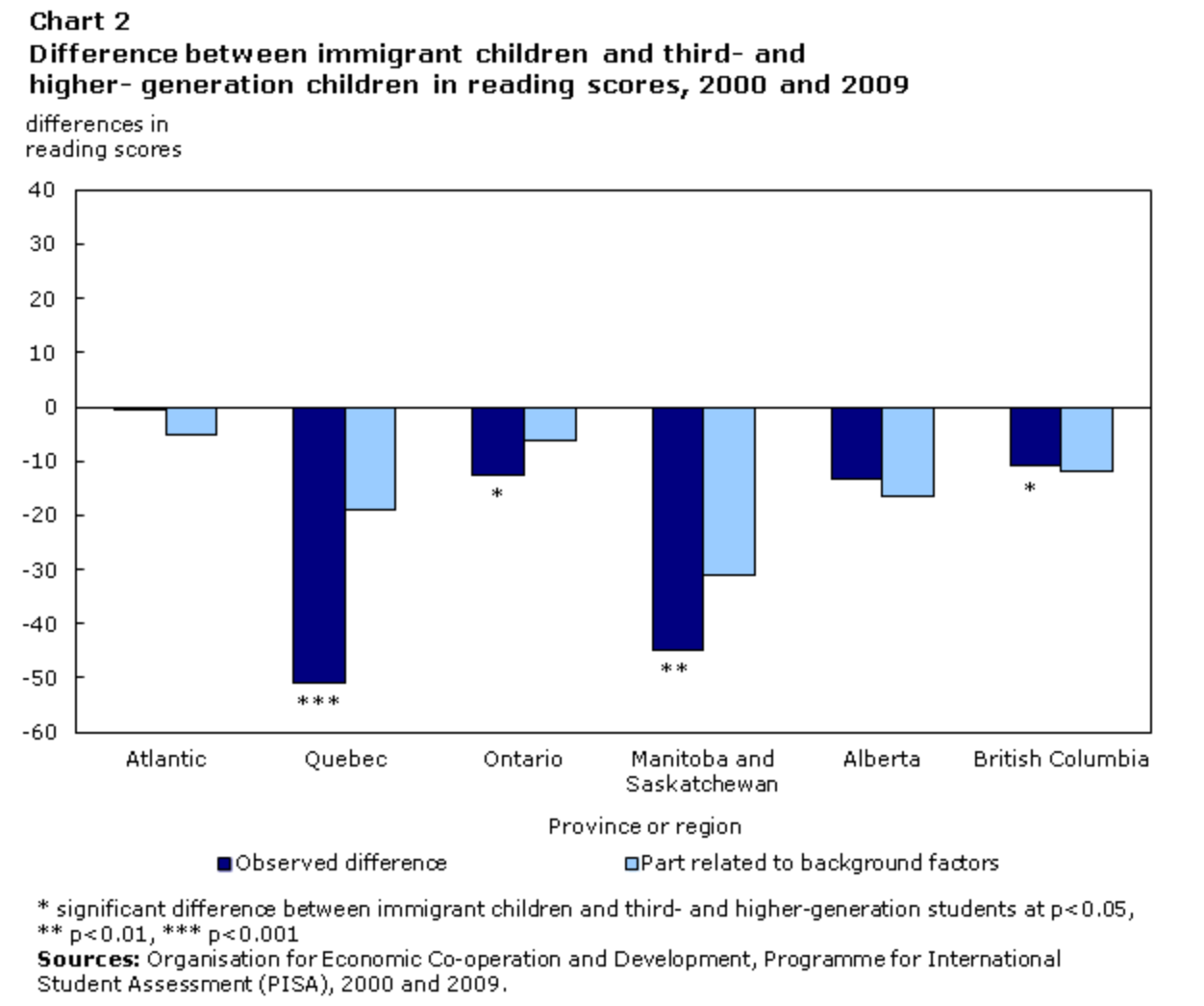
Immigrant Math Scores by RegionInteresting study comparing the educational outcomes of immigrant children and third-generation or more Canadians. The findings regarding Quebec are particularly worrisome, given implications for longer-term integration:


This article examines regional differences in the math and reading skills of immigrant children aged 15 based on data from the Programme for International Student Assessment (PISA). It also examines regional differences in high-school and university completion rates among young immigrants who came to Canada before the age of 15 using National Household Survey (NHS) data. Throughout the article, comparisons are made with the children of the Canadian-born (third- or higher-generation Canadians).

  • In Canada, the average PISA math score of immigrant students aged 15 was similar to the score of third- or higher-generation students. The average PISA reading score of immigrant children was slightly lower than the score of third- or higher-generation children.
  • In almost all regions, immigrant students had lower PISA reading scores than third- or higher-generation students. With respect to PISA math scores, immigrant students performed better than third- or higher-generation students in the Atlantic provinces and British Colombia, but performed less well in Quebec and in Manitoba and Saskatchewan.
  • Young immigrants aged 20 to 24 were more likely to have a high school diploma than their third- or higher-generation counterparts (93% versus 87%). Young immigrants aged 25 to 29 were also more likely to have a university degree (40%, compared with 26% of third- or higher-generation individuals in this age group).
  • Manitoba and Saskatchewan (29%) and Quebec (32%) had the lowest proportions of immigrants aged 25 to 29 with a university degree. In contrast, British Columbia (44%) and Ontario (41%) had the highest proportions.
  • Regional differences in the source countries of immigrants explained, in part, why some regions had higher university completion rates than others.

Immigrant Reading Scores by RegionSource: Regional differences in the educational outcomes of young immigrants

Long-form census could be reinstated for 2016, experts say

An early test  of the incoming Liberal government, one that looks like it could be done:

The return of the long form, promised by Justin Trudeau during the election campaign, would yield vastly more reliable data and cost less than running another national household survey, the former heads of the agency say.

“It should be possible. I am certainly very hopeful. But [the decision] needs to be done very soon. It’s an enormous logistical operation,” said Ivan Fellegi, chief statistician from 1985 to 2008.

It’s “no problem” to reintroduce the long form in time for the 2016 census, said Munir Sheikh, head of the agency from 2008 to 2010. The questions needn’t change, he said – just the instructions at the top. “All they need to do is put on the front page that this is mandatory.”

The other step is for “cabinet to approve it as a census, which they can do at any time – it would take a matter of seconds.”

Researchers are already pressing for action. “Undoing these mistakes cannot wait; the time for action is now as Statistics Canada is on the cusp of launching the 2016 census,” says a letter signed this week by 61 academics and directors of research centres, including Statscan’s former assistant director Alain Bélanger.

Issuing an immediate order in council “is the only way to implement the long form in time for the census six months from now,” they said. “This must be one of the first moves made ​​by the Liberal government of Mr. Trudeau. It would mark a clear break with the previous government and ensure that future social policies can be made on scientific grounds rather than ideological dogmatism.”

….The Liberal platform pledges to “immediately” restore the mandatory long form – and make Statistics Canada “fully independent.”

Mr. Sheikh, who resigned over the controversy in 2010, said having the agency operate at arm’s length to the government is an even more crucial step. “I would say that is more important than restoring the long-form census, because that really was the cause of the problem, that the government can interfere with Statscan on issues like this.If you have an independent agency, the census in the future wouldn’t be the cabinet or minister’s problem, it would be the chief statistician’s problem.”

Mr. Sheikh said “anyone who uses data” will benefit from the return of the census. The biggest beneficiaries would be governments at all levels, “which have to base their policies on reliable data. And then of course researchers, who use this data to determine social outcomes, the condition of households in terms of income, poverty, unemployment, the state of housing, transportation needs, the needs of ethnic minorities, language, the employment equity act. Any kind of social and economic policy issues you can think of really are related to the census.”

As well, “the census provides an anchor to all other surveys, will have much more reliable data to check all other survey results against that.”

Both former chief statisticians said the switch could save money by reducing printing costs and expenditures associated with the labour required to administer and analyze the separate household survey. The NHS was sent to about 4.5 million Canadian households while the 2006 long-form census was sent to 2.5 million dwellings. Running any census is a massive undertaking that typically takes years to plan. The total projected budget for the 2016 census – which had been planned as a mandatory short form and voluntary NHS – is $701.8-million.

Statistics Canada wouldn’t comment on whether it’s possible to make the changes in time for the 2016 census. “It’s a policy matter, and we can’t comment,” said spokesman Peter Frayne.

Other experts say it can be done. “It is inherently easier to return to a well-tested methodology” such as the traditional census, said Ian McKinnon, chair of the National Statistics Council. “If any statistical agency in the world can do it, Statistics Canada can.”

Reinstating the census “soon, both sends a signal of change of policy, and interest in basing policy on evidence – evidence-based decision-making, which I think is very healthy,” said Charles Beach, professor emeritus at Queen’s University and head of the Canadian Economics Association. Moreover, “doing something that is both cost effective and more useful, it’s an economic no-brainer.”

Source: Long-form census could be reinstated for 2016, experts say – The Globe and Mail

Social Assistance Receipt Among Refugee Claimants in Canada: Evidence from Linked Administrative Data Files

A good illustration of the benefits to evidence-based policy making by linking administrative and economic data. Bit dry analysis but essentially shows that number accessing declines with time but remains about Canadian average:

Focusing on the middle estimate [which excluded non-linked files], the receipt of SA in year t+1 among the 2005-to-2010 claimant cohorts generally ranged between 80% and 90% across family types, with rates highest among lone mothers and couples with more than two children. Similarly, the incidence of SA receipt generally ranged from about 80% to 90% across families in which the oldest member was between 19 to 24 and 55 to 64 years of age. Across provinces, the incidence of SA receipt in year t+1 was generally highest in Quebec, at over 85%, and lowest in Alberta, at under 60%.

SA receipt varied considerably across country of citizenship. Refugee claimants from countries such as Afghanistan, Colombia, the Democratic Republic of Congo, Eritrea, and Somalia all had relatively high SArates (close to or above 90%) throughout most of the study period, while  rates were lower among refugee claimants from Bangladesh, Haiti, India, and Jamaica (generally below 80%).

The rates of SA receipt tended to decline sharply in the years following the start of the refugee claim. Between years t+1 and t+2, rates fell by about 20 percentage points among most claimant cohorts, declining a further 15 percentage points between t+2 and t+3, and 10 percentage points between t+3 and t+4. By t+4, between 25% and 40% of refugee claimants received SA. However, it is important to recall that these figures pertain to the diminishing group of refugee claimants whose claims remained open up to that year. These figures are also well above the Canadian average of about 8%.

Among refugee claimant families that received SA in year t+1, the average total family income typically ranged from about $19,000 to $22,000, with SA benefits accounting for $8,000 to $11,000—or about 40% to 48%—of that total.

In aggregate terms, SA income paid to all recipients in Canada totaled $10 billion to $13 billion in most years. Given their relatively small size as a group, the dollar amount of SA paid to refugee claimant families amounted to between 1.9% and 4.4% of that total, depending on the year and on the treatment of unlinked cases.

Source: Social Assistance Receipt Among Refugee Claimants in Canada: Evidence from Linked Administrative Data Files

StatsCan takes criticism for cutting funding to LifePaths database

Another example of reduced government emphasis on evidence-based approaches:

Former Statistics Canada official Michael Wolfson is criticizing the agency’s decision to stop funding its LifePaths database, saying the program has been essential for researching the long-term impacts of policy decisions.

Mr. Wolfson, a professor at the University of Ottawa who was previously assistant chief statistician at Statistics Canada, has written a new paper on retirement adequacy, which includes comments about his disappointment over the decision to cut funding to the LifePaths database, which he has used in his own work on retirement income.

“As a result, discussion of multibillion-dollar policies – discussions that could be informed by far smaller investments in statistical infrastructure – can now be pursued in ignorance,” he writes.

Statistics Canada stopped supporting the LifePaths modelling tool at the end of 2014, which means the database is not being updated with new data.

Statistics Canada spokeswoman Nadine Lacroix said the resources required to update and maintain the model were too great, and it “was no longer feasible” to continue the program.

She said the agency is developing a new “dynamic socio-economic” modelling tool that will be structured to ensure “sustainability, efficiency and responsiveness to client needs.” Statistics Canada expects to solicit feedback from stakeholders on the proposal next year.

LifePaths is a complex modelling tool developed in the 1990s that contains data on Canadians starting from 1971. It was started during Mr. Wolfson’s time at Statistics Canada to project demographic trends for Canadians decades into the future. It was intended to help shape public policy in numerous areas – including pensions, education and health care – by modelling the impacts of various policy alternatives.

The decision to stop maintaining the model comes amid broader criticisms over cuts to Statistics Canada research, most notably the 2010 decision to eliminate the mandatory long-form census in Canada and replace it with a voluntary survey.

In an interview, Mr. Wolfson said he has not published comments critical of Statistics Canada in the past, and worries he is being disloyal to his former colleagues by speaking out now.

“But I felt it was sufficiently important that I really felt I had to do it,” he said Monday.

StatsCan takes criticism for cutting funding to LifePaths database – The Globe and Mail.

Immigrants took the brunt of recession-year turn toward self-employment

Self-EmploymentInteresting study by StatsCan on the effects of the 2008 recession and increase in self-employment:

During the recent recession in Canada, rates of self-employment increased by 3.9 per cent, while paid employment in both the private and public sectors shrank by 4.1 per cent and 1.6 per cent, respectively.

“Economic downturns do not impact all groups of workers equally. It is newcomers, particularly those recently arrived, who are more likely to lose their paid employment compared to Canadian-born workers,” says the 48-page study.

“These workers are often left to compete for low-paying, part-time and temporary types of precarious jobs to survive . . . Some workers are pushed into self-employment as a means to replace lost income from paid employment and due to the failure of government social safety nets.”

Toronto immigrants also fared worse than their Canadian counterparts in self-employment, with median income at $7,270 a year — $560 less than non-immigrants. They were also more likely to work in trade and transportation industries, while the business and professional services sectors are the most common for self-employed Canadians.

The newcomer group had a median before-tax total income including paid jobs of $17,220, compared with $25,180 for non-newcomers, though immigrant men made almost $1,000 per annum more than newcomer women.

Immigrants took the brunt of recession-year turn toward self-employment | Toronto Star.

Ending mandatory long-form census has hurt Canada – Globe Editorial

The Globe on the ideologically driven decision to cancel the Census and the private member bill to restore it:

The warnings were prophetic. The compulsory long-form census in 2006 had a 93.5 per cent response rate. The voluntary one in 2011 had a 68.6 per cent response rate, even though more surveys were sent to more homes. When the 2011 data were released, they came with prominent warnings about contamination due to “higher non-response error.” Information gathered about more than one quarter of all Canadian communities wasn’t released because too few people in those places filled out the voluntary form. Aboriginal communities were particularly underrepresented.

Think-tanks, economists, scientists and academics in Canada and around the world have dismissed the 2011 data as fatally flawed. It can’t be compared in a meaningful way with the 2006 data, because they were gathered using different methodologies. Vital research projects on issues like income, unemployment and poverty that require long-term data have been compromised. And Statistics Canada can’t provide an accurate picture of how Canadians are faring, relative to 2006, since the 2008 economic crash.

Statisticians are statisticians so we don’t have to be. If they say they need accurate, regular, comparable census, then that’s what they should get from the government. Mr. Hsu’s bill may be doomed, but it will go down fighting to reverse a decision that has harmed the country in tangible ways.

Ending mandatory long-form census has hurt Canada – The Globe and Mail.