Statscan fails to keep pace with seniors’ living arrangements

Valid concerns given the aging of the population:

In the wake of the 2016 census, researchers say they’re increasingly worried about limited data on a key segment of Canada’s booming senior population.
For the latest census distributed in May, Statistics Canada allowed administrators of nursing and retirement homes to complete a short-form census on behalf of residents. The agency also omitted the long-form census for all “collective dwellings,” which include hospitals, work camps and correctional institutions.

The move has irked some seniors and sparked calls from researchers for Statistics Canada to revise the 2021 census delivery as new models of senior living crop up.

“It’s something I’m concerned about with the aging of our population,” said Doug Norris, chief demographer at Environics Analytics and a census expert. “The data on our elderly population needs more attention than it’s gotten.”

Last year marked the first time that Canada had more people aged 65 and over – 16.1 per cent, or 5.8 million Canadians – than those 14 and under.

Without long-form results, Mr. Norris said researchers will lack crucial data about seniors’ income, ethnicity and education, among other findings. The data would be able to pinpoint demographic trends that have health implications, and shape myriad social policies, including seniors’ housing.

“Depending on the research and topic, it could be very important to include that group [of seniors], especially if you were doing anything health-related,” said Mr. Norris, who spent nearly 30 years at Statscan.

In the 2011 census, 378,000 people were counted in nursing and retirement homes classified as collective dwellings. This year, as in 2011, the short-form census – which captures age, gender, marital status and languages spoken – was distributed only to administrators of such homes.

Many questions on the long-form census, such as employment information, would not apply to seniors in nursing and retirement homes, said Geoff Bowlby, Statscan’s director-general of collection and regional services.

http://www.theglobeandmail.com/news/national/statscan-fails-to-keep-pace-with-seniors-living-arrangements/article31305272/ 

StatsCan looking for powers to make all surveys mandatory, compel data from companies

Will be interesting to see how the official opposition responds to this or whether, given the recognition by some prominent Conservatives that the arguments used to justify replacing the 2011 Census by the NHS were weak and wrong-headed, it lets this pass without comment:

Statistics Canada is privately floating the idea of new powers that would make all of its surveys mandatory by default and force certain companies to hand over requested data, such as credit card transactions and Internet search records.

Currently, the agency can ask for any information held by governments and businesses, but officials have long found it hard to get information like point-of-sale transactions that could give a more detailed and accurate picture of household spending.

The agency’s proposal would compel governments and companies to hand over information, and levy fines to discourage “unreasonable impositions” that “restrict or prevent the flow of information for statistical purposes.”

Corporate fines would depend on a company’s size and the length of any delays. The changes would also do away with the threat of jail time for anyone who refuses to fill out a mandatory survey, such as the long-form census.

The recommendations, contained in a discussion paper Statistics Canada provided to The Canadian Press, would enshrine in law the agency’s independence in deciding what data it needs and how to collect it.

New legislation to update the Statistics Act is expected to be tabled this fall, and the Liberals have promised to give Statistics Canada more freedom from government influence.

The current law permits the federal government to make unilateral changes — eliminating longitudinal studies about the Canadian population, for instance, or making the long-form census a voluntary survey, a Statcan spokesperson said.

Should the federal Liberals agree to the agency’s proposals, it would build a political wall between the government and Statistics Canada and ensure statistical decisions by the chief statistician take priority over political considerations.

StatsCan needs independence says Bains

Innovation Minister Navdeep Bains, who is responsible for Statistics Canada, said the government is still reviewing the Statistics Act. He said the government is committed to “strengthening the independence of Statistics Canada.”

“For a national statistical office to be credible, there must be a high degree of professional independence,” Bains said in a written statement.

“Canadians need to trust that their data are produced according to strict professional standards, ethics and scientific principles.”

Source: StatsCan looking for powers to make all surveys mandatory, compel data from companies – Politics – CBC News

Census response rate is 98 per cent, early calculations show

Belies the points that the Conservatives made to justify replacing the Census with the National Household Survey:

Canadians really were, it seems, enthusiastic about the census.

Statistics Canada is still calculating exact response rates, but it says early indications are that the overall response rate is 98 per cent – and about 96 per cent for the long-form census. That is higher than long-form response rates in the previous two censuses, the agency says.

“Early indications are positive,” Marc Hamel, director-general of the census program, said in an interview.

These numbers could shift up or down as results from early enumeration of Northern communities, late filers and First Nations reserves are added in, he said. “The range of error is not very high … it’s likely to move, but we’re talking most likely, at most, one percentage point.”

The census, conducted every five years, is a massive undertaking. The budget for the current census is $715.2-million and involves the temporary hiring of more than 35,000 people.

The sample size for the long-form census was increased to one in four households this year from one in five in 2006. The combination of high response rates this year and a bigger sample size will yield “incredibly precise data,” chief statistician Wayne Smith said.

He called this “probably the most successful census since 1666,” the year of the first census in what became Canada – when 3,215 inhabitants (of European background) were enumerated.

Still, there have been wrinkles – among them, Fort McMurray, Alta. The census was suspended there in May after a wildfire caused a citywide evacuation. As a result, Statscan may use administrative data (such as tax and migration records) to calculate a population count, and is still determining whether there’s time to have residents complete the long-form census so that their responses will be included in the census’s main database.

The goal is to have a portrait of the city as it was on May 1 – just before the wildfire, Mr. Hamel said.

There have been other challenges. He said some people had privacy concerns about filling out the forms online. A help line fielded more than one million calls from the public on questions such as how information will be protected.

Statscan produces two sets of response rates for the census – the initial collection rate (which should be officially tallied by September) and the final response rate, which is slightly lower as forms with too few answers are discounted. In 2006, Statscan did not produce a long-form collection response rate. But it says the final 2006 response rate was 93.8 per cent, while in 2011, when the long form was changed to a voluntary household survey, the rate was 68.6 per cent.

“From experience, the difference between the collection and final rate has always been less than one percentage point,” Statscan said. “Given this, it is safe to conclude that the 2016 rate for the long form, although not final yet, will surpass the rate for 2006.”

Source: Census response rate is 98 per cent, early calculations show – The Globe and Mail

StatsCan says government’s IT agency providing ‘slower, lower quality services’

Government IT is one of the most complex areas given the range and scale of services needed. But this report, along with the current problems with the Phoenix pay system, provides pretty compelling evidence that the officials who sold the concept – which I support – did not adequately address implementation issues.

The political level is equally to blame for not having asked the needed questions and likely for under-resourcing the initiative:

Setbacks and shortcomings at the federal government’s tech support agency could delay Statistics Canada’s release of “mission critical” information required by the Bank of Canada, Department of Finance and commercial banks, according to a report.

The document, submitted to Canada’s chief statistician Wayne Smith, is one among more than a dozen reports, drafted at Smith’s request from all of his directors general. Smith asked for the reports in an effort to fully understand the impact of Shared Services Canada (SSC) on his department.

The memos, obtained by CBC News under access to information laws, detail how yet another federal ministry is embroiled in a dispute with SSC over services standards, red tape, billing and the capacity of IT infrastructure to keep up with departmental demands.

SSC was created by the previous government to centralize and standardize information technology services in a bid to save money.

At the end of February, in the run-up to the 2016 Census, Smith shared the results of this report with Canada’s top civil servant, Privy Council clerk Michael Wernick. The correspondence is entirely redacted except for the subject line, which reads Heightened Program Risks at Statistics Canada.

“Numerous challenges in terms of reliability, timeliness, effectiveness and affordability are being experienced, impacting delivery of programs, projects and plans across all program areas,” wrote Lise Duquet, director general of the StatsCan informatics branch.

She said the savings expected from consolidating services under SSC have not materialized, pointing to how ongoing support from the IT Help Desk is now more costly than when StatsCan operated the email service.

Lack of accountability

Despite “harvesting” $38 million from Statistics Canada with the promise to upgrade IT infrastructure, Duquet said StatisCan was told it would have to cover the cost of migrating all information to new data centres — something she said the agency cannot afford without putting its programs at risk.

Governance at SSC has been identified as a problem by other departments. Duquet echoed those frustrations, “Governance is very complex and there is a lack of accountability to deliver on expected outcomes that are critical to programs.”

Another recurring theme that surfaced in the reports is that SSC can’t or won’t meet StatsCan’s IT requirements because it refuses to upgrade computer infrastructure.

Daniela Rivandra, director general of the industry statistics branch at the agency, warned of the risk of a bottleneck of processing capacity this year. “This will translate into many programs having to delay releases and not meeting legislative requirements for providing the data,” she said.

“Having to delay their release would be unprecedented and will impact the ability of key users (e.g. Bank of Canada, Department of Finance, commercial banks, etc.) of making timely decisions, translating into considerable embarrassment to the government of Canada.”

Due to the poor level of service provided by SSC, the corporate services support division decided to self-fund a unit of 3 persons to provide support to our employees and to ensure that some SSC initiatives get done.– Yves Béland, director general StatsCan operations branch

The directors general’s reports also reveal deep concerns about  branches running out of server space. Craig Kunz said the operating system on which the Consumer Price Index depends, is at an elevated risk of failure, yet SSC has frozen procurement with no apparent contingency plans.

‘Slower and lower quality service’

Telecommunications is another persistent irritant.

“Our relationship and experience with SSC with regards to telecommunications have been quite difficult to say the least,” reported Yves Béland, director general of the operations branch. “Due to the poor level of service provided by SSC, the corporate services support division decided to self-fund a unit of three persons to provide support to our employees and to ensure that some SSC initiatives get done.”

Assistant chief statistician Connie Graziadei said service is slower and lower quality, especially on the rollout of cellphones to census employees working in the field.

She described how SSC provided cellphones with the wrong area codes or “incorrect cellphone providers were sometimes assigned to a phone, making it unusable in the geography where the phone was intended to be in operation.”

In one case, an employee had an unusable phone for more than two months. A StatsCan manager sent the woman a spare phone on the Bell network, instead of Rogers. While the employee was thrilled to finally be able to do her job, a long string of emails shows SSC was more concerned about StatsCan overstepping its authority.

“You are not able to simply “re-assign” devices when there is an issue. We have procedures in place to deal with issues like Dana was having,” wrote Todd Mair of SSC on Feb. 2, 2016.

David Kudlovich of StatsCan fired back.

“Two months without a phone [is] far too long when this is the sole device they receive from SSC. Two weeks is actually far too long. There are occupational health and safety concerns when an employee doesn’t have a means of communication and the employee cannot do their job they’re hired to do,” he said.

Yet the documents show the problems continued for several more months.

Source: StatsCan says government’s IT agency providing ‘slower, lower quality services’ – Politics – CBC News

The Daily — Study: Immigrants’ initial firm allocation and earnings growth, 1999 to 2012

Immigrants’_Initial_Firm_Allocation_and_Earnings_GrowthThis study suggests limited mobility:

After arriving in Canada, immigrants whose first paid employment was in high-paying firms fared better in both the short and long-term than their counterparts whose first paid employment was in lower paying firms.

A new study uses Statistics Canada’s new Canadian Employer–Employee Dynamics Database to examine the differences in the earnings trajectories of immigrants, according to their initial allocation to low-, medium-low, or high-paying firms.

The benefit of initial employment in high-paying firms remained even after accounting for individual demographic and human capital factors.

For example, immigrant men first employed in low-paying firms earned almost $11,000 less in the first year after landing than their counterparts in high-paying firms. After 14 years in Canada, the earnings gap between these groups was $8,600 despite employment transitions during the intervening years. Similarly, the earnings difference between immigrant women initially employed in low-paying firms and those initially employed in high-paying firms was approximately $6,000 in the first year after landing and $5,500 in the 14th year after landing.

Furthermore, the returns of earnings to educational attainment and knowledge of English or French were larger in both the short and long-term among immigrants initially employed in high-paying firms than among those first employed in low-paying firms.

Source: The Daily — Study: Immigrants’ initial firm allocation and earnings growth, 1999 to 2012

The Daily — Study: Educational and labour market outcomes of childhood immigrants by admission class, 1980 to 2000

Interesting that refugees tend to do better than family class immigrants:

The educational attainment and earnings of immigrants who arrived in Canada before age 18 differ considerably by admission class.

The new study, “Educational and Labour Market Outcomes of Childhood Immigrants by Admission Class,” examines the university completion rates and annual earnings of childhood immigrants when they were aged 25 to 44 in 2011. These individuals immigrated to Canada between 1980 and 2000.

Childhood immigrants who were aged 25 to 44 at the moment of the survey and whose parents were in the business or skilled-worker class had the highest rates of university completion, with 59% of those from the business class and 50% of those from the skilled-worker class obtaining a university degree. The corresponding rate among individuals born in Canada to two Canadian-born parents was 24%.

Among childhood immigrants who were aged 25 to 44 in 2011 and who were from the family class, 21% had obtained a university degree, compared with 19% of those from the live-in caregiver class. In turn, university completion rates among childhood immigrants were 29% for those whose parents were government-assisted refugees and 32% for those whose parents were privately sponsored refugees.

Differences in university completion rates across admission classes were largely associated with differences in parental education and source region. These two factors accounted for one-third of the difference observed between childhood immigrants from the family class and those from the skilled-worker class. They also accounted for almost one-half of the difference observed between childhood immigrants from the live-in caregiver class and those from the skilled-worker class.

Annual earnings also varied considerably among childhood immigrants who were aged 25 to 44 in 2011. Those from the business class and skilled-worker class had average earnings of about $46,000 that year, similar to the earnings of individuals born in Canada to two Canadian-born parents. In turn, childhood immigrants from the family class had average earnings of $39,000, while those from the live-in caregiver class had average earnings of $34,000. Childhood immigrants whose parents were government-assisted refugees earned an average of $41,000, while those whose parents were privately sponsored refugees had average earnings of $44,000.

Differences in educational attainment and occupation accounted almost entirely for earnings differences among admission classes. Childhood immigrants in the skilled-worker and business classes were concentrated in high-paying occupations, including managerial, finance, natural science, and social science occupations.

Source: The Daily — Study: Educational and labour market outcomes of childhood immigrants by admission class, 1980 to 2000

Statistics Canada — Police-reported data on hate crime and cybercrime, 2014

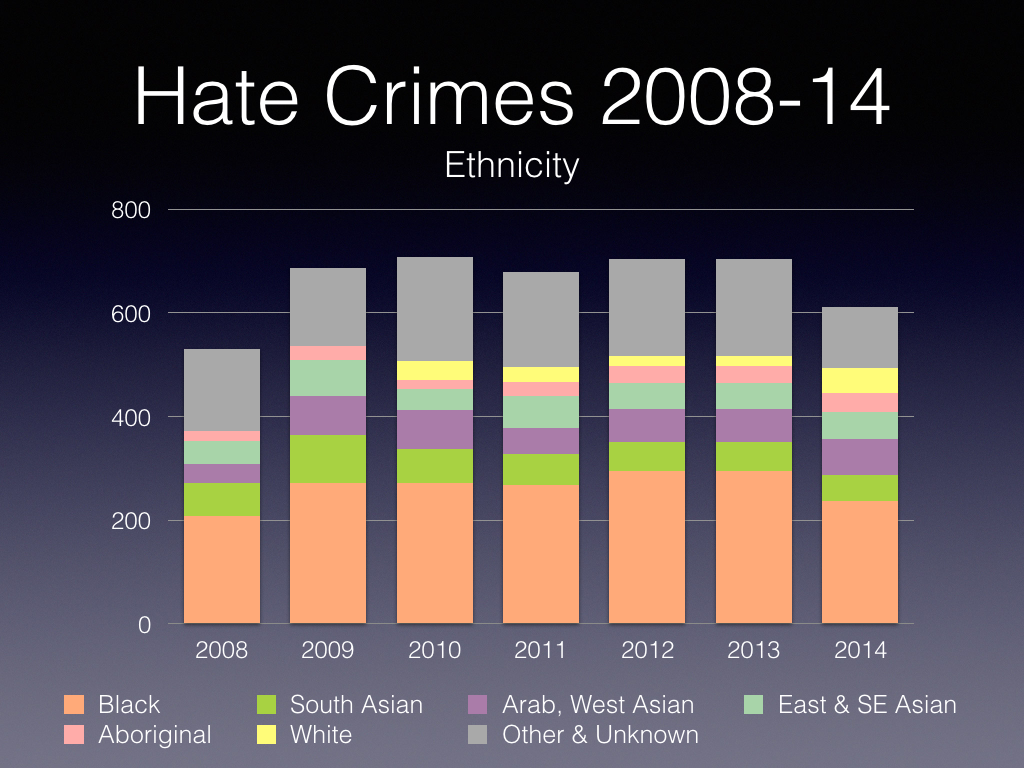
Hate Crimes Comparison.002In contrast to previous years, Statistics Canada does not provide a narrative analysis of what the current year reveals.

The chart above provides the data over the 2008-14 period, showing a slightly decreasing trend with respect to ethnicity related hate crimes and a corresponding slight increase in religion-related hate crimes. Overall numbers continue to remain largely flat at 1,295 (itself surprising given continued population growth).

About half are classified as mischief (612), with the remainder largely involving violence or threats of violence.

While Statistics Canada cautions against comparing year-to-year data, these trends over seven years are more reliable. Police-reported hate crime data tends to be more conservative than that collected by community organizations given the higher reporting burden on victims, so these figures likely under-estimate the number.

As is normal, the larger cities report more hate crimes (e.g., the GTA accounts for 26 percent, greater Montreal 8 percent, greater Vancouver 6 percent and Calgary also about 6 percent). On a per capita basis, larger cities tend to have lower rates than smaller centres. The table below lists communities with more than 10 hate crimes reported along with the per 100,000 rate:

cansim-2520091-eng-8622528054705954879_-_Police_Services_with_more_than_5_incidents

The variation in the per capita rate may reflect a variety of factors ranging from greater willingness to report hate crimes, a more aware police force as well as possible underlying differences.

The following chart confirms again that anti-Black hate is the most common form of ethnicity-related hate crimes: about 50 percent.

Hate Crimes Comparison.003

Religion-based hate crimes are captured in the following chart, showing once again that Canadian Jews are the most targeted. However, in 2014, the relative share for Canadian Jews declined from being in the mid-to-high 50 percent range to just under 50 percent, with hate crimes against Canadian Muslims showing significant increases in the last two years, reaching 23 percent of all religious hate crimes in 2014.

Hate Crimes Comparison.004It remains to be seen how the events of 2015 and some of the language used by the previous government in the lead-up to and during the election campaign affects this trend in next year’s report.

Source: The Daily — Police-reported data on hate crime and cybercrime, 2014

Study likely to fuel debate on foreign home buyers

One of the small, low-cost, but important initiatives in the budget, along with some estimates from economists regarding the extent of the issue. Better data means better decisions:

New funding from Ottawa to help remedy what economists call an “astonishing lack of data” about international investment in Canadian real estate amounts to less than the down payment on an average detached house in Vancouver, despite signs the country’s most expensive housing markets are witnessing a significant influx of foreign buyers.

Responding to Tuesday’s federal budget, National Bank of Canada economists Peter Routledge, Parham Fini and Paul Poon estimate that the Liberal government’s promise of $500,000 for Statistics Canada to study the issue of foreign investment in the housing market amounts to just 27.5 per cent of the average $1.8-million price of a detached home in the Greater Vancouver Area. (It equates to just 18 per cent of the $2.87-million average price of a detached house in the City of Vancouver, or less than the required minimum 20-per-cent down payment.)

Still, they say the funding, enough for Statscan to spend one year examining ways to collect data on international buyers, is a welcome change to help address what has become a “politically delicate” issue in a country that prides itself on having an open economy and immigration system.

In an analysis that is likely to add fuel to that political debate, the economists conducted their own research showing that as many as one-third of all home purchases in the Vancouver region last year and 14 per cent in Toronto came from buyers in China.

Without any Canadian-specific data on foreign investors to go on, the economists came up with their estimates by extrapolating from two international surveys of realtors and buyers.

One is an annual report on the level of foreign home-buyer investment by the National Association of Realtors, based on surveys of real estate agents in the United States. It estimates that Chinese investors bought $28.6-billion (U.S.) of real estate in the U.S. housing market between March, 2014, and March, 2015, a seven-fold increase from the $4.1-billion they spent in 2009.

The second is a multiple-choice survey by the Financial Times of 77 wealthy Chinese investors who had bought real estate outside of China. Of those, 33.5 per cent said they bought homes in United States, while 11.7 per cent invested in Vancouver and 8.3 per cent in Toronto.

Combining the two surveys, the economists estimate that Chinese investors spent roughly $9-billion (Canadian) on home sales in the Greater Toronto Area last year, or 14 per cent of all total sales volume in the region.

In the Greater Vancouver Area, they estimate Chinese investors spent $12.7-billion – or 33 per cent of total sales. That figure, they say, lines up with research from B.C. urban planner Andy Yan, who found that 66 per cent of all sales of 172 detached homes in three west-side Vancouver neighbourhoods within a six-month period were to buyers with non-Anglicized Chinese names.

The economists admit their survey is somewhat unscientific, but say such attempts highlight the importance of collecting better data on the influence of foreign investment, and even immigration, on housing market affordability.

Source: Study likely to fuel debate on foreign home buyers – The Globe and Mail

The Daily — Study: Immigration, business ownership and employment in Canada, 2001 to 2010

Another interesting and useful study (see the earlier Immigrants took the brunt of recession-year turn toward self-employment):

Immigrants who have been in Canada for more than 10 years have higher rates of private incorporated business ownership than individuals born in Canada. However, the types of businesses owned by immigrants tend to employ fewer paid workers than those owned by individuals born in Canada, according to a new study.

Rates of business ownership are relatively low among immigrants during their initial years in Canada, but, over time, these rates surpass those for individuals born in Canada.

Among immigrant taxfilers who had been in Canada for 10 to 30 years in 2010, about 6% were owners of private incorporated businesses that employed paid workers. This compares with about 5% of Canadian-born taxfilers. But, while immigrant-owned private incorporated businesses employed, on average, about four paid workers, those owned by Canadian-born individuals had about seven paid workers.

Of all immigrant-owned private incorporated businesses, 45% were located in four industries: professional, scientific and technical services; retail trade; accommodation and food services; and transportation and warehousing. One-third of private incorporated businesses owned by Canadian-born individuals were in these four industries.

The rate of unincorporated self-employment was also higher among longer-term immigrants (22%) than among individuals born in Canada (16%). When restricted to individuals who received at least one-half of their total earnings from unincorporated self-employment—defined as primary unincorporated self-employment—these rates were 12% for the longer-term immigrants and 8% for individuals born in Canada.

Immigrants who were principal applicants in the business class had the highest incidence of incorporated business ownership or primary unincorporated self-employment, with a combined rate of 40%. Among principal applicants in the economic class, the combined rate was 17%, while among both family-class immigrants and refugees, it was 15%.

Source: The Daily — Study: Immigration, business ownership and employment in Canada, 2001 to 2010

Statistics Canada: The contribution of immigration to the size and ethnocultural diversity of future cohorts of seniors

Projected_distribution_of_various_cohorts_at_age_65__by_place_of_birthNot surprising but interesting:

The aging of Canada’s population is currently related to the baby-boom cohort reaching their senior years. Subsequent cohorts will continue to sustain high populations of seniors because of declining mortality rates and higher immigration levels.

According to population projections, future cohorts of older Canadians could also be more ethnoculturally diverse, as a larger portion of them could be born outside of Canada.

Source: The Daily — Study: The contribution of immigration to the size and ethnocultural diversity of future cohorts of seniors