ICYMI: Statistics Canada findings buck trend on over-educated immigrants

Some good news:

The rate of immigrants hired in jobs they are overqualified for has dropped to the lowest rate in 20 years, says a new Statistics Canada study.

Using census data, researchers examined the educational achievements of immigrants and the educational requirements for their occupations. Overeducation or education-occupation mismatch is defined as when someone with at least a bachelor’s degree is employed in a position requiring no more than a high school education.

The 2021 census found only 26.7 per cent of recent immigrants were over-educated for their jobs, down from 31.1 per cent in 2016. Those in jobs fitting their qualifications went up to 44.4 per cent from just 40 per cent over the same five-year period.

“Selecting immigrants with high levels of education increases their chances of economic success,” said Statistics Canada in the report released on Wednesday. “Immigrants with a bachelor’s degree or higher are more adaptable to changes in the labour market and have steeper growth in employment earnings than those with a trades or high school education.”

But in reality, many immigrants with a bachelor’s degree or higher have occupations that underutilize their skills, which harm their employment income, productivity and well-being, it said.

The report attributed the progress to Canada’s job growth in high-skilled occupations between 2016 and 2021, compared to the previous 15 years, as well as reforms to the immigrant selection system in recent years that have put more emphasis on positive immigrant attributes such as Canadian education and work credentials contributing to better economic outcomes.

Census data from 2001 to 2021 showed the number of Canadians age 25 to 64 with a bachelor’s degree or higher increased to six million people from 5.2 million, with immigrants accounting for 60 per cent of that growth.

In 2021, about 55.3 per cent of recent immigrants and 39.8 per cent of established immigrants had at least a bachelor’s degree, while 32.6 per cent of their Canadian-born peers age 25 to 34 and 24.8 per cent of those age 35 to 64 had the same education level.

Canada hired more female police officers in 2022, while the number of racialized officers remained unchanged

Of note:

The representation of women in police departments across Canada continued to increase in 2022, according to a new report by Statistics Canada, while the number of racialized officers remained largely the same.

More than 2,000 police officers and nearly 1,900 recruits were hired in 2021/2022, an increase of about 900 between the categories compared to the year before, the report says.

That year, 15 per cent more female officers were hired than the year before and 16 per cent more female recruits were hired. Recruits are people training to be police officers.

Overall, women represented 23 per cent of police officers in 2022, while just eight per cent of the police force comprised racialized officers, the report says.

Number of women officers continues to increase steadily

Police services in the country have been hiring more and more women since 1986, the report notes, when data on gender was first collected. At the time, women represented less than 4 per cent of all officers in Canada.

As of May 2022, there are more than 16,000 women working in Canadian police departments, up by more than 270 compared to 2021.

Most women on the force last year held positions as constables, making up about 24 per cent of all such positions in the country.

While women still represent a slightly smaller portion of senior and nonsenior ranks (commissioned and non-commissioned), the number of officers is rising on both fronts.

In 2022, 18 per cent of senior officers were women — the highest number recorded to date.

Racialized officers continue to represent less than 10 per cent of the force

While 26.5 per cent of Canada’s population was racialized in 2021, according to census data, only eight per cent of all police officers were racialized in 2022, the report found.

The figure did not change from 2021.

The report notes efforts are underway to boost diversity and inclusion among the ranks, highlighting the importance of representing the diversity of the population among police.

Racialized recruits, training to be police officers, did increase by three percentage points compared to 2021. That year, 11 per cent of recruits were people of colour, while the same was true for 14 per cent of recruits in 2022.

In the RCMP, racialized officers made up 13 per cent of personnel. In municipal services, they made up seven per cent.

Indigenous populations, meanwhile, made up five per cent of people in Canada in 2021, and four per cent of police in 2022.

In First Nations police services, more than half of officers identified as Indigenous.

They comprised 7 per cent of the RCMP, one per cent of officers in municipal police and two per cent of those in the Sûreté du Québec and Ontario Provincial Police, the report says.

Police operating expenditures increased by 12 per cent

Across the country, police services spent $18.5 billion in 2021/2022 on operating budgets.

After factoring in inflation, operating expenditures increased by eight per cent. That amounts to $342 per person for the 2021/2022 year, the report adds.

Salaries and wages accounted for 67 per cent of expenses, benefits were 17 per cent and other operating expenditures accounted for 16 per cent of the money.

The report credits the implementation of the first collective agreement for RCMPmembers and reservists, in part, for the increase.

Since a reckoning hit police services across the country in 2020, many anti-racism advocates have called for police funding to decrease or for services to be abolished altogether.

Others have made the case for initiatives such as new body cameras, that have added funding to police, and some have called for more police in the face of growing violence, as has sometimes been the case in Toronto.

‘Police strength’ decreases despite an increase in number of officers

The number of police officers compared to the Canadian population had been relatively stable for two years, but that rate decreased in 2022, the report says.

In 2022, the rate of “police strength” was 181 officers per 100,000 population, down one per cent from 2021.

This rate decreased despite there being about 70,560 police officers in 2022 — 400 more than the year before — due to the growth in the Canadian population.

This occurred as police calls increased by 2.7 per cent, which the report points out happened as pandemic restrictions eased and fewer people stayed at home.

The report also notes that civilian employees — clerks, communications staff, managers and other administrative professionals — are making up more police employees.

Source: Canada hired more female police officers in 2022, while the number of racialized officers remained unchanged

Record jump in LGBTQ, religious hate crimes cases reported to police, with men and boys main targets

Previously reported but richer data:

A new report shows a record jump in hate crimes against the LGBTQ, Muslim and Jewish communities, prompting calls for more support for victims of the abuse.

The analysis based on police reports also showed around half of Canadians committing hate crimes had been accused of other crimes before and after those incidents.

The Statistics Canada hate crimes report notes that in 2021 there was a 64-per-cent rise in crimes against members of the LGBTQ community and a 67-per-cent increase in incidents linked to a person’s religion.

A further analysis of these police cases from 2018 to 2021 showed investigators found that two-thirds of the victims were boys and men, most of whom didn’t know the suspect – unlike victims of other crimes.

Almost half of the hate crimes cases were “violent,” including assault, harassment and uttering threats.

The number of hate crimes reported by the police, including military police, rose by 27 per cent to 3,360 in 2021 from 2,646 incidents in 2020.

Mohammed Hashim, executive director of the Canadian Race Relations Foundation and chair of the RCMP’s hate crimes task force, said the numbers are “an underrepresentation of the actual problem of hate in Canada.”

“Most people do not report hate crimes to the police mainly because they don’t have faith that anything will come of it,” he said, adding the statistics for 2022 are likely to show an even greater increase.

The Statscan report says: “Police data on hate crimes reflect only the incidents that come to the attention of police, and are classified as hate crimes.”

Just over one in five of the incidents resulted in “the laying or recommendation of charges,” the Police-Reported Hate Crime report said.

The analysis delved into who was committing the crimes and found that a cohort of almost 3,000 people are committing repeated offences. Between 2012 and 2018, 2,872 people were accused of at least one hate crime.

Just under half of them had been accused of an incident reported to the police – which may not relate to hate crimes. Fifty-four per cent came into contact with police again within three years after their “initial hate crime violation.”

The Statscan findings, published Wednesday, said after three consecutive years of decline, there was a 67-per-cent increase in reports of hate crimes based on religion.

That included a 71-per-cent jump from 2020 of hate crimes targeting Muslims, a 47-per-cent increase in hate crimes targeting Jews and a 260-per-cent surge in attacks on Catholics.

There were 423 hate crimes reported because of sexual orientation, up from the previous peak in 2019 of 265.

Tyler Boyce, executive director of the Enchante network, which includes over more than LGBTQ organizations, said the statistics were an understatement of the amount of abuse gay and lesbian people experience, and more support was needed. He expressed concern that Statscan does not track abuse directed at transgender people.

Mr. Boyce blamed the far right for fuelling a record number of attacks on members of the LGBTQ community. 

“We are seeing a rise in online hate and people are feeling emboldened to take this from an online space to in-person,” Mr. Boyce said.

Ontario had just over half of all hate crimes directed at people on the basis of sexual orientation.

Unlike other crimes, a large proportion of violent hate attacks were committed by strangers. In 3 per cent of cases, victims were killed or very badly injured. 

Based on population, members of the Jewish community were the most targeted religious group with 145 incidents per 100,000 people, followed by Muslims who experienced eight hate crime incidents per 100,000. Catholics experienced one incident per 100,000 people in 2021.

Nicole Amiel, of the Centre for Israel and Jewish Affairs, said Canadian Jews were more than 10 times more likely than other religious minorities to report being the target of a hate crime.

Fatema Abdalla, of the National Council of Canadian Muslims, said many hate crimes directed at Muslims were not reported to the police, but the council has seen a rise in people calling them for support after being attacked or abused in public.

Source: Record jump in LGBTQ, religious hate crimes cases reported to police, with men and boys main targets

Police-reported hate crime, 2020

Although numbers have been out for some time, here is the StatCan analytical note:

In the first year of the COVID-19 pandemic, police reported 2,669 hate crimes in Canada, up 37% from 2019. This marks the largest number of police-reported hate crimes since comparable data became available in 2009. In 2020, police-reported hate crimes targeting race or ethnicity almost doubled (+80%) compared with a year earlier, accounting for the vast majority of the national increase in hate crimes.

Today, Statistics Canada released a detailed analysis in the Juristat article “Police-reported hate crime in Canada, 2020” and the accompanying infographic “Infographic: Police-reported hate crime in Canada, 2020.”

The pandemic further exposed and exacerbated issues related to community safety and discrimination in Canada, including hate crime. According to a crowdsourcing initiative conducted early in the pandemic, respondents belonging to visible minority groups were three times more likely to have perceived an increase in race-based harassment or attacks compared with the rest of the population (18% vs. 6%). This difference was most pronounced among Chinese (30%), Korean (27%), and Southeast Asian (19%) participants. Furthermore, people designated as visible minorities and Indigenous peoples considered their neighbourhoods to be less safe during the pandemic.

Chart 1 
Number of police-reported hate crimes, Canada, 2009 to 2020

Chart 1: Number of police-reported hate crimes, Canada, 2009 to 2020

Hate-motivated crime rises sharply, while other crime drops

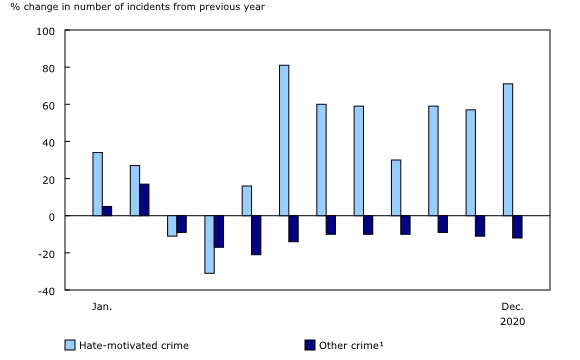
While police-reported hate crimes increased sharply, the overall police-reported crime rate (excluding traffic offences) decreased by 10% from 2019 to 2020. In the first month and a half of the pandemic, in which initial lockdown restrictions were in place, the number of police-reported hate crimes and other crimes was lower compared with the same period in 2019. From May to December 2020, however, other crimes remained lower month to month compared with 2019 (-12%), while hate-motivated crimes increased substantially (+52%).

Chart 2 
Percentage change in number of police-reported hate-motivated crimes compared with other crimes, by month of reporting, Canada, 2019 to 2020

Chart 2: Percentage change in number of police-reported hate-motivated crimes compared with other crimes, by month of reporting, Canada, 2019 to 2020

As with other crimes, self-reported data provide further insight into hate-motivated crimes as a complement to police-reported data. While the number of hate crimes rose sharply in 2020, this may still represent an underestimation. Self-reported data show that the majority of criminal incidents perceived to be motivated by hate are not reported to police. Specifically, according to the 2019 General Social Survey (GSS) on Canadians’ Safety (Victimization), Canadians were the victims of over 223,000 criminal incidents that they perceived as being motivated by hate in the 12 months that preceded the survey (3% of self-reported incidents). Approximately one in five (22%) of these incidents were reported to the police.

Most provinces and two territories report increases in hate crimes

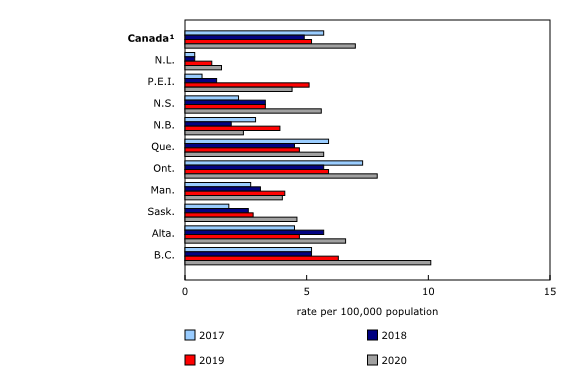
When population size is accounted for, the rate of police-reported hate crime in Canada from 2019 to 2020 rose 35% to 7.0 incidents per 100,000 population. The most notable increases in police-reported hate crime rates among the provinces were recorded in Nova Scotia (+70%; +23 incidents), British Columbia (+60%; +198 incidents), Saskatchewan (+60%; +20 incidents), Alberta (+39%; +84 incidents), and Ontario (+35%; +316 incidents). No increases were reported by Manitoba, Prince Edward Island, New Brunswick and the Northwest Territories. The relatively small population counts and number of hate crimes in the territories typically translate to more unstable rates, making year-over-year comparisons less reliable.

The rate of hate crime was highest in British Columbia (10.1 incidents per 100,000 population), Ontario (7.9 incidents per 100,000 population) and Alberta (6.6 incidents per 100,000 population).

While the majority (84%) of police-reported hate crimes in Canada occurred in large urban centres or census metropolitan areas (CMAs), rates increased the same (+35%) in CMAs and non-CMAs, which include smaller cities, small towns or rural areas.

Chart 3 
Rate of police-reported hate crimes, by province, 2017 to 2020

Chart 3: Rate of police-reported hate crimes, by province, 2017 to 2020

Non-violent and violent hate crimes up in 2020

More than half (57%) of all hate crime incidents reported by police were non-violent in 2020, while the remaining 43% were violent. These proportions were similar to recent years. Both non-violent (+41%) and violent (+32%) hate crimes increased compared with 2019, contributing fairly equally to the overall increase in hate crime in 2020.

The increase in non-violent hate crime was largely the result of more incidents of general mischief (+33%). The rise in violent hate crime was the result of more incidents of several violations, including criminal harassment (+70%), major or aggravated (level 2 and 3) assault (+58%), common assault (+23%) and uttering threats (+11%).

As is typical of police-reported hate crime historically, mischief (general mischief and mischief towards property used primarily for worship or by an identifiable group) was the most common hate crime-related offence, accounting for almost half (44%) of all hate crime incidents.

For all violent hate crimes reported by police between 2011 and 2020 and for which a victim was identified, 66% of victims were men or boys, and 34% were women or girls. Relative to other hate crime motivations, incidents targeting the Muslim population (47%) were more likely to involve women and girls. This was also the case for hate crimes targeting the Indigenous population, where 44% of victims were women or girls.

Crimes motivated by hatred of a race or ethnicity nearly double

The year 2020 was marked not only by the global pandemic, but also the rise of social movements seeking justice and racial and social equity. It is not possible to link police-reported hate crime incidents directly to particular events, but coverage and public discourse around particular issues can increase awareness and exacerbate or entice negative reactions from people who oppose the movement.

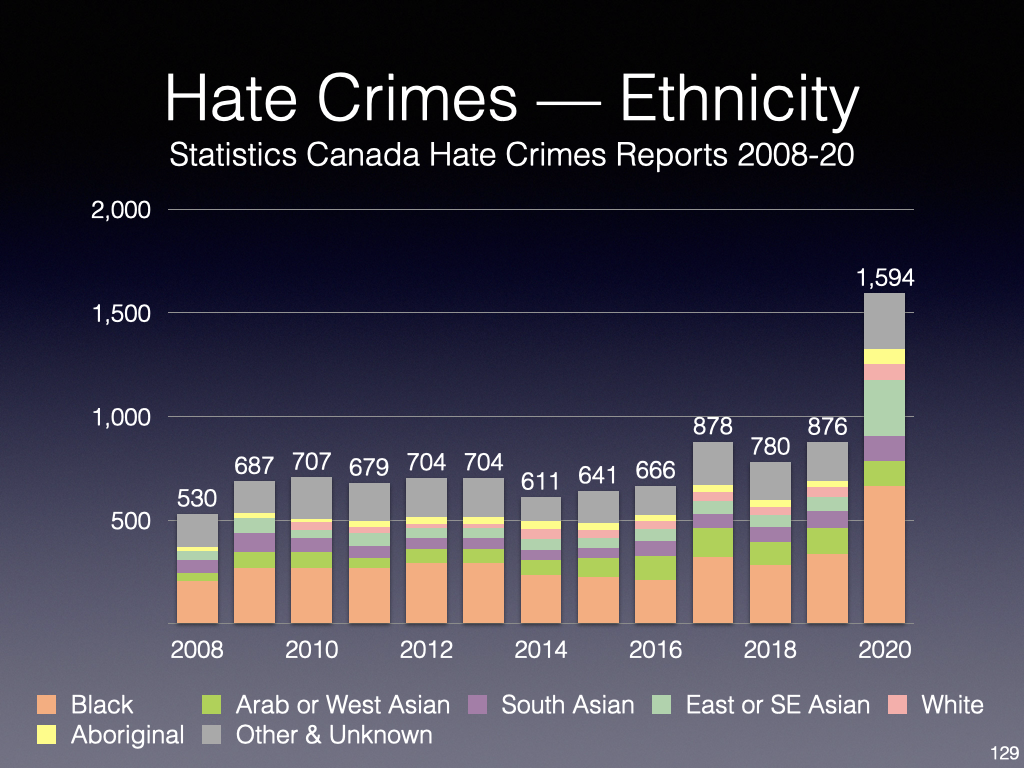
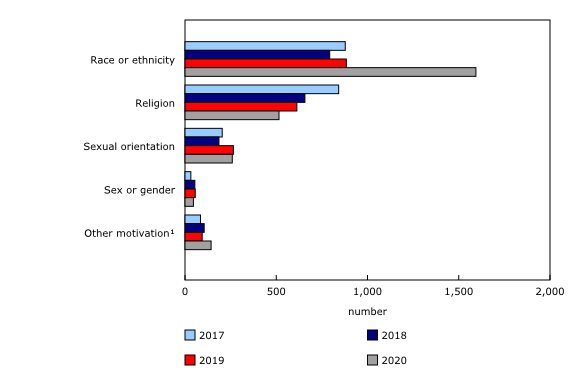
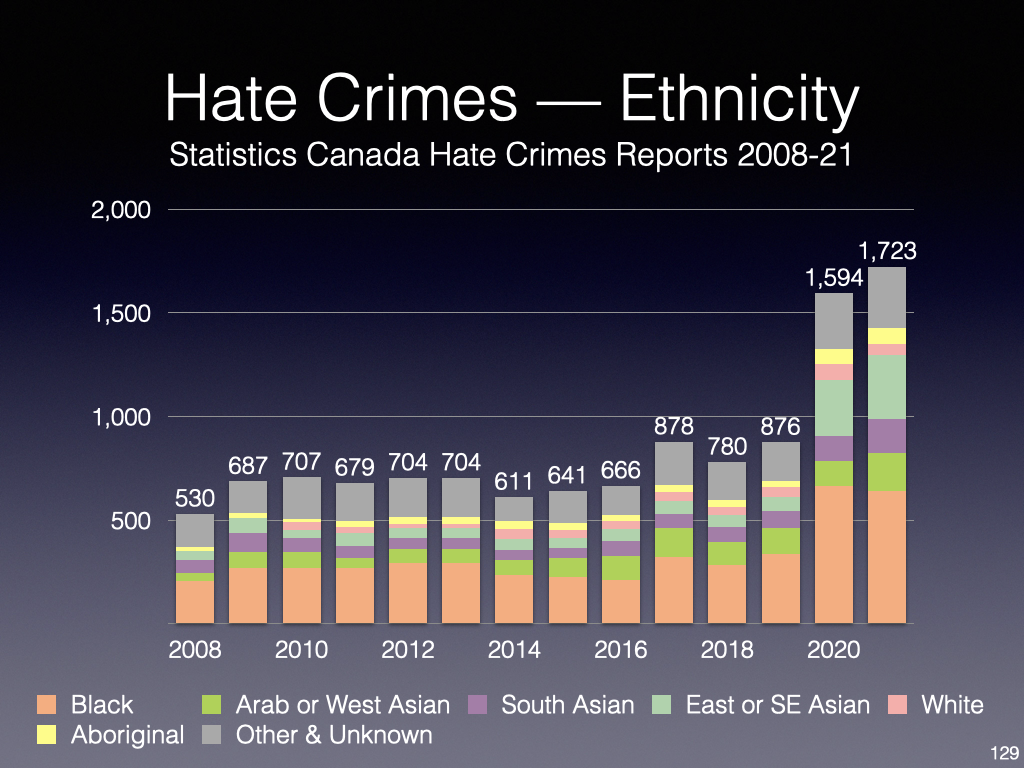
The number of police-reported hate crimes targeting race or ethnicity almost doubled (+80%) in 2020 compared with a year earlier, accounting for the vast majority of the national increase. Police reported 1,594 crimes motivated by hatred of a race or ethnicity. Much of the rise in these types of hate crimes was the result of crimes targeting the Black population (+318 incidents or +92%), the East or Southeast Asian population (+202 incidents or +301%), the Indigenous population (+44 incidents or +152%), and the South Asian population (+38 incidents or +47%). In 2020, police reported the highest number of hate crimes targeting each of these population groups since comparable data became available.

Chart 4 
Number of police-reported hate crimes, by type of motivation, Canada, 2017 to 2020

Chart 4: Number of police-reported hate crimes, by type of motivation, Canada, 2017 to 2020

Despite an increase, hate crimes targeting Indigenous populations continue to account for relatively few police-reported hate crimes

The number of police-reported hate crimes targeting Indigenous people—First Nations people, Métis or Inuit—more than doubled from 29 in 2019 to 73 in 2020. Despite the increase, incidents against Indigenous people continued to account for a relatively small proportion (3%) of police-reported hate crimes. Self-reported data indicate that rates of violent victimization among Indigenous people were more than double that among non-Indigenous people, but also showed that Indigenous people have lower confidence in police, the justice system and other institutions than their non-Indigenous counterparts. Different degrees of confidence in the police or other institutions among different populations may affect the likelihood that a particular crime is reported to the police.

Hate crimes targeting religion down for the third year in a row

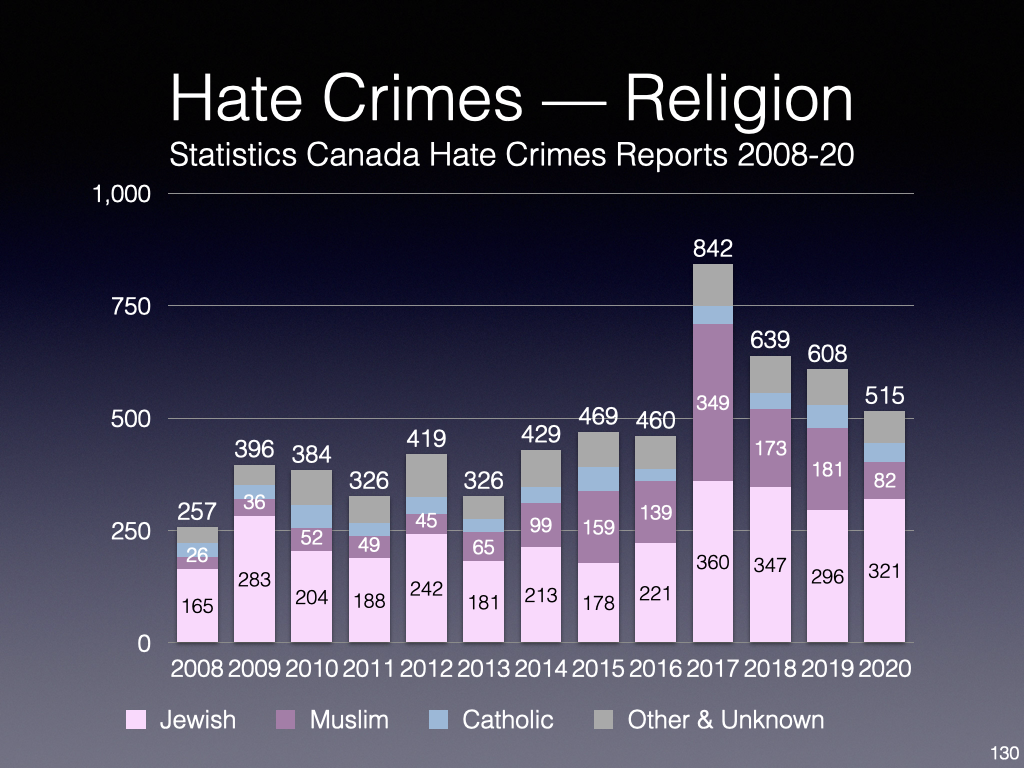
Following a peak in 2017, hate crimes targeting religion declined for the third year in a row, dropping 16% in 2020. Despite the recent declines, the 515 incidents targeting religion in 2020 remained higher than the number of incidents recorded annually prior to 2017. Among reported hate crimes targeting a religion in 2020, the Jewish and Muslim populations continued to be the most frequent targets, accounting for 62% and 16% of crimes against a religion, respectively.

These results mirror findings on self-reported discrimination from the 2019 GSS on Victimization. According to the GSS, the Jewish and Muslim populations were significantly more likely to report experiencing discrimination on the basis of their religion than most other religious affiliations.

The decrease in hate crimes targeting a religion was primarily because hate crimes targeting the Muslim population dropped by 55% in 2020, from 182 incidents to 82 incidents. Declines were mostly in Quebec (-50 incidents), Ontario (-27 incidents) and Alberta (-19 incidents).

In contrast, incidents targeting the Jewish population increased 5% in 2020, from 306 to 321 incidents. Among the provinces and territories, notable changes occurred in Ontario (+15 incidents), Quebec (+10 incidents) and Manitoba (-13 incidents).

Slight decrease in crimes motivated by hatred of a sexual orientation

According to the 2018 Survey of Safety in Public and Private Spaces, an estimated 1 million people in Canada reported their sexual orientation as lesbian, gay, bisexual, pansexual, asexual, a sexual orientation on the asexual spectrum, or a sexual orientation that is not otherwise classified. Compared with heterosexual Canadians, this population was more likely to report having been violently victimized in their lifetime and were more likely to have experienced inappropriate behaviours in public and online. At the same time, they were less likely to report being physically assaulted to the police.

Although the number of police-reported hate crimes targeting sexual orientation was down by 2% in 2020, the 259 incidents were the second highest reported since comparable data have been available since 2009. About 8 in 10 (81%) of these crimes specifically targeted the gay and lesbian community, while the remainder targeted the bisexual orientation (2%) and other sexual orientations, such as asexual, pansexual or other non-heterosexual orientations (9%). An additional 7% were incidents where the targeted sexual orientation was reported as unknown.

As was the case in previous years, violent crimes accounted for almost 6 in 10 (58%) hate crimes targeting a sexual orientation. In comparison, one-fifth (20%) of hate crimes targeting religion and less than half (47%) of those targeting race or ethnicity were violent.

Source: Police-reported hate crime, 2020

ICYMI: Women in executive roles make 56 per cent less than men, study shows

Of interest:

Women executives earned about 56 per cent less on average than men executives and this pay gap widened even further for racialized women, who earned about 32 per cent less than non-visible minority women, according to a new study from Statistics Canada that underscores the sweeping disparities in Corporate Canada.

Translated into dollar figures, there was a $600,000 difference between the average woman executive’s income ($495,600) and the average executive man’s ($1.1-million). The average compensation for visible minority women was $347,100, while visible minority men took home $681,900.

DOWNLOAD CSV×

The research included data from the Corporations Returns Act, which collects financial and ownership information on mid-size to large corporations, and census information from 2016.

In unpacking the gender divide at the most senior levels, researchers looked at marital status, number of children, education, backgrounds, sector of work, job title and professional networks.

One of the study’s most shocking findings concerned the number of racialized women in executive roles. There were so few Indigenous executives – both men and women – that Statistics Canada was limited in what could be reported over concerns about violating the individuals’ privacy. About 1 per cent of executives were Indigenous, although this group represents about 4 per cent of the working population. Most of the women Indigenous executives worked at large corporations.

Over all, about one in 10 women executives identified as a visible minority. The most common groups represented were South Asian and Chinese, with fewer executives being Black and Filipino.

Paulette Senior, the president and CEO of the Canadian Women’s Foundation, said the report’s findings were extremely concerning.

“It’s worse than I thought,” she said. “This makes me wonder what have we been doing? What have decision makers been doing in addressing [these issues] – whether it’s a leaky pipeline, or who is sitting at tables during hiring. What has been going on that this is the picture in 2021?”

Statistics Canada’s findings are in keeping with an analysis that The Globe and Mail conducted as part of its Power Gap investigation, which has been examining gender inequities in the modern work force. The series found that among women in the top 1 per cent of earners, just 3 per cent were racialized. In general, women were found to be outnumbered, outranked and out-earned by almost every measure examined.

Elizabeth Richards, who co-authored the Statistics Canada paper, said one of the most intriguing findings concerned companies that operate in Canada but are American owned. The researchers found that visible minority women were five times more likely than non-visible minority women to work at one of these American-controlled companies. The same trend – to a lesser degree – was also found with visible minority men, she said.

“That’s a key takeaway,” Ms. Richards said. “That to me says there’s some more country-specific influences that maybe we don’t fully understand and we should dig into further in future research.”

The analysts also examined the family status of the executives. Women were less likely to be in a relationship – about 80 per cent of women executives were married or in a common-law relationship, compared with 90 per cent of men – or to have children. When they did have children, they had fewer of them. About 36 per cent of women executives had two or more children, while about 44 per cent of men did.

The report also found that women executives were, on average, younger than the men – 51 years old compared with 54 years old respectively.

Economist Marina Adshade, an assistant professor with the University of British Columbia, said the finding about age was interesting and perhaps a clue as to the cause of the pay gap. In her own research, she’s found that women are retiring early, perhaps before they can fully reach their potential on the corporate ladder.

Prof. Adshade said that, as a country, the focus has been on keeping women with young children in the work force – which is important – but there hasn’t been enough attention paid to what’s happening at the other end of the career spectrum.

“We are starting to lose women in the work force at 45, 55, 65,” she said. “Why are women leaving the work force? … They have other caregiving responsibilities: caring for parents, spouses, grandchildren, for example. Older women are so undervalued that literally no one wants to think about why they’re not in the work force.”

Prof. Adshade noted that the average age of a senior manager in the federal government is 53, so if women are starting to retire at 45, it’s not surprising they are underrepresented at the top.

Another rationale for the executive wage gap that has been suggested is that women’s networks are smaller. Ms. Richards said that she and her co-author Léa-Maude Longpré-Verret were interested in seeing whether this held true with their dataset – it didn’t.

“There is some previous research that suggests that being connected to more executives leads to higher pay,” Ms. Richards said, “but what we found is that women actually had more extensive networks of colleagues.”

The reason is that women were more likely to sit on large boards with more members. On average, women directors were found to be connected to 7.5 colleagues through their board positions, while men were connected to 6.7 colleagues. Women were also more likely to be connected to other women directors.

Ms. Richards said that in their report, the goal was to quantify the extent of the imbalances in as many ways as possible, but the root causes will be for someone else to explore.

“Hopefully this provides some valuable information for other researchers,” she said. “We wanted to leverage everything that we could from the analysis and share our findings, but it is preliminary and it is exploratory so we would recommend that the academic business community or other researchers continue to really provide more insights in this space.”

Source: https://www.theglobeandmail.com/canada/article-gender-and-diversity-gaps-persist-in-corporate-canada-new-statistics/

StatCan: https://www150.statcan.gc.ca/n1/pub/11f0019m/11f0019m2021005-eng.pdf

StatCan/IRCC Study: Selecting economic immigrants from among temporary foreign workers and labour market outcomes by admission programs

Another insightful data-based analysis by StatCan and IRCC, showing the importance of Canadian work experience from being former temporary foreign workers:

Canada selects economic immigrants through various programs, including the Federal Skilled Worker Program (FSWP), the Provincial Nominee Program (PNP) and the Canadian Experience Class (CEC).

Previous research has shown that the last two groups fare better in the labour market than the first one, at least in the initial years after immigration. The difference stems largely from the fact that proportionately more economic immigrants selected from the PNP and the CEC were former temporary foreign workers, according to the first study released today.

The study, titled ‘Two-step immigration selection: Why did immigrant labour market outcomes vary by admission programs?,’ shows that from 2009 to 2016, about two-thirds of immigrants selected from the PNP and essentially all immigrants selected from the CEC were former temporary foreign workers, i.e. had employment earnings in Canada before obtaining their permanent residence.

In contrast, about one-quarter of their counterparts selected from the FSWP were former temporary foreign workers.

Since having worked in Canada before obtaining one’s permanent residence is associated with higher employment incidences and earnings, the fact that a relatively high proportion of immigrants selected from the PNP and the CEC worked in Canada in the past explains to a large extent their better labour market outcomes.

For example, 93% of immigrants selected from the PNP and 95% of immigrants selected from the CEC found employment in the first full year after obtaining permanent residency. The corresponding percentage for their FSWP counterparts was substantially lower, at 80%.

The study shows that the greater propensity to have worked in Canada in the past accounts for about 40% of the 13-percentage-point difference observed between immigrants selected from the PNP and the FSWP. It also accounts for about two-thirds of the 15-percentage-point difference observed between immigrants selected from the CEC and the FSWP.

The relatively high proportion of PNP and CEC immigrants who had previous work experience in Canada also explains why these groups earn more than their FSWP counterparts. It accounts for at least 94% of the earnings differences observed between these groups, on the one hand, and immigrants selected from the FSWP, on the other hand, during the first year after immigration.

Likewise, the greater propensity to have worked in Canada in the past accounts to a large extent for the differences in employment incidences and earnings observed between the three groups, five years after immigration.

The second study, titled ‘Two-step immigration selection: Skilled work experience vs. pre-arranged jobs,’ focuses on the economic immigrants who were selected under Canada’s Express Entry system in 2015 and 2016. It compares the degree to which Canadian work experience before immigration and pre-arranged employment at the time of application predict the initial labour market outcomes of these economic immigrants.

Both Canadian work experience and pre-arranged employment are key criteria underlying Canada’s Express Entry system of economic immigration selection.

The study shows that Canadian work experience appears to be a better predictor of initial labour market outcomes than pre-arranged employment.

Economic immigrants who had pre-arranged employment displayed, in the first two years after immigration, employment incidences that were similar to those of other economic immigrants selected under the Express Entry system.

In contrast, economic immigrants who had worked in Canada before immigrating and who had received relatively high annual earnings while doing so (over $50,000 in 2017 dollars) had employment incidences that were 8 percentage points higher than those of other economic immigrants without Canadian work experience.

Canadian work experience was also a stronger predictor of initial earnings after immigration than pre-arranged employment.

Even after controlling for education, among other factors, immigrants with a pre-arranged job earned 15% more than those without a pre-arranged job in the first two years after immigration. However, immigrants who had received high earnings in Canada before immigrating earned almost twice as much as those who had no Canadian work experience.”

View or download the full reports:

Two-step Immigration Selection: Why Did Immigrant Labour Market Outcomes Vary by Admission Programs?

Two-step Immigration Selection: Skilled Work Experience vs. Pre-arranged Jobs


Hate-motivated crimes down after peaking in 2017, but still higher than in 2016

The latest numbers from StatCan:

Following a 47% increase in 2017, the number of police-reported hate crimes in Canada was down 13% in 2018, from 2,073 incidents to 1,798. Even with this decline, the number of hate crimes remains higher (with the exception of 2017) than any other year since 2009, and aligns with the upward trend observed since 2014.

The year-over-year decrease was almost entirely a result of declines in Ontario. Nationally, the number of hate crimes targeting the Muslim population fell 50% after spiking in 2017 because of large increases in Ontario and Quebec. In 2018, there were also fewer police-reported hate crimes targeting Blacks (-12%) and fewer targeting sexual orientation (-15%). Hate crimes targeting the Jewish population accounted for 19% of hate crimes in 2018, down 4% from 2017. In 2018, non-violent hate crimes (-23%) declined more than violent hate crimes (-7%).

Police data on hate-motivated crimes include only those incidents that come to the attention of police services. These data also depend on police services’ level of expertise in identifying crimes motivated by hate.

For more information on hate crime, see data tables 35-10-0066-01, 35-10-0067-01 and 35-10-0191-01.