Social Media’s Globe-Shaking Power – The New York Times

Good long read by Farhad Manjoo on the increasing influence of social media and some of the implications:

As the technology industry came to grips in the last week with the reality of a presidential election that did not go its way, many in Silicon Valley landed on the idea that widespread misinformation spread online was a primary factor in the race’s outcome.

On Monday, both Google and Facebook altered their advertising policies to explicitly prohibit sites that traffic in fake news from making money off lies. That’s very likely a worthwhile fix, even if it comes too late. The internet has loosened our collective grasp on the truth, and efforts to fight that dismaying trend are obviously worth pursuing.

Yet it would be a mistake to end this investigation at fake news. In fact, the dangers posed by fake news are just a symptom of a deeper truth now dawning on the world: With billions of people glued to Facebook, WhatsApp, WeChat, Instagram, Twitter, Weibo and other popular services, social media has become an increasingly powerful cultural and political force, to the point that its effects are now beginning to alter the course of global events.

The election of Donald J. Trump is perhaps the starkest illustration yet that across the planet, social networks are helping to fundamentally rewire human society. They have subsumed and gutted mainstream media. They have undone traditional political advantages like fund-raising and access to advertising. And they are destabilizing and replacing old-line institutions and established ways of doing things, including political parties, transnational organizations and longstanding, unspoken social prohibitions against blatant expressions of racism and xenophobia.

Most important, because these services allow people to communicate with one another more freely, they are helping to create surprisingly influential social organizations among once-marginalized groups. These ad hoc social movements range widely in form, from “alt-right” white supremacists in the United States to Brexiters in Britain to ISIS in the Middle East to the hacker collectives of Eastern Europe and Russia. But each in its own way is now wielding previously unthinkable power, resulting in unpredictable, sometimes destabilizing geopolitical spasms.

“You now have billions of people on the internet, and most of them are not that happy with the status quo,” said Ian Bremmer, the president of the Eurasia Group, a research firm that forecasts global risks. “They think their local government is authoritarian. They think they’re on the wrong side of the establishment. They’re aggrieved by identity politics and a hollowed-out middle class.”

Many factors accounted for Mr. Trump’s win: middle-class economic anxiety in the industrial Midwest; an inchoate desire for some kind of change in the national direction; and some mix of latent racism, xenophobia and sexism across the electorate. But as even Mr. Trump acknowledged in an interview with “60 Minutes” aired Sunday, social media played a determining role in the race.

In the past, Mr. Bremmer said, the concerns of Mr. Trump’s supporters might have been ignored, and his candidacy would almost certainly have foundered. After all, he was universally written off by just about every mainstream pundit, and he faced disadvantages in money, organization and access to traditional political expertise. Yet by putting out a message that resonated with people online, Mr. Trump hacked through every established political order.

“Through this new technology, people are now empowered to express their grievances and to follow people they see as echoing their grievances,” Mr. Bremmer said. “If it wasn’t for social media, I don’t see Trump winning.”

For people who like an orderly, predictable world, this is the scariest thing about Facebook; not that it may be full of lies (a problem that could potentially be fixed), but that its scope gives it real power to change history in bold, unpredictable ways.

But that’s where we are. It’s time to start recognizing that social networks actually are becoming the world-shattering forces that their boosters long promised they would be — and to be unnerved, rather than exhilarated, by the huge social changes they could uncork.

This should come as no surprise. In a way, we are now living through a kind of bizarro version of the utopia that some in tech once envisioned would be unleashed by social media.

Over much of the last decade, we have seen progressive social movements powered by the web spring up across the world. There was the Green Revolution in Iran and the Arab Spring in the Middle East and North Africa. In the United States, we saw the Occupy Wall Street movement and the #BlackLivesMatter protests.

Social networks also played a role in electoral politics — first in the ultimately unsuccessful candidacy of Howard Dean in 2003, and then in the election of the first African-American president in 2008.

Yet now those movements look like the prelude to a wider, tech-powered crackup in the global order. In Britain this year, organizing on Facebook played a major role in the once-unthinkable push to get the country to leave the European Union. In the Philippines, Rodrigo Duterte, a firebrand mayor who was vastly outspent by opponents, managed to marshal a huge army of online supporters to help him win the presidency.

The Islamic State has used social networks to recruit jihadists from around the world to fight in Iraq and Syria, as well as to inspire terrorist attacks overseas.

And in the United States, both Bernie Sanders, a socialist who ran for president as a Democrat, and Mr. Trump, who was once reviled by most members of the party he now leads, relied on online movements to shatter the political status quo.

Why is this all happening now? Clay Shirky, a professor at New York University who has studied the effects of social networks, suggested a few reasons.

One is the ubiquity of Facebook, which has reached a truly epic scale. Last month the company reported that about 1.8 billion people now log on to the service every month. Because social networks feed off the various permutations of interactions among people, they become strikingly more powerful as they grow. With about a quarter of the world’s population now on Facebook, the possibilities are staggering.

“When the technology gets boring, that’s when the crazy social effects get interesting,” Mr. Shirky said.

One of those social effects is what Mr. Shirky calls the “shifting of the Overton Window,” a term coined by the researcher Joseph P. Overton to describe the range of subjects that the mainstream media deems publicly acceptable to discuss.

From about the early 1980s until the very recent past, it was usually considered unwise for politicians to court views deemed by most of society to be out of the mainstream, things like overt calls to racial bias (there were exceptions, of course, like the Willie Horton ad). But the internet shifted that window.

“White ethnonationalism was kept at bay because of pluralistic ignorance,” Mr. Shirky said. “Every person who was sitting in their basement yelling at the TV about immigrants or was willing to say white Christians were more American than other kinds of Americans — they didn’t know how many others shared their views.”

Thanks to the internet, now each person with once-maligned views can see that he’s not alone. And when these people find one another, they can do things — create memes, publications and entire online worlds that bolster their worldview, and then break into the mainstream. The groups also become ready targets for political figures like Mr. Trump, who recognize their energy and enthusiasm and tap into it for real-world victories.

Mr. Shirky notes that the Overton Window isn’t just shifting on the right. We see it happening on the left, too. Mr. Sanders campaigned on an anti-Wall Street platform that would have been unthinkable for a Democrat just a decade ago.

Now, after Hillary Clinton’s loss, the way forward for Democrats will very likely be determined as much by collectives on Facebook as by elites in Washington — and, as a result, we’re likely to see more unlikely candidates and policy positions than we would have in the past.

The upshot is further unforeseen events. “We’re absolutely going to get more of these insurgent candidates, and more crazy social effects,” Mr. Shirky said.

Mr. Trump is just the tip of the iceberg. Prepare for interesting times.

A New Study Shows The Hilarious Differences Between American And Canadian Tweets – BuzzFeed News

A good example of using social media analysis to complement polling and other public opinion research.

Would be interesting to see whether this technique could move from the general to more specific (e.g., attitudes towards immigrants and refugees):

Linguists at McMaster University have crunched the numbers, and it turns out Canadians really are nicerand more upbeat than Americans, at least on Twitter.

Linguists at McMaster University have crunched the numbers, and it turns out Canadians really are nicer and more upbeat than Americans, at least on Twitter.

McMaster University / Via dailynews.mcmaster.ca

These two word clouds show the most commonly used words by Americans (on the left) and Canadians (on the right).

Two PhD candidates, Daniel Schmidtke and Bryor Snefjella, sorted through about three million geo-tagged tweets from 2015 to get these results.

You may notice that the American results are partially blurred, because there were so many cuss words. Still, you can make out some other favourites like “hell,” “damn,” and “hate.”

You may notice that the American results are partially blurred, because there were so many cuss words. Still, you can make out some other favourites like "hell," "damn," and "hate."

McMaster University

Yep, there’s definitely some “shit” and “ass” in there.

The Canadian cloud, meanwhile, is dominated by upbeat, positive words like “great,” “amazing,” “gorgeous,” and “favourite.”

The Canadian cloud, meanwhile, is dominated by upbeat, positive words like “great,” “amazing,” “gorgeous,” and “favourite.”

McMaster University.

Also: “habs,” “raptors,” and “leafs.”

“We could see the difference between the two countries’ tweets as soon as we created a word cloud of the findings,” Schmidtke told McMaster Daily News.

Source: A New Study Shows The Hilarious Differences Between American And Canadian Tweets – BuzzFeed News

New Canadian immigrants spend 54% more time per day on mobile devices than the national average

Yahoo_Immigrant_JourneyInteresting:

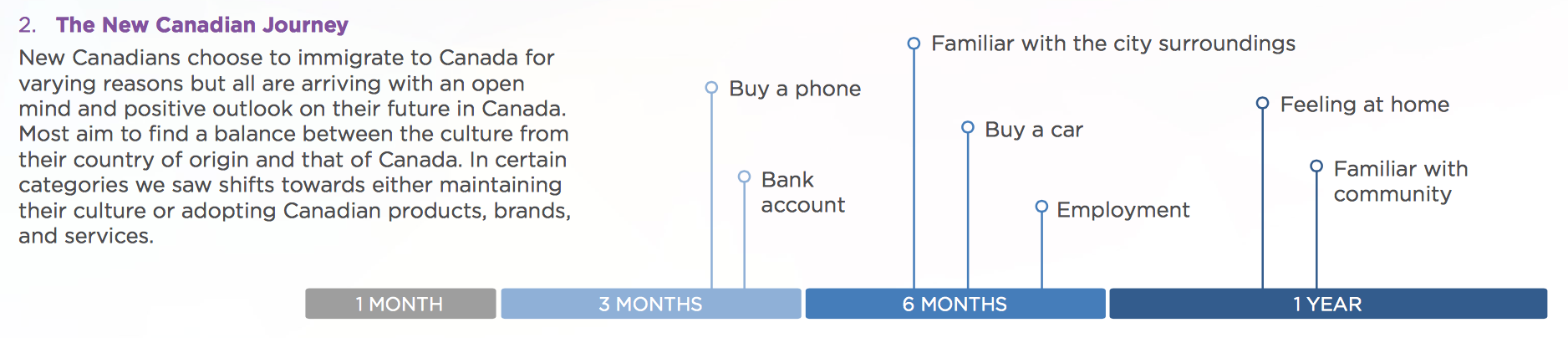
Yahoo Canada has published the results of a study it conducted on mobile usage amongst “new Canadians” – immigrants who have come to Canada in the past five years. According to Yahoo Canada, new Canadians spent four hours per day on their mobile devices, which is 54% higher than the national average of 2.6 hours per day. New Canadians also happen to spend slightly timer per day on tablets as well 1.9 hours compared to 1.5.

New Canadian immigrants spend 54% more time per day on mobile devices than the national average | MobileSyrup.com.

On LinkedIn, a Reference List You Didn’t Write – NYTimes.com

Interesting test case and a reminder of how social media is being used, and the potential impact, not to mention on the need to take care in one’s various social media profiles and activities:

In Sweet v. LinkedIn, a class-action suit filed last month in Northern California, the plaintiffs contended that LinkedIn, in providing the job reference material, enabled potential employers to “anonymously dig into the employment history of any LinkedIn member, and make hiring and firing decisions based upon the information they gather,” without ensuring that the information was accurate. This, they said, is a violation of the Fair Credit Reporting Act.

“You may never know you did not get the job based on one of these so-called references,” said James L. Davidson, one of the lawyers for the plaintiffs.

Joseph Roualdes, a spokesman for LinkedIn, says the company takes member privacy very seriously and intends to vigorously fight the lawsuit, whose claims it sees as without merit.

“A reference search, which is only available to premium account holders, simply lets a searcher locate people in their network who have worked at the same company during the same time period as a member they would like to learn more about,” Mr. Roualdes said in an email. “A reference search does not reveal any of that member’s nonpublic information.”

Whatever the suit’s merits, the case illustrates how social media sites have become an essential tool for many employers and recruiters, a productive fish bowl in which to trawl for, identify, observe and vet job candidates. It also suggests that many job seekers may be unaware of the techniques a company can use to parse the information they have publicly posted online — with possible consequences for their career prospects.

On LinkedIn, a Reference List You Didn’t Write – NYTimes.com.

Twin visions of Islamic Feminism Split Muslim Community – The Daily Beast

A good counter-point to ISIS/ISIL use of social media and how Muslim women activists are using it to press for a greater role and equality:

Fast-forward to present day and the explosive popularity of social media, which has finally given Muslim women, and Muslim feminists in particular, a resounding voice in cyberspace. “Social media has been great for Muslim feminism,” Zobair said. “It provides a space for Muslim women to speak, which is often denied particularly in sacred spheres such as mosques where the boards are all men and women are kept out of the decision-making. Sites like Twitter allow women to speak out.”

And speak out they have. Twitter hashtags such as #EmpoweredMuslimWomen and #ifKhadijacandoit, referring to the Prophet Muhammad’s first wife, a respected businesswoman and trusted advisor to the prophet in Islam’s early days, have gone viral as Muslim women have taken to social media to help shape their own discourse. Tumblr sites, such as Side Entrance, which highlights the inconsistent standards of women’s prayer spaces at mosques around the world and websites, such as Muslimah Montage, which offers a space for Muslim women to share their own personal narratives, have provided a window into how Muslim women truly feel about their place in society.

Call it Islamic feminism 2.0 – a global cyber movement where Muslim women and their male and non-Muslim feminist allies seek to drown out the critical rhetoric of both fundamentalist mouthpieces that seek to silence their Muslim sisters as well as Islamophobes that seek to reduce Muslim women to caricatures of oppression. But Islamic feminism, like its Western counterpart, is not without controversy.

Twin visions of Islamic Feminism Split Muslim Community – The Daily Beast.

Mother of fallen Canadian jihadi launches de-radicalization effort – Canada – CBC News

Good grassroots initiative led by Christianne Boudreau, mother of Damian Clairmont, and Dominique Bons, mother of Nicholas and Jean-Daniel Bons, all of whom were Western converts and were killed while fighting in Syria.

No universal strategy but the more grassroots and community level “soft” initiatives, the better, to complement the “hard” security measures. Sheema Khan also advocates a strong role for mothers (Partner with Muslims to root out extremism).

And for the mothers themselves, likely part of the grieving and healing process regarding their sons:

After sitting for hours and sharing lovingly built photo albums of their sons as little boys, parsing their lives and deaths and constantly replaying the questions about signs they saw or missed, they got to work.

Canadian-born Muslim convert Damian Clairmont left Calgary in 2012 for Syria, where he was killed in during battle against a faction of the Free Syrian Army.

The pair decided to form an international mothers group, determined that there must be a way to intervene and stop the radicalization process before it’s too late. They are sharing best practices as they find them and are both poking at their respective governments to step up.

Boudreau has also set her sights on establishing the Canadian chapter of a German group called Hayat. That means “life” in Arabic, and its aim is to work with families to help de-radicalize young men and women.

Hayat is an offshoot of a German organization called “Exit,” which has had good success in deprogramming neo-Nazis; as if plucking them from a cult. Hayat adopts similar methodology and applies it to dealing with militant Islamists.

After meeting with its organizers in Berlin, Boudreau came away convinced that with the right funding and staff, a Hayat chapter could make a difference in Canada.

“Its a sense of reining them [radicals] back in so they are closer to the family again,” she said. “They work with them closely after theyve taken a step back and decided maybe this is not for me, and help them get reintegrated within the community, finding a job, so they focus on the normalities.”

Mother of fallen Canadian jihadi launches de-radicalization effort – Canada – CBC News.

Satyamoorthy Kabilan of the Conference Board has a somewhat naive view of government and social media and its potential to reduce radicalization:

Despite the risk of individual mistakes and the required change in mindset for bureaucracy, I would also argue that the risk of not being a core part of the conversation and simply remaining mute, is far more dangerous. The benefits simply outweigh the risks.

We have recently seen successful uses of social media by authorities in emergency situations such as the 2013 Calgary flood and the tragic shootings in Moncton. Organizations like the Toronto Police Service TPS have had policies in place for some time that allow members of the force to represent the organization on social media. TPS has also been very vocal in sharing experiences. Learning from these and continuing to build a social media presence can help combat the threat of violent extremism in the virtual world. We simply cannot afford to have the extremists leading the conversation on social media.

By quickly occupying the public space around social media before someone else does, we can prevent others from setting the agenda and grant ourselves the opportunity to tell our own story first.

Hard to imagine any federal government taking such risks, let alone the current one, given the need to control messaging. One thing for local issues like the Calgary flood, another for issues related to radicalization where government will be very risk averse.

Better at the community level where there is likely more credibility than government.

To beat terrorists online, let’s raise our social media game – The Globe and Mail.

The Spiral Of Silence – Social Media « The Dish

Another angle to how social media narrows discussion and debate:

It seems counter-intuitive–if we’re getting only what Facebook things we want to get based on everything they know about us, which is a lot, shouldn’t we assume we are always among friends? But it makes sense. We’re worried about losing friends, which is to say that we’re worried our number of friends will diminish.

What’s peculiar about the Pew study is how the questions were asked. Though the survey took place in the months after Snowden’s revelations, the subjects were asked will you and would you… not did you. Using the conditional to report on behavior that already might or might not have happened tends to make the whole exercise, well, an exercise.

It turns out, too, that the spiral of silence does not only extend to individuals. Take this week’s revelation about the NSA’s Google-like search engine that shares something on the order of 850 billion data points such as private emails obtained without a warrant from ordinary American citizens among numerous government agencies. This is a big deal for many reasons, not the least of which is that it may enable the FBI or the DEA to illegally obtain evidence and cover their tracks while so doing. Yet the mainstream media almost uniformly ignored the story. When I searched ICREACH today, only the online tech media had picked it up and run with it. Is it possible that the mainstream media is afraid of losing friends, too?

The Spiral Of Silence « The Dish.

Israel, Gaza, War & Data — i ❤ data — Medium

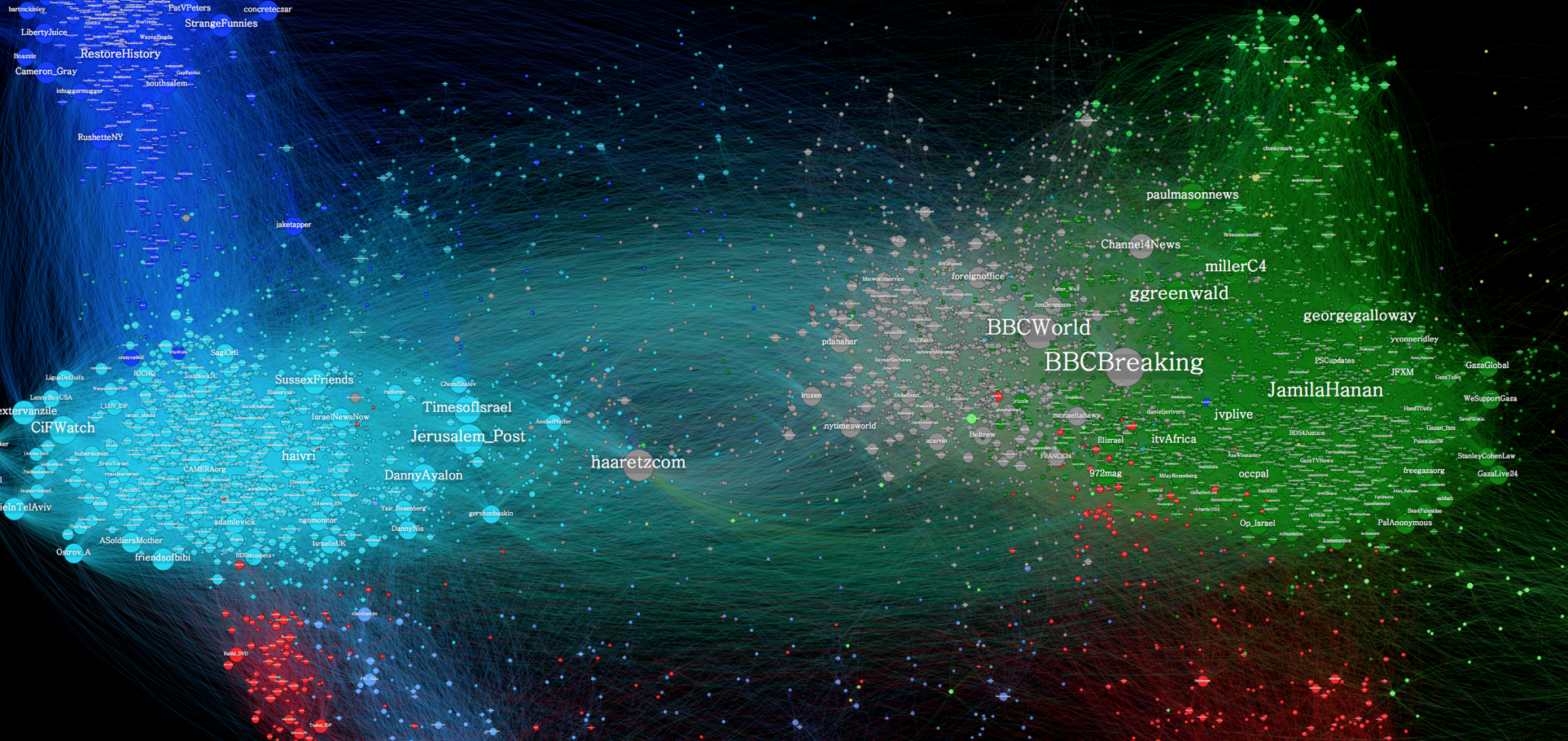
Twitter Mid-East solitudesFor data visualization geeks, as well as those more broadly interested in social networks and how they reinforce our existing views, this article by Gilad Lotan is a must read (Haaretz, the left-wing Israeli newspaper, draws the most from both sides):

Facebook’s trending pages aggregate content that are heavily shared “trending” across the platform. If you’re already logged into Facebook, you’ll see a personalized view of the trend, highlighting your friends and their views on the trend. Give it a try.

Now open a separate browser window in incognito mode Chrome: File->New Incognito Window and navigate to the same page. Since the browser has no idea who you are on Facebook, you’ll get the raw, unpersonalized feed.

How are the two different?

Personalizing Propaganda

If you’re rooting for Israel, you might have seen videos of rocket launches by Hamas adjacent to Shifa Hospital. Alternatively, if you’re pro-Palestinian, you might have seen the following report on an alleged IDF sniper who admitted on Instagram to murdering 13 Gazan children. Israelis and their proponents are likely to see IDF videos such as this one detailing arms and tunnels found within mosques passed around in their social media feeds, while Palestinian groups are likely to pass around images displaying the sheer destruction caused by IDF forces to Gazan mosques. One side sees videos of rockets intercepted in the Tel-Aviv skies, and other sees the lethal aftermath of a missile attack on a Gazan neighborhood.

The better we get at modeling user preferences, the more accurately we construct recommendation engines that fully capture user attention. In a way, we are building personalized propaganda engines that feed users content which makes them feel good and throws away the uncomfortable bits.

Worth reflecting upon. I try to have a range of news and twitter feeds to reduce the risk.

Israel, Gaza, War & Data — i ❤ data — Medium.