ICYMI: Trudeau radically overhauled the Senate — will Carney keep his reforms?

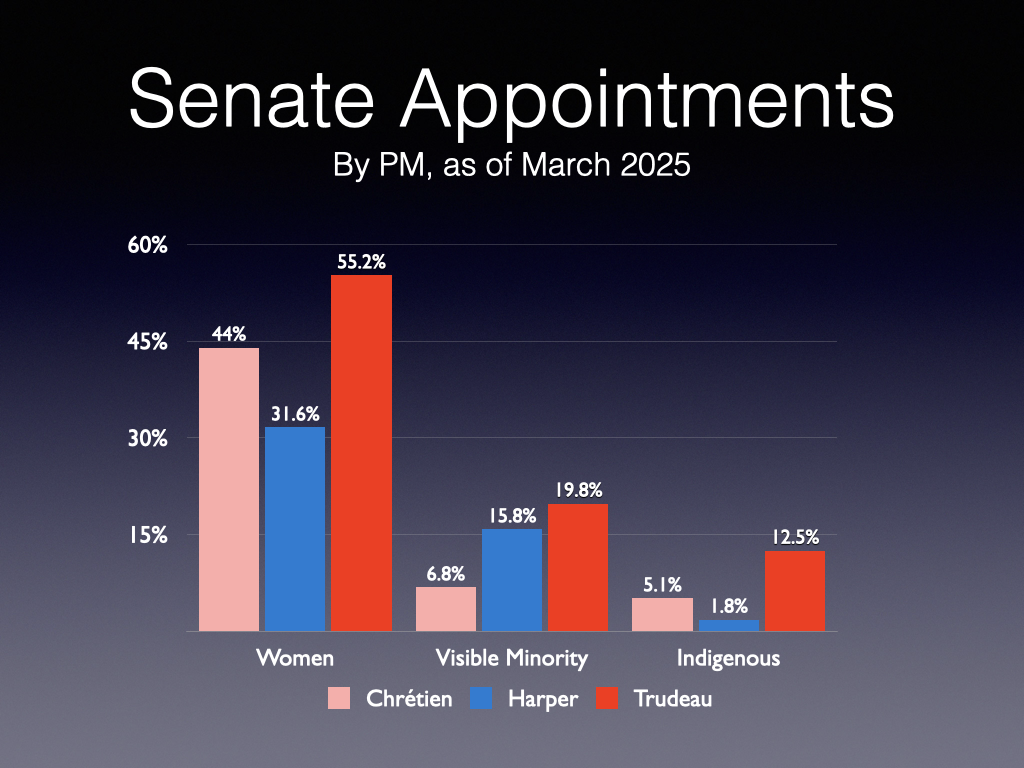
We shall see. Chart below contrasts Chrétien, Harper and Trudeau appointments:

…In an interview with CBC Radio’s The House, House leader Steve MacKinnon signalled there may indeed be more changes coming.

“I think the Senate is very much a work in progress,” he said.

“We continue to work constructively with the Senate in its current configuration and as it may evolve. I know many senators, the various groups in the Senate and others continue to offer some constructive thoughts on that.”

Asked if Carney will appoint Liberals, MacKinnon said the prime minister will name senators who are “attuned to the vagaries of public opinion, attuned to the wishes of Canadians and attuned to the agenda of the government as is reflected in the election results.”

Carney is interested in senators who “are broadly understanding of what the government’s trying to achieve,” MacKinnon said.

As to whether he’s heard about efforts to revive a Senate Liberal caucus, MacKinnon said: “I haven’t been part of any of those discussions.”

Alberta Sen. Paula Simons is a member of the Independent Senators Group, the largest in the chamber and one mostly composed of Trudeau appointees (she is one of them, appointed in 2018).

Simons said she knows the Conservatives would scrap Trudeau’s reforms at the first opportunity. What concerns her more are those Liberals who are also against the changes.

“There’s a fair bit of rumbling about standing up a Liberal caucus again. And I am unalterably opposed to that,” she said.

When the last Liberal caucus was disbanded, some of its members regrouped as the Progressive Senate Group, which now includes senators who were never Liberals.

“To unscramble that omelette, whether you’re a Liberal or a Conservative, I think would be a betrayal of everything that we’ve accomplished over the last decade,” Simons said.

“I think the Senate’s reputation has improved greatly as a result of these changes. I think the way we are able to improve legislation has also increased tenfold. It would be foolish and wasteful to reverse that.”

Still, she said there’s been pushback from some Trudeau appointees.

Senate debates are now longer, committee hearings feature more witnesses and there’s more amendments to legislation than ever before, she said.

Not to mention Independent senators can’t be whipped to vote a certain way. All of that makes the legislative process more difficult to navigate.

“Partisan Liberals don’t like the new independent Senate because they can’t control it as easily,” she said.

Marc Gold, Trudeau’s last government representative in the Senate who briefly served under Carney before retiring, said his advice to the new prime minister is to keep the Senate the way it is.

“The evolution of the Senate to a less partisan, complementary institution is a good thing. I think it’s a success, and I certainly hope that it continues,” Gold said….

Source: Trudeau radically overhauled the Senate — will Carney keep his reforms?

Le rapport sénatorial sur l’islamophobie est le fruit d’une intoxication idéologique

The Quebec laicité perspective on the recent Senate report:

Irresponsable ? Catastrophiste ? Incendiaire ? On hésite sur le bon adjectif à utiliser pour décrire le rapport sur l’islamophobie que le Comité sénatorial permanent des droits de la personne (CSPDP) vient de déposer.

Les attentats à la mosquée de Québec et de London ont profondément bouleversé les Canadiens. Tous les crimes haineux mentionnés dans le rapport sont inacceptables, et les gouvernements ont la responsabilité de les combattre et doivent tout mettre en oeuvre pour favoriser la coexistence pacifique et la sécurité de leurs citoyens. Mais amplifier indûment la menace en dépeignant un climat de terreur pour les musulmans canadiens ne peut que nuire davantage. Les chiffres de Statistique Canada infirment d’ailleurs cette thèse alarmiste. Pourquoi taire, par exemple, que les populations noire et juive sont, et de loin, davantage victimes de crimes haineux ?

Ce rapport, s’il suggère bien quelques rares mesures raisonnables, préfère brosser un tableau hideux et sans nuances de la situation des musulmans canadiens. Ils se sentiraient attaqués, des femmes et des filles auraient « peur de quitter leur domicile pour aller au travail et à l’école », certains subiraient même de l’islamophobie tous les jours.

Définition, laïcité et idéologie

C’est que la définition proposée de l’islamophobie est très large afin d’englober le plus de cas possible. Par exemple, le fait de ne pas accorder aux musulmans, dans le milieu de travail, des locaux et du temps pour les prières est considéré comme relevant de l’islamophobie, au sens de racisme antimusulman (p. 66). L’approche intersectionnelle, comme les notions d’islamophobie systémique et de micro-agressions inconscientes, permet également d’amplifier le phénomène.

Le rapport reconduit également une compréhension hautement caricaturale de la Loi sur la laïcité de l’État. Les témoins interrogés, qui confondent le respect des personnes avec le respect absolu des préceptes de l’islam, « s’entendent tous pour dire que la loi 21 est discriminatoire, qu’elle a exacerbé l’islamophobie et qu’elle devrait être abrogée » (p. 65). Elle est même accusée de « déshumaniser les personnes ». On le voit, le CSPDP n’a pas entendu comme témoin un seul des nombreux musulmans qui soutiennent la loi 21.

Le rapport évite également de penser la réalité de l’islamisme violent et la peur légitime qu’il soulève, y compris chez les musulmans. Seul Rachad Antonius, parmi les 138 témoins entendus lors des 21 séances publiques, ose en traiter expressément, mais le rapport le passera sous silence. Il n’y aurait, à entendre les autres témoins, que des préjugés et des stéréotypes à combattre à grands coups de campagnes médiatiques et de formations obligatoires contre les biais inconscients pour tous les fonctionnaires et les élèves.

Le rapport ne retient que ce qui appuie une conclusion tirée d’avance. Tout écart statistique, comme la sous-représentation des musulmans chez les fonctionnaires ou leur surreprésentation dans les prisons, est compris comme une « preuve » d’islamophobie systémique, sans qu’il y ait recherche d’une explication plus plausible. Le rapport confond également idéologie et science en prétendant, sans justification, que « la plus grande menace pour la sécurité nationale provient des groupes militant pour la suprématie blanche » (p. 50). On taira donc un document sur la stratégie antiterroriste du Canada qui précisait pourtant que « l’extrémisme islamique violent est la principale menace pour la sécurité nationale du Canada » .

Une offensive contre les institutions chargées de la sécurité

Ce sont assurément les instances responsables de la sécurité nationale qui hantent ce rapport. Cinq des 13 recommandations y sont d’ailleurs consacrées, mais vont dans le sens opposé à celui qu’on attend de la part d’un comité sénatorial crédible. C’est que ce dernier semble surtout à la remorque des recommandations du Conseil national des musulmans canadiens (CNMC), contre lesquelles nous faisions déjà une mise en garde ici.

Le CNMC ne réclame en effet rien de moins que l’interruption de la stratégie nationale de lutte contre l’extrémisme violent et la radicalisation, et la suspension de la Division de la revue et de l’analyse (DRA) de l’Agence de revenu du Canada (ARC), qui est chargée de repérer les menaces de financement du terrorisme au Canada qui s’exercent par l’entremise d’organisations caritatives. Il propose plutôt que soient scrutés les organismes de sécurité nationale, dont le Service canadien du renseignement de sécurité, et les services frontaliers du Canada, qu’il soupçonne de pratiques racistes, xénophobes, islamophobes et même de subir la « pénétration de la suprématie blanche ».

Le CSPDP approuve tout cela et affirme que « les lois, les politiques et les pratiques relatives à la sécurité nationale sont profondément ancrées dans l’islamophobie et continuent de perpétuer des préjugés à l’encontre des musulmans » (p. 51). La preuve ? Soixante-quinze pour cent des révocations d’associations caritatives posant le plus grand risque de financement du terrorisme au Canada visaient des organismes musulmans, alors que ceux-ci représentent moins de 1 % de l’ensemble des organisations caritatives (p. 57). Malgré le témoignage de Sharmila Khare (directrice générale de la Direction des organismes de bienfaisance de l’ARC), selon lequel « les vérifications de la DRA ne sont entreprises que lorsqu’il y a un risque d’abus terroriste », le rapport conclut néanmoins que la DRA « fait preuve d’un parti pris structurel à l’encontre des organismes de bienfaisance musulmans » (p. 58).

Le simple fait que le modèle d’évaluation du ministère des Finances soit axé sur le risque serait même, selon le professeur de droit Anver Emon, « une déclaration explicite d’islamophobie » . Mieux, qu’un Canadien voyageant à Gaza et combattant pour le Hamas devienne suspect pour le gouvernement serait, ajoute-t-il, un « exemple d’islamophobie systémique » ! Faut-il vraiment relever que le CSPDP perd ainsi toute crédibilité en « oubliant » que le Hamas est sur la liste des entités terroristes du Canada ? Qu’en amalgamant islam et islamisme violent sous le parapluie de l’islamophobie, il mine le sentiment de sécurité de ses citoyens ?

Comment expliquer pareille intoxication irresponsable ? Une partie de l’explication réside peut-être dans le fait que la présidente de ce comité sénatorial, Salma Ataullahjan, est toujours conseillère au CNMC. Rappelons, pour finir, que cette organisation fait partie des plaignants qui sont devant les tribunaux pour faire invalider la loi 21.

Source: Le rapport sénatorial sur l’islamophobie est le fruit d’une intoxication idéologique

Neutral coverage below:

Islamophobia remains a persistent problem in Canada and concrete action is required to reverse the growing tide of hate, says a new Senate report released Thursday.

“The evidence is clear. Islamophobia is an acute threat to Canadian Muslims and urgent action is needed,” Sen. Salma Ataullahjan, chair of the Senate human rights committee, told reporters Thursday.

“We must commit to building a more inclusive country and to better promoting our Muslim relatives and friends, neighbours and colleagues.”

The report, the first of its kind in Canada, took a year and involved 21 public meetings and 138 witnesses.

The report said the committee “was disturbed to hear that incidents of Islamophobia are a daily reality for many Muslims, that one in four Canadians do not trust Muslims and that Canada leads the G7 in terms of targeted killings of Muslims motivated by Islamophobia.”

The report’s finding that one in four Canadians do not trust Muslims comes from a submission to the committee from Maple Lodge Farms, a supplier of Halal meat in Ontario’s Peel region, which said it gathered the information from a “national survey” it conducted of 1,500 Canadians.

The submission does not provide details on how the respondents were chosen or what specific questions they were asked.

The report found that Muslim women have become the “primary targets when it comes to violence and intimidation” because they are easily recognizable from their attire. As a result, many are afraid to leave their homes for work, school or other activities.

“The profound effects of gendered Islamophobia are such that it compels certain women to consider removing their hijabs to enhance their employment opportunities,” the report said.

“Testimonies highlighted the fact that Islamophobia in the workplace is not merely the consequence of a handful of people’s actions; rather, it is a systemic issue that is widespread.”

The report said that as a result, Arab women have the highest unemployment rate of any demographic group in the country.

Sen. Mobina Jaffer, Canada’s first Muslim senator, told reporters Thursday that in 2001, not long after 9/11, she was flying from Vancouver to Ottawa with about 60 members of her family when she and her husband were singled out by airport authorities.

“Coming from a refugee background to be appointed by [former prime minister Jean] Chrétien to be a senator was a great pride for my family,” Jaffer said. “And my husband and I both were called outside. And my husband and I both had to completely undress … and I don’t wish that on anybody.”

‘A confirmation of what we have been seeing over many years’

Uthman Quick, the director of communications for the National Council of Canadian Muslims (NCCM), told CBC News that the council was satisfied to see the report highlight the poor treatment of Muslim women in Canada, which he said is a growing problem.

“I think the report is really a confirmation of what we have been seeing over many years, but particularly over the last few weeks, since October 7,” he said.

Quick said there has been an increase in the number of Islamophobic incidents reported to the NCCM since the starte of the recent conflict between Israel and Hamas, a group designated as a terrorist organization by the Canadian government and other nations.

“I am hoping the recommendations are followed through upon. Now more than ever, we can see that they are absolutely needed,” Quick said.

Islamophobia and the media

The report said that the problem can be blamed in part on negative and pervasive stereotypes of Muslims the report said have mischaracterized “concepts of sharia, jihad and hijab.”

“The recurring portrayal of Muslims in media has entrenched these stereotypes, leading them to become falsely accepted as truth,” the report said.

The report found that hate-based information being spread on social media remains a growing problem, with more than 3,000 anti-Muslim social media groups or websites active in Canada.

“The frequency of hate speech and misinformation on social media platforms such as Facebook, X (formerly Twitter) and Instagram was a common concern for [committee] witnesses,” the report said.

A written submission to the committee from Meta, Instagram and Facebook’s parent company, said its efforts to combat Islamophobia are a “work in progress.” It said it is taking steps that include monitoring hate speech and engaging with Muslim communities.

Representatives from X did not appear or make a submission to the committee.

Recommendations

The report makes a number of recommendations for the federal government:

  • Ensure mandatory, regular training on Islamophobia for all federal government employees and the judiciary.
  • Launch a multimedia campaign and educational resources on Islamophobia that can be incorporated into classrooms.
  • Provide additional money to address hate-motivated crimes.
  • Increase specific Criminal Code offences for hate-motivated crimes.
  • Review the Canadian Radio-television and Telecommunications Commission’s mandate to ensure it reflects the needs, interests and aspirations of racialized communities.
  • Introduce legislation to crack down on online hate.
  • Review national security legislation to ensure it takes Islamophobia into account.
  • Modernize the Employment Equity Act to ensure it takes Islamophobia into account.

The report also recommended the federal government introduce legislation in a number of areas to help the Canada Revenue Agency better understand the context for audits of religious organizations and provide quicker decisions on appeals.

The report said that in 2021, 144 anti-Muslim hate crimes were reported to police across the country, with an additional 1,723 crimes reported that were motivated by racial or ethnic hatred.

According to Statistics Canada data used to write the report, there were 223,000 reported cases of hate crime in general in 2020, but the report said those numbers fail to provide a complete picture of hate-motivated violence against Muslims in the country.

Mohammed Hashim, executive director of the Canadian Race Relations Foundation, is quoted in the report telling the committee that only one per cent of reported hate crimes are reported to police and only a fraction of those result in charges.

“Muslims in Canada feel like they are under attack. The psychological impact of constant fear and vigilance is a heavy burden,” the report said.

“Survivors of violent Islamophobia live with the trauma of their direct experience, while countless others live with vicarious trauma brought on by justified fear that their communities are not safe.”

Source: Senate report on Islamophobia says urgent action needed to reverse rising tide of hate
Ottawa forecasts 1.4 million international student applications a year by 2027, document shows

Hard to deny the impact such numbers would have on housing, healthcare and infrastructure pressures and the increased numbers of disillusioned students given worse economic outcomes and likely frustration for the majority who will not transition to permanent residency.

But unlikely to convince the denialisms among the various interest groups that favour higher numbers.

Good that IRCC officials are carrying out this analysis:

The number of foreign students applying to come to Canada each year is forecast by the federal immigration department to rise to 1.4 million by 2027, an internal policy document says, which also raises concerns that such growth is “unsustainable.”

Immigration, Refugees and Citizenship Canada forecast the rapid rise in the number of foreign students in a paper last month about establishing a class of “trusted” universities and colleges, which would qualify for faster processing of international student study permits.

The document, obtained by The Globe and Mail, says that from 2019 to 2022 study permit applications for overseas students have increased by nearly 300,000 a year.

“By 2027, volumes are forecasted to nearly double to 1.4 million applications per year,” it says.

The federal document was sent to a select group of universities and colleges taking part in a pilot to establish the proposed trusted-institutions framework.

The IRCC paper forecasts that applications from foreign students will reach 949,000 this year, and just over one million next year. The number is projected to rise to 1.1 million in 2025, 1.28 million in 2026 and 1.4 million in 2027.

It says a recent strategic immigration review – and a continuing review of the international students program – has raised a number of concerns including “unsustainable growth in application volumes, impacting education quality, community infrastructure, and IRCC processing capacity.”

The paper says that the rapid growth in the intake of foreign students “has disrupted processing times” for study permits to enter the country. Meanwhile universities and colleges have become “increasingly dependent” on international students for revenue, in some cases not providing international students with “a positive education experience in Canada.”

It is currently piloting metrics to determine which universities and colleges are eligible to be counted as trusted institutions. To qualify they would have to share data annually with the immigration department, including the number and percentage of international students living in university housing.

Alex Usher, founder of Higher Education Strategy Associates, said on-campus housing is often not the cheapest option and this measure could reward universities attracting the wealthiest international students

Housing Minister Sean Fraser – the former immigration minister – floated the prospect of a cap on international student numbers at the cabinet retreat in Charlottetown last month, saying the number of foreign students is putting pressure on rental markets and driving up costs. Immigration Minister Marc Miller said at the retreat that around 900,000 students are expected to enter Canada this year.

A Senate report on Canada’s international student program, published Wednesday, said that many international students are forced to live in crowded, sub-standard housing, with universities failing to provide them with accommodation, even though they pay far higher tuition fees than Canadian students and inject around $22-billion into the economy each year.

One of the report’s authors, Senator Hassan Yussuff, questioned assertions that international students are to blame for the shortage of affordable housing, saying that many are living in cramped and overpriced accommodation with little protection from avaricious landlords.

The Senate report quoted findings by Statistics Canada that 40 per cent of study permit holders live in unsuitable accommodation compared with 9 per cent of the rest of Canada’s population.

Housing supply and affordability are a decades-old problem that cannot be solved by putting the burden principally on international students,” the report said.

It said that reducing international student numbers will reduce housing demand although the benefits would vary in different parts of the country and depend on the “tenancy preferences of Canadians.”

The Senate report said 51 per cent of international students settle in Ontario, with 20 per cent in B.C., and 12 per cent in Quebec.

The report added that the number of foreign students coming to Canada could be affected by diplomatic disputes with India and China, the “top international source countries.”

The IRCC, in assessing whether universities and colleges qualify as trusted, will gather information from government of Canada databases, such as on the “rate of adverse outcomes for study permit holders” –including convictions of international students for crimes in Canada. Ottawa will also check the approval rate of study permits to attend an institution.

It will also assess the “average teacher-student ratio” for the most popular courses taken by international students, retention and completion rates, foreign students’ ability to speak English or French, and the proportion of students who transition to permanent residency in Canada.

It says following the pilot, universities and colleges would be able to apply and the trusted institutions system could be up and running by spring next year. Foreign students applying to attend colleges and universities on the approved list could “receive expedited processing for the 2024 academic session.”

Source: Ottawa forecasts 1.4 million international student applications a year by 2027, document shows

Islamophobia widespread in Canada, early findings of Senate committee study indicate

Of note:

Islamophobia and violence against Muslims is widespread and deeply entrenched in Canadian society, early findings from a Senate committee studying the issue indicate.

Muslim women who wear hijabs – Black Muslim women in particular – are the most vulnerable, and confronting Islamophobia in a variety of public spheres is difficult, the committee on human rights has found.

“Canada has a problem,” committee chair Sen. Salma Ataullahjan said in a phone interview with The Canadian Press.

“We are hearing of intergenerational trauma because young kids are witnessing this. Muslims are speaking out because there’s so many attacks happening and they’re so violent.”

The problem is worse than current statistics suggest, Ataullahjan said.

Many Muslims across Canada live with constant fear of being targeted, especially if they have experienced an Islamophobic attack, witnessed one or lost a loved one to violence, the committee found.

“Some of these women were afraid to leave their homes and it became difficult for them to take their children to school. Many were spat on,” Ataullahjan said. ” Muslims have to look over their shoulder constantly.”

Last month, figures released by Statistics Canada indicated police-reported hate crimes targeting Muslims increased by 71 per cent from 2020 to 2021. The rate of the crimes was eight incidents per 100,000 members of the Muslim population, based on census figures.

The Senate committee’s work began in June 2021, not long after four members of a Muslim family died after being run over by a pickup truck while out for an evening walk in London, Ont. A man is facing terror-related murder charges in their deaths.

The committee’s senators, analysts, translators and other staff travelled to Vancouver, Edmonton, Quebec, and across the Greater Toronto Area to speak with Canadians who attend mosques, Muslims who were victims of attacks, teachers, doctors and security officials, among others.

The findings from those conversations are now being put together in a report, which the committee began drafting this week, Ataullahjan said.

The final version of the report – set to be published in July – is expected to include recommendations on what can be done to combat Islamophobia and how government can better support victims of attacks, she said.

Among the committee’s findings is an observation that attacks against Muslims often appear to happen out on the streets and appear to be more violent than those targeting other religious groups, Ataullahjan said.

Analysts and experts interviewed by the Senate committee said the rise of far-right hate groups and anti-Muslim groups are among the factors driving attacks against Muslims, Ataullahjan said.

The committee looked at the cases of Black Muslim women in Edmonton who were violently assaulted in recent years.

“Some of them sat in front of us and everyone was getting teary-eyed because it’s not easy to tell your story especially where you’ve been hurt,” she said.

The 2017 shooting at a Quebec mosque when a gunman opened fire, killing six worshippers and injuring several others, is another example of violent Islamophobia, she said.

The Senate committee’s report will also address recent violence against Muslims, including an alleged assault outside a Markham, Ont., mosque where witnesses told police a man tore up a Qur’an, yelled racial slurs, and tried to ram a car into congregants.

The committee will also detail day-to-day aggression against Muslim Canadians, including accounts from hijab-wearing girls in schools who don’t feel comfortable reporting instances of Islamophobia to police, Ataullahjan said.

The National Council of Canadian Muslims said the initial findings align with what it has been observing and trying to inform government leaders about for years.

“We’re happy that this is being done,” said spokesman Steven Zhou. “It’s something that everyone everywhere needs to study up on. It’s a worsening problem.”

The council gets calls every day from Muslims across Canada detailing instances of Islamophobia, Zhou said, underscoring the need for action.

“People don’t like to report these things,” he said. “It takes a lot out of them to actually go to courts or talk to the police who might not understand exactly what they’ve gone through.”

Zhou said he expects the committee will make recommendations similar to suggestions the council has already put forward, including changes to hate crime legislation, creating policies that would prevent hate groups from gathering near places of worship, and legislation to deal with online hate.

The National Council of Muslim Canadians also hopes the report will help Canadians familiarize themselves with the Muslim community.

“We want to address hate,” he said. “But also it’s about building bridges. For people to learn about Islam, for people to learn about what this religion is actually about, how the community works.”

Source: Islamophobia widespread in Canada, early findings of Senate committee study indicate

Former Calgary mayor Naheed Nenshi urges politicians to stand up for Amira Elghawaby

Of note:

Former Calgary mayor Naheed Nenshi addressed concerns about Islamophobia in Canada to the Senate Committee on Human Rights virtually on Monday afternoon.

During his presentation, the former mayor urged politicians to stand up for Amira Elghawaby, Canada’s first special representative on combating Islamophobia.

Elghawaby has been mired in controversy since being appointed to the role due to a 2019 opinion column about Quebec’s religious symbols law — widely known as Bill 21 — that she co-authored. She has since apologized.

Nenshi, who has been a vocal critic of Bill 21, says he’s been “extraordinarily vexed” in the last few weeks about the lack of political response to the situation.

“The fact that the special representative has been browbeaten, has been harangued, has been lectured to, has been forced to take meetings with people who are not interested in listening to her but are interested in using her to score political points — to me, really highlights a very serious problem in our country,” said Nenshi in his presentation.

He points to moves the Alberta government has made in effort to deter vandalism of faith institutions, but says that only goes so far. Policymakers also need to stand up for those being impacted by hate, he says.

“I thought that it would be important to make a statement in the corridors of power in Ottawa, in the institutional framework of government to say, ‘Guys … as policymakers, you actually have to be able to have a little more courage,'” said Nenshi on CBC Calgary News at 6.

“We talk about it as though it’s about courage or bravery to stand up for people, but it’s really not. It’s the easiest thing in the world to do, and it is actually just about doing the right thing.”

Recommendations to government

In the meeting, Nenshi was asked to list three recommendations the committee should make to the government to address Islamophobia.

Source: Former Calgary mayor Naheed Nenshi urges politicians to stand up for Amira Elghawaby

Canada should Indigenize the Senate

Hard to see any government making such a significant change, given the constitutional and institutional impact and the likely Charter issues that such a policy would raise. About 17 percent of the current government’s Senate appointments are Indigenous.

And of course, given that such an ongoing process of new senators being Indigenous, this would require national and provincial consensus for future governments to follow such an approach. Not going to happen:

The appointment of Inuk leader Mary Simon as Canada’s 30th Governor-General is a vital step toward recognizing the significance of Indigenous peoples in Canada’s past, present and future. A northerner with decades of experience and a woman grounded in culture, she represents a true shift in Canada – and beyond.

We are all celebrating. In early July, Kahnawà:ke, Que., elected its first woman and 2SLGBTQ+ member as Grand Chief. And now RoseAnne Archibald is the first woman to be Assembly of First Nations National Chief. I agree with those who say this is an era of matriarchs.

This paradigm shift gives me hope, especially after a Canada Day unlike any other. There were fewer fireworks and less flag-waving, while orange shirts appeared to outnumber red-and-white ones in some communities. The nation took pause to reflect on the disturbing discoveries of children’s remains outside of former residential schools.

Canadians are increasingly recognizing the horror of their country’s deep-rooted colonial past and have begun looking for, and demanding, remedies. Now is the time for change.

One place where significant and meaningful change is immediately possible is in the Canadian Senate, which might be this country’s ultimate colonial institution. A remnant of the undemocratic legislative councils that governed the colonies before Confederation, the Senate was created both to represent the provinces, but more importantly, also as a check on elected government. Like the House of Lords in Britain, Canada’s Senate was created to safeguard the interests of propertied elites.

Following a series of scandals and a larger conversation about the purpose and nature of the institution, Prime Minister Justin Trudeau disbanded the Liberal caucus in the Senate several years ago. In its place, he vowed to appoint only independent senators, which would be recommended by the Independent Advisory Board for Senate Appointments, established in 2016. The effect has been positive, and already he has appointed 60 senators – a majority of its current members – in this way.

Further Senate reform should be Mr. Trudeau’s next step. He can reform the Senate to be not only independent but also Indigenous, which would mean a vital shift in how Canada is governed and power is shared. Indeed, Mr. Trudeau should ask the Senate advisory board to recommend only exceptional Indigenous candidates who are well-regarded by recognized Indigenous communities.

Transforming the Senate to truly reflect and include a majority Indigenous representation would be a significant gesture toward reconciliation. It would have natural legitimacy as a custodial body safeguarding the land and all peoples. In using his discretion to establish this new convention, Mr. Trudeau would set Canada on a new and more equitable constitutional path. “Indigenizing” the Senate could be among the Prime Minister’s most consequential legacies.

Of course, Indigenous perspectives vary and not all will welcome a dedicated parliamentary chamber within an apparatus some view as illegitimate. An Indigenized Senate would grapple with adequately representing the diversity of Indigenous perspectives, Nations and interests while preserving Canada’s constitutional commitment to bilingualism and representation of the provinces.

An Indigenous Senate would continue to scrutinize and improve legislation, while at the same time place Indigenous perspectives at the heart of Parliament and at the centre of our national conversation. It would exercise its responsibilities on behalf of all residents of this land – not only Indigenous ones.

With today’s 105 senators serving until age 75, the transition to a fully Indigenized Senate would happen over several decades. This would allow the Senate’s newest members to learn its traditions while also providing time for new practices to evolve.

In an interview before retiring as a senator, Truth and Reconciliation Commission chairman and former judge Murray Sinclair referred to his vision of the Senate as a “council of elders” that would provide thoughtful, non-partisan government oversight. An Indigenized Senate takes Justice Sinclair’s vision at face value – and to heart – and considers that his idea might be applied literally.

Ultimately, reconciliation will mean ceding and sharing power. The Prime Minister, acting of his own initiative, could and should demonstrate his commitment to Indigenous people with this act of political imagination.

Kluane Adamek has served as the Assembly of First Nations (AFN) Yukon Regional Chief since January, 2018. She is a proud northerner and citizen of Kluane First Nation. Regional Chief Adamek belongs to the Dakl’aweidi (Killer Whale) Clan and comes from a diverse background with Tlingit, Southern Tutchone, German and Irish origins.

Source: https://www.theglobeandmail.com/opinion/article-canada-should-indigenize-its-senate/

Feminist Senators are critical actors in women’s representation

Interesting take. Would also benefit from possible impact of visible minority and Indigenous senators:

The results of the federal election have produced much scrutiny over the number of women in Canadian Parliament. The Senate is nearing gender parity, with 60 percent of Prime Minister Trudeau’s appointments being women. Gender and politics scholarship has shown that meaningful representation of women’s interests is likely to occur not just because of a critical mass of women, but because of the presence of critical actors. It seems that a group of independent feminist senators have the potential to be critical actors in the representation of Canadian women’s policy interests. Their efforts will be ones to watch in the next Parliament.

The new Parliament will start in the coming weeks, and politicians will descend on Parliament Hill ready to get to work. They certainly haven’t forgotten the near-constitutional crisis at the end of the last Parliament. The Liberal government pushed many pieces of legislation through the House of Commons only to have them stall in the Senate. While some bills were passed, a few significant pieces of legislation died on the Senate’s Order Paper. Amidst the intensity of the last legislative session, a cadre of feminist independent senators worked hard to ensure that the interests of Canadian women were represented. When Parliament starts up again, these senators will surely continue to work together to pursue feminist initiatives in policy-making.

For decades, the Senate has had a better balance of men and women than the House of Commons has. However, we have no studies that show whether the presence of women senators has led to the effective representation of Canadian women’s policy interests.

In recent years, research on women’s representation has shifted focus. Rather than looking just at the number of women in Parliament, researchers are looking at the critical actors who represent women’s interests. We know that increasing the number of women in a legislature is likely to improve the representation of women’s policy interests. However, researchers have found the most important factor is that there are actually people in Parliament who are willing to stand up for women. The group of feminist Canadian senators could be those critical actors.

The new Senate appointment process allows individuals to nominate others or apply directly, and it emphasizes proficiency over partisanship. As a result, many feminists with specific expertise have been appointed as independent senators with free rein to form their own alliances.

Under the new appointment system, a number of Canadian feminist powerhouses have been introduced to Parliament. They bring with them a myriad of experience advocating for women’s interests. Donna Dasko helped found Equal Voice, which is a nonpartisan organization that supports women running for office in Canada. Kim Pate was formerly the director of the Canadian Association of Elizabeth Fry Societies, which advocates for women in the criminal justice system. Another senator who has fought for women’s rights is Marilou McPhedran, who was instrumental in getting section 15 equality rights into the CanadianCharter of Rights and Freedoms, and who helped to found the Women’s Legal Education and Action Fund. Mary Coyle has also promoted the rights of women and Indigenous peoples, setting up the First Peoples Fund to provide microfinancing to First Nations and Métis communities in Canada. Before entering politics, Frances Lankin was an active member of the Ontario Public Service Employees Union, where she acted as the provincial spokesperson for the Equal Pay Coalition. Rosemary Moodie comes from a career in maternal medicine, where she advocated for the expansion of quality health care to marginalized populations. The specific expertise that these senators bring to Parliament informs their work in the Senate.

There are also senators who have particular experience with advising governments on women’s issues. Wanda Thomas Bernard was the chair of the Nova Scotia Advisory Council on the Status of Women. Nancy Hartling cochaired the New Brunswick Minister’s Working Group on Violence Against Women. Julie Miville-Dechêne was the chair of the Quebec government’s Conseil du statut de la femme. These formidable women represent a few of the feminist senators who, along with many other senators, are working hard to represent women’s interests in the chamber as well.

With this influx of wide-ranging expertise, there have been questions about whether ad hoc Senate caucuses will form on different issues, especially because Liberal senators were removed from the party’s national caucus. Former senator Hugh Segal has been a supporter of that change. With the removal of party discipline, he says, “you could have a caucus on women’s issues, you could have a caucus on defence, you could have a caucus on First Nations issues, you could have regional caucuses.” The efforts of feminist senators seem to be an example of that prediction at work.

In fact, Pate, McPhedran and Coyle allied with NDP MP Christine Moore to found the Canadian Association of Feminist Parliamentarians in late 2018. It already has more than 60 members, and it is working on getting parliamentary approval. The association demonstrates the drive for collaboration and support among Canadian feminist senators.

In an illustration of collaboration between feminist senators, Senator Dasko has worked with her colleagues on oversight of Bill C-78, an Act to Amend the Divorce Act, which she identifies as a bill with vast importance for women: “I took on the responsibility for delving into it. A responsibility on behalf of a small group of senators, feminists as we were, who wanted to make sure that we understood the bill and made changes where we felt necessary.” She recounts a time when the group strategized that she would take the lead. Another senator gave her seat on the Legal and Constitutional Affairs Committee to Senator Dasko as a replacement, to ensure that she could deliberate and vote on the Divorce Act at the committee stage (since she had studied the bill’s subject matter and its weaknesses). This access to expertise is an example of the benefits of a cooperative feminist group.

Senator Dasko says she finds that “with the ISG senators, there are a lot of women…it really is a quite congenial work environment. I think we try to get along and we get along very well. I think we work very collaboratively.”

Before the Senate reform, senators’ memberships in party caucuses meant that they did a lot of collaborating behind closed doors, in caucus meetings. We cannot know the specifics of what feminist alliances might have been formed there, or the effects that they had. Now, a group of openly feminist senators operates within the context of a more independent Senate. This provides evidence that some members of the Senate are working in the interests of Canadian women.

Source: Feminist Senators are critical actors in women’s representation

Senate survey offers better picture of diversity among Chamber staff

Good to see these data collection efforts and their sharing despite their limitations:

New numbers suggest the Senate’s hiring of women, Indigenous people, and visible minorities is on par with each group’s availability in the workforce, but behind on employing those with disabilities.

An estimated 2.6 per cent of Senate staff are people with disabilities, though they represent 4.4 per cent of the available workforce, according to new data collected from some Senate staff.

At the June 6 Senate Internal Economy, Budgets, and Administration meeting Diane McCullagh, the Senate’s chief human resources officer, reported on her office’s efforts to get better statistics through a voluntary survey of staff in both the administration and Senators’ offices. Because it’s an opt-in survey, the Senate doesn’t have diversity data on all its staff.

The latest push brought in 266 responses, Ms. McCullagh said, and pooled with past efforts, the Senate now has information for 596 people. That represents 81.5 per cent of the 731 employees at the time of the survey, conducted between March 29 and April 26.

Three per cent of Senate staff recorded identify as Indigenous, compared to an estimated 3.4 per cent workforce availability, Ms. McCullagh told Senators. Similarly, among visible minorities, the Senate is a few points off, hiring 12.45 per cent, compared to an estimated workforce availability of 13 per cent. Women represented 60 per cent of those surveyed, well above the 52.5 per cent workforce availability.

Where the Senate is falling behind, it isn’t far, said Ms. McCullagh, but the Senate has “work to do” to hire more people with disabilities.

Breakdown of diversity for staff in the House of Commons, Senate, and public service, according to 2018 data reported by each body. Graph created with Infogram

Ms. McCullagh acknowledged the limitations in the data, noting people are “still fearful” of singling themselves out. But the numbers can still help establish “benchmarks against which we can measure our progress going forward,” she said.

The search for better statistics emerged following a June 2018 report, Diversity in the Senate: From Aspiration to Action, from Internal Economy’s Subcommittee on Diversity.

The new data shows a shift from the 2016 numbers the committee studied, though that report only looked at the Senate’s employees, and didn’t include staff working in Senators’ offices. As of March 2016, among the 354 employees, women represented 59 per cent, visible minorities 15.3 per cent, people with disabilities 5.6 per cent, and Aboriginal people 3.4 per cent.

The new data puts the Senate behind the core public services in all areas, except hiring women, and ahead of the House of Commons only in its hiring of women and Indigenous people.

Of the 192,467 that made up the core public service as of March 31, 2018, women represented 54.8 per cent, according to the most recent report on employment equity. That’s slightly up from the estimated workforce availability of 52.5 per cent for the same year. Indigenous people represented 5.1 per cent of the public service (compared to 3.4 per cent workforce availability), people with disabilities accounted for 5.3 per cent (compared to 4.4 per cent), and visible minorities were 15.7 per cent (compared to 13 per cent workforce availability).

In the House of Commons, as of June 2018, 48 per cent of the House administration’s 2,479 employees were women, two per cent were Aboriginal persons, 13 per cent were visible minorities (up from 10 per cent the previous year), and three per cent were people with disabilities (down from two per cent in 2017).

Senators also asked Ms. McCullagh’s team to start tracking regional representation among staff, and while she didn’t have that data, she said the Senate has a wider reach than it has in the past.

Source: Senate survey offers better picture of diversity among Chamber staff

Improve, then use, name-blind recruitment to boost Senate staff diversity: committee – The Hill Times

Ironically, the Senate staffer numbers are not too bad — out of 354 employees, there were 54 people who identify as visible minorities (15.3 per cent, about the same percentage who are also Canadian citizens), 20 people with disabilities (5.6 per cent), 12 Aboriginal people (3.4 per cent), and 209 women (59 per cent) as of March 31, 2016. However, the point on under-representation of Indigenous staff at more senior levels is of note:

A name-blind recruitment project could help improve Senate staff diversity, but only if done properly, according to the head of a Senate group studying employment equity in the Upper Chamber’s administration.

In a report tabled June 21 with the Senate’s Internal Economy, Budgets, and Administration Committee—a powerful group of Senators that handles the Chamber’s legal and financial matters—its Subcommittee on Diversity said the administration should “consider implementing a name-blind recruitment pilot project and evaluate whether name-blind recruitment could be expanded for hiring by the Senate administration and potentially by individual Senators’ offices.”

The recommendation was one of 10 made by the subcommittee chaired by Liberal Senator Mobina Jaffer (British Columbia) following a study of a 2016 report on diversity among the 354 members of the Senate administrative staff—authored by high-ranking officials in the Senate bureaucracy—and diversity in the Senate workforce more generally, including in Senators’ offices.

The subcommittee—which also includes Conservative Senator Elizabeth Marshall (Newfoundland and Labrador) and Independent Senator Raymonde Saint-Germain (De la Vallière, Que.)—was struck in late 2016and began its study the following spring, holding five meetings between March 1, 2017 and May 8, 2018.

But there should be major improvements to the name-blind recruitment project tried out in the federal public service before it gets used in the Senate, said Sen. Jaffer, who told The Hill Times she first wants Senate staff to study where the public service pilot project went wrong.

Run between April and October 2017, the goal of the name-blind recruitment pilot run by the Public Service Commission and Treasury Board Secretariat was to “determine whether concealing personal information…which could lead to the identification of a candidate’s origin from job applications, had an impact on the screening decisions made by reviewers when compared to the traditional assessment method where all personal information was presented.” The idea was to see if a hiring manager is biased by the name they see on the resume, or other such personal information about the potential new recruit.

The analysis, limited to those who self-declared as visible minorities, ultimately concluded that there was “no net benefit or disadvantage with the NBR assessment method for visible minorities,” though there were some problems identified with the method itself.

During a March 20 appearance by Treasury Board President Scott Brison (Kings-Hants, N.S.) at the Senate’s Question Period, Independent Senator Ratna Omidvar (Ontario) raised the methodology issues with him.

“First, the hiring managers who were recruited for this project volunteered. I would suggest that creates a certain lack of purity, if I can use that word. The second is that the hiring managers made their decisions knowing that their decisions and the comparative results would be subject to review,” she said.

Mr. Brison acknowledged there were problems with the pilot project’s method, and said he has told Treasury Board, a central agency that acts as the employer of the public service, that he wants “to actually continue to apply the name-blind hiring pilot and to potentially apply it in departments or agencies wherein there is less diversity, to apply it in certain departments and agencies and in regions, to actually continue to work to this.”

Of the results themselves, Mr. Brison said: “The good news is that the pilot came back and said that they did not find, necessarily, a bias or discriminatory hiring practices within the government of Canada.”

Sen. Jaffer said Mr. Brison’s response was disappointing.

“So to say there is no bias, he was happy to see there is no bias, that’s stretching it. There is,” she said, pointing to her years as chair of the Senate’s Human Rights Committee where she used to hear about people not wanting to voluntarily self-identify as belonging to a minority or marginalized group because they didn’t want to be seen as different.

“I am concerned that the public service has not done a good job [with the project], and I’m hoping that the Senate will show the way.”

Setting the tone and setting the example is a key tenet for Sen. Jaffer in her work to improve diversity in the Senate, after experiences in the halls of Parliament that she describes as “soul destroying.”

Sen. Jaffer is the first South Asian woman to be appointed to the Senate and, among other incidents, said she has been stopped from using entrances to Parliamentary Precinct buildings, even while wearing her Senate pin showing that she is a Senator.

And if these things can happen to her, as a Senator, she said it worries her what those lower in the pecking order experience.

“If it happens to me, what is happening to people who work here? I represent them too. If I don’t speak up, then I let them down, too, [and] they have much more to lose.”

Despite it not being in her nature to rock the boat, she said it’s important that she speak out and do things to make changes, drawing on experiences dating back to being the first South Asian woman to practise law in Canada.

“It’s not because I think that’s my role in life. I don’t go looking for it, because I don’t have time for it. It destroys you, it kills a part of me every time,” she said. “Anyone working in the Senate or in the House who feels that they have not been treated fairly, they should know they’re no longer alone. There are services, there are structures that can help and they shouldn’t suffer in silence.”

Senate needs to reflect Canada, says Sen. Jaffer

Sen. Jaffer said the Senate administration has been putting in a genuine effort to improve the diversity of its staff over the years.

Back in 2005, then-Conservative Senator Donald Oliver called the Senate out for “glaring” and  “problematic” systemic racism after a report foundthat there had been no visible minorities appointed to senior and middle management positions between 2000 and 2004 and that visible minorities made up only 6.8 per cent of the Senate’s 425 employees.

Throughout years of upheaval and change in the Senate, it’s remained an administrative priority to act on recommendations Senators have made in response to subsequent diversity reports, Sen. Jaffer said.

In 2014, the Senate’s Internal Economy Committee adopted a two-year Diversity and Accessibility Action Plan for the administration to act on, which included measures to ensure that representation of designated group members was monitored, along with the Senate’s “employment systems to identify systemic barriers and eliminate adverse impacts on the designated groups.”

According to the fifth report of the Senate’s Advisory Committee on Diversity and Accessibility, as of March 31, 2016, among the Senate’s 354 employees (which doesn’t include staff in Senators’ individual offices) there were 54 people who identify as visible minorities (15.3 per cent), 20 people with disabilities (5.6 per cent), 12 Aboriginal people (3.4 per cent), and 209 women (59 per cent).

“We had the auditors here, we had huge changeover, we had independent Senators—those all cause issues for the staff, the administration. Even then they were loyal in implementing, so I have lots of gratitude for that,” she said.

In the House of Commons, as of June 2017, 48 per cent of the House administration’s 2,234 employees were women, two per cent were Aboriginal persons, 10 per cent were visible minorities, and four per cent were people with disabilities.

The most recent report on employment equity in the core public service, covering the 2016-17 fiscal year, said that of the 181,674 employees tallied in March 2016, 54.4 per cent were women (compared to an estimated workforce availability of 52.5 per cent), 5.2 per cent were Aboriginal persons (against an estimated workforce availability of 3.4 per cent), 5.6 per cent were people with disabilities (compared to 4.4 per cent workforce availability), and 14.5 per cent were visible minorities (compared to 13 per cent).

But more work needs to be done, especially in encouraging and emphasizing the hiring of Aboriginal Canadians and veterans, the Senate subcommittee said.

It recommended that the Senate create an Aboriginal Young Interns program, expand its efforts to recruit staff from outside of the National Capital Region, and explore ways to target veterans in its recruitment efforts.

As of March 31, 2016, there were no Aboriginal people in the Senate’s manager occupational category and their representation in the professionals occupational category was below their national workforce availability.

The Senate, and all of the country’s institutions, need to reflect Canada, Sen. Jaffer said, or risk becoming irrelevant, and hitting the benchmark of workforce availability—the estimated availability in designated groups as a percentage of the entire workforce population—is not good enough.

“We’ve got to have people from different groups in management,” she said. “And until people get into management, we will not arrive at a proper goal because it’s the management that makes the decisions for hiring; it’s the management that sets the tone.”

The Senate administration has until June 13, 2019 to report back to the Senate Internal Economy Committee on steps it has taken to put in place the subcommittee’s recommendations.

via Improve, then use, name-blind recruitment to boost Senate staff diversity: committee – The Hill Times

Why the Senate is unpredictable — and its independents not so independent: Éric Grenier

Good detailed analysis, including voting records of individual senators, by Grenier:

The Senate is gumming up the work of the Liberal government, slowing the process that turns bills into law because the government cannot reliably count on a majority of senators lining up behind it, according to an analysis of votes in the upper chamber.

But the numbers also show this isn’t due to the independent senators named to the Red Chamber by Prime Minister Justin Trudeau. In fact, these independent senators have voted closely with the government — more often than the “Senate Liberals” cut loose from the party in 2014.

The Senate is currently divided into three groupings: Conservatives, Liberals and an Independent Senators Group (ISG). There are also a few non-affiliated senators, including Peter Harder, the government representative responsible for guiding the government’s agenda through the Senate.

The Conservative senators form part of the party’s parliamentary caucus, along with Conservative MPs from the House of Commons. But the Liberal senators were ejected from that caucus in 2014 by Trudeau, a move aimed at reducing partisanship in the upper chamber.

Though they still caucus together in the Senate, they no longer co-ordinate with their colleagues in the House.

The ISG is formed of senators who left their former Conservative or Liberal caucuses, as well as those put in the Senate by Trudeau as part of the government’s pledge to appoint non-partisan senators nominated by an independent commission.

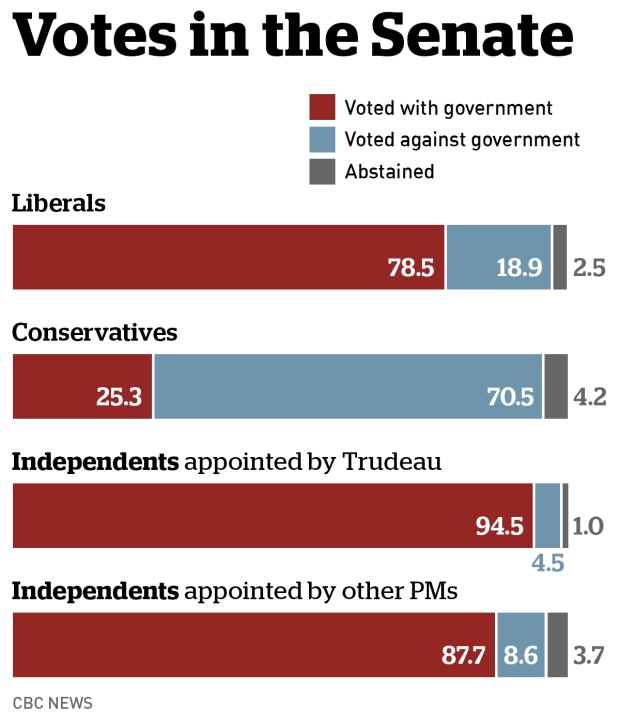
As the opposition in the Senate, the Conservatives have voted against the government’s position the most often, siding with Harder in just 25 per cent of all 48 recorded votes held since Harder took office. (This includes votes on both government and non-government bills and motions.)

But the swing votes in the Senate have not been the gaggle of independents, but rather the Senate Liberals, who have voted with Harder only 78.5 per cent of the time.

Votes in the Senate

The independents, by comparison, have been much more co-operative. Independents appointed by Trudeau’s predecessors voted with Harder 88 per cent of the time, while independents named by the prime minister have stood with Harder in 94.5 per cent of recorded votes.

This makes Trudeau’s independents — as a bloc — the most reliable votes that Harder can count upon in the Senate.

Senate Liberal swing votes

This bloc is not large enough for Harder to easily steer the government’s legislation through the Senate.

With 98 senators — excluding Speaker George Furey and Jacques Demers, who has been away due to poor health — Harder needs 49 votes to pass legislation when all senators are in the chamber.

In addition to himself, Harder can count on the support of his deputy, Diane Bellemare, and government liaison Grant Mitchell. The independents named by Trudeau increase his vote total to 29.

Adding the six independent senators appointed by past prime ministers who frequently vote with the government bumps that number to 35 — still short of a majority.

So in order to pass legislation, Harder needs most of the votes from the 18 Liberals, making them the Senate’s decisive swing votes.

Source: Why the Senate is unpredictable — and its independents not so independent – Politics – CBC News