Here are the top reasons why Canada rejects study permit applications

Useful information:

Almost five per cent of study permit applications were rejected last year because applicants allegedly misrepresented or withheld information, according to a new study that tracks international student refusal trends.

It was a small but noteworthy increase, according to the analysis released Monday by ApplyBoard, one of the largest online platforms for foreign student recruitment. The report looked at study permit applications for 2024 and found that 4.6 per cent of refusal reasons were linked to “authenticity and applicant honesty.”

In all, some 13,000 applicants were rejected based on misrepresenting or withholding facts in their applications.

Under the Canadian law, an immigration applicant can be found inadmissible “for directly or indirectly misrepresenting or withholding material facts.” Last year’s increase was up from 1.8 per cent in 2021, 2.3 per cent in 2022 and 3.5 per cent in 2023. 

In 2024, the Immigration Department rejected about 290,000 study permit applications, bringing the overall refusal rate to 52 per cent from 40 per cent the year before. The data covered applicants for all levels of studies; an application can be refused on multiple grounds.

Of the 81 different reasons given for refusals, 76 per cent were rejected because the officer was not satisfied the applicant would leave Canada — based on the person’s previous travel history. In comparison, this reason accounted for 7.6 per cent of all refusals in 2021.

The second-most common reason for refusal had to do with officers not believing an applicant would leave Canada, based on their financial assets. These rejected applications accounted for 53 per cent last year, up from 25 per cent in 2021.

Rounding the top five reasons for study permit refusals in 2024 were: an officer’s doubt over the purpose of the visit (47 per cent), applicants not having enough financial resources for tuition (19 per cent) and for living expenses (18 per cent).

While officials recognize some future students may want to stay and gain work experience in Canada after graduation, the predominant use of lack of travel history as a refusal ground, said the ApplyBoard study, “suggests that many applicants are perceived as having permanent residency as their primary purpose, instead of study.”

The report made no mention or speculation on the rise of this particular refusal reason, and it’s not known if immigration officials have heightened scrutiny of study permit applications amid integrity concerns raised about the international education program in the last couple years. 

Those alleged of submitting inauthentic documents and those who “didn’t truthfully answer all questions” were cited in 1.7 per cent and one per cent of all refusals in 2024, respectively — up from the correspondingly 0.3 per cent and 0.4 per cent since 2021, the report found.

In 2024, missing documents were also involved in thousands of refusals, with the proofs of financial assets being cited as the most commonly missing papers, followed by biometrics (photo and fingerprints), letters of acceptance by an institution, Quebec acceptance certificate and medical exam results.

“Every refusal reason above is entirely preventable, given enough time to review the application for completeness,” said ApplyBoard. “Having others review study permit applications can also prevent regrettable permit refusals.”

Source: Here are the top reasons why Canada rejects study permit applications
Canadian schools are accepting international students by the thousands — but nearly half aren’t being allowed into the country

Good data journalism highlighting the impact of provincial and federal government policies along with economic interests have resulted in the international student system losing its way. But encouraging that there is some selectivity being applied for study permits:

….The new data, in the eyes of one policy expert, shows the system is being flooded with subpar applicants, a consequence of schools’ hard push to get as many international students through their doors as possible.

Between Jan. 1, 2022, and April 30, 2023, the Immigration Department approved 54.3 per cent or 470,427 of the 866,206 study permit applicants who had been accepted by a school here — so-called designated learning institutions that have been authorized by provinces to host international students.

Ontario is the top destination for international students and home to the largest number of the 1,335 designated learning institutions in Canada. 

Approval rates vary vastly among the schools.

Public colleges generally had higher rejection rates than public universities. Private institutions had still higher rejection rates, though students destined for private institutions made up less than 10 per cent of the overall applications. …

Source: Canadian schools are accepting international students by the thousands — but nearly half aren’t being allowed into the country

Visitors from India face high rejection rates on visa applications

Good analysis of the data and indication that the government is addressing fraud and applying risk management to different applications:

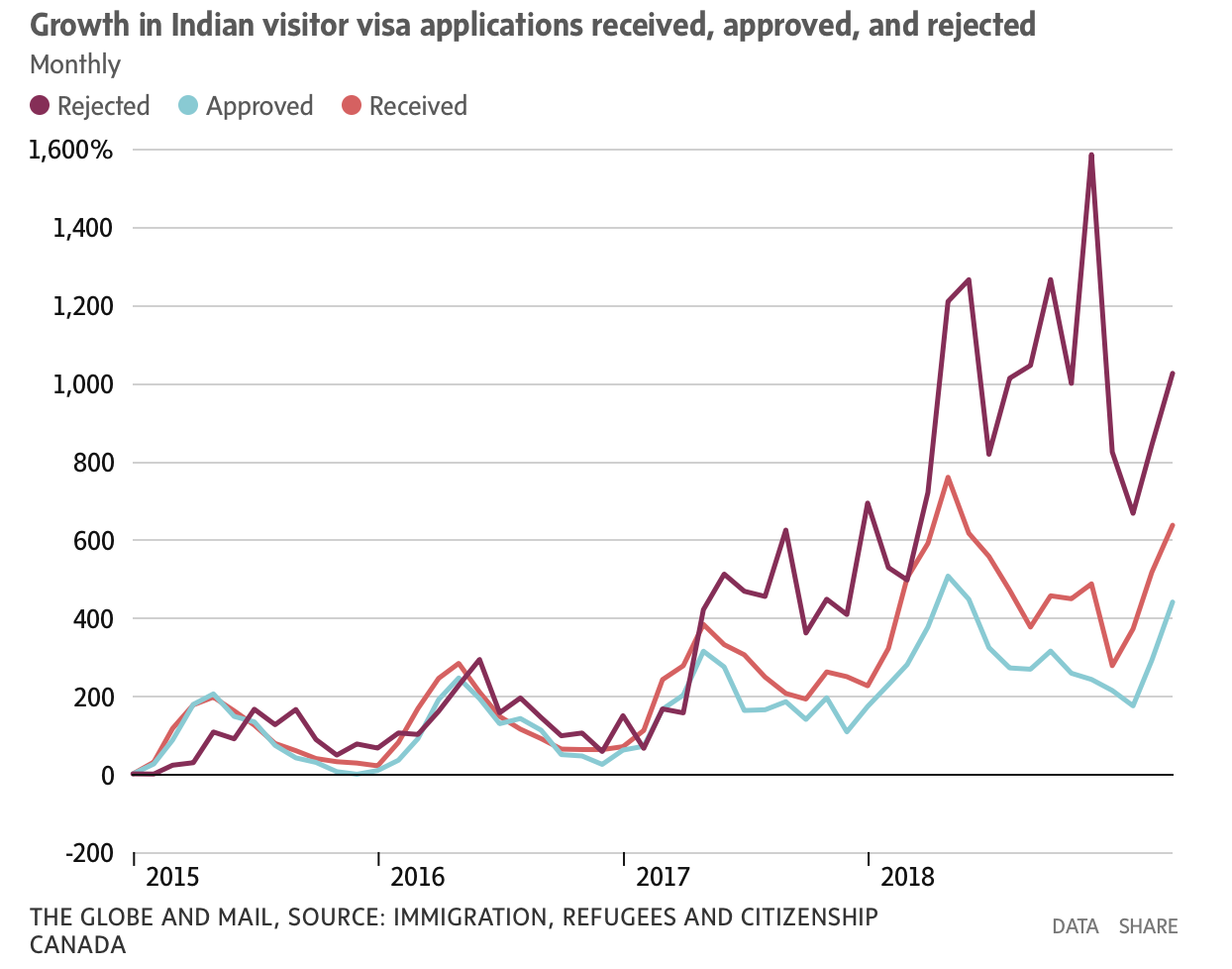
Refusals on visitor applications from India due to fraud and misrepresentation are soaring, which Ottawa and immigration experts say is in part due to unscrupulous “ghost consultants.”

While the number of Indian visitor visa applications has increased significantly, refusals are growing at an even faster clip. Data provided by the federal government show that the percentage of refusals due to an applicant misrepresenting themselves – through fraudulent submissions, for instance – has nearly tripled. In 2017, 0.9 per cent of all Indian visitor visa rejections were for misrepresentation; from January to May this year, the number jumped to 2.5 per cent.

Immigration, Refugees and Citizenship Canada (IRCC) refused 1,477 applications due to misrepresentation in 2017. Between January and May of this year, that number had already reached 3,709. The department could see close to a 500-per-cent increase in fraud refusals by year’s end compared with 2017 if current trends hold.

In response to the increasing number of refusals for Indian applications, in June the federal government rolled out an information campaign targeting Indians applying for visas. The effort includes resources on identifying and reporting fraud throughout the process, including by ghost consultants – unscrupulous, unlicensed immigration consultants.

“We anticipate that this campaign will help address some of the spinoff effects of circulating misinformation, such as high refusal rates and abuse of the asylum system,” Mathieu Genest, a spokesperson for Immigration Minister Ahmed Hussen, said in an e-mailed statement. Mr. Genest said the problem of ghost consultants is “particularly acute” in India.

Bank statements, income taxes, medical files, education histories, funeral home letters and even letters of support from members of Parliament are some of the types of fraudulent documents received by IRCC in recent years. Aside from fraud, Mr. Genest said the government is also seeing an increase in repeat applications from Indians previously denied and an overreliance on paper applications, which take longer to process, but noted that the increase in refusals should not affect legitimate applicants.

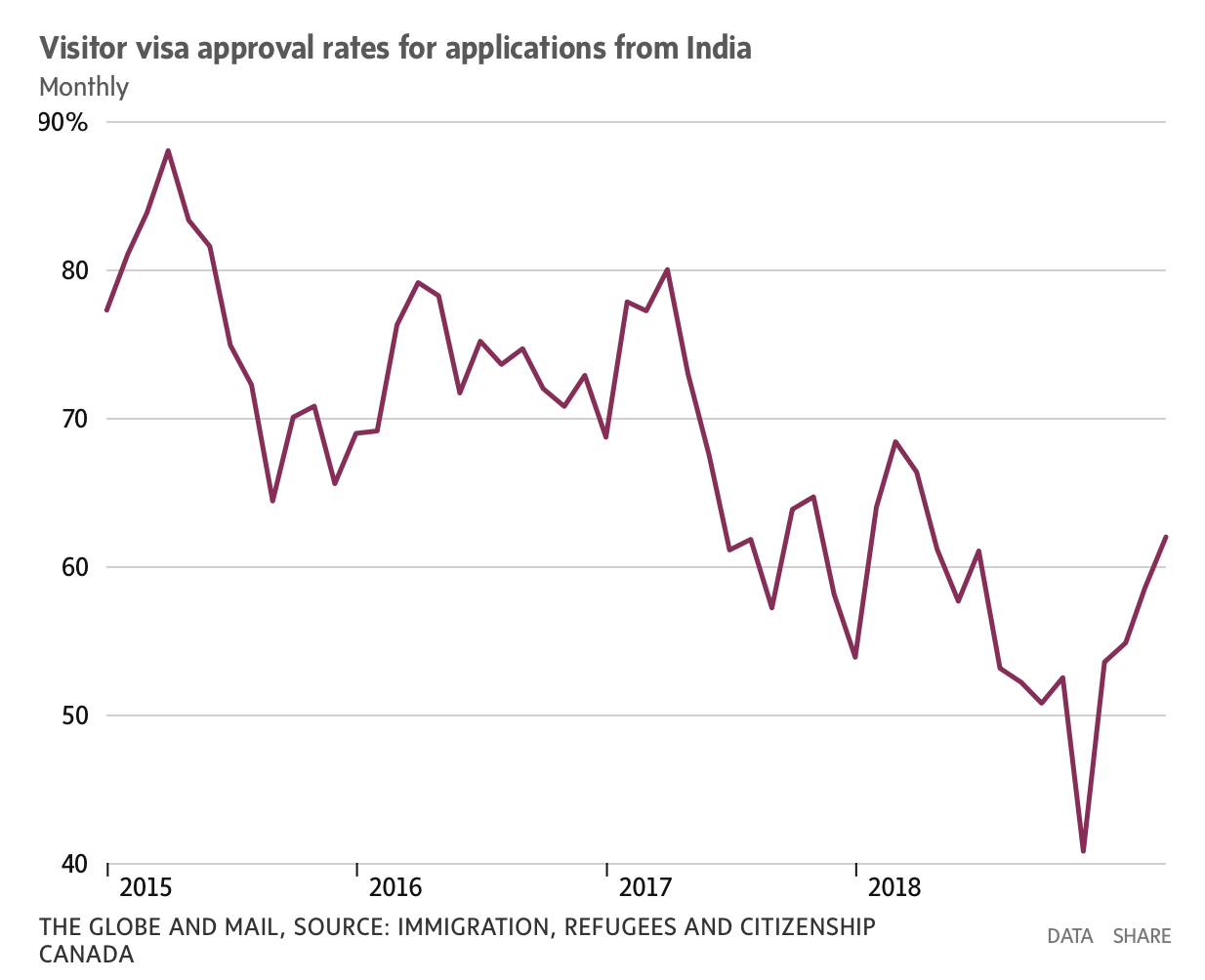
Partly owing to the increase in misrepresentation refusals, approval rates on Indian visitor visa applications have plummeted.

In April, 2015, 88 per cent of visa applications from India were approved – Ottawa received 27,600 applications that month. But by December of 2018, Canadian immigration authorities were receiving more than 58,000 applications each month and approval rates had dropped to 40.8 per cent.

The drop in India’s approval rates comes as the federal government has worked to streamline the visa process. According to documents obtained by The Globe and Mail through access-to-information requests, IRCC is using artificial-intelligence tools to review temporary resident visa applications from China and India as they come in.

Online applications predicted by AI models to be low-risk are sent to an immigration officer for review, simplifying the process. According to IRCC, 30 per cent to 40 per cent of China’s visitor visa applications are are now handled through this streamlined process; however, only 3 per cent to 5 per cent of Indian applications meet that low-risk threshold.

As of April, India was the top source of visitor visa applications to Canada. The country recently surpassed China, where applications have declined in recent months, which some attribute to the continuing diplomatic dispute between Ottawa and Beijing.

According to data from IRCC, Indians submitted 73,457 temporary resident visa applications that month, accounting for nearly a third of the worldwide total. China came in second place, with 46,646 applications.

Visitor visas are required for anyone from a non-visa-exempt country and looking to visit, work or study in Canada. As such, they’re often the first step in the immigration process.

Prashant Ajmera, an immigration lawyer in India who has an office in Montreal, was surprised to hear that the approval rate for visas from India had decreased so dramatically. He said the Canadian government has been touting the growing number of visitors from India, drawing attention to the fact that Canada welcomed nearly 300,000 visitors from that country last year. (There is no cap on how many visitor visas Canada issues each year.)

However, Mr. Ajmera said the Canadian government’s information campaign in India will not solve the problem, as applicants already know about visa fraud and immigration scams.

“They are aware of it but they’re taking calculated risks, most of them,” Mr. Ajmera said. “It’s a very common story.”

He said it would be a better use of Canada’s time to work with other like-minded governments, such as the United States, Britain and Australia, to encourage the Indian government to better regulate its immigration consultants in an effort to stem visa fraud.

One Canadian immigration lawyer thinks that the immigration consultant industry itself may be to blame. Ravi Jain, a Toronto-based immigration lawyer at Green and Spiegel LLP, said that lawyers are taking on clients who first worked with an Indian immigration consultant, only to find that the client’s visitor visa application was riddled with mistakes.

In some cases, unlicensed immigration consultants impersonate applicants throughout the process. “Often times, those people will even make up e-mail addresses. I’m not kidding, they do this,” he said.

Unscrupulous immigration consultants are not the only possible explanation for the decline in India’s approval rates.

Vancouver-based immigration lawyer Richard Kurland said he believes visa fraud, particularly relating to study permits, is the main reason for the decline in the approval rate of temporary resident visas from India. He said study permits are the “number one threat to Canada’s immigration system today” because there is no cap on the number of permits the government can issue, allowing foreign immigration consultants to take advantage of the program.

A recent Globe and Mail investigation revealed that private colleges in Canada are being accused of paying overseas agents to persuade international students that paying tens of thousands of dollars in tuition to study in Canada is the easiest way to get into the country and work toward becoming a permanent resident.

Asylum denials hit record-high in 2018 as Trump administration tightens immigration policy

Good data confirming other reports:

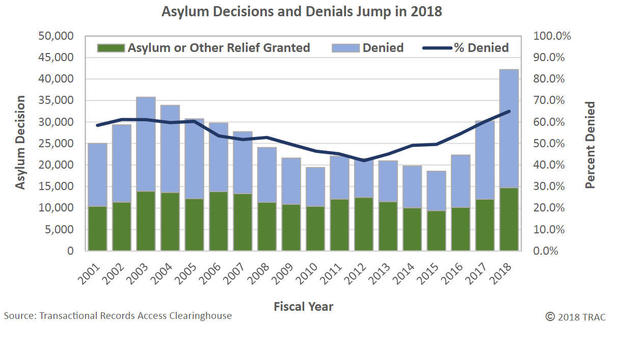
Immigration judges rejected a record-high number of asylum cases this year, refusing 65 percent of immigrants seeking the refugee status, according to a recent report published by Syracuse University’s Transactional Records Access Clearinghouse (TRAC). More than 42,000 asylum cases were decided in the fiscal year ending Sept. 30, 2018, the most since the group began tracking the data in 2001.

The rise marks the sixth consecutive year that the denial rate has increased, according to TRAC’s data. In 2012, the refusal rate was 42 percent; 2018’s rejection rate is nearly 50 percent larger, according to TRAC’s data. The group obtained data from the Department of Homeland Security through Freedom of Information Act requests.

TRAC pointed out the increase “largely reflects asylum applicants who had arrived well before President Trump assumed office.”

asylum-denials-fy2018-trac-syracuse-university-figure01.jpg

Immigration court asylum decisions, between fiscal years 2001 and 2018, shown in a graph provided by Syracuse University.

Immigration judges have been busier than ever before. Courts decided on 42,224 asylum cases this fiscal year, an 89 percent increase from two years ago, according to TRAC’s data. There is little relief in sight: as of Sept. 30, there were more than 1 million backlogged immigration cases, including those seeking asylum.

“I worry that people’s due process is at risk and that’s at play in the rise of denial rates,” said Aaron Reichlin-Melnick, policy analyst at the American Immigration Council, in a telephone interview with CBS News. “People’s claims are getting denied not because it wasn’t valid, but because there just wasn’t enough time to collect evidence and representation in an environment that’s seeking speed.”

Mr. Trump made immigration a key issue of the midterms, often tweeting about a migrant caravan traveling through Central America and Mexico and deploying thousands of troops to the southern border ahead of Election Day on Nov. 6. Days later, Mr. Trump signed an executive order barring asylum from anyone who illegally entered the country, a decree later blocked by a federal judge.

Asylum is a specific immigration process reserved for people of any nation fleeing persecution. Asylum seekers must establish they face “credible fear” in their home country, and – in a majority of cases – are allowed to live on U.S. soil while a judge determines the validity of their claim. Mr. Trump and other proponents of stricter immigration laws say the system has been abused by migrants, calling the practice “catch and release” and have made attempts to limit the system.

A change in immigration language from former Attorney General Jeff Sessionsearlier this year severely limited the ability for asylum seekers to establish persecution based domestic and gang-related violence, two forms of persecution that disproportionately impact migrants from Central America.

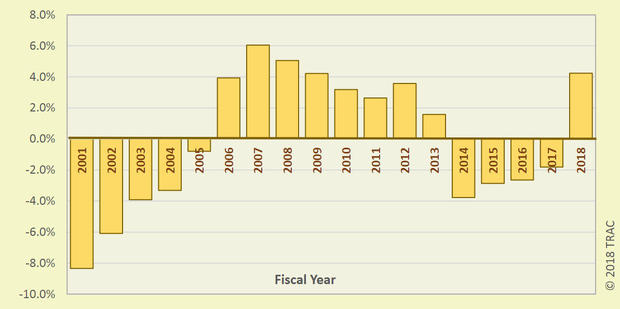
asylum-denials-fy2018-trac-syracuse-university-figure02.jpg

Change in representation rates compared with fiscal year 2001 through fiscal year 2018 (average).

Nearly 80 percent of last year’s asylum decisions were for immigrants from El Salvador, Honduras, Guatemala and Mexico, countries with already historically low asylum grant rates, according to Sarah Pierce, a policy analyst at the Migrant Policy Institute, a Washington, D.C.-based think tank.

“You’re dealing with an administration that’s putting a lot of pressure on immigration judges while looking skeptically at asylum and humanitarianism,” Pierce said in a telephone interview Monday evening with CBS News.

Immigration judge selection continued to play a major role in asylum decisions, according to TRAC. Asylum law can have wide-ranging interpretation, leaving immigration judges with more discretion than some other areas of law, said Reichlin-Melnick. For example in San Francisco’s immigration court, depending on the judge, asylum denial rates ranged from 10 percent to 97 percent.

“It’s refugee roulette,” Reichlin-Melnick said. “The single biggest factor on whether you win your case is just who you end up in front of.”

Source: Asylum denials hit record-high in 2018 as Trump administration tightens immigration policy