Immigrants from China struggling to obtain security clearances for government jobs, senator says

Of note and not surprising (Senator Woo tends to underestimate risks of foreign interference):

A senator told a parliamentary committee that he’s hearing of immigrants from China, with marginal connections to the ruling Chinese Communist Party or other government bodies, who are finding it difficult to obtain security clearances for Canadian public-sector jobs.

Senator Yuen Pau Woo raised the matter during a meeting of the Senate committee on foreign affairs and international trade Thursday, where he asked officials from the Department of Global Affairs to address it.

“I’ve encountered more and more cases of individuals looking to do government jobs, maybe work for a senator, or an MP, having their security clearances rejected or not responded to at all,” Mr. Woo said.

On the face of it, Mr. Woo said, it seems this is happening because the applicants “come from the People’s Republic of China and have the most tangential links to the CCP or some government organ,” he said, referring to the Chinese Communist Party, which has ruled China for 76 years….

Source: Immigrants from China struggling to obtain security clearances for government jobs, senator says

Canada needs a smaller, more capable, more affordable public service | MacDougall

Agree on potential to improve service and that public sector unions would be better off focussing on how it can and should be used to improve service to the public as well as reduce administrative costs in such areas as finance, HR and others:

…Now, I happen to think the promise of AI is vastly oversold. But it is also the kind of technology that should be able to empower public servants to deliver public services more effectively. It should help a smaller federal workforce deliver exactly the same level of service, if not better. Given the country is staring at red ink and increased debt service charges as far as the eye can see, a little trimming of the federal workforce, like taxes for the general population, is the price we pay for civil society.

Imagine if — just once — a federal public sector union put their hand up and acknowledged some need for cuts and/or reform? Imagine if the public service unions had the humility to acknowledge imperfection and their extremely privileged position vis-à-vis the vast majority of Canadians with lower salaries and cubic zirconium-plated pensions (if they have any pension savings at all)? Imagine if a public service union were a part of the solution instead of part of the problem? The country doesn’t need any more blocks on reform. It needs a smaller, more capable, more affordable public service.

Which isn’t to denigrate the role of unions. I’m sure Mark Carney’s blind trusts are full of investments in the kinds of companies that have chipped away all manner of worker protections to increase investor profits, as are many of our pension funds. I wouldn’t want to be an Uber driver or an Amazon fulfillment centre worker any more than you do, even if I benefit from their services. That hypocrisy is a prime example of why the people who most need union representation are not those in the public sector. What’s more, if recalcitrant public sector unions are the only remaining examples of union stewardship, their function will engender more anger than sympathy amongst the general population.

More to the point, the modernization of the public service can only happen effectively if the unions and government work together. Again, what the public service unions need to realize and accept is that this government might be the last one that approaches the task with a scalpel instead of a chainsaw.

Source: Canada needs a smaller, more capable, more affordable public service | Opinion

Canadian government employees’ productivity dropped 4 percent below private sector workers in last decade: Study

Worrisome, timing perfect in context of expected public service cuts. Really find the observation in the CSPS study on various program reviews is asking the right question:

“Technological developments during the past 80 years, if not the past 30 years, should have reduced the labour requirement. Computers, digital automation, and internet communications have made direct services easier to provide to Canadians. Forms and databases automate many tasks with higher accuracy, e.g. security checks, benefit applications, tax returns. Yet, the same number of Canadians is served by each public servant after decades of efficiency measures in spending restraint. Why is this? An un-nuanced early result appears to be that programs are more complex, as is the work to deliver them, even while the inflation-adjusted value delivered to each Canadian has not changed much in the last fifty years. However, some of this complexity may be unnecessary.”

The productivity of Canadian public sector workers declined over the last decade at a loss of 0.3 percent annually, while private sector employees’ productivity grew by 0.5 percent per year on average, according to a new research paper published by the Macdonald-Laurier Institute (MLI).

The study also found that if the productivity of government workers (federal and provincial) matched that of the private sector, Canada’s GDP in 2024 would have been $32 billion more or 1.5 percent higher.

“Essentially what we’re seeing through the data is that the size of government is growing, but a variety of different measures that you look at, for its overall performance and outputs and efficiency, [they’ve] been going down over time,” said Stephen Tapp, the author of the MLI study—“The Growing Government Gap”—and chief economist at the Centre for the Study of Living Standards. “So [public sector productivity is] obviously lagging behind and dragging [GDP] down.”

Tapp found that public sector worker productivity went from being slightly higher on average than private sector counterparts in 2015, then dropped 4 percentage points lower by 2024.

Despite this marked dip in productivity, government workers still earn an average of 27 percent more per hour worked than Canadians in the private sector. The MLI study mirrors a recent Fraser Institute study, which showed government employees in Canada make an average of 4.8 percent more, as well as receive more generous pensions and retire two years earlier on average….

Tapp found that for 88 percent of government subsectors, job growth outpaced the private sector; the same was true in eight of 10 provinces, and 78 percent of federal government organizations. He believes the Carney government’s reported plan to cut 15 percent across all government departments may be the wrong approach because some outlier government departments actually have a higher productivity rate….

Source: Canadian government employees’ productivity dropped 4 percent below private sector workers in last decade: Study

Lang: Ottawa’s bureaucracy has too many managers who are busy managing their own bloat

One of the interesting nuggets in this analysis is that the growth appears highest among ADMs as the overall growth since 2015 has been relatively stable, ranging from 2.9 to 3.0 percent of all public servants:

…Seventy years ago, British historian C. Northcote Parkinson coined “Parkinson’s Law,” which helps explain this staggering growth of the public service and its executive class. Observing the expansion of the British Colonial Office, which occurred alongside the decline of the British Empire, Parkinson pointed out that the ranks of the public service tend to grow regardless of the volume of work to be done. He attributed this to two claims: “An official wants to multiply subordinates, not rivals” and “Officials make work for each other,” in other words, there is a natural tendency to multiply subordinates to sustain the rise of officials, which in turn creates demand for more and more officials. As Parkinson put it, “Far more people have taken far longer to produce the same result. No one has been idle. All have done their best.” 

Ottawa’s bureaucracy is well aware of the problem, even if it hasn’t done much to fix it. According to the Parliamentary Budget Officer, recent attempts at work-force reduction have targeted term and casual employees, while the share of permanent positions, such as those occupied by executives, has reached a decade high

A report by the Public Service Management Advisory Committee could have been lifted directly from Parkinson’s playbook: “New [executive] jobs at all levels are created, in many cases without a significant change in the organization’s mandate.” The result is “dilution and duplication” leading to “unnecessary layers of decision-making and unclear accountabilities. It slows down productivity and creates workplace conflicts.” Former clerk of the Privy Council Michael Wernick has raised concerns that Ottawa’s “pyramid of executives” are slowing decision making and impeding communication.

Businesspeople will recognize the pathology. When companies multiply vice-presidents, decisions slow, accountability blurs and egos multiply faster than outcomes. But in the private sector, profit and loss eventually impose discipline. In government, the taxpayer funds the experiment until someone yells “enough is enough.” …

Source: Ottawa’s bureaucracy has too many managers who are busy managing their own bloat

Cuts will impact women and racialized public servants disproportionately, new analysis says

Likely but excessive growth in public service had to be curbed. Uses a departmental frame rather than an age frame. Annual EE reports will indicate extent of change:

Prime Minister Mark Carney’s coming cuts to the federal public service are expected to disproportionately impact female, Indigenous, racialized and disabled workers, according to a new analysis.

The analysis, published by the left-leaning Canadian Centre for Policy Alternatives on Oct. 20, estimated that 59 per cent of the employees whose jobs will be cut will be women, 5.5 per cent will be Indigenous people, 26 per cent will likely be racialized and 8.3 per cent will have a disability.

The analysis found that this outsized impact on these groups would largely be due to the fact that the departments and agencies facing the deepest reductions have some of the most diverse workforces in the federal government. And the organizations expected to see smaller cuts have less diverse employees.

“Depending on how the cuts play out, we can expect wider employment gaps, wider pay gaps and the erosion of access to critical employment benefits,” economists David Macdonald and Katherine Scott wrote in the analysis.

Early in July, Carney’s government announced a spending review asking most departments and agencies to cut 15 per cent of their operational budgets over three years.

The total job losses across the federal government from the spending review could amount to around 57,000 job losses, according to a previous analysis from the Canadian Centre for Policy Alternatives.

As Carney has promised to boost spending on defence and beefing up with border with the United States, the Department of National Defence (DND), Canada Border Services Agency (CBSA) and the RCMP will only see a cut of 2 per cent cut to their operational budgets over those three years. The analysis characterized these organizations as  “equity laggards.”x

Forty-three per cent of the civilian arm of DND are women and CBSA is staffed by around 47 per cent women.

In contrast, the workforce of Employment and Social Development Canada (ESDC) is around 67 per cent women. Macdonald and Scott estimate around 3,915 women could lose their jobs at that department in the coming spending review.

Indigenous Services Canada (ISC), the Department of Justice and Public Health Agency of Canada (PHAC) are all around 70 per cent women, and could see estimated 918, 604 and 935 women lose their jobs respectively.

In the federal public sector, Scott said women often don’t have to settle for lower paying jobs and are “not questioned if they’re leaving the office at five o’clock to pick up the kids from childcare.”

“You see massive wage gaps in the private sector,” Scott said.

When it comes to Indigenous workers, Scott and Macdonald estimated that around 5.5 per cent of jobs lost will be those of Indigenous workers, outpacing their current share in the public service at 5.3 per cent.

ISC (with a 27 per cent Indigenous workforce), Crown-Indigenous Relations (18 per cent Indigenous) and Correctional Service Canada (11 per cent Indigenous) will lose the most Indigenous jobs, according to Macdonald and Scott. These organizations could see an estimated 359, 84 and 318 Indigenous workers losing their jobs respectively.

Racialized workers make up 31 per cent of ESDC’s workforce and 41 per cent of Immigration, Refugees and Citizenship Canada, two departments expected to see high job loss as the spending review launches.
Source: Cuts will impact women and racialized public servants disproportionately, new analysis says

Gearey: In the federal public service, simple gender parity isn’t enough

Remarkably limited in scope. It’s not just gender parity but representation of visible minorities and Indigenous peoples, along with the intersectionality with gender.

The overall public service record has become much more representative over the years, as any cursory reading of employment equity reports and related data tables demonstrates.

Women visible minorities are slightly greater than the overall percentage of women: 57.8 percent, while Indigenous peoples women are much more strongly represented, 63.4 percent compared to 56.9 percent.

To put departmental diversity variation in context, out of the 31 departments with over 1,000 employees, only 6 do not have gender parity:

Partnership is collective; it doesn’t “give” women anything but rather frees everyone. True gender partnership is architectural — it’s not just paint on the walls. Partnerships must create space for trans women too, whose representation is even more marginal. Broadening partnerships in this way, even beyond binary gender lines, creates more durable and valuable culture change.

This kind of partnership culture-building is especially needed in portfolios such as National Defence, Innovation, Science and Economic Development, and STEM-related departments such as Natural Resources — areas where women remain under-represented and influence is unevenly distributed.

Departments that prioritize inclusion will not only improve productivity and retention, but also align more closely with the values of younger generations entering the workforce.

Still, not all mechanisms for achieving equity have kept pace with the progress they helped achieve. Some public service job postings continue to include criteria restricted to equity groups that include women. If true equity had been realized, women wouldn’t need to tick a box to be counted.

Not all equity groups have progressed at the same pace, so we’re not at a one-size-fits-all approach. Equity must begin with presence before it can refine process.

Tying this up, the risk card — “Diminished Male Relevance” — wasn’t just hypothetical. It captured a fear that progress must come at someone’s expense. Real partnership, however, isn’t subtraction, it’s about choosing to evolve together. If that feels uncomfortable, it likely means we’re getting somewhere.

Source: Gearey: In the federal public service, simple gender parity isn’t enough

Treasury Board reports gains on diversity and equity in public service, but will cuts hamper progress?

Good question:

The federal public service continued to increase the number of women, Indigenous people, visible minorities, and people with disabilities in its ranks between 2023 and 2024, according to the latest report on employment equity. But as the federal public service now begins to shrink for the first time in over 10 years, some have raised concerns that job cuts will hamper progress for equity-seeking groups….

Source: Treasury Board reports gains on diversity and equity in public service, but will cuts hamper progress?

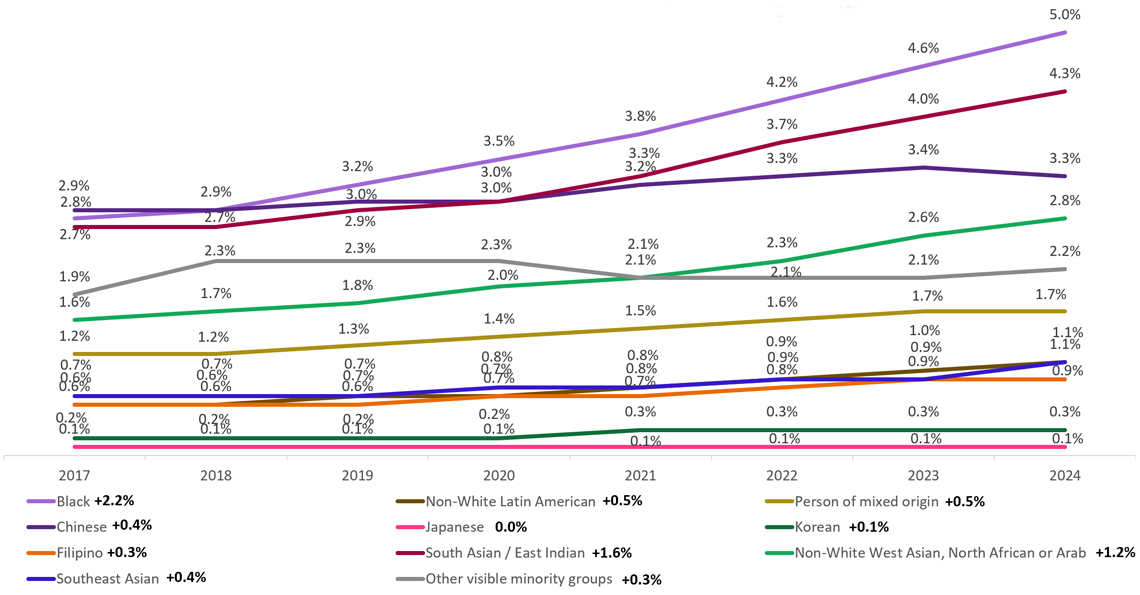
TBS publishes some rich infographics and infographics: Employment Equity Demographic Snapshot 2023–2024

Figure 33: Representation trends for members of visible minorities by subgroup – percentage

Text version below:


Savoie: Public service reform is only possible if the Prime Minister champions the project

Yep:

…The government’s agenda can be developed by asking a series of questions. What government structure is needed to promote a unified, single Canadian economy? How can we best redirect resources to high-priority areas such as trade and national defence? How can Ottawa pull back from more areas of provincial jurisdiction? The federal government has nearly 300 organizations, and it’s time to weed out those that are past their best-before dates; the same can be said about some federal government programs. 

But unless the Prime Minister ensures that these questions are answered and action is taken, the government will be like the proverbial goldfish, going around and around in its bowl repeating nice castle, nice castle

Source: Public service reform is only possible if the Prime Minister champions the project

Ottawa using AI to tackle Phoenix backlog as it tests replacement pay system

Needed. But again, a major part of the challenge is the multiple HR classifications, complex rules among other aspects, with major simplification and streamlining unlikely to be pursued as messy, time consuming and of little interest to the political level:

…Benay says AI is automating repetitive tasks, speeding up decision making and providing insights into human resources and pay data.

He says the government is testing the use of its AI assistant tool for three types of transactions – acting appointments, leave without pay and executive acting appointments – and is planning to launch automated “bulk processing” in these areas in April.

The government plans to expand AI-use to more transaction types over the course of next year, according to Benay, and could eventually use it to help with all types of cases, like departmental transfers and retirements.

There will always be an aspect of human verification, Benay says, as the tool was developed to keep humans in the loop.

“One thing we will not do is just turn it over to the AI machine,” says Benay.

The Government of Canada website says the backlog of transactions stood at 383,000 as of Dec. 31, 2024, with 52 per cent of those over a year old.

The government has said that it doesn’t want any backlog older than a year being transferred into a new system.

“A human only learns so fast, and the intake is continuing to come in,” Benay says. “The reason the AI work that we’re doing is so crucial is we have to increase (the) pace.”

Benay says the government has launched two boards that will oversee the use of AI and is looking at a third-party review of the AI virtual assistant tool over the course of the winter, with results to be published once it’s completed….

Source: Ottawa using AI to tackle Phoenix backlog as it tests replacement pay system

Former top bureaucrat calls for major overhaul of the federal government

Wernick is likely the clerk with the most active public role in contributing to debate and discussion regarding government and the need for serious public sector reform. But getting political backing for such reform, given lengthy and contentious discussions with no political benefits within a normal mandate, is virtually impossible.

Those of us who remember the Universal Classification System (UCS) in the 90s will remember the extensive job description rewrites and related efforts, and its abandonment given its unworkability and likely political questioning.

This excerpt focusses on the large number of executives and related levels (of note, the percentage of EX of total public servants has not increased as dramatically as stated in the article: from 2.6 percent in 2008 to 3.0 percent in 2023, and largely flat under the Liberal government):

…Another issue is the expanding number of executives, which has outpaced the growth of the unionized workforce over the last 15 years. There are now over 9,000 executives across five levels, with about 80 deputy ministers above them, ranked by four levels. 

Over time, the executive layer has become thicker with the proliferation of new “half-step” positions, such as senior and associate assistant deputy ministers—a pattern seen across other executive levels, as well. 

This thickening of the executive ranks raises significant questions. Are these appointments narrowing the scope and responsibility of executive roles, or are they necessary due to the increased pace and volume of work? 

Some argue that the proliferation of these positions contributes to high turnover, with many not staying in jobs long enough to learn the ropes, or be accountable for decisions under their watch.  

Additionally, some of the movement stems from using promotions to offer higher pay to keep or attract talent. 

As clerk, Wernick pushed to restructure the executive ranks and overhaul their compensation, but never gained political backing after the Phoenix fiasco. He suggests reducing the five executive levels to three: senior, middle, and junior. This would require a review of the need and scope of each position, potentially taking three years and offering buyouts to those displaced. 

Previously, the most discussed option was collapsing the five levels into three: merging EX-4 and EX-5, as well as EX-1 and EX-2, while keeping EX-3 intact.  

The executive ranks tend to be dominated by policy experts, and Wernick argues more weight should be given to those with skills and experience in operations and service.  

One possible solution is to create a separate track that would allow specialists in fields like IT or data to be promoted for those skills without having to move into management. This would likely mean raising salaries for the lowest tier of executives to make these jobs more appealing to executives while also rewarding specialists for their expertise.  

Source: Former top bureaucrat calls for major overhaul of the federal government