Court won’t block rollout of new screening process for public service | Ottawa Citizen

While I understand the Court’s reasoning with respect to fingerprinting, credit and criminal checks, as these are objective measures, I am less convinced by the need for sweeping searches of social media, given the greater degree of subjectivity in assessing security risks (e.g., while advocating for ISIS is an easy one, what about environmental activism, criticism of government policies etc).

Given that new recruits will invariably be digital natives, with rich social media histories, there will invariably be less clear cases. The old adage remains, ‘let he or she who is without sin,’ as most new employees will likely have some sharing that in retrospect was not wise:

The Federal Court has refused to stop the rollout of a new security screening process for Canada’s public servants, which includes fingerprinting, credit and criminal checks and sweeping searches of social media as the minimum clearance needed for the job.

The decision was a setback for the Professional Institute of the Public Service of Canada, which had sought an injunction to partly halt the implementation of the process, which is supposed to be fully operational by October 2017.

The union is appealing the decision.

In her decision, Federal Court Judge Catherine Kane said the union raised a “serious issue” but failed to prove the key tests needed for an injunction. She said the union didn’t provide “concrete evidence” of “irreparable harm” and offered only “speculative assertions” that the public interest would be harmed by proceeding.

“The applicants have raised one or more serious issues but have not established with any non-speculative evidence that any one of its members will suffer irreparable harm in the interim period,” Kane wrote.

The judge, however, found that the government would face “irreparable harm” if it had to halt the process and such a delay would not be in the public interest in ensuring Canada’s national security.

“There is also a public interest in maintaining international relations and in maintaining the trust and confidence of Canadians in the government employees who administer and deliver programs and services and have access to a wide range of information from and about citizens,” Kane wrote.

“The public has an interest in ensuring that government employees who handle their information are properly screened.”

PIPSC originally filed a legal challenge alleging that the new screening process is unconstitutional and violates the Privacy Act. That case has not yet been heard.

Meanwhile, it sought an injunction to stop public servants from the “irreparable harm” of turning over all kinds of personal and sensitive information before that court decision is rendered. It argued that once information is revealed and privacy is lost, it can’t be regained.

Departments have until October 2017 to implement the new security standard, which replaced a 20-year-old standard. Implementation coincidentally began days before the killing of a Canadian soldier in Quebec and the shooting of reservist Nathan Cirillo at the National War Memorial, which threw the government into a heightened security crisis.

Like the old policy, the new security protocol requires a basic reliability status and an enhanced reliability status. There is also a secret and top-secret security clearance.

PIPSC is objecting to the amount of information the government will be collecting for the “basic reliability status” — the minimum standard of screening for any public service job — arguing that the type of information required is unreasonable, unnecessary and unjustified.

The institute says that credit and criminal checks with fingerprinting and open-source searches are invasive and not necessary for most ordinary employees who don’t work in intelligence and security.

It argued the screening measures force employees to reveal details about their lifestyle and personal choices. They violate “reasonable” expectations of privacy and “employees shouldn’t have to trade off privacy rights” to become employees.

The union wanted the government to go back to the old standard for those who don’t need “enhanced reliability status” until the court decides on its constitutional challenge.

The government, however, argued the overhaul was necessary because the old one didn’t live up to the security standards of Canada’s allies. Halting screening for basic reliability would be confusing and unworkable because it’s the base level all employees would have to meet first.

The government has been screening employees since the 1940s, but a standard was not introduced until 1994. The government argued it had to modernize the standard to keep up with technology changes, security threats and to “maintain trust in government by citizens, stakeholders and other foreign governments.”

The government also noted that credit and criminal checks, including fingerprinting, aren’t new and were previously done on a case-by-case basis.

The government said that old policy had already been rescinded so there would be a big gap in screening which would undermine Canada’s relationship with its allies and their confidence in Canada’s security.

In her ruling, Kane said the basic reliability status was the foundation for all security clearances, and reverting to the previous standard would be “impractical, inefficient, costly and would create inconsistency, confusion, gaps in security screening pending the determination of the judicial review.”

She said government has a responsibility and authority to make policy to screen its employees and contractors to “ensure proper administration of government.”

“Modernization of the standard is in the public interest. The advances of technology cannot be ignored,” she wrote.

“On the one hand, technology that allows broad access to networks of information and collaborative work environments has many benefits but, on the other hand, permits a wider range of people to access information they otherwise had no access to and no need to access. “

She said drawing that line between employees’ privacy and ensuring that government programs operate securely “is not the role of the court on this motion.”

Religious Minorities in the Public Service: What the data tells us

Public_Administration_-_Religious_Minorities_-_Core_Public_AdminTo complement the employment equity analysis in my book Multiculturalism in Canada: Evidence and Anecdote (see here), I applied the same methodology using NHS data for religious minorities.

This was prompted in part by Minister Clement’s comment that hijabs and niqabs “are frequently worn” in the public service and that “I’m sure we have employees in the public sector who wear a niqab – I’m sure we do.”

The full series of charts, tables  and related analysis are found here.

The main conclusions:

Policy makers at all government levels should complement their internal employment equity data with the NHS to assess whether there are issues with respect to particular groups. This analysis of religious and visible minority data indicates that there is variation among groups, and this needs to be considered as part of employment equity strategies and programs. The five-year frequency of this NHS data also provides a longer-term view of employment equity trends than the annual government reports, which tend to focus on year-to-year changes.
Given overall demographic trends, the percentage of newer religious minorities in government will likely continue to increase. While most members of religious minorities may not need or request accommodation, the more traditional members will, and it is likely that the number and type of requests will increase.
Getting back to Minister Clement’s statement, while we know that some 8,800 Canadian Muslims work for the federal government (47 percent women), we do not have any information regarding their religiosity and the extent to which deeper religiosity is reflected in men’s facial hair or women’s head coverings (which do not mean identical religiosity, beliefs or interpretations of the respective religions). Nor do we have such information regarding other religions (e.g., Canadian Jewish public servants wearing the kippa, or Canadian Sikh public servants wearing turbans and carrying the kirpan). Nor to my knowledge is there any publicly available summary of religious accommodation requests.
We may not have hard numbers to back his assertion that “we have employees in the public sector who wear a niqab.” However, any public servant who wished to wear a niqab would provoke considerable bureaucratic discussion regarding whether this could be accommodated. That no such discussion has come to light suggests that there are no such cases at the federal level.
At some time, however, it is likely that someone will request such an accommodation (just as voting, citizenship and judicial processes have shown). While some would argue that such a request should be accommodated, this would not be healthy to an integrated workplace and society given the degree to which the face provides needed cues to interpret words.
In the interim, the public service may wish to consider collecting and analyzing data related to accommodation requests in core public administration to complement employment equity reporting and strengthen the current framework by providing a more comprehensive and consistent evidence base.


Kevin Page delivers a warning to the public service

Excerpt from Kevin Page’s book, Unaccountable: Truth and Lies on Parliament Hill. Some uncomfortable observations that merit reflection:

The ethical values section of the code speaks to a public service reflecting the need to act at all times in such a way as to uphold the public trust. It says that public servants shall act at all times in a manner that will bear the closest public scrutiny, an obligation that is not fully discharged by simply acting within the law.

This does not happen when deputy ministers refuse to provide spending plans to Parliament and the PBO that outline where Budget 2012 cuts will take place, along with an explanation of how those cuts will affect services to the public. Shame on all of us for sticking our collective heads in the sand.

Finally, under the code, the people values stipulate that public servants should demonstrate respect, fairness, and courtesy in their dealings with both citizens and fellow public servants. It says that appointment decisions in the public service shall be based on merit and that public service values should play a key role in recruitment, evaluation, and promotion. This did not happen with the recruitment of the new PBO.

What I learned from my PBO experience is that our public service has become good at avoiding accountability and transparency. The result is that public trust in the public service declines. Jane Jacobs, the famous American-Canadian urban activist, said “the absence of trust is inimical to a well-run society.” If only we could institutionalize trust, but alas, that is impossible.

Our public service leaders are going to have to step up and earn trust! To my friends and colleagues in the public service, I say this: Blueprint 2020, more than anything else it espouses, must be about restoring trust to the public service in Canada.

Source: Kevin Page delivers a warning to the public service | Ottawa Citizen

Public servants brace for war against Conservatives | Ottawa Citizen

More on the Tony Turner fall-out and the public service unions campaigning against the Conservatives:

It’s unclear when Environment Canada — Turner’s employer — will make a decision on whether the singer breached the ethics act with his song. This will turn on whether he can still be perceived as objective and impartial at his job, which is tracking migratory bird patterns.

But [Donald] Savoie and [Ian] Lee agree on one thing: the partisan Harperman performance could undermine any party’s trust in the neutrality of public servants and could particularly reinforce the Tories’ long-held view that bureaucrats are mostly a bunch of Liberals.

“The public service should be concerned about this,” said Savoie. “If the Conservatives are re-elected … they can question if they can really get policy advice that supports their agenda without fear or favour,” he said.

“If Harper sees this video he might say, ‘We can’t trust public servants’ advice …. so let’s go somewhere else.’ This doesn’t help a relationship that has been strained for years.”

Agree with Savoie as both the Turner song and the union campaign will only further Conservative distrust of the public service, not without reason.

Source: Public servants brace for war against Conservatives | Ottawa Citizen

Our health needs a healthy civil service: Picard

André Picard on the importance of a strong regulatory capacity and public service. His comment on Blueprint 2020 (highlighted) is unfortunately all too true:

Among other things, we need drug regulators who can regulate rigorously, free of political and corporate pressures. More broadly, we need a public service that works, and is free to work, in the public interest.

It’s not enough to have laws – let’s not forget that drug regulations were similar in Canada and the U.S. at the time thalidomide came along – we need people who can give those laws life, to embrace the spirit and not just the letter of the law, especially when it comes to ensuring public safety.

In short, we need to foster a new generation of Dr. Kelseys.

Sadly, we are doing exactly the opposite.

We have a public service that is muzzled, emasculated, derided and decimated.

There are about a quarter-million federal public servants in Canada, a considerably lower figure than from a decade ago. They serve a broad variety of functions from, overseeing national parks to ensuring aviation safety, and everything in between.

It is in our best interest, economically as well as socially, that every one of those workers serves a useful function.

Yet consultations with the public servants show that they feel mired in red tape and frustrated by cumbersome processes that leave them unable to do their jobs. That’s why the Privy Council has undertaken an initiative to transform the public service, dubbed Blueprint 2020.

The plan features some lovely rhetoric, such as Conservative Leader Stephen Harper saying in the introduction: “An agile, efficient and effective Public Service is essential to the well-being of Canadians.” And it is chock-full of good intentions.

But Blueprint 2020 lacks of a clear philosophical bent and strong political commitment to an independent, empowered public service.

What is required, especially in these difficult economic times, is a scientific, non-partisan approach to drafting and implementing policy.

While it is fashionable to bad-mouth the bureaucracy and sing the praises of free market, public regulation plays an essential role as a ballast to corporate excesses driven by self-interest.

The role of government, duly elected, is to formulate legislation and other policies in what it believes is the best interests of citizens. But its role is not to micromanage and bark orders down the line. Rather, elected officials should depend on civil servants for thoughtful, independent advice, especially on scientific matters.

What we need today is evidence-based policy-making if, for no other reason than it produces better policy.

Public servants should not be toadies, singing the praises of ill-conceived or partisan initiatives. Nor should they be muzzled. They should be offering constructive criticism to ensure policies are workable and fair, and analysis and insight that helps avoid unintended consequences.

For this, we need to create an atmosphere where public servants can innovate, take risks, and, as Dr. Kelsey did, call B.S. when necessary.

If we want better government and more sensible public policies, we need to give public-sector employees autonomy, authority and responsibility.

That, rather than a celebration of individual heroics, should be Frances Kelsey’s legacy.

Our health needs a healthy civil service – The Globe and Mail.

Reevely: Sticking up for the public service a tricky line for Ottawa politicians

On the public service and political level relationship, picking up some of the themes of my book, Policy Arrogance or Innocent Bias: Resetting Citizenship and Multiculturalism:

They [the Conservatives] fired the head of the Canadian Nuclear Safety Commission for being too meticulous about nuclear safety, forced the head of Statistics Canada to resign on principle, went to war with Parliamentary budget officer Kevin Page and Elections Canada boss Marc Mayrand. Ombudsmen for veterans and victims of crime lost faith in the Tories and said so publicly, then got frozen out.

That the Conservatives would be suspicious of the public service is understandable: A small-government party isn’t naturally friends with people who work in the government, who’ll tend toward statist solutions to public problems. And there’s a real divide between public-sector workers with stable employment and private-sector ones in Canada’s growing precariat (some of whom actually work for the government as temps, creating a shadow public service that began under the Liberals).

The Tories’ approach to the genuine challenges they have with the public service has, in the main, been to dump on public servants generally and get rid of specific senior ones who get too uppity. That might be satisfying for certain elements of the Conservative base but does not actually get Canada a better government. After nine years in power, they’ve likely effected about as much genuine reform as we can hope for.

But it says a great deal about how low the relationship between the politicians and the public service has gotten that “we would listen to the advice of professionals even if we don’t always take it” counts as a meaningful change from the way the Canadian government works now.

Reevely: Sticking up for the public service a tricky line for Ottawa politicians | Ottawa Citizen.

Back to the beginning: the Conservatives burst a hiring bubble of their own making

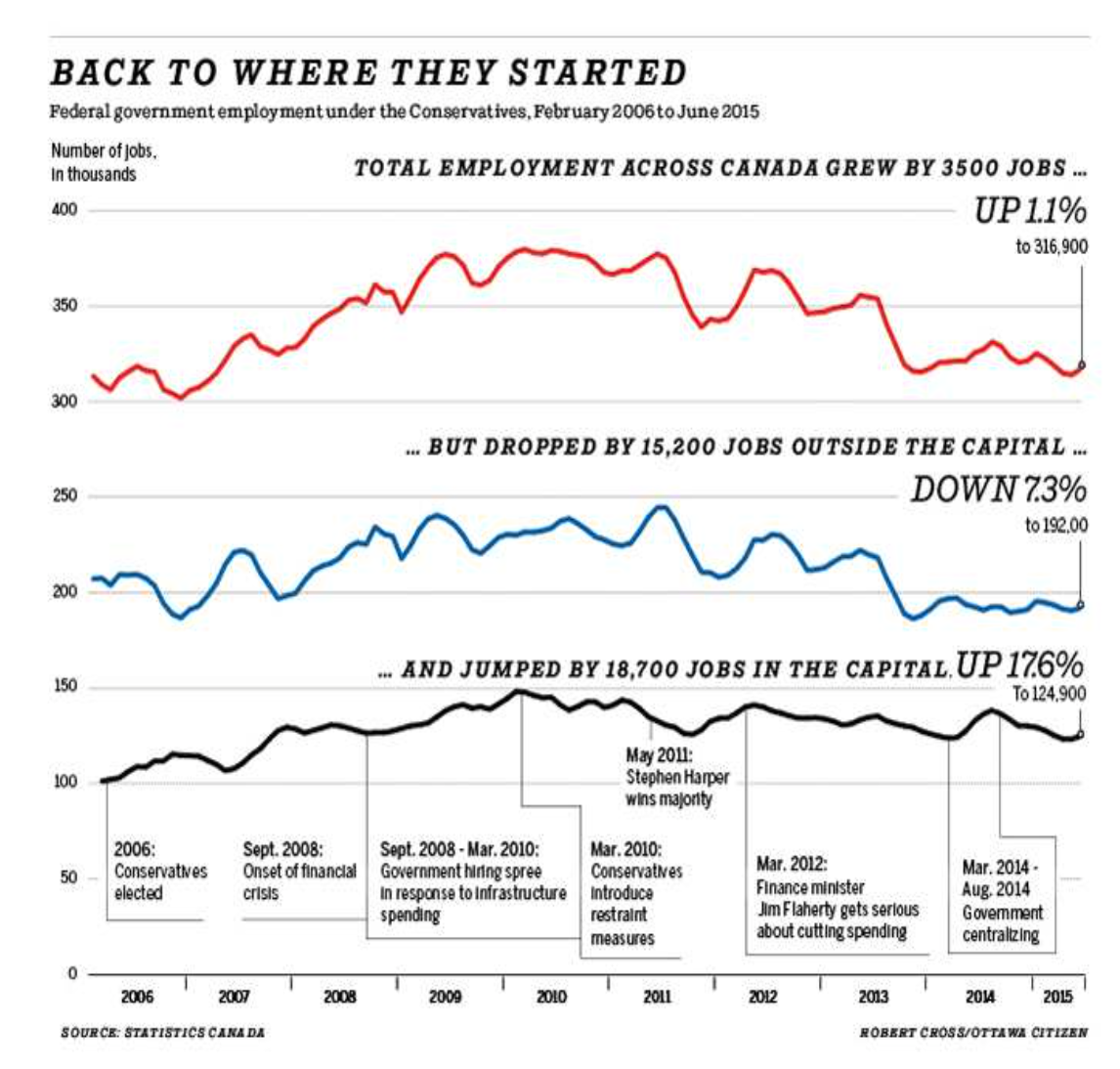
Back_to_the_beginning__the_Conservatives_burst_a_hiring_bubble_of_their_own_making___Ottawa_CitizenGood analysis by James Bagnall on public service employee number swings. Most interesting figure for me was shift from the regions to Ottawa/Gatineau (from 33.9 to 39.4 percent), reflecting in part that the decisions are made in the capital, not the regions, and likely disproportionate cuts to service delivery. The controversy over the closing of Veterans Affairs example being the most public example, with cuts to CIC’s regional network being partly responsible for the dramatic decline in the number of new citizens in 2012 and 2013 :

The initial rapid rise in the size of the federal workforce was a response to the onset of the 2008 financial crisis. The thinking was that if the private sector stopped spending, government had to pick up the slack to prevent economic collapse.

When it became apparent a couple of years later that the world hadn’t ended, the Conservatives reasserted a party imperative: the budget must balance. The late finance minister Jim Flaherty began signalling restraint in 2010, then accelerated things with his March 2012 budget. An important catalyst was the introduction of executive bonus programs that rewarded managers who trimmed their budgets.

Huge swings in government employment aren’t unique to Conservatives. The Liberals under prime minister Jean Chrétien implemented equally drastic cuts in percentage terms during the mid- to late-1990s. Chrétien and his finance minister, Paul Martin, had little choice. Interest payments on the federal government’s debt consumed 31 per cent of total revenues and were growing.

Even after adding more than $150 billion to taxpayers’ debt burden, the Conservatives budget is still much healthier. Last year, debt interest represented little more than 10 per cent of revenues, thanks in large part to substantially lower interest rates than were faced by Chrétien.

An unexpected result of the Conservative government’s recent retrenchment has been a sharp rise in the percentage of public sector employees based in the National Capital Region. According to data compiled by Statistics Canada, 39.4 per cent of the federal government’s workforce in June lived in Ottawa or Gatineau – compared to just 33.9 per cent when the Conservatives were sworn in almost nine-and-a-half years ago.

Indeed, had it not been for this centralization, the economy of the National Capital Region might have dipped perilously close to recession. Another way to look at it: From early 2006 to mid-2015, the Conservatives added 18,700 government jobs in Ottawa and Gatineau – and took away 15,200 from the rest of the country. Among the federal departments disproportionately hurt by the job losses were Veterans Affairs, Agriculture, Defence, Employment and Environment – organizations with a strong presence nationally.

Whoever wins the federal election will find much within the government’s workforce in need of repair – and many employees who would like to see an end to the wild swings of the past 20 years.

Back to the beginning: the Conservatives burst a hiring bubble of their own making | Ottawa Citizen.

At one federal department, office pals are risky business

Does seem like NRCan has gone overboard:

The survey has been greeted with disbelief, concern, and some anger within an already demoralized workforce, says a civil servant within NRCan. “It starts off pretty reasonably, but then gets into personal items, such as having friends at the office.”

Employment-law specialists express surprise at that personal focus: “It’s more reaching, in terms of questions about friends and family and advocacy than corporate codes of conduct,” says Toronto lawyer Kumail Karimjee, who speculates that inquiries about family and friends could violate human rights codes. Political neutrality is a tenet within civil service—particularly in the top tier, says Karimjee, who used to work for the Ontario government and encountered a similar requirement there. “I had these sorts of political restrictions. I found it a bit over the top, but this strikes me as worse. It’s ‘Give us all this information and we’ll decide.’ ” The focus appears to be on the employee, not on what constitutes conflict and how to navigate it, he says, unlike corporate conflict codes, which spell out conflict-of-interest situations. “This isn’t that,” he says. “It’s saying, ‘You’re on this spectrum.’ ”

For instance, being “an adjunct professor,” or teaching “at a postgraduate level” is “high risk,” whereas teaching at a “postsecondary (but not postgraduate) level” constitutes a “moderate risk.” While the government says this has to do with balancing other commitments, it may come across as a bias against academics. The NRCan spokesperson explains that, “in cases involving adjunct professorships, it’s important for the employee and the manager to agree on details, including time spent in class and preparing course material.”

Wichers-Schreur points out that having a high public profile, including professorships, is directly linked to scientists’ and researchers’ salary and professional reputations: “Things like being an adjunct professor, or having worldwide recognition, or speaking at conferences, plays into how much money they earn and move through the pay grid,” she says. “The higher their level of recognition and productivity, the more value they are—or were, in the old days.” She’s not sure what’s behind the new classifications: “It’s not clear whether the government is trying to control costs through this measure by maintaining a lower level of compensation for research sciences, or whether this is another way of controlling their access to the broader scientific population or the public,” she says.

… Within NCRCan, many see the Employee Confidentiality Report as a waste of time and taxpayers’ money. The mandatory information session is 2½ hours long; filling out the form takes another half-hour, which adds up to more than 11,100 department man hours. In addition, there’s the time managers spend evaluating each form and reporting suspected problems, as well as on interviews with the employees. The erosion of morale could cost even more, says one staffer.

Some wonder if the whole exercise is redundant. “It’s amazing they are evaluating trustworthiness using an email survey, when all of these people have signed an oath to the Queen,” says a former NRCan staffer. “And most research scientists have an enhanced level of security clearance.” He questions the pre-election timing. NRCan is a front line of climate-change policy, he notes: “I’m wondering if this survey is coming up now, because people within the department have the potential to say things that could embarrass the government.” Ironically, now, they don’t have to say anything; the questions raised by the survey speak for themselves.

At one federal department, office pals are risky business – Macleans.ca.

One-third of public service executives have mentally ‘checked out,’ study suggests

Part of this ‘checking-out’  is within the nature of the public service itself: a bureaucratic, hierarchical culture, with divided accountability between the public service and the political level.

Exacerbated, of course, by the distrust between the two, and the general values and ideological divide:

Studies show those who do whatever they can to remove obstacles for employees have highly motivated staff – a phenomenon whose importance is typically underestimated by leaders, according to Dowden.

Dowden said people want to feel like they are making a meaningful contribution and, as long as they are fairly paid, will go the extra mile. The public service historically attracted people who wanted to make a difference, so they came to the job with a strong sense of purpose.

“Leaders and executives in an organization very much want to live their values and when they perceive gaps … or disconnect between values and purpose, that can be incredibly challenging to work through.”

Dowden said autonomy is another key driver of engagement and motivation. In the majority of organizations, executives have the most autonomy, with more control the higher up the chain they move. APEX’s surveys, however, show executives often feel they have little authority and are micromanaged. Surveys found executives feel this lack of control regardless of level, whether Ex 1 or Ex 5.

Autonomy comes almost entirely from the culture created by the direct supervisor. Those who don’t micro-manage and who give workers the freedom to work on projects in the way that suits them – while still being accountable – get the best results.

There are two kinds of micro-managers. The perfectionist – à la Steve Jobs – who have high standards and like control over the projects for which they are responsible.

The more toxic micro-manager seems to have a need for people to know who is charge, gives little autonomy to direct reports, doesn’t accept feedback and gets involved in the minutiae of a project.

The 2014 public service survey gives mixed messages on this front. Generally, employees – including 84 per cent of executives – are satisfied with their direct supervisors and feel they can count on them. They aren’t as positive about senior management, especially when it comes to making “timely and effective” decisions and ensuring critical information flows down to staff.

But Dowden said so much about leadership and management comes down to trust.

The Conservatives have made little secret of their distrust of the public service. Experts, including the Public Policy Forum, have cited the “trust gap” between politicians and public servants as the biggest challenge facing the next generation of leaders.

APEX has also flagged its concern about this relationship and the need to improve “understanding” between the two.

The lack of trust, coupled with the concentration of power and decision-making in the Prime Ministers Office and the Privy Council Office, has intensified the lack of control and authority many executives complain about today.

So while I was fully engaged during most of my time in the public service (and fortunate to have had an interesting career with supportive managers), there are structural limits to the degree of engagement  possible or desirable.

One-third of public service executives have mentally ‘checked out,’ study suggests

ADMs have become too insular and inexperienced: study

Interesting and relevant study on ADMs by Jim Lahey (disclosure have spoken to his EX2-3 course on the lessons from Policy Arrogance or Innocent Bias: Resetting Citizenship and Multiculturalism) and Mark Goldenberg, with relevant thoughts on how to improve their expertise and depth of experience:

Once they have become ADMs, they tend to move from job to job and spend less than two years in a position. Most of those moves are within their own departments.

“ADMs move too much and don’t necessarily make the right moves. ADM churn needs slowing down. They are moving too frequently, and not always making the kinds of moves that can broaden and deepen their knowledge, experience and skills,” said Lahey.

“It is absolutely wrong to have ADMs who are generic managers divorced from policy and content. There has been a kind of managerialization of ADM jobs … bringing those jobs down below what they should be.”

The report offers five areas of reform to “raise the bar” for managing and recruiting these senior executives so they have more responsibility, experience, knowledge and leadership skills. It says future ADMs should be a strategic thinkers and visionary; should focus on results, effectiveness and economy; have strong interpersonal skills; and be able to work collaboratively.

Lahey said the overall executive cadre could be significantly cut but this must be managed slowly while targeting the talent in the lower executive levels to develop for the future. Slashing jobs to delayer is too disruptive; instead, the key is to figure out the roles and responsibilities for each level of management. This means adjusting the expectations of ministers and political staff – which could be tough in an era of mistrust between politicians and bureaucrats.

The report also urged bringing in new blood from outside the public service with external recruits accounting for up to 15 per cent of ADM appointees. It also suggests fast-tracking younger executives in their 30s and 40s so they become ADMs – and DMs – at a younger age and having them stay in the jobs longer before retiring.

The study also suggested ADMs stay in a position at least three years before moving to another. In fact, it argued that staying in the job, mastering it and leadership should be tied to performance pay.

ADMs have become too insular and inexperienced: study | Ottawa Citizen.