At one federal department, office pals are risky business

Does seem like NRCan has gone overboard:

The survey has been greeted with disbelief, concern, and some anger within an already demoralized workforce, says a civil servant within NRCan. “It starts off pretty reasonably, but then gets into personal items, such as having friends at the office.”

Employment-law specialists express surprise at that personal focus: “It’s more reaching, in terms of questions about friends and family and advocacy than corporate codes of conduct,” says Toronto lawyer Kumail Karimjee, who speculates that inquiries about family and friends could violate human rights codes. Political neutrality is a tenet within civil service—particularly in the top tier, says Karimjee, who used to work for the Ontario government and encountered a similar requirement there. “I had these sorts of political restrictions. I found it a bit over the top, but this strikes me as worse. It’s ‘Give us all this information and we’ll decide.’ ” The focus appears to be on the employee, not on what constitutes conflict and how to navigate it, he says, unlike corporate conflict codes, which spell out conflict-of-interest situations. “This isn’t that,” he says. “It’s saying, ‘You’re on this spectrum.’ ”

For instance, being “an adjunct professor,” or teaching “at a postgraduate level” is “high risk,” whereas teaching at a “postsecondary (but not postgraduate) level” constitutes a “moderate risk.” While the government says this has to do with balancing other commitments, it may come across as a bias against academics. The NRCan spokesperson explains that, “in cases involving adjunct professorships, it’s important for the employee and the manager to agree on details, including time spent in class and preparing course material.”

Wichers-Schreur points out that having a high public profile, including professorships, is directly linked to scientists’ and researchers’ salary and professional reputations: “Things like being an adjunct professor, or having worldwide recognition, or speaking at conferences, plays into how much money they earn and move through the pay grid,” she says. “The higher their level of recognition and productivity, the more value they are—or were, in the old days.” She’s not sure what’s behind the new classifications: “It’s not clear whether the government is trying to control costs through this measure by maintaining a lower level of compensation for research sciences, or whether this is another way of controlling their access to the broader scientific population or the public,” she says.

… Within NCRCan, many see the Employee Confidentiality Report as a waste of time and taxpayers’ money. The mandatory information session is 2½ hours long; filling out the form takes another half-hour, which adds up to more than 11,100 department man hours. In addition, there’s the time managers spend evaluating each form and reporting suspected problems, as well as on interviews with the employees. The erosion of morale could cost even more, says one staffer.

Some wonder if the whole exercise is redundant. “It’s amazing they are evaluating trustworthiness using an email survey, when all of these people have signed an oath to the Queen,” says a former NRCan staffer. “And most research scientists have an enhanced level of security clearance.” He questions the pre-election timing. NRCan is a front line of climate-change policy, he notes: “I’m wondering if this survey is coming up now, because people within the department have the potential to say things that could embarrass the government.” Ironically, now, they don’t have to say anything; the questions raised by the survey speak for themselves.

At one federal department, office pals are risky business – Macleans.ca.

One-third of public service executives have mentally ‘checked out,’ study suggests

Part of this ‘checking-out’  is within the nature of the public service itself: a bureaucratic, hierarchical culture, with divided accountability between the public service and the political level.

Exacerbated, of course, by the distrust between the two, and the general values and ideological divide:

Studies show those who do whatever they can to remove obstacles for employees have highly motivated staff – a phenomenon whose importance is typically underestimated by leaders, according to Dowden.

Dowden said people want to feel like they are making a meaningful contribution and, as long as they are fairly paid, will go the extra mile. The public service historically attracted people who wanted to make a difference, so they came to the job with a strong sense of purpose.

“Leaders and executives in an organization very much want to live their values and when they perceive gaps … or disconnect between values and purpose, that can be incredibly challenging to work through.”

Dowden said autonomy is another key driver of engagement and motivation. In the majority of organizations, executives have the most autonomy, with more control the higher up the chain they move. APEX’s surveys, however, show executives often feel they have little authority and are micromanaged. Surveys found executives feel this lack of control regardless of level, whether Ex 1 or Ex 5.

Autonomy comes almost entirely from the culture created by the direct supervisor. Those who don’t micro-manage and who give workers the freedom to work on projects in the way that suits them – while still being accountable – get the best results.

There are two kinds of micro-managers. The perfectionist – à la Steve Jobs – who have high standards and like control over the projects for which they are responsible.

The more toxic micro-manager seems to have a need for people to know who is charge, gives little autonomy to direct reports, doesn’t accept feedback and gets involved in the minutiae of a project.

The 2014 public service survey gives mixed messages on this front. Generally, employees – including 84 per cent of executives – are satisfied with their direct supervisors and feel they can count on them. They aren’t as positive about senior management, especially when it comes to making “timely and effective” decisions and ensuring critical information flows down to staff.

But Dowden said so much about leadership and management comes down to trust.

The Conservatives have made little secret of their distrust of the public service. Experts, including the Public Policy Forum, have cited the “trust gap” between politicians and public servants as the biggest challenge facing the next generation of leaders.

APEX has also flagged its concern about this relationship and the need to improve “understanding” between the two.

The lack of trust, coupled with the concentration of power and decision-making in the Prime Ministers Office and the Privy Council Office, has intensified the lack of control and authority many executives complain about today.

So while I was fully engaged during most of my time in the public service (and fortunate to have had an interesting career with supportive managers), there are structural limits to the degree of engagement  possible or desirable.

One-third of public service executives have mentally ‘checked out,’ study suggests

ADMs have become too insular and inexperienced: study

Interesting and relevant study on ADMs by Jim Lahey (disclosure have spoken to his EX2-3 course on the lessons from Policy Arrogance or Innocent Bias: Resetting Citizenship and Multiculturalism) and Mark Goldenberg, with relevant thoughts on how to improve their expertise and depth of experience:

Once they have become ADMs, they tend to move from job to job and spend less than two years in a position. Most of those moves are within their own departments.

“ADMs move too much and don’t necessarily make the right moves. ADM churn needs slowing down. They are moving too frequently, and not always making the kinds of moves that can broaden and deepen their knowledge, experience and skills,” said Lahey.

“It is absolutely wrong to have ADMs who are generic managers divorced from policy and content. There has been a kind of managerialization of ADM jobs … bringing those jobs down below what they should be.”

The report offers five areas of reform to “raise the bar” for managing and recruiting these senior executives so they have more responsibility, experience, knowledge and leadership skills. It says future ADMs should be a strategic thinkers and visionary; should focus on results, effectiveness and economy; have strong interpersonal skills; and be able to work collaboratively.

Lahey said the overall executive cadre could be significantly cut but this must be managed slowly while targeting the talent in the lower executive levels to develop for the future. Slashing jobs to delayer is too disruptive; instead, the key is to figure out the roles and responsibilities for each level of management. This means adjusting the expectations of ministers and political staff – which could be tough in an era of mistrust between politicians and bureaucrats.

The report also urged bringing in new blood from outside the public service with external recruits accounting for up to 15 per cent of ADM appointees. It also suggests fast-tracking younger executives in their 30s and 40s so they become ADMs – and DMs – at a younger age and having them stay in the jobs longer before retiring.

The study also suggested ADMs stay in a position at least three years before moving to another. In fact, it argued that staying in the job, mastering it and leadership should be tied to performance pay.

ADMs have become too insular and inexperienced: study | Ottawa Citizen.

Canada’s public service and the new global normal of change: Lynch

Former Clerk of the Privy Council Kevin Lynch on the role and challenges for the public service:

The public service plays a core role in our Westminster system of government. It is nonpartisan, it is permanent, serving governments past, present and future, of any political party, with equal loyalty and effectiveness, and its appointments are merit-based. It offers evidence-based policy advice to the government of the day, it administers the policies, programs and regulations approved by Parliament on a nonpartisan basis, and it provides the essential services of government. Given its roles, responsibilities, and accountabilities, a Westminster public service should not be mistaken for an administrative service, nor should it be confused with an American civil service, which is institutionally designed to be partisan and non-permanent at all senior levels.

These same global trends are impacting Canadian public services, both federally and provincially. Demographics—our public services are aging, and recruiting, training and retaining the next generation of public servants, and developing its leaders are a key challenge. The competition for exceptional talent is intensifying, and the public service will be able to attract such talent only if the work environment within government offers the ability to make a difference, help shape policy options and choices, be innovative in service delivery, and do great science. Globalization—a public servant today needs a worldview not a parochial one, an understanding that something happening anywhere in the world can have impacts here in Canada. And technology—innovations in ICT, social media, cloud computing, data analytics and adaptive learning have enormous potential to reshape both the “back office” of government operations and the “citizen-facing” service delivery and interaction functions.

The public service is under stress, both responding to these demographic, globalization and technology pressures and dealing with a challenging governance environment. At a time when Canada faces many longer-term policy issues, there seems to be little demand for public service policy advice. At a time when the private sector is shifting to distributed leadership and entrepreneurship models and risk management, the governance model of the federal government is moving towards ever greater centralization and risk aversion. At a time when attracting and retaining superb talent to the federal public service is facing stiff competition from the private sector here and abroad, there is ambiguity from the government itself about the importance of government and governance to the economy and society in these transforming global times—hardly motivating to prospective public servants. As leading experts on the public service such as Donald Savoie have stressed, the apparent antipathy of the government today toward the public service may have deleterious long term impacts on the public service as an institution.

http://ipolitics.ca/2015/07/09/canadas-public-service-and-the-new-global-normal-of-change/ (paywall)

Niqab welcome in federal public service: Clement

That’s interesting. I am not so sure that in fact a niqab or burqa would be welcome in the federal government workplace but Clement’s comments are a welcome change from that of some of his colleagues.

Contrary to his assertion that hijabs and niqabs are frequently worn in the public service, the number of hijabs I believe is relatively small and I am not aware of any niqab-wearing federal employees. But if any reader knows of any cases, please advise.

Muslim women can’t wear a niqab at a citizenship ceremony but they are perfectly free to wear them working for Canada’s public service, says Treasury Board President Tony Clement.

In an interview with iPolitics, Clement said what counts for him as the head of the federal public service is how well someone gets the job done – not what they are wearing.

“If you are in your place of work or privately in your home or in your private life, what you wear is of no concern to the state,” Clement explained. “But the state does have a concern on citizenship and citizenship is a public demonstration of loyalty and allegiance to Canada and its values and its principles and that’s where the niqab is inappropriate.”

Clement said to his knowledge hijabs and niqabs “are frequently worn” in the public service.

“I’m sure we have employees in the public sector who wear a niqab – I’m sure we do.”

“If you’re carrying on your job and doing your job well then I don’t think we have a problem with that.

The one exception, he said, might be if a hijab or a niqab posed an operational or safety problem.

“I can’t talk about bona fide occupational requirement – if there is an occupational requirement that requires something that might be different.”

Niqab welcome in federal public service: Clement

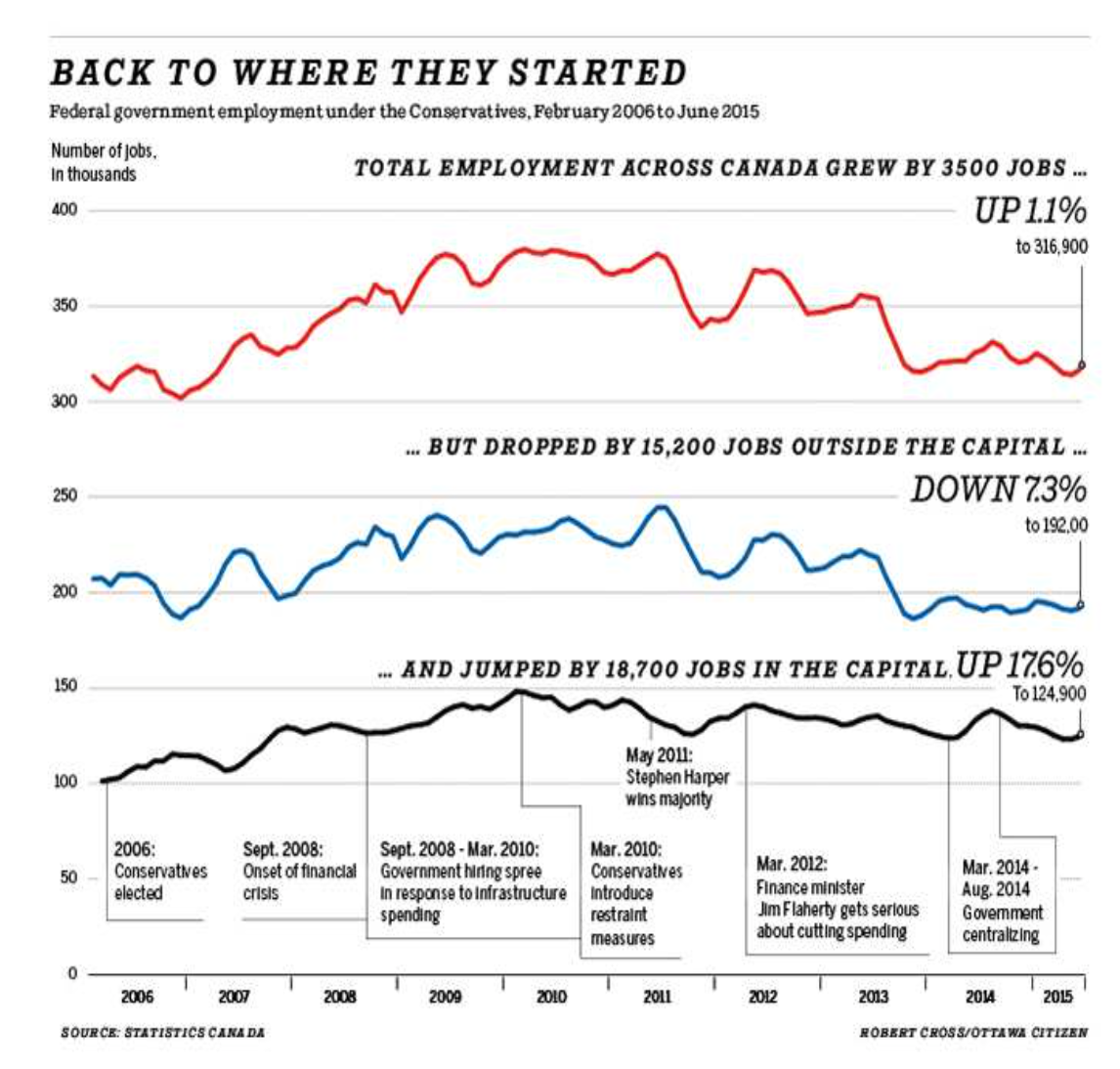
Brunt of public service cuts outside of Ottawa, report finds

Not surprising, the people making the decisions are in Ottawa-Gatineau. One of the factors contributing to the dramatic fall in citizenship processing in 2012 was cutbacks to CIC’s regional network:

“The bottom line is that, proportionately, there have been more cuts in the regions than in the NCR,” said Mostafa Askari, assistant parliamentary budget officer.

The report found about two-thirds of the job cuts were outside the National Capital Region, where the head offices of most departments and agencies are located.

Overall, the number of jobs in the federal public service has fallen by 7.5 per cent – 6.5 per cent in the National Capital Region – since the 2012 restraint budget.

At that time, the government said 70 per cent of the reductions would come from operational and “back office” efficiencies and wouldn’t even be noticed by most Canadians. The regions, where most of the front-line employees work providing programs and services to Canadians, were to be largely unaffected.

The bulk of the job cuts were supposed to come in the Ottawa area, where the size of the public service has mushroomed over the past decade. The government estimated that 12,000 bureaucrats would be laid off and the remaining 7,000 cuts would be through its five per cent yearly attrition rate.

The PBO offered no explanation as to why a larger portion of the public service has shifted to the national capital or whether this indicated a shift in the nature of work. The public service has changed considerably, becoming more “professional” in hiring new employees and facing an unprecedented generational turnover as baby boomers retire.

The public service has come under fire for being too Ottawa-focused, isolated and out of touch with Canadians. A big focus of the modernization of the public service now underway is to consult and collaborate more when making decisions.

Brunt of public service cuts outside of Ottawa, report finds | Ottawa Citizen.

Federal government to extend sick-leave changes to executives

I was “lucky” that my cancer happened under the old rules:

Unlike unionized employees, executives can get an extra 130 days of paid sick days once in their careers – at the discretion of deputy ministers – which they don’t have to repay. They can use it all at once for a prolonged illness or draw upon it as needed for a recurring illness or during recovery. It’s expected this special leave would disappear under the Conservatives’ plan.

Many executives have banked more unused sick leave than other workers as a cushion in the face of prolonged illness. That stockpile would disappear too.

The government has paid 100 per cent of the executives’ premiums for disability insurance since 1990, while unionized employees contribute 15 per cent of their premium costs. It’s unclear what would happen to that perk.

Executives – along with diplomats and scientists – use the least amount of sick leave in the public service, although they claim more than their counterparts in the private sector. They typically take off less than half the number of sick-leave days of other public servants, who average about 11.5 days a year.

The Association of Professional Executives of the Public Service of Canada (APEX) said the latest five-year trend showed 75 per cent of executives took less than five days annually; 54 per cent took less than one or two days and 30 per cent took no sick leave at all.

Still, APEX, which has tracked the health and work of executives with studies for more than 15 years, found executives are taking more sick days than ever. They averaged 3.5 days in 1997; 3.3 days in 2002 – then 4.3 days in 2007 and 5.4 days in 2012.

Again, these changes will impact those struck with catastrophic illnesses, not those who are abusing the system. And as the stats indicate, little evidence that executives are in fact abusing sick leave and related provisions.

Federal government to extend sick-leave changes to executives | Ottawa Citizen.

Women reach top in PS but lack clout male counterparts had, study shows

Interesting study contrasting the number and impact (disclosure I was interviewed for the study):

It’s one of the many paradoxes uncovered by Carleton University researchers Marika Morris and Pauline Rankin in an interim report on a study of female leadership in the public service where women now dominate, holding more than 55 per cent of all jobs and 45 per cent of the executive positions below deputy ministers.

The study is part of the Women in the Public Service Project, run by the Washington-based Wilson Centre, aimed at getting women into 50 per cent of the world’s public service jobs by 2050.

Canada stands out with a public service that already exceeds the 50 per cent female target. The study is examining the impact women are having on shaping the public service and finding ways to measure it. The report is a springboard for such a debate at Carleton on Tuesday.

“With women accounting for 45 per cent of the executive rank, we no longer ask how to get more women in the public service but what difference it makes having them there,” said Morris.

…But that’s also when public servants started losing their monopoly grip on policy and as the sole, trusted advisers to ministers.

“So just as women are entering senior levels, it is harder now than ever to have an impact,” said Morris.

Women who took executive jobs over the past decade arrived just as developing big policy ideas took a back seat to economic restraint. Accountability, spending and job cuts, and avoiding risks were the order of the day.

It’s also a time when the trust between politicians and bureaucrats is low.

“I heard a lot about changes in the past 10 years, less trust and diminished policy-making role, so now that more women … have made their entry into management, they have less responsibility to actually create policy and programs than public servants had in the past,” said Morris.

She said women also moved into the senior jobs with a management style at odds with the hierarchy and traditional lines of accountability. Morris said many executives — both men and women — interviewed felt they “made a difference” and that often the biggest impact they had came from being “collaborative” leaders.

Women reach top in PS but lack clout male counterparts had, study shows | Ottawa Citizen.

Public service still shrinking, but signs show hiring picking up

PS_Hiring_2013-14Understandably, latest report focus on hiring after recent rounds of downsizing:

In its latest annual report, the Public Service Commission revealed signs the bureaucracy is coming out of a major downsizing and gearing up to hire. More jobs were advertised, more people applied and more were hired, moved and promoted within the bureaucracy than the year before.

“What we are now seeing in the data – and we started to see it turn around last year – is that the demand by departments for new hires is starting to go up. So we do anticipate that we will turn the corner on this and start to hire new graduates into permanent jobs in the coming year,” PSC president Anne-Marie Robinson recently told the Senate finance committee.

In fact, the commission has been active getting the message out that once the downsizing is completed, the government will recruit new talent.

Robinson said the public service is “changing” as it emerges smaller and leaner from the 2012 federal budget cuts, which reduced the number of employees by 10 per cent from March 2011.

But last year also saw the first increase in hiring and staffing, both of which had fallen every year for four years. Overall, hiring and staffing jumped 11.7 per cent over the previous year – a far cry from the hiring spree in the years before the Conservatives froze operating budgets and put the brakes on spending.

Relative little on employment equity, which awaits the more comprehensive Treasury Board report, but the above graph highlights the main trends for visible minorities and Aboriginal peoples.

For visible minorities, applicants are greater than labour market availability (LMA), appointments less. The report, unless I missed it, did not have any up-to-date figures on actual representation within the public service.

Public service still shrinking, but signs show hiring picking up | Ottawa Citizen.

The perils of the career politician – Donald Savoie

Donald Savoie on the implications of having more career politicians with minimal outside experience:

Career politicians also bring a narrow skill set to their governance. They excel at partisan politics and at surviving the gruelling 24-hour news cycle. But they lack the ability to test policy prescriptions against experiences gained outside politics. If commitments aren’t met, career politicians can always blame others the bureaucracy is an easy target, often bypassing their parliaments or legislative assemblies in the process, since traditional and social media have become the stage where the blame game is played out. This explains why career politicians have redefined the doctrine of ministerial responsibility, always so fundamental to our system of government. Supposedly responsible politicians now routinely blame others when things go wrong.

The proliferation of career politicians goes a long way toward explaining the public’s increasing cynicism about our political and administrative institutions. It also explains why those who have achieved distinction in other sectors tend to shun politics, leaving governance to a much narrowed political class. This, at a time when many Canadians are crying out for less partisan posturing, or are giving up on voting.

What is the solution? We could start by returning parties to the rank and file, by making it easier for non-career politicians to enter the political arena, by decentralizing power so that one does not have to sit in the prime minister’s or premier’s chair to make a substantial contribution. We also need to retool our public services by peeling away constraints to good management, and by rediscovering the importance of evidence-based policy advice.

I would say it depends partially on the individual. Some career politicians, like Minister Kenney, do have a breadth of perspective, others, the Polievres of the world do not.

The perils of the career politician – The Globe and Mail.