A change in government alone won’t fix the malaise: Savoie

Always interesting to read Savoie’s observations.

A good list of fundamental questions facing the public service:

A change in government in itself will not address the malaise confronting the public service. It can, however, open a window to answering fundamental questions about organizing government.

If nothing belongs to a single department any more, should we still rely on traditional line departments to come up with policy proposals and deliver public services? Should government have self-governing delivery arms tied to policy centres led by ministers? If government departments and agencies cannot retain revenues or their budget, how can we expect them to remain frugal? How can we streamline accountability requirements? How can we isolate, at least some government operations, so that missteps become lessons learned for managers rather than “gotcha” fodder for the blame game? How can we improve relations between ministers and the public service, government and Parliament?

Dealing with fundamental questions will force senior government officials to go beyond giving the appearance of change while standing still. The question needs the attention of at least some senior ministers and some senior public servants operating away from the demands of the day. Past reform attempts have sadly ignored Parliament, which may offer some explanations for their failure.

Why not structure a House of Commons committee and ask that it pursue these questions?

Public servants should be encouraging this debate. They should, however, shy away from partisanship, even the appearance of partisanship. The one thing that gives the public service strength, credibility and standing with Canadians and, yes, with politicians, is its non-partisan status and the ability to serve all politicians without fear or favour.

I would add to the list greater awareness and mindfulness of public servant biases and values, rather than just focusing on more avert partisanship, to improve the impartiality and neutrality of advice.

Source: A change in government alone won’t fix the malaise – The Globe and Mail

Public servants ‘gaming the system’ — take twice as many sick days as private sector workers: report

While the data is correct, the interpretation that most people ‘game the system’ is more anecdotal than evidence-based (some clearly do of course).

While I support changes that reduce such abuse, I would want to preserve provisions for sick day banking in cases of catastrophic illness (e.g., cancer):

And the article is silent on Canada’s public servants take up to twice the number of sick days a year as private sector workers do, because of different motivations, work cultures and rules that encourage “gaming the system,” says a new report by the Macdonald-Laurier Institute.

Phillip Cross, Statistics Canada’s former chief economic analyst, concludes in the report that the existing sick-leave regime in the federal government should be overhauled because attitudes and cultural practices “rather than biology and medicine” are at the root of the problem.

Cross, who made his name as a straight-shooting analyst, said a “sickness in the system” accounts for why public servants claim 10.5 days a year for illness while private sector employees average 6.4 days. The overall public sector – including education and health care workers – is close to the federal average at 10.6 days a year.

He said differences between the sectors are so significant that working in the public sector itself is a determinant of sick-leave use, rather than exposure to illness or injury.

‘I don’t want to sound like private sector workers are saints and public sector are sinners’

“I don’t want to sound like private sector workers are saints and public sector are sinners. If they had the same opportunity to game the system, I think it is human nature to take advantage of it, and the opportunities for gaming are much easier in the federal government,” said Cross.

“The rules allow people who want to work as little as possible to succeed. Is it the system or the individual? It’s a bit of both.”

The study was based on data from Statistics Canada’s labour force survey, which includes all full-time employees other than the self-employed. The survey’s finding of federal employees taking 10.5 days a year is in line with the 10.3 days that a Parliamentary Budget Office report found several years ago.

Cross’s study found the gap between the private and public sectors has also been widening. Public servants took an average of 7.2 days off in 1987 – including federal employees – compared to 10.6 days today. Most of that increase came after 1995. At the same time, private sector employees take 6.4 days, the same as they did 27 years ago.

Source: Public servants ‘gaming the system’ — take twice as many sick days as private sector workers: report

Les fonctionnaires saluent le gouvernement Trudeau

More on the public service public (and private) reaction to the change in government and approach to the public service:

Mel Cappe, un ancien greffier du Conseil privé (sorte de grand patron de la fonction publique fédérale), accueille lui aussi favorablement la nouvelle, tout en apportant un bémol. Il rappelle que les fonctionnaires ont le devoir de servir leurs maîtres politiques du jour. Si les scientifiques devraient avoir le droit de parler de leurs recherches, cela ne leur donne pas pour autant le droit de critiquer publiquement les choix politiques du gouvernement.

Fonctionnaires partisans ?

Cette annonce vendredi n’est pas le seul événement à avoir ébranlé la bulle fédérale. En après-midi, le ministre des Affaires étrangères, Stéphane Dion, a donné à son ministère un point de presse au cours duquel plusieurs fonctionnaires présents l’ont applaudi à trois reprises : lorsqu’il a parlé de la valeur de tous les fonctionnaires, d’évaluations environnementales et de lutte contre les changements climatiques.

Les critiques ont fusé sur les réseaux sociaux, de nombreux commentateurs y voyant la preuve que la fonction publique fédérale est « rouge » dans l’âme et que Stephen Harper avait raison de s’en méfier.

Debi Daviau y voit plutôt une « réaction complètement naturelle et humaine après neuf ans d’abus complet et absolu »« Notre fonction publique vit une lune de miel du fait qu’elle peut, après neuf ans, être autorisée à faire son travail correctement. On ne doit pas s’inquiéter que notre fonctionpublique célèbre cela. »

Tom Flanagan, professeur de sciences politiques de Calgary et ancien collaborateur de Stephen Harper, trouve ces applaudissements problématiques. Ils trahissent non pas un biais pro-libéral, mais un biais en faveur d’une vision interventionniste de l’État.« Les fonctionnaires ont intérêt à ce que l’État soit gros. C’est leur industrie. Plus l’État est gros, plus il y a d’emplois, d’occasions de promotions et meilleur est le salaire. C’est pour cela qu’ils sont toujours suspicieux des gouvernements qui prônent la retenue. » Les visions politiques libertariennes véhiculées par les partis politiques de l’Ouest sont donc perçues comme étant étrangères.

« Je vais utiliser cet exemple dans mes cours pour démontrer la dominance du courant de pensée laurentien [du Canada central] à Ottawa et comment l’Ouest est encore perçu comme un outsider ! » reconnaît-il.

Mel Cappe lui donne en partie raison. Les applaudissements soulignaient, à son avis, « la revitalisation et la renaissance du rôle du Canada sur la scène internationale ». En ce sens, dit-il, les fonctionnaires avaient beaucoup aimé le gouvernement de Brian Mulroney, preuve que ce n’est pas la « partisanerie » qui anime les fonctionnaires, mais une certaine vision de l’État.

Source: Les fonctionnaires saluent le gouvernement Trudeau | Le Devoir

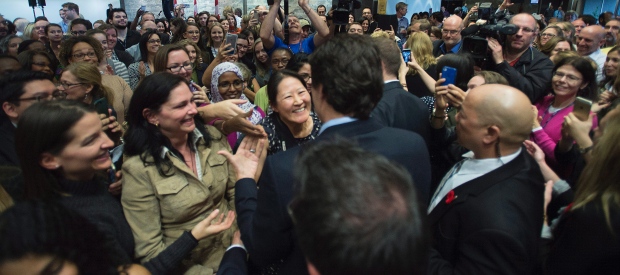
Justin Trudeau joyfully mobbed by federal civil servants

PM Trudeau at the rebranded Global Affairs department. Unprofessional but understandable:

Suddenly there was a buzz and the crowd moved forward.

Trudeau appeared and began to make his way out of the building. He was swarmed. Many took photos and even selfies along the way.

Liberal Cabinet 20151106

Trudeau was mobbed as he tried to leave the Lester B. Pearson building Friday. He told the crowd his government would need the civil service’s absolute best. (Sean Kilpatrick/Canadian Press)

The prime minister was hugged. Cheers erupted. He smiled, waved and stopped by the door.

He thanked the crowd for supporting the members of his cabinet, who had just left.

Then he continued: “We’re going to need every single one of you to give us, as you always do, your absolute best.”

They applauded and cheered some more. Some yelled back: “You’ve got it.”

One longtime staffer nearby said he’d never seen anything like it. Not in all of his years.

And it might not be the only instance of a crowd forming to welcome a minister Friday.

On Facebook, a photo circulated of civil servants at another location waiting to greet Sajjan.

Source: Justin Trudeau joyfully mobbed by federal civil servants – Politics – CBC News

And Donald Savoie puts it into context:

Donald Savoie, a public administration expert at the University of Moncton, said public servants are gripped by “the euphoria” of working for a government that promises renewed respect.

He said many hope they are returning to their “days in the sun” when public servants worked on policy and were listened to. He likened it to when Pope John XXIII opened the Vatican and liberalized the Catholic Church.

As a result, bureaucrats’ heckling and cheering, and unions revelling in their political campaigns, may not be appropriate but isn’t unexpected.

“Don’t try to make sense of this. School’s out and people are beside themselves with joy,” Savoie said. “Stay tuned, it’s too fresh. Wait until things calm down in a few months.

“I wouldn’t get too worked up because what happened today doesn’t define the public service and its non-partisanship.”

Public servants shed cloak of impartiality – at least for the day

The Grits are back in charge, all’s right in Ottawa: Yakabuski

While there are elements of truth in Konrad Yakabuski’s piece (as I covered in Policy Arrogance or Innocent Bias: Resetting Citizenship and Multiculturalism), he over simplifies the reasons for the collective sigh of relief felt by the public service.

It is not driven by an incestuous ‘gene pool’ between Liberal politicians and public servants. It is more driven by education and related experience. We know from polling data that the university-educated are the group that supports the Conservatives the least (government policy analysts are all university-educated). And this support is driven more by small ‘l’ liberal values than big ‘L’ affiliation.

The sharper ideological edge of the Harper government compared to previous Conservative governments, along with a general distrust of evidence in favour of anecdotes and a general less inclusive approach, accentuated the tension between the government and public servants.

Greater alignment between the values of the Liberal government and the public service, along with the latter’s more inclusive approach and support for evidence-based policy, will make for a smoother relationship.

However, the public service needs to be more mindful of its own biases and values in its formulation of policy advice given that it will be less challenged than it was under the Conservatives:

Stephen Harper’s parting thank-you note to the bureaucrats – telling them in a Monday missive that he “will always be grateful for the support of Canada’s world-class public service” – was promptly used by its recipients to line the bird cages of the capital.

The civil servants are already banking on retrieving the sick days the Conservative government had tried to take away from them; the scientists are savouring the prospect of being free to speak out, even if it’s against government policy; the diplomats are yearning to show off a kinder, gentler foreign policy to a world that, Harper critics contend, has been wondering, “What happened to Canada?”

Among public servants, there is a natural preference for Liberal governance. It stems in part from previous long Liberal stints in power during which most of the senior bureaucracy moved up the ranks. In the tiny company town that is Ottawa, decades of intermarriage among bureaucrats, journalists, lobbyists and Parliament Hill staffers have left a gene pool that leans predominantly (L)iberal.

The Ottawa elites share a similar world view, one that squares with Prime Minister Justin Trudeau’s promise of activist government. They also share a bias, acknowledged or not, in favour of a government-driven economy. A bigger state and more regulation enhances the prestige, power and bank accounts of this cozy cohort of Ottawa insiders.

Mr. Harper was not the first outsider to see this. As a candidate for the Progressive Conservative leadership in 1983, Brian Mulroney vowed to hand out “pink slips and running shoes” to a bureaucracy he considered to be infested with Liberal sympathizers. But in Ottawa, he found he needed to get the bureaucracy onside to get anything done.

Though he purged Liberal appointees at government agencies and Crown corporations, Mr. Mulroney trusted, and in turn succeeded in winning the trust of, most of the senior bureaucrats he inherited. His one high-profile ouster of a senior mandarin (Ed Clark, an architect of Pierre Trudeau’s National Energy Program, who went on to become chief executive officer of TD Bank) was an exception to the rule.

Source: The Grits are back in charge, all’s right in Ottawa – The Globe and Mail

New executives anxiously await Liberal marching orders

Will be interesting to observe over the next year whether or not there are major changes (my expectation is that the incoming government will move incrementally, as they develop a better sense of current senior public service executives, given that dramatic change is disruptive when a public service  is trying to deliver an ambitious agenda):

There has been much speculation about whether executives – particularly the deputy ministers, almost all of whom were promoted to top jobs by outgoing Prime Minister Stephen Harper – are up to implementing the agenda of a more activist government.

Some argue the public service needs a shakeup at the top to bring about the “culture change” expected after Liberal promises of openness and respect in the battered relationship between bureaucrats and politicians. “You can’t change culture with the leadership that created that culture in the first place,” said one official.

But most expect the government will opt for continuity, quietly shuffling the people it wants in or out of top posts in coming months.

There’s no word, for instance, whether Justin Trudeau intends to keep Charette as his deputy minister and secretary to cabinet, but incoming prime ministers typically do, if only for a few months.

There’s much debate on what needs to be done to “fix” the public service. Numerous studies – many done by APEX – have examined the problems facing executives and the changing nature of their work over the decade.

[Linda] Duxbury says public service culture was reshaped at every level over the past decade by a government that didn’t respect public servants, didn’t want their advice, barked orders from the Prime Minister’s Office, ignored data, and rewarded “doers” and implementers. Those who “joined the public service to serve didn’t know what their jobs were anymore,” she said.

But “I sense there is a pent-up demand in the public service to show people what they could do, given half the chance,” said Duxbury.

She is confident many of the senior executives who worked in government before the Conservative ethos took hold can quickly adapt to Liberal demands. They have the needed policy- and decision-making skills but have spent the past decade “out of their comfort zone,” with those skills “dormant and pushed underground,” Duxbury said.

She argues political leaders, not senior bureaucrats, set the tone in government and “if the Liberals practise what they preach, we could see a blossoming of the public service.”

James Lahey, a former senior bureaucrat who teaches federal executives at the University of Ottawa, said he thinks executives are generally up to the challenge, and those who aren’t will be weeded out. The risk is that if they aren’t fast enough, the government, with a small window to show progress, will look elsewhere for help.

“In general, people are energized by the expected change in tone and chance to do what they like but haven’t been able to do as freely,” said Lahey.

Lisanne Lacroix, APEX’s former chief executive officer, said the bureaucracy reacted to the Conservative culture of fear and disrespect by building a system that turned leaders into micro-managers: too controlling; focused on details rather than priorities, not trusting the people who work for them; avoiding risks and wanting no surprises.

“I feel people are tactical, not strategic; focused on the narrow and short-term, and their decisions are guided by rules, not judgment. People are paid to do, not to think or question,” Lacroix said.

“We need leaders but the culture is such that the ones promoted and rewarded are the micro-managers, and that has to change.”

Source: New executives anxiously await Liberal marching orders | Ottawa Citizen

Top bureaucrats met to resist partisanship imposed on public service #cdnpoli

Encouraging sign that senior levels appear not to have remained in denial mode (the change in government makes this all the more pertinent as the incoming government and the public service need to establish trust):

As a new Liberal government takes the reins this week, Canada’s top bureaucrats are looking for ways to purge partisan politics from the shell-shocked public service.

The highest echelon of the bureaucracy met in the spring, before the election was called, to discuss ways to insulate public servants from intense pressure to be “promiscuously partisan” instead of neutral in carrying out the government’s agenda.

The May 13 meeting of deputy ministers was asked by Canada’s top civil servant to consider how Canada’s Westminster parliamentary system needs to be “re-set and if medium-term planning could provide the opportunity.”

The group was provided with one paper for backgrounding — dating from 2010, by the late scholar Peter Aucoin — describing how partisanship has damaged Westminster systems in Canada, Britain and Australia.

The new reality “is characterized by integration of governance and campaigning, partisan-political staff as a third force in public administration, politicization of appointments to the senior public service, and expectation that public servants should be promiscuously partisan,” says a summary provided for the meeting by the Privy Council Office, the central organ of government .

The group was urged to consider how the damaged system could be fixed “during periods of transition and government formation.”

One proposal called for clarifying the job description of Canada’s top public servant, the clerk of the Privy Council.

‘Confusion and mistrust’

“Without a set of guidelines to clearly determine which of the clerk’s roles should be given primacy in situations where duties may conflict, confusion and mistrust can arise during periods of government formation.”

Meeting documents, some heavily censored, were obtained by CBC News under the Access to Information Act. They represent a candid acknowledgment by the bureaucracy that partisan politics have radically changed the nature of their work, especially under the Harper government.

A spokesman for Janice Charette, appointed clerk just last year, declined to respond to questions, including what actions were taken arising from the meeting. “We are not able to provide details of meetings of senior executives,” Raymond Rivet said in an email.

The so-called “creeping politicization” of the public service dates as far back as the 1970s, under Liberal governments, but the Harper administration has come under special criticism from some scholars.

Ralph Heintzman, a research professor at the University of Ottawa, has cited the example of a communications directive requiring bureaucrats to refer to the “Harper government” in news releases, rather than the government of Canada.

Other examples include a request last year that departments send retweets promoting a family-tax measure not yet passed by Parliament, including a hashtag with the Conservative slogan #StrongFamilies, and public servants working overtime to create promotional videos about child benefits, spots that prominently featured Pierre Poilievre, the employment minister.

“For anyone who cares about the condition of our federal public service, this is a very depressing story,” Heintzman wrote about the “Strong Families” tweets last April, a month before the deputy ministers’ meeting.

“It seems to confirm the widely reported slide of too many senior public service leaders from their traditional and proper role as non-partisan professionals to a new and improper role as partisan cheerleaders for the current political administration.”

Source: Top bureaucrats met to resist partisanship imposed on public service – Politics – CBC News

Union wants top bureaucrat to help restore public service ‘neutrality’ | Ottawa Citizen

Various commentary on the decision by unions to play a partisan role in the election. I agree with the overall message that this harms the overall public service-political relationship:

This wasn’t the first election in which unions opposed the government of the day but many say it was the most aggressive.

“The decision of unions to campaign against Harper … was unfortunate and harmful because it legitimizes the Conservative view that the public service is a partisan institution. I don’t think it is, but the actions of unions certainly makes it appear to be,” said Ralph Heintzman, a University of Ottawa professor who has proposed various reforms to restore public service neutrality.

He said a Liberal or NDP government would have to wonder about whether the public service could turn on them.

“No party can rejoice in public servants becoming actively involved in electoral politics against the government,” said Heintzman. “Mulcair and Trudeau … can’t be thrilled with unions campaigning against the Conservative government because it suggests that if unions don’t like what you do, they will become partisan again.”

That trust was further called into question when a secret policy briefing, prepared by the Department of Foreign Affairs for deputy ministers on Canada’s shrinking international clout, was leaked during the election campaign. Charette called in the RCMP to find the leak. In a separate incident, the deputy minister at Citizenship and Immigration called the Mounties to track down who leaked that the Prime Minister’s Office had directed bureaucrats to stop processing Syrian refugees pending an audit.

Donald Savoie, a Canada Research Chair in Public Administration and Governance at Université de Moncton, said leaking information to embarrass the government in an election is such a breach of the public service’s ethos that the clerk had to play hardball and call the Mounties.

“They hurt the institution they service. What is the opposition supposed to think if they do this to the government of the day; what will stop them from leaking when we’re the government?” said Savoie.

But Daviau is convinced the public service will have the trust and respect of the Liberals or NDP because both parties were “forthright” in their promises and consulted with unions on their proposed reforms months before the election.

“I feel confident that with the declarations of the other parties to revert back to the traditional way of doing business, that the genie can be put back in the bottle, but now comes the work to get us back to where we were,” said Daviau.

But Heintzman said the eroding neutrality of the public service goes much further than unions’ electoral activism and the system needs a structural overhaul.

He said the Conservative government “exploited all the ambiguities of the parliamentary system for its own partisan advantage,” pushing public servants over the line that used to be drawn between politics and public service.

A big problem, he said, is that deputy ministers didn’t challenge this politicization of the public service, particularly “turning the PCO into a partisan communications machine.” The most talked-about example was a video Employment Minister Pierre Poilievre had public servants produce with department funds to promote the Conservatives’ universal child-care benefit.

“The clerk is part of the problem. (Her) role corrupts the public service by creating a hierarchy of power that no deputy minister will challenge. The deputy minister is appointed by the clerk, looks to the clerk as boss and won’t challenge directions from PCO,” said Heintzman.

David Zussman, the Jarislowsky Chair on Management in the Public Sector at the University of Ottawa, has written a book on transitions from one government to another called Off and Running. He said questions about neutrality will have to be dealt with but they won’t be on the priority list of a new government.

But the public service is the key player in managing a transition, giving it a “chance to shine” – which can go a long way to rebuilding trust, Zussman said.

Source: Union wants top bureaucrat to help restore public service ‘neutrality’ | Ottawa Citizen

Ministers had no objection to niqabs in public service last March | hilltimes.com

Ongoing interest in my study (Religious Minorities in the Public Service):

But at the time Mr. Clement made his remarks as he and other Cabinet ministers were reacting to the court decision in Ms. Ishaq’s case, several of the ministers said their opposition to the wearing of niqabs only pertained to citizenship ceremonies, not in the public service.

Canadian Press reporter Joan Bryden and other journalists questioned the ministers about Prime Minister Stephen Harper’s comment then that wearing the niqab was contrary to Canadian values and “rooted in a culture that is anti-women.”

“That is what the prime minister said and that is a point of view that one can hold,” Ms. Bryden reported Mr. Clement as saying at the time. “That doesn’t mean that you can impose that view in the workplace or in the private sphere. The one place where I think we have a right and an obligation to stress Canadian values is the act of obtaining one’s citizenship.”

As the election sparks flew again this week over Mr. Harper’s view on the niqab, the department that oversees the public service on his behalf, Treasury Board Secretariat, said in response to questions from The Hill Times it does not have “any data or other information pertaining to niqabs” or any complaints about women wearing them in the public service.

The election campaign research by Mr. Griffith might back up a statement to The Hill Timesfrom the head of the Canadian Council for Muslim women, Alia Hogben, that it is likely no Muslim women in the public service wear niqabs.

…Mr. Griffith prepared a brief paper on the topic based on data he obtained from Statistics Canada from an inquiry last April, when his curiosity was piqued after Mr. Clement’s comments after a change Citizenship Minister Jason Kenney ordered for a legal manual citizenship judges must abide by.

Federal Court Judge Keith Boswell ruled last February the change, which required citizenship judges to reject citizenship applications from female candidates wearing niqabs if they refused to show their faces at two successive ceremonies, was unlawful because it violated an existing regulation that requires citizenship judges to administer the oath of citizenship “with dignity and solemnity,” and “allowing the greatest possible freedom in the religious solemnization or the solemn affirmation thereof.”

The Harper government appealed the ruling, failed in a bid to get the Federal Court of Appeal to overturn Judge Boswell’s ruling and also failed in an attempt to get the Federal Court of Appeal to stay the ruling during an appeal to the Supreme Court of Canada.

Mr. Griffith’s paper  included a wider comparison of religious minorities employed in the federal public services and the public services of British Columbia, Alberta, Ontario and Quebec. Quebec was the lowest at 2.1 per cent, compared to 6.2 per cent in the federal public service, 8.7 per cent in Ontario, 6.8 per cent in B.C. and 6.2 per cent in Alberta.

Source: Ministers had no objection to niqabs in public service last March | hilltimes.com

Bureaucracy baffled by Harper’s niqab stance: Quotes and Interview

Following the PM’s more measured comments Wednesday on the niqab and the public service, comments by me and others:

Unions and other political party leaders were quick to condemn the Conservative leader’s remarks. However, it wasn’t clear if there were more than a few, if any, women who wear the niqab – a veil that conceals the face except for the eyes – in the federal public service.

A request to wear the Islamic garb would have to be reviewed on a case-by-case basis under the federal government’s “duty to accommodate” policy – which would set a precedent for all departments, said Andrew Griffith, a former senior public servant who writes extensively on citizenship and multiculturalism.

“Frankly, I don’t think the issue has ever come up and it’s unlikely it would have happened without consultations at the high levels,” he told the Citizen.

At a campaign stop in Saskatoon Wednesday, Harper repeated his intention, if re-elected, to consider federal legislation modelled on Quebec’s Bill 62, introduced by the provincial Liberal government in June. If passed, that law would prohibit public servants from wearing niqabs in provincial offices.

“Let me be very clear, we’ve actually been saying the same thing for several months,” said Harper. “The Quebec government, the Liberal government in Quebec, has brought forward legislation to require that people reveal their identity when delivering or receiving frontline service. They have tabled a bill before the Quebec assembly, we’ve said we will look at that bill before taking further steps.

“The Quebec government has been handling this controversy in a very responsible manner and we will do exactly the same things.”

The Public Service Alliance of Canada, which represents the majority of federal employees, said it doesn’t know how many women working in the public service wear a niqab – if any – and has never received concerns or complaints about the garment.

Still, PSAC President Robyn Benson said a ban on the niqab or any religious symbol would violate the anti-discriminatory provisions of employees’ collective agreements and the Canadian Human Rights Act.

“This is just another cynical attempt by the Harper Conservatives to distract from what is really at stake in this election: the reckless government cuts that have impacted millions of Canadians,” said Benson.

NDP Leader Tom Mulcair Wednesday called Harper’s remarks “bizarre.”

“For him to run an election campaign on the backs of minorities, stigmatizing, singling out, going after minorities … he’s looking to divide Canadians,” Mulcair said.

But beyond the barbs, puzzling questions loom.

Griffith argued the public service should get a better handle on religious and minority groups as part of its employment-equity strategy so managers are better prepared if and when a request to wear the niqab actually does arise.

The number of Muslims working in the public service is likely in line with the proportion who are Canadian citizens (the public service has a hiring preference for Canadian citizens). Muslims women represent about 1.8 per cent of the population.

Source: Bureaucracy baffled by Harper’s niqab stance | Ottawa Citizen

And my interview on CBC’s Ottawa Morning:

Should public servants be allowed to wear the niqab?Andrew Griffith is a former director general at Citizenship and Immigration Canada. He’s also written about multiculturalism and government.Listen 7:10