The young and the restless: Liberals look to infuse public service with new blood

Good overview by Kathryn May of the demographics of the public service and recruitment challenge:

Knowing the talent pool of the public service will need to be renewed to push forward its agenda, the Liberal government is trying to figure out how to attract more young people to a sector where the average age of a new hire is pushing 40.

The rising age of new recruits was flagged for Prime Minister Justin Trudeau, who is also the minister of youth, as an “area in need of increased attention.”

According to Privy Council Office briefing documents, the average age of new hires has hit 37, and few young people are being hired. Once hired, however, people stay in the public service until they retire at about age 60.

“Sustained efforts are needed to recruit young people and to attract highly skilled professionals from other sectors, especially those with the skill sets needed for the future work of the public service,” say the briefing documents.

The average age of entry into the public service has been creeping up, rather than decreasing, as more and more jobs require university degrees. A decade ago, the average age of a new hire was 36 — 35 for women and 36 for men.

The public service is an older workforce compared with the private sector. It emerged out of the restraints of the Conservative era smaller and slightly older. Today, it is largely middle-aged, with more than 60 per cent of the employees between 35 and 54, and the largest concentration huddled between 40 and 54.

Over the past five years, the number of bureaucrats under 35 decreased and those over 50 increased. The average age is now 45, and more than half have worked in the public service between five and 14 years.

It’s an issue Treasury Board President Scott Brison quickly seized upon when he made a pitch last month at the World Economic Forum in Davos to the millennial generation — those under 35 — to work in government.

In an interview, Brison signalled he is reviewing how to tackle the problem to give millennials the “chance to make a difference in the future of the country.

“The complexity of decisions today is greater than it has ever been in the history of government or democracy, and now more than ever at any point in our history we need bright, talented people in government,” he said.

“And we also have the most talented, most educated, and most globally connected generation. So it seems pretty obvious to me that we need to find ways to bring millennials into these key decision-making roles in government.”

The public service never has a problem attracting people, especially when the economy slows. The big challenges are getting people with the right skills and keeping them. Young people tend to see the public service as a slow, rules-bound hierarchy with little tolerance for risk or creativity. It has countered with campaigns over the years, including one branding itself as the “employer of a thousand opportunities.”

But Brison said the image of the public service took a major beating under the Conservatives, which mistrusted public servants and “gratuitously took pot shots at public servants whenever they had the chance”

“They toxified relations with the public which was incredibly stupid given governments need the engagement of public servants to implement their agenda … We have a progressive agenda and need a motivated public service. We recognize the importance of renewing talent.”

Linda Duxbury, professor at Carleton University’s Sprott School of Business, said Brison has every reason to be worried. After a decade of being “beaten down by the Conservatives the word public service has a bad connotation.”

The big attraction, she said, for many workers in their 30s is not the work as much as job security, pensions and benefits — reinforcing a long-standing characterization of public servants who join for the benefits and stay for the pensions.

But Duxbury said the problem is that employees attracted by such “extrinsic motivators” don’t tend to be the entrepreneurial, creative thinkers and innovators the government wants to shake up the way work is done and services are delivered.

“I would like to see what is attracting them to the public service at age 37,” said Duxbury. “This isn’t just an age issue but who is attracted by what you have to offer, and if what you have to offer are extrinsic motivators like a good pension and benefits, those may not be the people you want.”

The Public Service Commission in its 2013-14 report noted the number and proportion of employees under age 35 had declined four years in a row, even though the number of new hires from this group increased. At last count, they represent 17 per cent of all permanent employees after peaking at 21.4 per cent in 2010.

At the same time, the number of people leaving or retiring outnumbered those coming into the public service. The commission warned this gap could have “implications for the renewal and future composition of the public service.”

By the Numbers: Composition of the Public Service

  • 37: average age of new hires
  • 45: average age of public servants
  • 50.4: average age of executives
  • 50: percentage with 5 to 14 years experience
  • 22: percentage with 15 to 25 years experience
  • 58: average retirement age
  • 36: percentage of baby boomers in public service workforce
  • 21: percentage of millennials in the public service
  • 257,000: number of employees in public service
  • 87: percentage of employees who are permanent or indeterminate employees
  • 13: percentage of employees who are term, casual and student employees
  • 55: percentage of employees who are women
  • 42: percentage of public servants working in National Capital Region

Source: The young and the restless: Liberals look to infuse public service with new blood | Ottawa Citizen

ICYMI: So how are those ‘sunny ways’ working out so far? Flumian

Maryantonett Flumian, president of the Institute on Governance and one of my former deputies, on the new government’s steps to dates and some of the deeper challenges.

Hard to argue with her formulation of one of her broader questions:

As it contemplates new engagement strategies, the government confronts a broader question — how governance needs to evolve in the digital age, when ubiquitous information and the instantaneous ability to collect it have challenged the position of many traditional intermediaries, governments included. Governments have already ventured into the twitterverse, with mixed results.

But for the most part it has yet to confront a host of issues. For example, what are the benefits and risks of massive “virtual” engagement in policy making? What are the best techniques? What happens to so-called ‘message control’? What frameworks might guide interaction between the public service, citizens and the media?

The governance challenges of the digital age don’t stop there. In an age of near-frictionless connectivity, why do citizens have to deal with multiple government silos to address various aspects of the same issue — whether it’s a disability, a business start-up, or becoming a senior? And given the ever-expanding applications for data, why do governments continue to sit on vast stores of information they can’t begin to fully use in the name of “confidentiality”?

Here again, the government is off to an encouraging start. In his (no longer secret!) mandate letters to ministers, the prime minister charged several of his colleagues with working toward single-window service. The government also has committed to a policy of open data by default. Some traditionalists have cautioned that it may come to regret such a commitment, but among other considerations, it’s far from clear that a generation accustomed to the digital sharing of information is invested in the information-hoarding ethic of an earlier age.

So how are those ‘sunny ways’ working out so far?

Open government push requires ‘cultural shift’ in public service, federal documents warn

Sound analysis of the challenge:

The Liberals’ promise to pry open government requires nothing less than “cultural change” within the public service, warn documents obtained by the Star.

Treasury Board President Scott Brison was told in November that there are significant hurdles to the Liberals’ campaign pledge to reform access to information laws, make government information open by default, and more effectively communicate with the public.

Documents prepared for Brison describe a federal culture of “limited disclosure, insular policy making,” which takes into account the “federal view only.”

To implement the Liberals’ ambitious democratic reform agenda, that culture will need to shift to one of “proactive release, engagement and connectivity, (and) broad leadership on open government.”

It’s not clear exactly how the government intends to change the culture of some 257,000 employees in the core public service. But Prime Minister Justin Trudeau has already made clear he wants to end the era of the federal government deciding and acting on issues unilaterally, putting an emphasis on meeting with provincial premiers and, on Friday, the mayors of Canada’s largest cities.

“The government holds a largely untapped wealth of mostly unclassified information of interest to Canadians,” read the documents, obtained under access to information laws. “This information is not sufficiently leveraged to fuel the digital economy, spur innovation, and give Canadian business a competitive edge.”

Trudeau made openness and accountability a key plank in his party’s election platform. The idea is to make government information “open by default,” unlike the current system where citizens need to resort to access to information requests that can take months or even years to process.

But releasing more information about government operations, the documents warn, carries with it the risk of public relations headaches for the new government.

In an interview Tuesday, Brison acknowledged that risk.

“(But) you can’t expect Canadians to trust us if we can’t trust them,” Brison said.

“The other thing to keep in mind is we will make better decisions when we engage Canadians in the decision-making process. The old days where governments would be covetous and secretive (with) information to try and make a decision because government thought they were smarter than citizens, are over.”

When it comes to changing the public services culture, Brison suggested the Liberals need to lead by example – and the leadership starts with the prime minister.

“(Trudeau) is absolutely committed to this throughout government,” Brison said.

“For most Canadians, the transparency bus has left the station. You try to explain to a millennial why a lot of this information isn’t rendered public, and you lose them.”

But it’s not just the culture of secrecy and risk aversion preventing information from getting to Canadians. The documents note Canada’s dated privacy and access to information acts are falling out of sync with technological development.

The Access to Information Act, for instance, has not been substantially changed since the early 1980s when most government business was conducted on paper.

Source: Open government push requires ‘cultural shift’ in public service, federal documents warn | Toronto Star

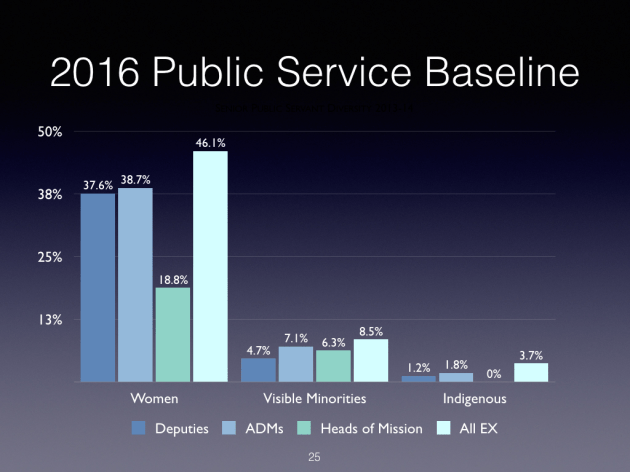
Diversity of Deputy Ministers – Current Baseline

With the announcement that Janice Charente is being replaced by Michael Wernick as Clerk of the Privy Council, I thought it might be interesting to see what the baseline is before further appointments and changes take place this year.

Including the 22 deputies for departments (per GEDS), eight deputies at PCO, and the heads of CBSA, CRS, CSE, CSIS, PSC, RCMP, SSC, StatsCan and TBS (39 deputies or equivalents), generates the following results (14 women, 25 men, 1 visible minority):

Untitled.001

Will update this at the end of the year to see if any significant changes given the government’s focus on diversity and inclusion (and of course if I have missed anyone or mischaracterized anyone, happy to revise).

Kathryn May’s analysis of the appointment worth reading:

The announcement left many public servants scratching their heads as to why Trudeau replaced Charette with Wernick and asked him to help find his replacement.

It’s unclear how long Wernick will be in the job, but one of his key tasks will be studying how to select the next clerk. “The Prime Minister has asked Mr. Wernick for advice on a process to fill the position on a permanent basis,” said the press statement.

Ralph Heintzman, the University of Ottawa research professor who has long argued for an independent appointment process to pick the clerk and all deputy ministers, said the move is in line with the new approach Trudeau is taking to all appointments.

He said finding a new arm’s length process for appointing the clerk is the first step to a “renaissance” of Canada’s non-partisan public service, which many argued had become politicized as more power shifted to the Prime Minister’s Office.

Michael Wernick new Clerk of the Privy Council

ICYMI: How the federal government centralized under the Tories

Potential reasons for the increased centralization:

Several months before then-prime minister Stephen Harper called the 2015 federal election, the size of the federal workforce dipped below 314,000 — practically the same level as during the earliest months of his nearly decade-long reign.

But there was nothing remotely stable about what happened in between, when federal departments and agencies swiftly added more than 65,000 workers, then just as quickly cut the positions that had been created.

The topsy-turvy environment did little for efficiency, morale or clear thinking. But one unexpected result was a pronounced centralization of government in the National Capital Region.

It was a surprise because the Conservatives are strongest in the regions and outside the urban core, and might have been expected to shift some government operations away from the capital.

Yet the percentage of federal government employees working in Ottawa-Gatineau jumped to 39.3 per cent of the total last May from 33 per cent in May 2006, according to data supplied by Statistics Canada. The numbers are unadjusted for seasonal influences, but they are compiled using three-month moving averages to smooth out fluctuations.

Since May, the centralizing trend has reversed somewhat, but this reflects the one-time impact of the Oct. 19 federal election — which featured a mini-hiring boom of election helpers, mostly outside the capital region. Even so, the number of federal government workers in Ottawa-Gatineau — 131,500 in November — was 38.4 per cent of the total.

The question is: Why did the concentration here rise? It’s unlikely top bureaucrats deliberately set out to achieve this result.

….This is in sharp contrast with the situation in the late 1990s, when the federal government last embarked on a major downsizing. At the peak of the tech boom, the percentage of the federal government workforce based in Ottawa-Gatineau slipped to just 30 per cent of the total, as many former government employees jumped to fast-growing firms in the private sector.

Another factor that might have supported the recent centralizing pattern has to do with the internal politics of federal departments. Employees close to the head office are likely better able to safeguard positions here — or to identify other positions in the capital that might soon come open.

Whatever the reasons for the move to the government core, it presents the new Liberal administration with an interesting choice. The government’s spending plans suggest more hiring is in store for federal workers. Liberal cabinet ministers might find it difficult to resist the urge to steer new hiring to where the economy is weakest.

I would not underestimate the internal politics or dynamics which tend to guard headquarters more than regions.

Source: How the federal government centralized under the Tories | Ottawa Citizen

ICYMI: Trudeau must clarify ‘unwritten’ PS rules: expert panel

Always interesting, the views of Kevin Lynch and others on the panel. Personally, not sure about the proposed solutions but report is raising  the right questions:

For the public service, the first thing to do is clarify the “conventions” or unwritten rules underpinning its role on policy advice, as well as carrying out programs and delivering services, says the panel.

Lynch said that clarity should come in a statement from the prime minister. He said the statement should be made in Parliament, with all-party support, and would be the benchmark for future behaviour.

After the sponsorship scandal of the Chrétien era, the Conservative government under Stephen Harper passed legislation that beefed up the role and responsibilities of deputy ministers, making them “accounting officers” responsible for the management of their departments.

The panel wants deputy ministers to also annually attest to measures that ensure regular meetings between the minister and deputy ministers, as well as working relationships between the minister, minister’s office and departmental officials.

Deputies would also have to attest to the “highest levels of integrity and impartiality” in the department on policy advice, program delivery, regulatory administration and departmental communications. They would have to confirm departments have the policy capacity to deliver the government’s agenda and handle the study of long-term issues.

The department would also be expected to consult Canadians and use digital technology to stay abreast of the public’s views when developing policies and programs.

Many argue the existing legislation for “accounting officers” covers much of this territory because deputy ministers are responsible for following all Treasury Board policies and the code of conduct.

Lynch said the panel was intent that its report, published by the Public Policy Forum, not be shelved without debate so it is taking the discussion on the road. He and other members are touring the public policy and management schools at universities across the country to discuss the proposals.

Academics and public management experts have sounded the alarm for years on the deterioration of Canada’s democratic institutions as more power was centralized in the Prime Minister’s Office. Many argue the problems got worse under the Conservative government.

Lynch said the panel is proposing “practical” fixes that could be done quickly without changing the constitution and new legislation.

A big problem for the public service is the mushrooming army of political staffers led by the PMO, the “political service” that has taken over some of the work of the public service.

Politicians began to rely on staffers for ideas and advice, sidelining the public service. As a result, the public service didn’t use, and thus lost, some of its policy capacity, and deputy ministers ended up more connected to the PMO than their ministers.

The panel recommended a new code of conduct for political staff that would clearly spell out the roles and duties of public servants and what political staff can do. It also urged more training and an oversight body for political staff.

Trudeau introduced a new code of conduct for staffers in his updated Guide to Ministers.

But Lynch said “short-termism” and political parties being in “permanent campaign” mode have changed the nature of the work of the public service and its relationship with politicians.

“This is not about going back to the good old days,” said Lynch. “These broad trends are happening regardless and what we have to do is figure out — given that reality — the checks and balances that will ensure (our institutions) work they way they are intended.”

Politicians are racing to keep up with today’s rapid, “technology-driven round-the-clock news cycle.” Parties are seen to be always in campaign mode and focus on short-term issues for political gain rather than long-term policies and strategies. Public servants, however, are supposed to be neutral and have no role in campaigns.

“We have drifted into a period of permanent campaigning, which is an American phenomenon …. which is not a good thing for the role of the public service because it doesn’t have a role in a campaign, said Lynch.

“Political parties operate less as a government and more as a party for re-election so the more we get into permanent campaign modes, it changes the relationships and not necessarily in good ways.”

Lynch argued that once the governance issue is fixed, the next challenge for the public service will be changing the way it does policy in a world driven by big data and analytics. Public servants must learn to manage risk; they will have to become innovative and use more open communications and using social media.

Source: Trudeau must clarify ‘unwritten’ PS rules: expert panel | Ottawa Citizen

Tories call for probe of public servants who aided report on tax agency

Valid concerns regarding the breach of the impartiality of the public service, not just leaking of documents (which also is problematic):

The Conservatives are calling for an investigation into claims that Canada Revenue Agency employees teamed up with an advocacy group for a report that alleges mismanagement and political interference in tax investigations that cost billions in uncollected revenue.

Conservative MP Ziad Aboultaif, the party’s national revenue critic, said the involvement of public servants in such a report during an election is “disturbing” and shouldn’t be ignored just because a new government was elected.

“I would hope that the Minister of National Revenue realizes the seriousness of this and is investigating the supposed wrongdoing, not ignoring it because the incident took place under the previous government,” said Aboultaif.

“There is a principle involved here; it is not about party politics. Canadians expect their public service to be both professional and neutral.”

The report, by Canadians for Tax Fairness, was based on 28 interviews with former and current auditors and other tax specialists. They alleged the agency is mismanaged, undermined by major budget cuts, and that it targets ordinary taxpayers over the “big-time tax cheats” hiding money offshore.

Public servants are supposed to be non-partisan and loyal to the elected government. They face even stricter limits on their behaviour during an election.

Aboultaif argued neutrality is part of the job and that public servants give up the right to criticize government policies when they join the public service.

“Public servants take an oath of office and agree to abide by a code of ethics while employed in the civil service,” he said.

….So far, the Canada Revenue Agency has rejected the report’s allegations as unfounded. It said it was unable to determine if the ethics code was breached because it didn’t know who the employees were.

Donald Savoie, Canada Research Chair in public administration and governance at the University of Moncton, has written books on how the traditional “bargain” or relationship between public servants and politicians is broken. He says this case is one of the most blatant violations yet.

“If public servants become political actors, which is what is happening here, that is just not how the Westminster system was conceived. We are reshaping fundamental tenets of the system on the fly without any reflection or debate.”

Savoie argued this is an issue that warrants the attention of Prime Minister Justin Trudeau to clarify what is expected of public servants today.

“This is a government issue, not a CRA issue. It should be raising alarm bells in the Privy Council Office and Treasury Board because it goes to the heart of the fundamental role of the public service.

“I think the prime minister, cabinet and head of the public service should be responding.”

Source: Tories call for probe of public servants who aided report on tax agency | Ottawa Citizen

The earlier article ICYMI:

Source: Public Servants ‘blow the whistle’ on tax system shortfalls | Ottawa Citizen

A modern public service has great expectations to meet: Lynch

Kevin Lynch’s (former PCO Clerk) prescriptions for rebuilding the public service:

First, a strong analytic policy capacity that is both broad and deep is a basic necessity of effective governing in an increasingly interconnected, complex and uncertain world….

Second, a risk-management orientation. In a world experiencing a sharp spike in risk and volatility, the smart response by government is proactive  not reactive – risk management….

Third, an innovation focus. In a world where technological innovation is at an inflexion point, disrupting how business is done in sector after sector, government should be at the leading edge of innovation adaptation. It is not.  …

A re-empowered public service can be a magnet for talent and contribute significantly to Canada’s long-term success as a strong economy and vibrant society. It now has great expectations to meet.

Source: A modern public service has great expectations to meet – The Globe and Mail

Report calls for a ‘humanized’ public service

A good initiative of the previous government:

The report, which recommends implementing the Mental Health Commission’s national psychological standard across government, concludes that the way the public service is managed must shift from an “output-focused environment to one that is more people-focused.”

The recommendations revolve around fixes in key areas: leadership, engagement, education on mental health, training and workplace practices, communication, and promotion and accountability.

“We must humanize the workplace … A more people-focused environment contributes to a high-quality federal public service (and) compassion is fundamental to this shift,” said the report.

Treasury Board President Scott Brison said the report shows the government and unions have “common ground” where they can work together.

“Humanizing is consistent with our government agenda to create a culture of respect for the public service,” said Brison.

“Mental health is part of that, ensuring public servants have a healthy workplace,” he said. “It is the right thing and healthy workplaces are more productive.”

The task force grew out of the bargaining demand PSAC tabled nearly a year ago. It asked the government to adopt the Mental Health Commission’s national psychological standard across government and enshrine it in all collective agreements.

Clement took the extraordinary step of taking the proposal off the table, and setting up a task force to examine the standard and identify the toxic factors in the workplace that are making workers sick.

“The unions deserve credit … and I give full marks to Tony Clement for having helped to initiate this,” said Brison. “I told the unions that it this is just the beginning.”

Brison stressed the committee’s work won’t be used as a bargaining chip in “any way, shape or form” when Treasury Board negotiators and the 18 unions resume collective bargaining on sick leave in January.

The cost of mental illness, from absenteeism to productivity, has been on the government’s radar for the past decade, with mental health claims accounting for 47 per cent of all disability claims.

The 2014 public service survey found employees’ engagement was falling and one in five said they were harassed, mostly by co-workers or bosses.  Studies of executives and their health showed similar trends.

Last year, 40 per cent of all calls to the hotline for the Employee Assistance Program were about mental health.

Source: Report calls for a ‘humanized’ public service | Ottawa Citizen

Clinton e-mails reveal Canadian foreign service enmity towards Harper Tories – The Globe and Mail

Not unique to the newly-renamed Global Affairs but nevertheless particularly striking and reinforces the Conservative government’s suspicion of public servants, particularly the foreign affairs and aid public servants.

And this strikes me as disloyalty to the former government, not in keeping with the public service ‘loyal implementation’ obligation:

The U.S. special co-ordinator for Haiti said Canadians were worried about budget cuts that would have slashed down an operation from 11 employees to four, for a country that was ostensibly a major Canadian foreign policy priority.

“I was a little astonished at how openly the career folks at the foreign and assistance ministries disliked their new political masters and wanted us to convince them not to cut Haiti,” said Tom Adams, in a May 2012 e-mail forwarded to Clinton and released Monday.

“In my many years here I have never seen such open disloyalty with a change of administrations. Although the political appointees told me there was no need to have the Secretary talk to Baird about Haiti, the senior career folks, on the margins, implored me to have this done.”

The dynamic described in that e-mail was on public display recently after the federal election, when employees at the foreign ministry cheered during a visit from their new Liberal bosses.

Clinton replied that she was happy to call her counterpart John Baird, if necessary. The presidential contender’s e-mails are now being released in instalments, after an uproar over her use of a private home-based server that couldn’t be searched for freedom of information requests.

Source: Clinton e-mails reveal Canadian foreign service enmity towards Harper Tories – The Globe and Mail