How will we know when police have earned their way back to Toronto Pride?: Robyn Urback

Valid questions by Robyn Urback:

If the issue is more so about visibility, as some BLM supporters say, noting that police are still welcome to participate in Pride as long as they’re not wearing their uniforms, then perhaps Pride should consider also asking clergymen not to wear their collars during marches and parades.

The religious leaders who choose to join in on Pride activities — such as those from the Metropolitan Community Church of Toronto — are obviously open, welcoming and inclusive, though some Pride-goers might find the symbols triggering because of the many religious groups and institutions that are not so open, welcoming and inclusive.

Toronto Pride Parade Mark Saunders

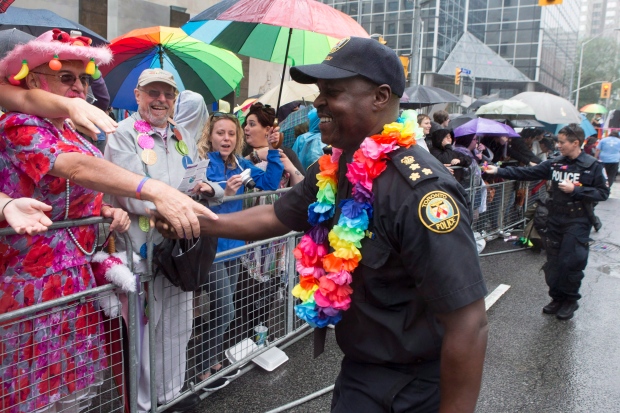
Police Chief Mark Saunders greets the crowd during Toronto’s Pride parade in 2015. (Chris Young/Canadian Press)

But if we accept that the police are being singled out because of the severity of their brutality against Canada’s black and LGBT communities — both past and present — which is a defensible position, then perhaps it would be prudent for BLM to define some sort of tangible criteria delineating how, and when, and by what measure police conduct would be acceptable enough for them to participate in the marches again.

Revoking the ban

At what point will police be distant enough from their past, like the Canadian Forces, innocuous enough in their present, like the education system, and adequately inoffensive in their image, like religious leaders, to once again be able to show their solidarity?

If we accept the notion that individuals have to carry misdeeds of the people before them — and the reputations of the worst among them — then it makes sense to prohibit any uniformed officer from participating in Pride activities.

But if we recognize that people are more than simply facets of the groups to which they belong, we’d know better than to paint them all with the same brush.
Source: How will we know when police have earned their way back to Toronto Pride?: Robyn Urback – CBC News | Opinion

Globe editorial: Toronto Pride parade marches backwards

Agree:

Toronto, the non-profit organization that holds Toronto’s annual Pride Parade, lists “inclusivity” as one of its main values. “We welcome everyone and want everyone to be welcomed,” reads the group’s website.

They should rewrite that. Pride Toronto has officially banned Toronto Police Services from putting a float in the parade, or having stands along the route. LGBTQ people who are police officers can march on their own, but not as an identifiable group.

It’s a horribly misguided decision. Yes, we know, Toronto’s Pride Parade began in 1981 in part as a reaction to police harassment of the city’s gay community. The history is real. But it’s also history.

Last summer, members of Black Lives Matter Toronto held a sit-in during the parade, bringing it to a standstill for half an hour. The group only ended its blockade when Pride Toronto officials agreed to its demands, one of which was that police participation be banned.

Black Lives Matter is a group that spends a lot of its energy protesting the police. In a democratic society, it has every right to. It also has reason to: Police often deserve to be criticized – the TPS’s long-standing practice of carding, which fell most heavily on black Torontonians, was only recently curtailed by provincial legislators.

BLM thinks it’s taking Pride Toronto back to its protest roots. After all, the police weren’t invited to take part in the first gay pride rally in 1981. And now Pride Toronto, in deference to a group that claims to speak for all black Torontonians, has agreed to go back in time.

But surely Pride Toronto would agree that the willingness of groups to work with the police to end harassment has been a key part of the social progress that has made Toronto one of the world’s most diverse and tolerant cities. The Pride weekend is a hugely popular annual event and a major symbol of Toronto’s inclusivity. Or it used to be, anyway.

Then there is the fact that Pride Toronto has agreed to the ban while accepting hundreds of thousands of dollars in support from all levels of government. To take that money and then discriminate against members of an important public institution is problematic, to put it mildly. There will be a taint on this year’s parade if the ban isn’t lifted.

Source: Globe editorial: Toronto Pride parade marches backwards – The Globe and Mail