Can Jason Kenney throw a rope around Alberta’s unruly Right? Delacourt

Good column by Susan Delacourt on Kenney’ s move to Alberta politics and his many strengths, with a nice shout out to my books:

One of the events obliged panelists to give quick answers to provocative questions posed by the audience. “Who’s the best cabinet minister in Ottawa right now?” someone asked. I didn’t even have to pause for thought: “Jason Kenney,” I said. Many others on stage and in the audience shared that view.

It wasn’t just his reputation for hard work, although that certainly was a factor. Kenney was everywhere in the old Conservative government, building his clout on the political front (with those cultural communities and others) but also on the policy front. I was told once that Kenney had a representative at every meeting in Ottawa, keeping tabs on all kinds of decision-making processes, even those beyond his ministerial brief.

open quote 761b1bKenney does have strong views (no one’s going to mistake him for a Red Tory) but the caricatures ignore his practical side. And party mergers need practical politicians.

For a sense of what kind of minister Kenney was, I tend to urge people to take a look at books published by Andrew Griffith, a former director general in Kenney’s old department of Multiculturalism. Griffith has written revealingly of a public service coming to grips with a minister who had definite ideas about how to blend policy and politics, evidence and anecdote.

And where many ministers hewed to the PMO diktat and avoided contact with the media, Kenney was eminently approachable. I don’t think he ever said no when I asked him for comment on one thing or another. (Though he hasn’t replied to a message I sent him today as I was writing this article.)

For years he held annual Christmas parties at which reporters were not only welcome, but positively encouraged. The reward for attending was getting to hear Kenney tell funny, behind-the-scenes stories about the Harper government — nothing headline-making, just anecdotes that presented his political workplace as a little less stuffy and aloof.

And it was never hard to find opposition MPs during the Harper years willing to say that Kenney (along with John Baird) was one of the more co-operative ministers in cabinet, willing to occasionally drop the hyper-partisan posture that characterized so much of that government’s style.

This version of Jason Kenney is at odds, naturally, with the caricature painted by his critics — of a rigid, even scary, ideologue. Kenney does have strong views (no one’s going to mistake him for a Red Tory) but the caricatures ignore this high-energy politician’s practical side.

And party mergers need practical politicians. Harper was a pragmatist when he set about uniting the old federal PC party with the Canadian Alliance back in 2003.

Still, I will concede that I’m finding it hard to square the more nuanced Kenney I saw with the politician who tweeted out his support for the Brexit vote a couple of weeks ago. Given that much of Brexit’s support came from hostility towards immigrants, it seemed odd, to say the least, to see a former immigration minister — a courter of cultural communities — on that side of the question.

Interim Conservative Leader Rona Ambrose, I noticed, also seemed at a loss to explain the support for Brexit from the likes of Kenney and Tony Clement in an interview last weekend on CBC’s The House — suggesting vaguely that it might have something to do with friendships they’ve forged abroad.

Perhaps it was just Kenney keeping things interesting, blurring the tidy lines of the boxes people want to throw around him. If he is going to seek the leadership of the Alberta PCs, that in itself is a bit of a surprise; many people expected to see him seek the leadership of the federal Conservatives.

It may not be a good sign for those federal Conservatives that Kenney sees his future elsewhere right now. He became pretty adept — as his old boss would attest — at figuring out where there was room for growth in the conservative movement.

Could he pull off a merger in Alberta? I wouldn’t put it past him. Kenney has developed a knack for doing — and being — the unexpected.

Source: Can Jason Kenney throw a rope around Alberta’s unruly Right?

Because it’s 2015 … Implementing Diversity and Inclusion – My latest ebook

because-its-2015_pdf__page_1_of_59_Over the past months, as many of you know, I have been doing a series of articles on the 2015 election, Cabinet and other senior appointments, along with baseline data for the public service, Governor in Council and judicial appointments by which to measure the government’s implementation of its diversity and inclusion commitments.

I have integrated and updated these in mini-book form, available as a free download from:

iPad/Mac version (iBooks)

Windows version (PDF)

I hope you find this compilation and the reference data it provides of interest and use.

The description is below.


——————-

Because it’s 2015 … Implementing Diversity and Inclusion

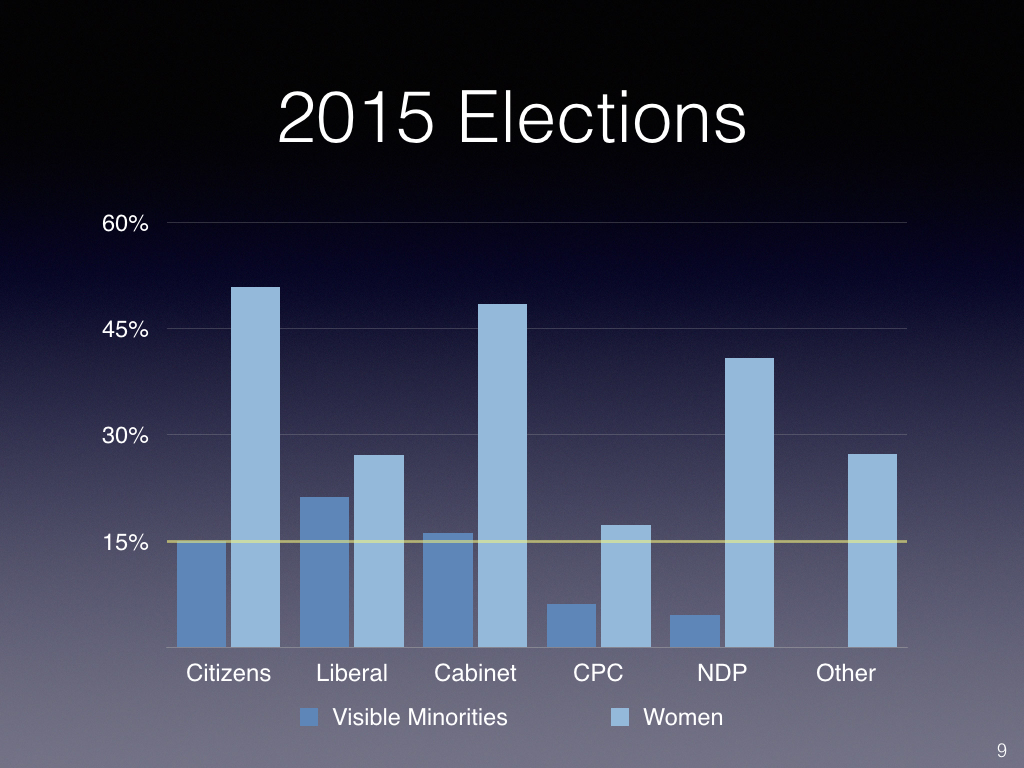
Canada’s 2015 election provided a sharp contrast between the social cohesion focus of the Conservative party and its use of identity politics, and the Liberal party’s emphasis on diversity and inclusion. This was not only reflected in policy and language but in candidate recruitment, with the Liberals having the largest number of visible minority candidates, although Conservative and NDP numbers also increased.

The overall voting shift to the Liberals was particularly strong among new Canadian voters, reflecting a mix of the overall shift to the Liberals in this election, perceived anti-immigrant bias and identity politics, and lack of support for Conservative restrictive citizenship and immigration policies.

In power, the Liberals implemented their diversity and inclusion commitment through the establishment of a Cabinet Committee on Diversity and Inclusion, Cabinet and Parliamentary Secretary appointments, Ministerial mandate letters and initial Senate appointments. They also set expectations for other senior appointments.

This short book provides data and related analysis with respect to the election results, political representation and leadership positions, and establishes the 2016 baseline for senior public servants, Governor in Council and judicial appointments by which to judge the Government’s implementation.

With over 40 charts and tables, Because it’s 2015 … is an invaluable reference for those interested in Canadian politics and diversity. iPad optimized.

Table of Contents

  1. Introduction
  2. Political Institutions
  3. Public Service Impact
  4. Governor in Council Appointments
  5. Judicial Diversity
  6. Concluding Observations

Tories unfairly targeted Muslims during election, supporter tells convention

Jenni Byrne still in denial mode?

A Muslim Conservative supporter took to the floor of the federal Tory convention in Vancouver to accuse her party of unfairly targeting Muslims during the failed 2015 election campaign.

Urz Heer, who hails from the riding of Brampton South in the Toronto area, told Conservative Party executive director Dustin van Vugt that the party made her feel like an outsider.

The Tories came under fire during the 2015 campaign for vowing to ban people from wearing the niqab head covering during citizenship swearing-in ceremonies and for pledging to consider barring public servants from donning the same garb at work.

 “This party worked actively and aggressively against my people,” Ms. Heer said as some fellow Conservatives disputed what she was saying.

“It did,” she said. “It didn’t differentiate who Muslims were versus the enemy.”

She said Conservative tactics spurred Muslims to vote against the Tories in the election, Ms. Heer said.

“For the first time I felt like I didn’t belong here and this was my country,” the Conservative delegate said.

Former Conservative campaign manager Jenni Byrne, also attending the Vancouver party convention, defended the campaign’s conduct. The Tories also promised late in the campaign to set up a tip line so Canadians could report allegations of “barbaric cultural practices.”

Ms. Byrne noted that Mr. Harper’s announcement in early October last year that his government would consider a ban on niqabs in the public service followed a court decision on the headgear.

A day before the Conservative Leader’s statement, the Federal Court of Appeal had rejected the Tory government’s request that its ruling on the unlawfulness of barring the garb from citizenship ceremonies be put on hold while it sought leave to take the matter to the Supreme Court.

“In terms of the barbaric cultural practices or the niqab debate, the campaign had absolutely no choice but to speak on it, the [former] prime minister had choice but to speak because there was a court ruling midway through the campaign. It wasn’t that it was a campaign choice. It was: we had to react to a court case,” Ms. Byrne said.

Source: Tories unfairly targeted Muslims during election, supporter tells convention – The Globe and Mail

In Austria’s Jewish Community, Some Who Fear Muslims Are Drawn To The Far-Right : NPR

Interesting report regarding the political divisions within Austria’s small Jewish community:

KAKISSIS: Van der Bellen is the independent liberal-leaning candidate running against Norbert Hofer. Winkler, an Orthodox Jewish teacher, worries that Austria’s next president could be Hofer, someone from a party with Nazi roots.

WINKLER: Yes, they want to claim that they are OK. Yes, yes, of course. They want to disguise a little bit.KAKISSIS: She says the Freedom Party, which Austrians call the FPO, likes to blame outsiders for the country’s problems. And Muslims are just the current targets.

WINKLER: If there wouldn’t be a Youssef, it would be about Yosef. And if there wouldn’t be a Mohammed, it would about the Moshe. So if the – if wouldn’t have the Muslims to target, it would be us.

KAKISSIS: Vienna was once a mecca for Jewish intellectuals like psychoanalyst Sigmund Freud. But the rise of Nazism forced many to leave. Tens of thousands of Austrian Jews who did not leave died in the Holocaust. About 15,000 Jews live in Austria today.But for some Austrian Jews, the government’s decision last year to accept 90,000 refugees, mainly from the Middle East and Afghanistan, is more of a worry than far right politicians. Michael Kaner is a Jewish web designer. And he believes Muslim immigrants are teaching their children anti-Semitic values.

MICHAEL KANER: The greedy Jew, the Jew with the big nose who’s always after the money, who’s controlling the economy and who wants to rule the world – these are anti-Semitic things we got rid of in Europe.

KAKISSIS: That’s why Kaner is supporting Hofer. The Freedom Party even has one Jewish number of Parliament, David Lasar, who has taken party members to Israel. Writer Peter Sichrovsky, a former member of the European Parliament was actually the first Jewish number of the Freedom Party. He joined in 1996, he says, because he was tired of Austria’s two mainstream parties dominating politics.

PETER SICHROVSKY: You couldn’t get a job without the support of one of the parties. You would join a sport club that was connected to one of the two parties. If you wanted a cheap apartment in Vienna, you had to become a member.

KAKISSIS: Sichrovsky left the Freedom Party in 2002 after populists took over.

SICHROVSKY: They don’t offer solutions in economics. They don’t offer solutions in education. All they do is using the anger and the frustration and pour oil into the fire, as you say.

KAKISSIS: His son Ilja Sichrovsky now organizes an annual conference that brings together Muslims and Jews from around the world. For NPR News, I’m Joanna Kakissis in Vienna.

Source: In Austria’s Jewish Community, Some Who Fear Muslims Are Drawn To The Far-Right : NPR

Election 2016: the most exciting time to be multicultural in Australia?

Australian election platforms and multiculturalism – good overview by :

Laundry [of the governing Liberal party] does not believe in setting targets for diversity inclusion, preferring to let the market sort it out. Given the clear precedence of Australian law in all cases, as a practising Catholic, he strongly supports the freedom of communities to use religious tribunals to provide guidance for individuals in conflict. He cites Catholic Canon Law, Jewish Beth Din and Islamic Sharia as appropriate.

Laundy is opposed to extending racial vilification protection to religious vilification. He argues that religions are far stronger and don’t need it.

He is also opposed to a Multicultural Australia Act, rejecting even the option of debating it. He does not believe there is any need for a Multicultural Affairs office in the prime minister’s portfolio, nor mandated participation for cultural minorities in government advisory bodies.

Laundy accepts, however, that the Australian Multicultural Council needs serious work, with its membership changed to be far more representative.

As someone who has spoken out in defence of multiculturalism, he says:

“I know the views that vilify me are those of a small minority. Most Australians like what multiculturalism has done for the country.”

Reflecting on the past, he notes:

“Any prime minister who doesn’t support multiculturalism does so at his own peril.”

Rowland [Labour party shadow critic] shares many of Laundy’s social values. Labor, she stresses, has no policy for a Multicultural Act, though she also points to the party’s strong defence of Section 18C, especially through the shadow attorney-general, Mark Dreyfus.

Rowland agrees that perhaps an incoming government might charge a revised Australian Multicultural Council to explore legislative options for national multicultural legislation. But it is unlikely to be an election policy, and she doesn’t have a view.

The wider issues of diversity and representation have not been on Rowland’s radar. She admits she has never discussed with the shadow communications minister, Jason Clare, issues of diverse representation on either the ABC board or in its programming.

Rowland takes a diametrically opposed position to Laundy on where religious law sits. She believes religious groups should play no role in any Australian legal situation. For her, the law is and must remain secular – be it for Jews, Catholics or Muslims.

She is also wary of whether religious vilification should be part of the Racial Discrimination Act, flipping it to Dreyfus as his responsibility. She would, however, have the review of the Multicultural Council as a pressing issue, especially in terms of its ability to advise government on key areas such as employment, support for grassroots organisations, and the building of more community hubs.

Source: Election 2016: the most exciting time to be multicultural in Australia?

Politician’s cancelled visit causes tension in Indo-Canadian communities

I think the existing policy, implemented under the Conservatives, is preferred rather than reinforcing political attachment to countries of origin:

The planned visit of an Indian politician to Canada to campaign to non-resident Indians and its ensuing cancellation has caused tension in Indo-Canadian communities.

Amarinder Singh of the Punjab Pradesh Congress Committee had planned to visit Canada to hold rallies and events in the GTA and Vancouver, according to news reports out of India, but cancelled the visit after a complaint was made by a human rights group called Sikhs for Justice to Global Affairs Canada and the Indian High Commission in Canada.

Mr. Singh instead interacted with Indo-Canadians and non-resident Indians—known as ‘NRIs’—via Skype.

When asked about the Canadian government’s involvement in the re-routing of Mr. Singh’s North American political tour, foreign ministry spokesperson Francois Lasalle pointed to a government policy banning political campaigning by foreigners, and wrote in an email that “Global Affairs Canada has made this policy very clear to all foreign missions in Canada (including bringing it to the attention of the Indian High Commission in Ottawa) and will continue to do so.”

Canada’s government enacted a policy in September 2011 that reads “the Government of Canada will continue to refuse requests by foreign States to include Canada in their respective extraterritorial electoral constituencies. Also, the Department will not allow foreign governments to conduct election campaigns in Canada or establish foreign political parties and movements in Canada.”

Minister of Innovation, Science and Economic Development Navdeep Bains (Mississauga-Malton, Ont.) appeared to disagree with the government’s policy, saying that his constituents are engaged in international politics and that allowing politicians to visit communities is a matter of Charter rights.

“I think we have a very vibrant diaspora here in Canada that’s very engaged in domestic and international politics. I think we’re a country that supports a Charter. Freedom of expression, freedom of opinion, freedom of assembly. These are all Canadian attributes and we welcome any opportunity that politicians have when they want to come and engage with the diaspora, and I think that’s the message I heard from my constituents and that’s the message I relayed on to them,” he told The Hill Times.

Mr. Singh himself characterized the ban on his political action in much the same way, writing a letter to Mr. Trudeau on the matter. “It feels like a gag order that has left a very bad taste,” he wrote, according to a report from India Today.

Source: Politician’s cancelled visit causes tension in Indo-Canadian communities |

Donald Trump proves racial nationalism is alive and well: Doug Saunders

Doug Saunders on Trumpism and its variants:

In a big survey conducted this month by the think tank PRRI, one thing stands out, and it isn’t economic. When given the statement “It bothers me when I come in contact with immigrants who speak little or no English,” a whopping 64 per cent of Trump supporters agreed. Among backers of other candidates, fewer than half agreed.

As surveys by San Francisco political scientist Jason McDaniel have shown, expressions of “racial resentment” among voters increase with their level of support for Mr. Trump – something that doesn’t happen with other candidates.

This is explained well in the study White Backlash: Immigration, Race and American Politics, by political scientists Marisa Abrajano and Zoltan Hajnal. Their surveys show that racial resentment has displaced class, income inequality, education, income, gender and age as identifying factors among a large part (but not majority) of white Republican voters. The group who came to support Mr. Trump are clearly defined by anger and resentment at having a black president, and a sense that their racial identity is their country’s, and is therefore threatened.

But, as the authors note, this is not an inevitable turn in Republican politics. “The United States faces two radically different futures,” they conclude. “In one scenario, the Republican Party

alters its stance on immigration, it garners more votes from the nation’s expanding racial and ethnic minority population, the worrisome racial divide … shrinks, and wide-ranging racial conflict is averted. In a more ominous scenario, though, the Republican Party continues to fuel a white backlash against immigrants and minorities … the racial divide in U.S. party politics expands to a racial chasm, and the prospects for racial conflict swell.”

The fact that the first scenario offers a clearer path to victory – as conservatives in Canada, Britain and Germany have found – suggests that this last big idea will not become a map of the future.

Source: Donald Trump proves racial nationalism is alive and well – The Globe and Mail

Canada can do better on getting more women elected, 60th place in world right now

Election 2015 - VisMin and Foreign-Born MPs.002Nancy Peckford and Grace Lore of EqualVoice argue for a gender-based lens with respect to evaluating electoral reform proposals. Women who are now more under-represented than visible minorities, where all parties have made major and successful recruiting efforts:

But, it is crucial to understand that “proportional representation” is not one thing and neither is “women’s political representation.” Proportional representation systems vary widely in how individuals become candidates, how votes are cast, and how those votes are translated into seats. UBC political scientist Grace Lore, and EV’s senior researcher, has just finished a multi-country study of electoral systems in Europe and North America with a specific focus on their effect on women’s representation. The data from that research strongly reveals that while the number of women elected is an important indicator of success, so is the ability of these women to act to represent their constituents, including women.

In ‘closed list’ PR systems, parties determine a set list of pre-approved candidates and voters simply pick a party and, de facto, accept the list of candidates in the ordered that is proposed by the party. In ‘open list’ systems, voters have the opportunity to indicate preferences between candidates. In some countries that use open list proportional representation, voters can even indicate a preference for candidates from multiple parties. Like open list proportional systems, alternative vote systems give voters the chance to rank parties instead of just indicating their top choice.

These are not minor or mechanical details—they matter greatly to how one participates in the democratic process. The nuts and bolts of each system also shape the role of parties and the choices available to voters, including the possibilities for women’s political representation. Some features of electoral systems, whether based on proportional representation or not, lead to the election of a greater number of women, while potentially reducing women’s capacity to represent women’s and other interests once they are in office. Other features improve the power of individual women to have influence, but do not maximize the possibilities for the sheer number of women elected. Lore’s extensive research of electoral systems on two continents and 15 countries underscores that if women representatives are more beholden to a political party for their election (versus having a direct relationship with constituents), their lack of independence frequently prevents them from effectively advocating on behalf of other women.

In short, proportional representation is neither necessary nor sufficient to ensure women’s equal representation. Political culture matters significantly, i.e. voters and parties need to seek more women to appear on the ballot and create the conditions for their participation. More women also need to choose politics as the place to dedicate their time, energy, and skills. If we do not also tackle other systemic barriers, including inequality in access to political resources and the uncertainty of the nomination processes, we cannot count on this happening. These concerns can and should be part of the electoral reform discussion. Revisiting the rules around financing and timing of nomination races are two key areas where there is much room for improvement.

Canada can do better than its current 60th place in the global community for its representation of women. Open discussion around electoral reform provides us all—voters, parties, MPs, and organizations, with an opportunity to take action. Action, however, must be thoughtful and evidence based. A consideration of the impacts on women in politics should be incorporated at every stage of the process—from broad principals to basic mechanics.

Source: Canada can do better on getting more women elected, 60th place in world right now |

Conservative MP Deepak Obhrai: New Rules Turning Tories Into ‘Elitist And White-Only’ Club

Interesting – and a major risk for the party given the importance of new Canadian voters:

A longtime Conservative MP is blasting his own party for becoming an “elitist and white-only” club.

Calgary MP Deepak Obhrai, the dean of the Tory caucus, told The Huffington Post Canada he is deeply frustrated by new rules the party imposed earlier this year that raised the annual Conservative membership fee to $25 — “the highest of any party” — and set the entrance fees for leadership contestants at $100,000. 

deepak obhrai

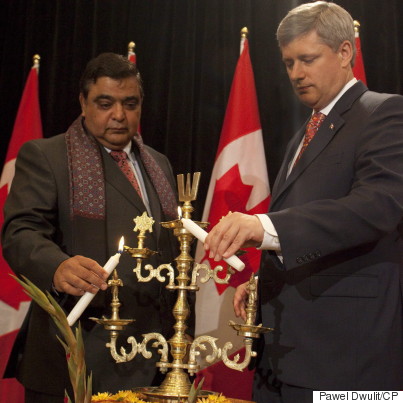
Deepak Obhrai and former prime minister Stephen Harper celebrate Diwali by lighting a candle on Parliament Hill on Oct. 8, 2009. (Photo: Pawel Dwulit/Canadian Press)

“Since we lost power in 2015, I have become very concerned about the direction my party has taken,” he told HuffPost over the phone on Thursday.

“These actions, in my view, have disenfranchised a vast majority of Canadians. Newcomers, immigrants, low-income Canadians, and those economically challenged will be turned off and walk away because they can’t afford these high fees…

“What is concerning me is that, unfortunately, [the Conservatives] will be seen as an elitist and white-only party,” he said.

Ethnic communities’ outreach

Since his election in 1997, Obhrai said he’s been working his “butt off” to bring immigrants to the party, a job that was subsequently taken on with great fanfare by former cabinet minister Jason Kenney. Success in connecting with ethnic communities culminated in the Tories’ majority election win in 2011, Obhrai said.

But that work has been dropped as a priority for the Conservatives under the leadership of party president John Walsh, Obhrai said. He added that the party has lost touch with grassroots members and pointed out that the caucus was not consulted.

“This party has become a party that is seen [to be only] for like rich people, I ask why? Why only for those who can afford it? Why the rich?

“For a family of four, it’s like asking them to give $100, and then also asking them to give through a credit card, which many don’t have. I have had these problems and my EDA [electoral district association] passed a motion telling the national council that we are unhappy with these rules,” the Calgary MP told HuffPost.

Source: Conservative MP Deepak Obhrai: New Rules Turning Tories Into ‘Elitist And White-Only’ Club

ICYMI: Canadian and U.S. right not that different | Supriya Dwivedi 

Interesting to see this kind of commentary in The Sun:

The Canadian right also seems to be just as allergic to the term political correctness as their American counterparts. When former Prime Minister Stephen Harper announced the election was underway, he made an overt reference to political correctness, stating, “now is not the time for political correctness”.

Several commentators noted it was an odd remark to make at the onset of the election, but as the campaign started to unfold it became clear why Harper made the reference. As much as conservative pundits might opine that those on the left are merely afraid of being anything other than politically correct, I’m not sure that the repudiation of things like the Barbaric Cultural Practices Tip Line, reference to “old-stock” Canadians and obsession with what Muslim women are allowed to wear during a citizenship ceremony was the embracing of political correctness as much as it was the rejection of veiled xenophobia.

More recently, in an interview with Embassy News Conservative MP Marilyn Gladu (Sarnia-Lambton) stated that Trump’s rhetoric has been positive for free speech advocates: “The only bright light is that he has sort of restored freedom of speech to America”. Gladu went on to assert that many people in Canada are fearful of saying what they think out of fear of being accused of “breeding hatred and fear”.

It’s worth asking where Gladu thinks she lives, considering Canada is still indeed a free state, and people are free to think, believe and say what they choose. Similarly, people with opposing viewpoints are free to say they disagree. That is what freedom of speech is. Evidently, confusing freedom of speech and freedom from consequences of that speech is something that Conservatives and Republicans have in common.

The Conservatives were not completely off-base in trying to appeal to nativist politics. The support is there. It just won’t win you a majority anymore. Canadians may not be as comfortable in the overt displays of racism as our American brethren, but we are inclined to dabble in our homegrown brand of racism that tends to be framed in a more palatable manner. It’s coded, it’s often implicit, but it’s there.

Perhaps we’re not the enlightened, toque-wearing citizenry that we like to make ourselves out to be, eh?

Source: Canadian and U.S. right not that different | DWIVEDI | Columnists | Opinion | To